 plumi
Use of amount of substance in relation to volumes of gases: AQA GCSE Chemistry questions
Every AQA GCSE Chemistry exam question on 4.3.5 Use of amount of substance in relation to volumes of gases, 2018–2025, with its mark scheme and examiner’s report.
Find questions1,744
Calculations
Q05.7
The whole paper ↗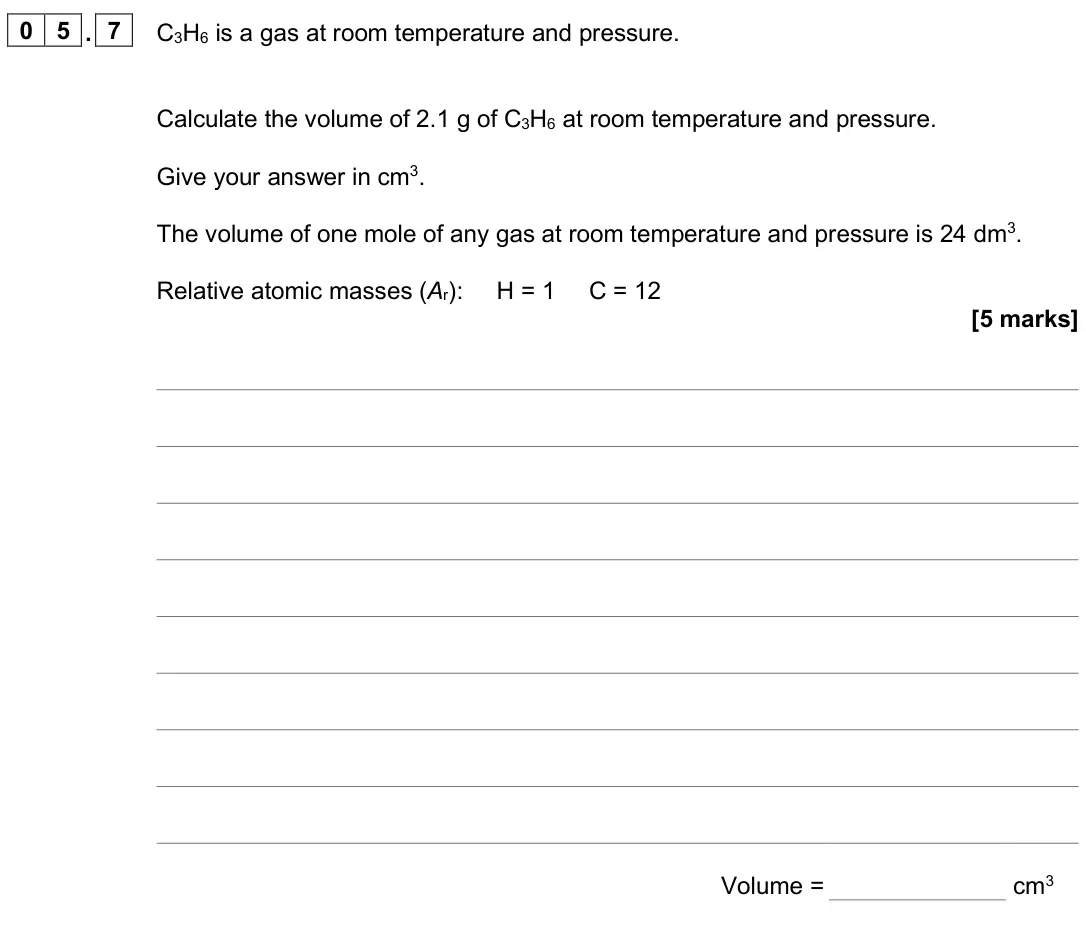
Q05.4
The whole paper ↗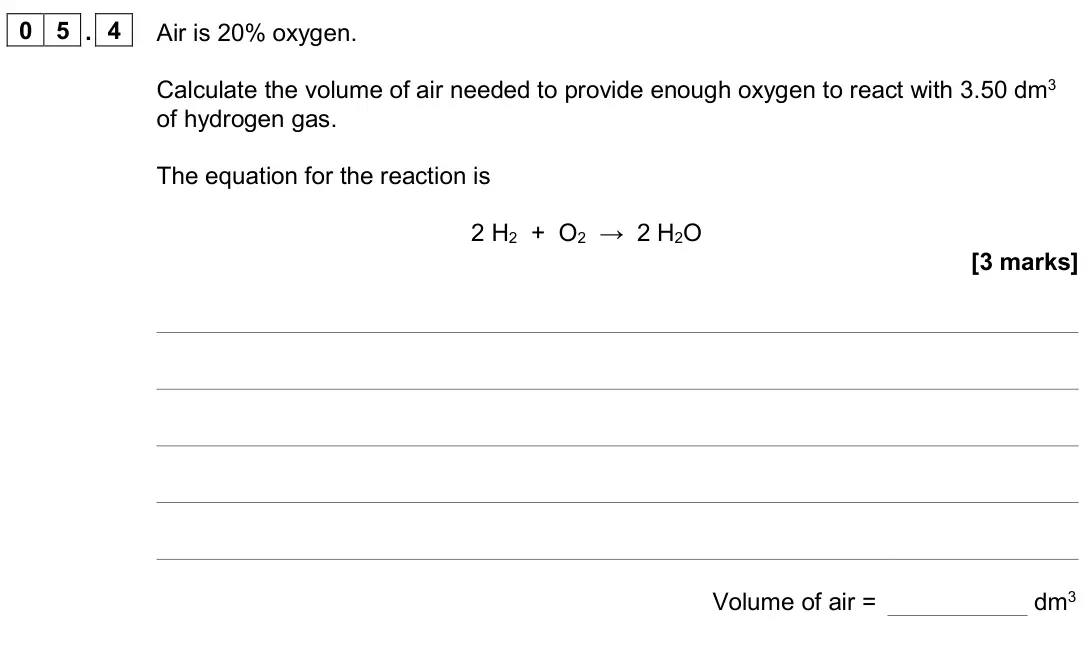
Q09.2
The whole paper ↗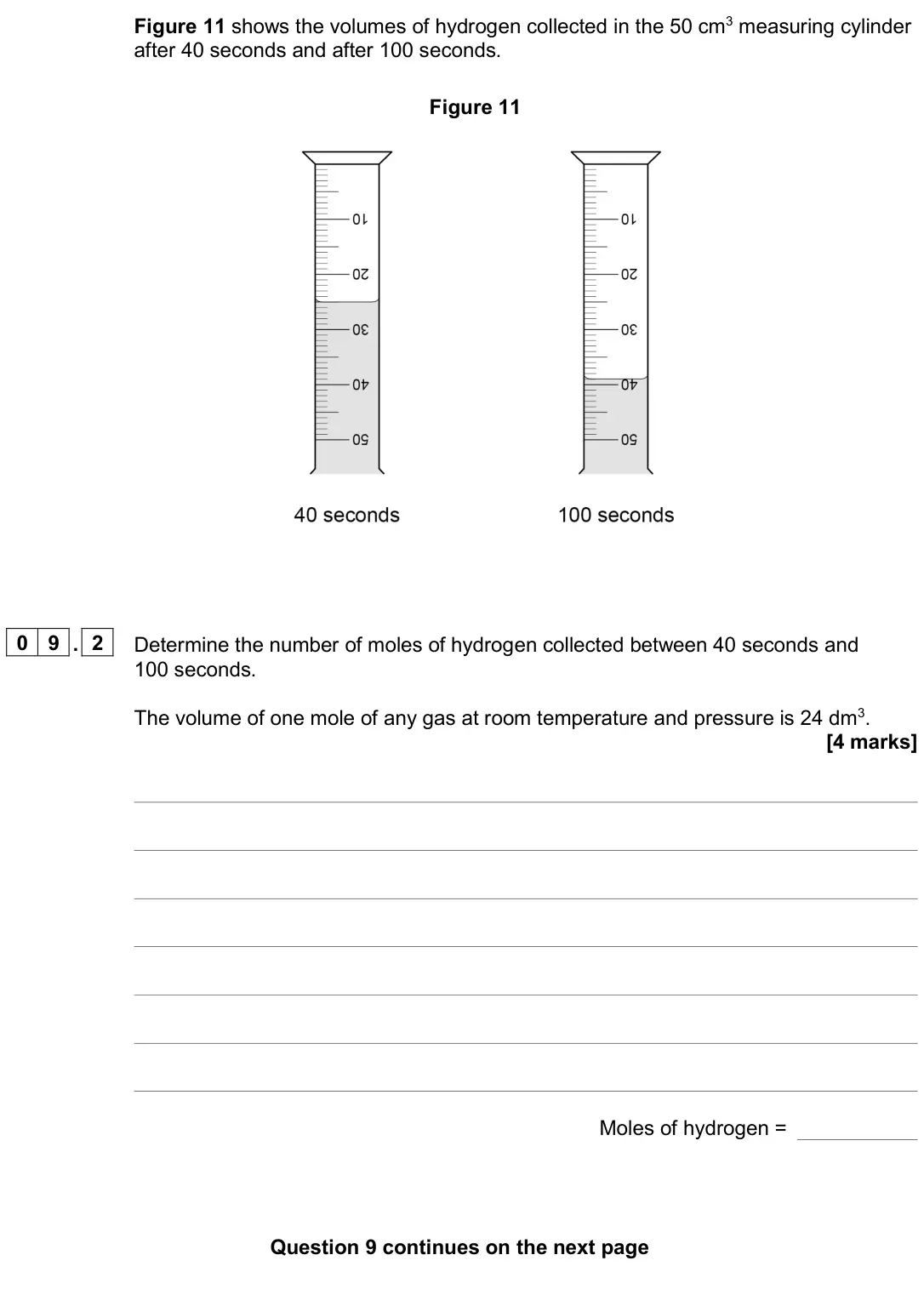
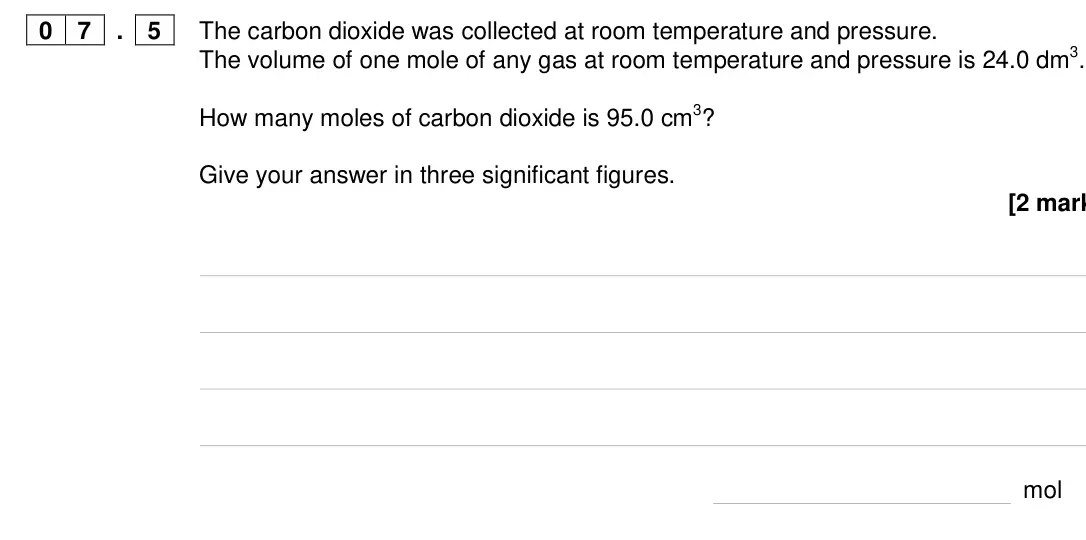
Q07.5
The whole paper ↗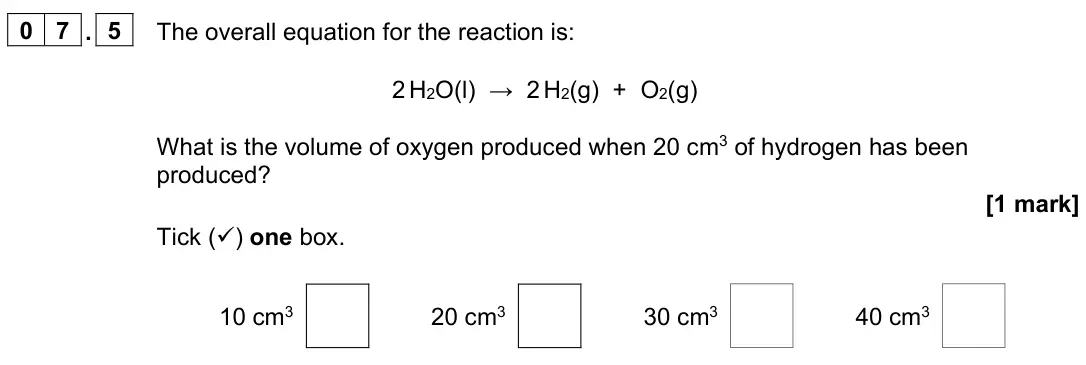
Q07.6
The whole paper ↗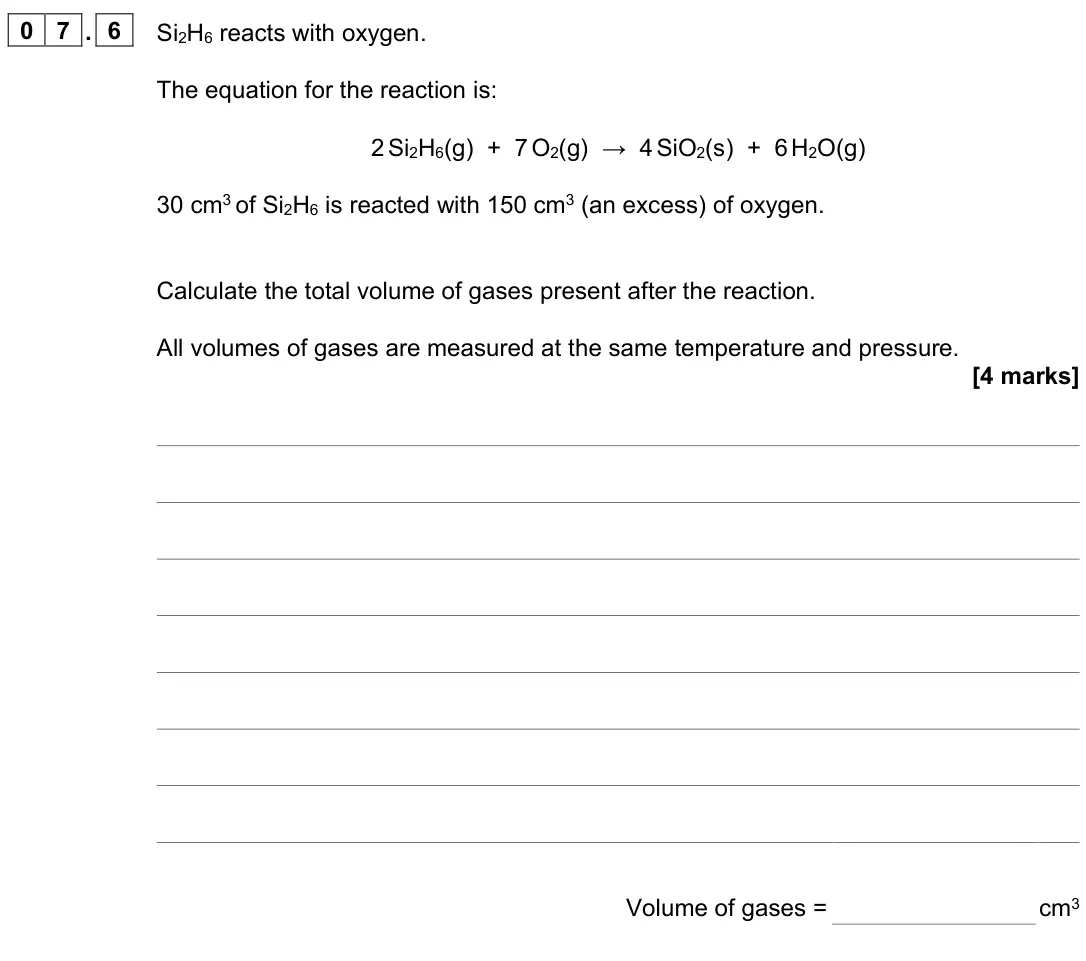
Q05.6
The whole paper ↗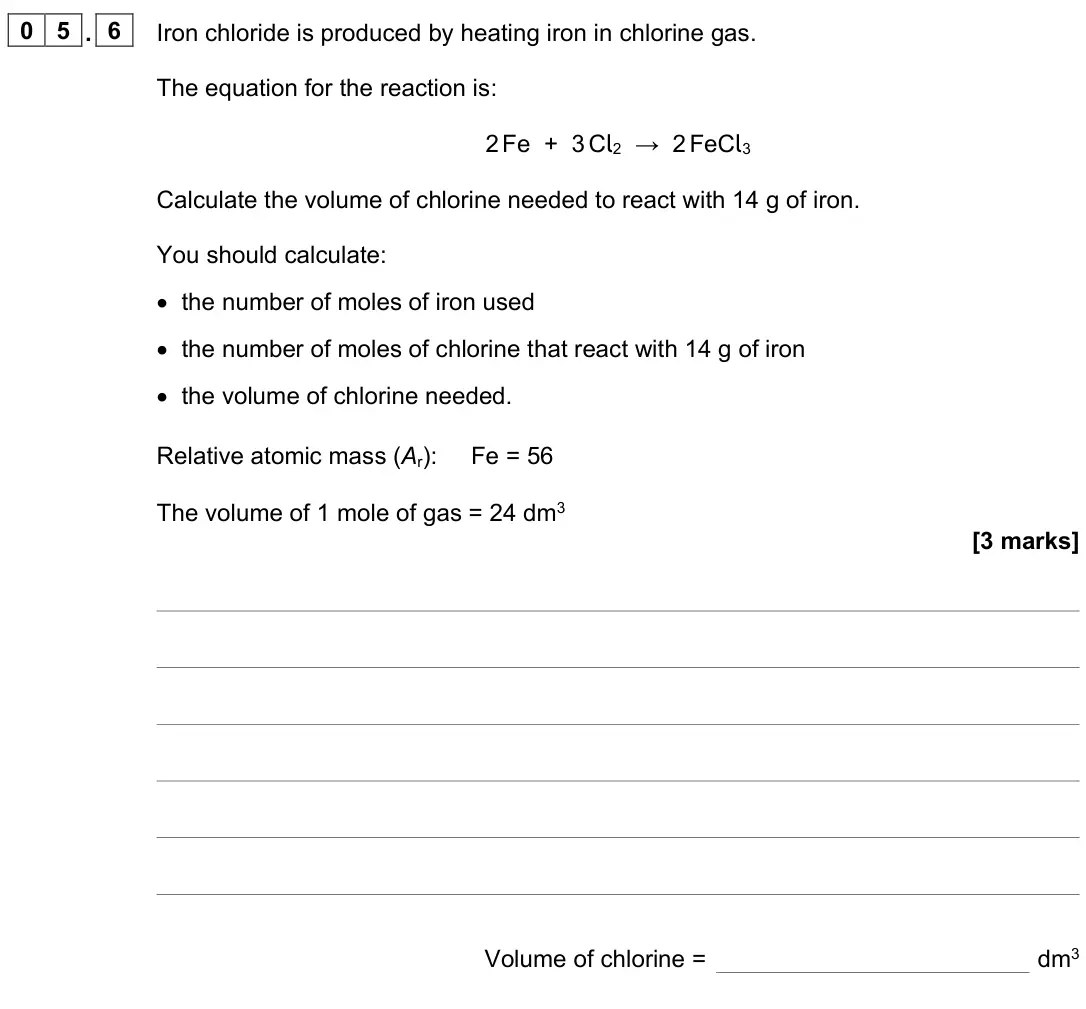
Q08.2
The whole paper ↗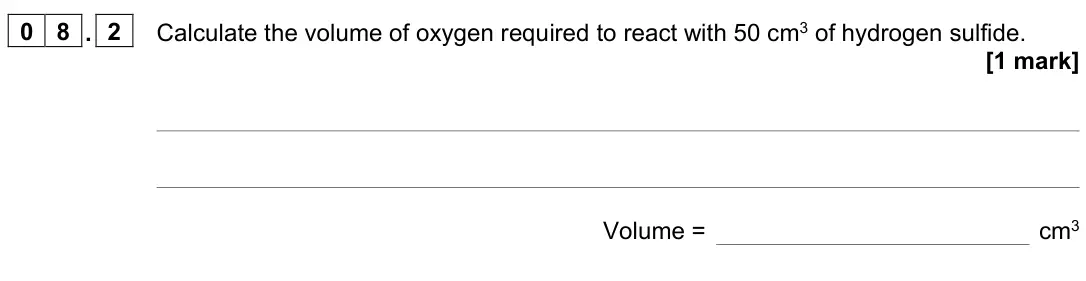
Q07.6
The whole paper ↗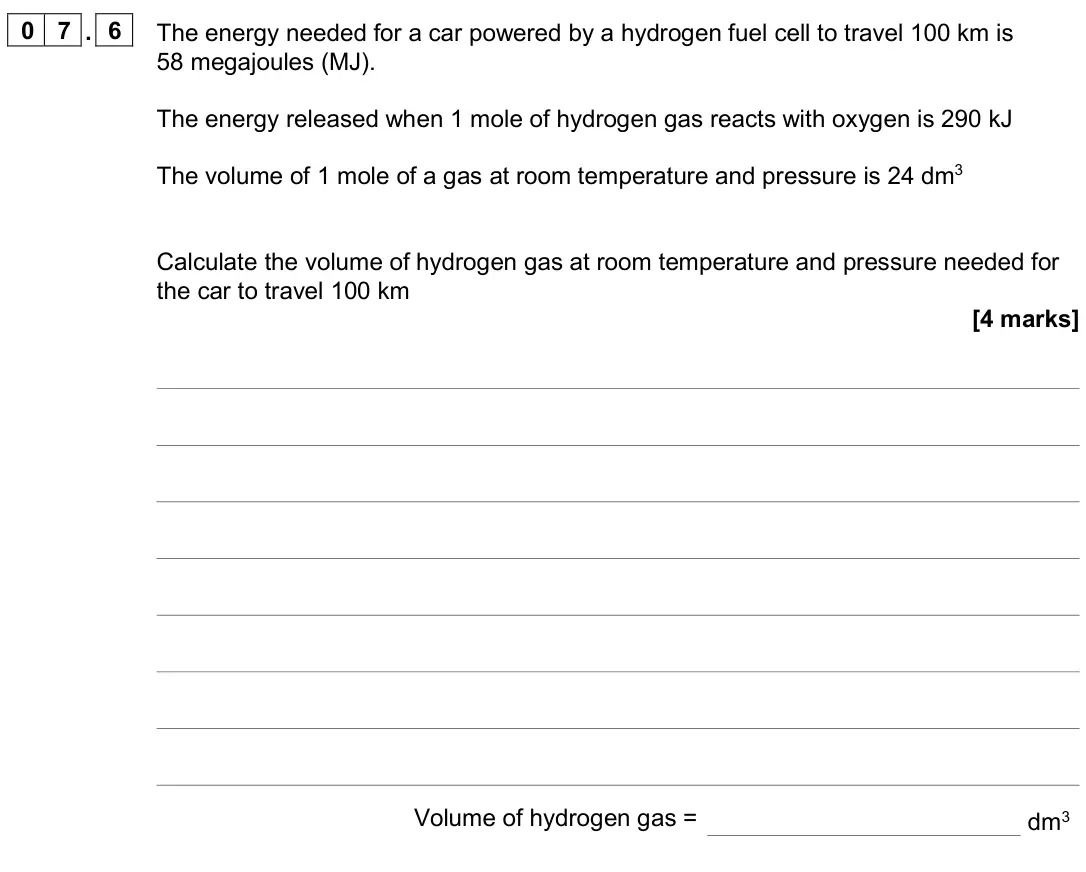
Q07.7
The whole paper ↗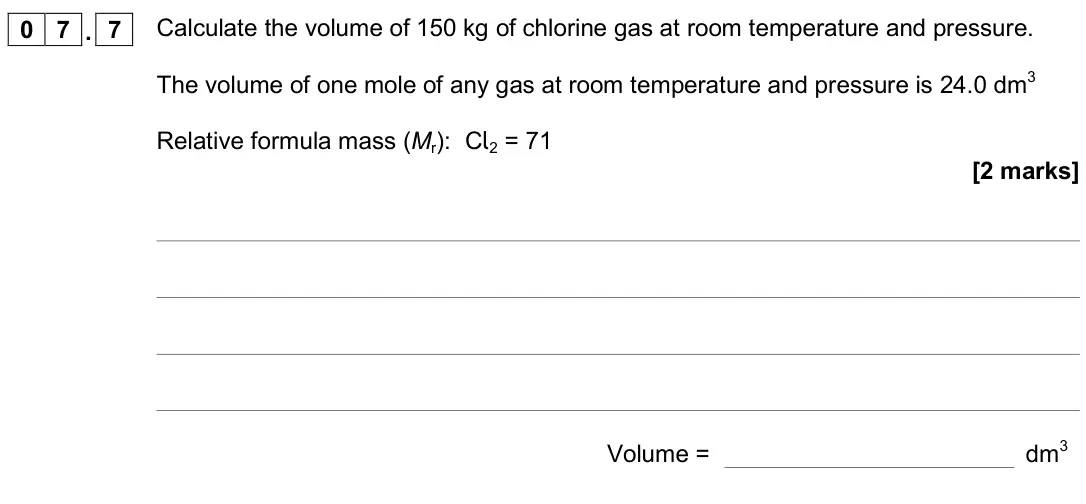
Q06.5
The whole paper ↗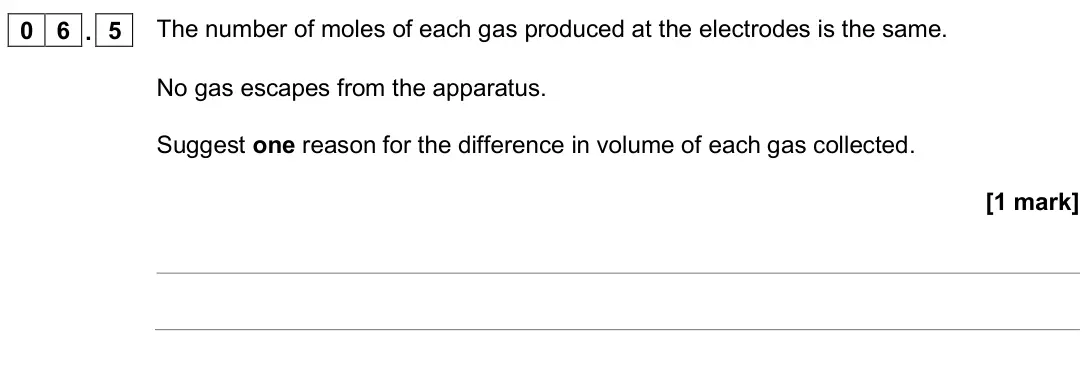
Q06.6
The whole paper ↗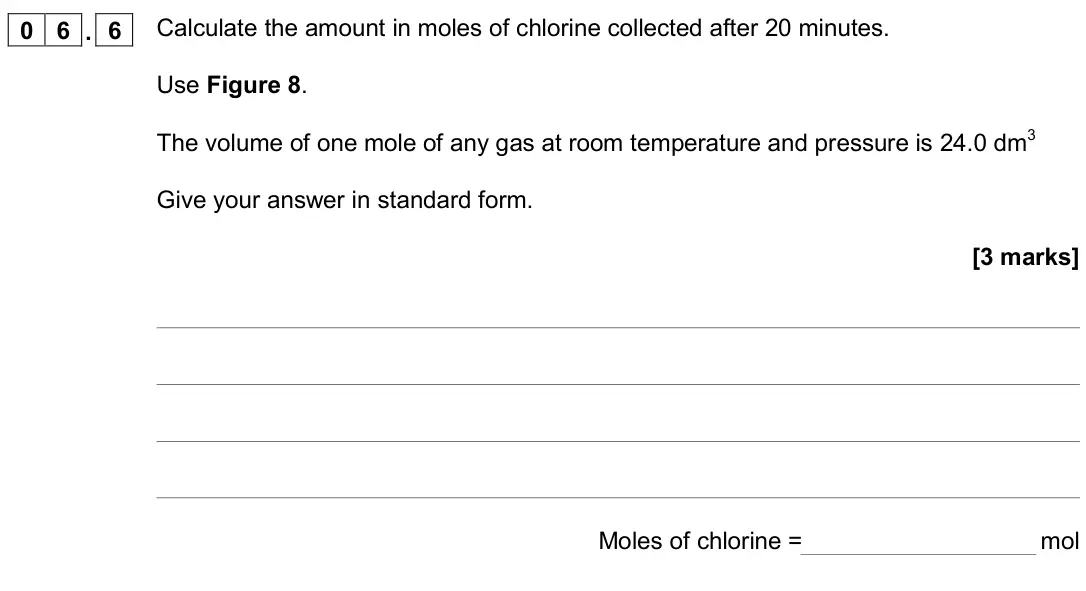
All 12 questions on Use of amount of substance in relation to volumes of gases, as a list
- June 2025, Paper 2 Higher, Q05.7 (5 marks): C3H6 is a gas at room temperature and pressure. Calculate the volume of 2.1 g of C3H6 at room temperature and pressure. Give your answer in cm3. The volume of o
- June 2024, Paper 2 Higher, Q05.4 (3 marks): Air is 20% oxygen. Calculate the volume of air needed to provide enough oxygen to react with 3.50 dm3 of hydrogen gas. The equation for the reaction is 2 H2 + O
- June 2024, Paper 2 Higher, Q09.2 (4 marks): Determine the number of moles of hydrogen collected between 40 seconds and 100 seconds. The volume of one mole of any gas at room temperature and pressure is 24
- June 2023, Paper 1 Higher, Q07.5 (1 mark): The overall equation for the reaction is: 2 H2O(l) → 2 H2(g) + O2(g) What is the volume of oxygen produced when 20 cm3 of hydrogen has been produced? [1 mark] T
- June 2022, Paper 1 Higher, Q07.6 (4 marks): Si2H6 reacts with oxygen. The equation for the reaction is: 2 Si2H6(g) + 7 O2(g) → 4 SiO2(s) + 6 H2O(g) 30 cm3 of Si2H6 is reacted with 150 cm3 (an excess) of o
- November 2021, Paper 1 Higher, Q05.6 (3 marks): Iron chloride is produced by heating iron in chlorine gas. The equation for the reaction is: 2 Fe + 3 Cl2 → 2 FeCl3 Calculate the volume of chlorine needed to r
- November 2021, Paper 1 Higher, Q08.2 (1 mark): Calculate the volume of oxygen required to react with 50 cm3 of hydrogen sulfide. [1 mark] Volume = cm3
- November 2020, Paper 1 Higher, Q07.6 (4 marks): The energy needed for a car powered by a hydrogen fuel cell to travel 100 km is 58 megajoules (MJ). The energy released when 1 mole of hydrogen gas reacts with
- June 2019, Paper 1 Higher, Q07.7 (2 marks): Calculate the volume of 150 kg of chlorine gas at room temperature and pressure. The volume of one mole of any gas at room temperature and pressure is 24.0 dm3
- June 2018, Paper 1 Higher, Q06.5 (1 mark): The number of moles of each gas produced at the electrodes is the same. No gas escapes from the apparatus. Suggest one reason for the difference in volume of ea
- June 2018, Paper 1 Higher, Q06.6 (3 marks): Calculate the amount in moles of chlorine collected after 20 minutes. Use Figure 8. The volume of one mole of any gas at room temperature and pressure is 24.0 d
- Specimen, Paper 1 Higher, Q07.5 (2 marks): The carbon dioxide was collected at room temperature and pressure. The volume of one mole of any gas at room temperature and pressure is 24.0 dm3. How many mole
Questions, mark schemes and examiner’s reports are © AQA, from their published past papers. Plumi isn’t affiliated with any exam board. Want whole papers? Every AQA GCSE Chemistry paper.
Rather write your answers by hand on iPad? Plumi marks them against the same mark schemes.