 plumi
Bulk and surface properties of matter including nanoparticles: AQA GCSE Chemistry questions
Every AQA GCSE Chemistry exam question on 4.2.4 Bulk and surface properties of matter including nanoparticles, 2018–2025, with its mark scheme and examiner’s report.
Find questions1,744
Calculations
Q05.5
The whole paper ↗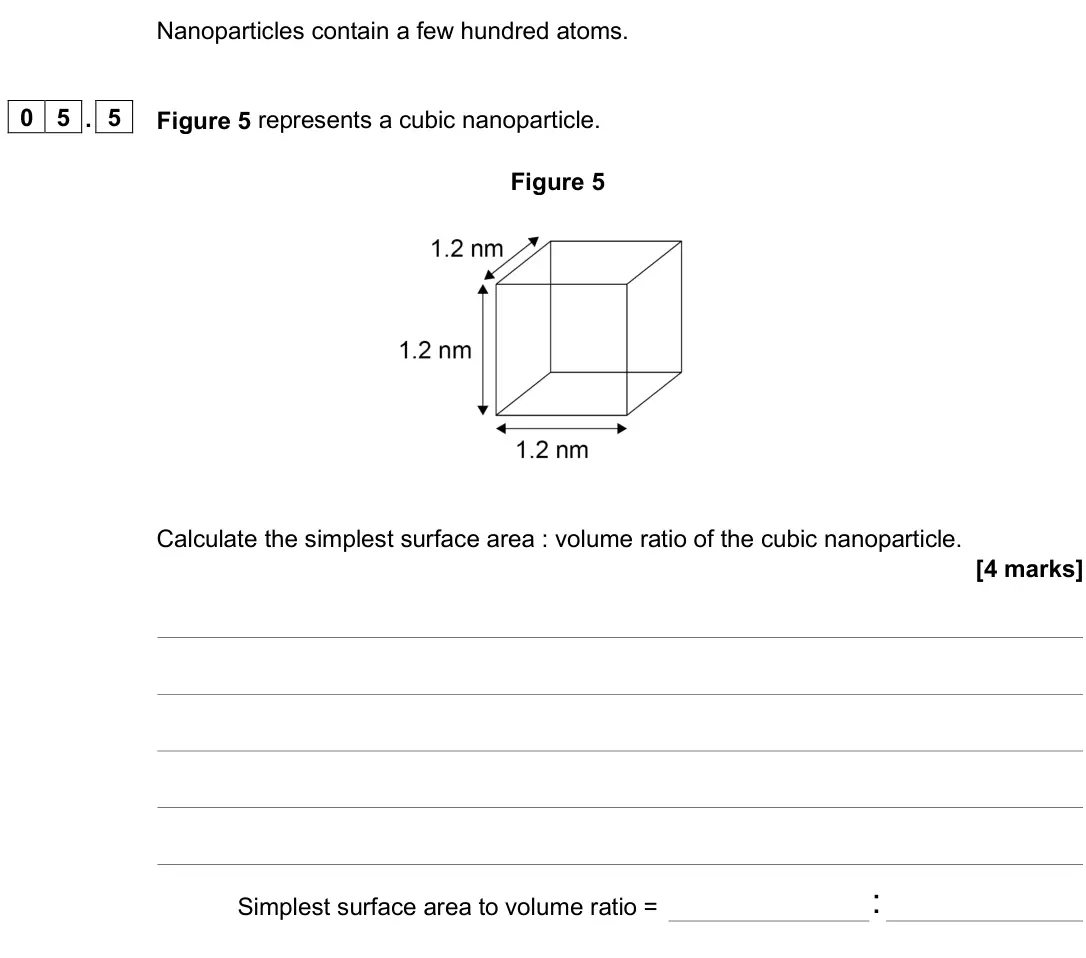
Q05.6
The whole paper ↗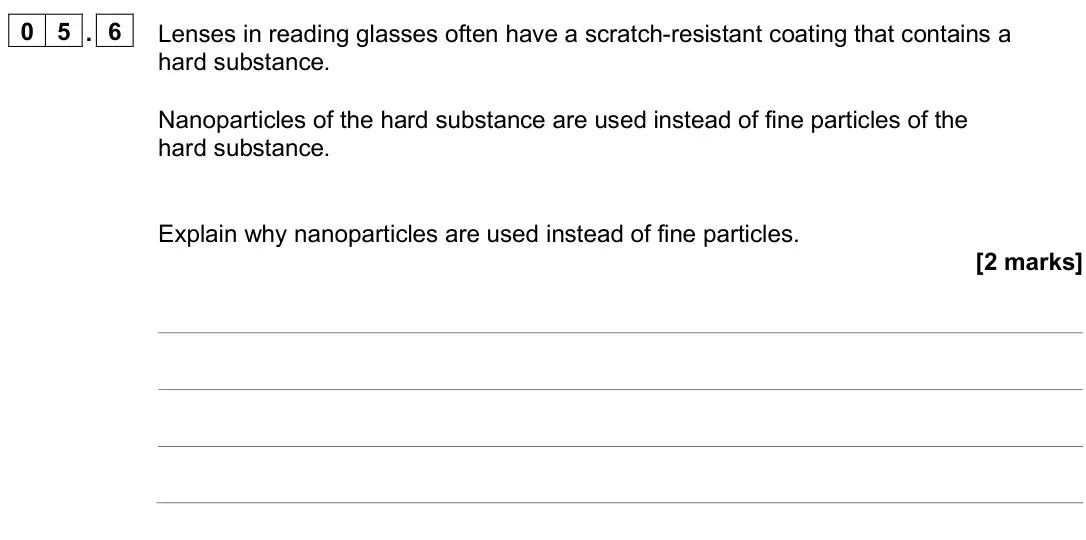
Q06.2
The whole paper ↗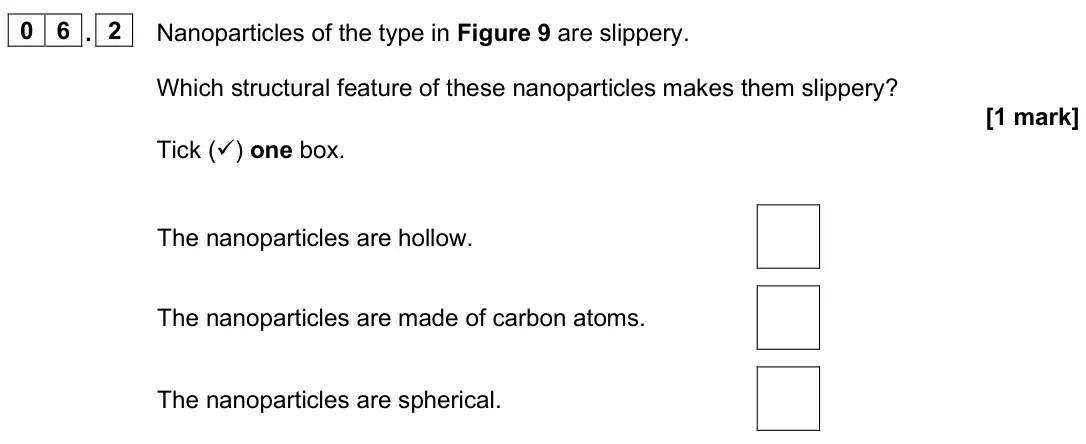
Q06.4
The whole paper ↗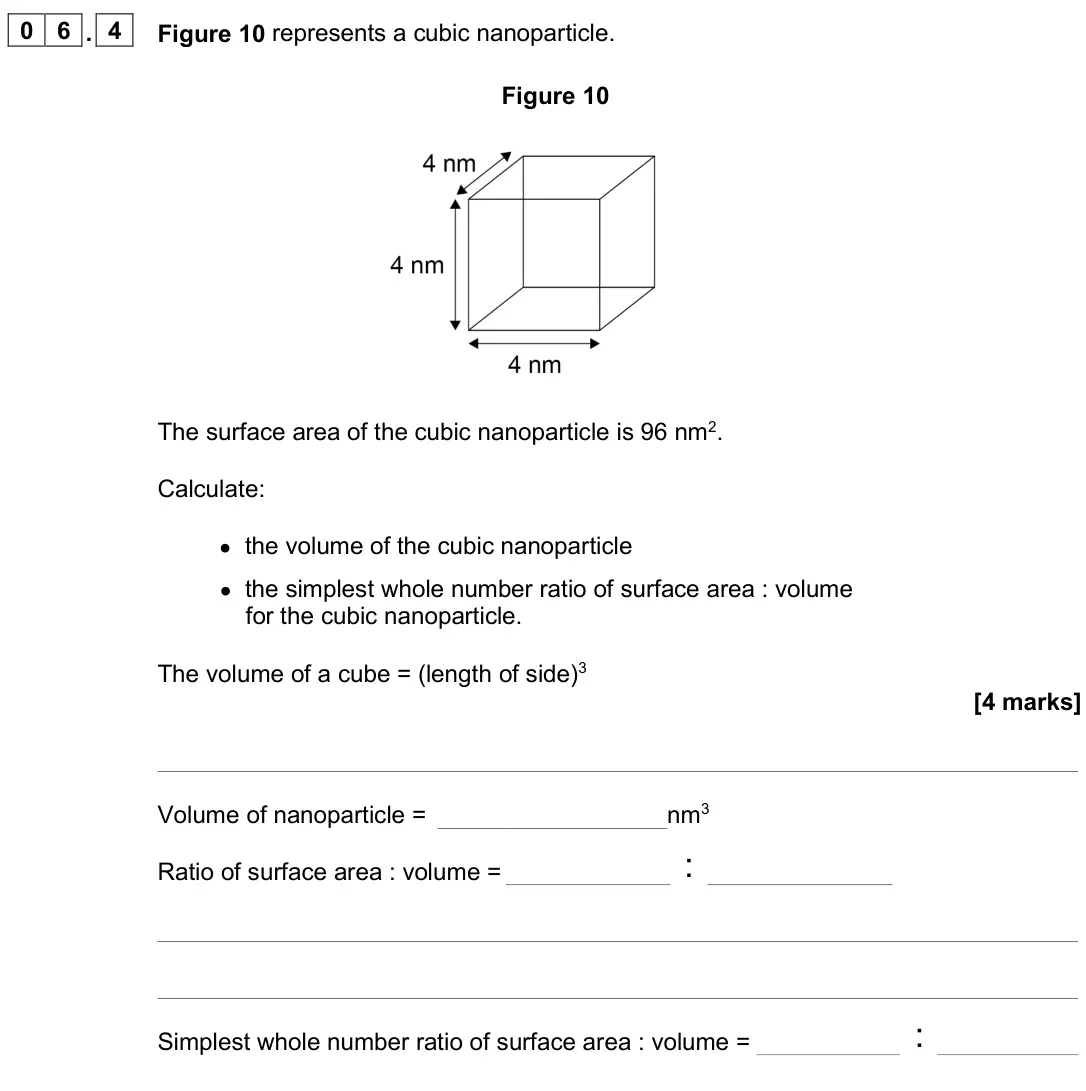
Q06.5
The whole paper ↗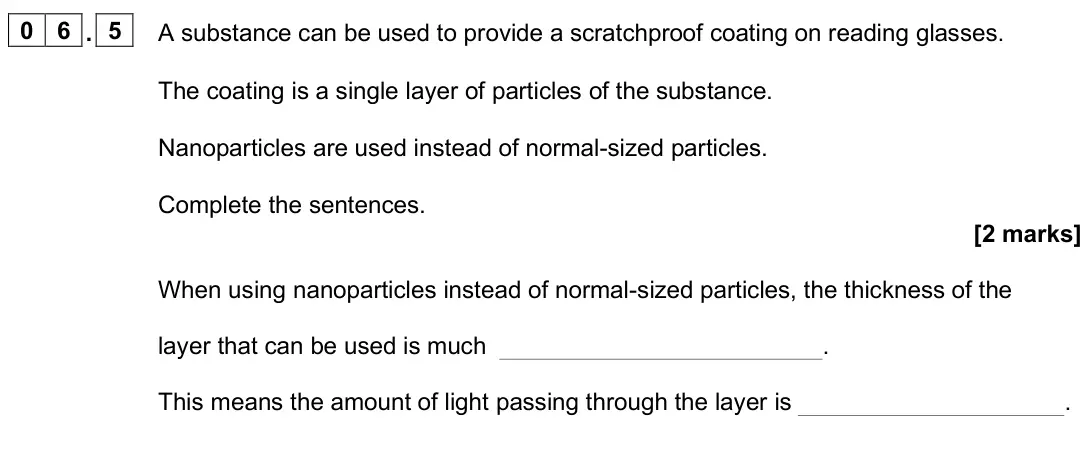
Q04.1
The whole paper ↗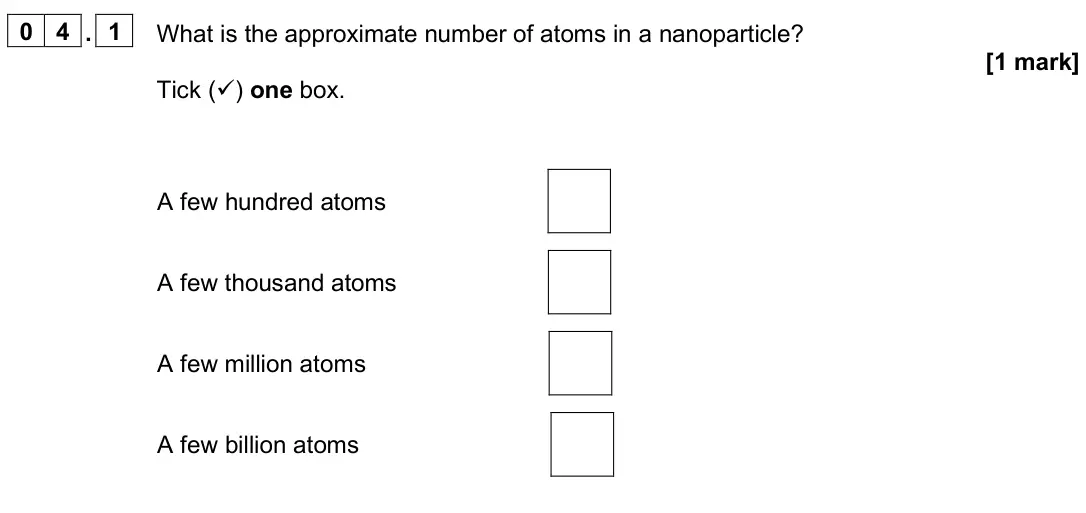
Q04.3
The whole paper ↗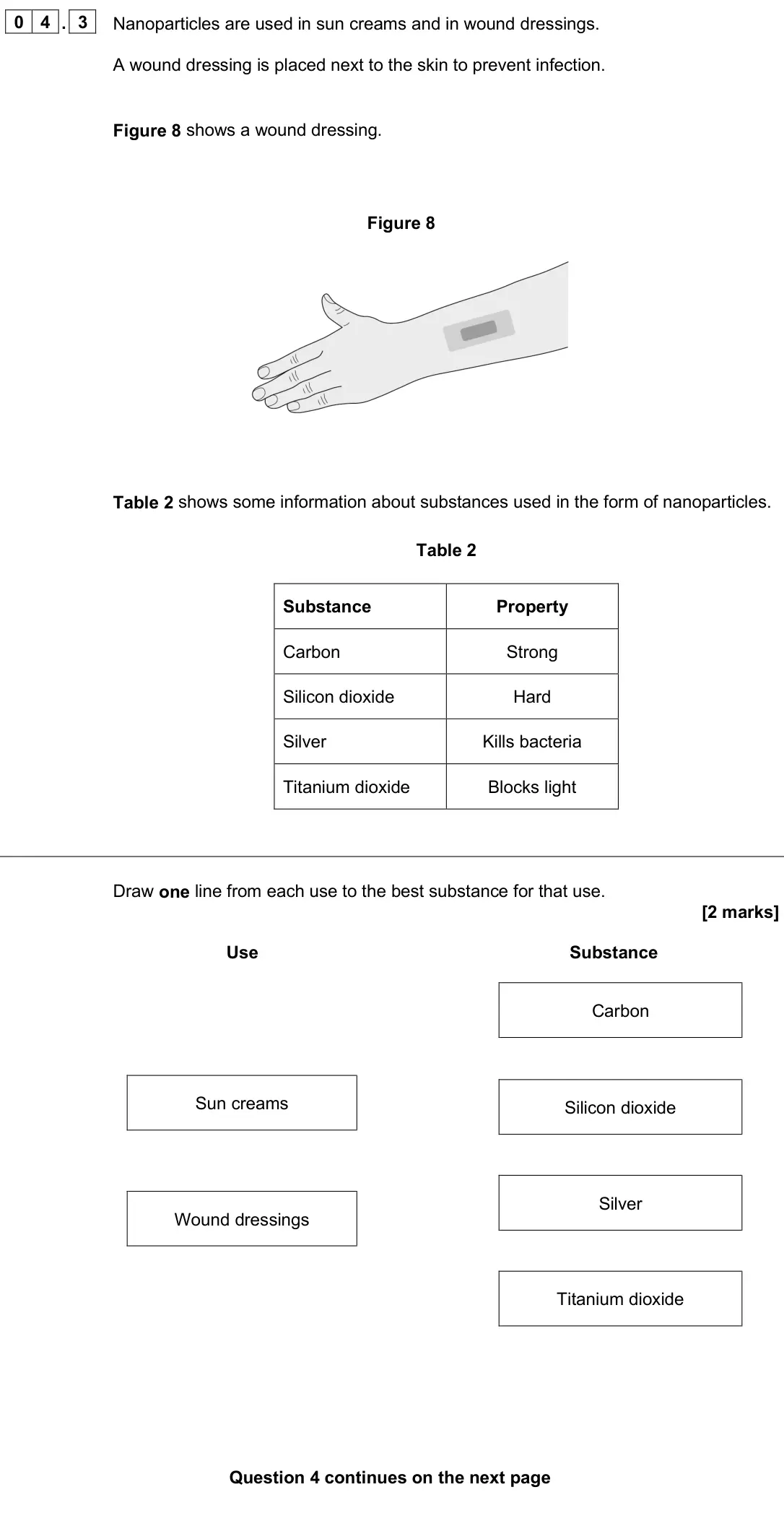
Q04.4
The whole paper ↗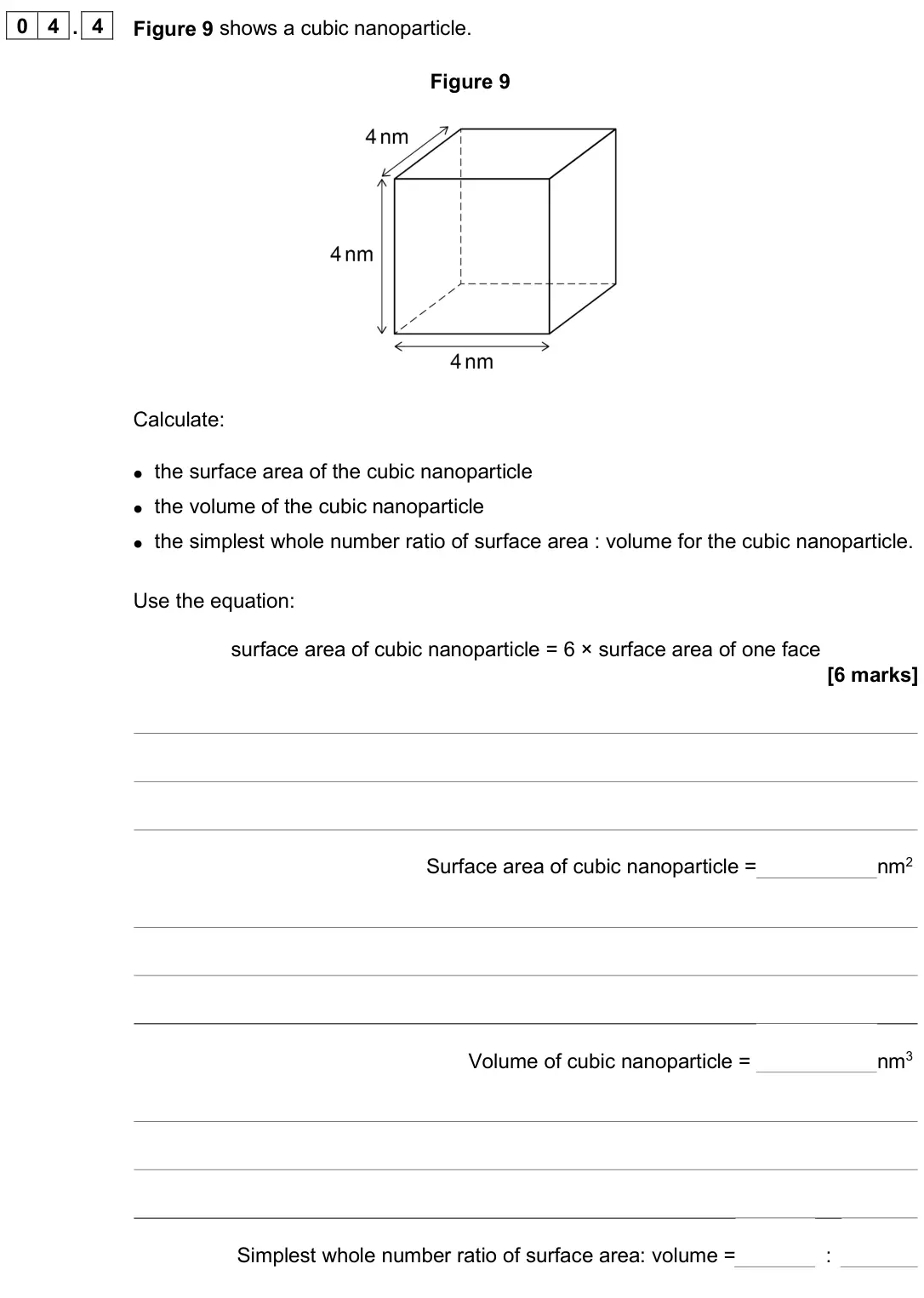
Q10.1
The whole paper ↗
Q05.1
The whole paper ↗
Q05.2
The whole paper ↗
Q05.3
The whole paper ↗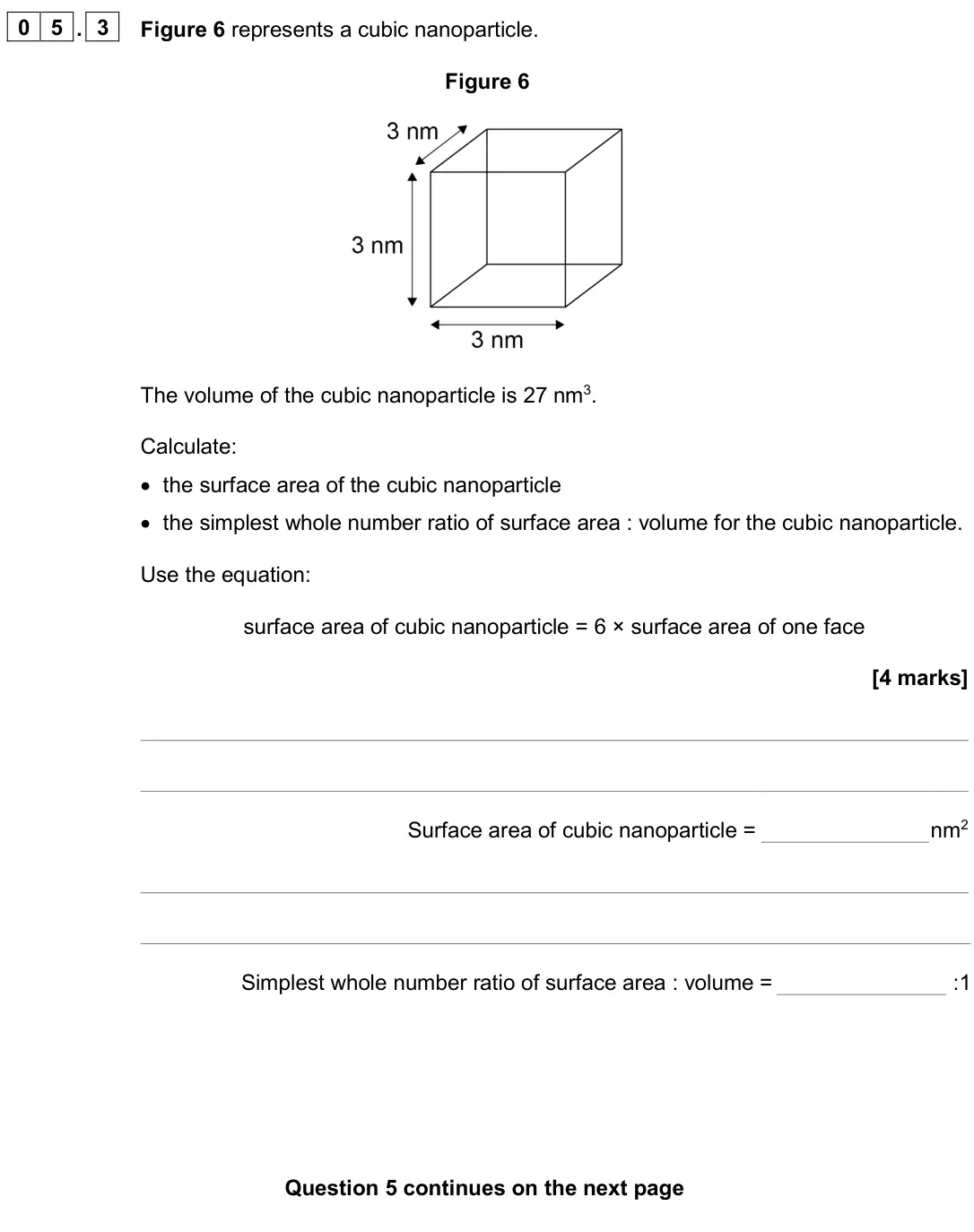
Q05.4
The whole paper ↗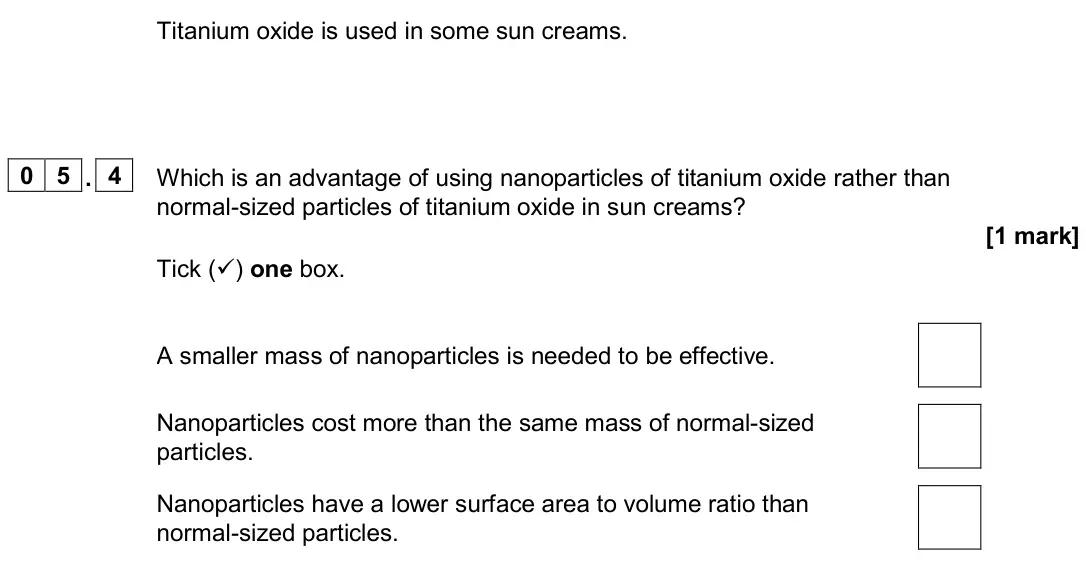
Q07.1
The whole paper ↗
Q07.2
The whole paper ↗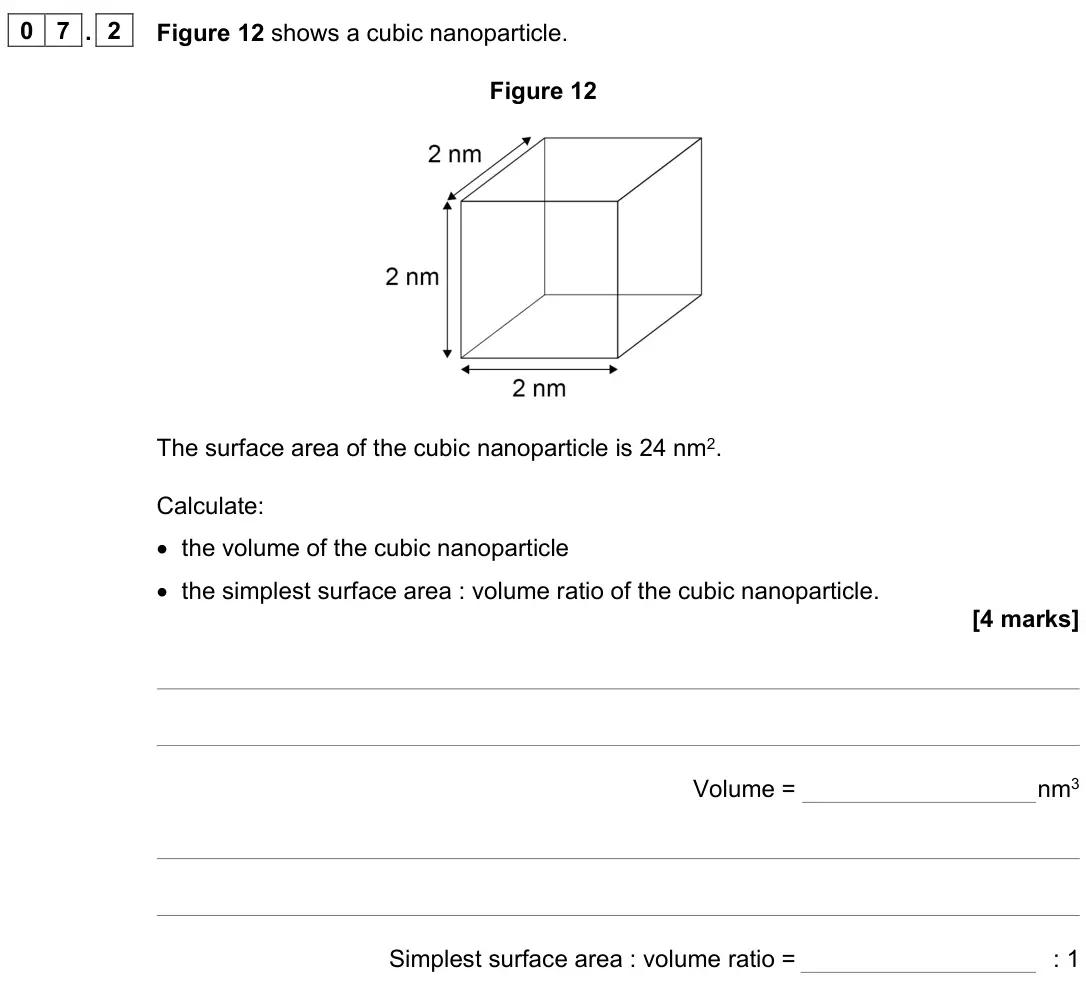
Q07.3
The whole paper ↗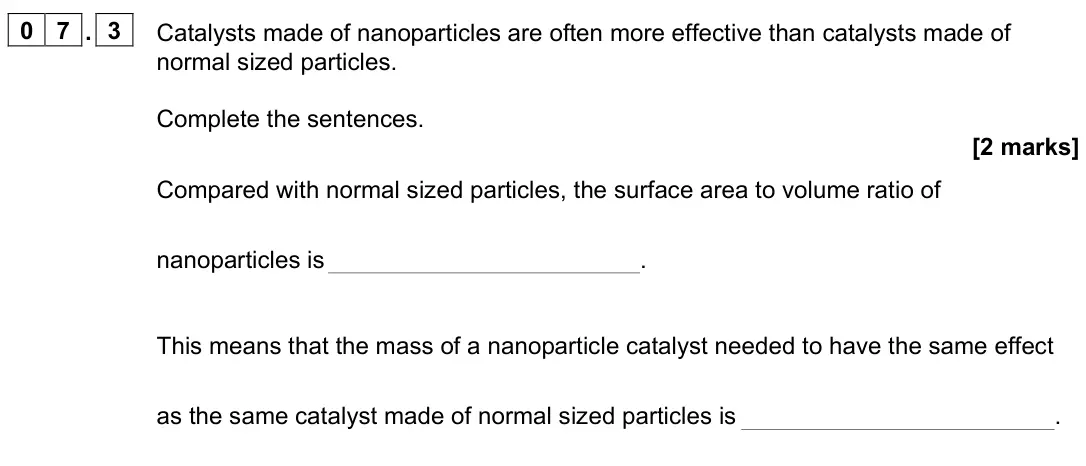
Q07.4
The whole paper ↗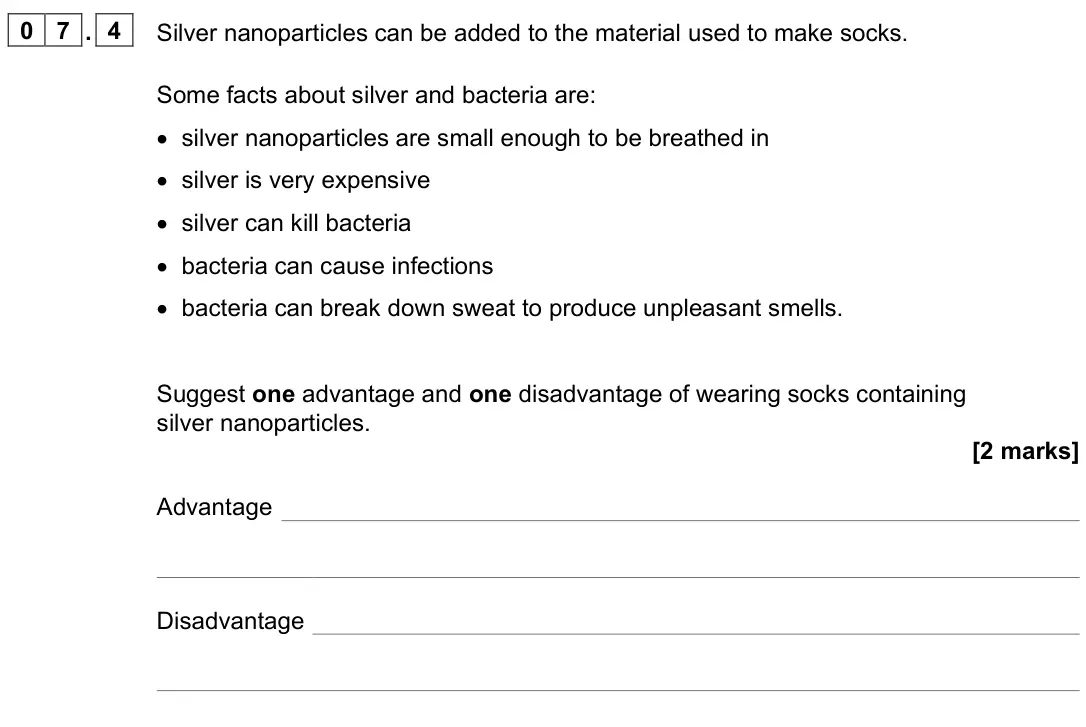
Q07.5
The whole paper ↗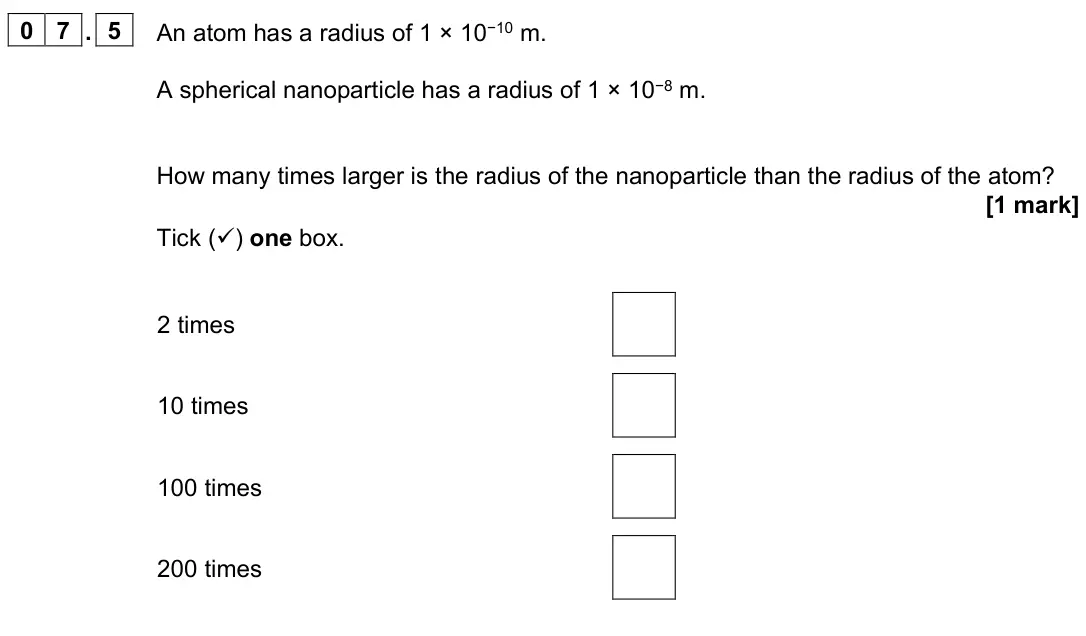
Q01.7
The whole paper ↗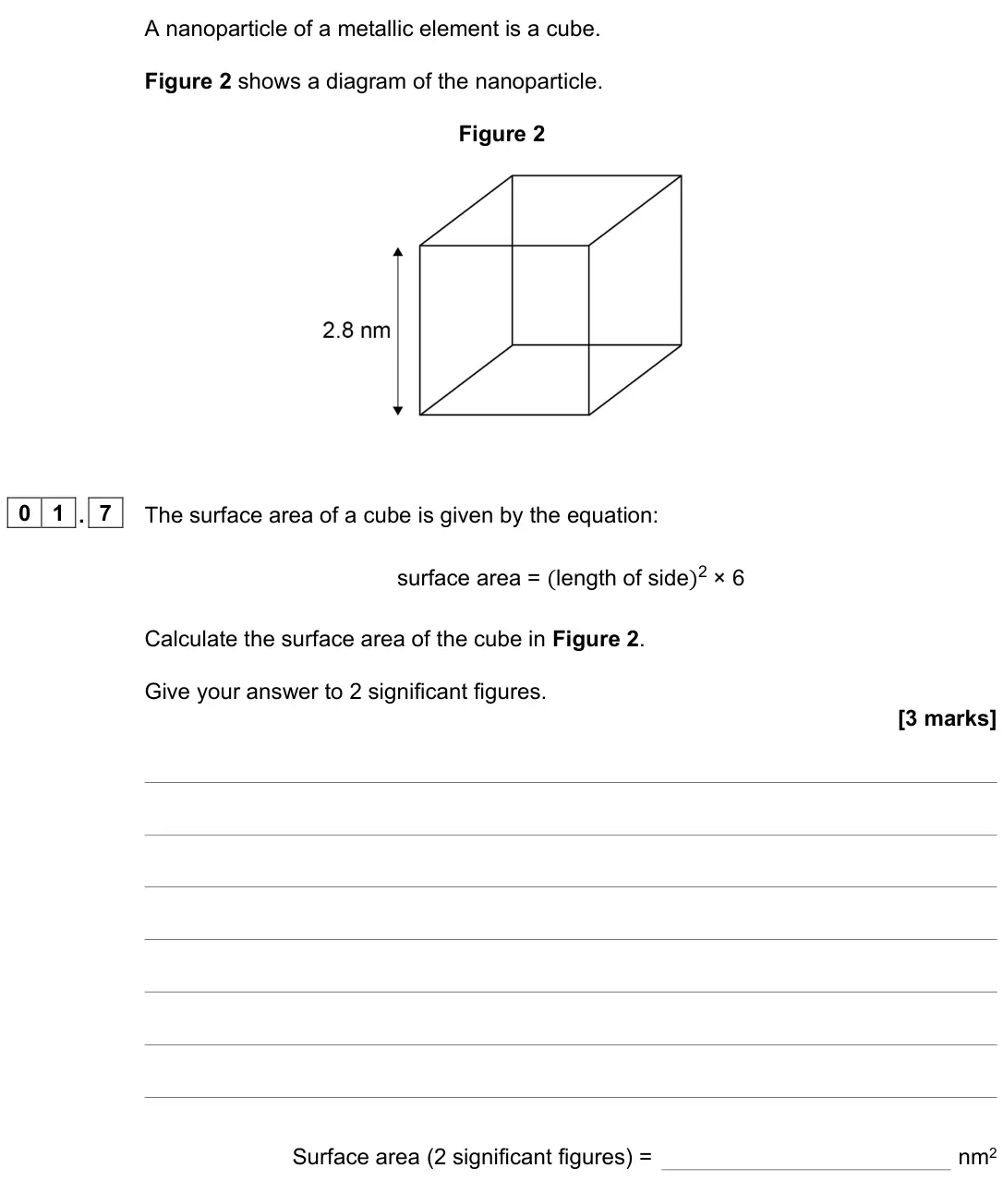
All 31 questions on Bulk and surface properties of matter including nanoparticles, as a list
- June 2025, Paper 1 Higher, Q05.5 (4 marks): Figure 5 represents a cubic nanoparticle. Figure 5 Calculate the simplest surface area : volume ratio of the cubic nanoparticle. [4 marks] Simplest surface area
- June 2025, Paper 1 Higher, Q05.6 (2 marks): Lenses in reading glasses often have a scratch-resistant coating that contains a hard substance. Nanoparticles of the hard substance are used instead of fine pa
- June 2025, Paper 1 Foundation, Q06.2 (1 mark): Nanoparticles of the type in Figure 9 are slippery. Which structural feature of these nanoparticles makes them slippery? [1 mark] Tick () one box. The nanopart
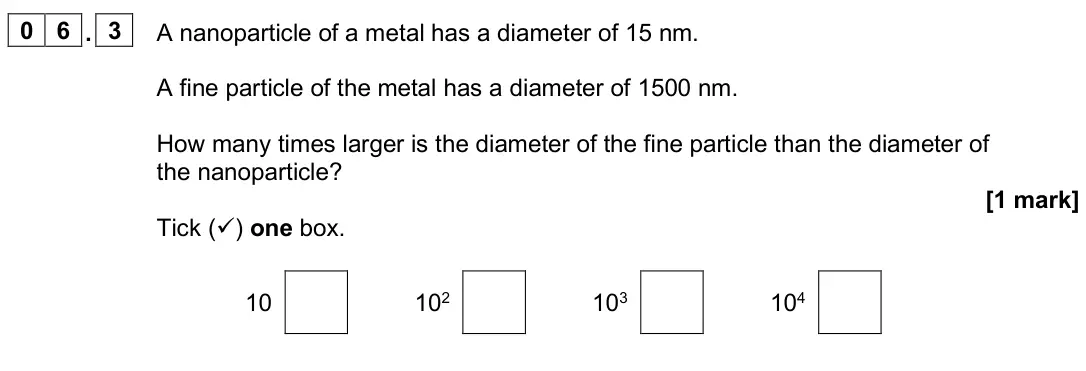
- June 2025, Paper 1 Foundation, Q06.3 (1 mark): A nanoparticle of a metal has a diameter of 15 nm. A fine particle of the metal has a diameter of 1500 nm. How many times larger is the diameter of the fine par
- June 2025, Paper 1 Foundation, Q06.4 (4 marks): Figure 10 represents a cubic nanoparticle. Figure 10 The surface area of the cubic nanoparticle is 96 nm2. Calculate: • the volume of the cubic nanoparticle • t
- June 2025, Paper 1 Foundation, Q06.5 (2 marks): A substance can be used to provide a scratchproof coating on reading glasses. The coating is a single layer of particles of the substance. Nanoparticles are use
- June 2024, Paper 1 Foundation, Q04.1 (1 mark): What is the approximate number of atoms in a nanoparticle? [1 mark] Tick () one box. A few hundred atoms A few thousand atoms A few million atoms A few billion
- June 2024, Paper 1 Foundation, Q04.3 (2 marks): Nanoparticles are used in sun creams and in wound dressings. A wound dressing is placed next to the skin to prevent infection. Figure 8 shows a wound dressing.
- June 2024, Paper 1 Foundation, Q04.4 (6 marks): Figure 9 shows a cubic nanoparticle. Figure 9 Calculate: • the surface area of the cubic nanoparticle • the volume of the cubic nanoparticle • the simplest whol
- June 2023, Paper 1 Higher, Q10.1 (2 marks): Self-cleaning windows are coated with a layer of nanoparticles of titanium dioxide. Titanium dioxide: • helps sunlight break down dirt particles • attracts wate
- June 2023, Paper 1 Foundation, Q05.1 (1 mark): Which type of particle is often referred to as dust? [1 mark] Tick () one box. Coarse particle Fine particle Nanoparticle
- June 2023, Paper 1 Foundation, Q05.2 (1 mark): A spherical coarse particle has a diameter of 4000 nm. A spherical fine particle has a diameter of 200 nm. How many times larger is the diameter of the coarse p
- June 2023, Paper 1 Foundation, Q05.3 (4 marks): Figure 6 represents a cubic nanoparticle. Figure 6 The volume of the cubic nanoparticle is 27 nm3. Calculate: • the surface area of the cubic nanoparticle • the
- June 2023, Paper 1 Foundation, Q05.4 (1 mark): Which is an advantage of using nanoparticles of titanium oxide rather than normal-sized particles of titanium oxide in sun creams? [1 mark] Tick () one box. A
- June 2022, Paper 1 Foundation, Q07.1 (1 mark): Coarse particles, fine particles and nanoparticles are all small particles. Which is the largest particle? [1 mark] Tick () one box. Coarse particle Fine parti
- June 2022, Paper 1 Foundation, Q07.2 (4 marks): Figure 12 shows a cubic nanoparticle. Figure 12 The surface area of the cubic nanoparticle is 24 nm2. Calculate: • the volume of the cubic nanoparticle • the si
- June 2022, Paper 1 Foundation, Q07.3 (2 marks): Catalysts made of nanoparticles are often more effective than catalysts made of normal sized particles. Complete the sentences. [2 marks] Compared with normal s
- June 2022, Paper 1 Foundation, Q07.4 (2 marks): Silver nanoparticles can be added to the material used to make socks. Some facts about silver and bacteria are: • silver nanoparticles are small enough to be br
- June 2022, Paper 1 Foundation, Q07.5 (1 mark): An atom has a radius of 1 × 10⁻¹⁰ m. A spherical nanoparticle has a radius of 1 × 10⁻⁸ m. How many times larger is the radius of the nanoparticle than the radiu
- November 2021, Paper 1 Foundation, Q01.7 (3 marks): The surface area of a cube is given by the equation: surface area = (length of side)2 × 6 Calculate the surface area of the cube in Figure 2. Give your answer t
- November 2021, Paper 1 Foundation, Q01.8 (1 mark): Fine and coarse particles of the metallic element are also cubes. The length of a fine particle cube is 10 times smaller than the length of a coarse particle cu
- November 2020, Paper 2 Higher, Q08.5 (1 mark): A larger cube of calcium carbonate has sides of 5 cm Describe how the surface area to volume ratio of this larger cube differs from that of the cube shown in Fi
- June 2019, Paper 1 Higher, Q03.3 (3 marks): A nanoparticle of zinc oxide is a cube of side 82 nm Figure 5 represents a nanoparticle of zinc oxide. Figure 5 Calculate the surface area of a nanoparticle of
- June 2019, Paper 1 Higher, Q03.4 (1 mark): Some suncreams contain zinc oxide as nanoparticles or as fine particles. Suggest one reason why it costs less to use nanoparticles rather than fine particles in
- June 2019, Paper 1 Foundation, Q10.3 (3 marks): A nanoparticle of zinc oxide is a cube of side 82 nm Figure 15 represents a nanoparticle of zinc oxide. Figure 15 Calculate the surface area of a nanoparticle o
- June 2019, Paper 1 Foundation, Q10.4 (1 mark): Some suncreams contain zinc oxide as nanoparticles or as fine particles. Suggest one reason why it costs less to use nanoparticles rather than fine particles in
- June 2018, Paper 1 Foundation, Q01.7 (1 mark): A nanoparticle of pure metal A is a cube. Each side of the cube has a length of 20 nm. Figure 3 shows the cube. Figure 3 What is the volume of the nanoparticle?
- Specimen, Paper 1 Foundation, Q05.5: Why are nanoparticles effective in very small quantities?
- Specimen, Paper 1 Foundation, Q05.6: Give one advantage of using nanoparticles in sun creams. [1 mar
- Specimen, Paper 1 Foundation, Q05.7: Give one disadvantage of using nanoparticles in sun creams. [1 mar 3
- Specimen, Paper 1 Foundation, Q05.8 (2 marks): A coarse particle has a diameter of 1 × 10⁻⁶ m. A nanoparticle has a diameter of 1.6 × 10⁻⁹ m. Calculate how many times bigger the diameter of the coarse partic
Questions, mark schemes and examiner’s reports are © AQA, from their published past papers. Plumi isn’t affiliated with any exam board. Want whole papers? Every AQA GCSE Chemistry paper.
Rather write your answers by hand on iPad? Plumi marks them against the same mark schemes.