 plumi
Rate of reaction: AQA GCSE Chemistry questions
Every AQA GCSE Chemistry exam question on 4.6.1 Rate of reaction, 2018–2025, with its mark scheme and examiner’s report.
Find questions1,744
Calculations
Q06.6
The whole paper ↗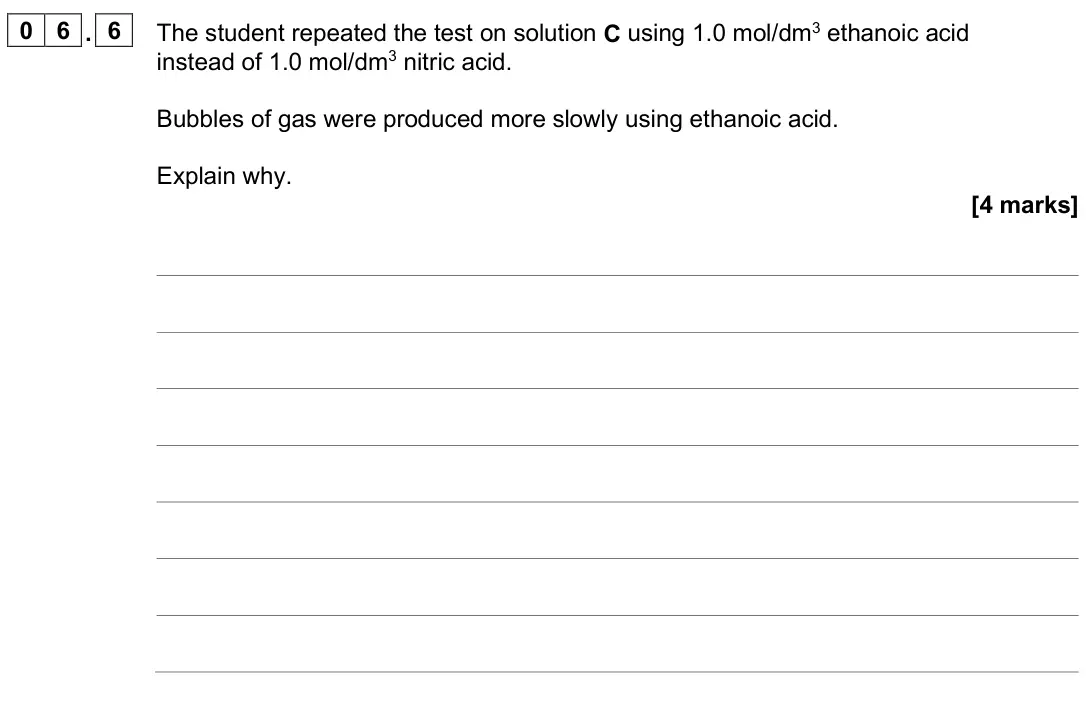
Q08.1
The whole paper ↗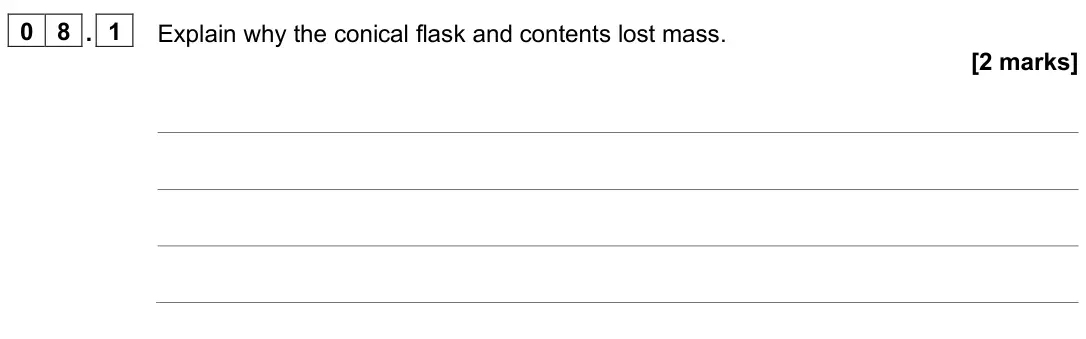
Q08.2
The whole paper ↗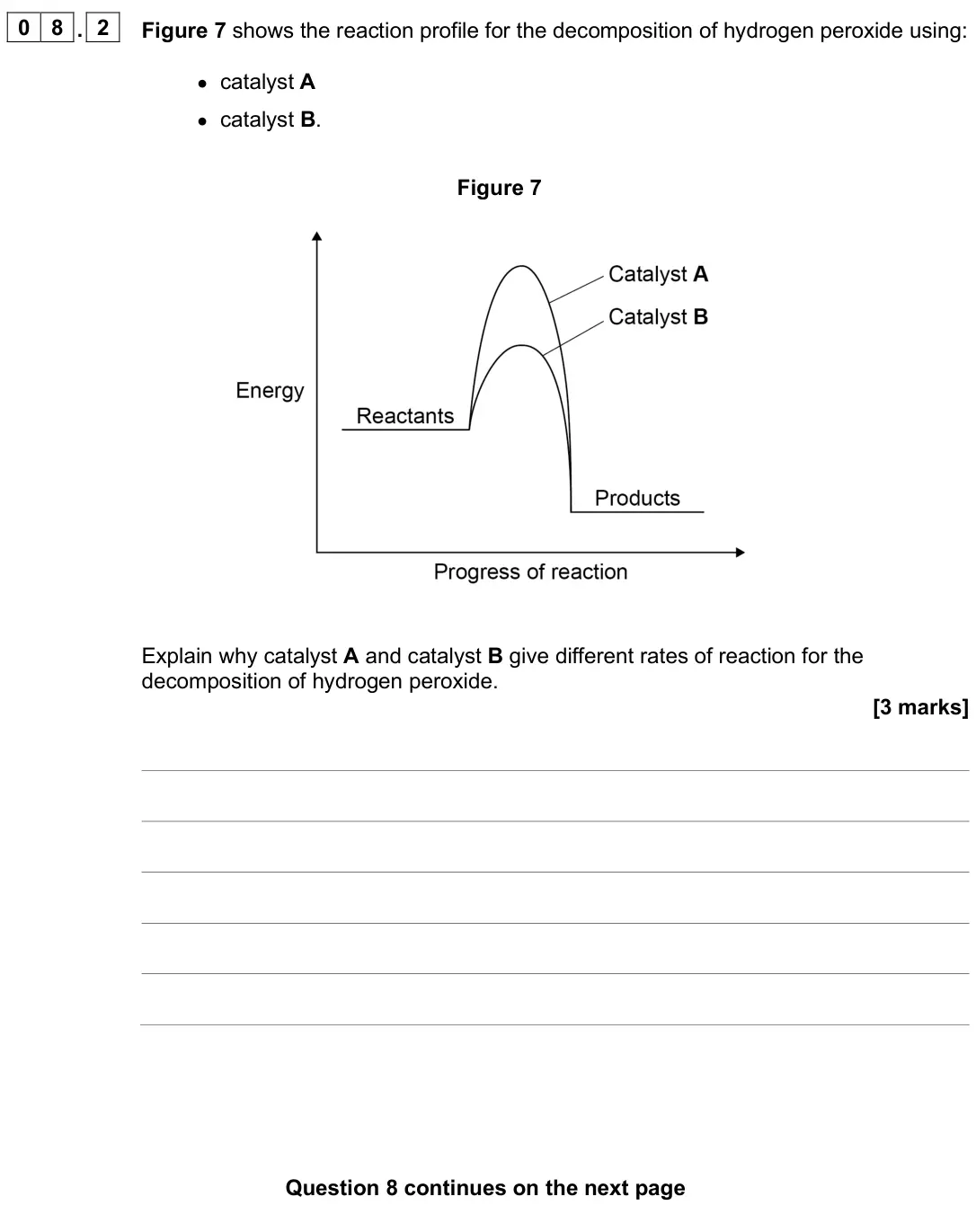
Q08.3
The whole paper ↗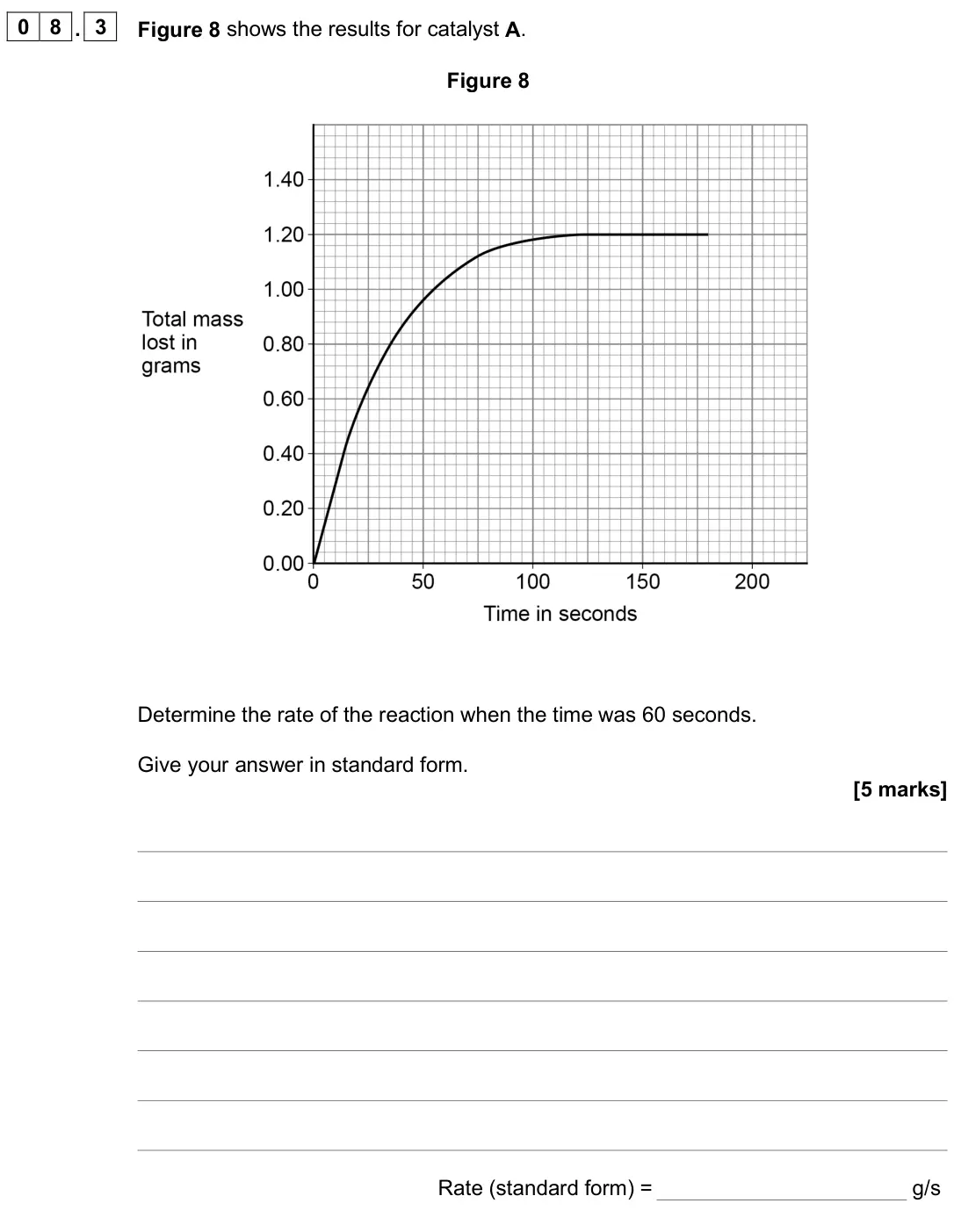
Q08.4
The whole paper ↗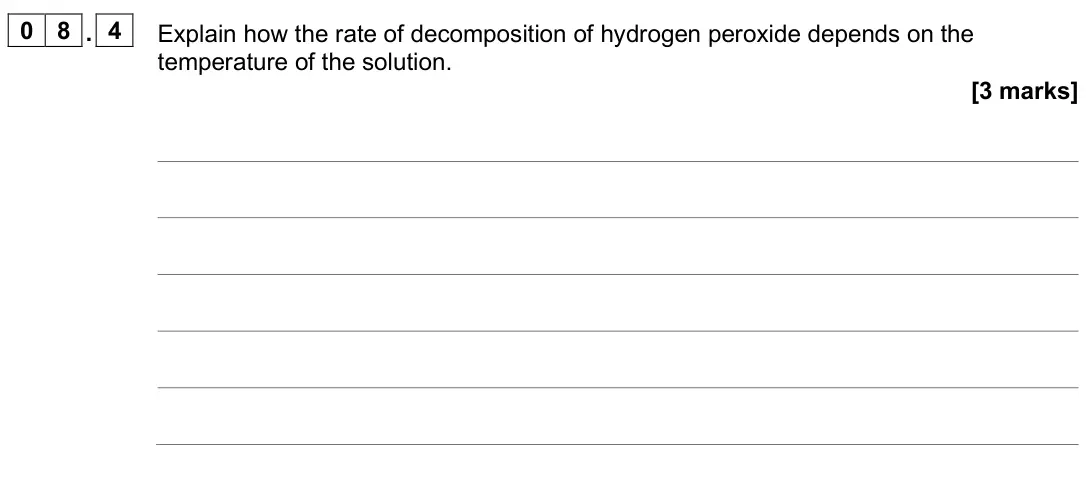
Q09.1
The whole paper ↗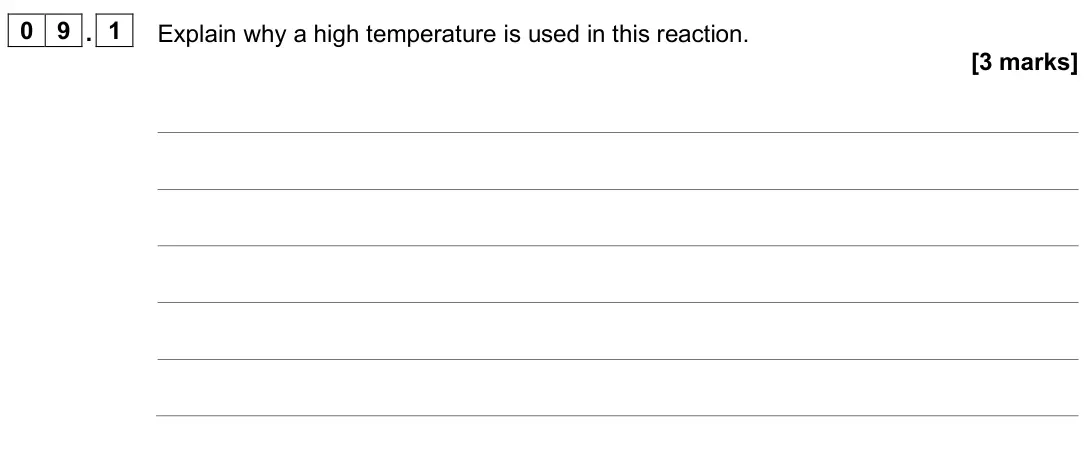
Q09.3
The whole paper ↗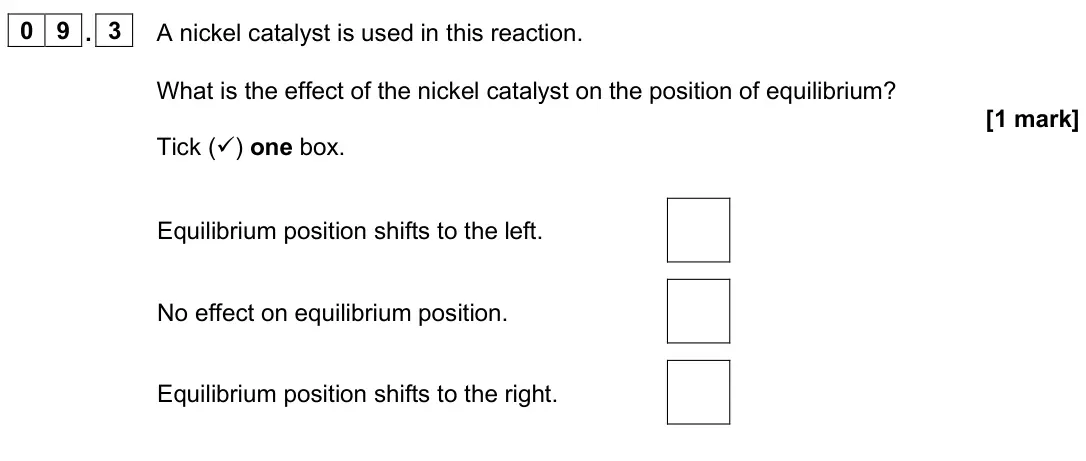
Q02.8
The whole paper ↗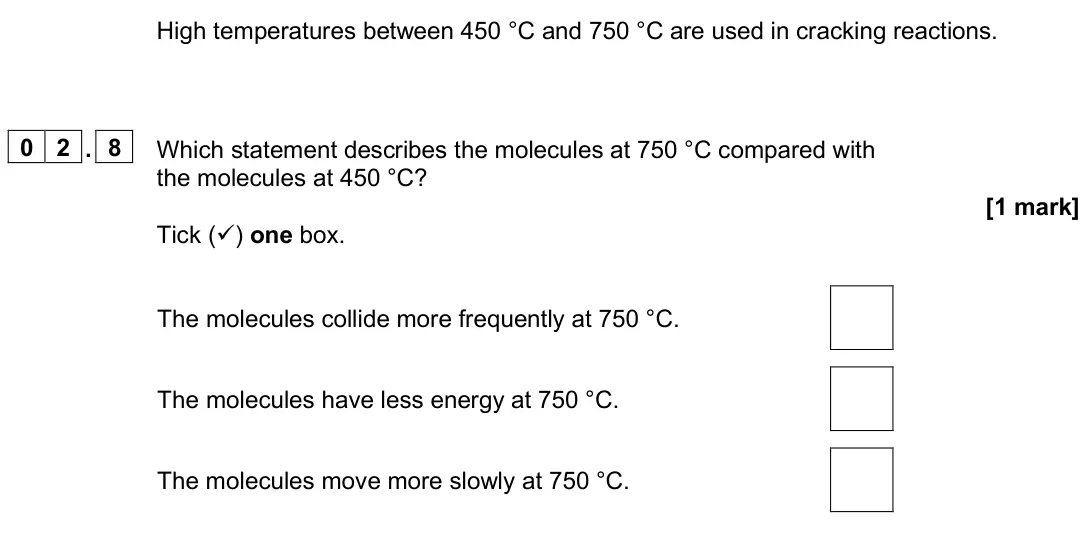
Q02.9
The whole paper ↗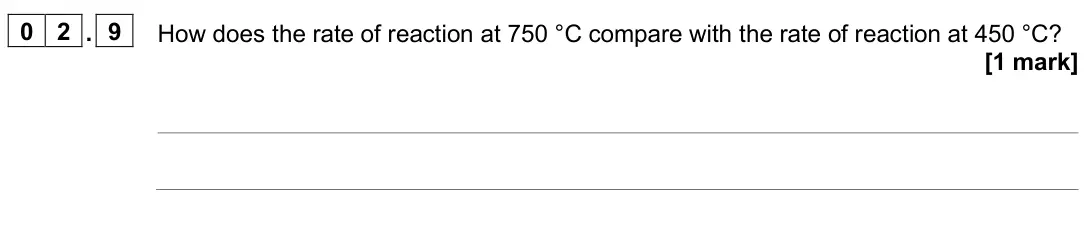
Q02.2
The whole paper ↗
Q02.4
The whole paper ↗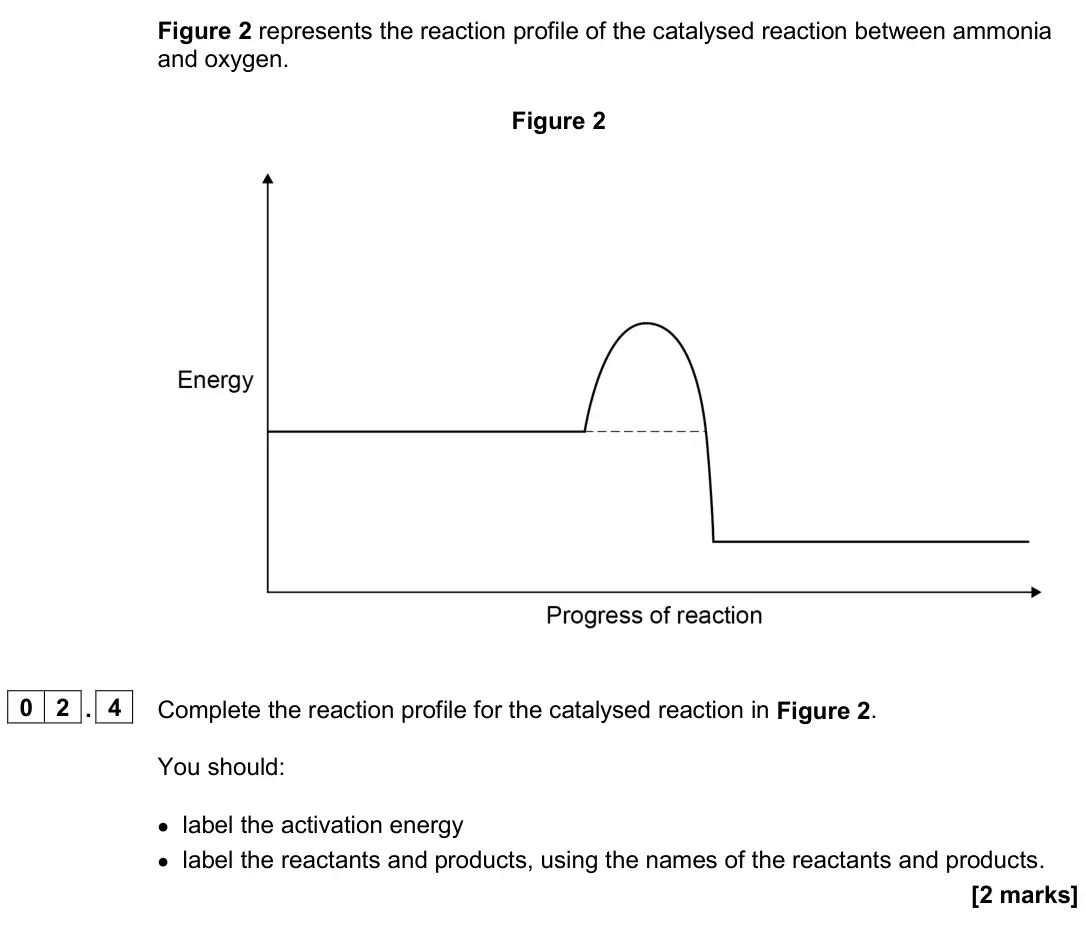
Q02.5
The whole paper ↗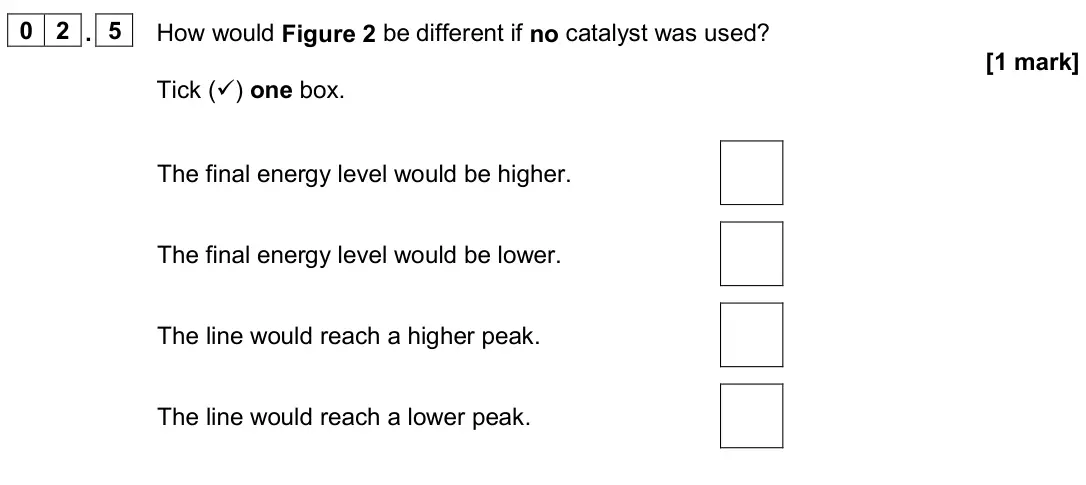
Q09.1
The whole paper ↗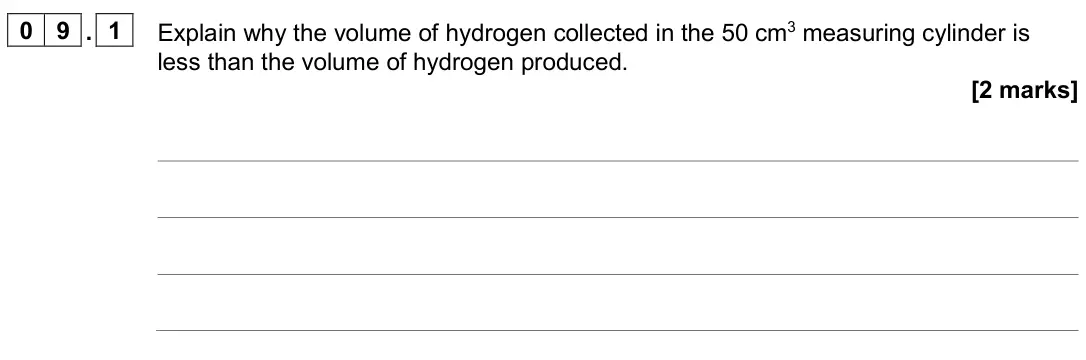
Q09.2
The whole paper ↗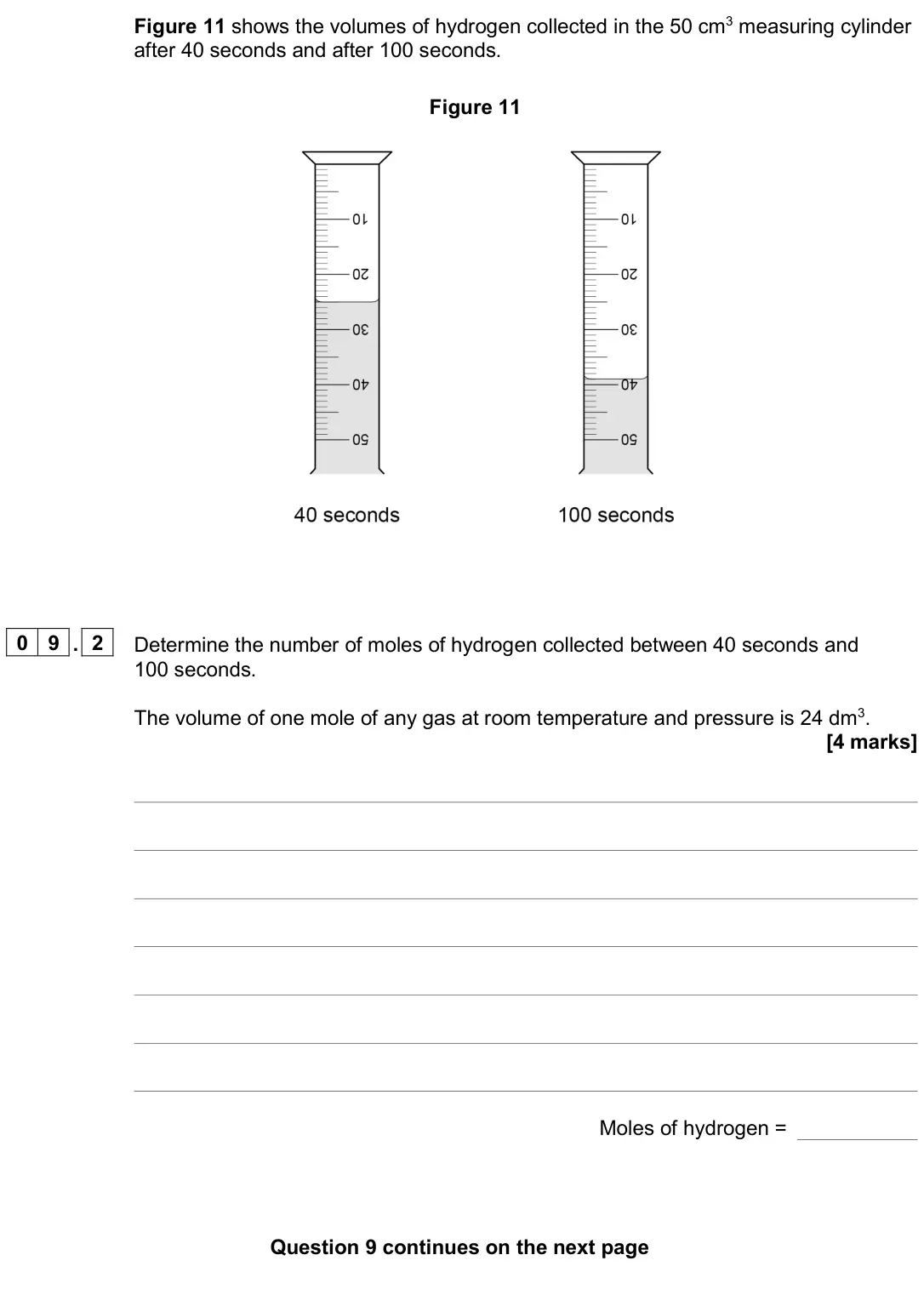
Q09.3
The whole paper ↗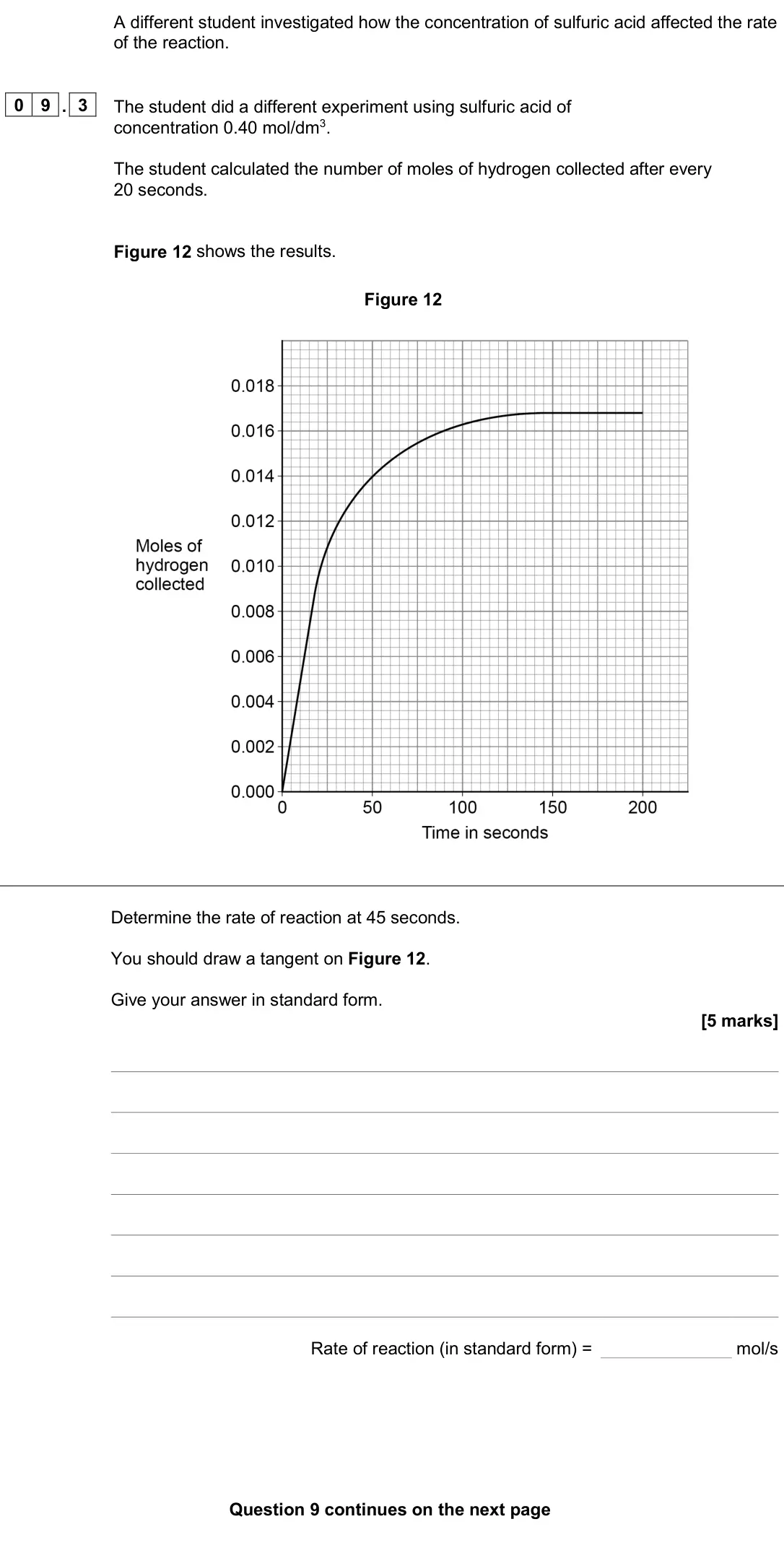
Q09.5
The whole paper ↗
Q05.1
The whole paper ↗
Q05.2
The whole paper ↗
Q05.3
The whole paper ↗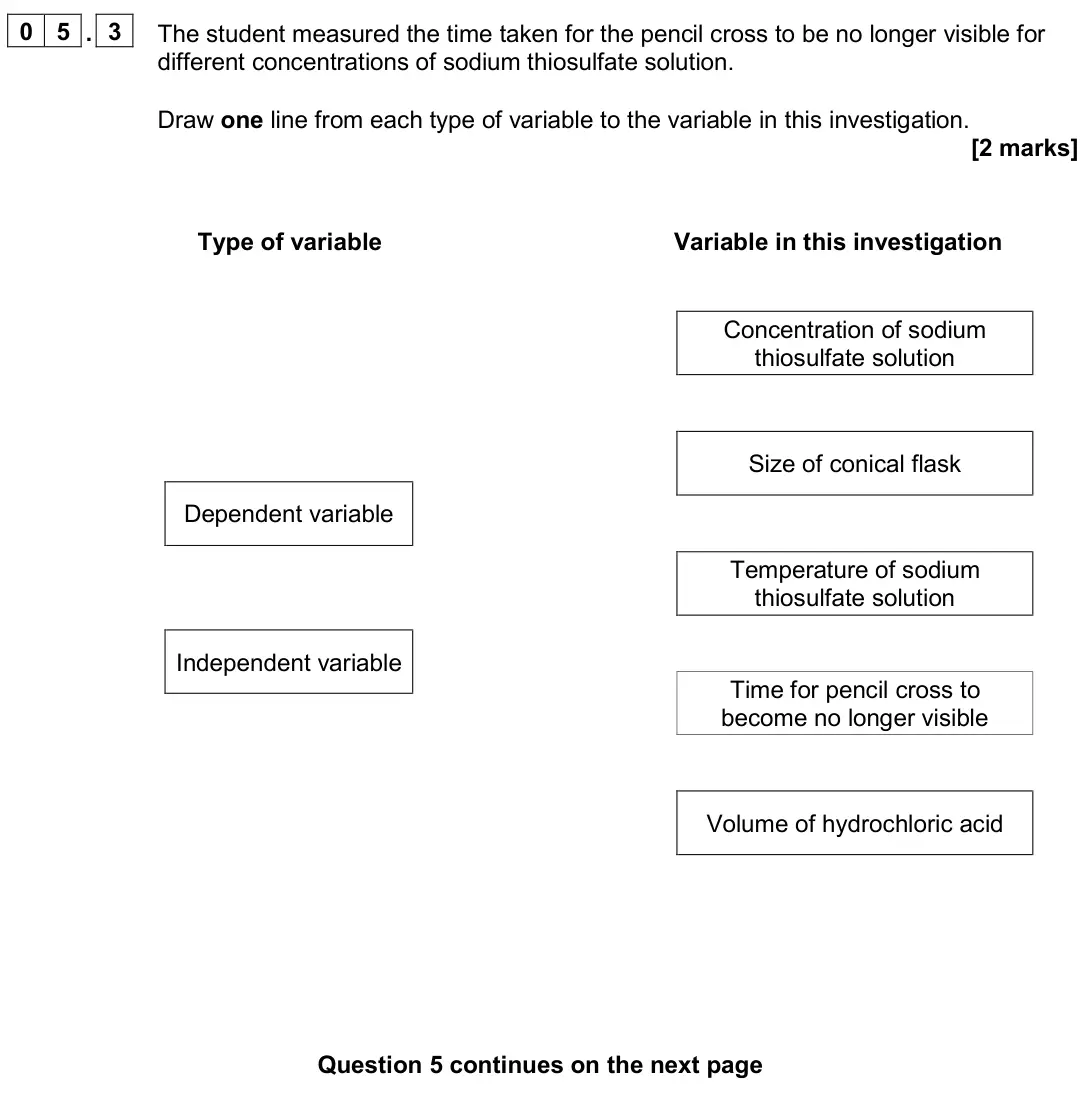
Q05.4
The whole paper ↗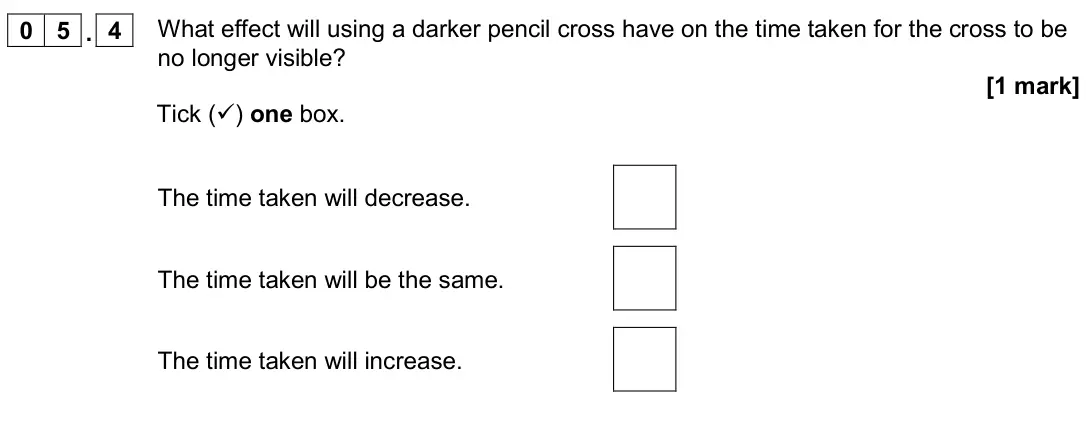
All 104 questions on Rate of reaction, as a list
- June 2025, Paper 2 Higher, Q06.6 (4 marks): The student repeated the test on solution C using 1.0 mol/dm3 ethanoic acid instead of 1.0 mol/dm3 nitric acid. Bubbles of gas were produced more slowly using e
- June 2025, Paper 2 Higher, Q08.1 (2 marks): Explain why the conical flask and contents lost mass. [2 marks]
- June 2025, Paper 2 Higher, Q08.2 (3 marks): Figure 7 shows the reaction profile for the decomposition of hydrogen peroxide using: • catalyst A • catalyst B. Figure 7 Explain why catalyst A and catalyst B
- June 2025, Paper 2 Higher, Q08.3 (5 marks): Figure 8 shows the results for catalyst A. Figure 8 Determine the rate of the reaction when the time was 60 seconds. Give your answer in standard form. [5 marks
- June 2025, Paper 2 Higher, Q08.4 (3 marks): Explain how the rate of decomposition of hydrogen peroxide depends on the temperature of the solution. [3 marks]
- June 2025, Paper 2 Higher, Q09.1 (3 marks): Explain why a high temperature is used in this reaction. [3 marks]
- June 2025, Paper 2 Higher, Q09.3 (1 mark): A nickel catalyst is used in this reaction. What is the effect of the nickel catalyst on the position of equilibrium? [1 mark] Tick () one box. Equilibrium pos
- June 2025, Paper 2 Foundation, Q02.8 (1 mark): Which statement describes the molecules at 750 °C compared with the molecules at 450 °C? [1 mark] Tick () one box. The molecules collide more frequently at 750
- June 2025, Paper 2 Foundation, Q02.9 (1 mark): How does the rate of reaction at 750 °C compare with the rate of reaction at 450 °C? [1 mark]
- June 2024, Paper 2 Higher, Q02.2 (1 mark): Which metal is used as a catalyst in this reaction? [1 mark]
- June 2024, Paper 2 Higher, Q02.4 (2 marks): Complete the reaction profile for the catalysed reaction in Figure 2. You should: • label the activation energy • label the reactants and products, using the na
- June 2024, Paper 2 Higher, Q02.5 (1 mark): How would Figure 2 be different if no catalyst was used? [1 mark] Tick () one box. The final energy level would be higher. The final energy level would be lowe
- June 2024, Paper 2 Higher, Q09.1 (2 marks): Explain why the volume of hydrogen collected in the 50 cm3 measuring cylinder is less than the volume of hydrogen produced. [2 marks]
- June 2024, Paper 2 Higher, Q09.2 (4 marks): Determine the number of moles of hydrogen collected between 40 seconds and 100 seconds. The volume of one mole of any gas at room temperature and pressure is 24
- June 2024, Paper 2 Higher, Q09.3 (5 marks): The student did a different experiment using sulfuric acid of concentration 0.40 mol/dm3. The student calculated the number of moles of hydrogen collected after
- June 2024, Paper 2 Higher, Q09.5 (3 marks): Explain how increasing the temperature would affect the rate of reaction between zinc and sulfuric acid. [3 marks]
- June 2024, Paper 2 Foundation, Q05.1 (2 marks): Explain why a 50 cm3 conical flask is unsuitable to use in this method. [2 marks]
- June 2024, Paper 2 Foundation, Q05.2 (1 mark): Name a piece of equipment suitable for measuring the volume of sodium thiosulfate solution. [1 mark]
- June 2024, Paper 2 Foundation, Q05.3 (2 marks): The student measured the time taken for the pencil cross to be no longer visible for different concentrations of sodium thiosulfate solution. Draw one line from
- June 2024, Paper 2 Foundation, Q05.4 (1 mark): What effect will using a darker pencil cross have on the time taken for the cross to be no longer visible? [1 mark] Tick () one box. The time taken will decrea
- June 2024, Paper 2 Foundation, Q05.5 (1 mark): Table 2 shows the results. Table 2 Concentration of sodium thiosulfate solution in g/dm3 Time for cross to become no longer visible in seconds 8 120 16 60 24 40
- June 2024, Paper 2 Foundation, Q05.6 (2 marks): Increasing the concentration of sodium thiosulfate solution changes the rate of the reaction with hydrochloric acid. Which two statements explain the effect of
- June 2024, Paper 2 Foundation, Q05.7 (2 marks): The effect on the time taken for the cross to disappear can also be investigated by: • changing the temperature of the hydrochloric acid • changing the concentr
- June 2024, Paper 2 Foundation, Q09.2 (1 mark): Which metal is used as a catalyst in this reaction? [1 mark]
- June 2024, Paper 2 Foundation, Q09.4 (2 marks): Complete the reaction profile for the catalysed reaction in Figure 11. You should: • label the activation energy • label the reactants and products, using the n
- June 2024, Paper 2 Foundation, Q09.5 (1 mark): How would Figure 11 be different if no catalyst was used? [1 mark] Tick () one box. The final energy level would be higher. The final energy level would be low
- June 2023, Paper 2 Higher, Q01.1 (1 mark): Suggest why the stopper must be put in the conical flask as quickly as possible in step 3. [1 mark]
- June 2023, Paper 2 Higher, Q01.2 (5 marks): The student calculated the rate of the reaction for each trial. Table 1 shows the results of the calculations. Table 1 Trial 1 Trial 2 Trial 3 Trial 4 Rate of r
- June 2023, Paper 2 Higher, Q01.3 (2 marks): The student changed the investigation so that the mean time taken to collect 20 cm3 of gas was greater. Which two changes would increase the mean time taken to
- June 2023, Paper 2 Higher, Q07.1 (2 marks): Explain how a manganese dioxide catalyst increases the rate of decomposition of hydrogen peroxide. [2 marks]
- June 2023, Paper 2 Higher, Q07.2 (2 marks): Explain why the mass of the conical flask and contents decreased. [2 marks]
- June 2023, Paper 2 Higher, Q07.3 (4 marks): Figure 4 shows the results for 50 cm3 of 2.0 mol/dm3 hydrogen peroxide solution and 1.0 g of manganese dioxide. A tangent to the line has been drawn at 75 secon
- June 2023, Paper 2 Higher, Q07.4 (2 marks): The results for 50 cm3 of 2.0 mol/dm3 hydrogen peroxide solution and 1.0 g of manganese dioxide are shown again on Figure 5. Figure 5 The student repeated the i
- June 2023, Paper 2 Foundation, Q01.5 (1 mark): Which test tube contained hydrogen peroxide solution at the highest temperature? [1 mark] Tick () one box. Test tube A Test tube B Test tube C
- June 2023, Paper 2 Foundation, Q01.7 (1 mark): Manganese dioxide does not appear in the chemical equation for this reaction. Which is a correct statement about manganese dioxide in this reaction? [1 mark] Ti
- June 2023, Paper 2 Foundation, Q08.1 (1 mark): Suggest why the stopper must be put in the conical flask as quickly as possible in step 3. [1 mark]
- June 2023, Paper 2 Foundation, Q08.2 (5 marks): The student calculated the rate of the reaction for each trial. Table 7 shows the results of the calculations. Table 7 Trial 1 Trial 2 Trial 3 Trial 4 Rate of r
- June 2023, Paper 2 Foundation, Q08.3 (2 marks): The student changed the investigation so that the mean time taken to collect 20 cm3 of gas was greater. Which two changes would increase the mean time taken to
- June 2022, Paper 2 Higher, Q07.6 (6 marks): The equation for the production of ammonia in the Haber process is: N2(g) + 3 H2(g) ⇌ 2 NH3(g) The forward reaction is exothermic. The conditions used are: • a
- June 2022, Paper 2 Higher, Q08.1 (1 mark): Sulfur is produced in the reaction. Why does the mixture become cloudy? [1 mark] A student investigated the effect of changing the concentration of sodium thios
- June 2022, Paper 2 Higher, Q08.2 (5 marks): The percentage of light reaching the light sensor decreases by 1% when 7.1 × 10⁻⁵ moles of sulfur is produced. Determine the rate of reaction in mol/s for the p
- June 2022, Paper 2 Higher, Q08.3 (2 marks): Explain why the rate of reaction changes between 0 and 60 seconds. Answer in terms of concentration. Use Figure 7. [2 marks]
- June 2022, Paper 2 Higher, Q08.4 (1 mark): The line of best fit on Figure 8 is horizontal between 80 and 120 seconds because the reaction stopped. Why did the reaction stop? [1 mark]
- June 2022, Paper 2 Higher, Q08.5 (2 marks): Sketch a line on Figure 8 to show the results you would predict for 0.20 mol/dm3 sodium thiosulfate solution. [2 marks]
- June 2022, Paper 2 Higher, Q08.6 (1 mark): How could the student improve the method so that the same percentages of light reached the light sensor? [1 mark] Tick () one box. Record the percentage of lig
- June 2022, Paper 2 Higher, Q08.7 (1 mark): The student improved the method so that similar results were obtained on different days. What name is given to similar results obtained on different days under
- June 2022, Paper 2 Higher, Q08.8 (1 mark): Which expression represents the relationship between the volume (V) of sodium thiosulfate solution used and the mass (m) of sulfur produced? Use Figure 9. [1 ma
- June 2022, Paper 2 Higher, Q08.9 (3 marks): Determine the simplest whole number ratio of the volumes of sodium thiosulfate solution : hydrochloric acid which completely react with each other. Use Figure 9
- June 2022, Paper 2 Foundation, Q06.2 (1 mark): The mixture becomes cloudy because the sulfur produced is a solid. What is the state symbol for a solid? [1 mark] Tick () one box. (aq) (g) (l) (s)
- June 2022, Paper 2 Foundation, Q06.3 (1 mark): The student monitored the cloudiness of the reaction mixture using a light sensor. What other piece of equipment could be used to monitor the cloudiness of the
- June 2022, Paper 2 Foundation, Q06.4 (1 mark): What happened to the rate of reaction between 40 and 60 seconds? Use Figure 8. [1 mark] Tick () one box. The rate of reaction decreased. The rate of reaction s
- June 2022, Paper 2 Foundation, Q06.5 (1 mark): The student stopped taking measurements after 120 seconds because the percentage of light reaching the sensor stayed constant. Why did the percentage of light r
- June 2022, Paper 2 Foundation, Q06.6 (1 mark): The student repeated the experiment using sodium thiosulfate solution of a higher concentration. How would the line of best fit for sodium thiosulfate solution
- June 2022, Paper 2 Foundation, Q06.7 (2 marks): The student then investigated the effect of changing the temperature on the rate of reaction. The student used sodium thiosulfate solution and hydrochloric acid
- November 2021, Paper 2 Higher, Q09.1 (1 mark): The student made an error in setting up the apparatus in Figure 8. What error did the student make? [1 mark] The student corrected the error.
- November 2021, Paper 2 Higher, Q09.2 (2 marks): Explain why the lines of best fit on Figure 9 become horizontal. [2 marks]
- November 2021, Paper 2 Higher, Q09.3 (1 mark): How does Figure 9 show that zinc powder reacts more slowly with 0.05 mol/dm3 sulfuric acid than with 0.10 mol/dm3 sulfuric acid? [1 mark]
- November 2021, Paper 2 Higher, Q09.4 (5 marks): Determine the rate of the reaction for 0.05 mol/dm3 sulfuric acid at 80 seconds. Show your working on Figure 9. Give your answer to 2 significant figures. [5 ma
- November 2021, Paper 2 Higher, Q09.5 (1 mark): The activation energy for the reaction between zinc and sulfuric acid is lowered if a solution containing metal ions is added. What is the most likely formula o
- November 2021, Paper 2 Higher, Q10.3 (6 marks): Ethanol can be produced from ethene and steam. The equation for the reaction is: C2H4(g) + H2O(g) ⇌ C2H5OH(g) The forward reaction is exothermic. Explain how th
- November 2021, Paper 2 Foundation, Q04.4 (3 marks): The rate of reaction between gases is affected by changing the pressure. Complete the sentences. [3 marks] When the pressure of the reacting gases is increased,
- November 2021, Paper 2 Foundation, Q04.5 (1 mark): Give one other way of changing the rate of reaction between gases. You should not refer to pressure in your answer. [1 mark]
- November 2021, Paper 2 Foundation, Q05.1 (1 mark): X shows where a piece of equipment is connected to measure the volume of hydrogen gas collected. Complete Figure 4 to show the equipment used. [1 mark]
- November 2021, Paper 2 Foundation, Q05.2 (2 marks): The student made an error setting up the delivery tube shown in Figure 4. Describe the error and the problem this error would cause. [2 marks] Error made Proble
- November 2021, Paper 2 Foundation, Q05.3 (1 mark): Complete Figure 5 by drawing a line of best fit. [1 mark]
- November 2021, Paper 2 Foundation, Q05.4 (4 marks): Determine the mean rate of reaction between 0 seconds and 60 seconds. Use the equation: mean rate of reaction = volume of gas formed time taken Use data from Fi
- November 2021, Paper 2 Foundation, Q05.5 (1 mark): The student repeated the investigation using sulfuric acid of a higher concentration. The student plotted the results and drew a line of best fit. How would the
- November 2020, Paper 2 Higher, Q07.4 (3 marks): The student compares the rates of the reaction of zinc carbonate with: • 0.01 mol/dm3 methanoic acid • 0.01 mol/dm3 ethanoic acid. The rate of the reaction with
- November 2020, Paper 2 Higher, Q08.1 (3 marks): Complete Figure 4. You should: • plot the data for large calcium carbonate lumps from Table 4 • draw a line of best fit. [3 marks] Figure 4
- November 2020, Paper 2 Higher, Q08.2 (4 marks): Determine the mean rate of reaction for small calcium carbonate lumps between 20 seconds and 105 seconds. Give the unit. Use Figure 4. [4 marks] Mean rate of re
- November 2020, Paper 2 Higher, Q08.3 (1 mark): The student concluded that the large calcium carbonate lumps reacted more slowly than the small calcium carbonate lumps. How do the student’s results show that
- November 2020, Paper 2 Higher, Q08.4 (3 marks): Calculate the surface area to volume ratio of the cube in Figure 5. Give your answer as the simplest whole number ratio. [3 marks] Surface area : volume = :
- November 2020, Paper 2 Higher, Q08.5 (1 mark): A larger cube of calcium carbonate has sides of 5 cm Describe how the surface area to volume ratio of this larger cube differs from that of the cube shown in Fi
- November 2020, Paper 2 Foundation, Q01.3 (1 mark): Figure 1 shows the reaction profile for the production of ammonia both with a catalyst and without a catalyst. Figure 1 What is represented by label X? [1 mark]
- November 2020, Paper 2 Foundation, Q03.1 (1 mark): The student used the 50 cm3 line on the conical flask to measure the volume of hydrochloric acid. Suggest a piece of equipment the student could use to make the
- November 2020, Paper 2 Foundation, Q03.3 (3 marks): Complete Figure 4. You should: • plot the data for large calcium carbonate lumps from Table 2 on Figure 4 • draw a line of best fit for large calcium carbonate
- November 2020, Paper 2 Foundation, Q03.4 (3 marks): Determine the mean rate of reaction using small calcium carbonate lumps between 0 seconds and 60 seconds. Use the equation: mean rate of reaction = volume of ga
- November 2020, Paper 2 Foundation, Q03.5 (2 marks): Describe what happens to the volume of gas collected using small calcium carbonate lumps: • between 0 and 20 seconds • between 80 and 100 seconds. Use Figure 4.
- November 2020, Paper 2 Foundation, Q03.6 (1 mark): The balance used to weigh 10.0 g of calcium carbonate lumps caused an error. The balance always read 0.2 g before being used. What type of error was caused by t
- November 2020, Paper 2 Foundation, Q03.7 (3 marks): A cube of calcium carbonate has six faces. Calculate the total surface area of the large cube of calcium carbonate. Use Figure 5. [3 marks] Total surface area =
- November 2020, Paper 2 Foundation, Q03.8 (1 mark): The large cube of calcium carbonate was divided into eight smaller cubes. The eight smaller cubes have a greater total surface area than the one large cube. Com
- June 2018, Paper 2 Higher, Q05.2 (6 marks): Plan an investigation to show how the concentration of the sodium thiosulfate solution affects the rate of the reaction with dilute hydrochloric acid. Your plan
- June 2018, Paper 2 Higher, Q08.1 (2 marks): Explain why the contents of the conical flask lose mass. [2 marks]
- June 2018, Paper 2 Higher, Q08.2 (3 marks): Table 5 shows the student’s results for hydrochloric acid at 30 ºC Table 5 Time in seconds Loss of mass in grams 0 0.00 20 0.26 40 0.48 60 0.67 80 0.82 100 0.91
- June 2018, Paper 2 Higher, Q08.3 (4 marks): Determine the rate of reaction at 50 °C when the loss of mass is 0.95 g Show your working on Figure 7. Give your answer to 2 significant figures. [4 marks] Rate
- June 2018, Paper 2 Higher, Q09.1 (1 mark): Methanol is broken down in the body during digestion. What type of substance acts as a catalyst in this process? [1 mark] Tick one box. Amino acid Enzyme Ester
- June 2018, Paper 2 Higher, Q09.4 (4 marks): A pressure of 100 atmospheres is used instead of atmospheric pressure. The higher pressure gives a greater yield of methanol and an increased rate of reaction.
- June 2018, Paper 2 Higher, Q09.5 (2 marks): Explain how a catalyst increases the rate of a reaction. [2 marks]
- June 2018, Paper 2 Higher, Q09.6 (1 mark): Suggest why a catalyst is used in this industrial process. Do not give answers in terms of increasing the rate of reaction. [1 mark]
- June 2018, Paper 2 Higher, Q09.7 (1 mark): Suggest the effect of using the catalyst on the equilibrium yield of methanol. [1 mark]
- Specimen, Paper 1 Foundation, Q03.5 (1 mark): Why does the limewater bubble? [1 mark]
- Specimen, Paper 1 Foundation, Q03.6 (1 mark): The student repeated the experiment with potassium carbonate. The limewater did not bubble. Suggest why there were no bubbles in the limewater. [1 mark] 16
- Specimen, Paper 2 Higher, Q09.2 (4 marks): Table 4 shows the student’s results. Table 4 Time in s Volume of gas in dm3 0 0.000 30 0.030 60 0.046 90 0.052 120 0.065 150 0.070 180 0.076 210 0.079 240 0.080
- Specimen, Paper 2 Higher, Q09.3 (2 marks): Sketch a line on the grid in Figure 10 to show the results you would expect if the experiment was repeated using 20 g of smaller marble chips. Label this line A
- Specimen, Paper 2 Higher, Q09.4 (4 marks): Explain, in terms of particles, how and why the rate of reaction changes during the reaction of calcium carbonate with hydrochloric acid. [4 marks] Another stud
- Specimen, Paper 2 Higher, Q09.5 (4 marks): Use Figure 11 to calculate the mean rate of the reaction up to the time the reaction is complete. Give your answer to three significant figures. [4 mark Mean ra
- Specimen, Paper 2 Higher, Q09.6 (4 marks): Use Figure 11 to determine the rate of reaction at 150 seconds. Show your working on Figure 11. Give your answer in standard form. [4 mark Rate of reaction at 1
- Specimen, Paper 2 Foundation, Q07.2 (1 mark): What is iron used for in the Haber process? [1 mark] Tick one box. catalyst fuel monomer reactant 9
- Specimen, Paper 2 Foundation, Q09.1 (1 mark): What is A? [1 mark] Tick one box. cotton wool limestone poly(ethene) rubber bung
- Specimen, Paper 2 Foundation, Q09.2 (3 marks): Table 4 shows the student’s results for one investigation. Table 4 Time in s Mass lost in g 0 0.0 20 1.6 40 2.6 60 2.9 80 3.7 100 4.0 120 4.0 On Figure 10: • Pl
- Specimen, Paper 2 Foundation, Q09.3 (2 marks): Use Figure 10 to complete Table 5. [2 marks] Table 5 Mass lost after 0.5 minutes …………………….. g Time taken to complete the reaction …………………….. s
- Specimen, Paper 2 Foundation, Q09.5 (2 marks): Another student investigated the rate of a different reaction. Table 6 shows the results from the different reaction. Table 6 Mass lost when the reaction was co
- Specimen, Paper 2 Foundation, Q09.6 (2 marks): The student measured the change in mass of the reactants. Describe another method, other than measuring the change in mass of the reactions, that the student co
- Specimen, Paper 2 Foundation, Q09.7 (2 marks): Another student planned to investigate the effect of temperature on the rate of reaction. The student predicted that the rate of reaction would increase as the
Questions, mark schemes and examiner’s reports are © AQA, from their published past papers. Plumi isn’t affiliated with any exam board. Want whole papers? Every AQA GCSE Chemistry paper.
Rather write your answers by hand on iPad? Plumi marks them against the same mark schemes.