 plumi
Reactivity of metals: AQA GCSE Chemistry questions
Every AQA GCSE Chemistry exam question on 4.4.1 Reactivity of metals, 2018–2025, with its mark scheme and examiner’s report.
Find questions1,744
Calculations
Q03.1
The whole paper ↗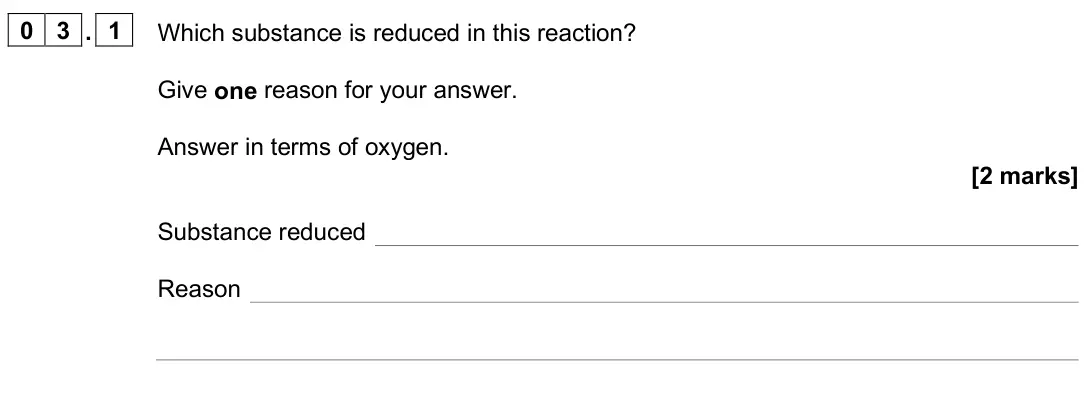
Q03.2
The whole paper ↗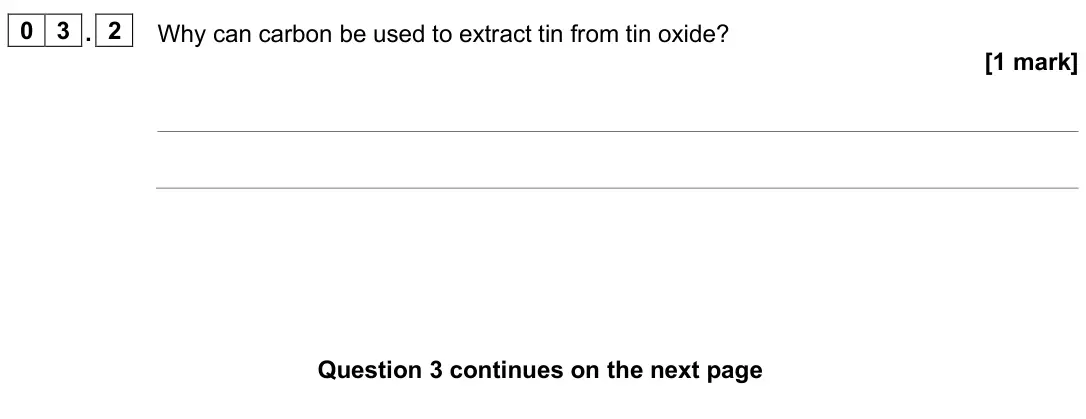
Q10.1
The whole paper ↗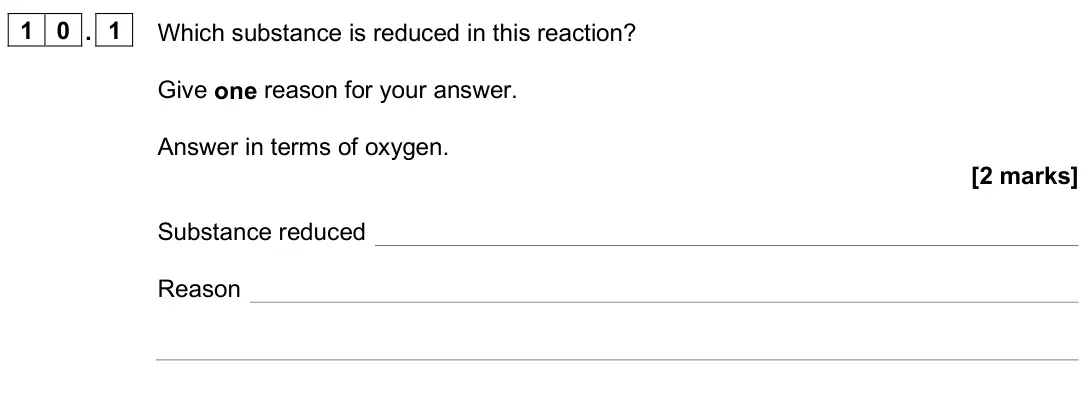
Q10.2
The whole paper ↗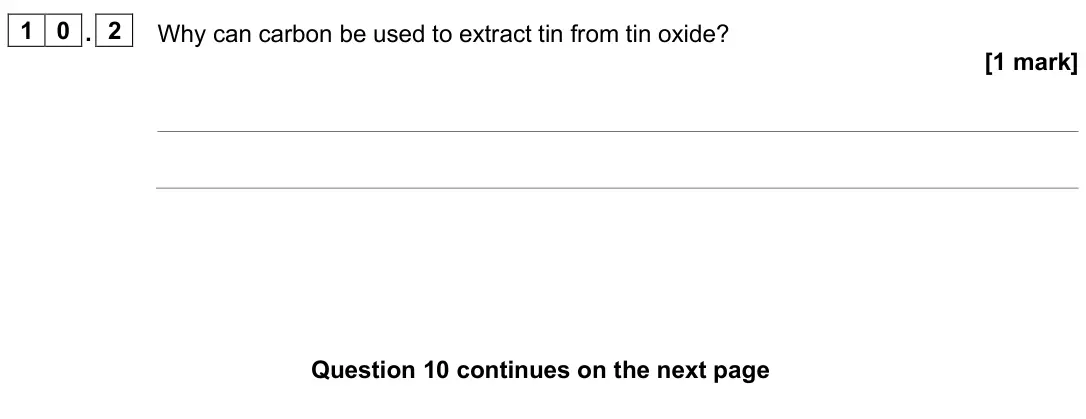
Q01.6
The whole paper ↗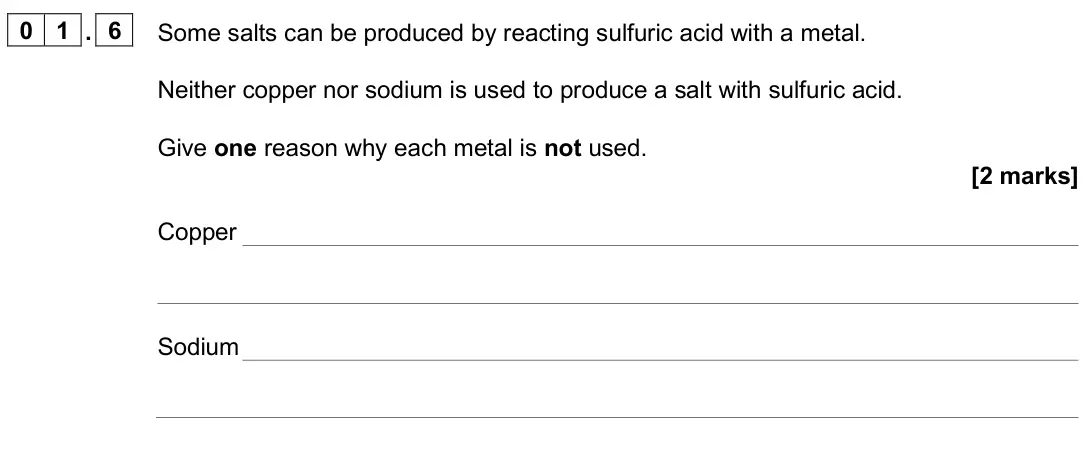
Q02.2
The whole paper ↗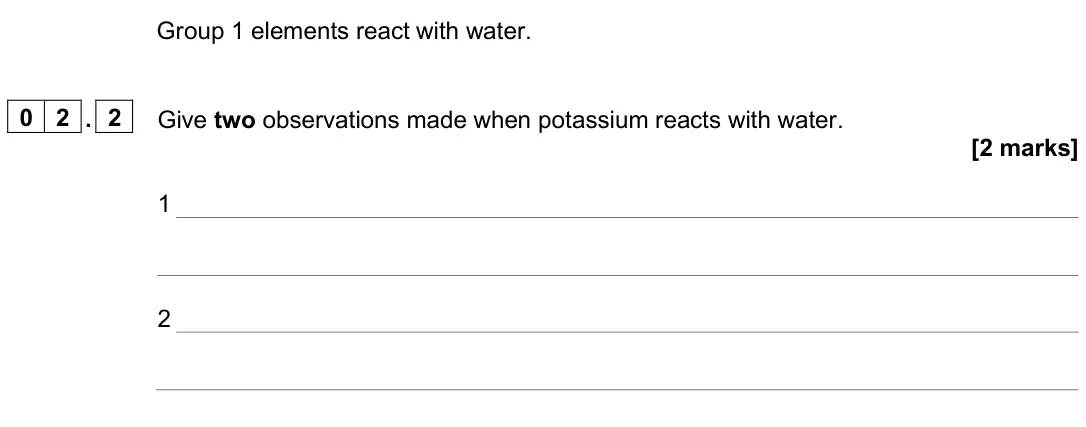
Q06.1
The whole paper ↗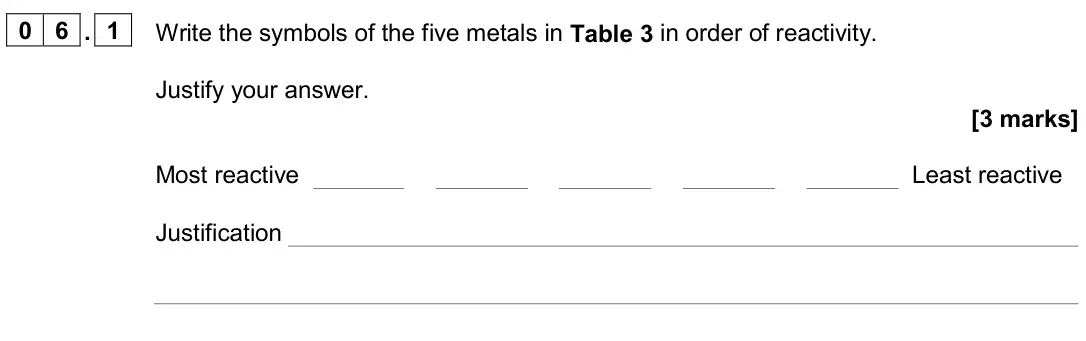
Q03.1
The whole paper ↗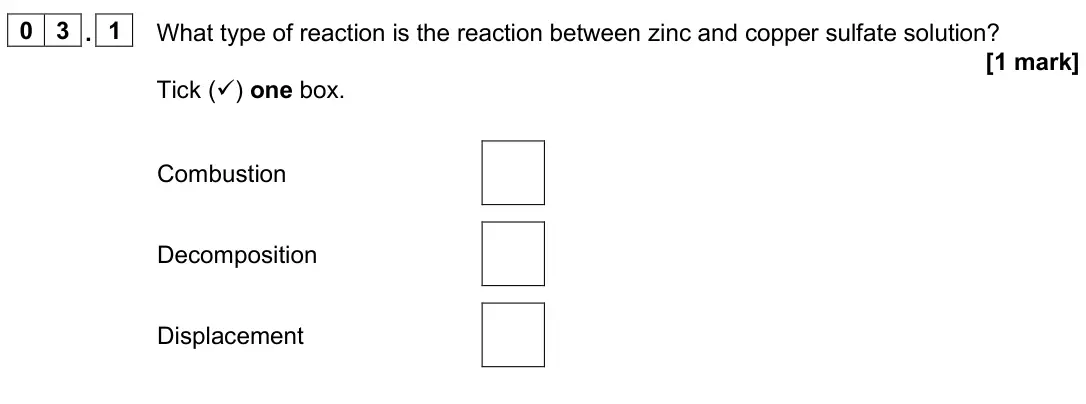
Q06.5
The whole paper ↗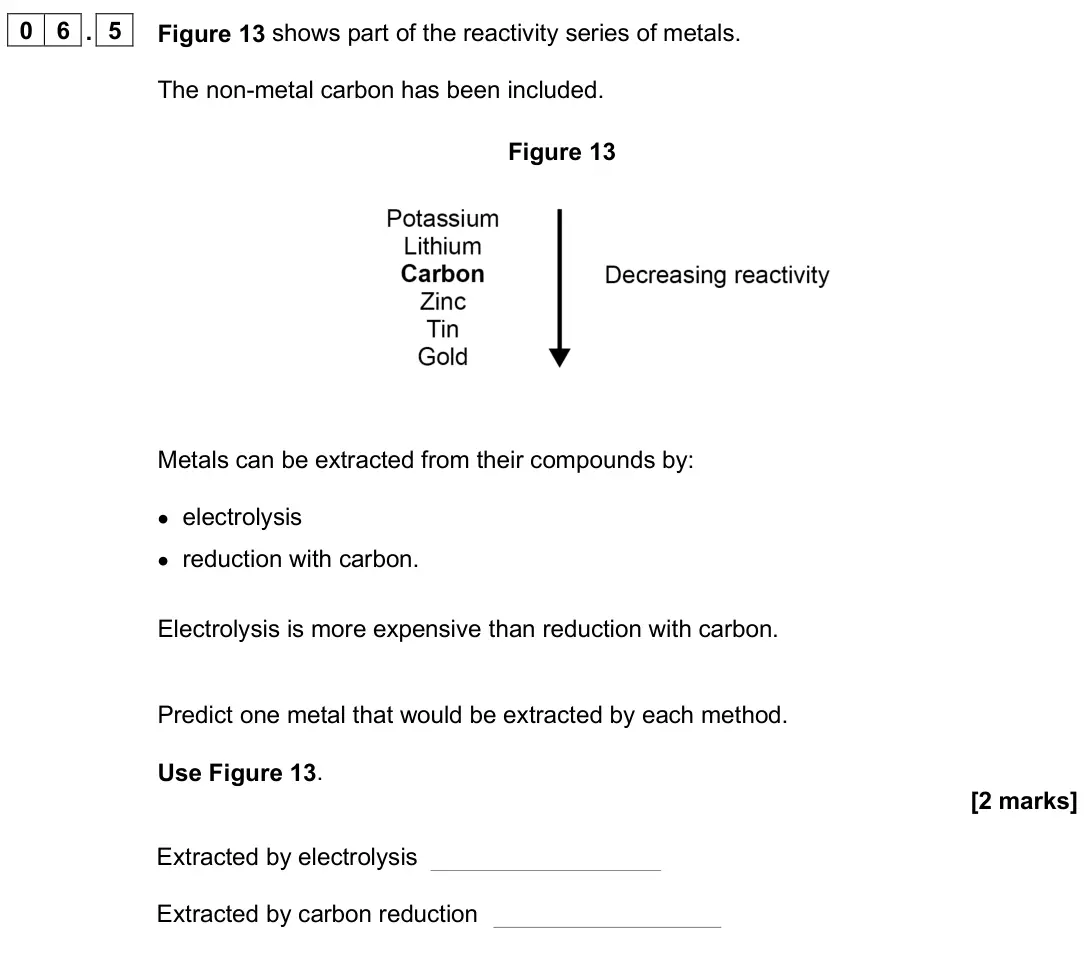
Q08.6
The whole paper ↗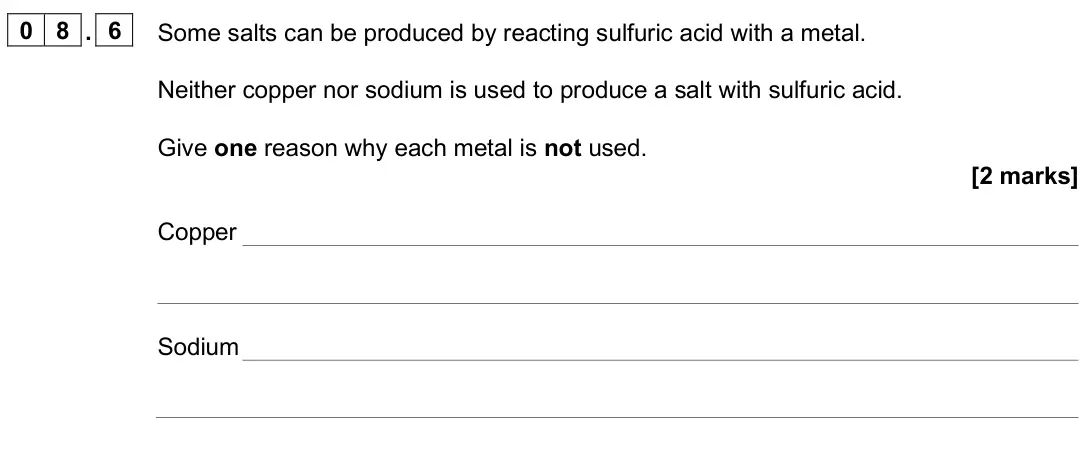
Q09.2
The whole paper ↗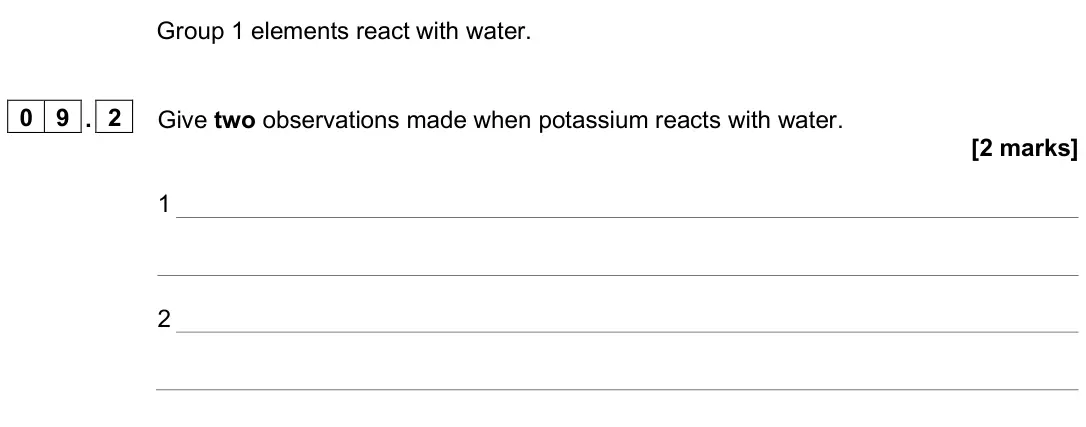
Q06.1
The whole paper ↗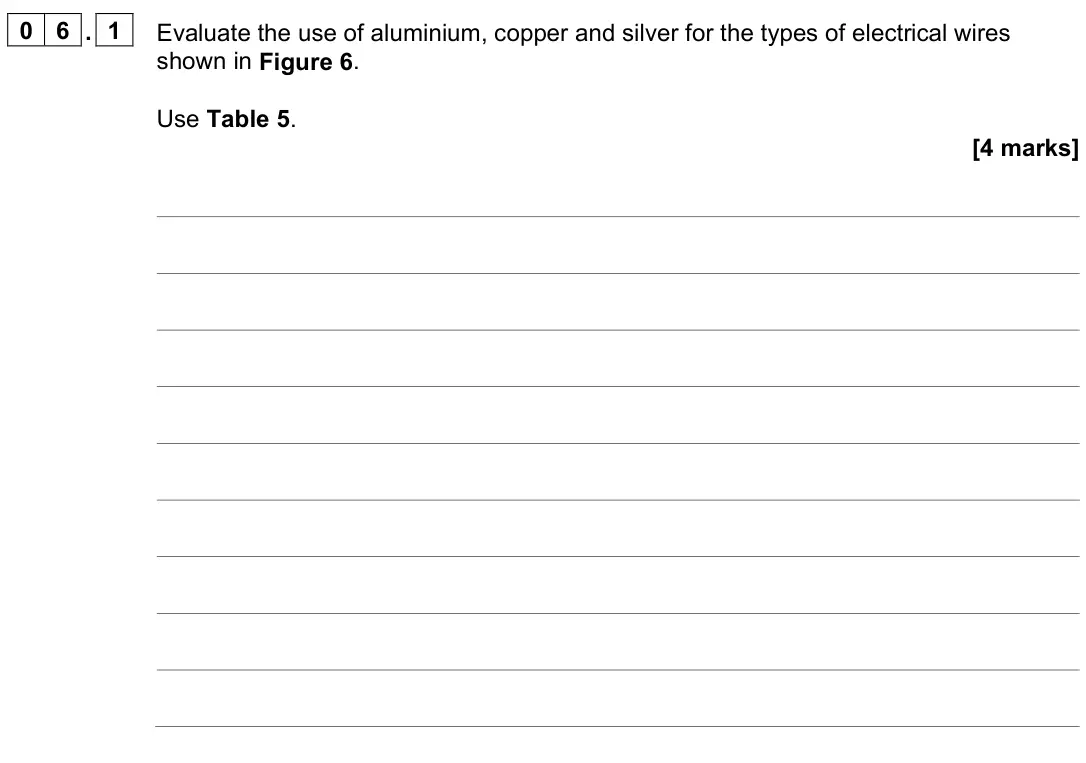
Q08.4
The whole paper ↗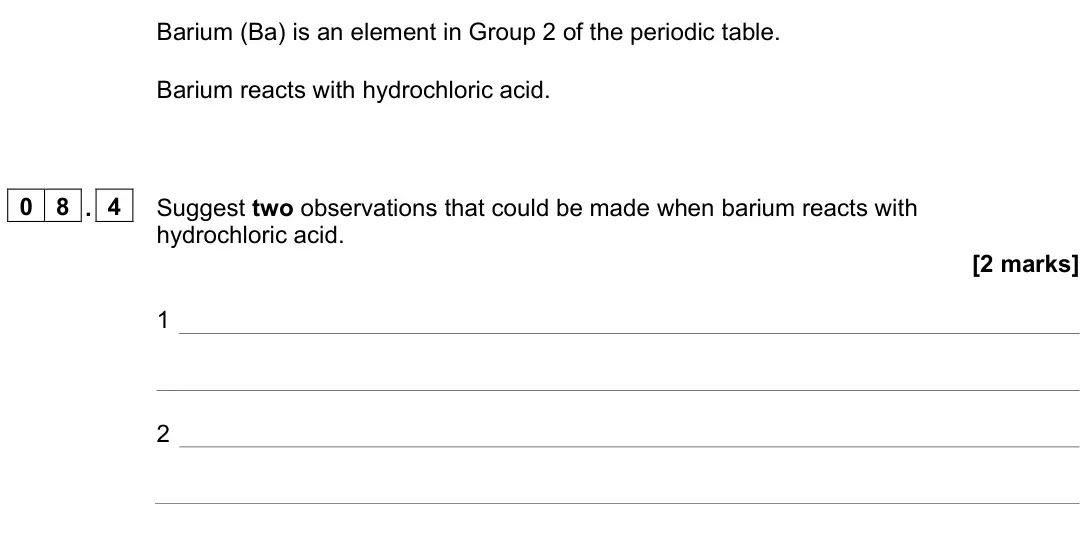
Q08.5
The whole paper ↗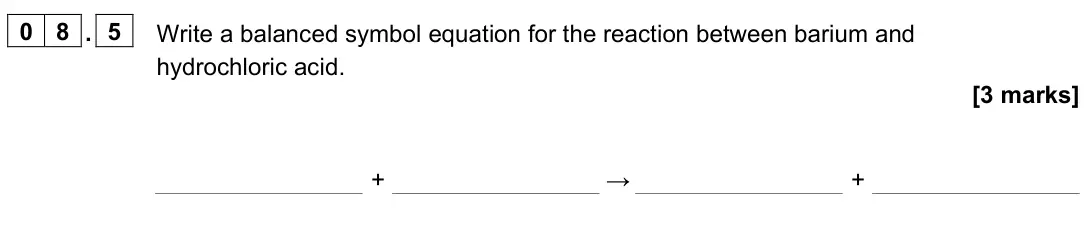
Q09.1
The whole paper ↗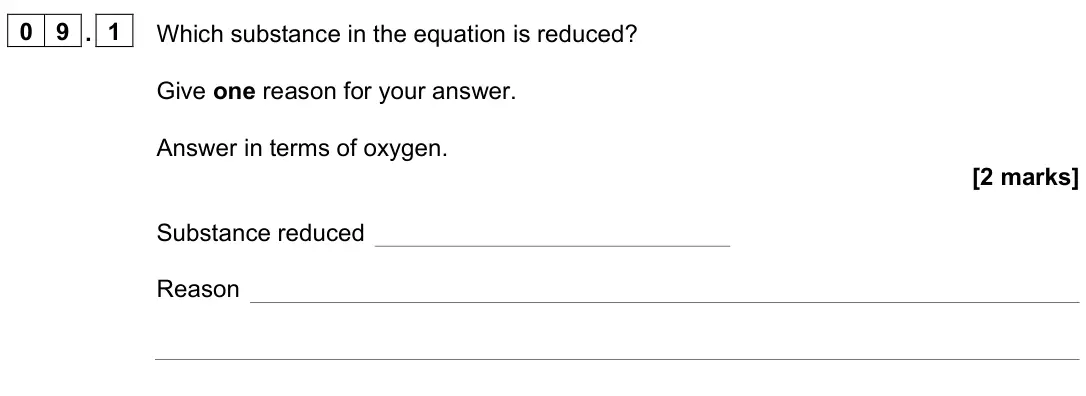
Q09.3
The whole paper ↗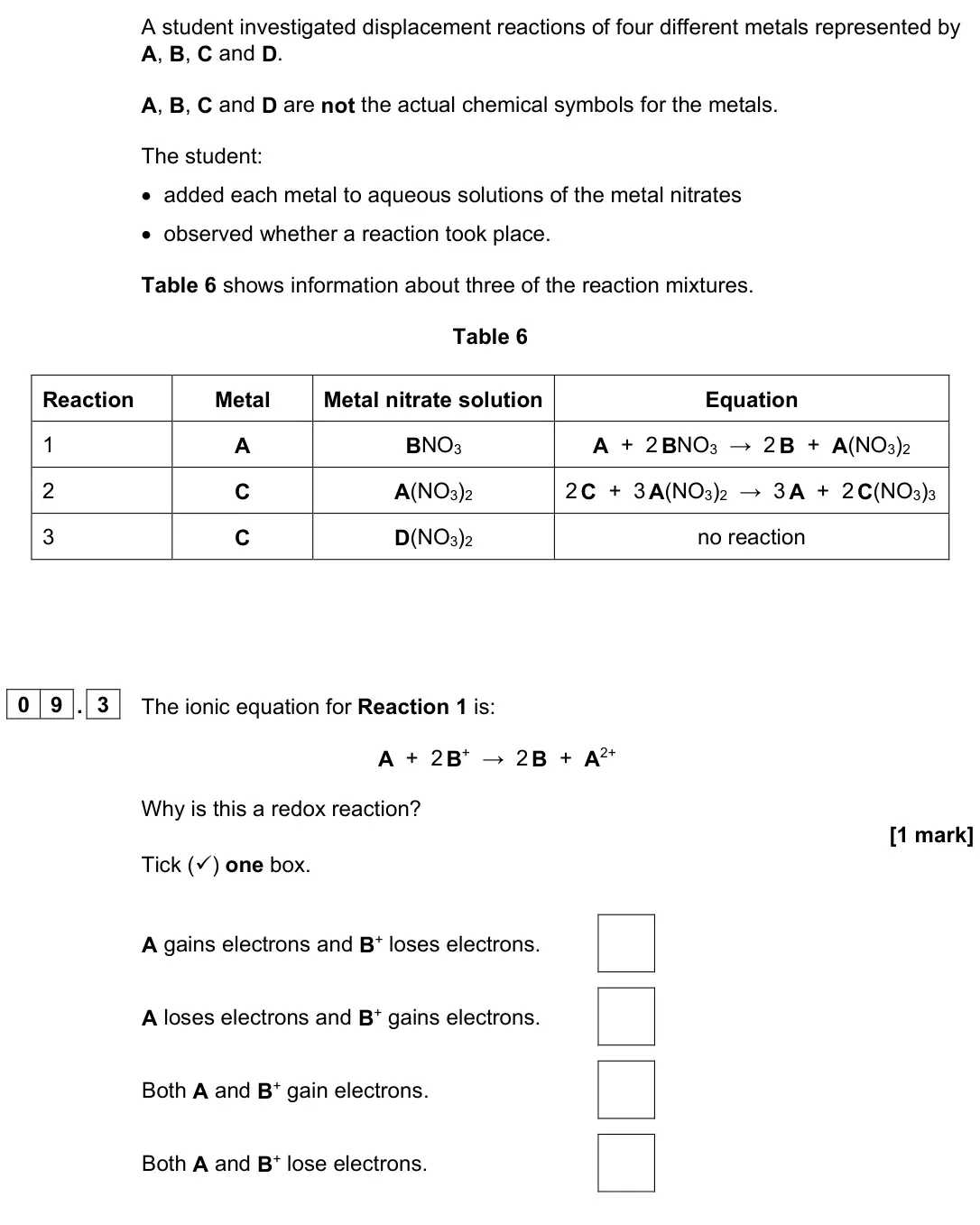
Q09.4
The whole paper ↗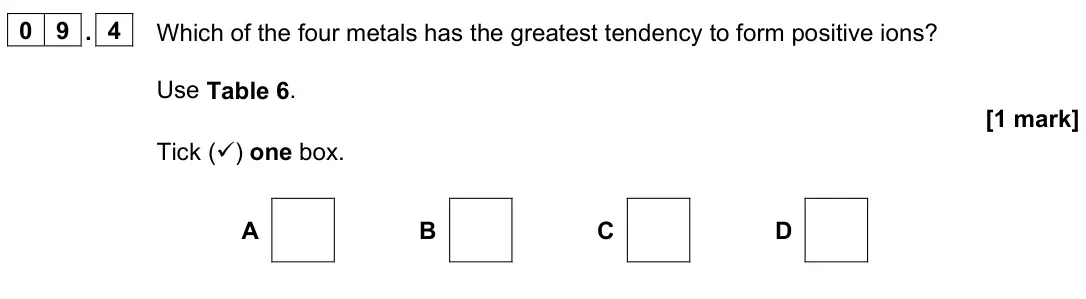
Q09.5
The whole paper ↗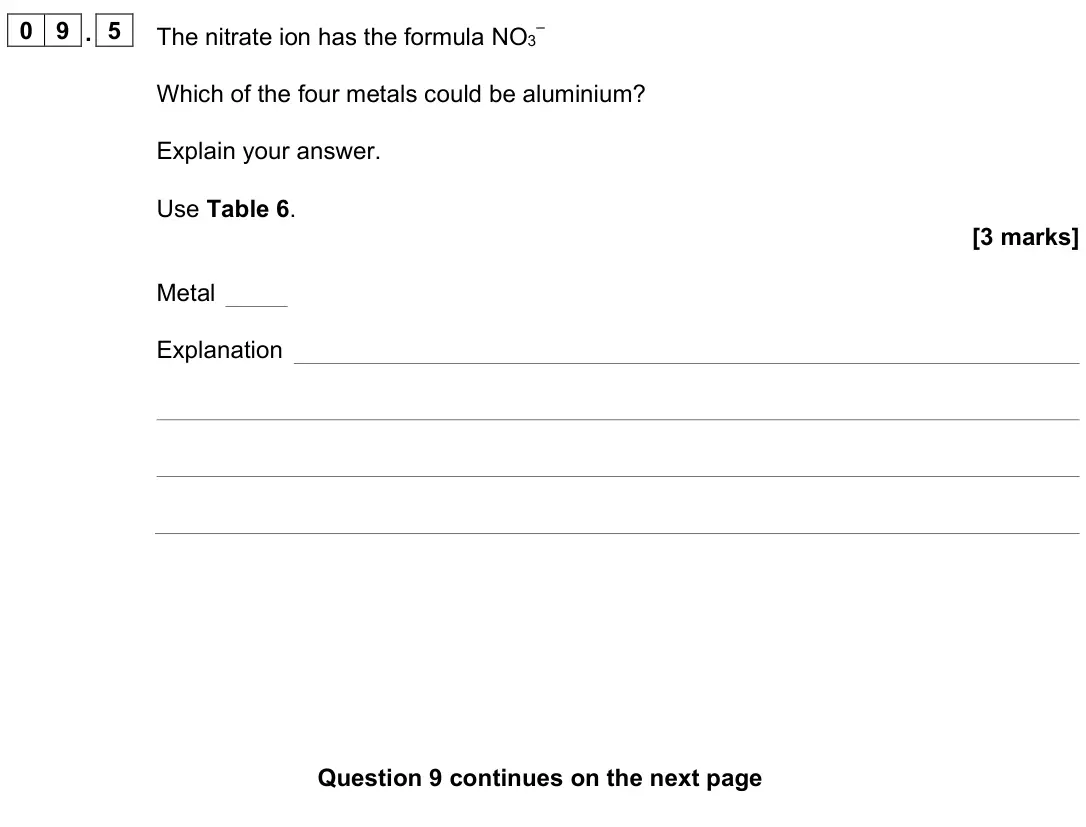
Q06.1
The whole paper ↗
Q06.2
The whole paper ↗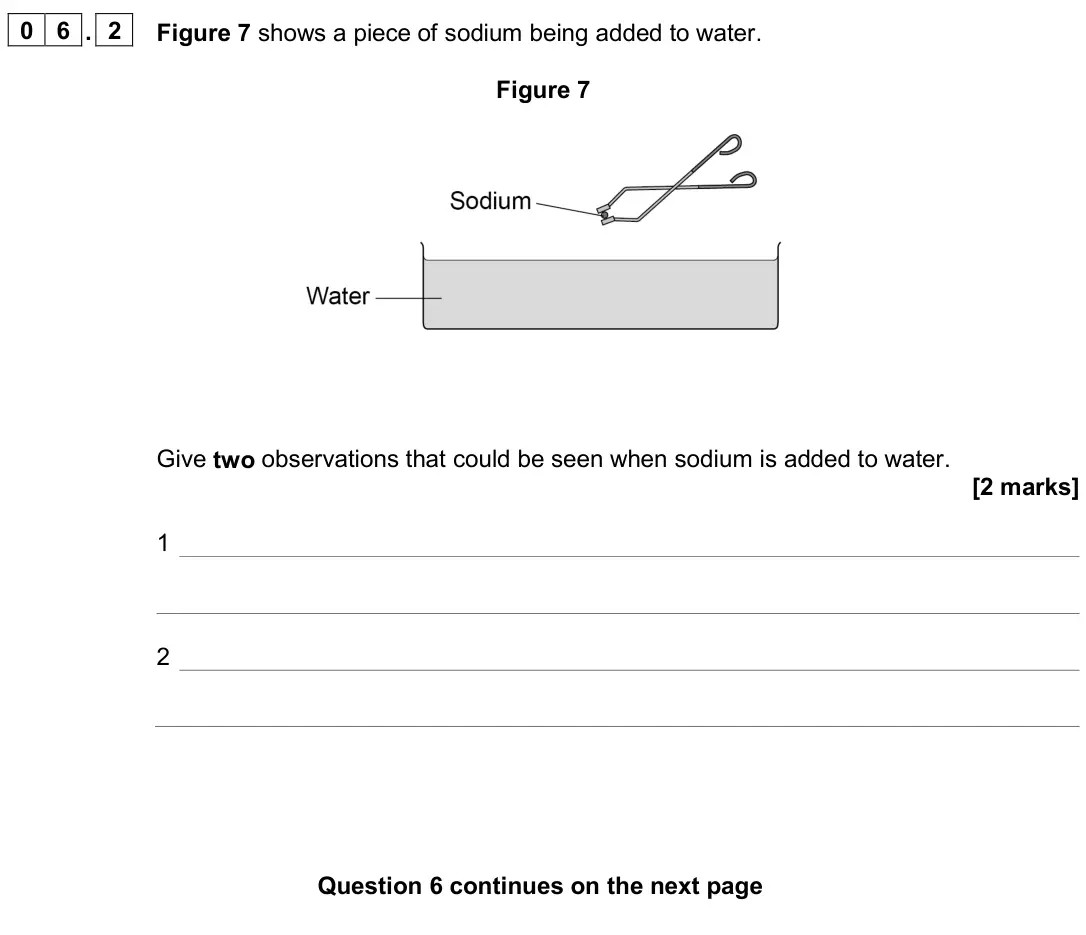
All 88 questions on Reactivity of metals, as a list
- June 2025, Paper 1 Higher, Q03.1 (2 marks): Which substance is reduced in this reaction? Give one reason for your answer. Answer in terms of oxygen. [2 marks] Substance reduced Reason
- June 2025, Paper 1 Higher, Q03.2 (1 mark): Why can carbon be used to extract tin from tin oxide? [1 mark]
- June 2025, Paper 1 Foundation, Q10.1 (2 marks): Which substance is reduced in this reaction? Give one reason for your answer. Answer in terms of oxygen. [2 marks] Substance reduced Reason
- June 2025, Paper 1 Foundation, Q10.2 (1 mark): Why can carbon be used to extract tin from tin oxide? [1 mark]
- June 2024, Paper 1 Higher, Q01.6 (2 marks): Some salts can be produced by reacting sulfuric acid with a metal. Neither copper nor sodium is used to produce a salt with sulfuric acid. Give one reason why e
- June 2024, Paper 1 Higher, Q02.2 (2 marks): Give two observations made when potassium reacts with water. [2 marks] 1 2
- June 2024, Paper 1 Higher, Q06.1 (3 marks): Write the symbols of the five metals in Table 3 in order of reactivity. Justify your answer. [3 marks] Most reactive Least reactive Justification
- June 2024, Paper 1 Foundation, Q03.1 (1 mark): What type of reaction is the reaction between zinc and copper sulfate solution? [1 mark] Tick () one box. Combustion Decomposition Displacement
- June 2024, Paper 1 Foundation, Q06.5 (2 marks): Figure 13 shows part of the reactivity series of metals. The non-metal carbon has been included. Figure 13 Metals can be extracted from their compounds by: • el
- June 2024, Paper 1 Foundation, Q08.6 (2 marks): Some salts can be produced by reacting sulfuric acid with a metal. Neither copper nor sodium is used to produce a salt with sulfuric acid. Give one reason why e
- June 2024, Paper 1 Foundation, Q09.2 (2 marks): Give two observations made when potassium reacts with water. [2 marks] 1 2
- June 2023, Paper 1 Higher, Q06.1 (4 marks): Evaluate the use of aluminium, copper and silver for the types of electrical wires shown in Figure 6. Use Table 5. [4 marks]
- June 2023, Paper 1 Higher, Q08.4 (2 marks): Suggest two observations that could be made when barium reacts with hydrochloric acid. [2 marks] 1 2
- June 2023, Paper 1 Higher, Q08.5 (3 marks): Write a balanced symbol equation for the reaction between barium and hydrochloric acid. [3 marks] + → +
- June 2023, Paper 1 Higher, Q09.1 (2 marks): Which substance in the equation is reduced? Give one reason for your answer. Answer in terms of oxygen. [2 marks] Substance reduced Reason
- June 2023, Paper 1 Higher, Q09.3 (1 mark): The ionic equation for Reaction 1 is: A + 2 B+ → 2 B + A2+ Why is this a redox reaction? [1 mark] Tick () one box. A gains electrons and B+ loses electrons. A
- June 2023, Paper 1 Higher, Q09.4 (1 mark): Which of the four metals has the greatest tendency to form positive ions? Use Table 6. [1 mark] Tick () one box. A B C D
- June 2023, Paper 1 Higher, Q09.5 (3 marks): The nitrate ion has the formula NO3 – Which of the four metals could be aluminium? Explain your answer. Use Table 6. [3 marks] Metal Explanation
- June 2023, Paper 1 Foundation, Q06.1 (1 mark): Platinum is used to make jewellery. Suggest one reason why platinum is used to make jewellery. [1 mark]
- June 2023, Paper 1 Foundation, Q06.2 (2 marks): Figure 7 shows a piece of sodium being added to water. Figure 7 Give two observations that could be seen when sodium is added to water. [2 marks] 1 2
- June 2023, Paper 1 Foundation, Q08.2 (1 mark): Iron oxide is reduced in this reaction. How does the equation show that iron oxide is reduced? [1 mark]
- June 2023, Paper 1 Foundation, Q08.5 (1 mark): Give one observation that would show a reaction took place. [1 mark]
- June 2023, Paper 1 Foundation, Q08.6 (2 marks): Table 4 shows the results. Table 4 Metal sulfate solution Metal A sulfate B sulfate C sulfate D sulfate A × × ✓ × B ✓ × ✓ × C × × × × D ✓ ✓ ✓ × ✓ shows that a d
- June 2022, Paper 1 Higher, Q04.5 (1 mark): Complete the ionic equation for this reaction. [1 mark] Zn + __________ → Zn2+ + __________
- June 2022, Paper 1 Higher, Q04.6 (1 mark): Why is zinc described as being oxidised in this reaction? [1 mark]
- June 2022, Paper 1 Higher, Q05.2 (3 marks): Explain why rubidium is more reactive than potassium. [3 marks]
- June 2022, Paper 1 Higher, Q07.1 (2 marks): The reactivity series sometimes includes non-metals such as carbon, hydrogen and silicon. Silicon can be extracted by reducing silicon dioxide with different su
- June 2022, Paper 1 Higher, Q07.2 (2 marks): Aluminium also reduces silicon dioxide. Carbon is used rather than aluminium to reduce silicon dioxide because carbon is cheaper than aluminium. Carbon can be o
- June 2022, Paper 1 Higher, Q07.3 (1 mark): Give one reason why the products are difficult to separate if magnesium is used to reduce silicon dioxide. [1 mark]
- June 2022, Paper 1 Foundation, Q03.1 (1 mark): and 03.2. 0 3 . 1 Which metal is copper? [1 mark] Tick () one box. A B C D
- June 2022, Paper 1 Foundation, Q03.2 (1 mark): Which metal is the most reactive? [1 mark] Tick () one box. A B C D
- June 2022, Paper 1 Foundation, Q08.5 (1 mark): The electrolysis of molten sodium chloride is used to extract sodium metal. Why is sodium metal extracted by electrolysis instead of by reduction with carbon? [
- November 2021, Paper 1 Higher, Q03.4 (4 marks): Tungsten (W) is a metal. Tungsten is extracted from tungsten oxide (WO3). All other solid products from the extraction method must be separated from the tungste
- November 2021, Paper 1 Higher, Q04.1 (2 marks): Give two observations you could make when a small piece of potassium is added to water. [2 marks] 1 2
- November 2021, Paper 1 Higher, Q04.3 (4 marks): Explain why the reactivity of elements changes going down Group 1. [4 marks]
- November 2021, Paper 1 Higher, Q04.5 (1 mark): Why is oxygen described as being reduced in the reaction between sodium and oxygen? [1 mark]
- November 2021, Paper 1 Higher, Q05.3 (1 mark): Soluble salts can be produced by reacting dilute hydrochloric acid with an insoluble solid. Copper, copper carbonate and copper oxide are insoluble solids. Whic
- November 2021, Paper 1 Higher, Q06.3 (4 marks): A student wants to compare the reactivity of an unknown metal, Q, with that of zinc. Both metals are more reactive than silver. The student is provided with: •
- November 2021, Paper 1 Higher, Q07.3 (3 marks): Two aqueous salt solutions are electrolysed using inert electrodes. Complete Table 4 to show the product at each electrode. [3 marks] Table 4 Salt solution Prod
- November 2021, Paper 1 Foundation, Q03.4 (2 marks): Give two observations you could make when sodium reacts with water. Write your answers in Table 3. [2 marks]
- November 2021, Paper 1 Foundation, Q03.6 (2 marks): Give two ways in which the observations in Table 3 show the change in reactivity going down Group 1. [2 marks] 1 2
- November 2021, Paper 1 Foundation, Q03.7 (1 mark): Which gas is produced when Group 1 elements react with water? [1 mark] Tick () one box. Carbon dioxide Hydrogen Nitrogen Oxygen
- November 2021, Paper 1 Foundation, Q04.1 (2 marks): Calculate the mean temperature increase X for magnesium in Table 4. Do not include the anomalous result in your calculation. [2 marks] X = °C
- November 2021, Paper 1 Foundation, Q04.2 (1 mark): Determine the order of reactivity for the metals cobalt, magnesium and zinc. Use Table 4. [1 mark] Most reactive Least reactive
- November 2021, Paper 1 Foundation, Q04.4 (1 mark): What type of variable is the volume of hydrochloric acid in this investigation? [1 mark] Tick () one box. Control Dependent Independent
- November 2021, Paper 1 Foundation, Q04.5 (1 mark): Suggest one way of improving step 3 in the method to give results which are more repeatable. [1 mark]
- November 2021, Paper 1 Foundation, Q07.4 (2 marks): A student investigated the electrolysis of two aqueous salt solutions. Hydrogen is produced at the negative electrode when the metal in the salt solution is mor
- November 2021, Paper 1 Foundation, Q10.4 (4 marks): Tungsten (W) is a metal. Tungsten is extracted from tungsten oxide (WO3). All other solid products from the extraction method must be separated from the tungste
- November 2020, Paper 1 Higher, Q02.2 (3 marks): A student added copper metal to colourless silver nitrate solution. The student observed: • pale grey crystals forming • the solution turning blue. Explain how
- November 2020, Paper 1 Higher, Q02.3 (4 marks): A student is given three metals, X, Y and Z to identify. The metals are magnesium, iron and copper. Plan an investigation to identify the three metals by compar
- November 2020, Paper 1 Higher, Q06.4 (2 marks): Explain why the reaction between magnesium atoms and zinc ions is both oxidation and reduction. [2 marks]
- November 2020, Paper 1 Foundation, Q03.4 (2 marks): A student investigated the voltage produced by a chemical cell. The student used different metals as the electrodes in the cell. The metals used were: • copper
- November 2020, Paper 1 Foundation, Q09.2 (3 marks): A student added copper metal to colourless silver nitrate solution. The student observed: • pale grey crystals forming • the solution turning blue. Explain how
- November 2020, Paper 1 Foundation, Q09.3 (4 marks): A student is given three metals, X, Y and Z to identify. The metals are magnesium, iron and copper. Plan an investigation to identify the three metals by compar
- June 2019, Paper 1 Higher, Q06.2 (4 marks): Write the six metals used for electrode X in order of reactivity. Use Table 4. Justify your order of reactivity. [4 marks] Most reactive Least reactive Justific
- June 2019, Paper 1 Higher, Q07.2 (1 mark): What happens at the negative electrode during the production of aluminium? [1 mark] Tick () one box. Aluminium atoms gain electrons. Aluminium atoms lose elect
- June 2019, Paper 1 Higher, Q07.6 (2 marks): Explain why sodium chloride solution cannot be used as the electrolyte to produce sodium metal. [2 marks]
- June 2019, Paper 1 Foundation, Q04.2 (1 mark): Write the three metals used for electrode X in order of reactivity. Use Table 1. [1 mark] Most reactive Least reactive
- June 2019, Paper 1 Foundation, Q06.2 (2 marks): 38% of a rock sample is aluminium oxide. Calculate the mass of aluminium oxide in 40 kg of the rock sample. [2 marks] Mass of aluminium oxide = kg
- June 2019, Paper 1 Foundation, Q06.5 (2 marks): Extracting metals by electrolysis is a very expensive process. Explain why aluminium is extracted using electrolysis and not by reduction with carbon. [2 marks]
- June 2018, Paper 1 Higher, Q02.4 (2 marks): Explain why carbon can be used to extract nickel from nickel oxide. [2 marks]
- June 2018, Paper 1 Higher, Q05.1 (2 marks): Plot the data from Table 2 on Figure 4 as a bar chart. [2 marks] Figure 4
- June 2018, Paper 1 Higher, Q05.3 (4 marks): The temperature change depends on the reactivity of the metal. The student’s results are used to place copper, iron, magnesium and zinc in order of their reacti
- June 2018, Paper 1 Higher, Q08.1 (1 mark): Suggest one hazard associated with Stage 1. [1 mark]
- June 2018, Paper 1 Higher, Q08.2 (1 mark): Water must be kept away from the reaction in Stage 2. Give one reason why it would be hazardous if water came into contact with sodium. [1 mark]
- June 2018, Paper 1 Higher, Q08.3 (2 marks): Suggest why the reaction in Stage 2 is carried out in an atmosphere of argon and not in air. [2 marks]
- June 2018, Paper 1 Higher, Q08.5 (1 mark): Sodium atoms are oxidised to sodium ions in this reaction. Why is this an oxidation reaction? [1 mark]
- June 2018, Paper 1 Higher, Q08.6 (1 mark): Complete the half equation for the oxidation reaction. [1 mark] Na +
- June 2018, Paper 1 Foundation, Q06.5 (1 mark): The temperature increase depends on the reactivity of the metal. Write the metals magnesium, nickel and zinc in order of reactivity. Use Table 5. [1 mark] Most
- June 2018, Paper 1 Foundation, Q06.6 (3 marks): Y is an unknown metal. Describe a method to find the position of Y in the reactivity series in Question 06.5 [3 marks]
- June 2018, Paper 1 Foundation, Q07.2 (1 mark): What is the name of this type of reaction? [1 mark] Tick one box. Decomposition Electrolysis Oxidation Precipitation
- June 2018, Paper 1 Foundation, Q09.4 (2 marks): Explain why carbon can be used to extract nickel from nickel oxide. [2 marks]
- Specimen, Paper 1 Higher, Q06.1 (1 mark): The ionic equation for the reaction occuring at the zinc electrode in the simple cell made using copper and zinc electrodes is: Zn → Zn2+ + 2e- Zinc is oxidised
- Specimen, Paper 1 Foundation, Q02.1: What is the dependent variable in the investigation? [1 mar Tick one box. Time taken Type of metal Volume of metal sulfate Whether there was a reaction or not
- Specimen, Paper 1 Foundation, Q02.2 (1 mark): Give one observation the student could make that shows there is a reaction betwee zinc and copper sulfate. [1 mark]
- Specimen, Paper 1 Foundation, Q02.3 (2 marks): The student used measuring instruments to measure some of the variables. Draw one line from each variable to the measuring instrument used to measure the variab
- Specimen, Paper 1 Foundation, Q02.4 (1 mark): Use the results shown in Table 1 to place zinc, copper and magnesium in order of reactivity. [1 mark] Most reactive Least reactive
- Specimen, Paper 1 Foundation, Q02.5 (1 mark): Suggest one reason why the student should not use sodium in this investigation. [1 mark] 8
- Specimen, Paper 1 Foundation, Q02.6 (1 mark): Which metal is found in the Earth as the metal itself? [1 mark Tick one box. Calcium Gold Lithium Potassium
- Specimen, Paper 1 Foundation, Q02.7: Iron is found in the Earth as iron oxide (Fe2O3). Iron oxide is reduced to produce iron. Balance the equation for the reaction. [1 mar ___Fe2O3 + ___C → ___Fe +
- Specimen, Paper 1 Foundation, Q02.8 (1 mark): Name the element used to reduce iron oxide. [1 mark]
- Specimen, Paper 1 Foundation, Q02.9 (1 mark): What is meant by reduction? [1 mark] Tick one box. Gain of iron Gain of oxide Loss of iron Loss of oxygen 0
- Specimen, Paper 1 Foundation, Q04.1 (2 marks): Give two variables the student should control so that the investigation is a fair test. [2 marks] 1 2
- Specimen, Paper 1 Foundation, Q04.2 (2 marks): One of the results for magnesium is anomalous. Which result is anomalous? Suggest one reason why this anomalous result was obtained. [2 marks] Result Reason
- Specimen, Paper 1 Foundation, Q04.3 (1 mark): Calculate the mean temperature rise for calcium. [1 mark] Mean temperature rise = oC 18
- Specimen, Paper 1 Foundation, Q04.4 (2 marks): The temperature rose when the metals were added to sulfuric acid. Give one other observation that might be made when the metal was added to sulfuric acid. How w
- Specimen, Paper 1 Foundation, Q04.5 (1 mark): Aluminium is more reactive than iron and zinc but less reactive than calcium and magnesium. Predict the temperature rise when aluminium is reacted with dilute h
- Specimen, Paper 1 Foundation, Q05.2 (1 mark): Name the product from the reaction of magnesium in Figure 8. 21
Questions, mark schemes and examiner’s reports are © AQA, from their published past papers. Plumi isn’t affiliated with any exam board. Want whole papers? Every AQA GCSE Chemistry paper.
Rather write your answers by hand on iPad? Plumi marks them against the same mark schemes.