Skip to content

Edexcel GCSE Physics questions by topic

Every question from every Edexcel GCSE Physics paper, 2018–2025, part by part. Filter by topic, paper or year, open the mark scheme under any question, and download a set as a PDF.

Find questions1,554
Topics Pick as many as you like. Open one to choose its sub-topics.

By area

Exam
All years
Calculations

1,554 questions

  1. Q1(a)

    June 2025 · Paper 1 Higher

    1 mark
    The whole paper ↗
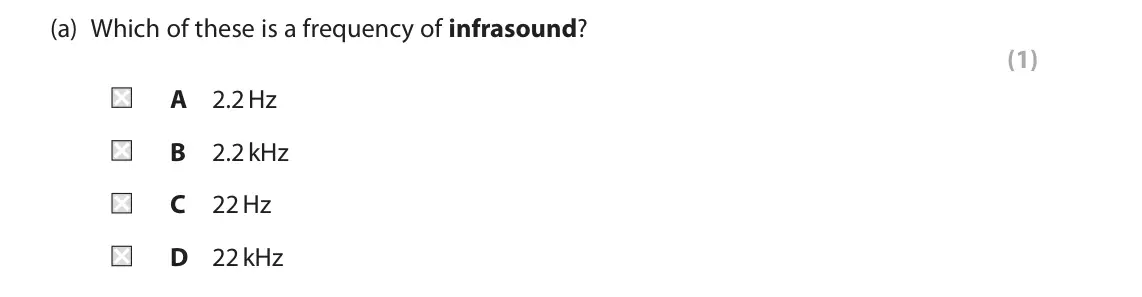
    June 2025 Paper 1 Higher, question 1(a): Which of these is a frequency of infrasound? (1) A 2.2 Hz B 2.2 kHz C 22 Hz D 22 kHz
  2. Q1(b)

    June 2025 · Paper 1 Higher

    3 marks
    The whole paper ↗
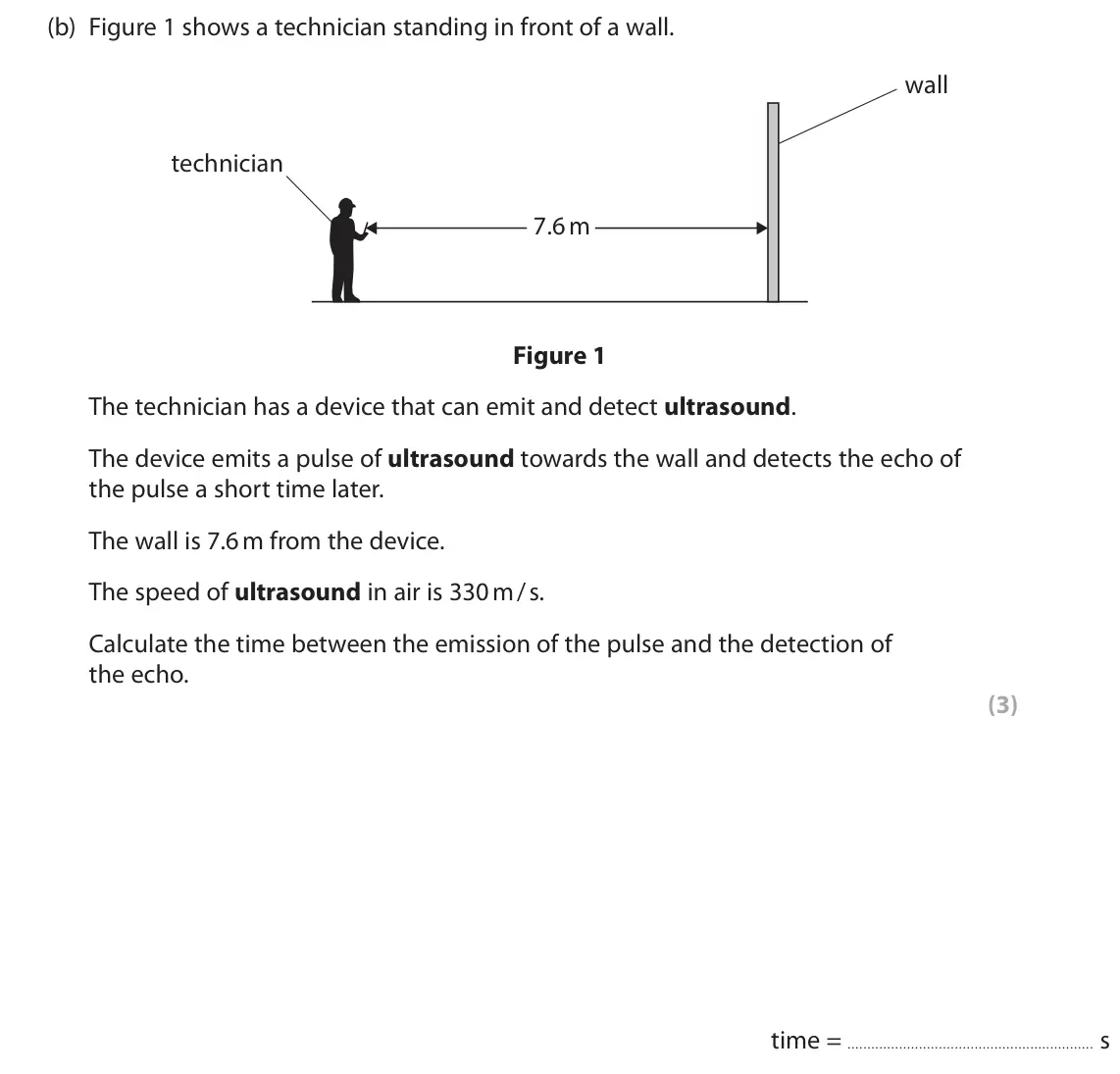
    June 2025 Paper 1 Higher, question 1(b): Figure 1 shows a technician standing in front of a wall. wall technician 7.6 m Figure 1 The technician has a device that can emit and detect ultrasound. The dev
  3. Q1(c)

    June 2025 · Paper 1 Higher

    2 marks
    The whole paper ↗
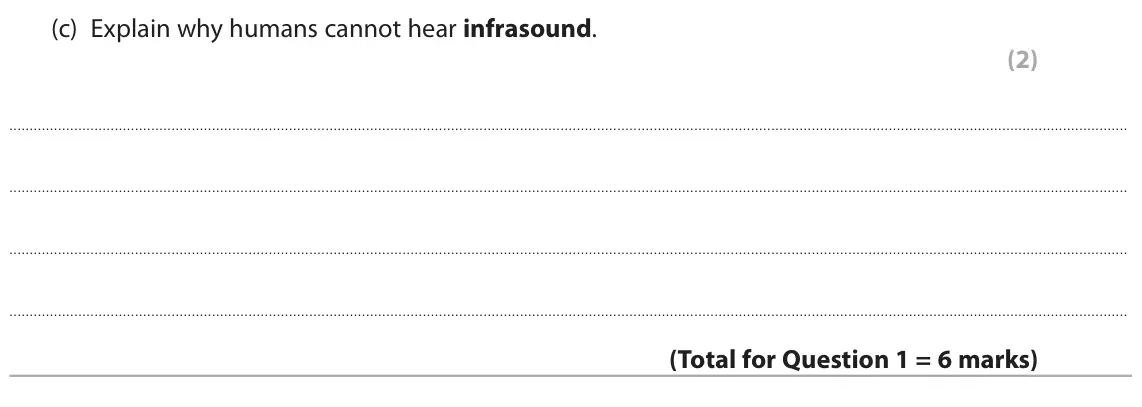
    June 2025 Paper 1 Higher, question 1(c): Explain why humans cannot hear infrasound. (2)
  4. Q2(a)(i)

    June 2025 · Paper 1 Higher

    3 marks
    The whole paper ↗
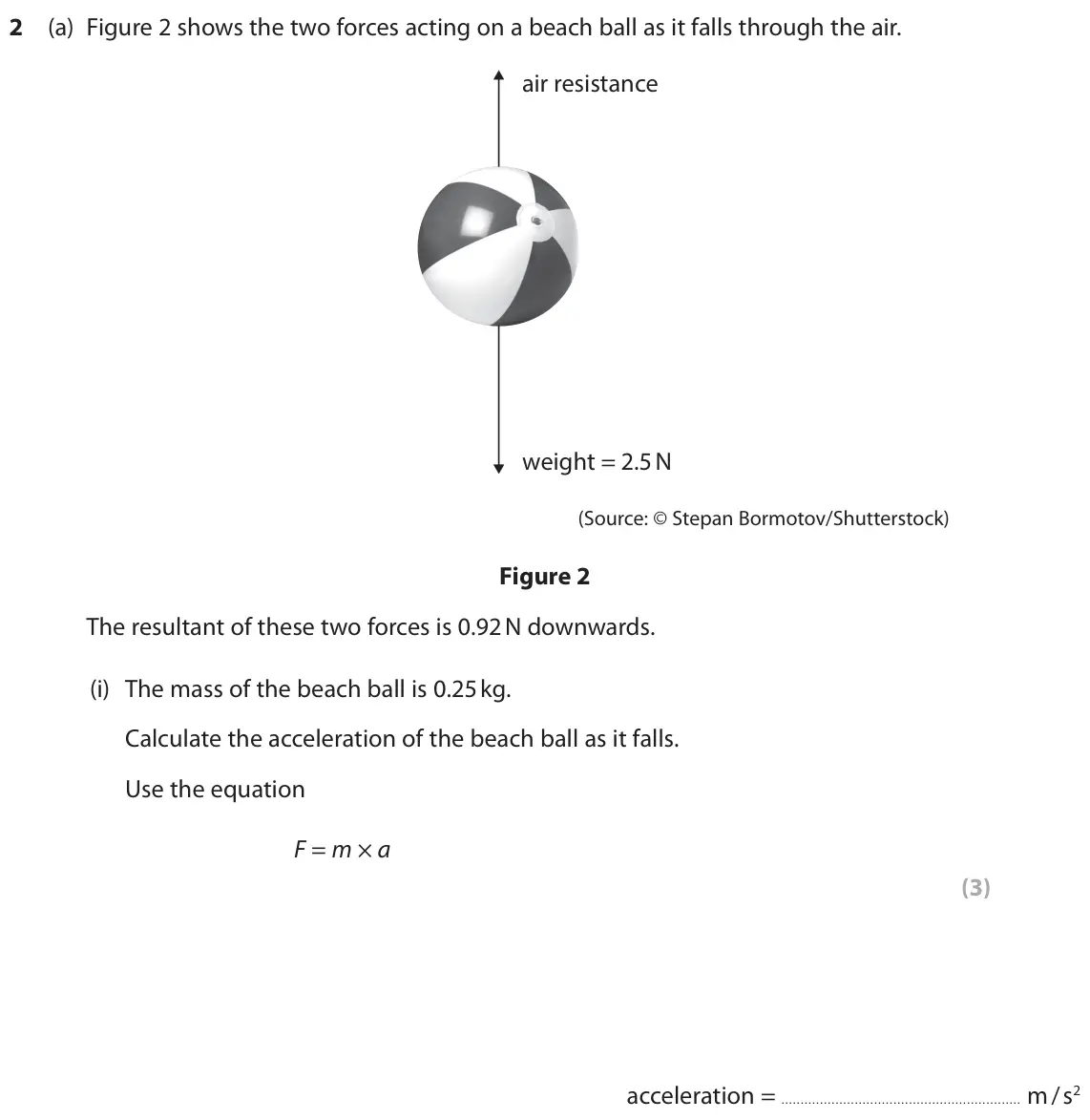
    June 2025 Paper 1 Higher, question 2(a)(i): The mass of the beach ball is 0.25 kg. Calculate the acceleration of the beach ball as it falls. Use the equation F = m × a (3) acceleration = m / s2
  5. Q2(a)(ii)

    June 2025 · Paper 1 Higher

    1 mark
    The whole paper ↗
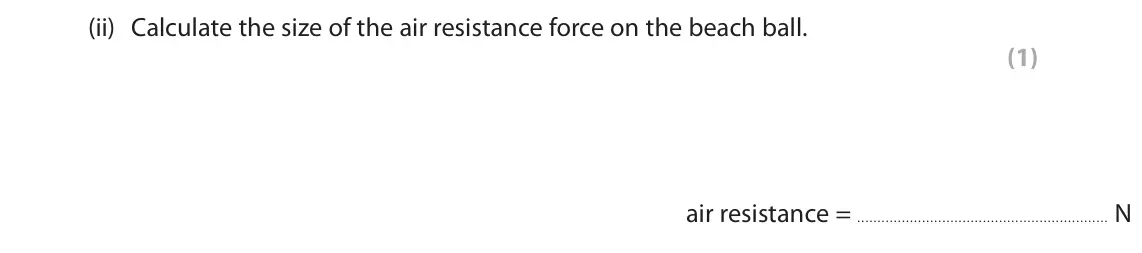
    June 2025 Paper 1 Higher, question 2(a)(ii): Calculate the size of the air resistance force on the beach ball. (1) air resistance = N
  6. Q2(b)(i)

    June 2025 · Paper 1 Higher

    1 mark
    The whole paper ↗
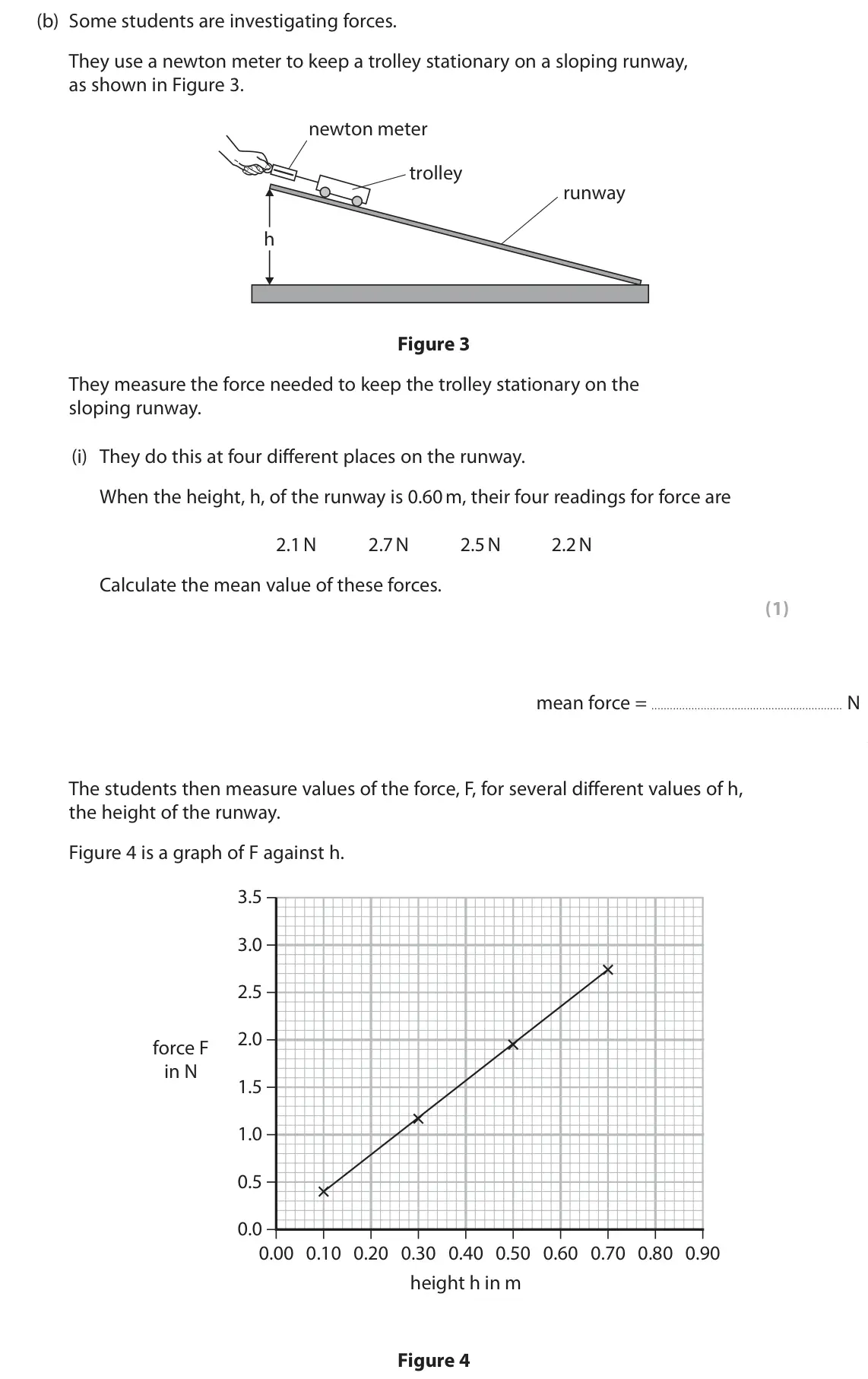
    June 2025 Paper 1 Higher, question 2(b)(i): They do this at four different places on the runway. When the height, h, of the runway is 0.60 m, their four readings for force are 2.1 N 2.7 N 2.5 N 2.2 N Calc
  7. Q2(b)(ii)

    June 2025 · Paper 1 Higher

    2 marks
    The whole paper ↗
    June 2025 Paper 1 Higher, question 2(b)(ii): Use the graph in Figure 4 to determine the value of F when h = 0.80 m. (2) F = N
  8. Q2(b)(iii)

    June 2025 · Paper 1 Higher

    2 marks
    The whole paper ↗
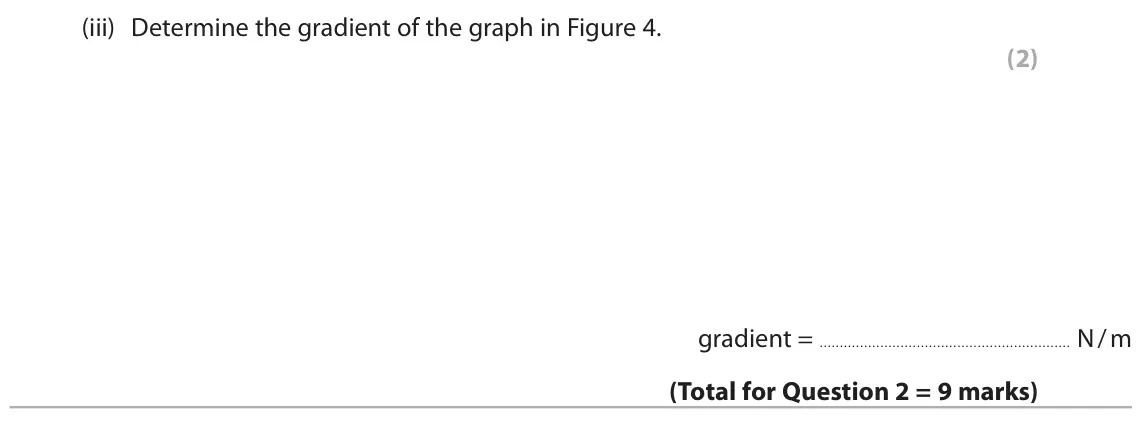
    June 2025 Paper 1 Higher, question 2(b)(iii): Determine the gradient of the graph in Figure 4. (2) gradient = N / m
  9. Q3(a)(i)

    June 2025 · Paper 1 Higher

    1 mark
    The whole paper ↗
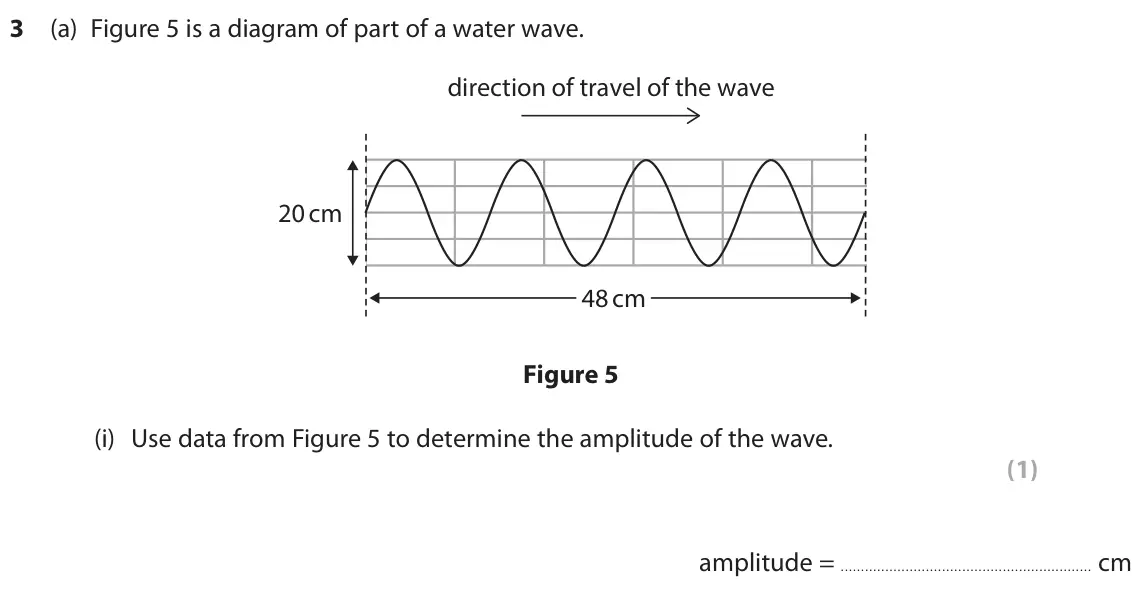
    June 2025 Paper 1 Higher, question 3(a)(i): Use data from Figure 5 to determine the amplitude of the wave. (1) amplitude = cm
  10. Q3(a)(ii)

    June 2025 · Paper 1 Higher

    1 mark
    The whole paper ↗
    June 2025 Paper 1 Higher, question 3(a)(ii): Use data from Figure 5 to determine the wavelength of the wave. (1) wavelength = cm
  11. Q3(a)(iii)

    June 2025 · Paper 1 Higher

    2 marks
    The whole paper ↗
    June 2025 Paper 1 Higher, question 3(a)(iii): The water wave shown in Figure 5 is generated in a large tank. A student observes the wave. Describe how the student could determine the wave speed of the wave.
  12. Q3(b)(i)

    June 2025 · Paper 1 Higher

    1 mark
    The whole paper ↗
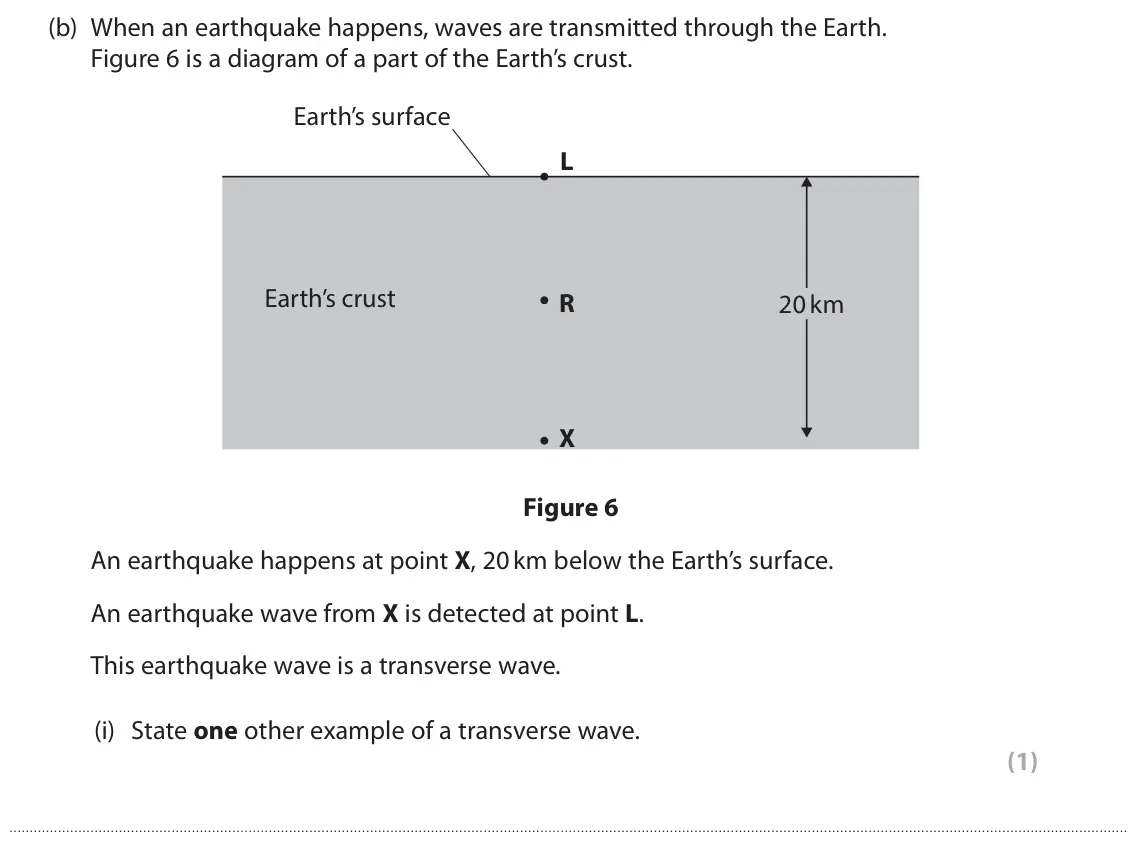
    June 2025 Paper 1 Higher, question 3(b)(i): State one other example of a transverse wave. (1)
  13. Q3(b)(ii)

    June 2025 · Paper 1 Higher

    2 marks
    The whole paper ↗
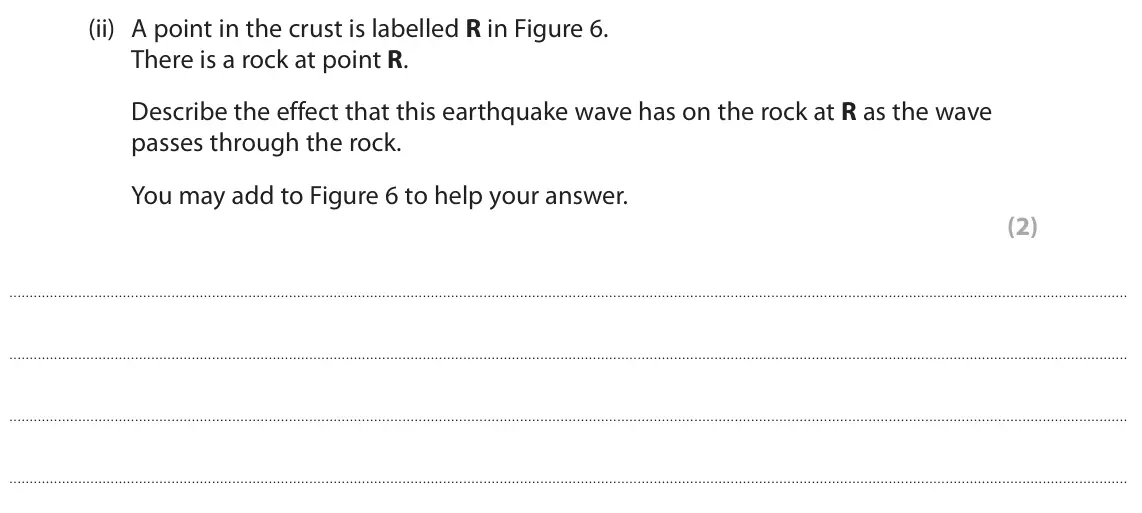
    June 2025 Paper 1 Higher, question 3(b)(ii): A point in the crust is labelled R in Figure 6. There is a rock at point R. Describe the effect that this earthquake wave has on the rock at R as the wave passe
  14. Q3(b)(iii)

    June 2025 · Paper 1 Higher

    2 marks
    The whole paper ↗
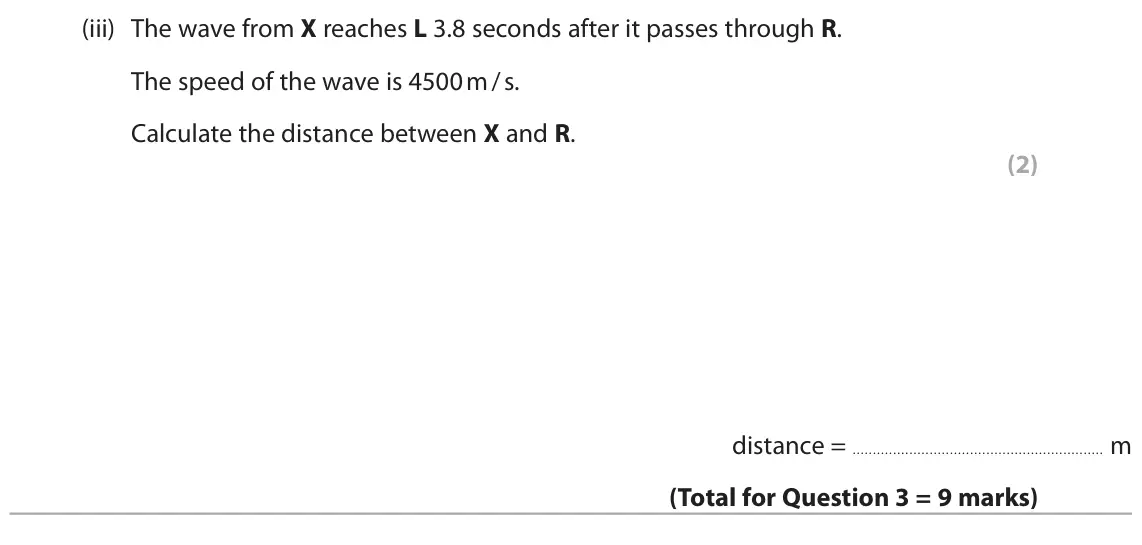
    June 2025 Paper 1 Higher, question 3(b)(iii): The wave from X reaches L 3.8 seconds after it passes through R. The speed of the wave is 4500 m / s. Calculate the distance between X and R. (2) distance = m
  15. Q4(a)(i)

    June 2025 · Paper 1 Higher

    1 mark
    The whole paper ↗
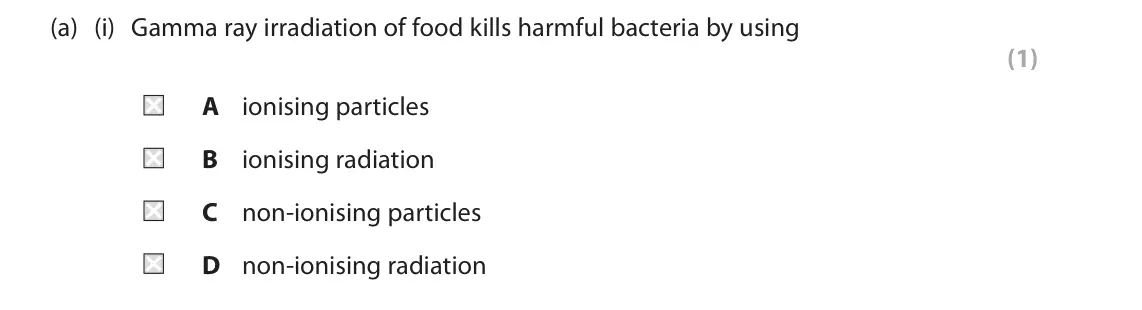
    June 2025 Paper 1 Higher, question 4(a)(i): Gamma ray irradiation of food kills harmful bacteria by using (1) A ionising particles B ionising radiation C non-ionising particles D non-ionising radiation
  16. Q4(a)(ii)

    June 2025 · Paper 1 Higher

    1 mark
    The whole paper ↗
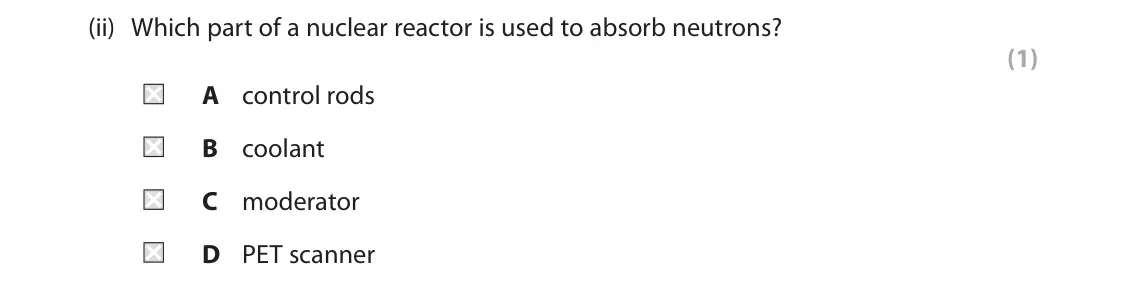
    June 2025 Paper 1 Higher, question 4(a)(ii): Which part of a nuclear reactor is used to absorb neutrons? (1) A control rods B coolant C moderator D PET scanner
  17. Q4(b)(i)

    June 2025 · Paper 1 Higher

    2 marks
    The whole paper ↗
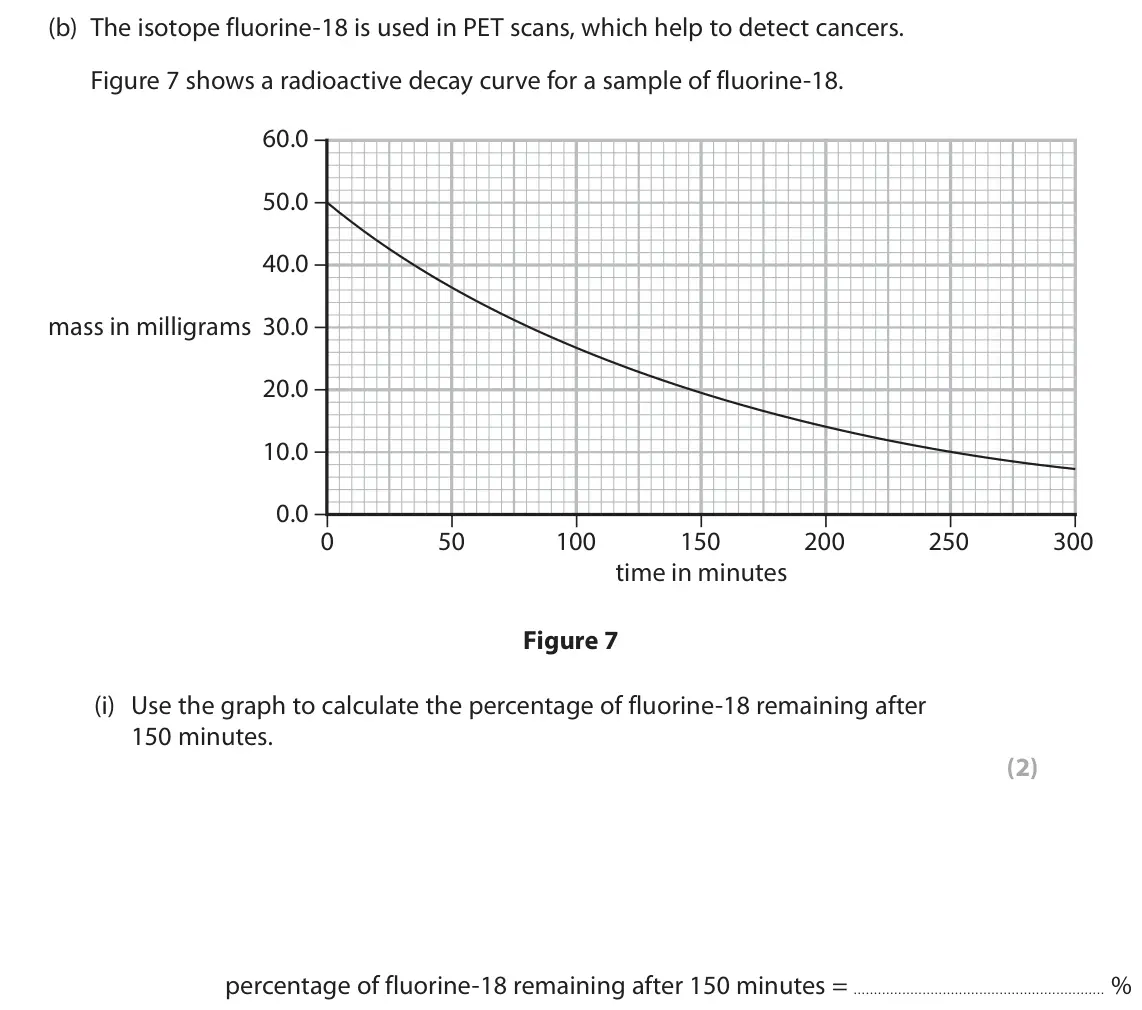
    June 2025 Paper 1 Higher, question 4(b)(i): Use the graph to calculate the percentage of fluorine-18 remaining after 150 minutes. (2) percentage of fluorine-18 remaining after 150 minutes = %
  18. Q4(b)(ii)

    June 2025 · Paper 1 Higher

    2 marks
    The whole paper ↗
    June 2025 Paper 1 Higher, question 4(b)(ii): Fluorine-18 releases positrons. Describe what happens when positrons meet electrons. (2)
  19. Q4(c)

    June 2025 · Paper 1 Higher

    3 marks
    The whole paper ↗
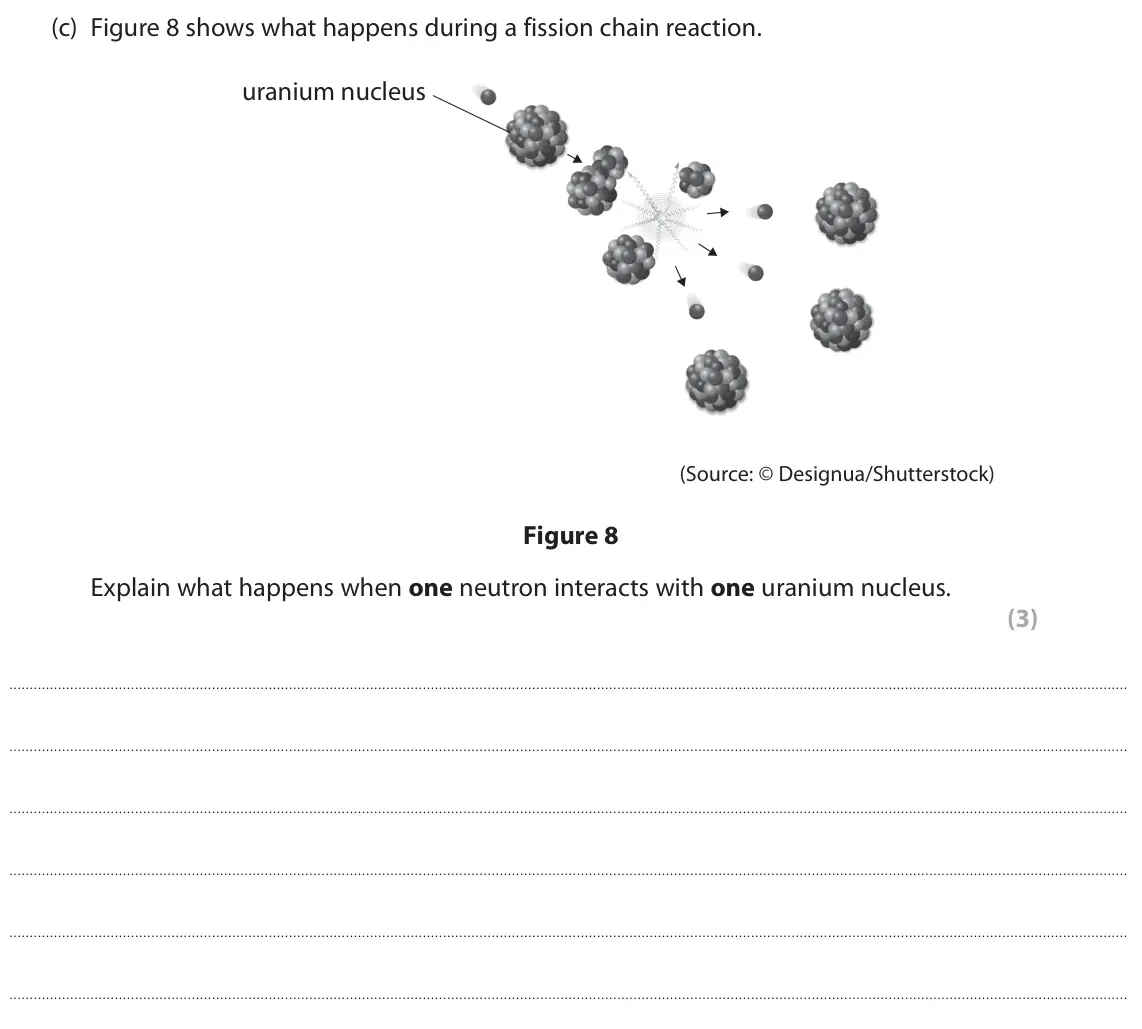
    June 2025 Paper 1 Higher, question 4(c): Figure 8 shows what happens during a fission chain reaction. uranium nucleus (Source: © Designua/Shutterstock) Figure 8 Explain what happens when one neutron in
  20. Q4(d)

    June 2025 · Paper 1 Higher

    2 marks
    The whole paper ↗
    June 2025 Paper 1 Higher, question 4(d): In 2023, Finland produced 4.4 GW of power from nuclear power plants. The UK produced 8.9 GW of power from nuclear power plants. Calculate the ratio of nuclear p

Questions, mark schemes and examiner’s reports are © Pearson Edexcel, from their published past papers. Plumi isn’t affiliated with any exam board. Want whole papers? Every Edexcel GCSE Physics paper.

Rather write your answers by hand on iPad? Plumi marks them against the same mark schemes.