 plumi
Fission and fusion: Edexcel GCSE Physics questions
Every Edexcel GCSE Physics exam question on Fission and fusion (specification points 6.37–6.46), 2018–2025, with its mark scheme and examiner’s report.
Find questions1,554
Exam
All years
Calculations
Q4(a)(ii)
The whole paper ↗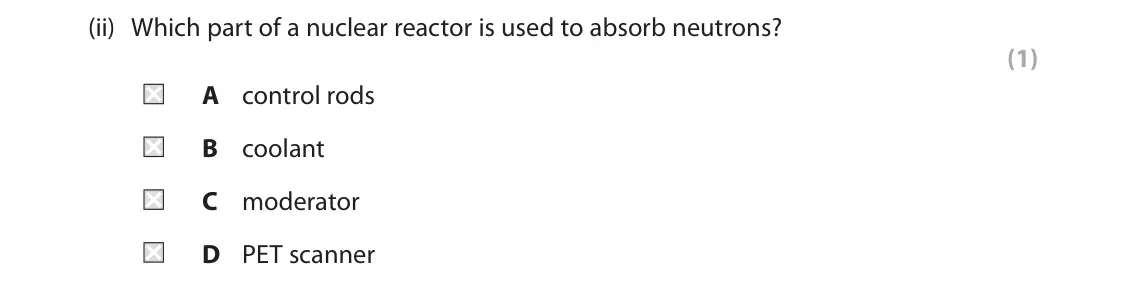
Q4(c)
The whole paper ↗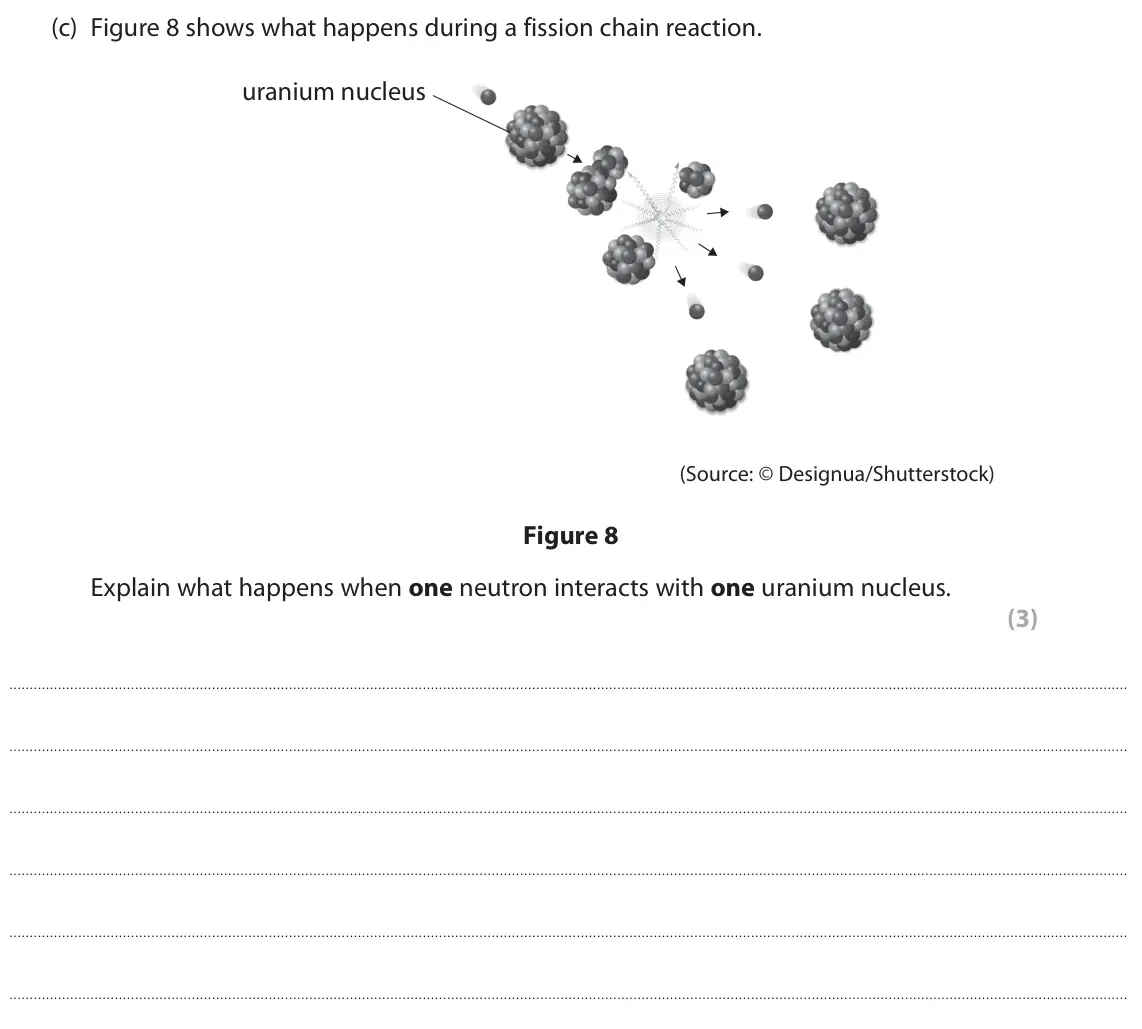
Q10(b)(i)
The whole paper ↗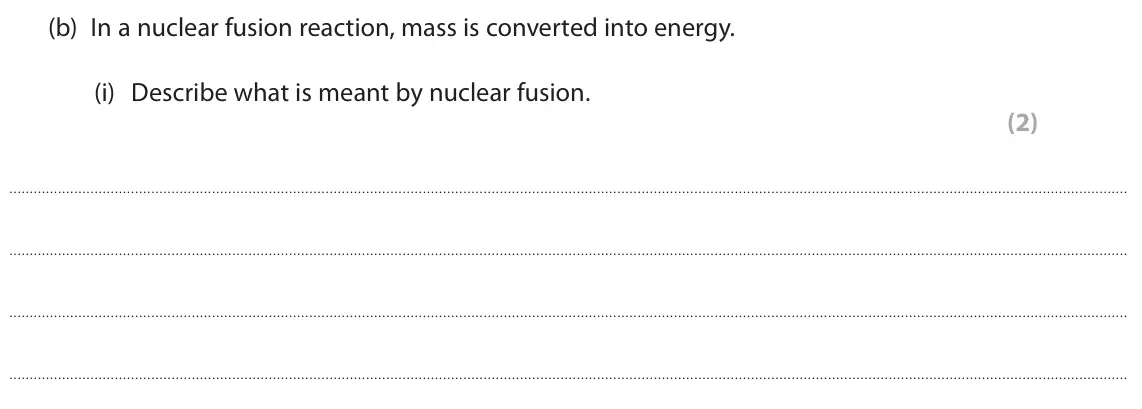
Q10(b)(ii)
The whole paper ↗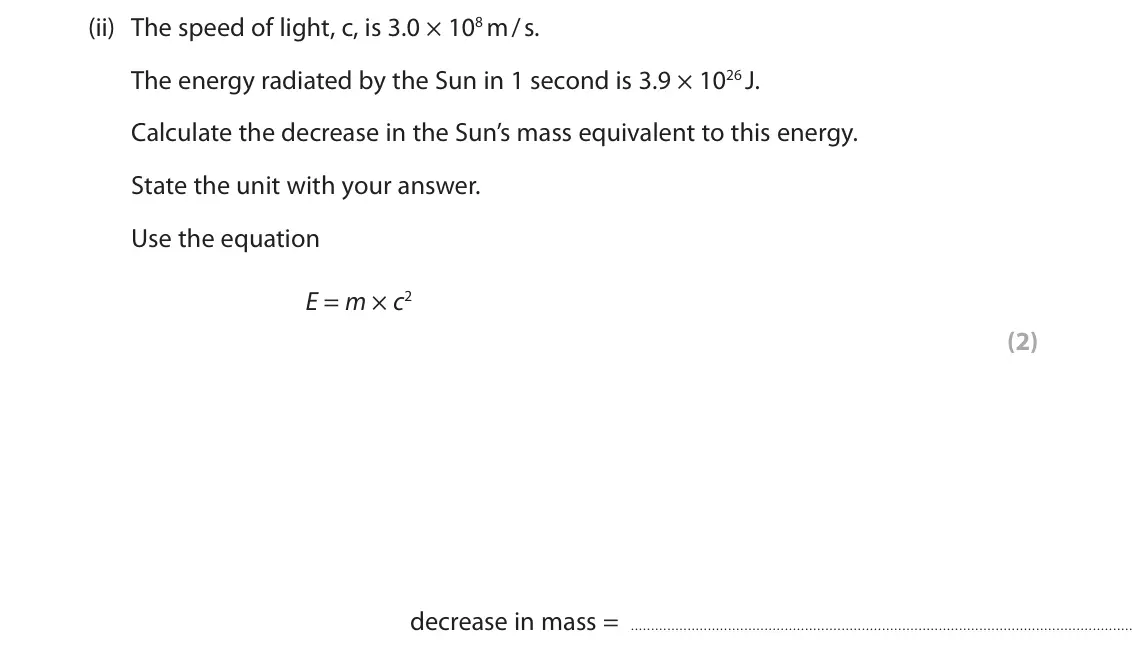
Q10(a)(ii)
The whole paper ↗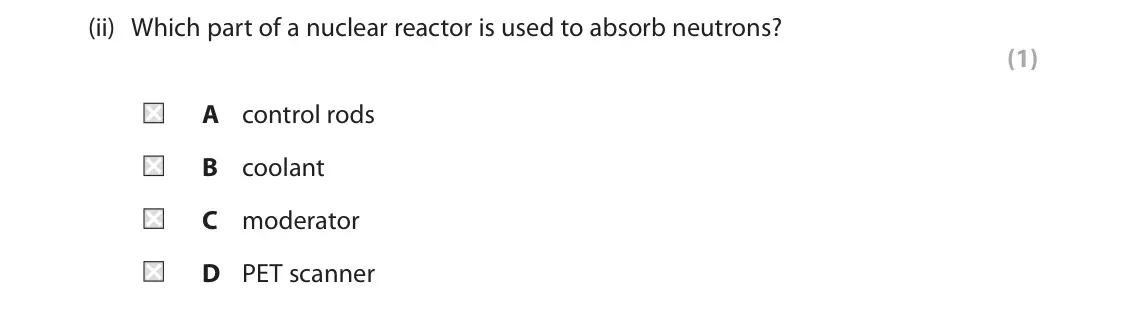
Q10(c)
The whole paper ↗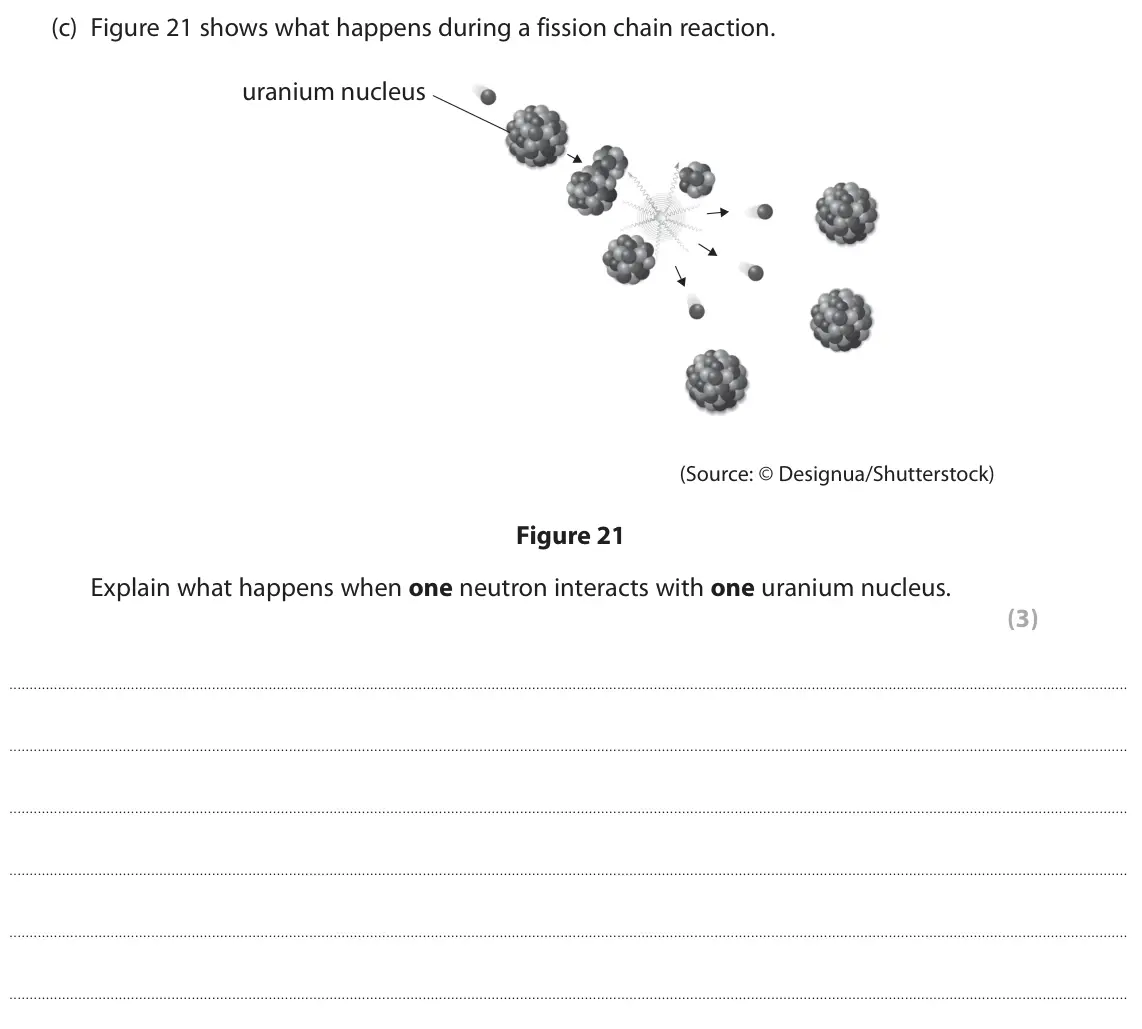
Q3(c)
The whole paper ↗
Q3(d)
The whole paper ↗
Q10(b)
The whole paper ↗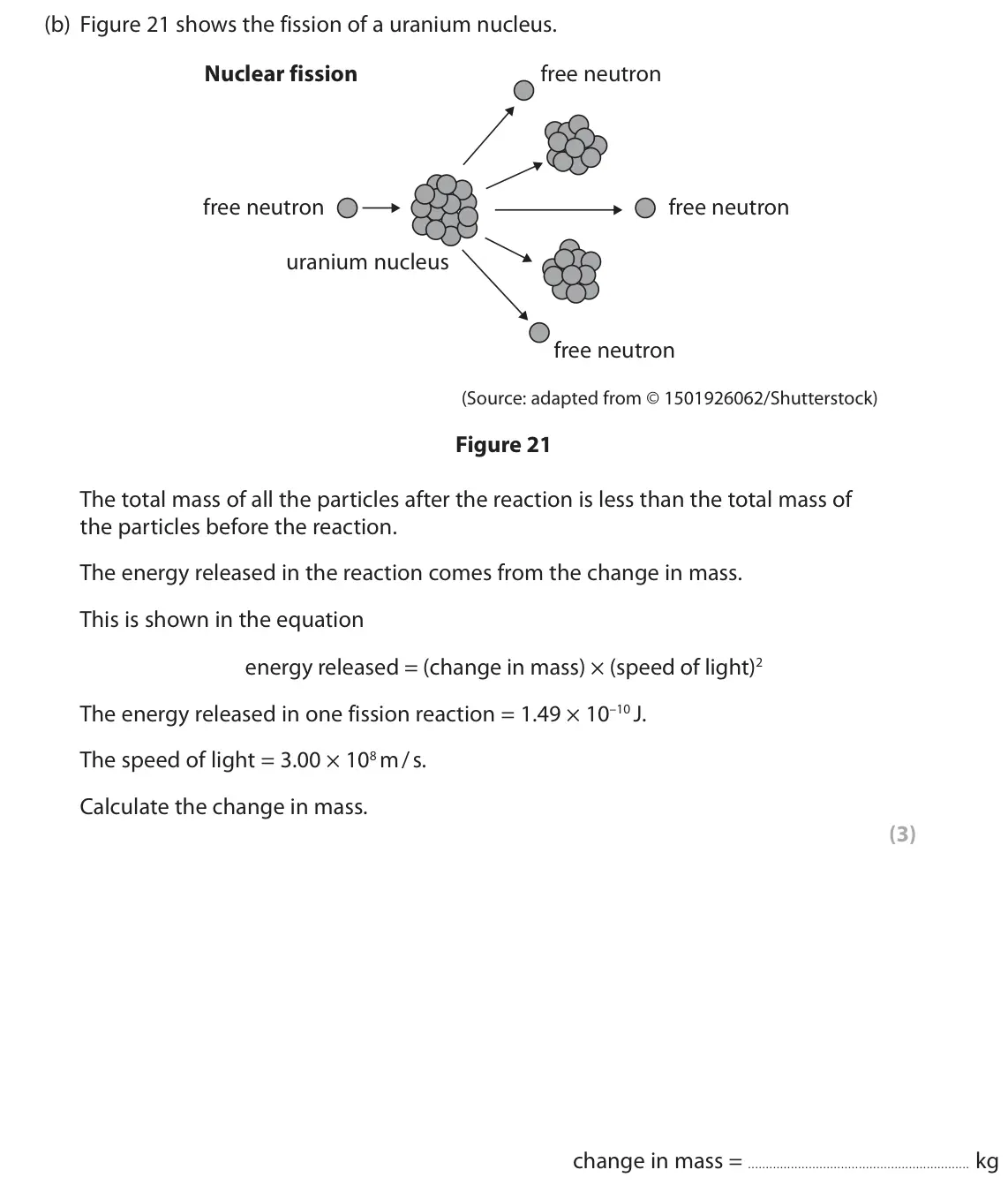
Q10(c)
The whole paper ↗
Q4(b)(i)
The whole paper ↗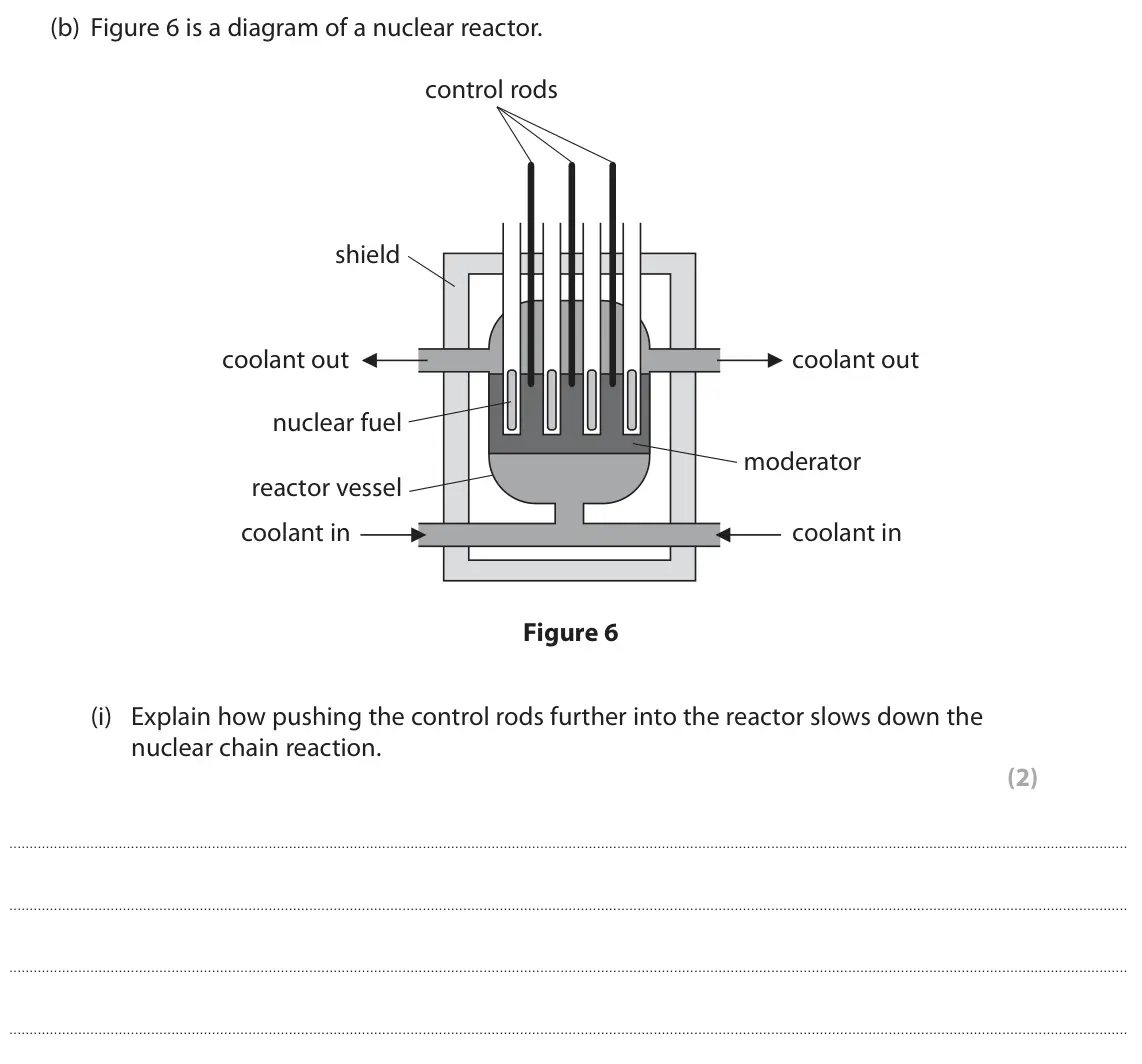
Q4(b)(ii)
The whole paper ↗
Q4(b)(iii)
The whole paper ↗
Q5(c)(i)
The whole paper ↗
Q5(c)(ii)
The whole paper ↗
Q10(b)(i)
The whole paper ↗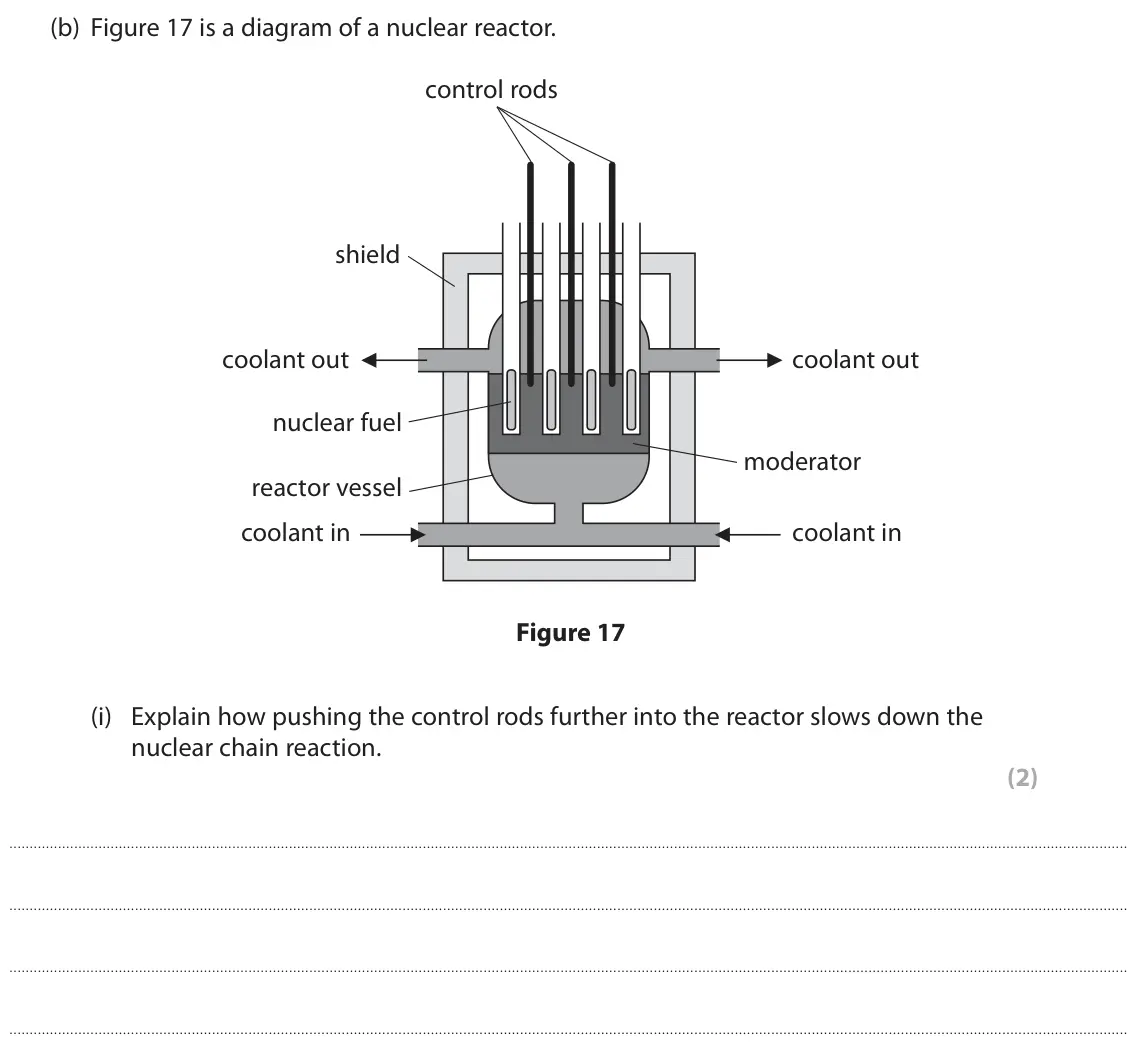
Q10(b)(ii)
The whole paper ↗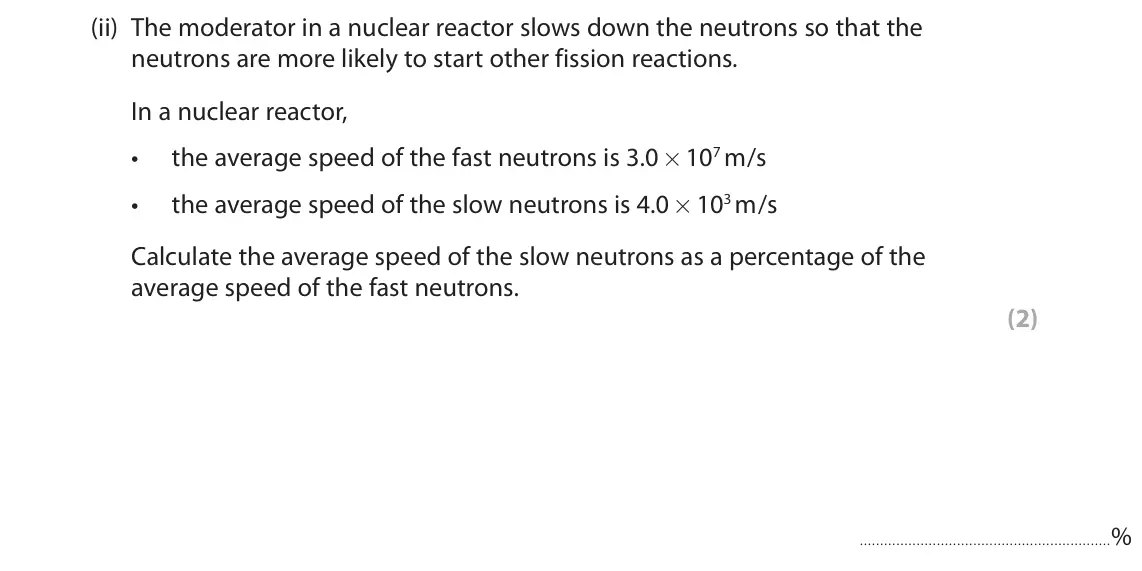
Q10(b)(iii)
The whole paper ↗
All 42 questions on Fission and fusion, as a list
- June 2025, Paper 1 Higher, Q4(a)(ii) (1 mark): Which part of a nuclear reactor is used to absorb neutrons? (1) A control rods B coolant C moderator D PET scanner
- June 2025, Paper 1 Higher, Q4(c) (3 marks): Figure 8 shows what happens during a fission chain reaction. uranium nucleus (Source: © Designua/Shutterstock) Figure 8 Explain what happens when one neutron in
- June 2025, Paper 1 Higher, Q10(b)(i) (2 marks): Describe what is meant by nuclear fusion. (2)
- June 2025, Paper 1 Higher, Q10(b)(ii) (2 marks): The speed of light, c, is 3.0 × 10⁸ m / s. The energy radiated by the Sun in 1 second is 3.9 × 1026 J. Calculate the decrease in the Sun’s mass equivalent to th
- June 2025, Paper 1 Foundation, Q10(a)(ii) (1 mark): Which part of a nuclear reactor is used to absorb neutrons? (1) A control rods B coolant C moderator D PET scanner
- June 2025, Paper 1 Foundation, Q10(c) (3 marks): Figure 21 shows what happens during a fission chain reaction. uranium nucleus (Source: © Designua/Shutterstock) Figure 21 Explain what happens when one neutron
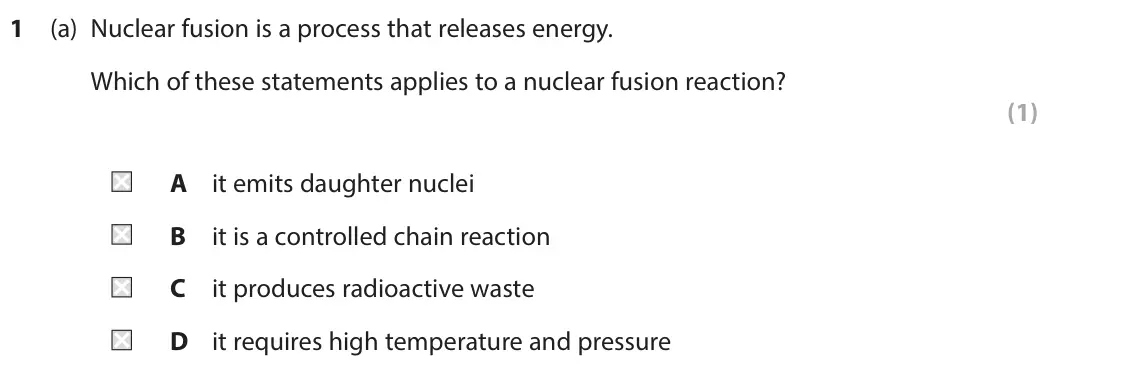
- June 2024, Paper 1 Higher, Q1(a) (1 mark): Nuclear fusion is a process that releases energy. Which of these statements applies to a nuclear fusion reaction? (1) A it emits daughter nuclei B it is a contr
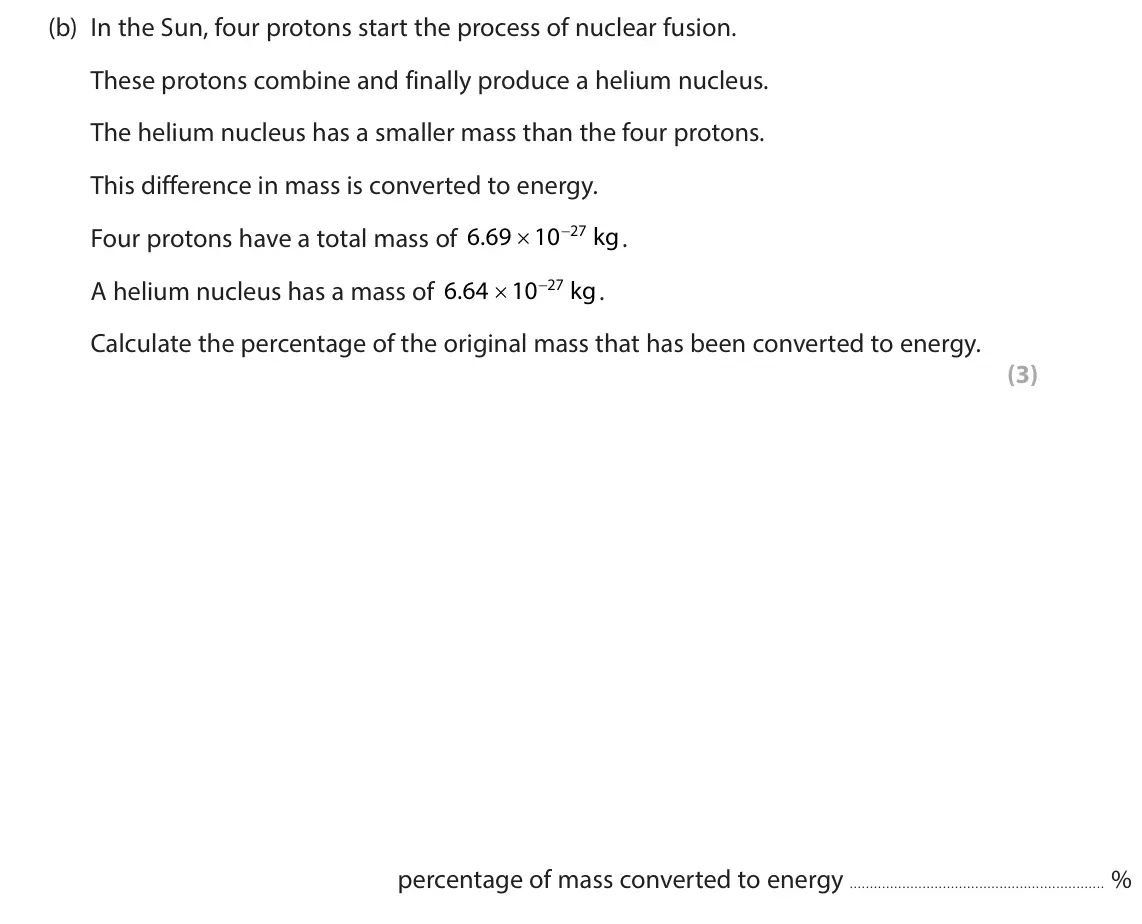
- June 2024, Paper 1 Higher, Q1(b) (3 marks): In the Sun, four protons start the process of nuclear fusion. These protons combine and finally produce a helium nucleus. The helium nucleus has a smaller mass
- June 2024, Paper 1 Foundation, Q3(c) (2 marks): Nuclear fusion reactions take place in the Sun. Describe what happens in a nuclear fusion reaction. (2)
- June 2024, Paper 1 Foundation, Q3(d) (2 marks): In 1989, two scientists claimed that they could produce a nuclear fusion reaction in their laboratory. They said their reaction could take place at room tempera
- June 2023, Paper 1 Higher, Q10(b) (3 marks): Figure 21 shows the fission of a uranium nucleus. Nuclear fission free neutron free neutron free neutron uranium nucleus free neutron (Source: adapted from © 15
- June 2023, Paper 1 Higher, Q10(c) (6 marks): The energy released in a single uranium fission is very small. In a nuclear power station, the fission of uranium in the reactor releases large amounts of energ
- June 2022, Paper 1 Higher, Q4(b)(i) (2 marks): Explain how pushing the control rods further into the reactor slows down the nuclear chain reaction. (2)
- June 2022, Paper 1 Higher, Q4(b)(ii) (2 marks): The moderator in a nuclear reactor slows down the neutrons so that the neutrons are more likely to start other fission reactions. In a nuclear reactor, • the av
- June 2022, Paper 1 Higher, Q4(b)(iii) (2 marks): The nuclear reaction is the first stage in the process of generating electricity. Describe how energy is transferred from the nuclear reaction to the next stage
- June 2022, Paper 1 Foundation, Q5(c)(i) (1 mark): State one of the conditions necessary for this nuclear fusion reaction to start. (1)
- June 2022, Paper 1 Foundation, Q5(c)(ii) (2 marks): Describe what happens in this nuclear fusion reaction. (2)
- June 2022, Paper 1 Foundation, Q10(b)(i) (2 marks): Explain how pushing the control rods further into the reactor slows down the nuclear chain reaction. (2)
- June 2022, Paper 1 Foundation, Q10(b)(ii) (2 marks): The moderator in a nuclear reactor slows down the neutrons so that the neutrons are more likely to start other fission reactions. In a nuclear reactor, • the av
- June 2022, Paper 1 Foundation, Q10(b)(iii) (2 marks): The nuclear reaction is the first stage in the process of generating electricity. Describe how energy is transferred from the nuclear reaction to the next stage
- November 2021, Paper 1 Higher, Q10(b) (6 marks): Nuclear fission and nuclear fusion are two non-renewable sources of energy. Compare nuclear fission and nuclear fusion as possible sources of energy for generat
- November 2021, Paper 1 Foundation, Q3(a) (1 mark): When a uranium-235 (U-235) nucleus absorbs a neutron, the nucleus splits into smaller parts. This reaction is called nuclear fission. How many daughter nuclei a
- November 2021, Paper 1 Foundation, Q3(b)(i) (2 marks): When a uranium-235 (U-235) nucleus splits, neutrons are also emitted. The neutrons may start a chain reaction. Describe what is meant by a chain reaction. You m
- November 2021, Paper 1 Foundation, Q3(b)(ii) (2 marks): In the nuclear reactor of a power station, the chain reaction has to be controlled. Explain the action of a moderator in a nuclear reactor. (2)
- November 2021, Paper 1 Foundation, Q3(b)(iii) (2 marks): In a nuclear reactor there are 2.0 ´ 1017 fission reactions each second. Each fission reaction releases 4.0 ´ 10–11J of energy. Calculate the energy released in
- November 2021, Paper 1 Foundation, Q3(c) (2 marks): Nuclear fusion is a nuclear reaction that takes place in the Sun. Describe what happens during a nuclear fusion reaction. (2)
- November 2020, Paper 1 Higher, Q1(b) (2 marks): Figure 1 is a diagram of a nuclear reactor, used in the generation of electricity. P Q fuel rods Figure 1 P may be used to shut down the reactor when necessary.
- November 2020, Paper 1 Higher, Q1(c) (2 marks): Explain how neutrons enable a nuclear chain reaction to take place. (2)
- November 2020, Paper 1 Higher, Q4(c) (3 marks): Nuclear fusion provides the energy source for stars including the Sun. Describe what happens during nuclear fusion. (3)
- November 2020, Paper 1 Higher, Q8(c) (6 marks): The global demand for electricity is increasing. There is a debate about whether nuclear power generation should or should not contribute to meeting this increa
- November 2020, Paper 1 Foundation, Q7(a) (3 marks): Use words from the box to complete the sentences about nuclear fission of uranium‑235 (U‑235). chain chemical fuse neutrons protons split (3) A neutron hits a n
- November 2020, Paper 1 Foundation, Q10(c) (3 marks): Nuclear fusion provides the energy source for stars including the Sun. Describe what happens during nuclear fusion. (3)
- June 2019, Paper 1 Higher, Q8(b)(i) (1 mark): In a controlled chain reaction of uranium-235, which of these could cause a uranium-235 nucleus to undergo fission? (1) A an alpha particle B a beta particle C
- June 2019, Paper 1 Higher, Q8(b)(ii) (3 marks): The kinetic energy of one of the particles released in a fission reaction is 1.2 × 10⁻¹¹ J. The mass of the particle is 1.4 × 10⁻²⁵ kg. Calculate the velocity o
- June 2018, Paper 1 Higher, Q10(a)(i) (3 marks): In a fusion reaction, two hydrogen nuclei are forced together to form a helium nucleus. Explain why a very high temperature is needed for this reaction to happe
- June 2018, Paper 1 Higher, Q10(a)(ii) (3 marks): In a fusion reaction, the combined mass of the two small nuclei is greater than the mass of the resulting nucleus. This decrease in mass, m, appears as energy,
- June 2018, Paper 1 Higher, Q10(b) (6 marks): Nuclear fission is used in nuclear reactors in some power stations. In the reactor, a fission chain reaction is maintained and controlled to produce a supply of
- June 2018, Paper 1 Foundation, Q5(b)(i) (2 marks): Describe the difference between a fusion reaction and a fission reaction. (2)
- June 2018, Paper 1 Foundation, Q5(b)(ii) (1 mark): Nuclear fusion does not happen at low temperatures because of electrostatic repulsion between (1) A beta particles B electrons C neutrons D protons
- June 2018, Paper 1 Foundation, Q5(c)(i) (2 marks): Calculate the ratio of the energy released in fusion compared with the energy released in burning oil. Use the equation energy released from fusion = ratio ener
- June 2018, Paper 1 Foundation, Q5(c)(ii) (2 marks): State two advantages of using a fusion reactor rather than burning oil in a power station. (2) 1 2
- June 2018, Paper 1 Foundation, Q5(c)(iii) (2 marks): State two of the difficulties that need to be overcome to produce a fusion reactor. (2) 1 2
Questions, mark schemes and examiner’s reports are © Pearson Edexcel, from their published past papers. Plumi isn’t affiliated with any exam board. Want whole papers? Every Edexcel GCSE Physics paper.
Rather write your answers by hand on iPad? Plumi marks them against the same mark schemes.