 plumi
The electromagnetic spectrum: Edexcel GCSE Physics questions
Every Edexcel GCSE Physics exam question on The electromagnetic spectrum (specification points 5.7–5.14), 2018–2025, with its mark scheme and examiner’s report.
Find questions1,554
Exam
All years
Calculations
Q5(a)
The whole paper ↗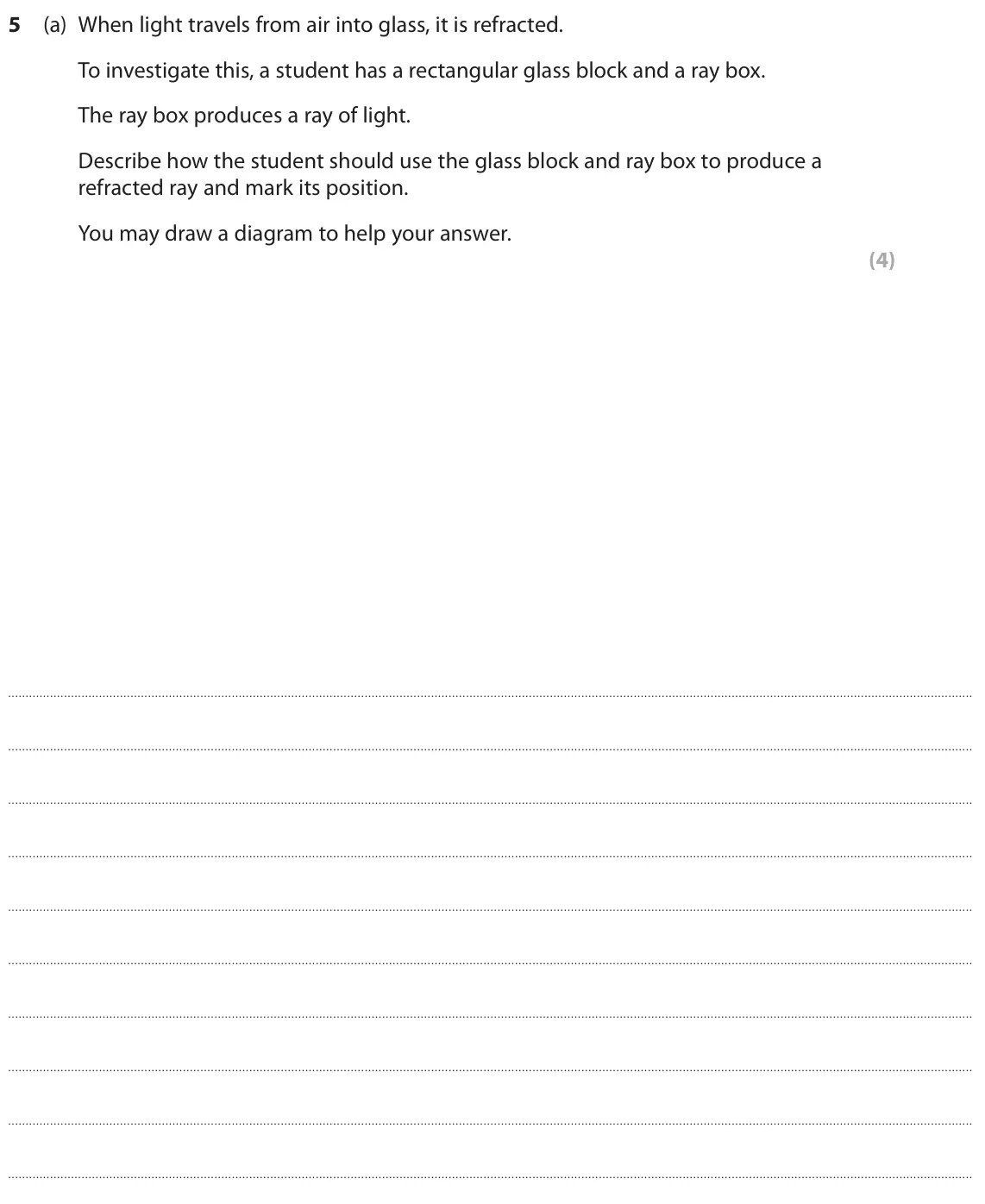
Q2(b)
The whole paper ↗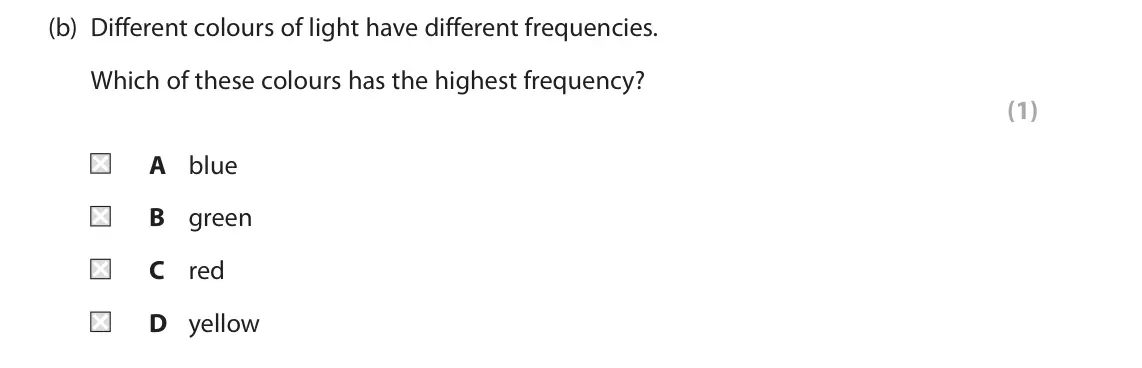
Q2(c)(i)
The whole paper ↗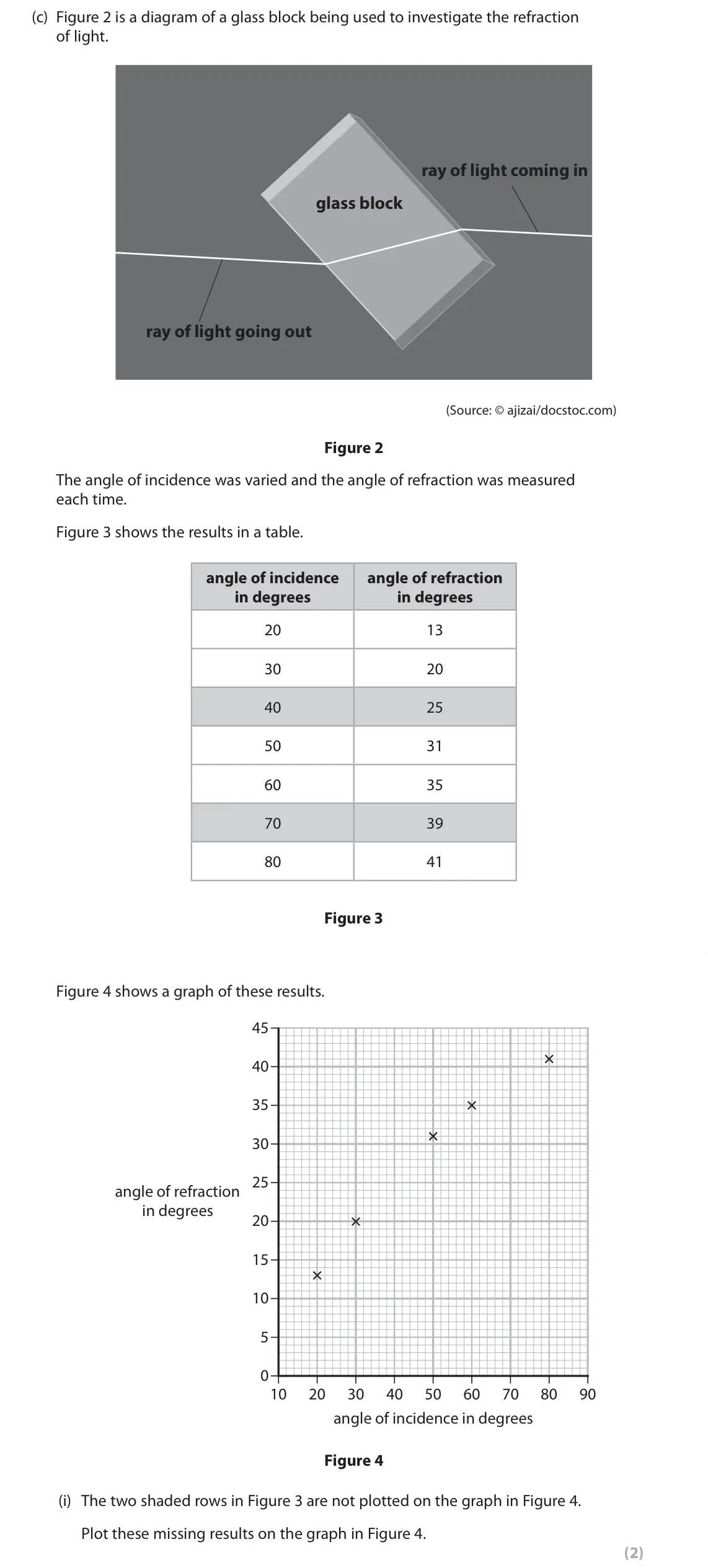
Q2(c)(ii)
The whole paper ↗
Q2(c)(iii)
The whole paper ↗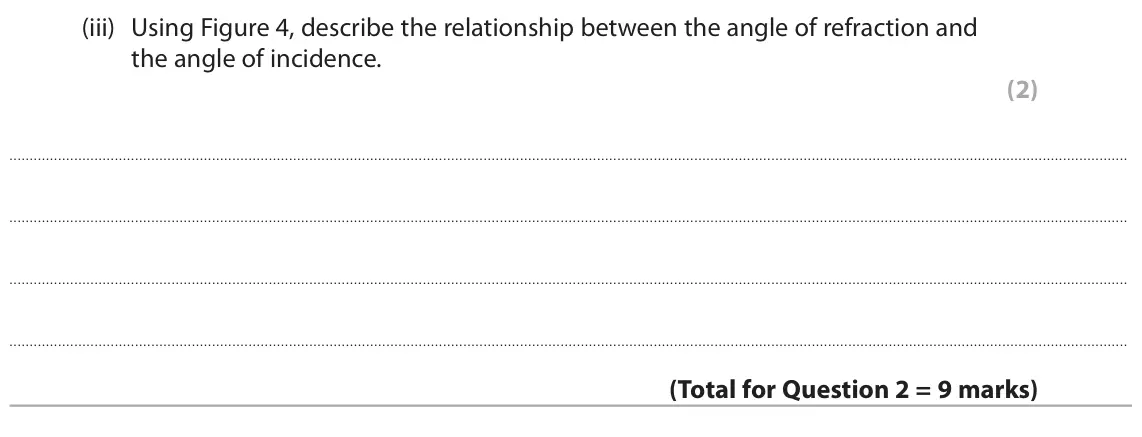
Q1(a)
The whole paper ↗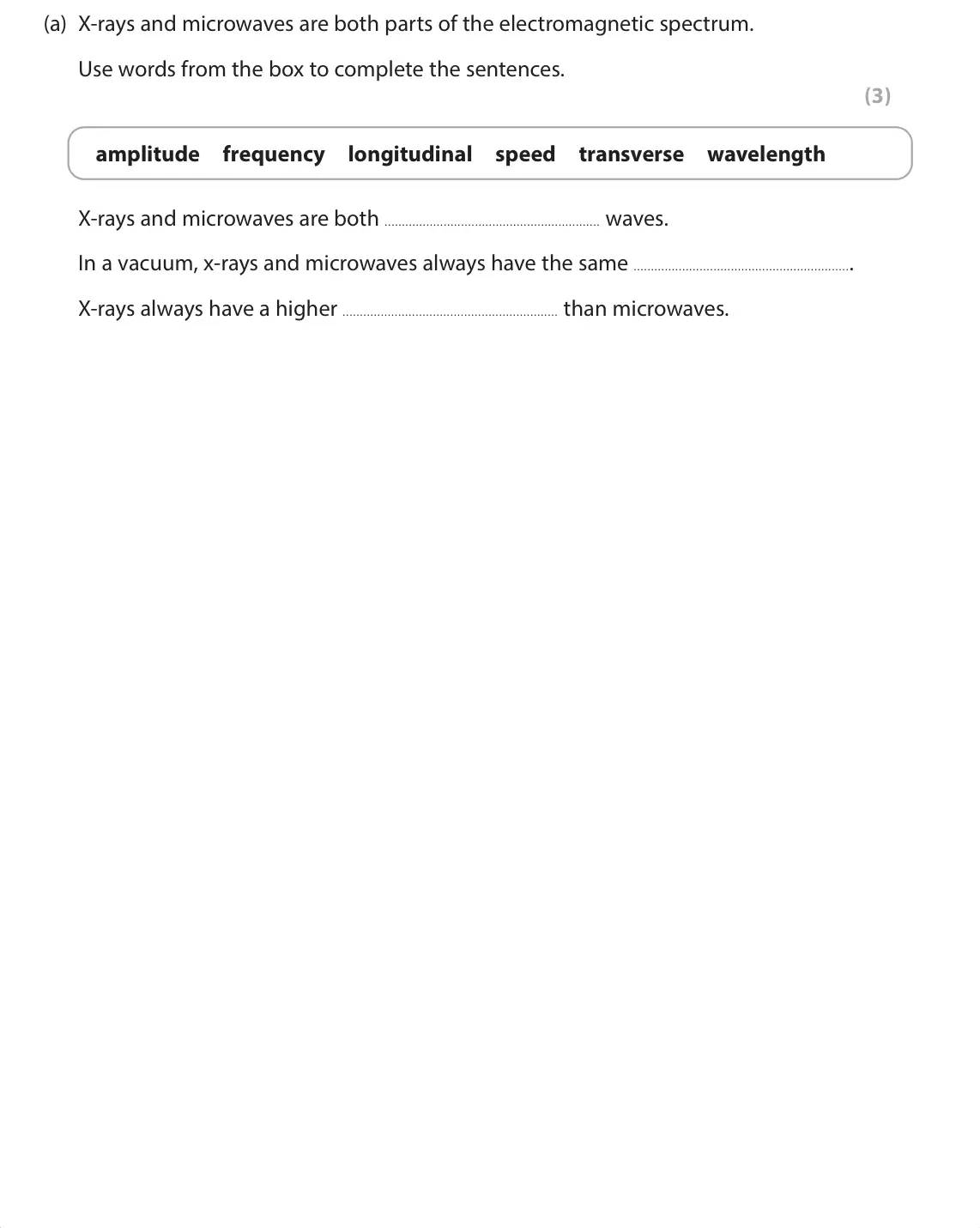
Q1(b)
The whole paper ↗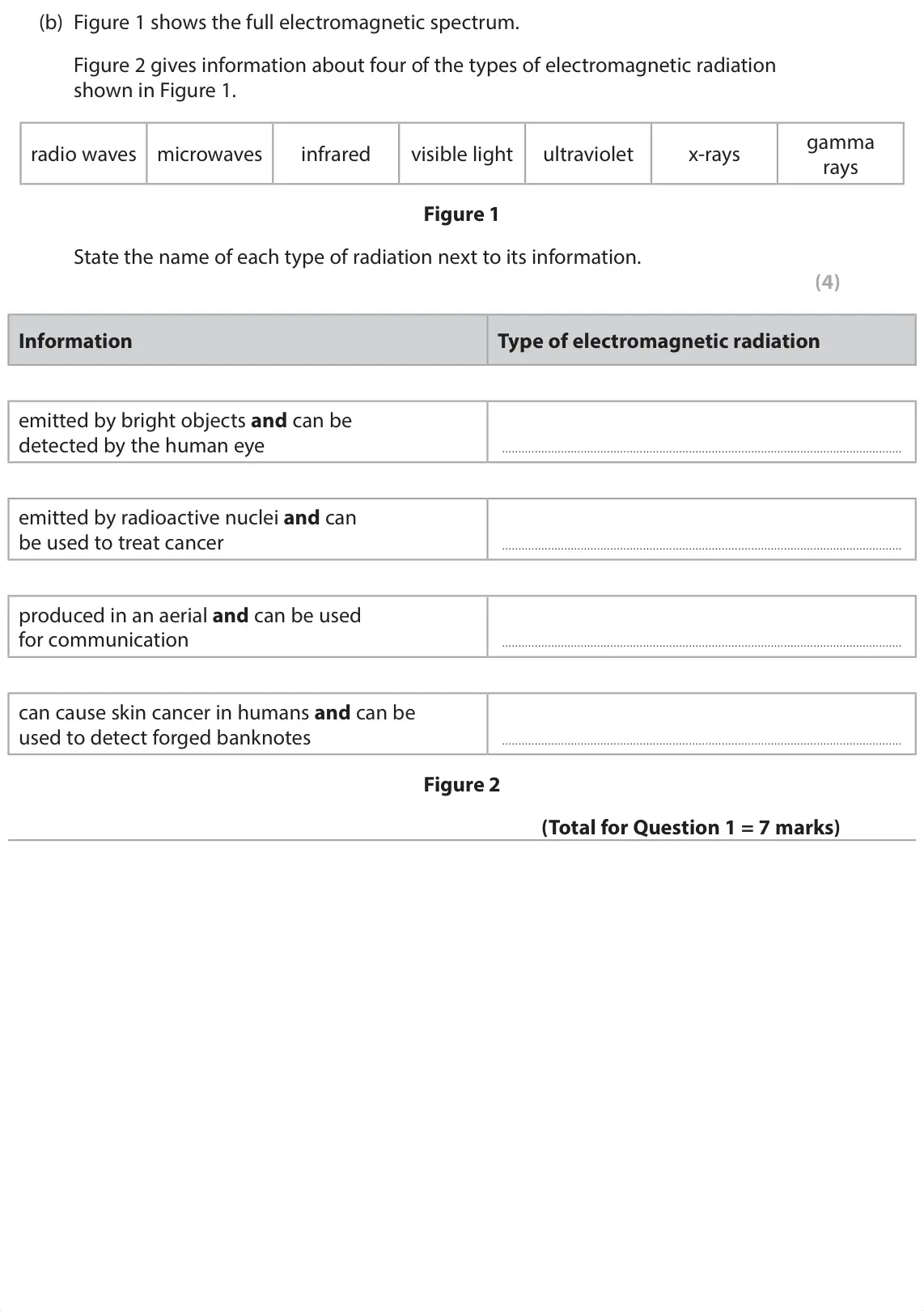
Q6(c)
The whole paper ↗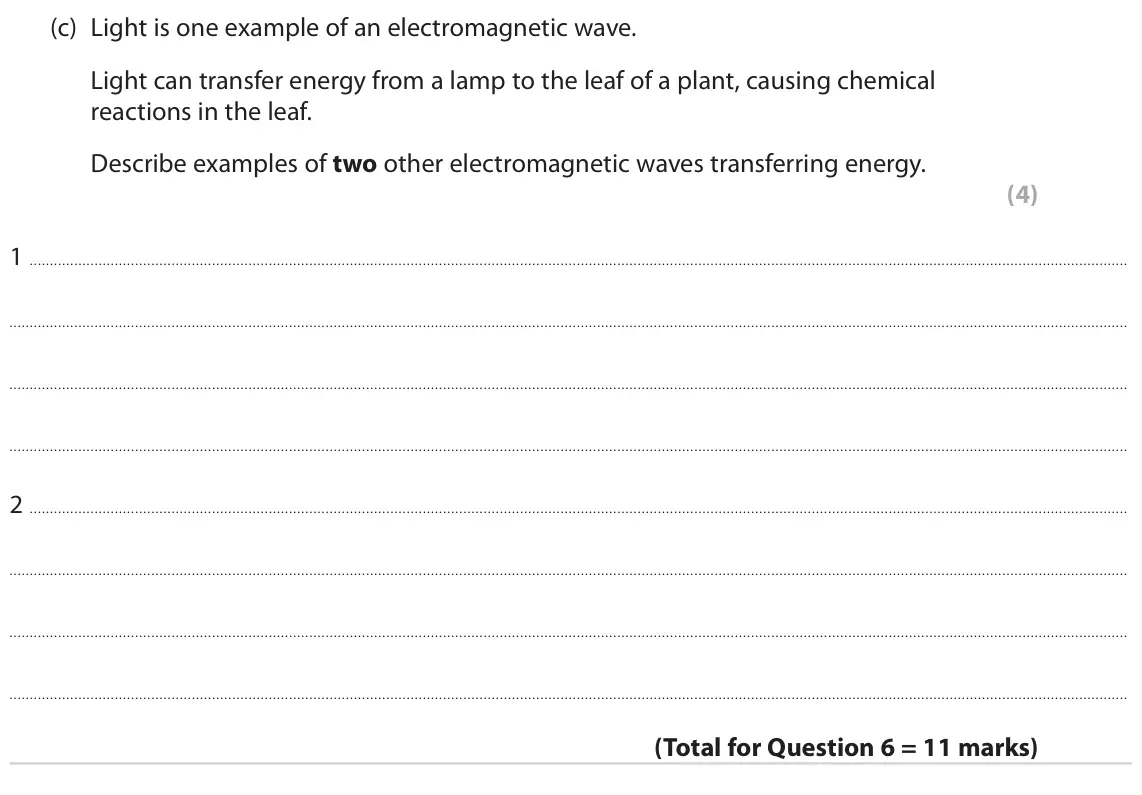
Q1(a)(ii)
The whole paper ↗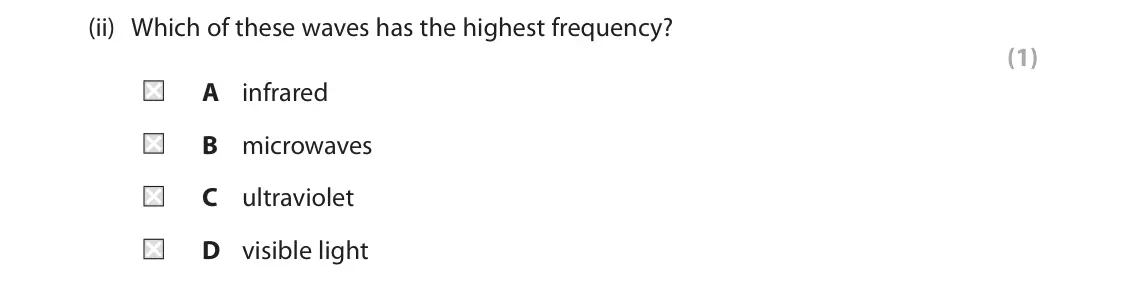
Q9(c)
The whole paper ↗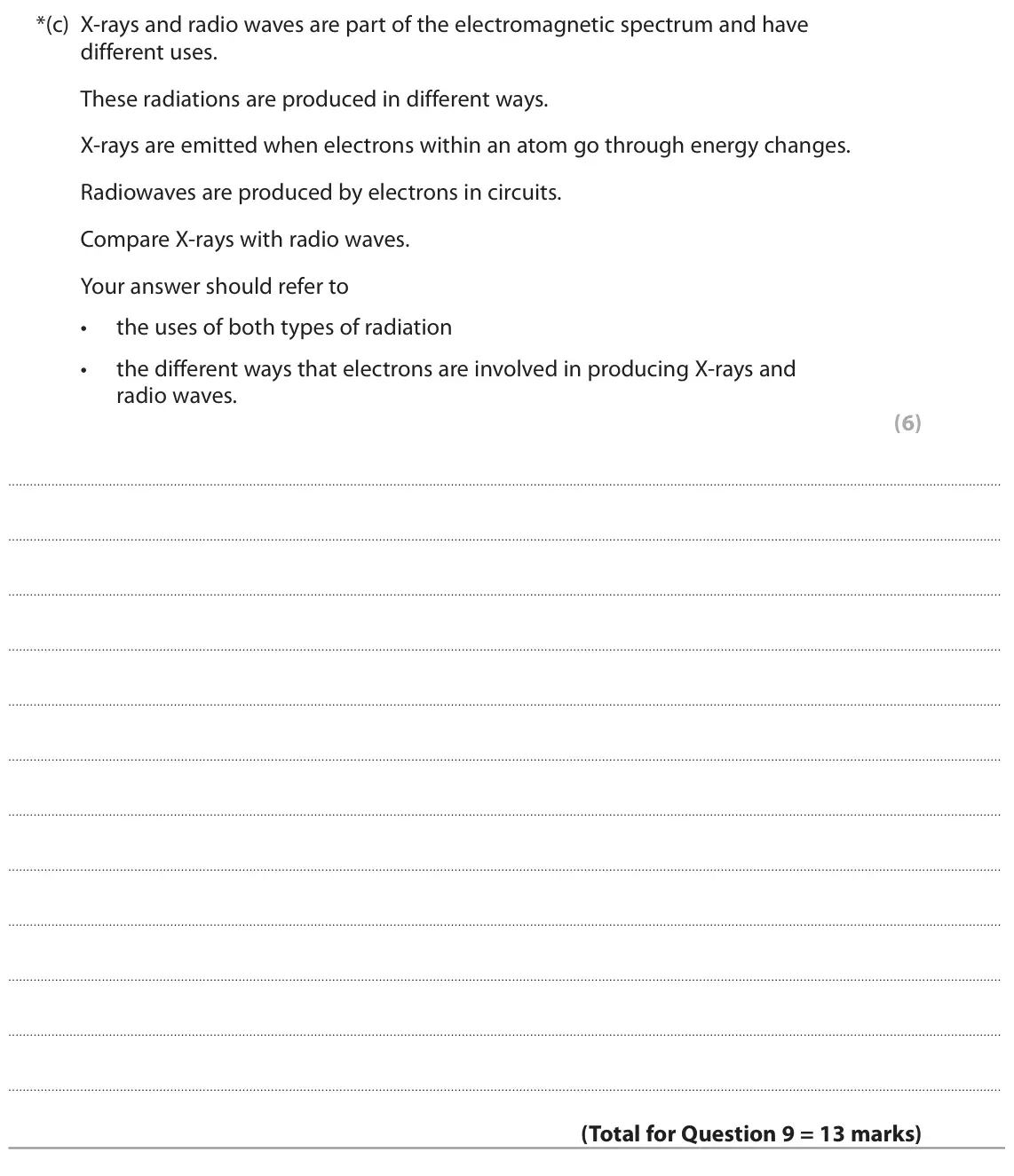
Q1(a)(i)
The whole paper ↗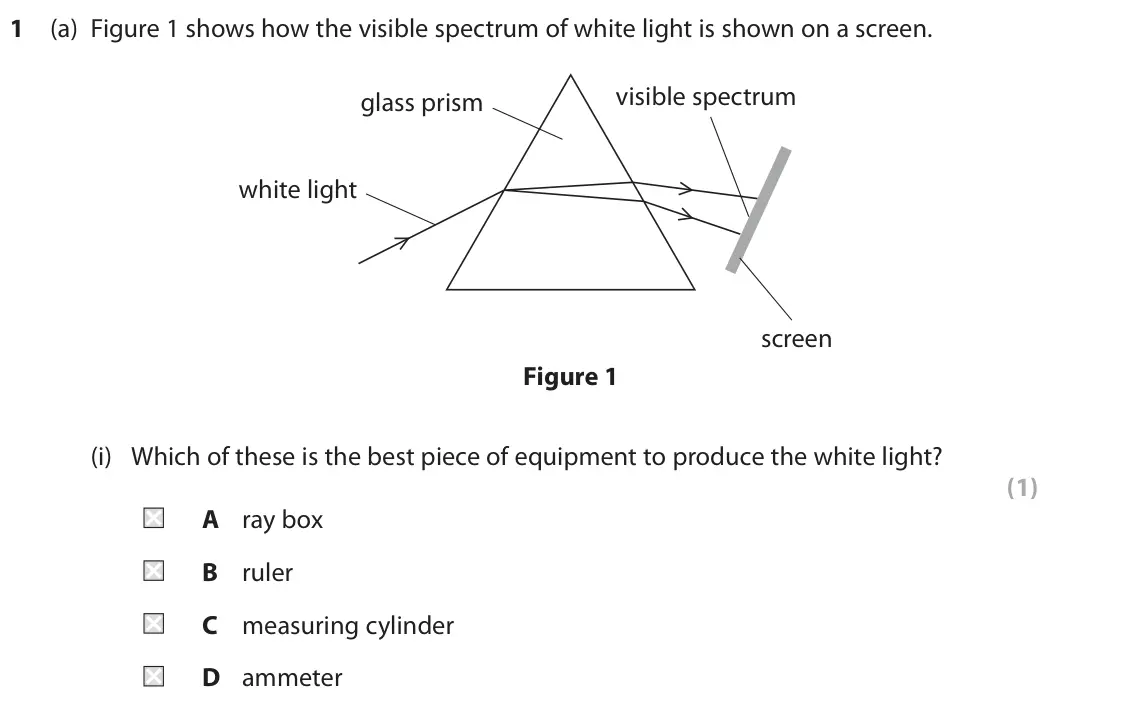
Q1(a)(ii)
The whole paper ↗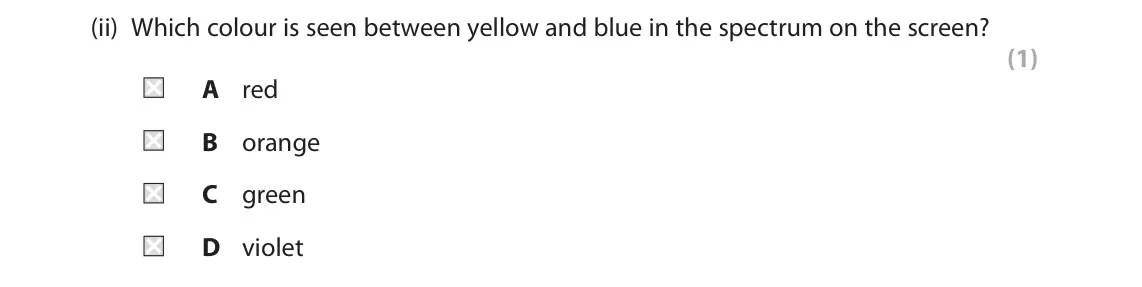
Q1(b)(iii)
The whole paper ↗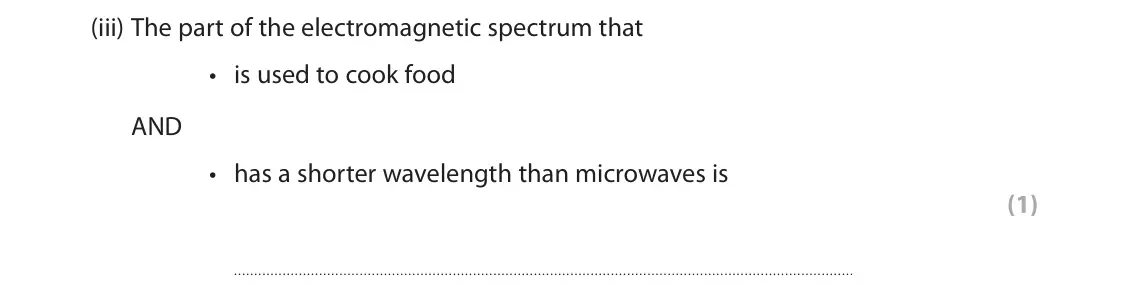
Q1(b)(iv)
The whole paper ↗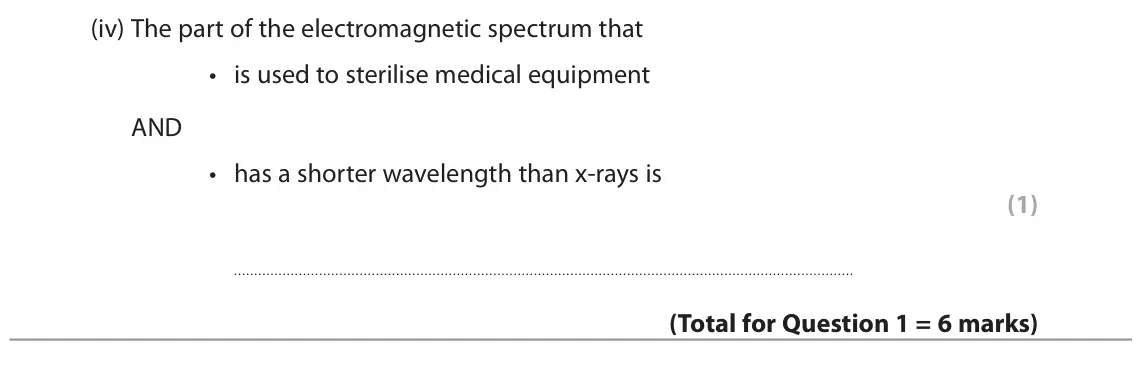
Q5(a)(i)
The whole paper ↗
Q5(a)(ii)
The whole paper ↗
Q5(a)(iii)
The whole paper ↗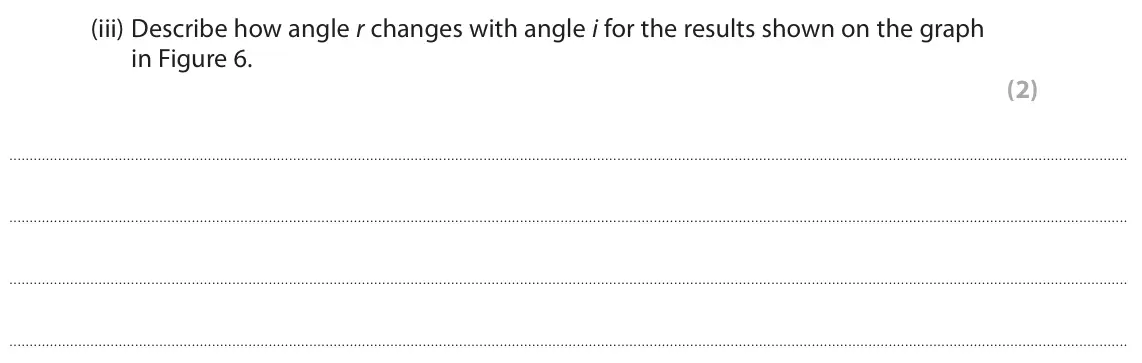
Q2(a)(i)
The whole paper ↗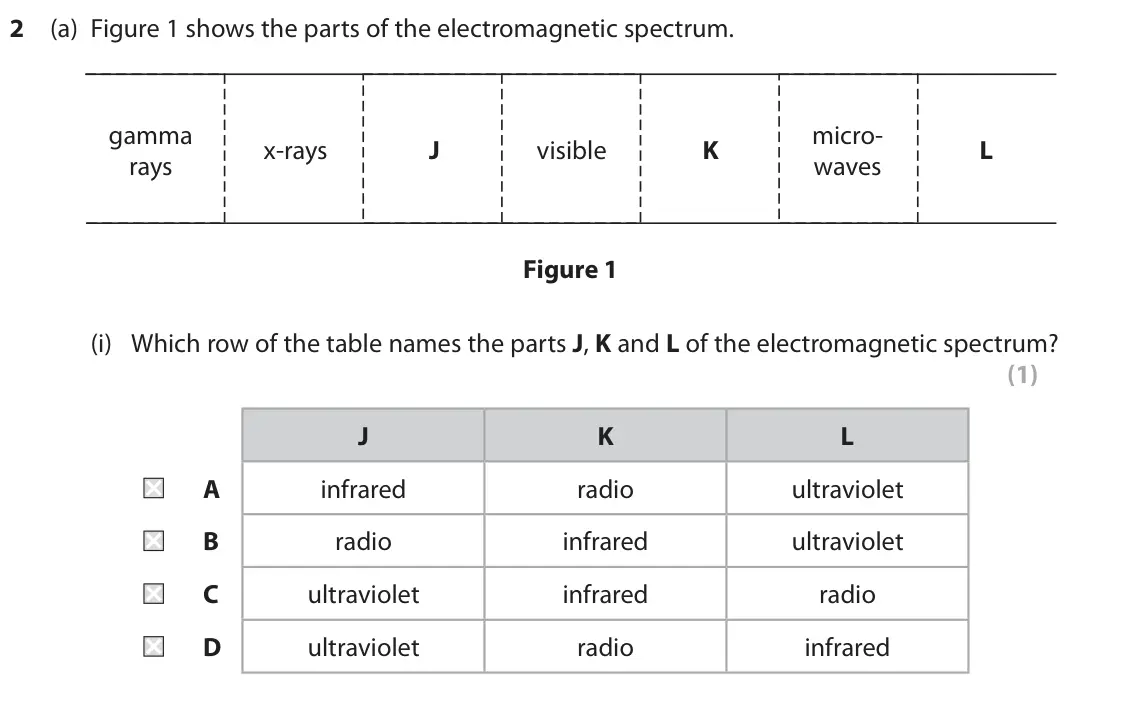
Q2(a)(ii)
The whole paper ↗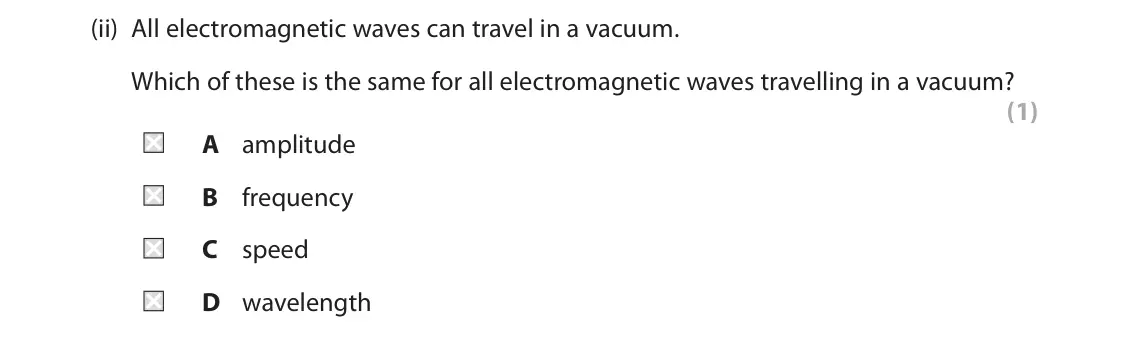
Q5(b)
The whole paper ↗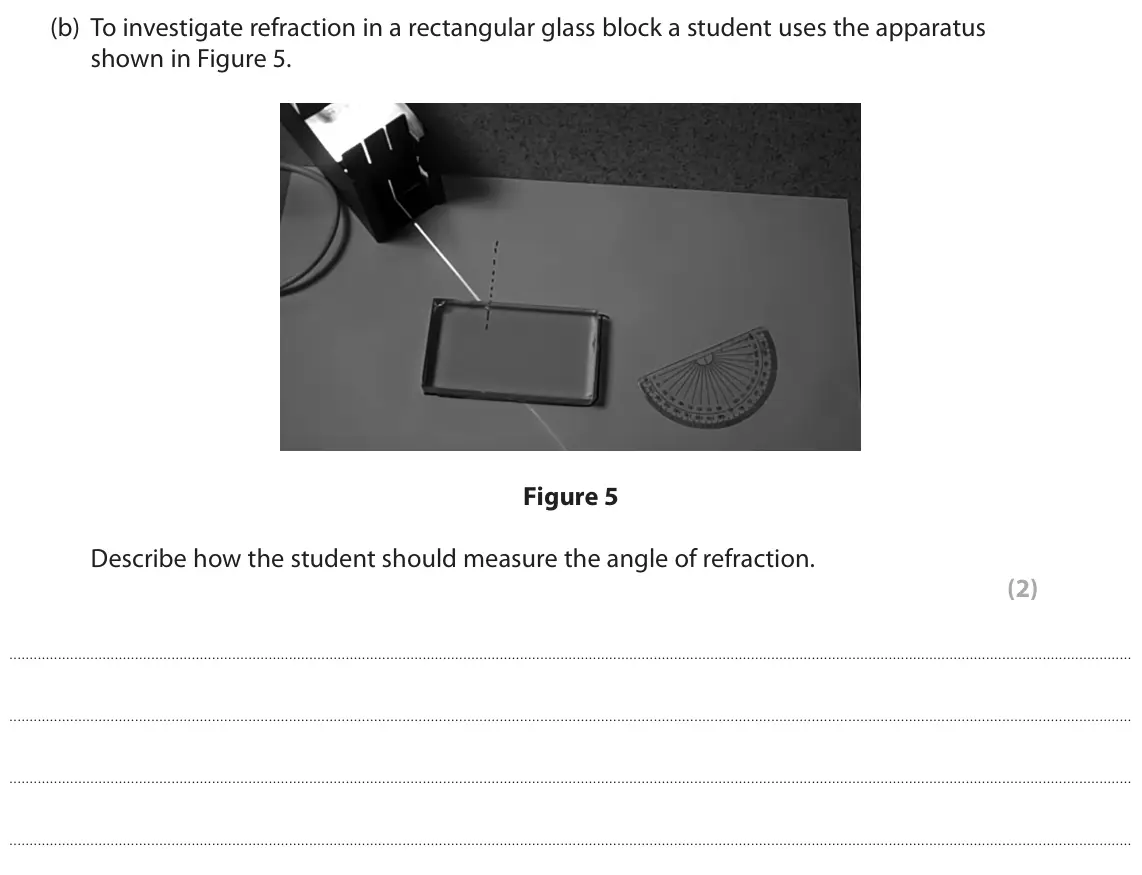
All 38 questions on The electromagnetic spectrum, as a list
- June 2025, Paper 1 Higher, Q5(a) (4 marks): When light travels from air into glass, it is refracted. To investigate this, a student has a rectangular glass block and a ray box. The ray box produces a ray
- June 2025, Paper 1 Foundation, Q2(b) (1 mark): Different colours of light have different frequencies. Which of these colours has the highest frequency? (1) A blue B green C red D yellow
- June 2025, Paper 1 Foundation, Q2(c)(i) (2 marks): The two shaded rows in Figure 3 are not plotted on the graph in Figure 4. Plot these missing results on the graph in Figure 4. (2)
- June 2025, Paper 1 Foundation, Q2(c)(ii) (1 mark): Draw a curve of best fit through the points on the graph in Figure 4. (1)
- June 2025, Paper 1 Foundation, Q2(c)(iii) (2 marks): Using Figure 4, describe the relationship between the angle of refraction and the angle of incidence. (2)
- June 2024, Paper 1 Foundation, Q1(a) (3 marks): X-rays and microwaves are both parts of the electromagnetic spectrum. Use words from the box to complete the sentences. (3) amplitude frequency longitudinal spe
- June 2024, Paper 1 Foundation, Q1(b) (4 marks): Figure 1 shows the full electromagnetic spectrum. Figure 2 gives information about four of the types of electromagnetic radiation shown in Figure 1. gamma radio
- June 2023, Paper 1 Higher, Q6(c) (4 marks): Light is one example of an electromagnetic wave. Light can transfer energy from a lamp to the leaf of a plant, causing chemical reactions in the leaf. Describe
- June 2023, Paper 1 Foundation, Q1(a)(ii) (1 mark): Which of these waves has the highest frequency? (1) A infrared B microwaves C ultraviolet D visible light
- June 2022, Paper 1 Higher, Q9(c) (6 marks): X-rays and radio waves are part of the electromagnetic spectrum and have different uses. These radiations are produced in different ways. X-rays are emitted whe
- June 2022, Paper 1 Foundation, Q1(a)(i) (1 mark): Which of these is the best piece of equipment to produce the white light? (1) A ray box B ruler C measuring cylinder D ammeter
- June 2022, Paper 1 Foundation, Q1(a)(ii) (1 mark): Which colour is seen between yellow and blue in the spectrum on the screen? (1) A red B orange C green D violet
- June 2022, Paper 1 Foundation, Q1(b)(iii) (1 mark): The part of the electromagnetic spectrum that • is used to cook food AND • has a shorter wavelength than microwaves is (1)
- June 2022, Paper 1 Foundation, Q1(b)(iv) (1 mark): The part of the electromagnetic spectrum that • is used to sterilise medical equipment AND • has a shorter wavelength than x‑rays is (1)
- November 2021, Paper 1 Higher, Q5(a)(i) (1 mark): On the graph in Figure 6, draw the best fit curve. (1)
- November 2021, Paper 1 Higher, Q5(a)(ii) (1 mark): Use the graph in Figure 6 to estimate the value of angle r when angle i is 80°. (1) angle r = °
- November 2021, Paper 1 Higher, Q5(a)(iii) (2 marks): Describe how angle r changes with angle i for the results shown on the graph in Figure 6. (2)
- November 2021, Paper 1 Foundation, Q2(a)(i) (1 mark): Which row of the table names the parts J, K and L of the electromagnetic spectrum? (1) J K L A infrared radio ultraviolet B radio infrared ultraviolet C ultravi
- November 2021, Paper 1 Foundation, Q2(a)(ii) (1 mark): All electromagnetic waves can travel in a vacuum. Which of these is the same for all electromagnetic waves travelling in a vacuum? (1) A amplitude B frequency C
- November 2020, Paper 1 Higher, Q5(b) (2 marks): To investigate refraction in a rectangular glass block a student uses the apparatus shown in Figure 5. Figure 5 Describe how the student should measure the angl
- November 2020, Paper 1 Foundation, Q1(b) (1 mark): Ultraviolet light has a higher frequency than infrared light. Which of these colours of visible light has the highest frequency? (1) A blue B green C orange D y
- November 2020, Paper 1 Foundation, Q1(c) (2 marks): Figure 1 shows how the brightness of a source of light changes with wavelength. brightness 0 360 380 400 420 440 460 wavelength in nm Figure 1 Describe how the
- June 2019, Paper 1 Higher, Q2(a) (1 mark): Which colour of visible light has the longest wavelength? (1) A blue B green C red D yellow
- June 2019, Paper 1 Higher, Q2(b) (2 marks): Some television remote controls use infrared radiation and other remote controls use radio waves. Explain why an infrared remote control may not switch on the t
- June 2019, Paper 1 Higher, Q9(b) (2 marks): Radio waves from Jupiter take 40 minutes to reach Earth. Light waves from the Sun take 8 minutes to reach Earth. Calculate how many times further it is from Ear
- June 2019, Paper 1 Higher, Q9(d) (6 marks): Radio waves and gamma radiation are at opposite ends of the electromagnetic spectrum. Compare how these two electromagnetic radiations are produced. (6)
- June 2019, Paper 1 Foundation, Q7(c)(i) (1 mark): State one type of electromagnetic radiation that has a higher frequency than ultraviolet. (1)
- June 2019, Paper 1 Foundation, Q8(a) (1 mark): Which colour of visible light has the longest wavelength? (1) A blue B green Cred D yellow
- June 2019, Paper 1 Foundation, Q8(b) (2 marks): Some television remote controls use infrared radiation and other remote controls use radio waves. Explain why an infrared remote control may not switch on the t
- June 2018, Paper 1 Higher, Q2(a)(i) (1 mark): In Figure 2, angle Y is the angle of (1) A deflection B incidence C reflection D refraction
- June 2018, Paper 1 Higher, Q2(a)(ii) (2 marks): Figure 3 is a graph of the student’s results. 50 45 40 35 30 angle Y 25 in degrees 20 15 10 5 0 0 10 20 30 40 50 60 angle X in degrees Figure 3 Use the graph to
- June 2018, Paper 1 Higher, Q2(a)(iii) (3 marks): The student concludes that angle Y is directly proportional to angle X. Explain what the student must do to test this conclusion in more detail. (3)
- June 2018, Paper 1 Higher, Q5(b) (4 marks): The following descriptions describe waves from different parts of the electromagnetic spectrum. Complete each description by adding the name of the wave. Use th
- June 2018, Paper 1 Foundation, Q8(a)(i) (1 mark): In Figure 15, angle Y is the angle of (1) A deflection B incidence C reflection D refraction
- June 2018, Paper 1 Foundation, Q8(a)(ii) (2 marks): Figure 16 is a graph of the student’s results. 50 45 40 35 30 angle Y 25 in degrees 20 15 10 5 0 0 10 20 30 40 50 60 angle X in degrees Figure 16 Use the graph
- June 2018, Paper 1 Foundation, Q8(a)(iii) (3 marks): The student concludes that angle Y is directly proportional to angle X. Explain what the student must do to test this conclusion in more detail. (3)
- June 2018, Paper 1 Foundation, Q8(c)(i) (1 mark): Give one colour of light that has a longer wavelength than yellow light. (1)
- June 2018, Paper 1 Foundation, Q8(c)(ii) (1 mark): Give one colour of light that has a higher frequency than yellow light. (1)
Questions, mark schemes and examiner’s reports are © Pearson Edexcel, from their published past papers. Plumi isn’t affiliated with any exam board. Want whole papers? Every Edexcel GCSE Physics paper.
Rather write your answers by hand on iPad? Plumi marks them against the same mark schemes.