 plumi
Gravity, the Solar System and orbits: Edexcel GCSE Physics questions
Every Edexcel GCSE Physics exam question on Gravity, the Solar System and orbits (specification points 7.1–7.7), 2018–2025, with its mark scheme and examiner’s report.
Find questions1,554
Exam
All years
Calculations
Q7(a)(i)
The whole paper ↗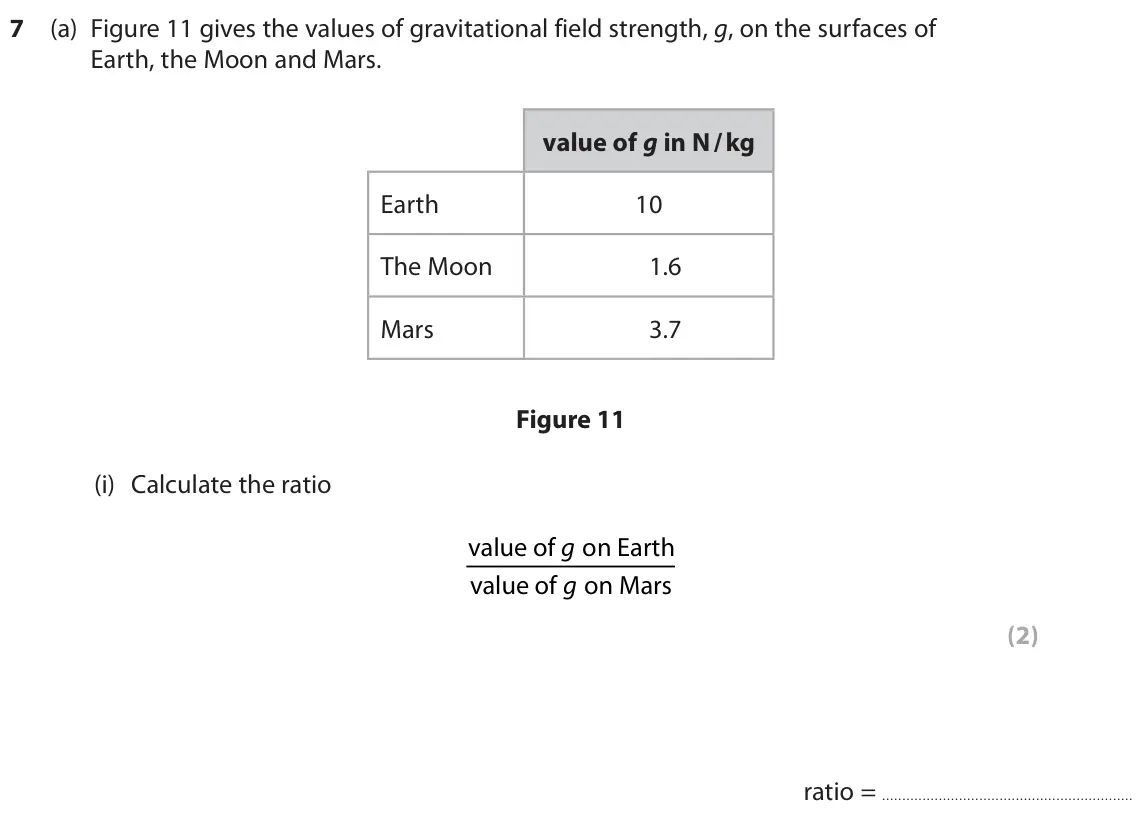
Q7(a)(ii)
The whole paper ↗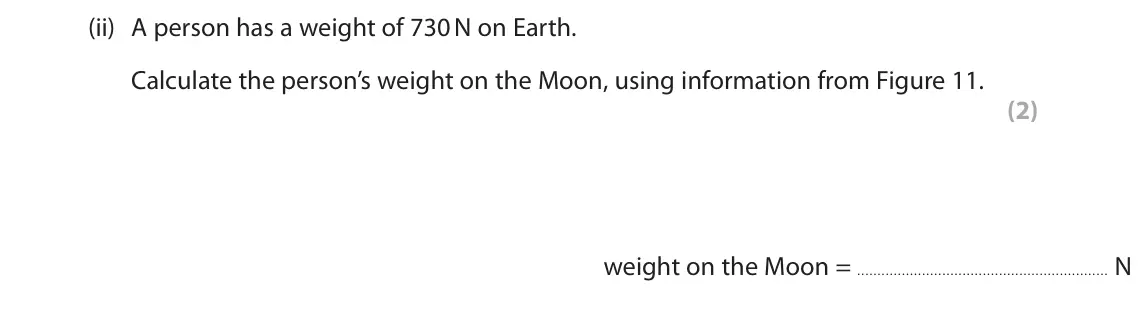
Q7(a)(iii)
The whole paper ↗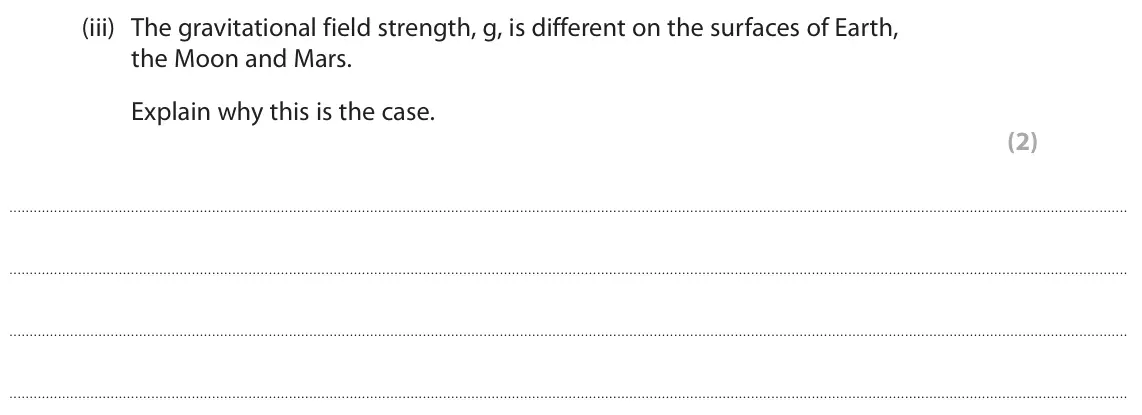
Q7(b)
The whole paper ↗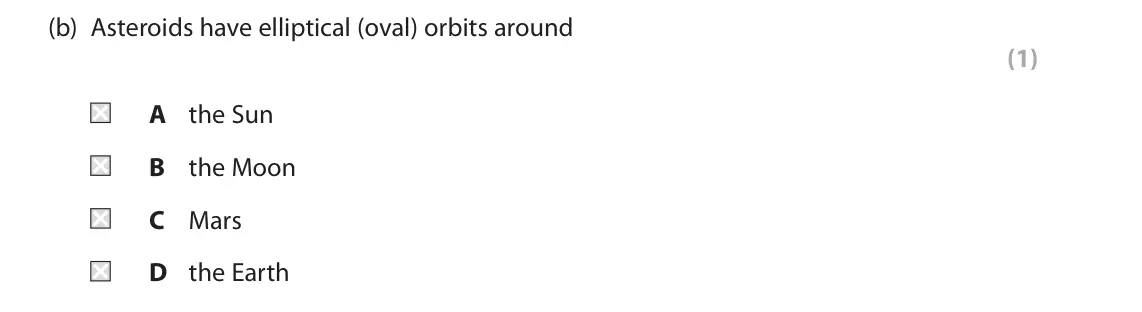
Q7(c)
The whole paper ↗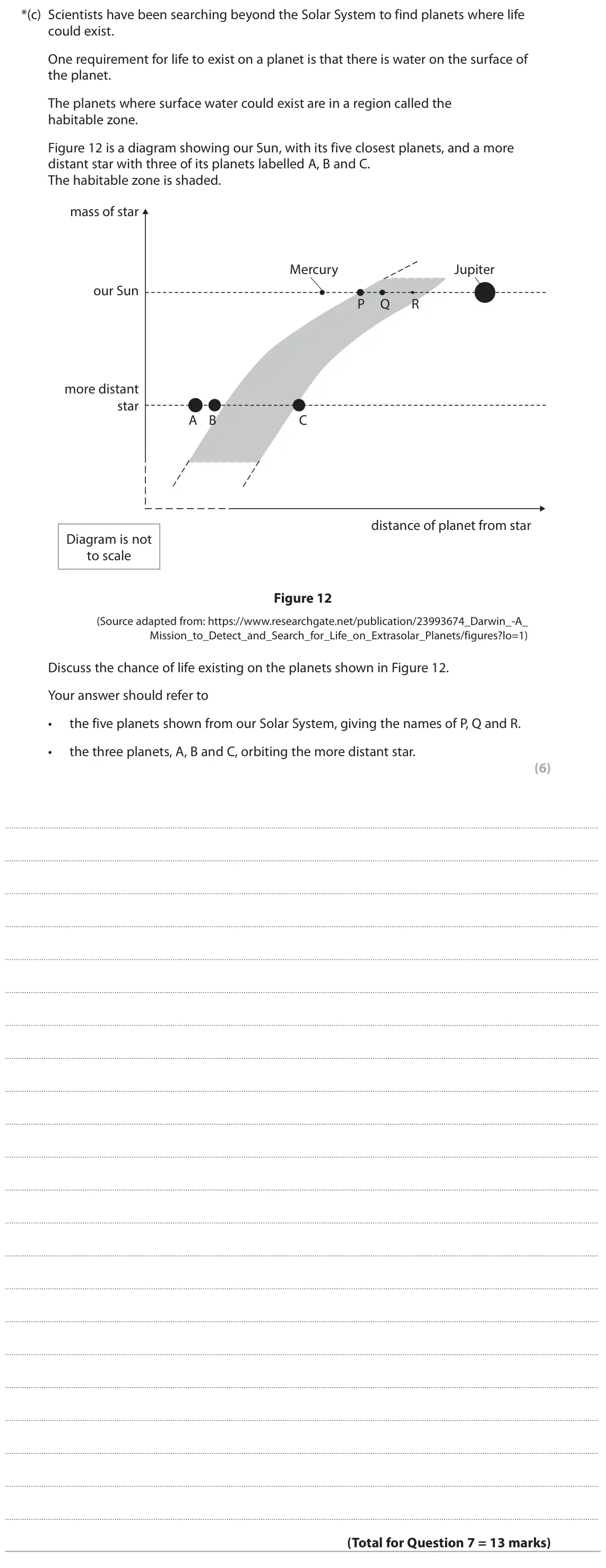
Q7(a)(i)
The whole paper ↗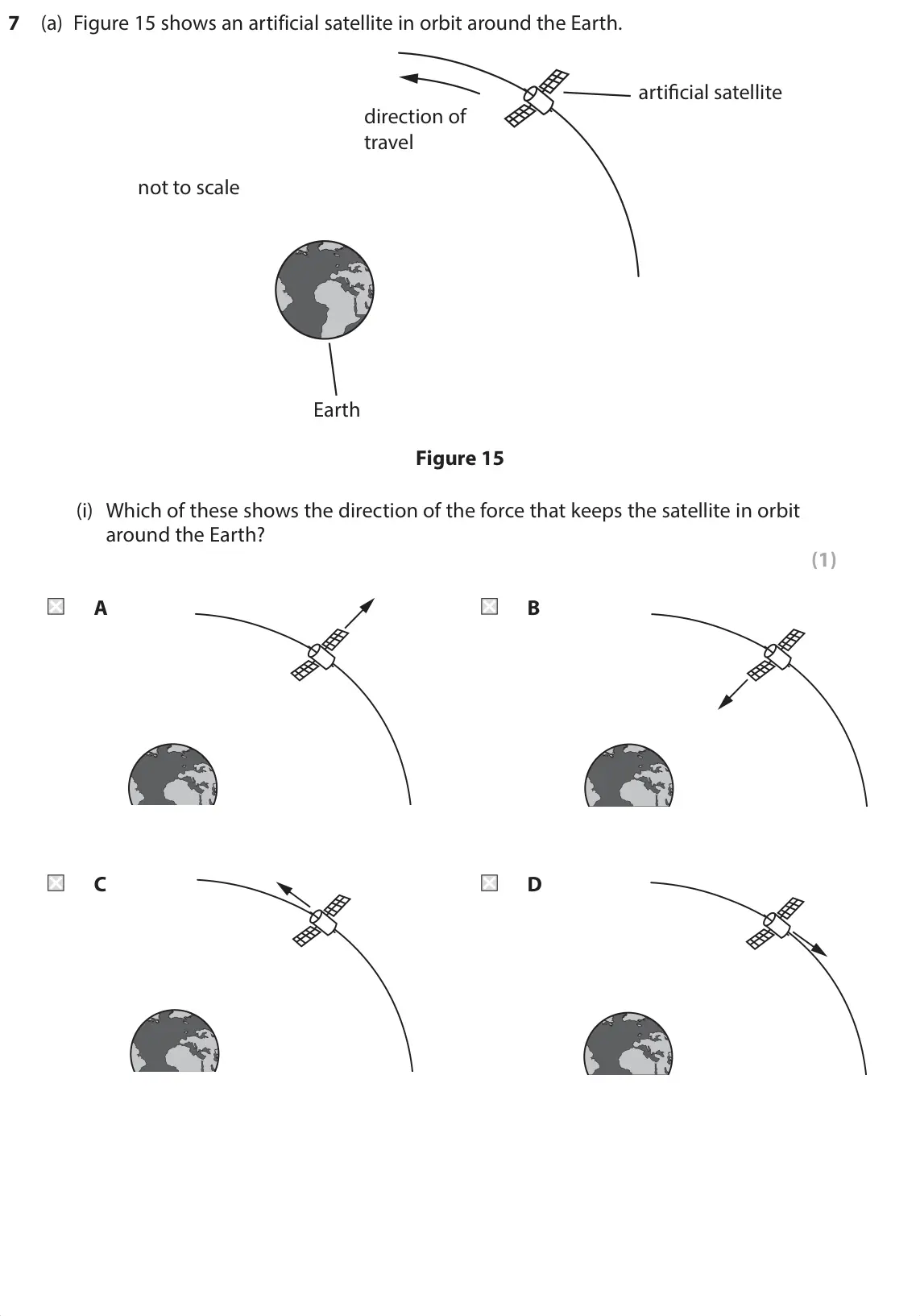
Q7(c)
The whole paper ↗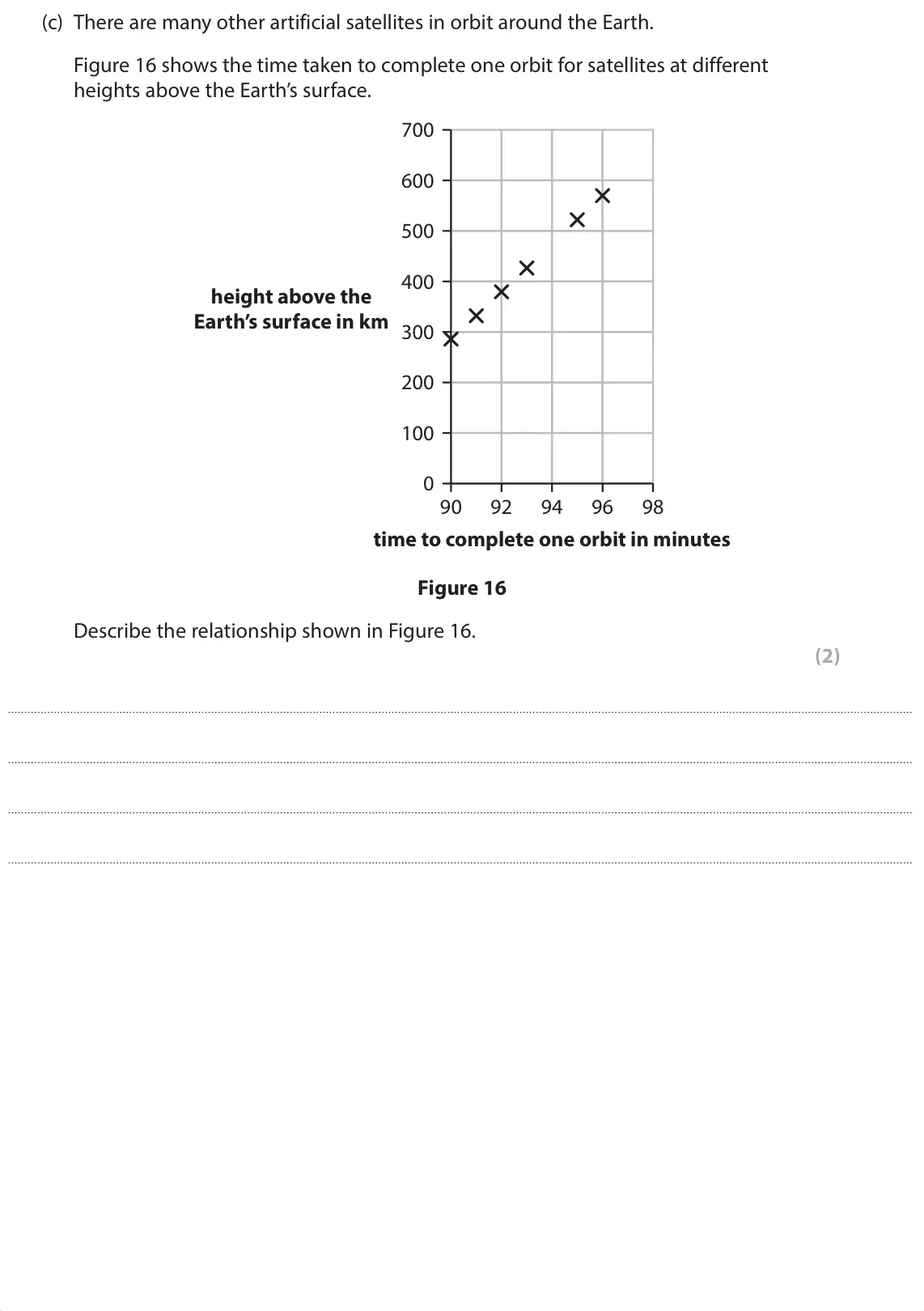
Q7(d)
The whole paper ↗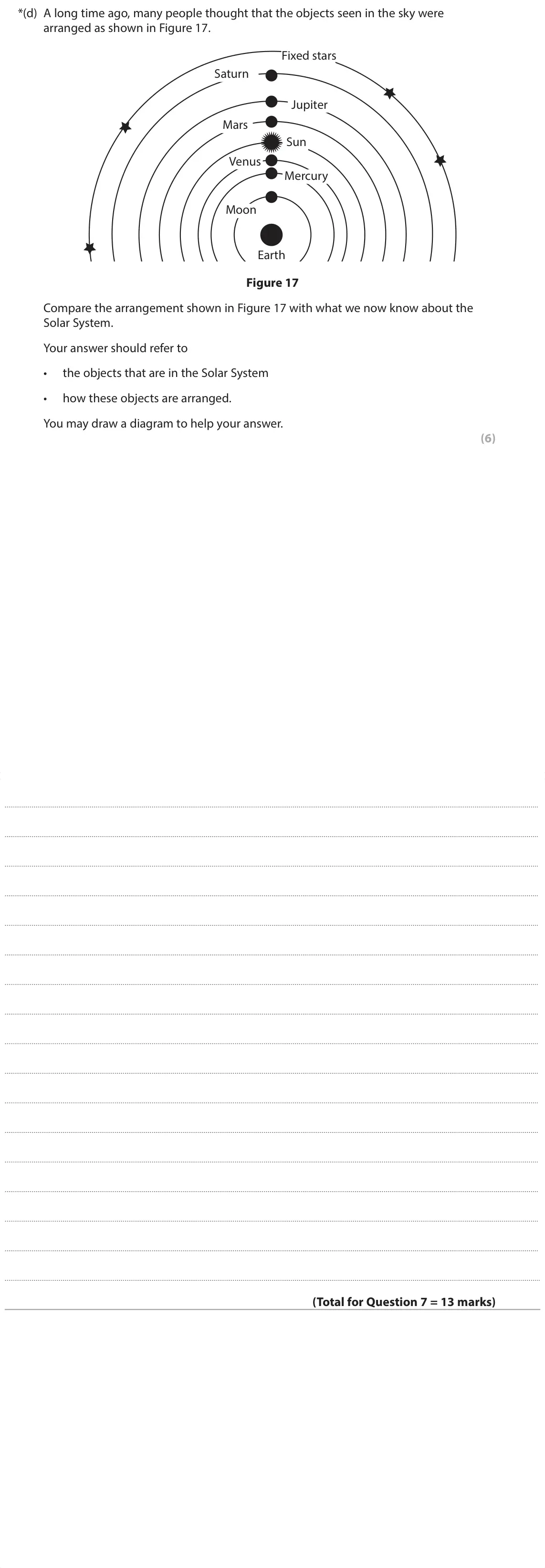
Q5(c)(iii)
The whole paper ↗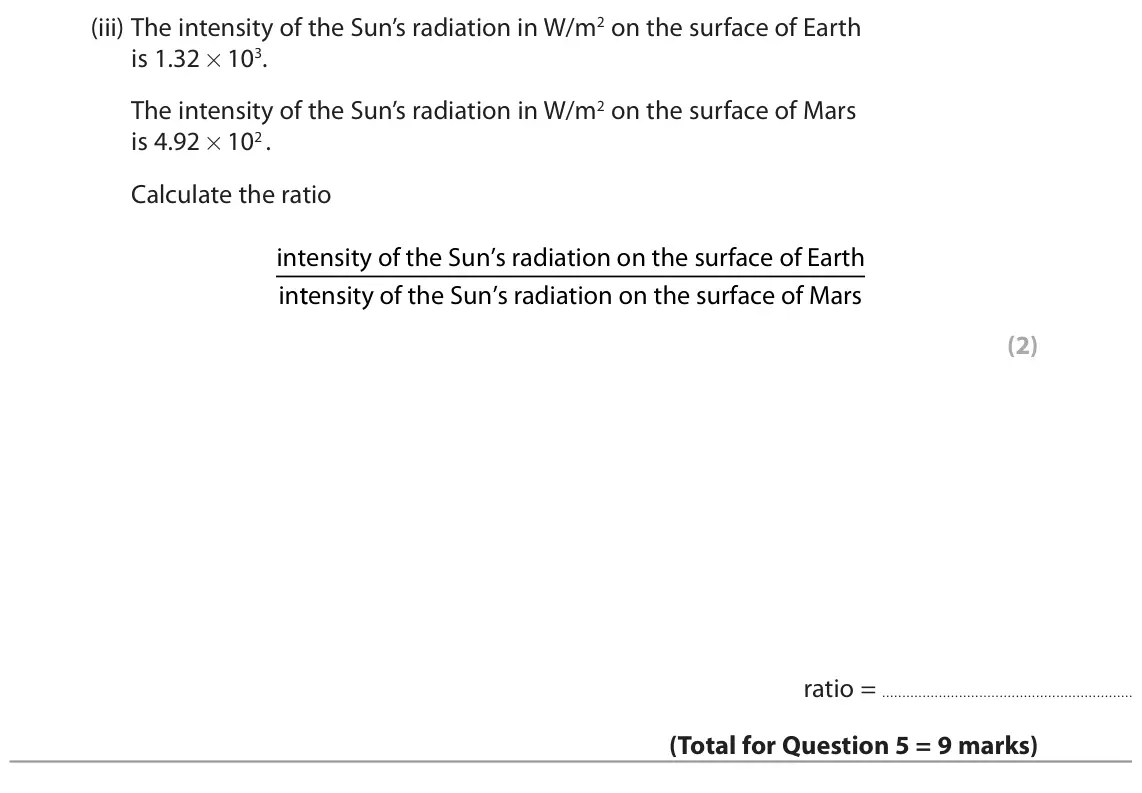
Q7(a)(ii)
The whole paper ↗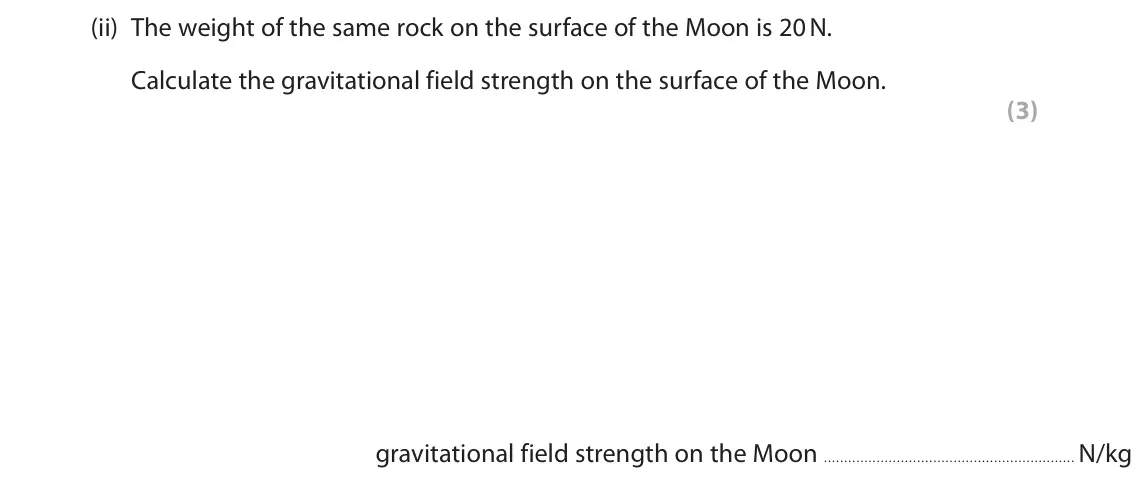
Q7(b)
The whole paper ↗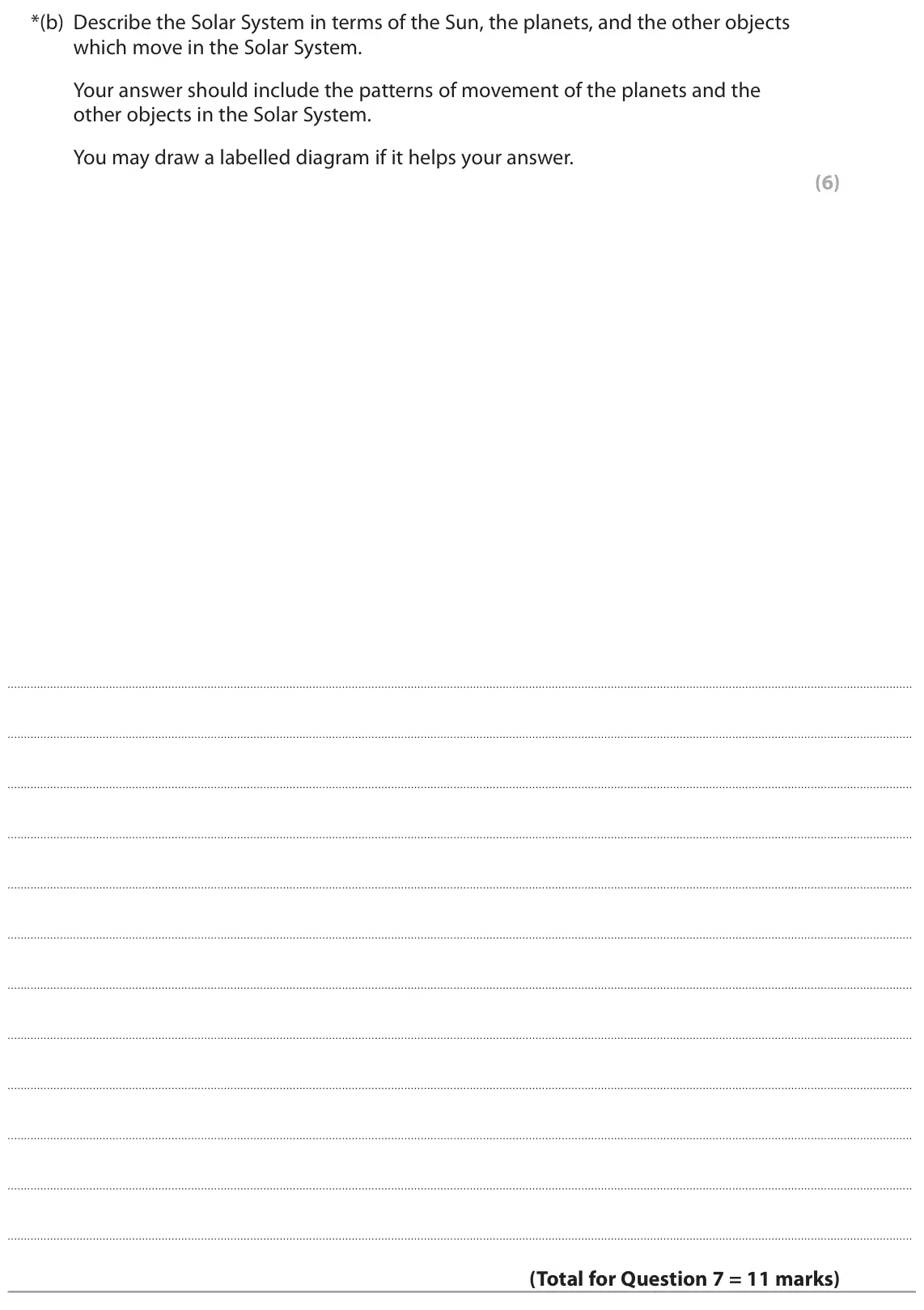
Q8(a)
The whole paper ↗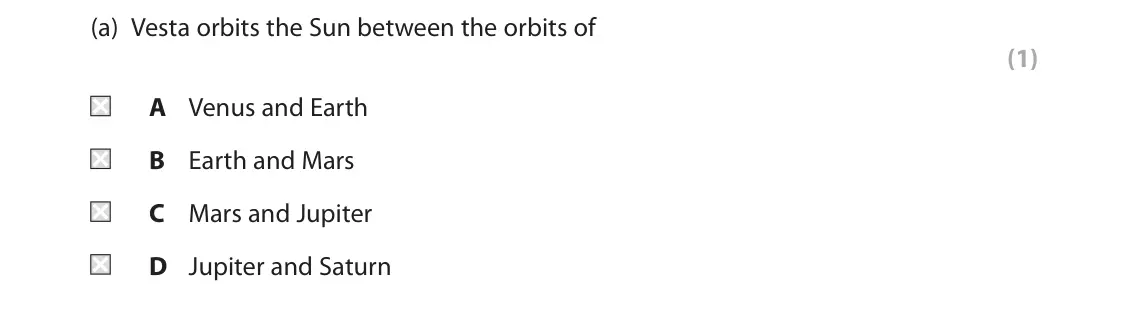
Q8(b)
The whole paper ↗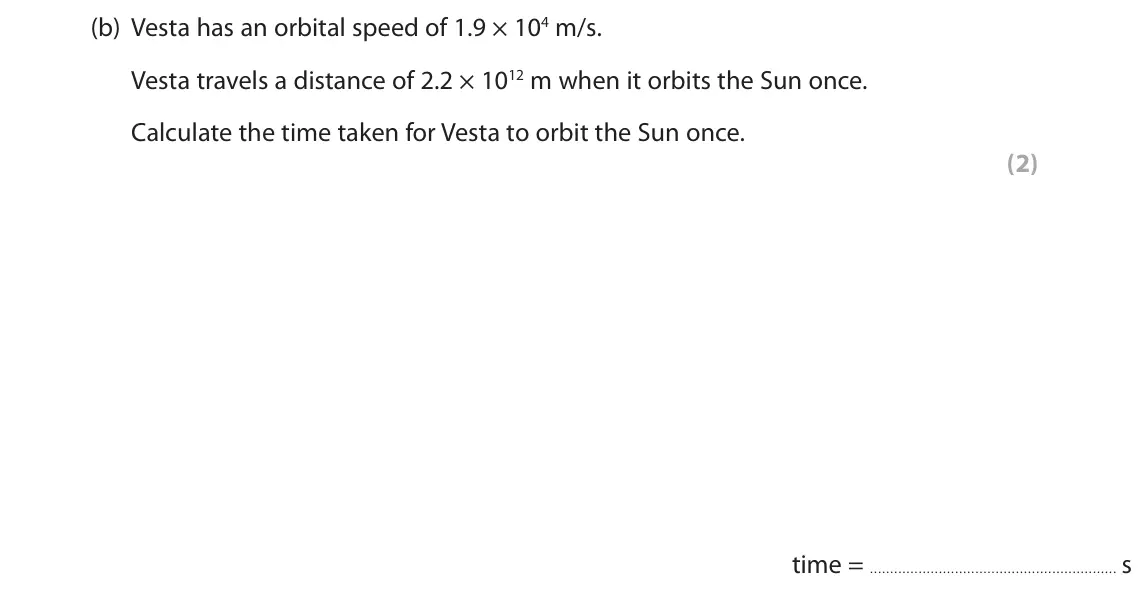
Q1(a)
The whole paper ↗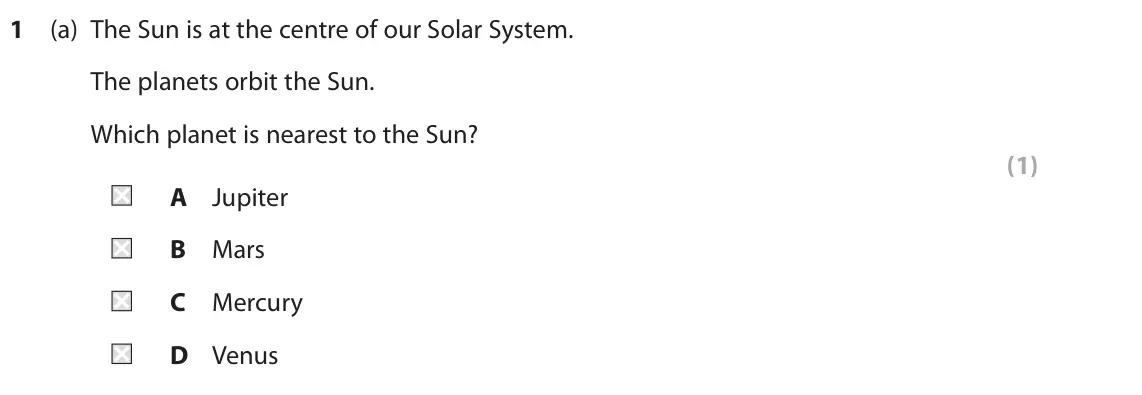
Q1(b)
The whole paper ↗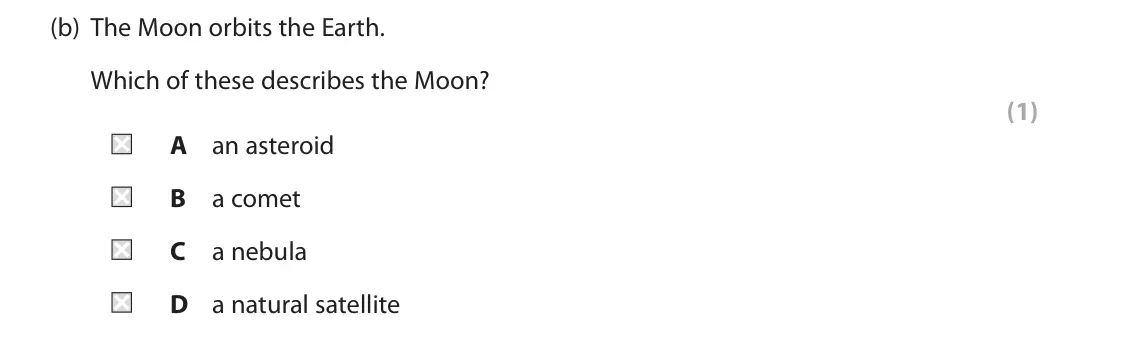
Q1(c)
The whole paper ↗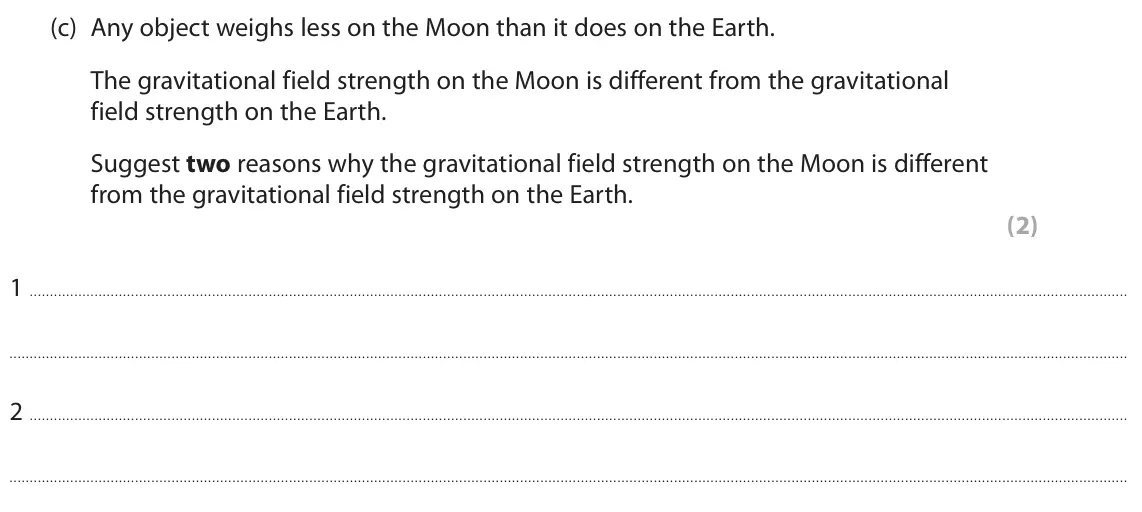
Q3(a)
The whole paper ↗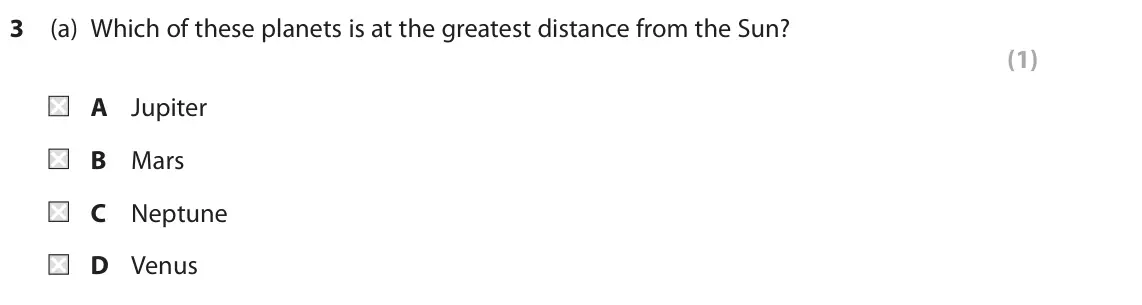
Q3(b)(i)
The whole paper ↗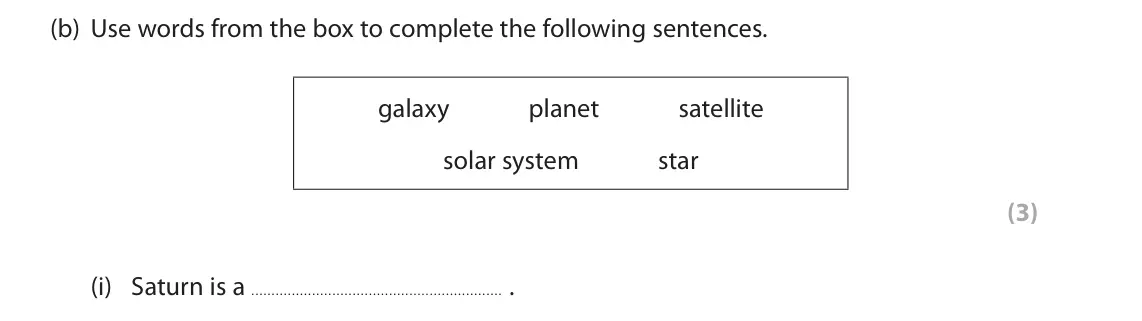
Q3(b)(ii)
The whole paper ↗
Q3(b)(iii)
The whole paper ↗
All 32 questions on Gravity, the Solar System and orbits, as a list
- June 2025, Paper 1 Foundation, Q7(a)(i) (2 marks): Calculate the ratio value of on Earth g value of on Mars g (2) ratio =
- June 2025, Paper 1 Foundation, Q7(a)(ii) (2 marks): A person has a weight of 730 N on Earth. Calculate the person’s weight on the Moon, using information from Figure 11. (2) weight on the Moon = N
- June 2025, Paper 1 Foundation, Q7(a)(iii) (2 marks): The gravitational field strength, g, is different on the surfaces of Earth, the Moon and Mars. Explain why this is the case. (2)
- June 2025, Paper 1 Foundation, Q7(b) (1 mark): Asteroids have elliptical (oval) orbits around (1) A the Sun B the Moon C Mars D the Earth
- June 2025, Paper 1 Foundation, Q7(c) (6 marks): Scientists have been searching beyond the Solar System to find planets where life could exist. One requirement for life to exist on a planet is that there is wa
- June 2024, Paper 1 Foundation, Q7(a)(i) (1 mark): Which of these shows the direction of the force that keeps the satellite in orbit around the Earth? (1) A B C D
- June 2024, Paper 1 Foundation, Q7(c) (2 marks): There are many other artificial satellites in orbit around the Earth. Figure 16 shows the time taken to complete one orbit for satellites at different heights a
- June 2024, Paper 1 Foundation, Q7(d) (6 marks): A long time ago, many people thought that the objects seen in the sky were arranged as shown in Figure 17. Fixed stars Saturn Jupiter Mars Sun Venus Mercury Moo
- June 2022, Paper 1 Foundation, Q5(c)(iii) (2 marks): The intensity of the Sun’s radiation in W/m2 on the surface of Earth is 1.32 × 10³. The intensity of the Sun’s radiation in W/m2 on the surface of Mars is 4.92
- June 2022, Paper 1 Foundation, Q7(a)(ii) (3 marks): The weight of the same rock on the surface of the Moon is 20 N. Calculate the gravitational field strength on the surface of the Moon. (3) gravitational field s
- June 2022, Paper 1 Foundation, Q7(b) (6 marks): Describe the Solar System in terms of the Sun, the planets, and the other objects which move in the Solar System. Your answer should include the patterns of mov
- November 2021, Paper 1 Higher, Q8(a) (1 mark): Vesta orbits the Sun between the orbits of (1) A Venus and Earth B Earth and Mars C Mars and Jupiter D Jupiter and Saturn
- November 2021, Paper 1 Higher, Q8(b) (2 marks): Vesta has an orbital speed of 1.9 × 10⁴ m/s. Vesta travels a distance of 2.2 × 10¹² m when it orbits the Sun once. Calculate the time taken for Vesta to orbit t
- November 2021, Paper 1 Foundation, Q1(a) (1 mark): The Sun is at the centre of our Solar System. The planets orbit the Sun. Which planet is nearest to the Sun? (1) A Jupiter B Mars C Mercury D Venus
- November 2021, Paper 1 Foundation, Q1(b) (1 mark): The Moon orbits the Earth. Which of these describes the Moon? (1) A an asteroid B a comet C a nebula D a natural satellite
- November 2021, Paper 1 Foundation, Q1(c) (2 marks): Any object weighs less on the Moon than it does on the Earth. The gravitational field strength on the Moon is different from the gravitational field strength on
- November 2020, Paper 1 Foundation, Q3(a) (1 mark): Which of these planets is at the greatest distance from the Sun? (1) A Jupiter B Mars C Neptune D Venus
- November 2020, Paper 1 Foundation, Q3(b)(i) (3 marks): Saturn is a .
- November 2020, Paper 1 Foundation, Q3(b)(ii): The Moon is a .
- November 2020, Paper 1 Foundation, Q3(b)(iii): Halley’s Comet orbits a .
- November 2020, Paper 1 Foundation, Q3(c)(i) (1 mark): The gravitational field strength on Earth is 10 N / kg. Calculate the weight of the rover on Earth. Use the equation weight = mass × gravitational field strengt
- November 2020, Paper 1 Foundation, Q3(c)(ii) (2 marks): The weight of the rover on Mars is 700 N. Calculate the gravitational field strength on Mars. (2) gravitational field strength on Mars = N / kg
- June 2019, Paper 1 Higher, Q4(c)(i) (1 mark): A long time ago, scientists believed that the Earth was at the centre of the Solar System. Evidence has since proved that the Sun is at the centre of the Solar
- June 2019, Paper 1 Higher, Q4(c)(ii) (3 marks): Figure 4 shows data for some of the planets of the Solar System. 14.0 Jupiter 12.0 10.0 8.0 year length in Earth years 6.0 4.0 Mars Earth 2.0 Venus Mercury 0.0
- June 2019, Paper 1 Foundation, Q10(c)(i) (1 mark): A long time ago, scientists believed that the Earth was at the centre of the Solar System. Evidence has since proved that the Sun is at the centre of the Solar
- June 2019, Paper 1 Foundation, Q10(c)(ii) (3 marks): Figure 13 shows data for some of the planets of the Solar System. 14.0 Jupiter - 12.0 10.0 - 8.0- year length in Earth years 6.0 - 4.0 Mars Earth 2.0- Venus Mer
- June 2018, Paper 1 Higher, Q4(b)(i) (1 mark): State the name of the force that keeps the satellite in orbit around the Earth. (1)
- June 2018, Paper 1 Higher, Q4(b)(ii) (1 mark): Draw an arrow on Figure 6 to show the direction of the force acting on the satellite, that keeps the satellite in orbit around the Earth. Label this arrow ‘F’.
- June 2018, Paper 1 Foundation, Q7(c) (6 marks): More than two thousand years ago the Earth was believed to be at the centre of the universe as shown in Figure 13. The planets, the Moon and the Sun were believ
- June 2018, Paper 1 Foundation, Q10(b)(i) (1 mark): State the name of the force that keeps the satellite in orbit around the Earth. (1)
- June 2018, Paper 1 Foundation, Q10(b)(ii) (1 mark): Draw an arrow on Figure 20 to show the direction of the force acting on the satellite, that keeps the satellite in orbit around the Earth. Label this arrow ‘F’.
- June 2018, Paper 2 Foundation, Q4(a)(i) (1 mark): Which of these forces keeps the Moon moving around the Earth? (1) A contact B electrostatic C gravitational D magnetic
Questions, mark schemes and examiner’s reports are © Pearson Edexcel, from their published past papers. Plumi isn’t affiliated with any exam board. Want whole papers? Every Edexcel GCSE Physics paper.
Rather write your answers by hand on iPad? Plumi marks them against the same mark schemes.