Skip to content

AQA A‑Level Biology questions by topic

Every question from every AQA A-Level Biology paper, 2016–2025, part by part. Filter by topic, paper or year, open the mark scheme under any question, and download a set as a PDF.

Find questions1,383
Topics Pick as many as you like. Open one to choose its sub-topics.

Year 1 · AS

Year 2 · A‑Level only

Calculations

1,383 questions

  1. Q01.1

    June 2025 · Paper 1

    4 marks
    The whole paper ↗
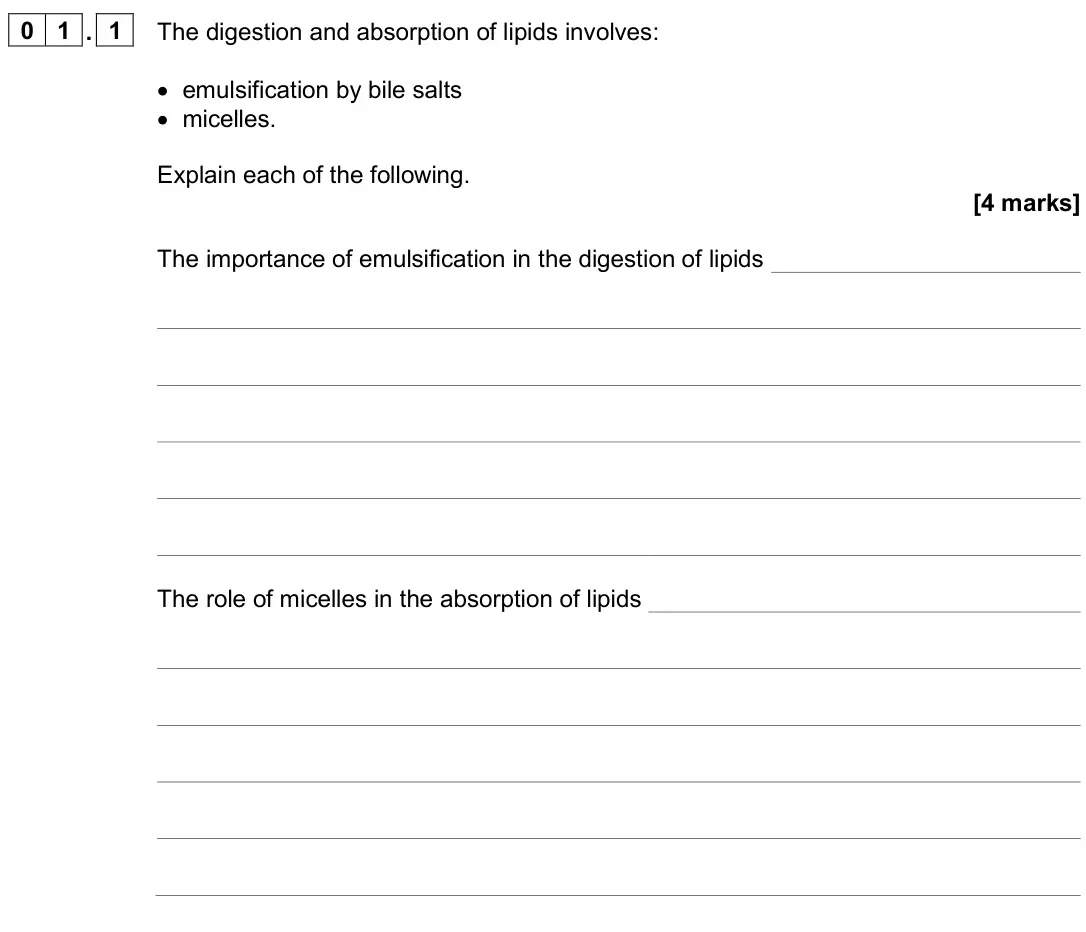
    June 2025 Paper 1, question 01.1: The digestion and absorption of lipids involves: • emulsification by bile salts • micelles. Explain each of the following. [4 marks] The importance of emulsific
  2. Q01.2

    June 2025 · Paper 1

    2 marks
    The whole paper ↗
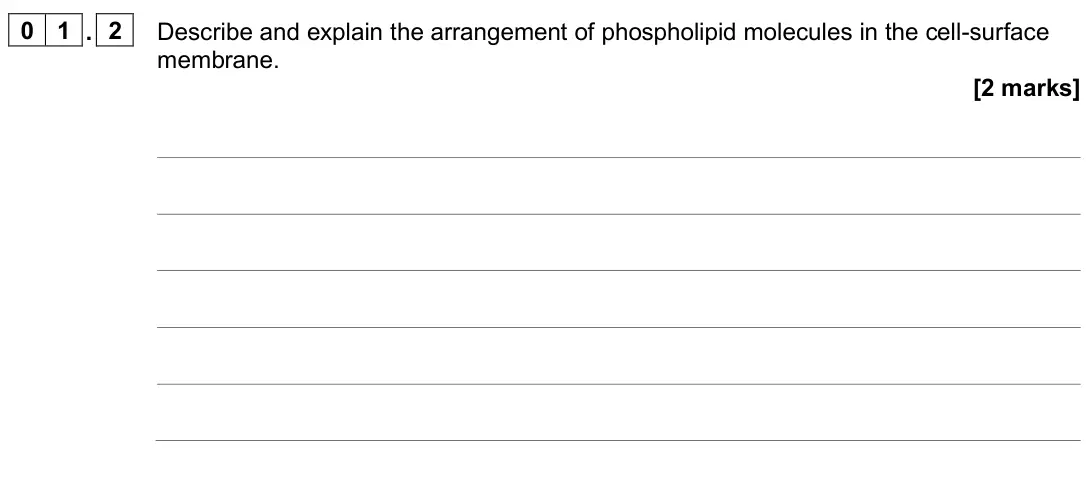
    June 2025 Paper 1, question 01.2: Describe and explain the arrangement of phospholipid molecules in the cell-surface membrane. [2 marks]
  3. Q02.1

    June 2025 · Paper 1

    1 mark
    The whole paper ↗
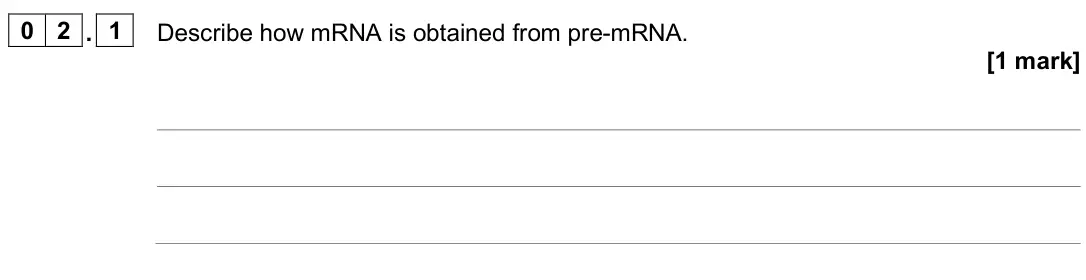
    June 2025 Paper 1, question 02.1: Describe how mRNA is obtained from pre-mRNA. [1 mark]
  4. Q02.2

    June 2025 · Paper 1

    2 marks
    The whole paper ↗
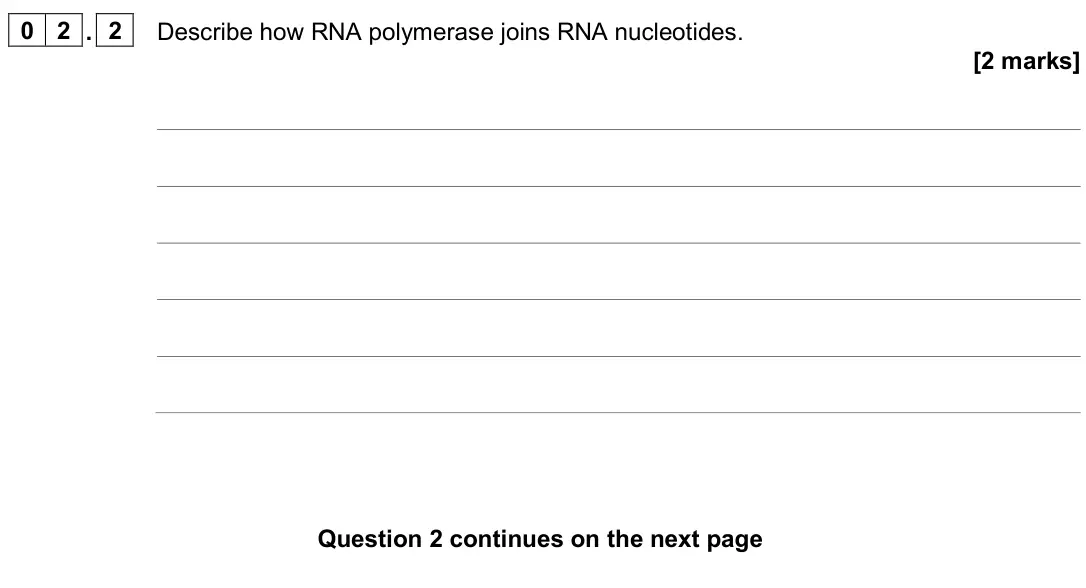
    June 2025 Paper 1, question 02.2: Describe how RNA polymerase joins RNA nucleotides. [2 marks]
  5. Q02.3

    June 2025 · Paper 1

    1 mark
    The whole paper ↗
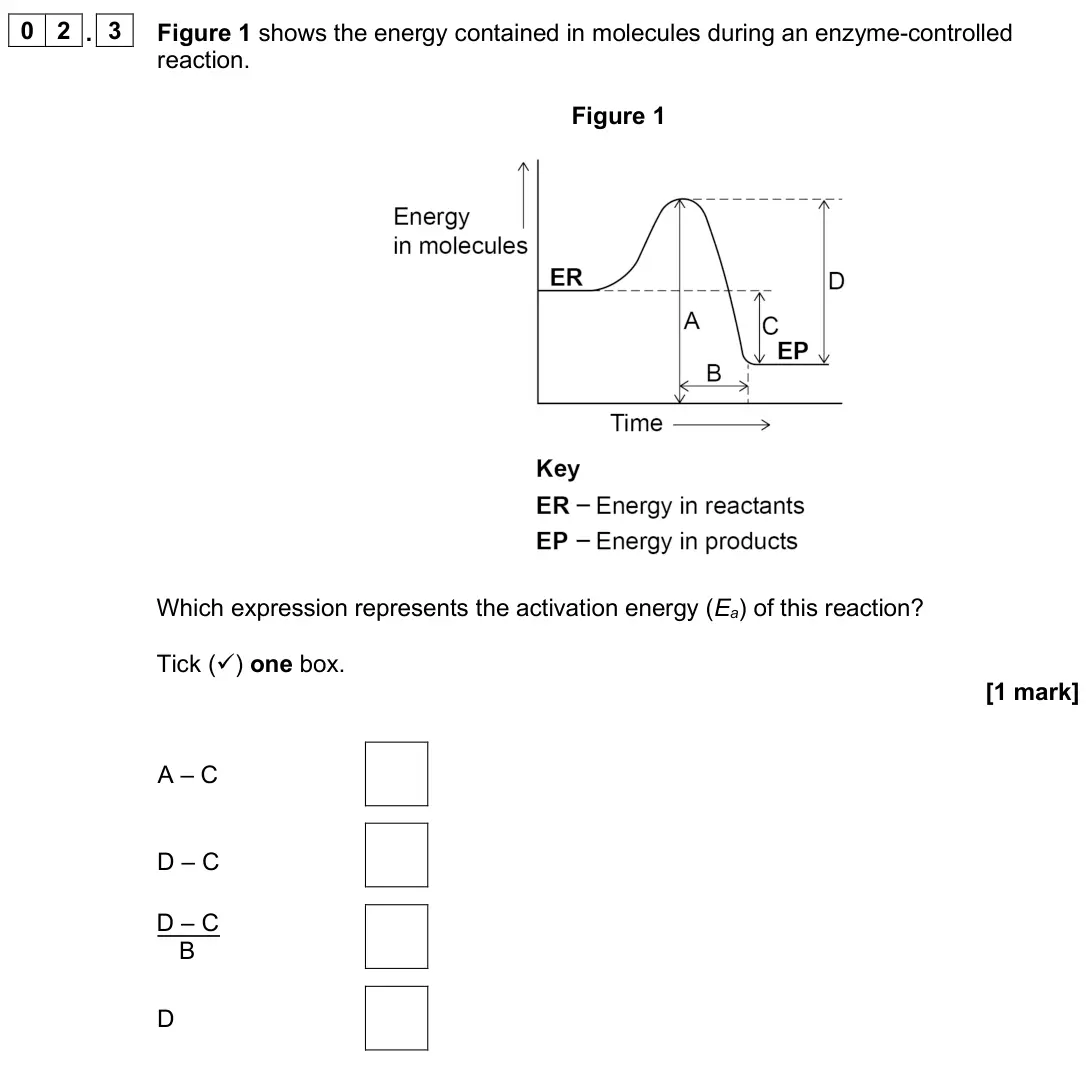
    June 2025 Paper 1, question 02.3: Figure 1 shows the energy contained in molecules during an enzyme-controlled reaction. Figure 1 Which expression represents the activation energy (Ea) of this r
  6. Q02.4

    June 2025 · Paper 1

    4 marks
    The whole paper ↗
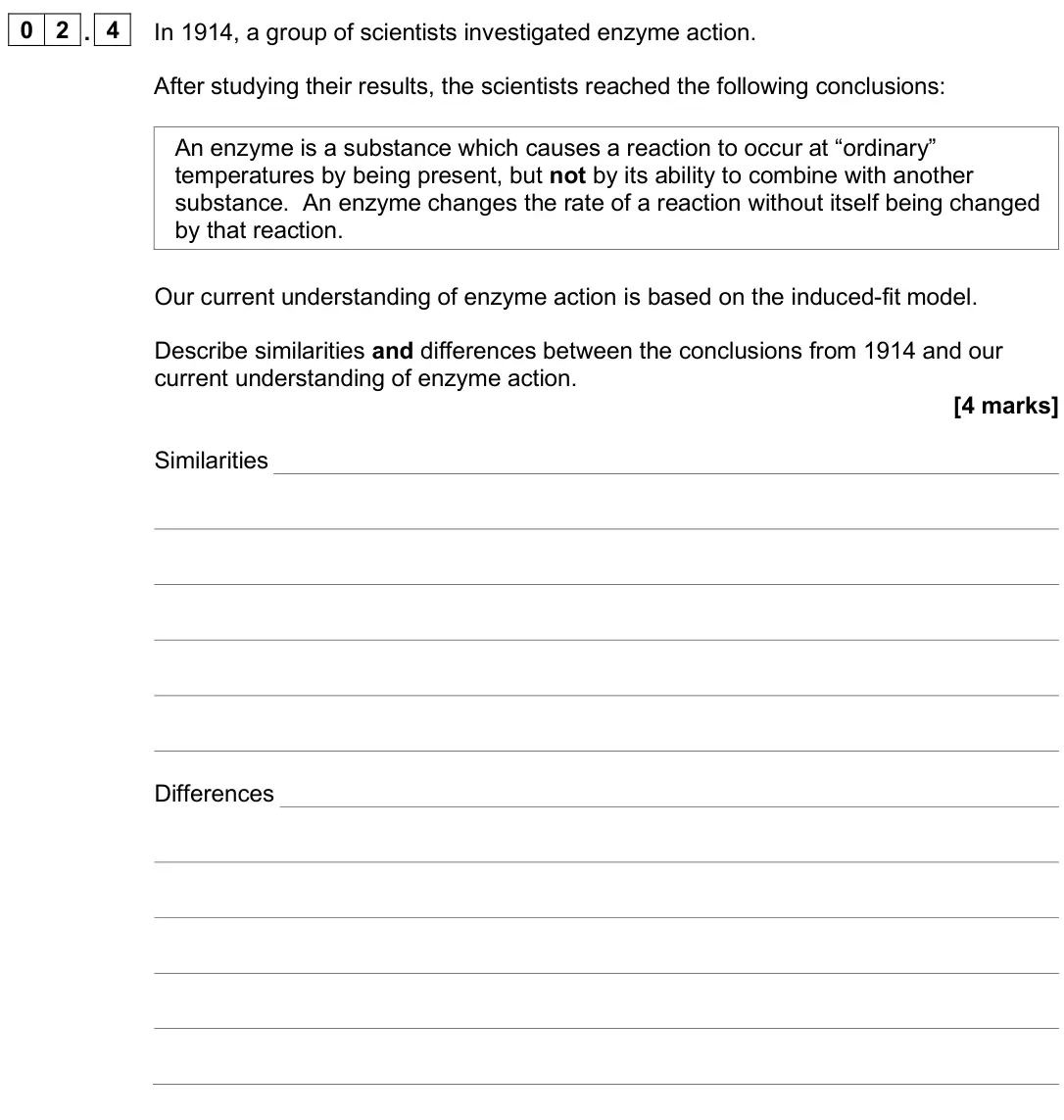
    June 2025 Paper 1, question 02.4: In 1914, a group of scientists investigated enzyme action. After studying their results, the scientists reached the following conclusions: An enzyme is a substa
  7. Q03.1

    June 2025 · Paper 1

    3 marks
    The whole paper ↗
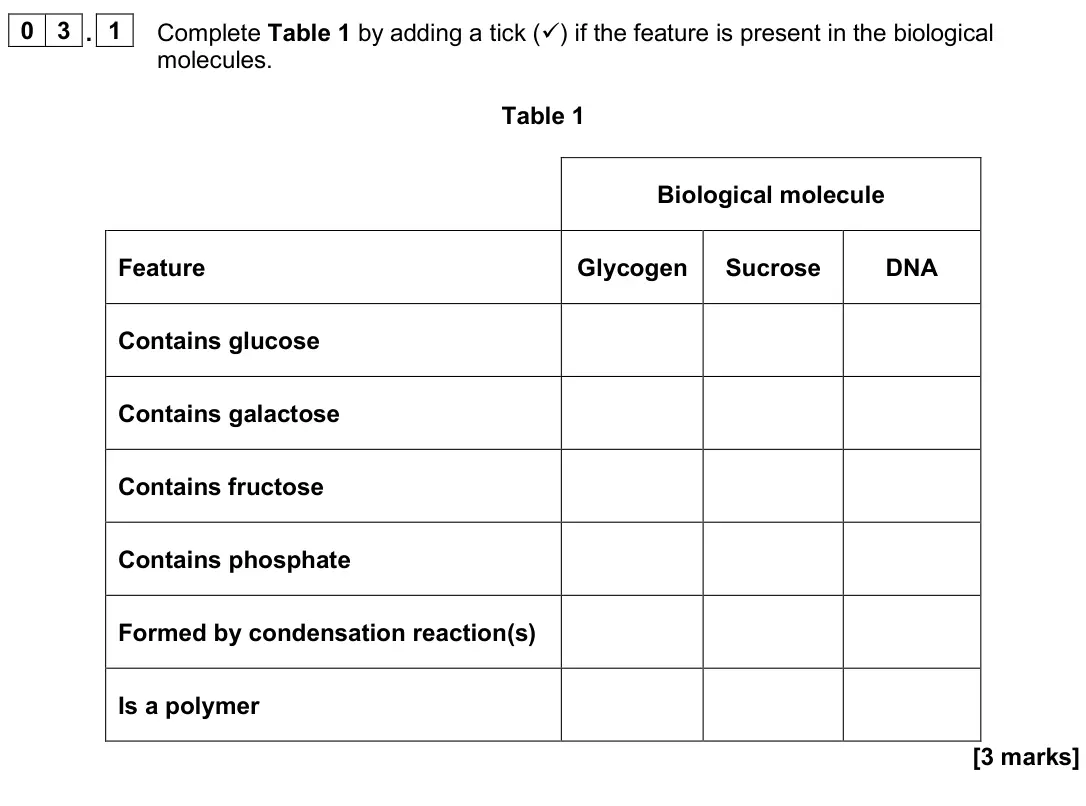
    June 2025 Paper 1, question 03.1: Complete Table 1 by adding a tick () if the feature is present in the biological molecules. Table 1 Biological molecule Feature Glycogen Sucrose DNA Contains g
  8. Q03.2

    June 2025 · Paper 1

    1 mark
    The whole paper ↗
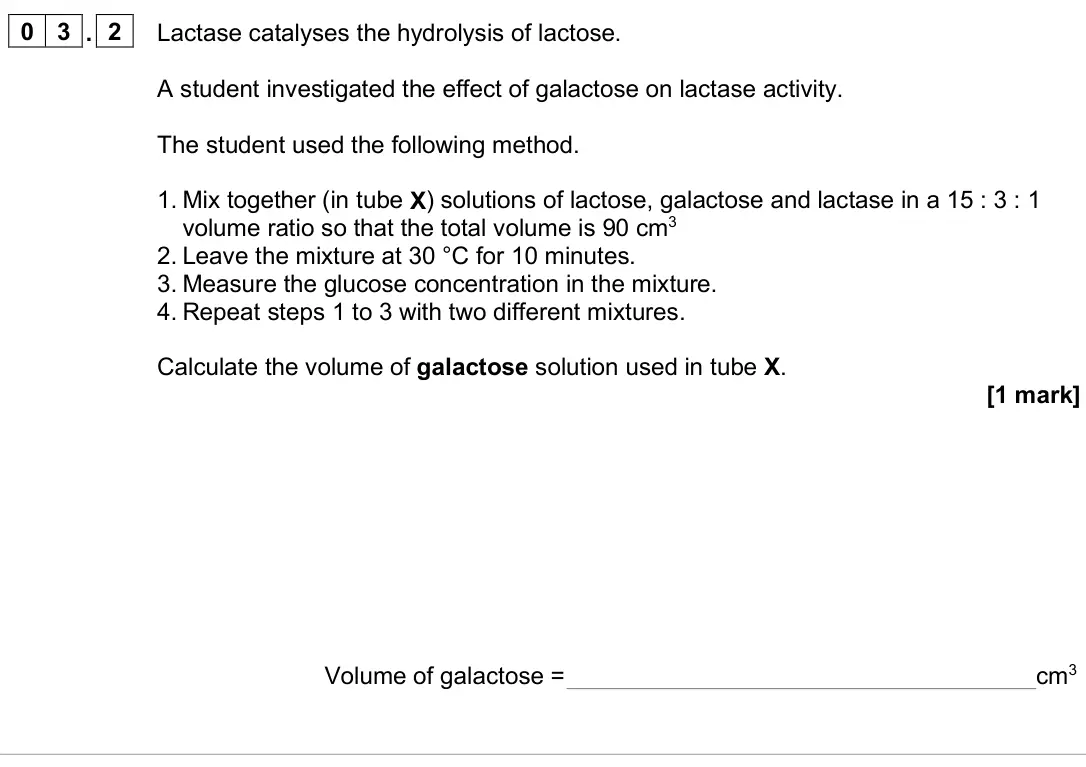
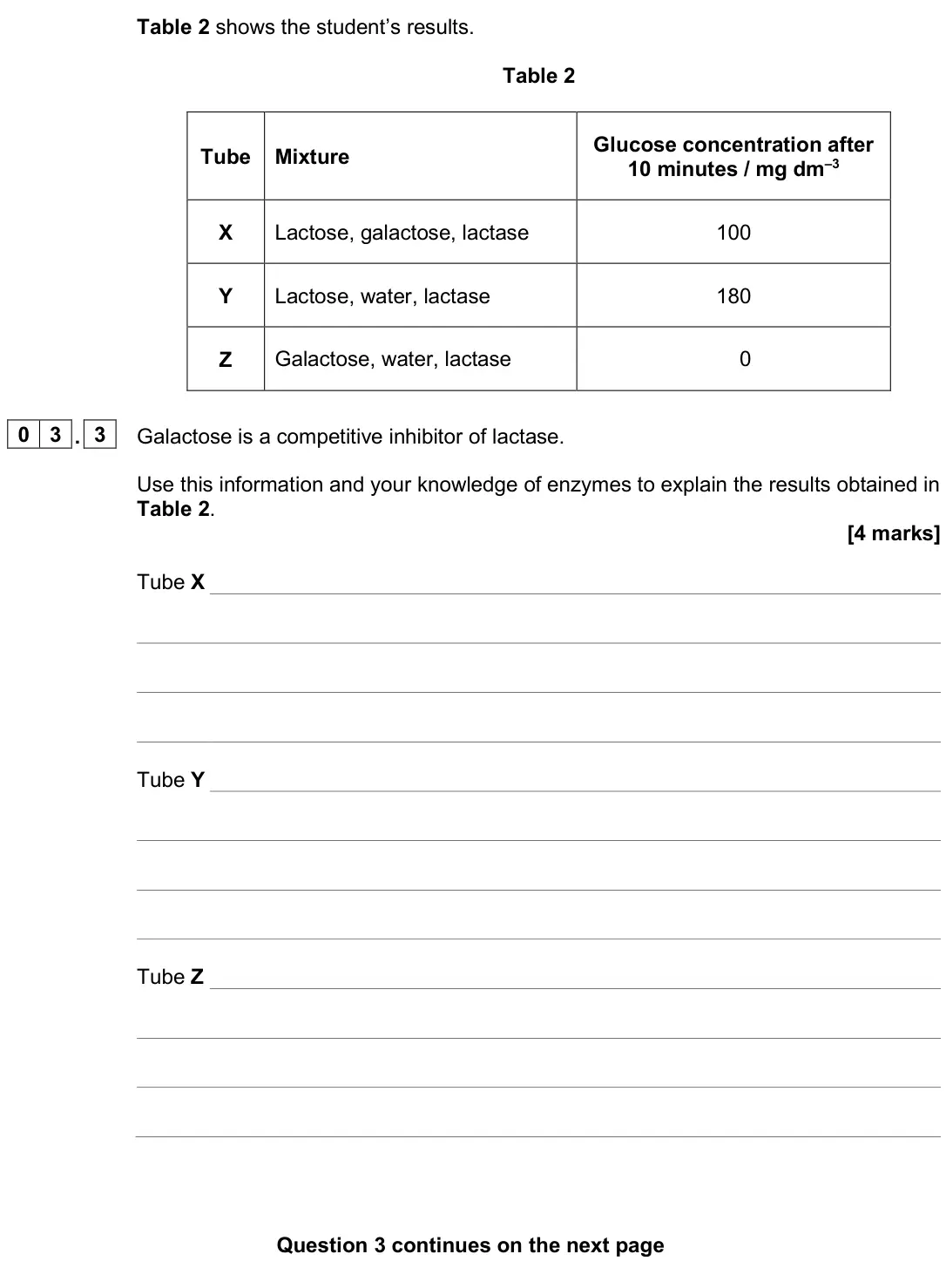
    June 2025 Paper 1, question 03.2: Lactase catalyses the hydrolysis of lactose. A student investigated the effect of galactose on lactase activity. The student used the following method. 1. Mix t
  9. Q03.3

    June 2025 · Paper 1

    4 marks
    The whole paper ↗
    June 2025 Paper 1, question 03.3: Galactose is a competitive inhibitor of lactase. Use this information and your knowledge of enzymes to explain the results obtained in Table 2. [4 marks] Tube X
  10. Q03.4

    June 2025 · Paper 1

    2 marks
    The whole paper ↗
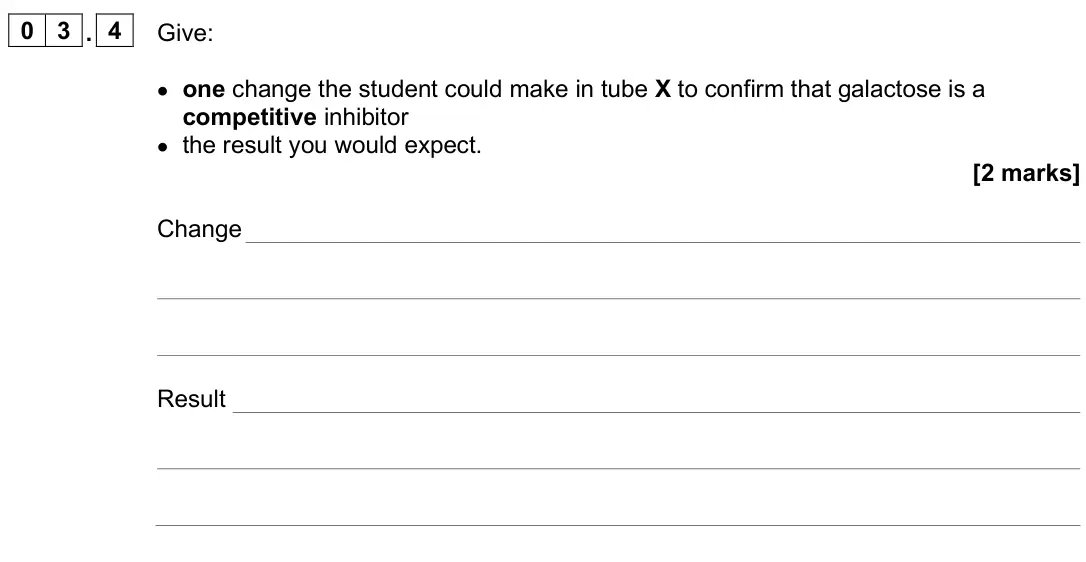
    June 2025 Paper 1, question 03.4: Give: • one change the student could make in tube X to confirm that galactose is a competitive inhibitor • the result you would expect. [2 marks] Change Result
  11. Q04.1

    June 2025 · Paper 1

    2 marks
    The whole paper ↗
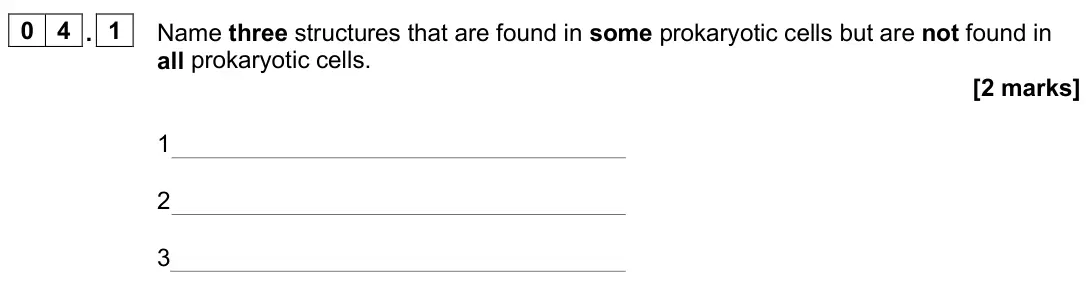
    June 2025 Paper 1, question 04.1: Name three structures that are found in some prokaryotic cells but are not found in all prokaryotic cells. [2 marks] 1 2 3
  12. Q04.2

    June 2025 · Paper 1

    4 marks
    The whole paper ↗
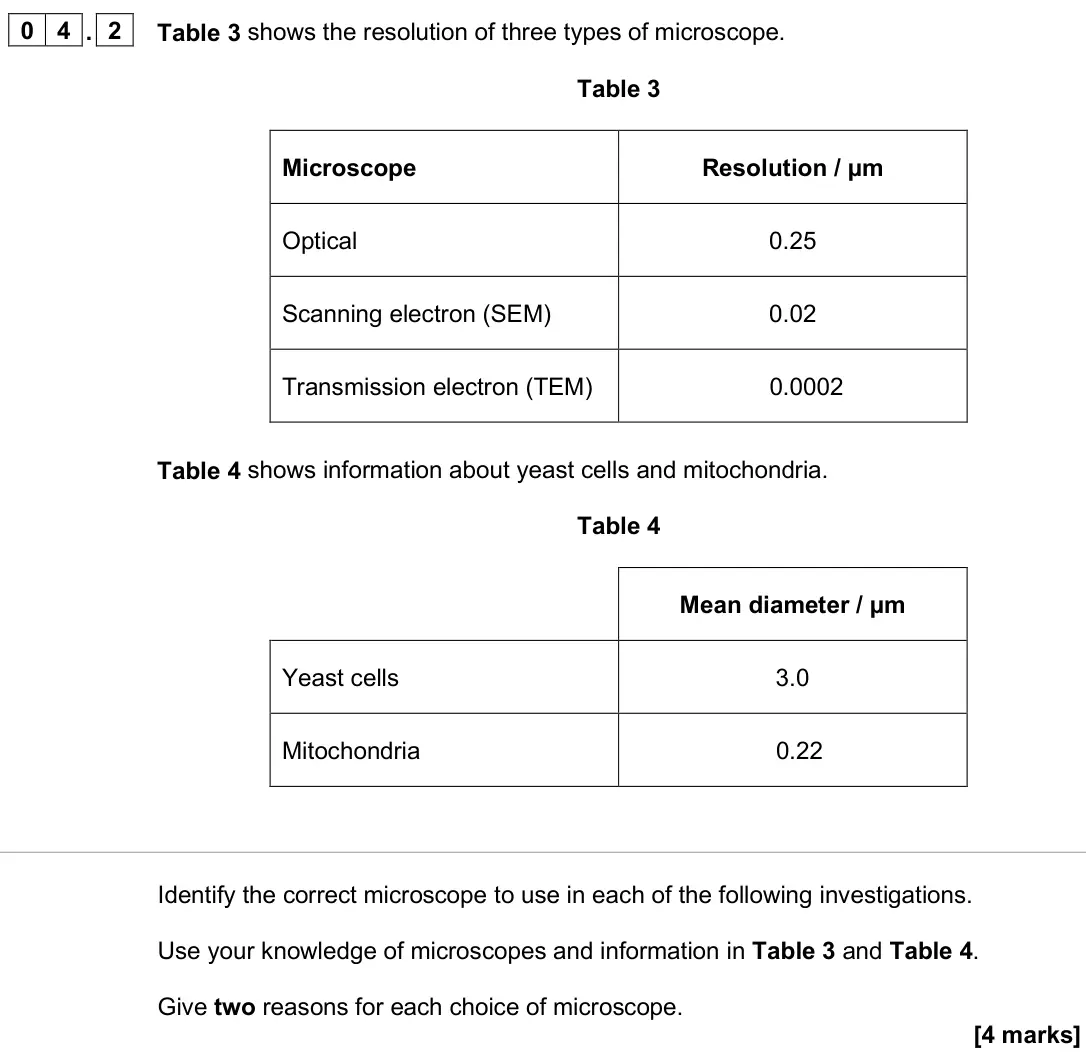
    June 2025 Paper 1, question 04.2: Table 3 shows the resolution of three types of microscope. Table 3 Microscope Resolution / μm Optical 0.25 Scanning electron (SEM) 0.02 Transmission electron (T
  13. Q05.1

    June 2025 · Paper 1

    4 marks
    The whole paper ↗
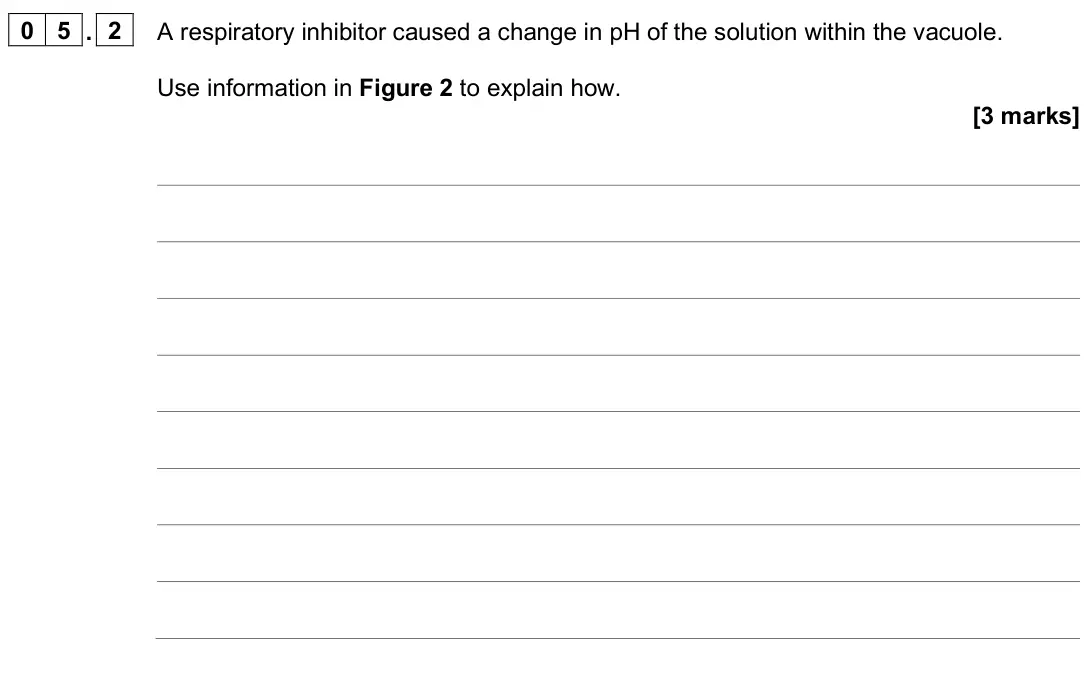
    June 2025 Paper 1, question 05.1: Pears are a type of fruit. When pears ripen, the: • fructose concentration increases in cell vacuoles • volume of cell vacuoles increases. Figure 2 shows inform
  14. Q05.2

    June 2025 · Paper 1

    3 marks
    The whole paper ↗
    June 2025 Paper 1, question 05.2: A respiratory inhibitor caused a change in pH of the solution within the vacuole. Use information in Figure 2 to explain how. [3 marks]
  15. Q05.3

    June 2025 · Paper 1

    2 marks
    The whole paper ↗
    June 2025 Paper 1, question 05.3: Explain how a change in the expression of the genes coding for the carrier proteins can increase the rate of ripening of pears. [2 marks]
  16. Q06.1

    June 2025 · Paper 1

    2 marks
    The whole paper ↗
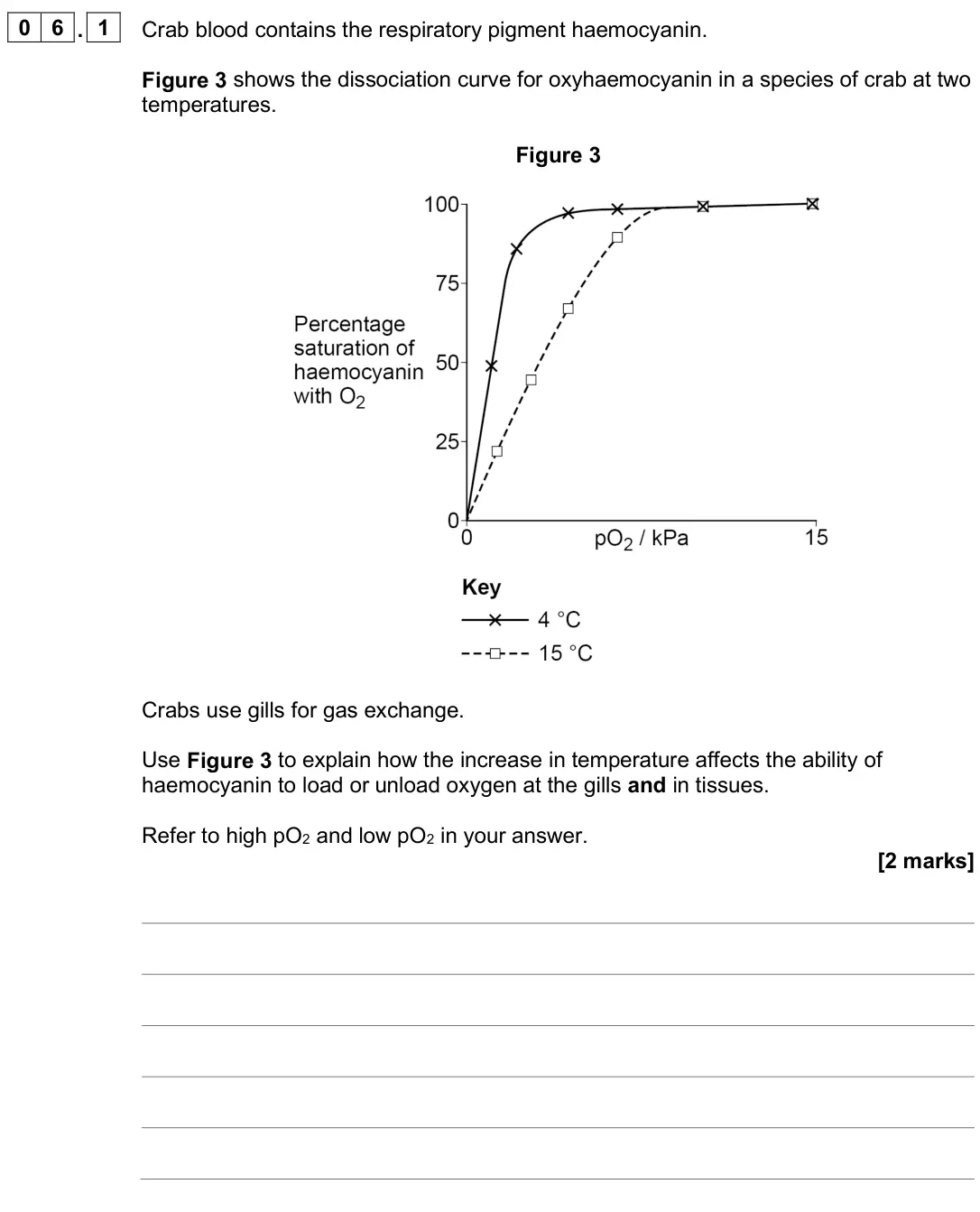
    June 2025 Paper 1, question 06.1: Crab blood contains the respiratory pigment haemocyanin. Figure 3 shows the dissociation curve for oxyhaemocyanin in a species of crab at two temperatures. Figu
  17. Q06.2

    June 2025 · Paper 1

    3 marks
    The whole paper ↗
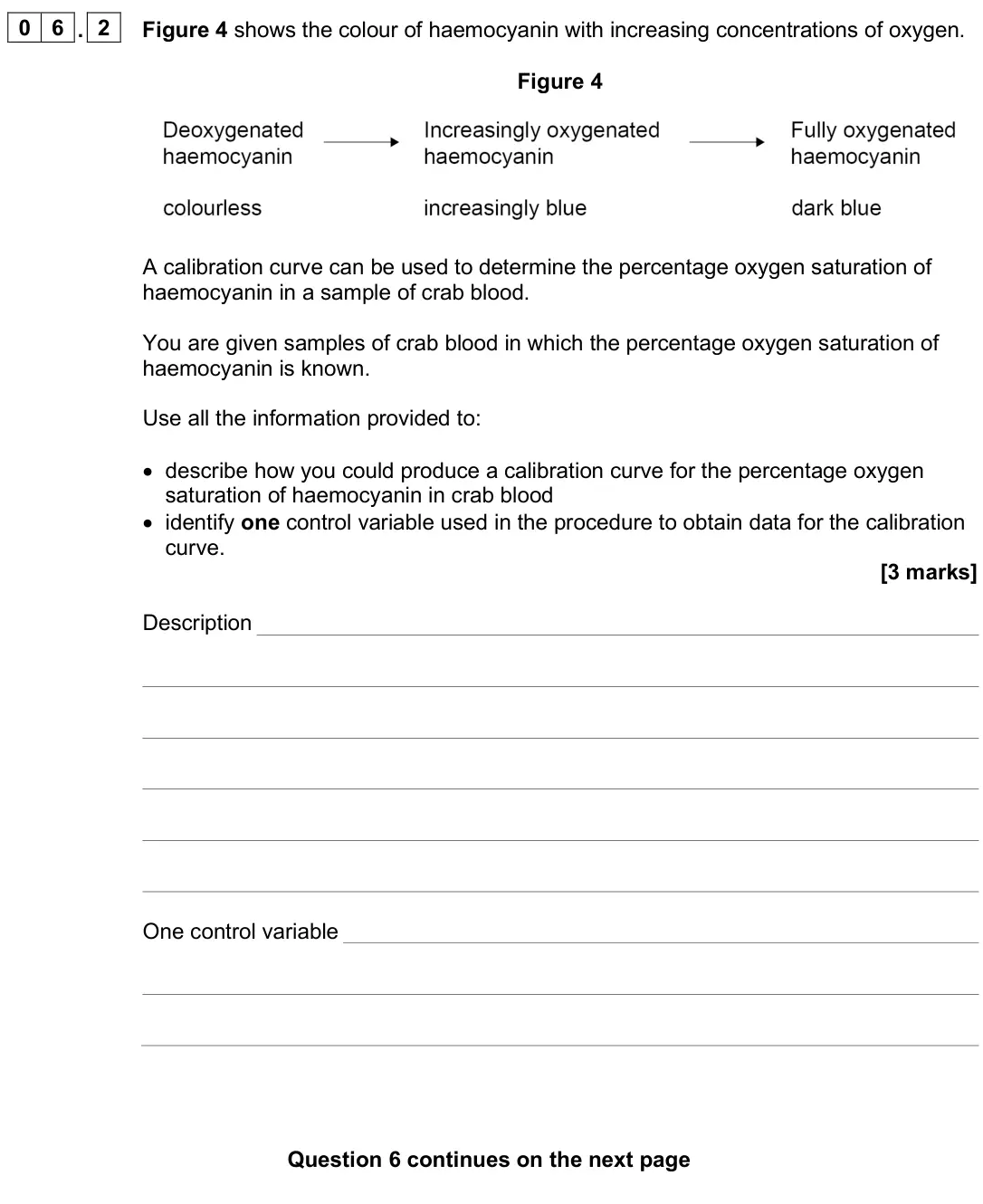
    June 2025 Paper 1, question 06.2: Figure 4 shows the colour of haemocyanin with increasing concentrations of oxygen. Figure 4 A calibration curve can be used to determine the percentage oxygen s
  18. Q06.3

    June 2025 · Paper 1

    2 marks
    The whole paper ↗
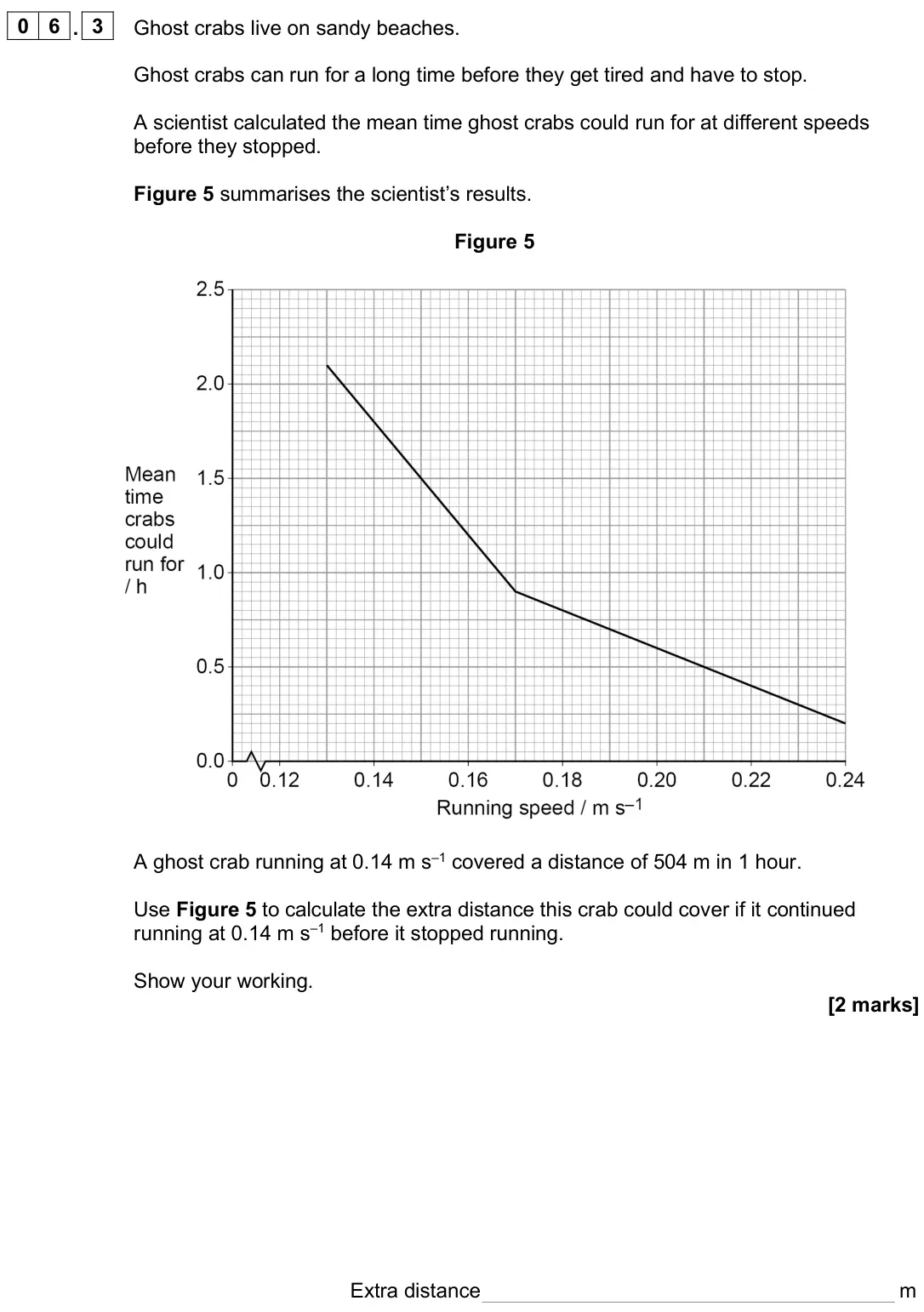
    June 2025 Paper 1, question 06.3: Ghost crabs live on sandy beaches. Ghost crabs can run for a long time before they get tired and have to stop. A scientist calculated the mean time ghost crabs
  19. Q06.4

    June 2025 · Paper 1

    3 marks
    The whole paper ↗
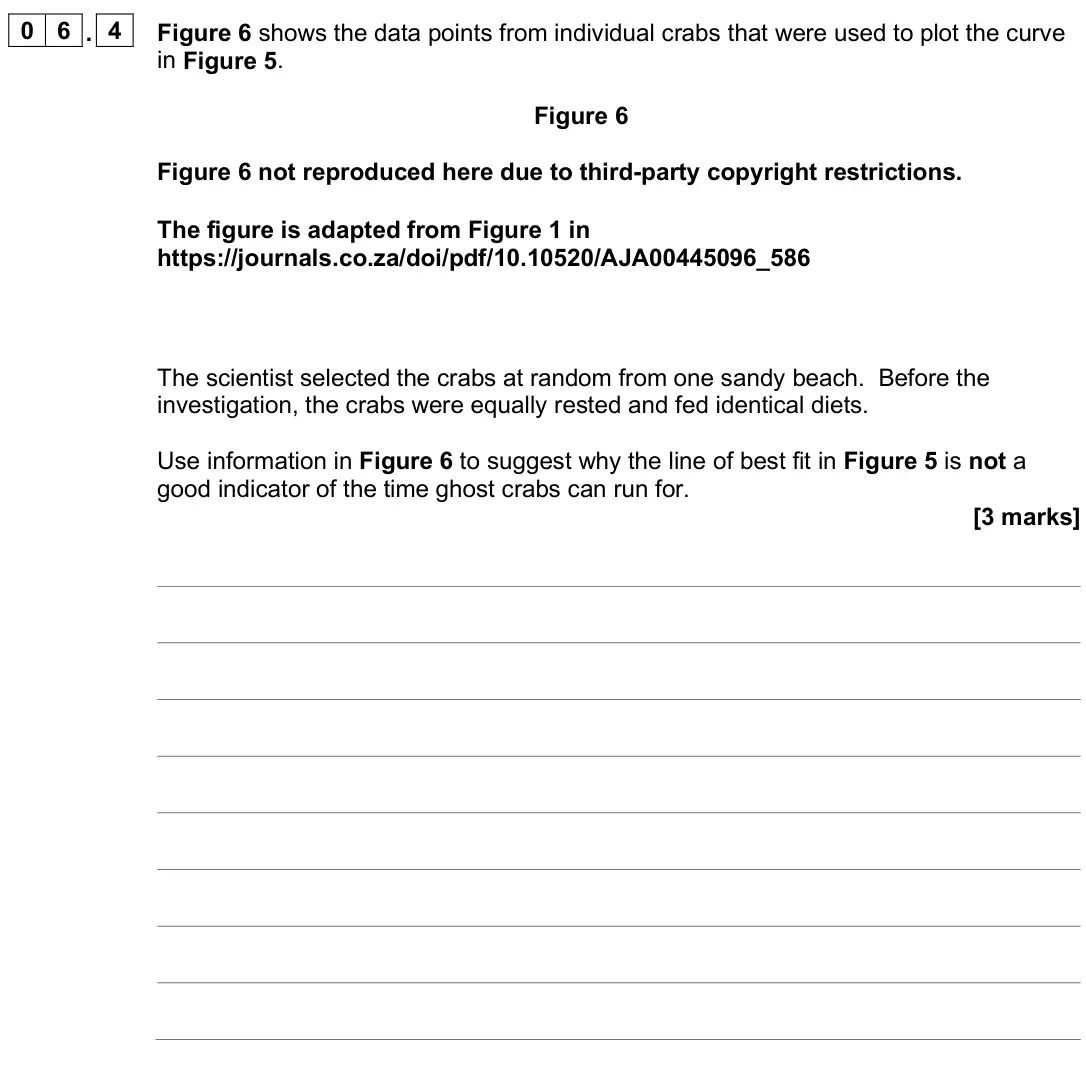
    June 2025 Paper 1, question 06.4: Figure 6 shows the data points from individual crabs that were used to plot the curve in Figure 5. Figure 6 Figure 6 not reproduced here due to third-party copy
  20. Q07.1

    June 2025 · Paper 1

    2 marks
    The whole paper ↗
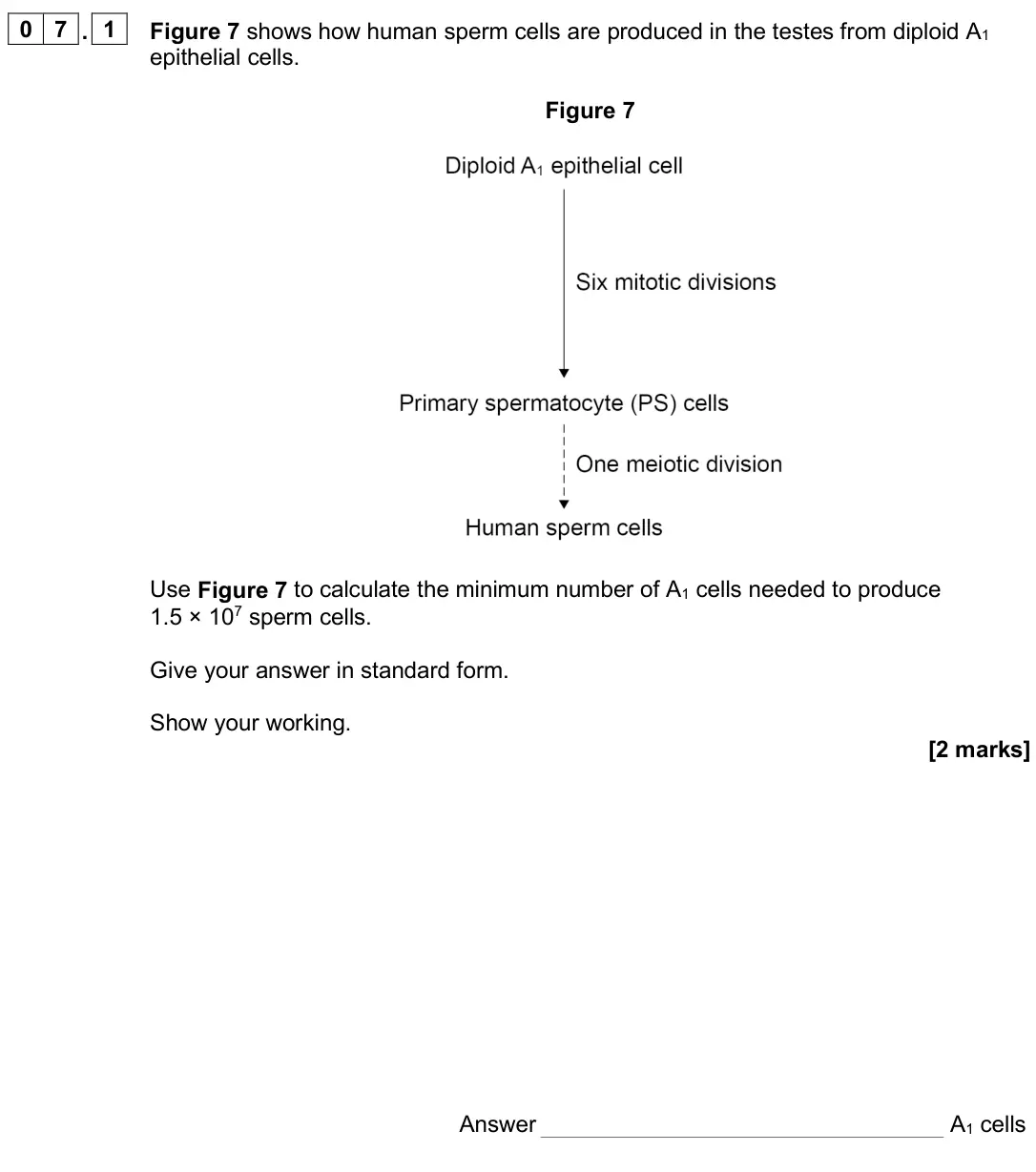
    June 2025 Paper 1, question 07.1: Figure 7 shows how human sperm cells are produced in the testes from diploid A1 epithelial cells. Figure 7 Use Figure 7 to calculate the minimum number of A1 ce

Questions, mark schemes and examiner’s reports are © AQA, from their published past papers. Plumi isn’t affiliated with any exam board. Want whole papers? Every AQA A-Level Biology paper.

Rather write your answers by hand on iPad? Plumi marks them against the same mark schemes.