 plumi
Genetic diversity can arise as a result of mutation or during meiosis: AQA A‑Level Biology questions
Every AQA A-Level Biology exam question on 3.4.3 Genetic diversity can arise as a result of mutation or during meiosis, 2016–2025, with its mark scheme and examiner’s report.
Find questions1,383
Calculations
Q07.1
The whole paper ↗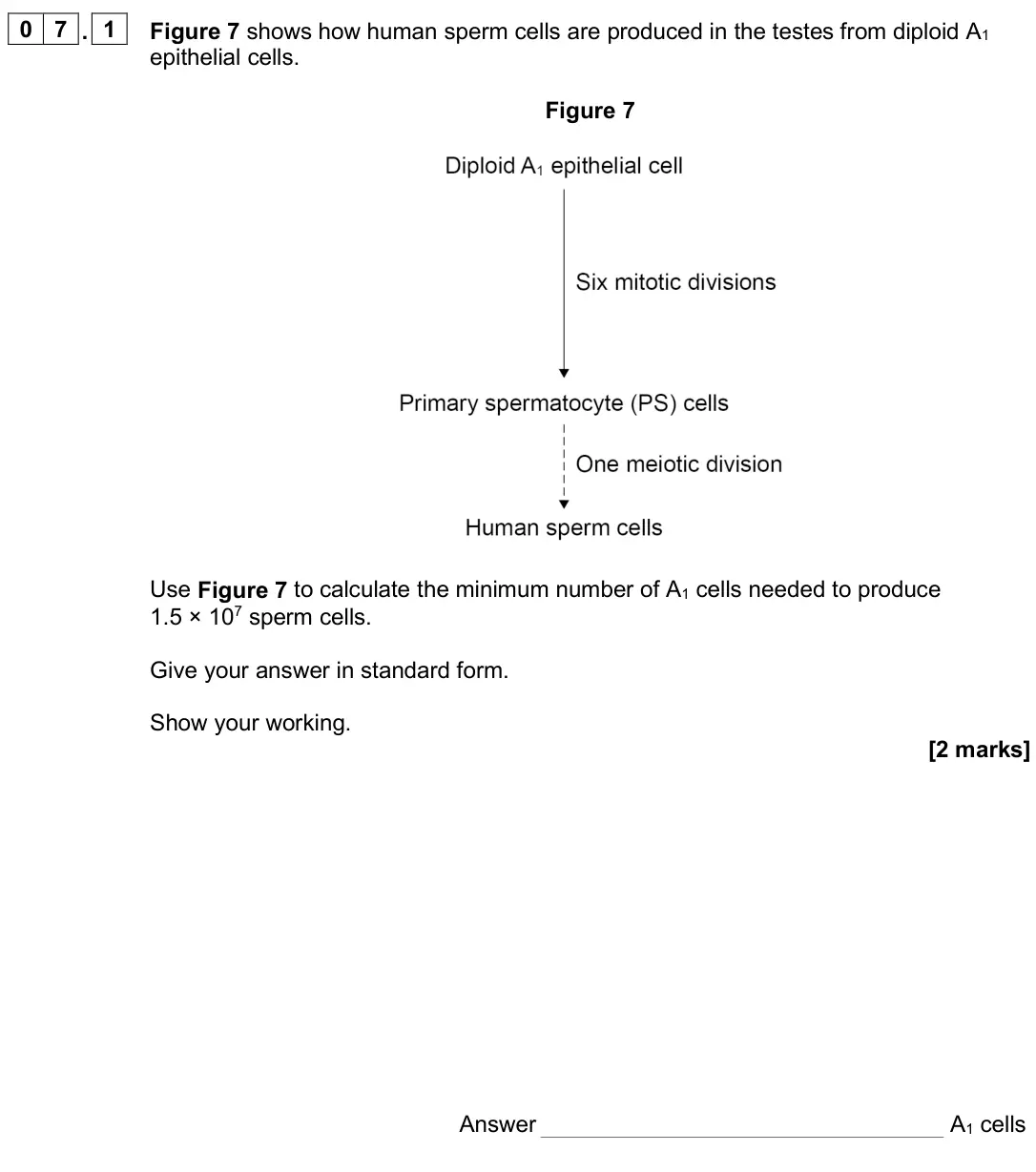
Q07.2
The whole paper ↗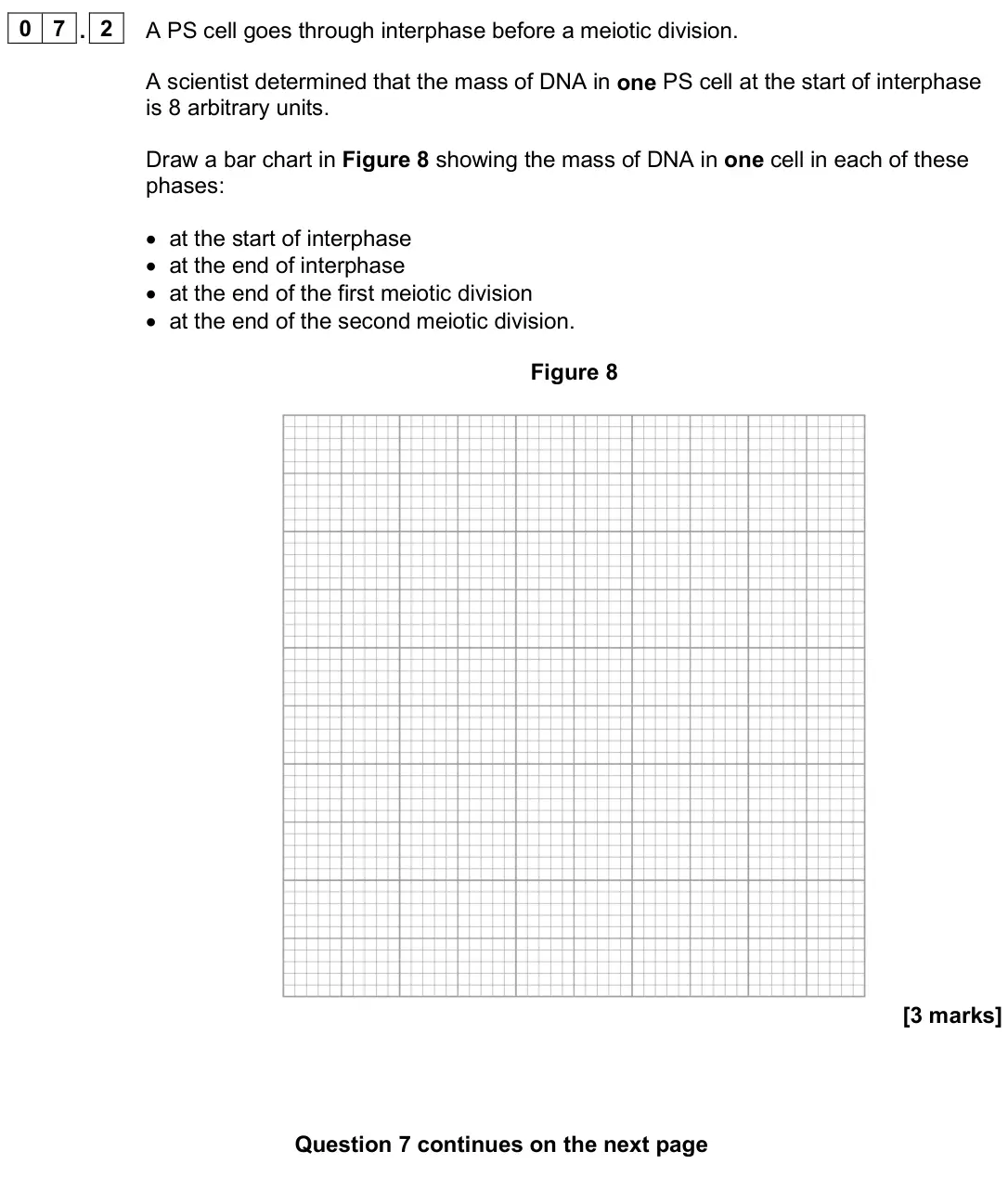
Q07.3
The whole paper ↗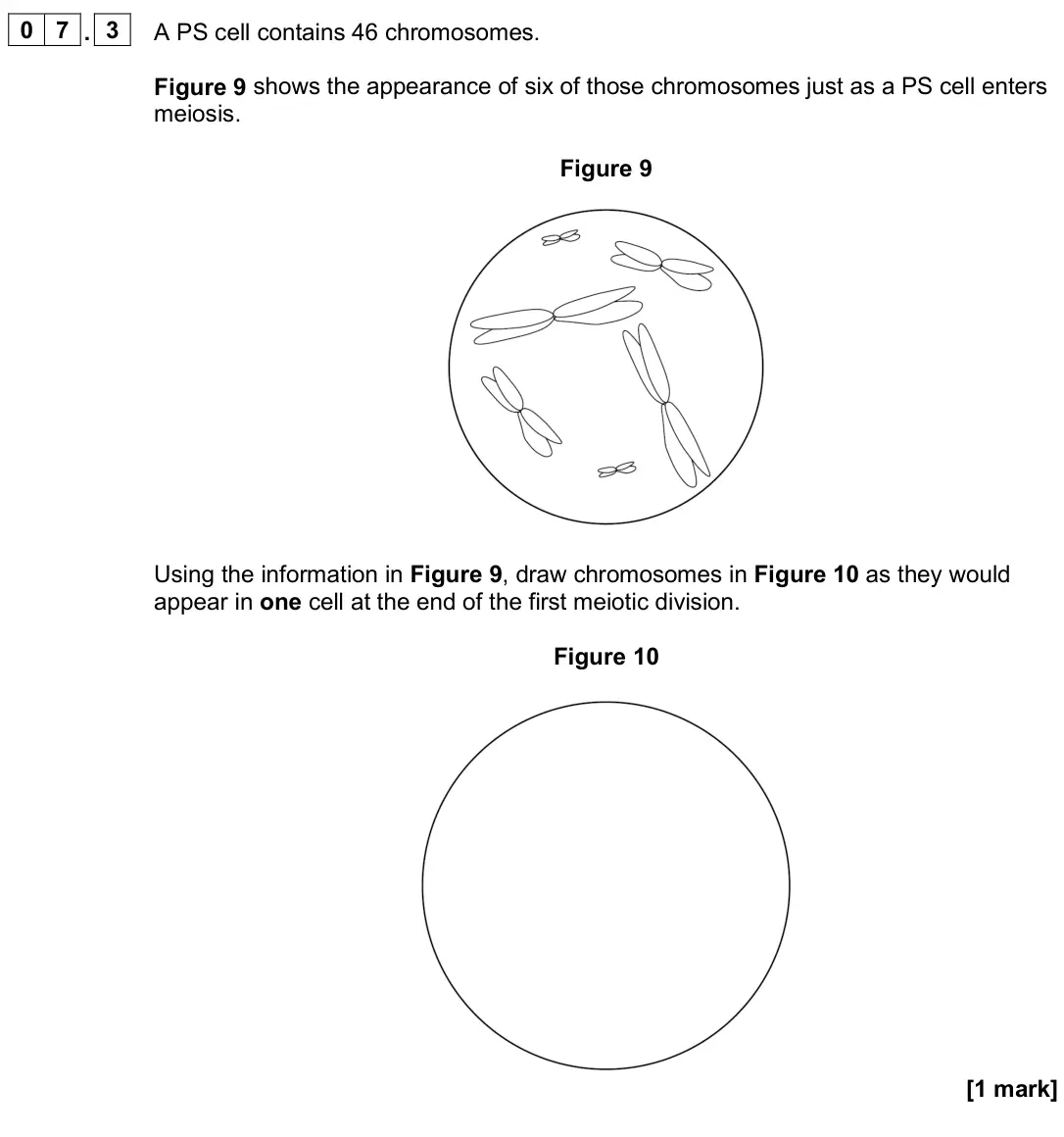
Q07.4
The whole paper ↗
Q08.1
The whole paper ↗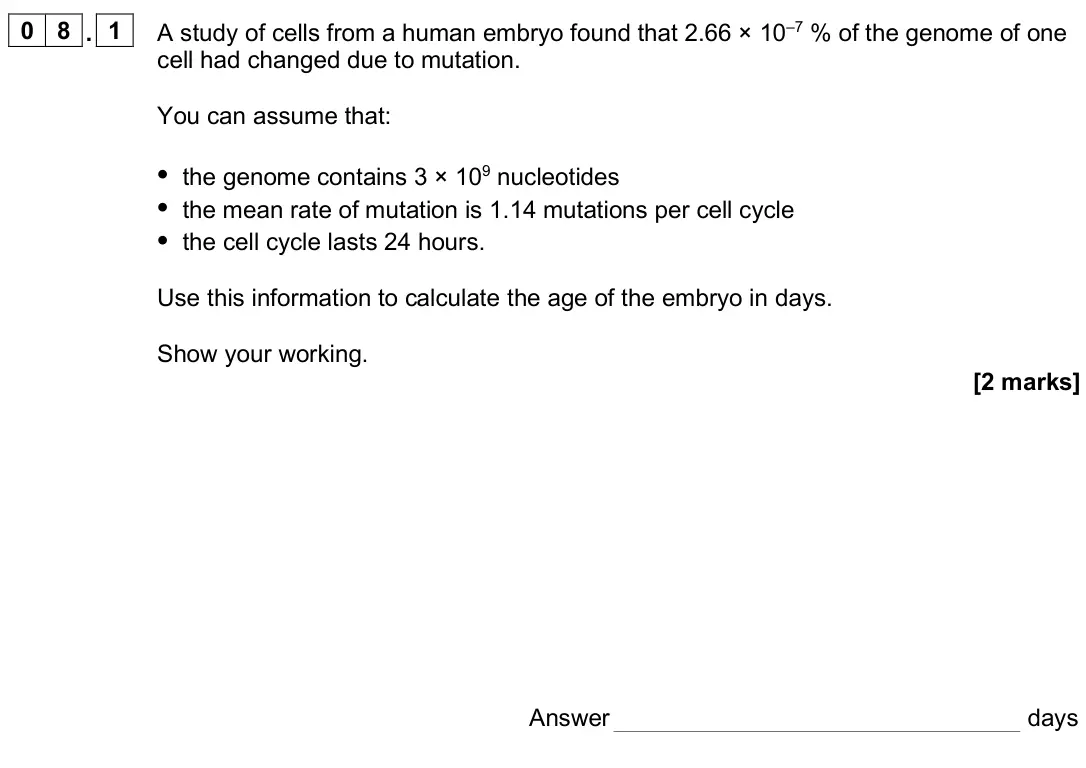
Q04.3
The whole paper ↗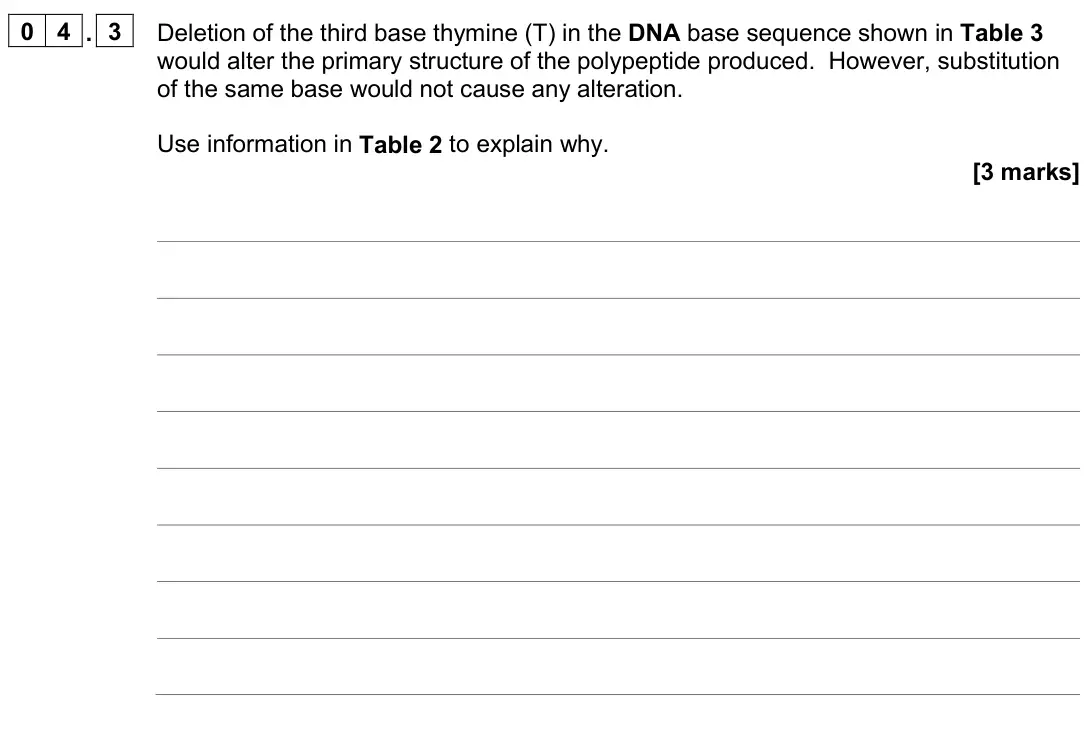
Q09.1
The whole paper ↗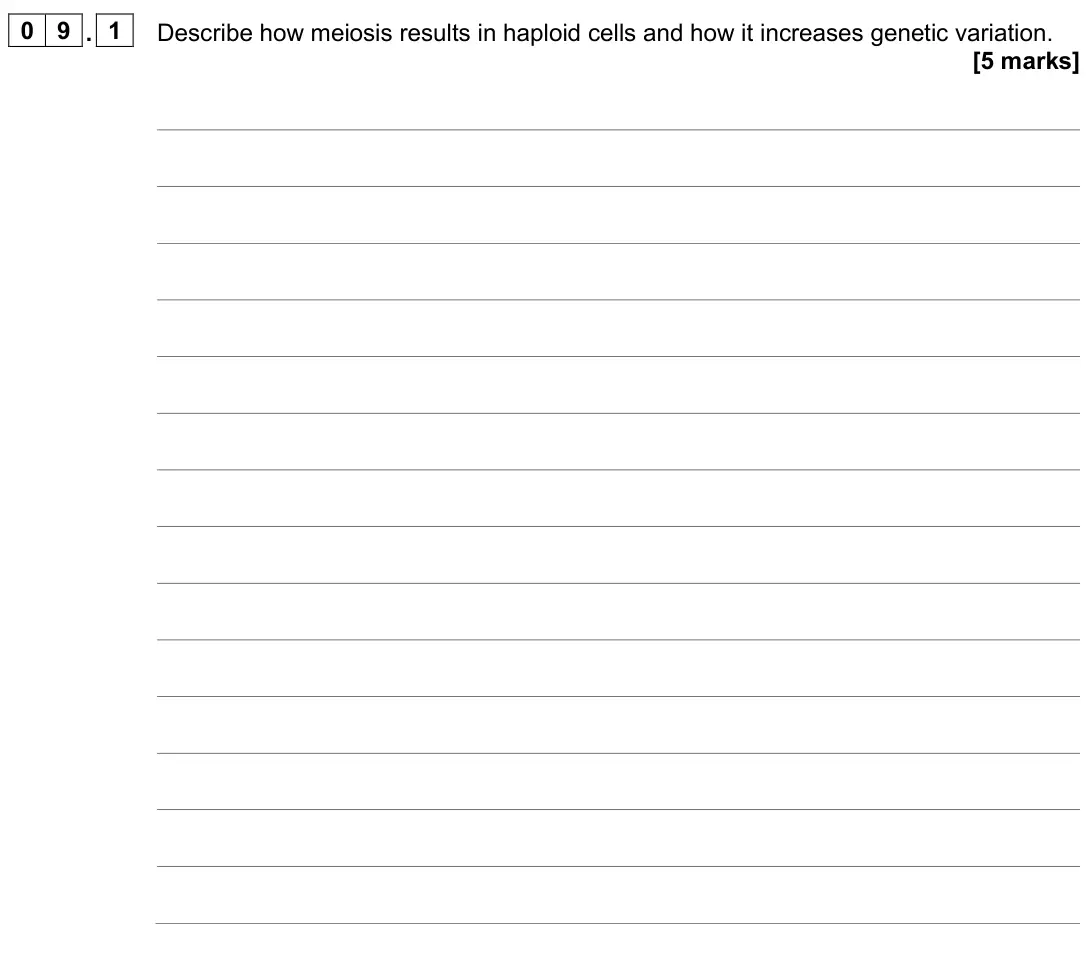
Q06.3
The whole paper ↗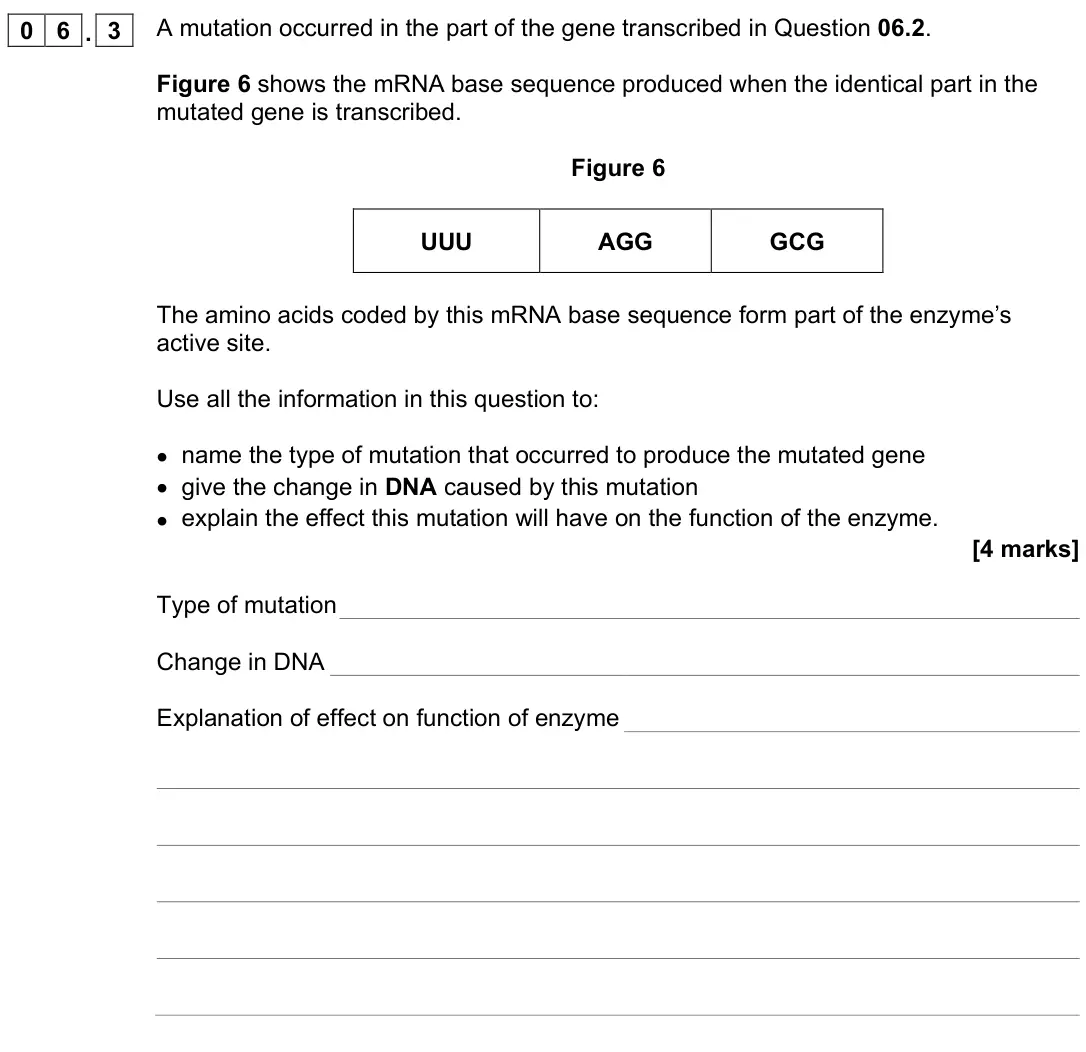
Q09.2
The whole paper ↗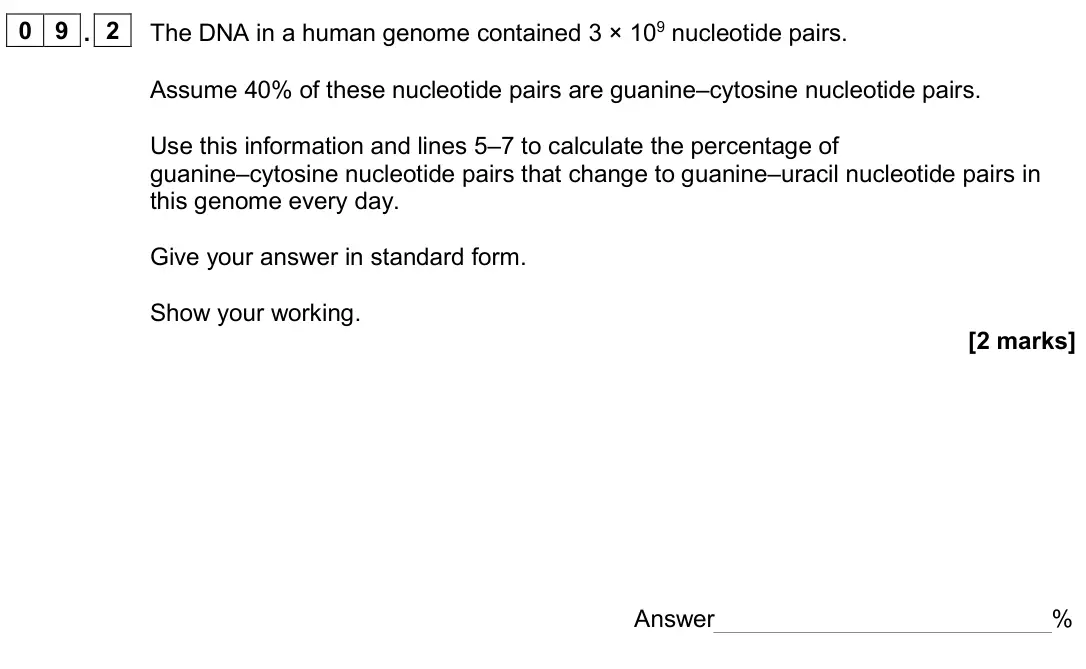
Q09.3
The whole paper ↗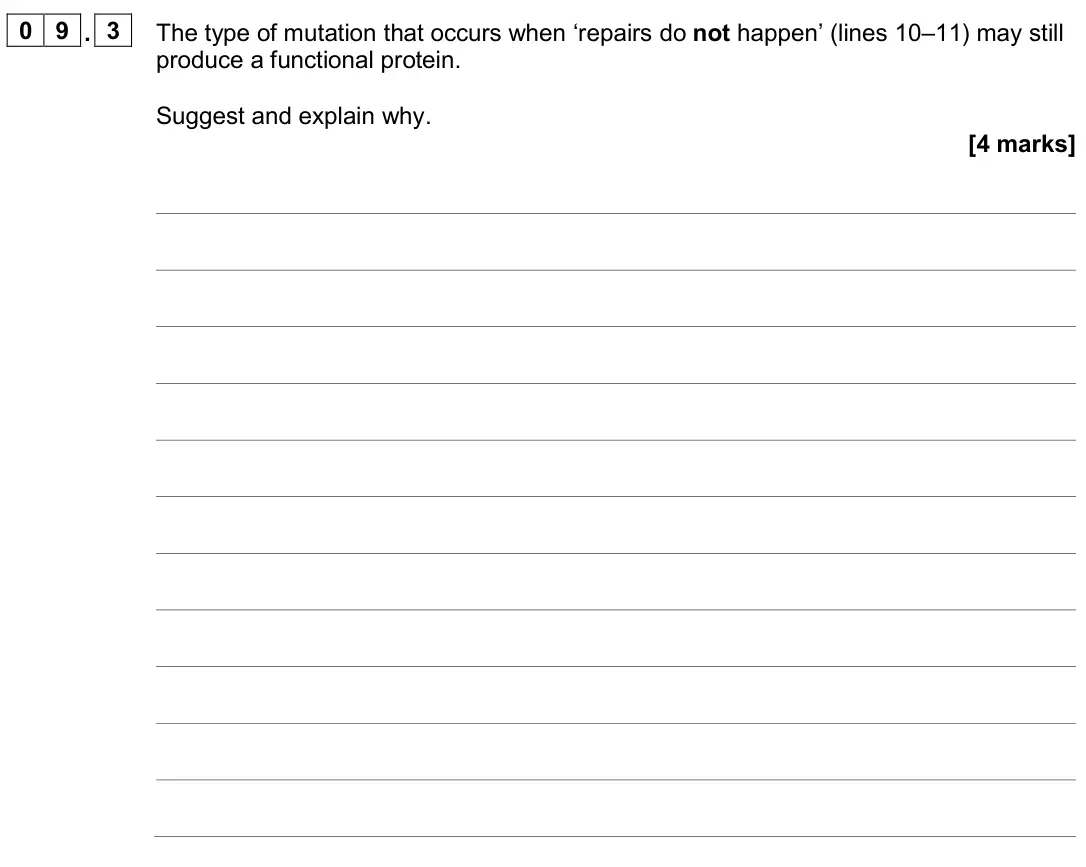
Q09.4
The whole paper ↗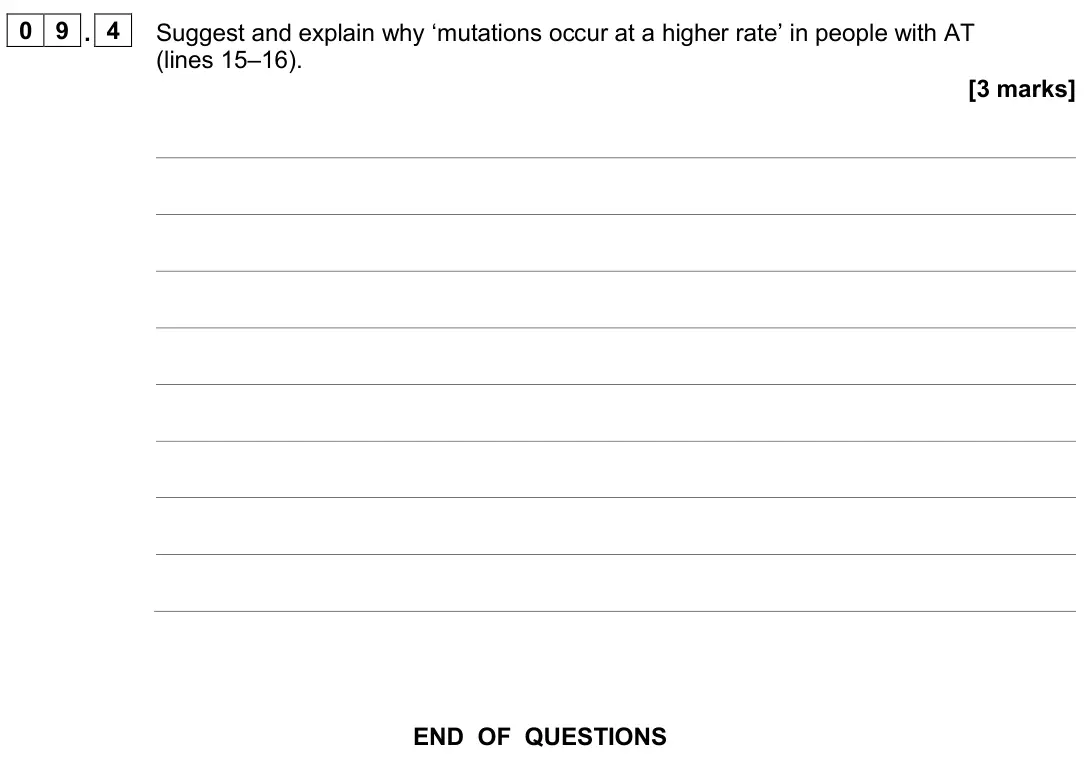
Q04.4
The whole paper ↗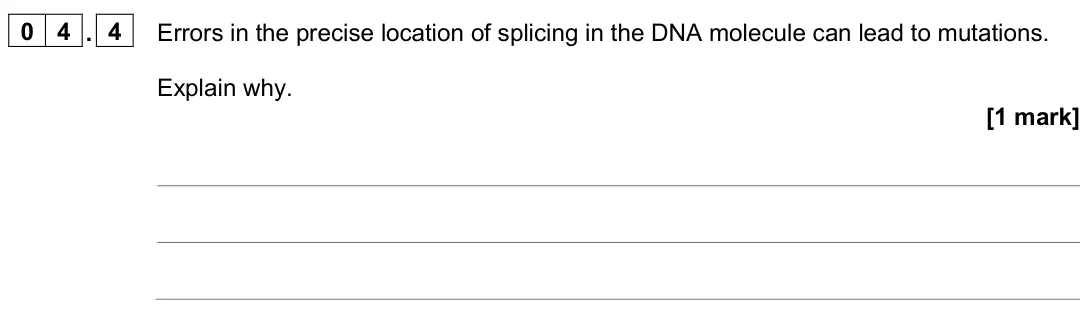
Q07.1
The whole paper ↗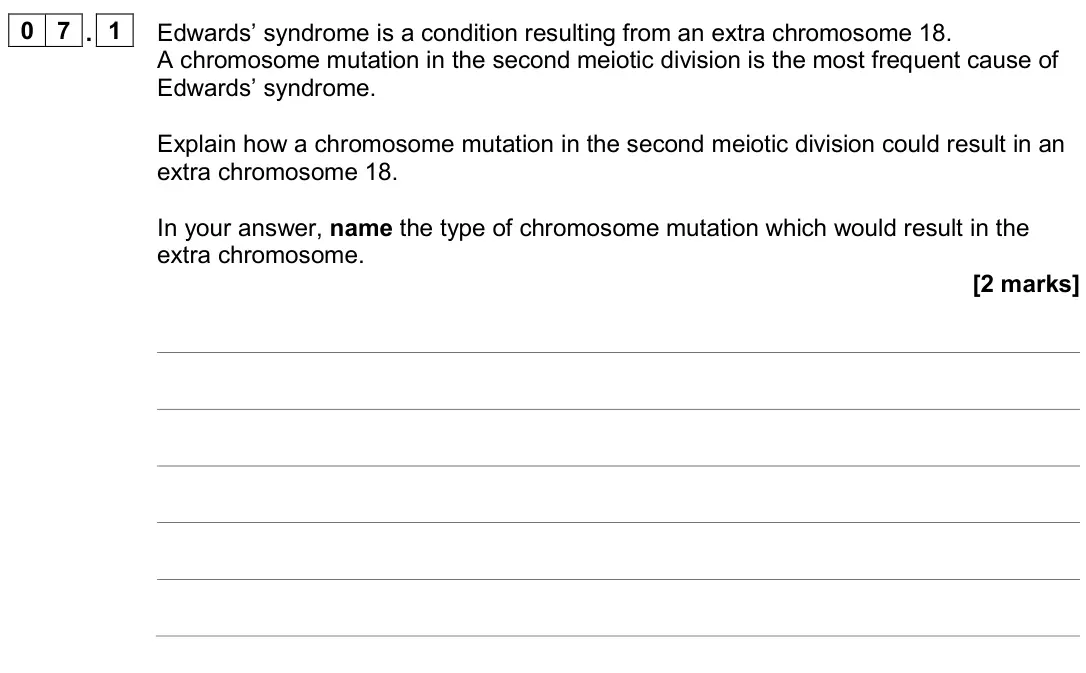
Q07.2
The whole paper ↗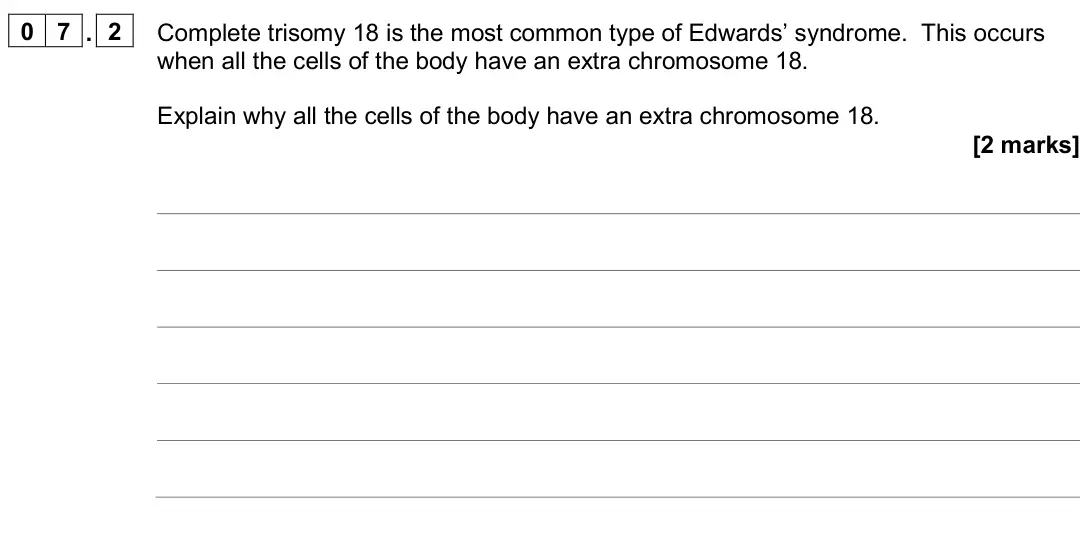
Q07.3
The whole paper ↗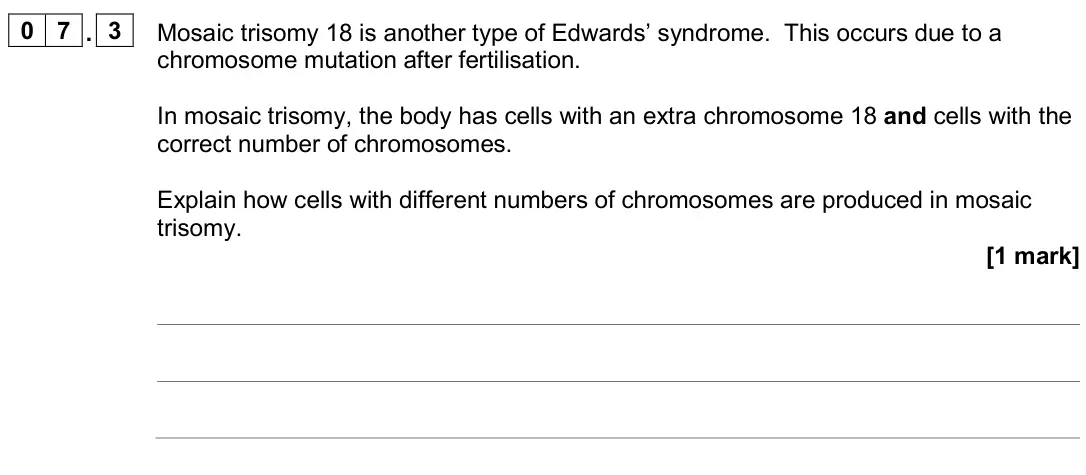
Q07.4
The whole paper ↗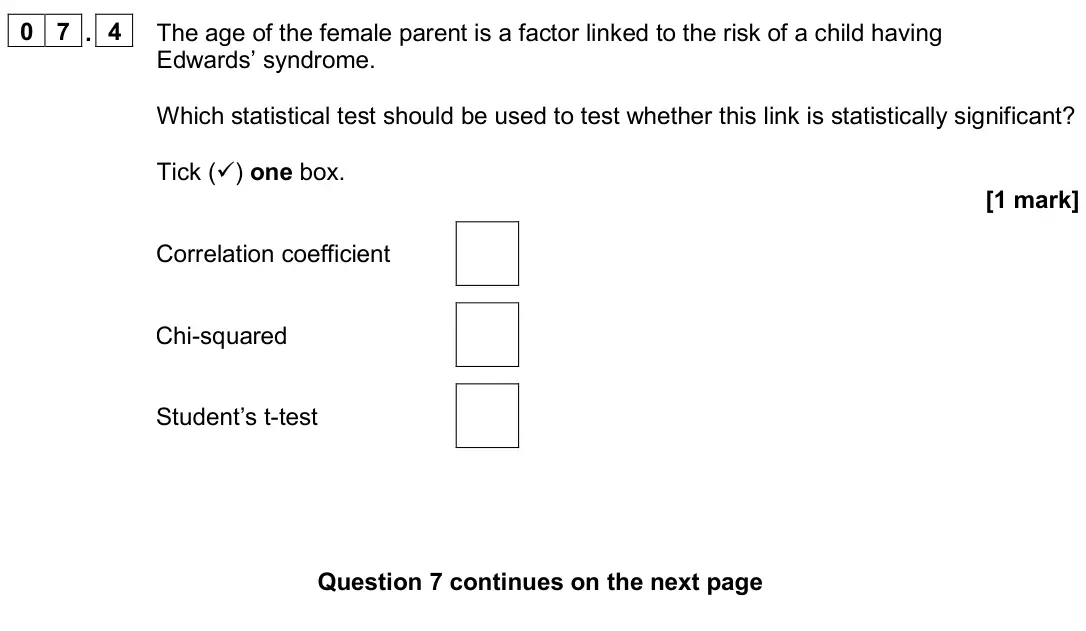
Q10.3
The whole paper ↗
Q05.1
The whole paper ↗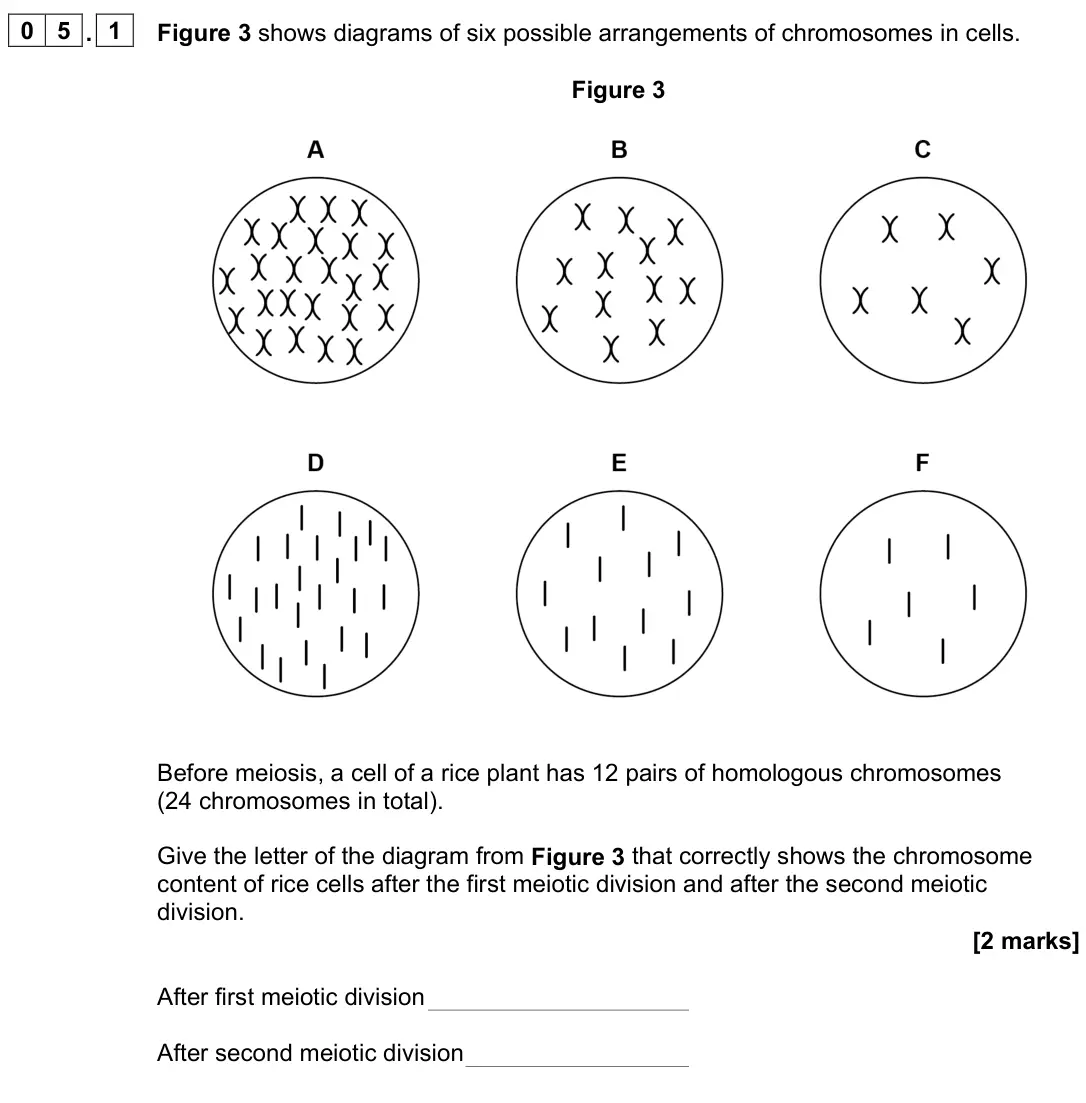
Q05.2
The whole paper ↗
Q04.3
The whole paper ↗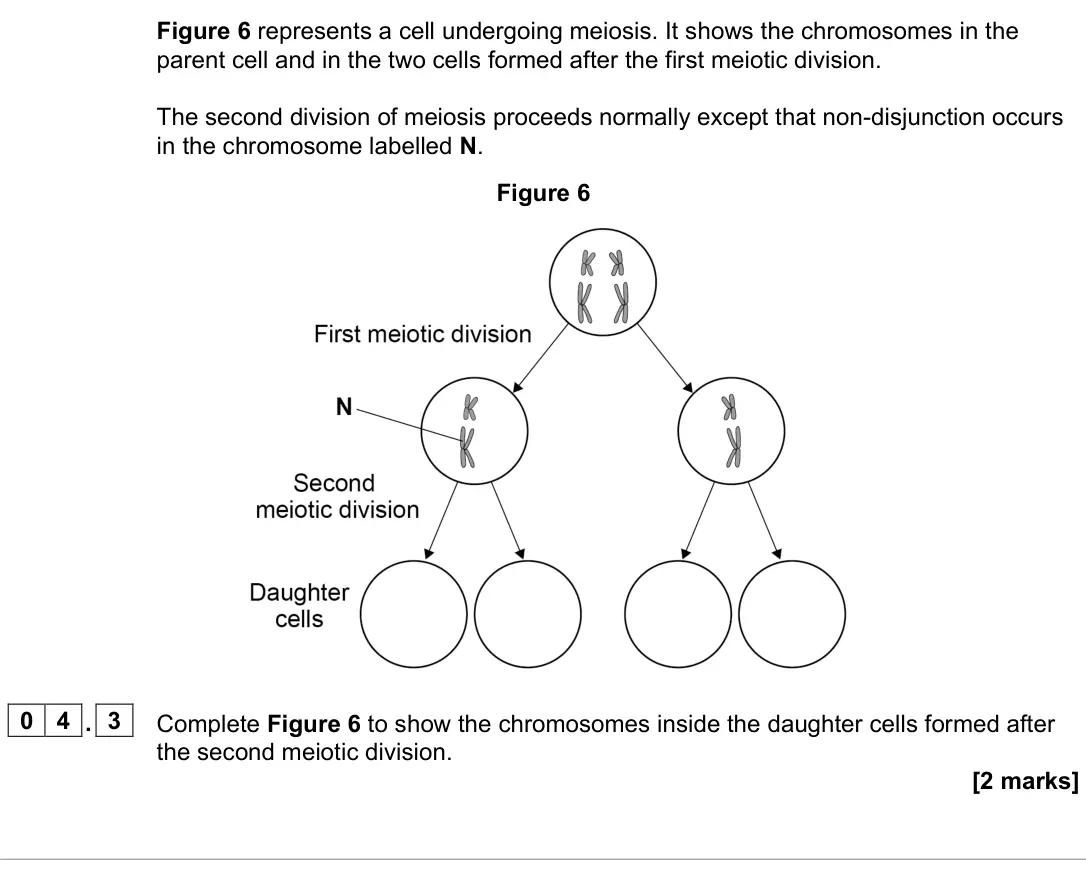
All 52 questions on Genetic diversity can arise as a result of mutation or during meiosis, as a list
- June 2025, Paper 1, Q07.1 (2 marks): Figure 7 shows how human sperm cells are produced in the testes from diploid A1 epithelial cells. Figure 7 Use Figure 7 to calculate the minimum number of A1 ce
- June 2025, Paper 1, Q07.2 (3 marks): A PS cell goes through interphase before a meiotic division. A scientist determined that the mass of DNA in one PS cell at the start of interphase is 8 arbitrar
- June 2025, Paper 1, Q07.3 (1 mark): A PS cell contains 46 chromosomes. Figure 9 shows the appearance of six of those chromosomes just as a PS cell enters meiosis. Figure 9 Using the information in
- June 2025, Paper 1, Q07.4 (3 marks): A mutation can produce a gamete with one extra chromosome. Name the type of mutation that produces a gamete with one extra chromosome. Explain how meiosis can p
- June 2025, Paper 2, Q08.1 (2 marks): A study of cells from a human embryo found that 2.66 × 10⁻⁷ % of the genome of one cell had changed due to mutation. You can assume that: • the genome contains
- June 2025, AS Paper 1, Q04.3 (3 marks): Deletion of the third base thymine (T) in the DNA base sequence shown in Table 3 would alter the primary structure of the polypeptide produced. However, substit
- June 2025, AS Paper 2, Q09.1 (5 marks): Describe how meiosis results in haploid cells and how it increases genetic variation. [5 marks]
- June 2024, Paper 1, Q06.3 (4 marks): A mutation occurred in the part of the gene transcribed in Question 06.2. Figure 6 shows the mRNA base sequence produced when the identical part in the mutated
- June 2024, AS Paper 1, Q09.2 (2 marks): The DNA in a human genome contained 3 × 10⁹ nucleotide pairs. Assume 40% of these nucleotide pairs are guanine–cytosine nucleotide pairs. Use this information a
- June 2024, AS Paper 1, Q09.3 (4 marks): The type of mutation that occurs when ‘repairs do not happen’ (lines 10–11) may still produce a functional protein. Suggest and explain why. [4 marks]
- June 2024, AS Paper 1, Q09.4 (3 marks): Suggest and explain why ‘mutations occur at a higher rate’ in people with AT (lines 15–16). [3 marks]
- June 2024, AS Paper 2, Q04.4 (1 mark): Errors in the precise location of splicing in the DNA molecule can lead to mutations. Explain why. [1 mark]
- June 2024, AS Paper 2, Q07.1 (2 marks): Edwards’ syndrome is a condition resulting from an extra chromosome 18. A chromosome mutation in the second meiotic division is the most frequent cause of Edwar
- June 2024, AS Paper 2, Q07.2 (2 marks): Complete trisomy 18 is the most common type of Edwards’ syndrome. This occurs when all the cells of the body have an extra chromosome 18. Explain why all the ce
- June 2024, AS Paper 2, Q07.3 (1 mark): Mosaic trisomy 18 is another type of Edwards’ syndrome. This occurs due to a chromosome mutation after fertilisation. In mosaic trisomy, the body has cells with
- June 2024, AS Paper 2, Q07.4 (1 mark): The age of the female parent is a factor linked to the risk of a child having Edwards’ syndrome. Which statistical test should be used to test whether this link
- June 2023, Paper 1, Q10.3 (4 marks): Mutation can result in an increase in genetic variation within a species. Describe and explain the other processes that result in increases in genetic variation
- June 2023, AS Paper 2, Q05.1 (2 marks): Figure 3 shows diagrams of six possible arrangements of chromosomes in cells. Figure 3 Before meiosis, a cell of a rice plant has 12 pairs of homologous chromos
- June 2023, AS Paper 2, Q05.2 (3 marks): Scientists have produced a mutated rice variety in which there is no crossing over. A population of the mutant rice variety produced by sexual reproduction show
- June 2022, Paper 1, Q04.3 (2 marks): Complete Figure 6 to show the chromosomes inside the daughter cells formed after the second meiotic division. [2 marks]
- June 2022, Paper 1, Q04.4 (2 marks): A student concluded that there were more mothers of age ˃37 with MM2 errors than with MM1 errors. Using Figure 7 and suitable calculations show why this conclus
- June 2022, AS Paper 2, Q04.1 (4 marks): Describe how the process of meiosis results in haploid cells. Do not include descriptions of how genetic variation is produced in meiosis. [4 marks]
- June 2022, AS Paper 2, Q04.2 (2 marks): Figure 2 shows the arrangement of chromosomes in a cell during the first meiotic division. Figure 2 A scientist observed 300 cells. All of the cells were at exa
- June 2022, AS Paper 2, Q04.3 (1 mark): Draw a diagram to show the chromosomes in one gamete produced by meiosis from the cell shown in Figure 2. [1 mark]
- June 2022, AS Paper 2, Q04.4 (1 mark): Figure 3 shows the life cycle of a fungus. The life cycle includes sexual reproduction. Figure 3 What is the name of the process shown by arrow A in Figure 3? T
- November 2021, Paper 1, Q03.3 (2 marks): The amino acid replacement of Arg with Gly is caused by a single base substitution mutation in the DNA. The non-mutant DNA triplet is TCC. Complete Table 3. Giv
- November 2021, Paper 3, Q01.3 (1 mark): S. carolinensis were first introduced to the UK from North America in the 1870s. They are now widely distributed across the UK. S. carolinensis from both North
- November 2021, Paper 3, Q01.4 (2 marks): The protein coded for by the C B allele is 306 amino acids long. Calculate the percentage reduction in size of the protein coded for by the C B allele compared
- November 2021, AS Paper 2, Q03.2 (2 marks): Define the term mutagenic agent. [1 mark] 0 3 . 3 Figure 4 shows how the species Spartina townsendii is produced. The number of chromosomes in cells is shown in
- November 2021, AS Paper 2, Q03.4 (3 marks): Name the type of mutation that changed the number of chromosomes in S. townsendii to produce S. anglica. Explain your answer. [3 marks] Name of mutation Explana
- November 2021, AS Paper 2, Q03.5 (2 marks): Genetic variation within a species is increased during meiosis by crossing over and the independent segregation of homologous chromosomes. Apart from mutation,
- November 2020, Paper 1, Q10.3 (4 marks): Define ‘gene mutation’ and explain how a gene mutation can have: • no effect on an individual • a positive effect on an individual. [4 marks]
- November 2020, Paper 2, Q06.1 (2 marks): Mutation is one cause of genetic variation in organisms. Give two other causes of genetic variation. [2 marks] 1 2
- November 2020, Paper 3, Q03.1 (2 marks): Suggest and explain how the viruses became able to infect other species of frog. [2 marks]
- November 2020, Paper 3, Q07.2 (25 marks): The causes and importance of variation and diversity in organisms. [25 marks]
- November 2020, AS Paper 1, Q06.4 (2 marks): A mutation in the nucleotide sequence shown in Figure 6 resulted in the following amino acid sequence. Serine Glycine Glycine Proline A student concluded that t
- November 2020, AS Paper 2, Q06.1 (2 marks): Use Figure 4 and the equation to calculate the median mass of fish after 195 days’ feeding. Show your working. [2 marks] Answer mg
- November 2020, AS Paper 2, Q06.2 (2 marks): A trout body cell contains 80 chromosomes. Table 2 shows the number of chromosomes and the mass of DNA in different nuclei. All the nuclei are from the same tro
- November 2020, AS Paper 2, Q06.3 (1 mark): Give one reason why trout eggs produced by meiosis are genetically different. [1 mark]
- November 2020, AS Paper 2, Q06.4 (1 mark): Give the number of chromosomes in body cells of the offspring produced from treated farmed female trout and untreated farmed male trout. [1 mark] Number of chro
- November 2020, AS Paper 2, Q06.5 (2 marks): The offspring produced from farmed trout are sterile. Suggest and explain why. [2 marks]
- June 2019, Paper 3, Q04.1 (1 mark): The control regions of Group T and Group C were the same length. Name the type of gene mutation that is most likely to have occurred at nucleotide position 16 5
- June 2019, AS Paper 2, Q06.2 (2 marks): Give two differences between mitosis and meiosis. [2 marks] 1 2
- June 2019, AS Paper 2, Q06.3 (1 mark): There are seven chromosomes in a spore nucleus. Place a tick () in the box next to the number that represents the number of chromatids present in the zygote sh
- June 2019, AS Paper 2, Q06.4 (3 marks): Using all the information in this question, what can you conclude from the scientist’s results about the movement of chromosomes in meiosis in this fungus? [3 m
- June 2017, AS Paper 1, Q06.1 (1 mark): Which letter, A, B, C or D, in Figure 5, shows where meiosis occurs in the life cycle of the moss? Write the appropriate letter in the box provided. [1 mark]
- June 2017, AS Paper 1, Q06.2 (2 marks): Explain how the chromosome number is halved during meiosis. [2 marks] Figure 6 shows a cell from the moss plant. The cell is in the second meiotic division. Fig
- June 2017, AS Paper 1, Q06.3 (1 mark): What is the haploid number of chromosomes for this species of moss? [1 mark]
- June 2017, AS Paper 1, Q06.4 (4 marks): Crossing over greatly increases genetic diversity in this species of moss. Describe the process of crossing over and explain how it increases genetic diversity.
- June 2016, AS Paper 2, Q07.1 (4 marks): HIV attaches to a specific protein receptor on helper T cells. A low percentage of people have a mutation of the CCR5 gene which codes for this protein receptor
- Specimen, Paper 1, Q10.3 (3 marks): [ ]
- Specimen, Paper 1, Q10.4 (1 mark): Figure 8 shows some cells from an onion root tip at different stages of the cell cycle. 1 0 This source has been removed due to third-party copyright restrictio
Questions, mark schemes and examiner’s reports are © AQA, from their published past papers. Plumi isn’t affiliated with any exam board. Want whole papers? Every AQA A-Level Biology paper.
Rather write your answers by hand on iPad? Plumi marks them against the same mark schemes.