Skip to content
Android waitlistTry on iPad
Get started

OxfordAQA International A Level Chemistry questions by topic

Official specimen papers for Units 1–5

Topics Pick as many as you like. Open one to choose its sub-topics.

Year 1 · AS

Past paper difficulty
Paper
All papers
Exam
All years
Calculations

Loading the full question list…

168 questions

Full page
  1. Q01.1

    Specimen · Unit 1 · ★★★★

    4 marks
    The whole paper ↗
    1
    Setup for original question 01.1

    Loading the question setup…

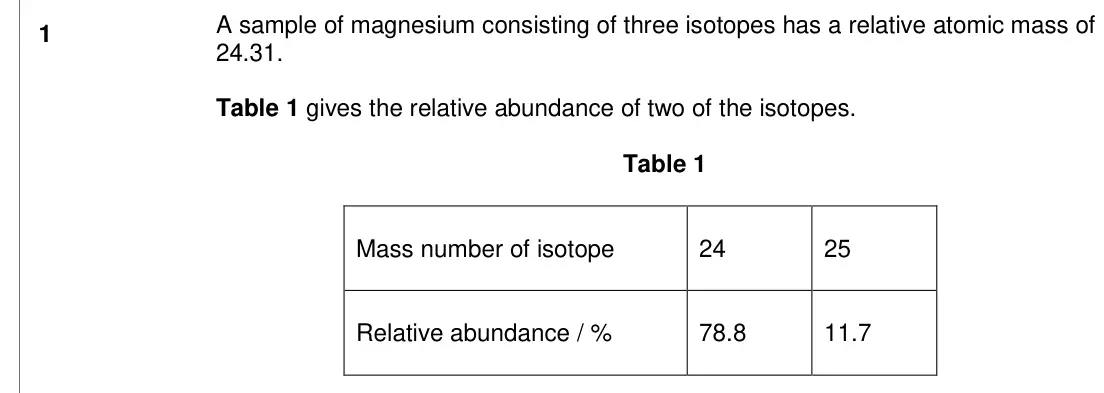
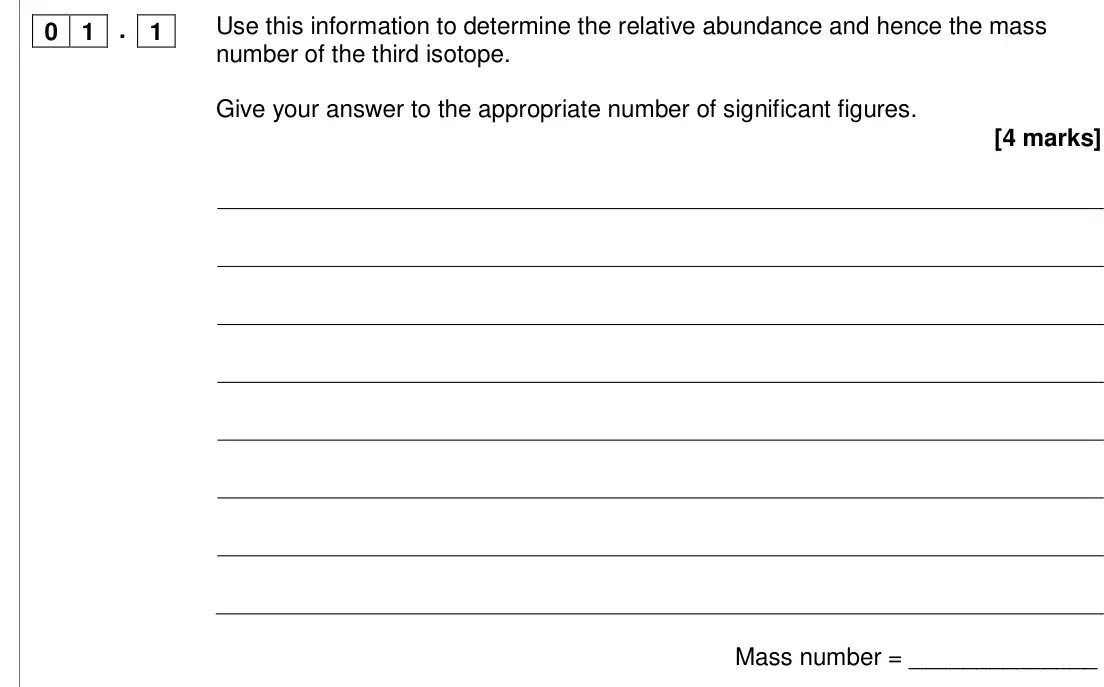
    Original question 01.1: A sample of magnesium consisting of three isotopes has a relative atomic mass of 24.31. Table 1 gives the relative abundance of two of the isotopes. Table 1 Mass number of isotope

    Loading the question…

  2. Q01.2

    Specimen · Unit 1 · ★★

    2 marks
    The whole paper ↗
    2
    Setup for original question 01.2

    Loading the question setup…

    Original question 01.2: A sample of magnesium consisting of three isotopes has a relative atomic mass of 24.31. Table 1 gives the relative abundance of two of the isotopes. Table 1 Mass number of isotope

    Loading the question…

  3. Q01.3

    Specimen · Unit 1 · ★★

    2 marks
    The whole paper ↗
    3
    Setup for original question 01.3

    Loading the question setup…

    Original question 01.3: A sample of magnesium consisting of three isotopes has a relative atomic mass of 24.31. Table 1 gives the relative abundance of two of the isotopes. Table 1 Mass number of isotope

    Loading the question…

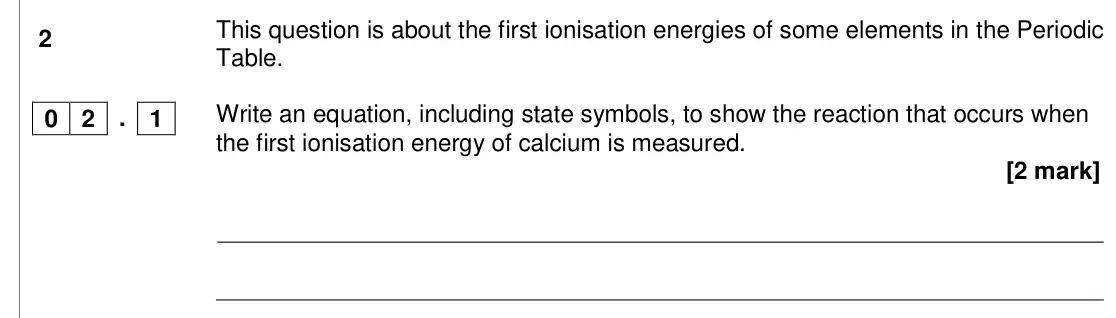
  4. Q02.1

    Specimen · Unit 1 · ★★

    2 marks
    The whole paper ↗
    4
    Original question 02.1: This question is about the first ionisation energies of some elements in the Periodic Table. Write an equation, including state symbols, to show the reaction that occurs when the f

    Loading the question…

  5. Q02.2

    Specimen · Unit 1 · ★★★

    3 marks
    The whole paper ↗
    5
    Original question 02.2: State and explain the general trend in first ionisation energies for the Period 2 elements boron to neon. [3 marks] Trend __________________________________________________________

    Loading the question…

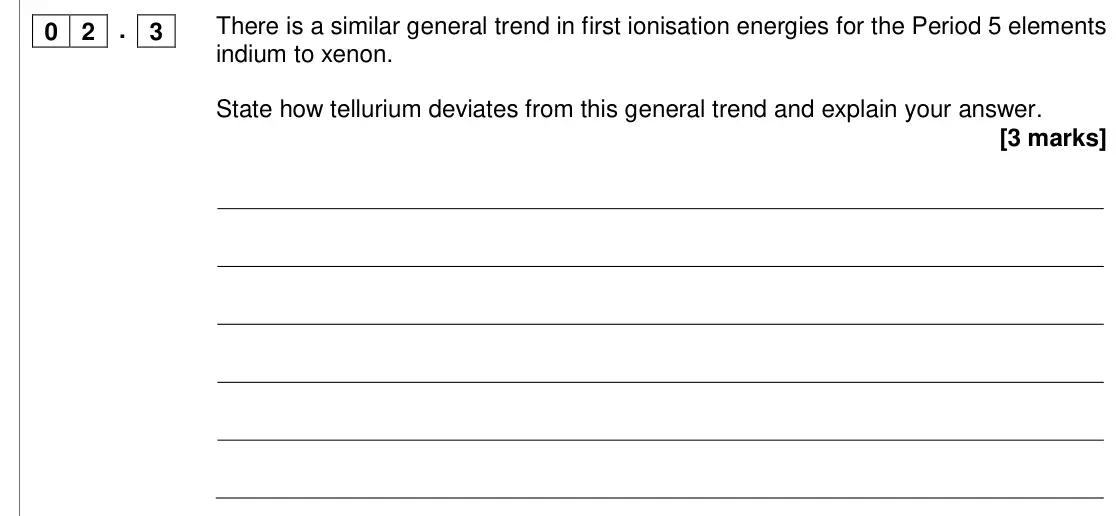
  6. Q02.3

    Specimen · Unit 1 · ★★★

    3 marks
    The whole paper ↗
    6
    Original question 02.3: There is a similar general trend in first ionisation energies for the Period 5 elements indium to xenon. State how tellurium deviates from this general trend and explain your answe

    Loading the question…

  7. Q02.4

    Specimen · Unit 1 · ★★

    1 mark
    The whole paper ↗
    7
    Original question 02.4: Suggest why the first ionisation energy of xenon is lower than the first ionisation energy of krypton. [1 mark] 0 2 . 4 5

    Loading the question…

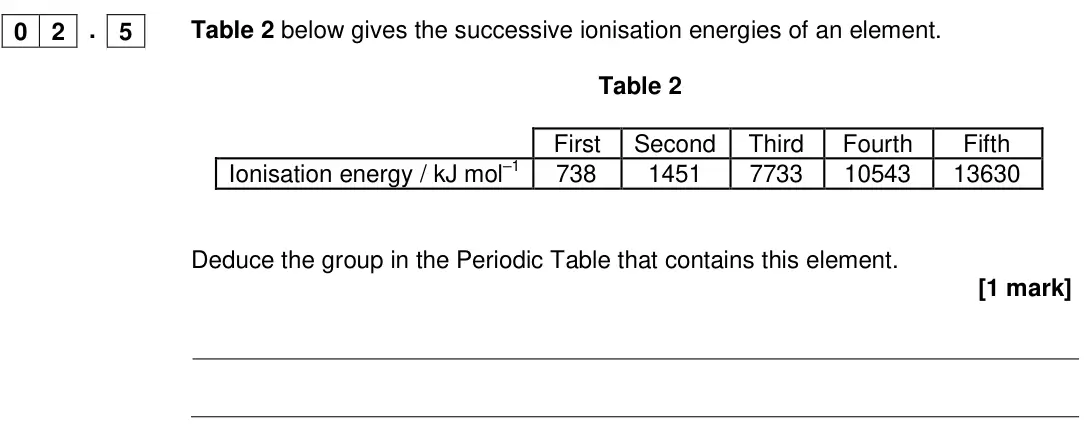
  8. Q02.5

    Specimen · Unit 1 · ★

    1 mark
    The whole paper ↗
    8
    Original question 02.5: Table 2 below gives the successive ionisation energies of an element. Table 2 First Second Third Fourth Fifth Ionisation energy / kJ mol–1 738 1451 7733 10543 13630 Deduce the grou

    Loading the question…

  9. Q02.6

    Specimen · Unit 1 · ★

    1 mark
    The whole paper ↗
    9
    Original question 02.6: Identify the element that has a 5+ ion with an electron configuration of 1s2 2s2 2p6 3s2 3p6 3d104s2 4p6 4d10 [1 mark] 0 2 . 6 6

    Loading the question…

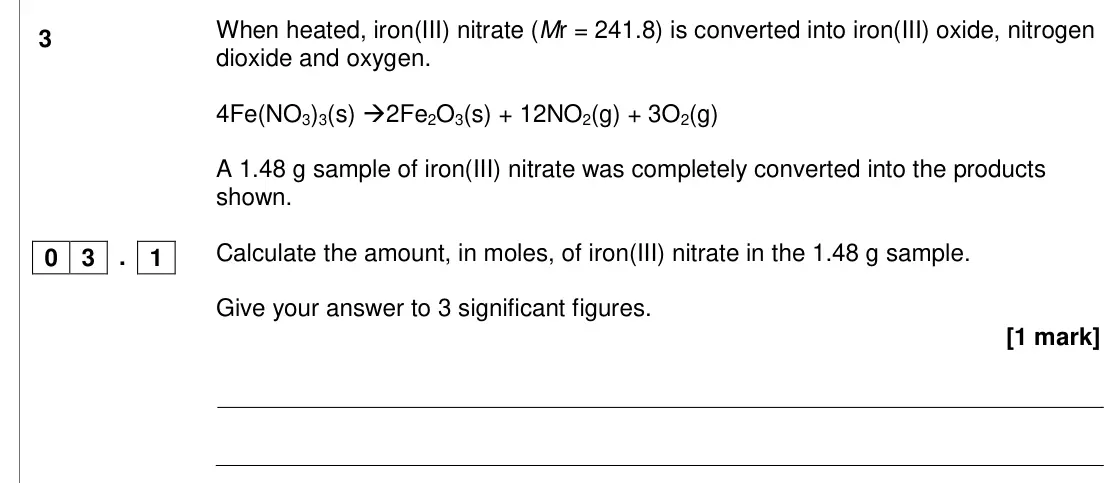
  10. Q03.1

    Specimen · Unit 1 · ★

    1 mark
    The whole paper ↗
    10
    Original question 03.1: When heated, iron(III) nitrate (Mr = 241.8) is converted into iron(III) oxide, nitrogen dioxide and oxygen. 4Fe(NO3)3(s) 2Fe2O3(s) + 12NO2(g) + 3O2(g) A 1.48 g sample of iron(III)

    Loading the question…

  11. Q03.2

    Specimen · Unit 1 · ★

    1 mark
    The whole paper ↗
    11
    Original question 03.2: Calculate the amount, in moles, of oxygen gas produced in this reaction. [1 mark] 0 3 . 2

    Loading the question…

  12. Q03.3

    Specimen · Unit 1 · ★★★★

    4 marks
    The whole paper ↗
    12
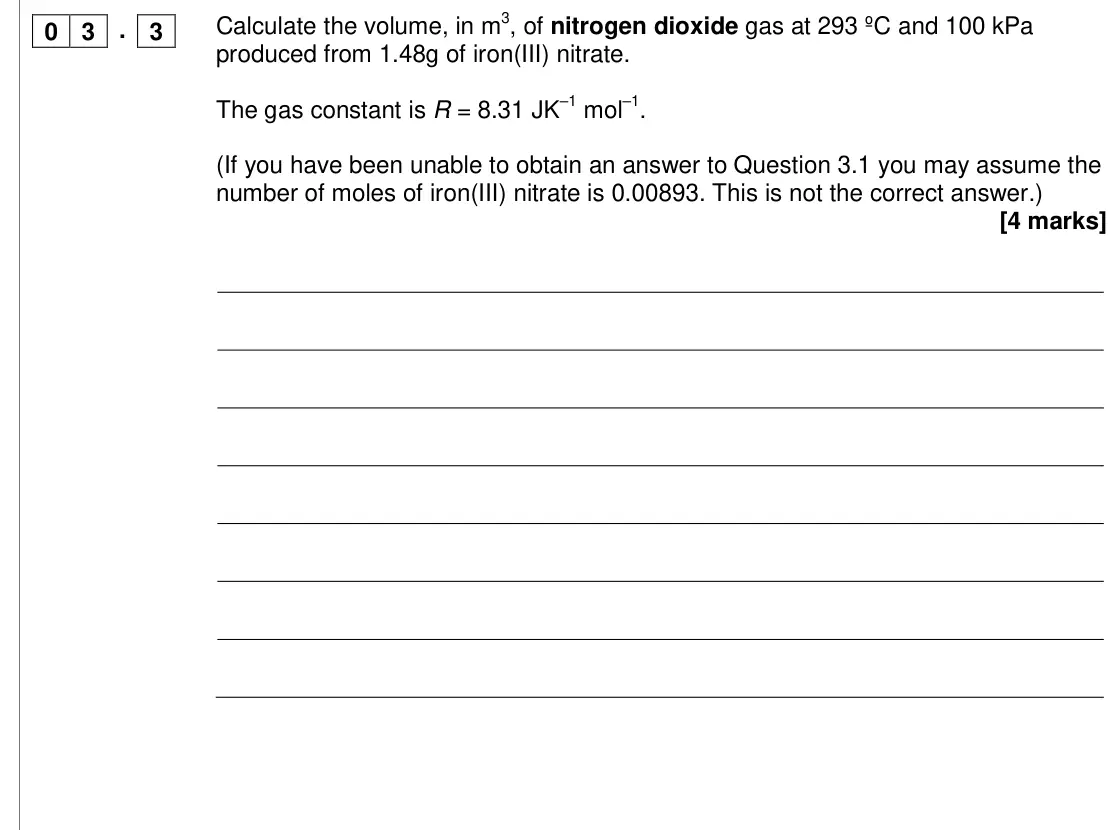
    Original question 03.3: Calculate the volume, in m3, of nitrogen dioxide gas at 293 ºC and 100 kPa produced from 1.48g of iron(III) nitrate. The gas constant is R = 8.31 JK–1 mol–1. (If you have been unab

    Loading the question…

  13. Q03.4

    Specimen · Unit 1 · ★★

    1 mark
    The whole paper ↗
    13
    Original question 03.4: Suggest a name for this type of reaction that iron(III) nitrate undergoes. [1 mark] 0 3 . 4

    Loading the question…

  14. Q03.5

    Specimen · Unit 1 · ★★

    1 mark
    The whole paper ↗
    14
    Original question 03.5: Suggest why the iron(III) oxide obtained is pure. Assume a complete reaction. [1 mark] 0 3 . 5 8

    Loading the question…

  15. Q04.1

    Specimen · Unit 1 · ★

    1 mark
    The whole paper ↗
    15
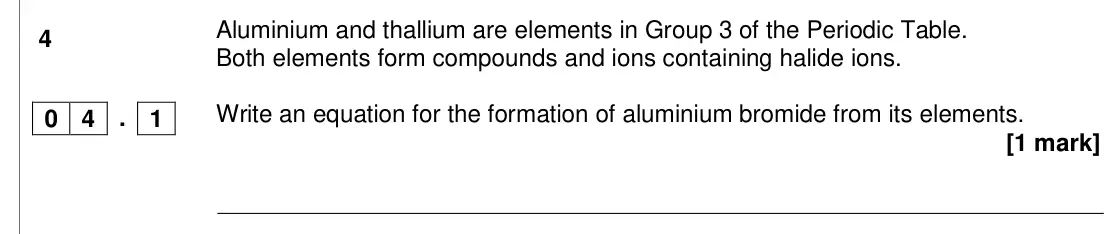
    Original question 04.1: Aluminium and thallium are elements in Group 3 of the Periodic Table. Both elements form compounds and ions containing halide ions. Write an equation for the formation of aluminium

    Loading the question…

  16. Q04.2

    Specimen · Unit 1 · ★★

    2 marks
    The whole paper ↗
    16
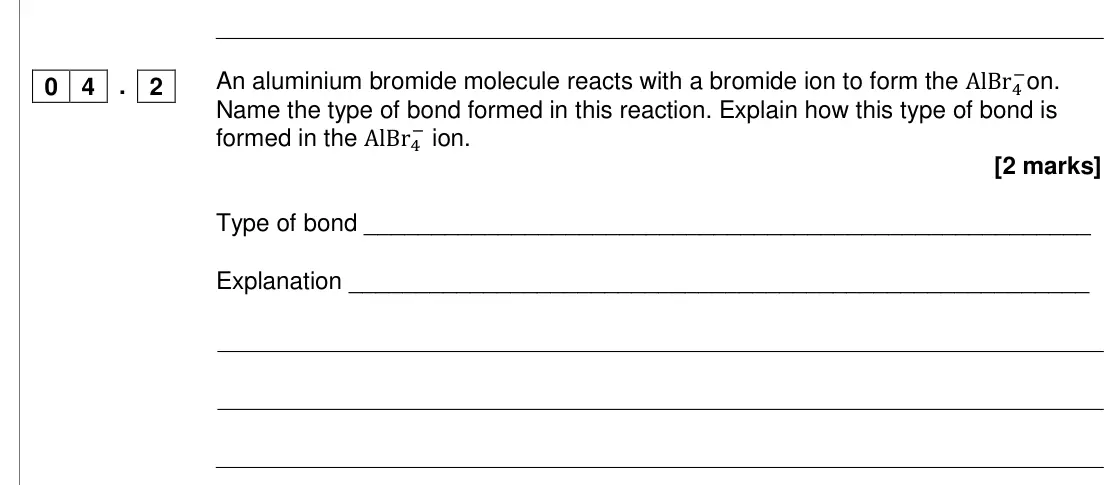
    Original question 04.2: An aluminium bromide molecule reacts with a bromide ion to form the AlBr4 −on. Name the type of bond formed in this reaction. Explain how this type of bond is formed in the AlBr4 −

    Loading the question…

  17. Q04.3

    Specimen · Unit 1 · ★★

    1 mark
    The whole paper ↗
    17
    Original question 04.3: Aluminium bromide has a relative molecular mass of 533.4 in the gas phase. Deduce the formula of the aluminium compound that has a relative molecular mass of 533.4 [1 mark] 0 4 . 3

    Loading the question…

  18. Q04.4

    Specimen · Unit 1 · ★★

    1 mark
    The whole paper ↗
    18
    Original question 04.4: Deduce the name or formula of a compound that has the same number of atoms, the same number of electrons and the same shape as the AlBr4 −ion. [1 mark] 0 4 . 4 9

    Loading the question…

  19. Q04.5

    Specimen · Unit 1 · ★★

    2 marks
    The whole paper ↗
    19
    Original question 04.5: Draw and name the shape of the TlF5 2− ion. [2 marks] Shape of the TlF5 2− ion. Name of shape ____________________________________________________ 0 4 . 5

    Loading the question…

  20. Q04.6

    Specimen · Unit 1 · ★

    1 mark
    The whole paper ↗
    20
    Original question 04.6: Draw the shape of the TlF5 2− ion. [1 mark] 𝐓𝐓𝐅𝟓𝟐 0 4 . 6

    Loading the question…

Questions, mark schemes and examiner’s reports are © OxfordAQA, from their published past papers. Plumi isn’t affiliated with any exam board. Want whole papers? OxfordAQA International A Level Chemistry past papers.

The Plumi iPad app also offers exam-style questions with AI feedback on your handwritten working.