 plumi
Kinetics: OxfordAQA International A Level Chemistry questions
OxfordAQA International A Level Chemistry past-paper questions on 3.1.6 Kinetics, Official specimen papers for Units 1–5, with mark schemes and examiner’s reports where available.
Past paper difficulty
Paper
All papers
Exam
All years
Calculations
Loading the full question list…
Q03.1
The whole paper ↗Q03.2
The whole paper ↗Q03.3
The whole paper ↗Q04.1
The whole paper ↗Q04.2
The whole paper ↗Q04.3
The whole paper ↗Q04.4
The whole paper ↗




All 10 questions on Kinetics, as a list
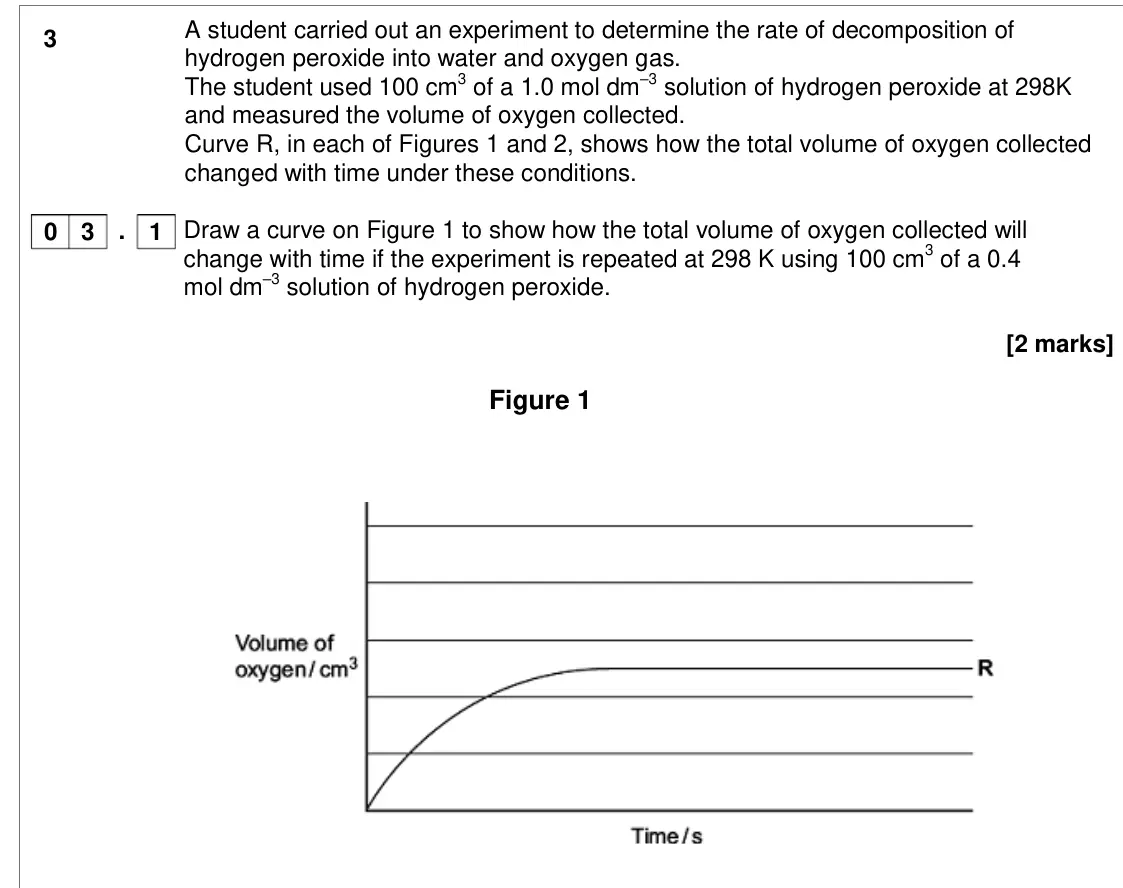
- Specimen, Unit 2, Q03.1 (2 marks): A student carried out an experiment to determine the rate of decomposition of hydrogen peroxide into water and oxygen gas. The student used 100 cm3 of a 1.0 mol dm–3 solution of hy
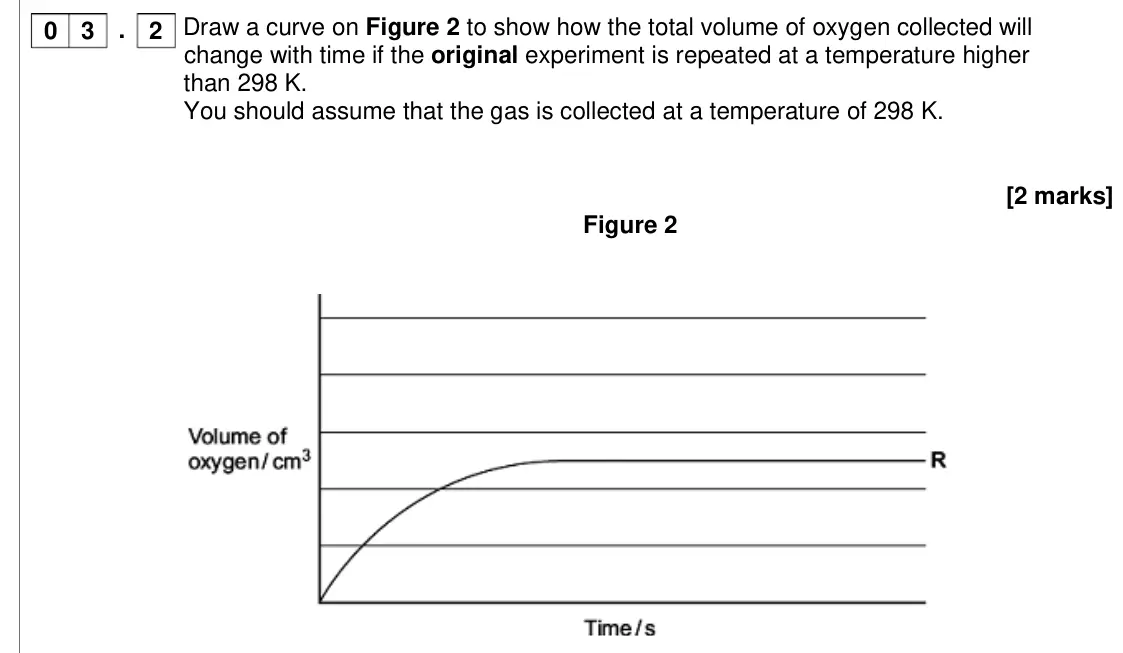
- Specimen, Unit 2, Q03.2 (2 marks): Draw a curve on Figure 2 to show how the total volume of oxygen collected will change with time if the original experiment is repeated at a temperature higher than 298 K. You shoul
- Specimen, Unit 2, Q03.3 (2 marks): Explain why the slope (gradient) of curve R decreases as time increases. [2 marks] 0 3 . 3 0
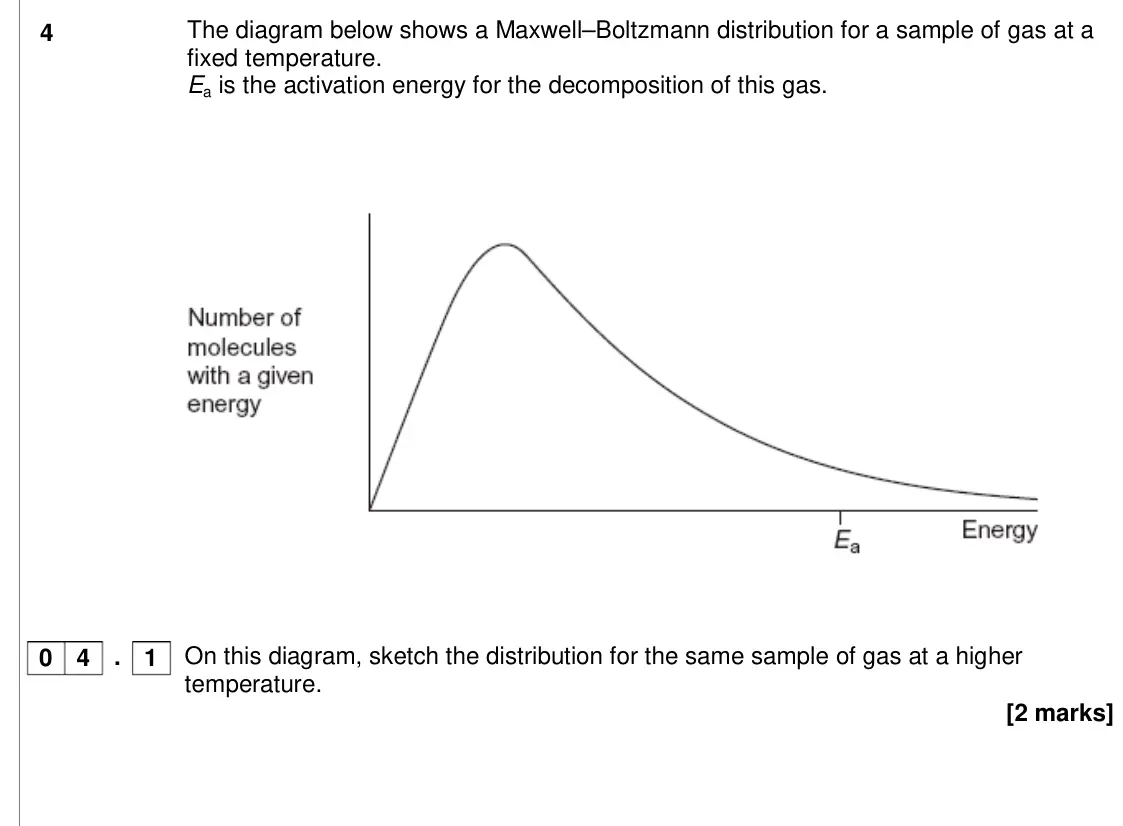
- Specimen, Unit 2, Q04.1 (2 marks): The diagram below shows a Maxwell–Boltzmann distribution for a sample of gas at a fixed temperature. Ea is the activation energy for the decomposition of this gas. On this diagram,
- Specimen, Unit 2, Q04.2 (2 marks): With reference to the Maxwell–Boltzmann distribution, explain why an increase in temperature increases the rate of a chemical reaction. [2 marks] 0 4 . 2
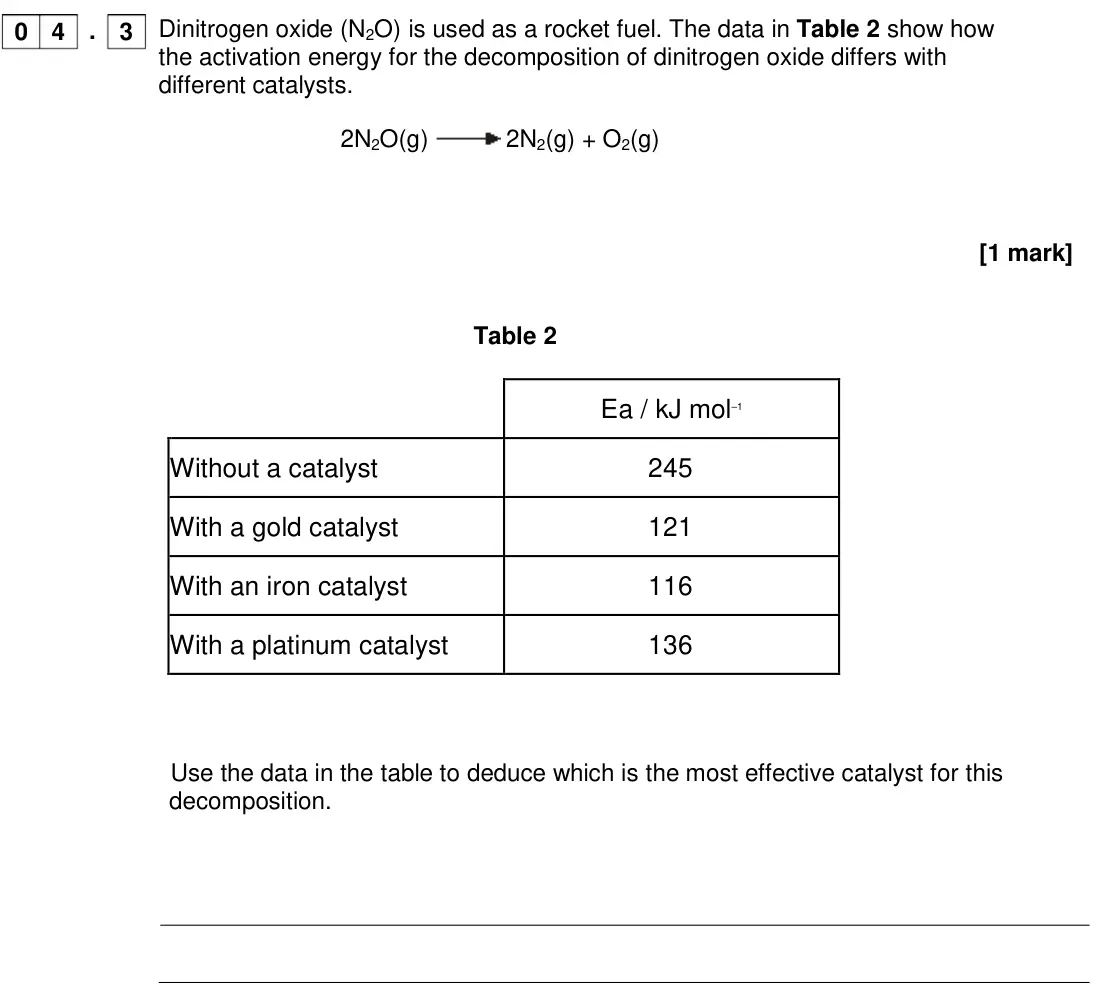
- Specimen, Unit 2, Q04.3 (1 mark): Dinitrogen oxide (N2O) is used as a rocket fuel. The data in Table 2 show how the activation energy for the decomposition of dinitrogen oxide differs with different catalysts. 2N2O
- Specimen, Unit 2, Q04.4 (2 marks): Explain how a catalyst increases the rate of a reaction. [2 marks] 0 4 . 4 Epoxyethane is formed when ethane is oxidised by air in the presence of a catalyst. The reaction is exoth
- Specimen, Unit 5, Q06 (1 mark): Figure 1 Figure 1 shows a Maxwell-Boltzmann distribution What does the area under the curve represent? [1 mark] A Total energy of particles B Total number of particles C Number of
- Specimen, Unit 5, Q07 (1 mark): What is likely to decrease the accuracy of the experiment? [1 mark] A Rinsing the flask with acid before each new experiment. B Stirring the solution throughout each experiment. C
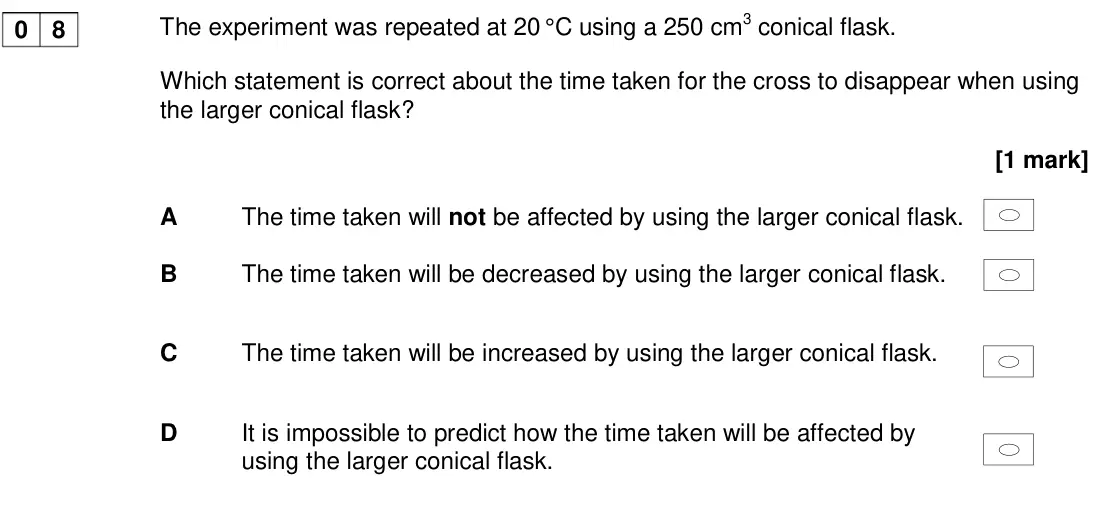
- Specimen, Unit 5, Q08 (1 mark): The experiment was repeated at 20 °C using a 250 cm3 conical flask. Which statement is correct about the time taken for the cross to disappear when using the larger conical flask?
Questions, mark schemes and examiner’s reports are © OxfordAQA, from their published past papers. Plumi isn’t affiliated with any exam board. Want whole papers? OxfordAQA International A Level Chemistry past papers.
The Plumi iPad app also offers exam-style questions with AI feedback on your handwritten working.