Skip to content
Android waitlistTry on iPad
Get started

Atomic structure: OxfordAQA International A Level Chemistry questions

OxfordAQA International A Level Chemistry past-paper questions on 3.1.1 Atomic structure, Official specimen papers for Units 1–5, with mark schemes and examiner’s reports where available.

Past paper difficulty
Paper
All papers
Exam
All years
Calculations

Loading the full question list…

168 questions

Full page
  1. Q01.1

    Specimen · Unit 1 · ★★★★

    The whole paper ↗
    1
    Setup for original question 01.1

    Loading the question setup…

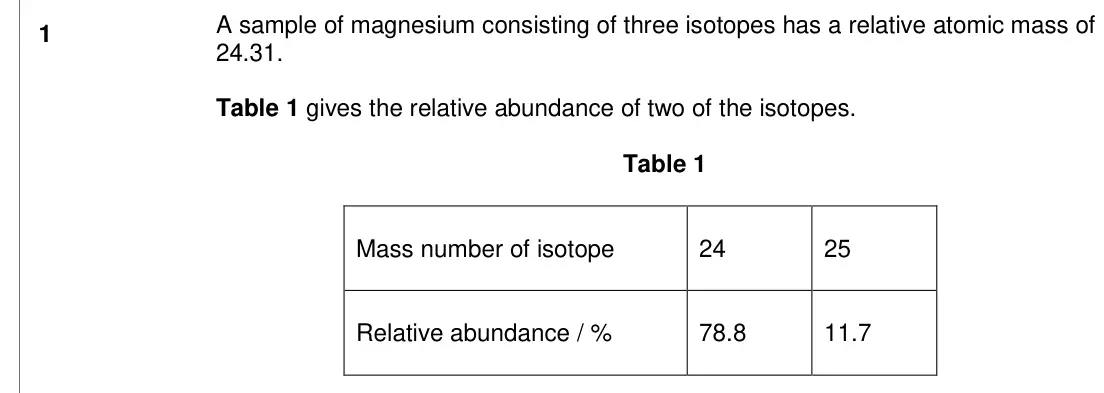
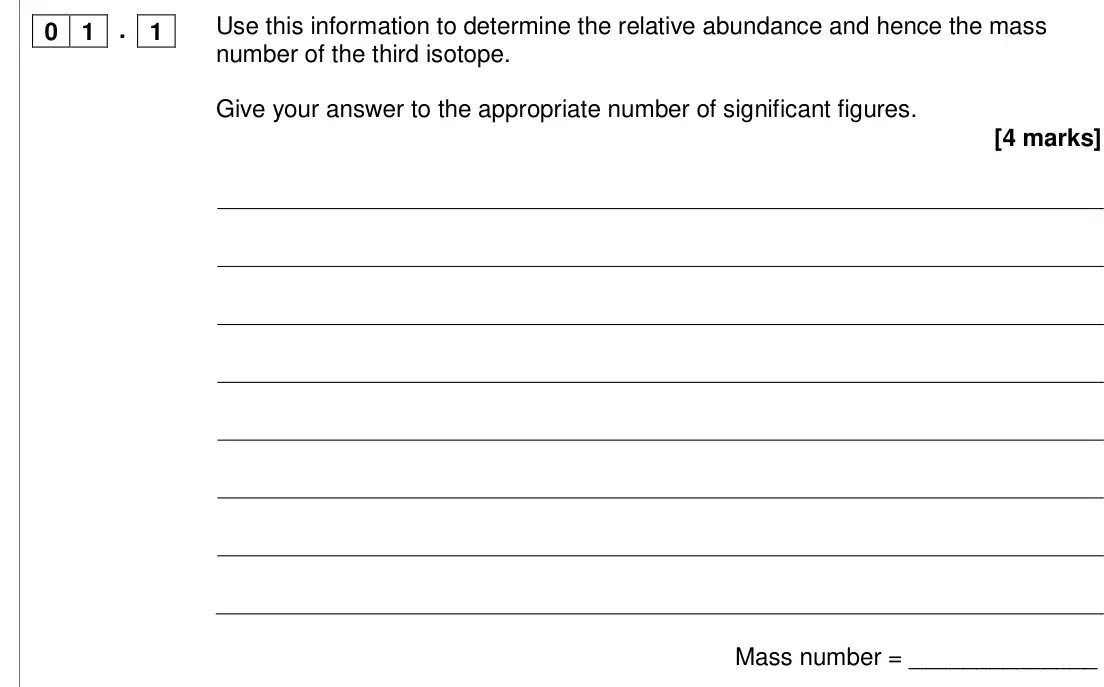
    Original question 01.1: A sample of magnesium consisting of three isotopes has a relative atomic mass of 24.31. Table 1 gives the relative abundance of two of the isotopes. Table 1 Mass number of isotope

    Loading the question…

  2. Q01.2

    Specimen · Unit 1 · ★★

    The whole paper ↗
    2
    Setup for original question 01.2

    Loading the question setup…

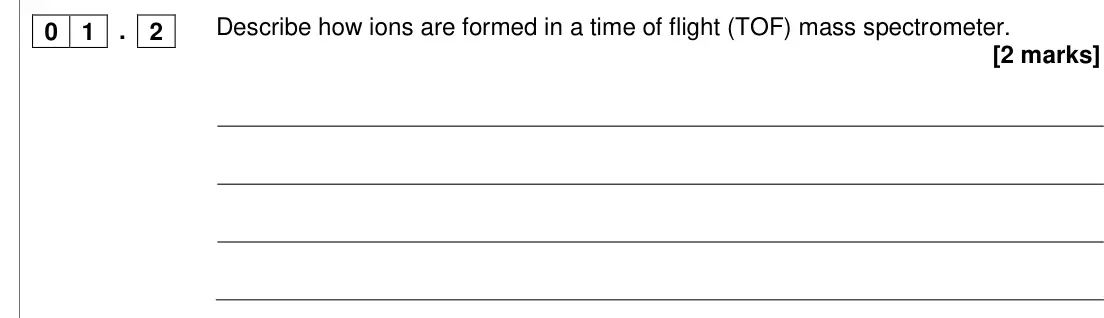
    Original question 01.2: A sample of magnesium consisting of three isotopes has a relative atomic mass of 24.31. Table 1 gives the relative abundance of two of the isotopes. Table 1 Mass number of isotope

    Loading the question…

  3. Q01.3

    Specimen · Unit 1 · ★★

    The whole paper ↗
    3
    Setup for original question 01.3

    Loading the question setup…

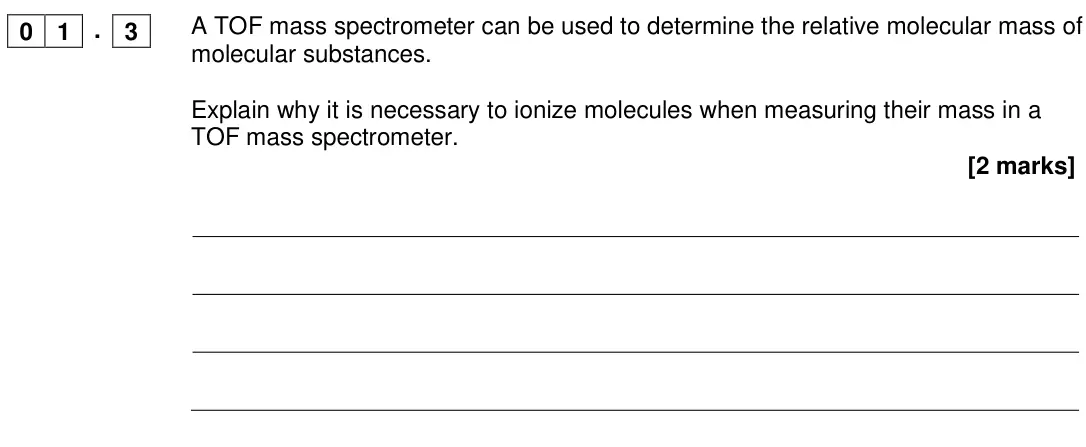
    Original question 01.3: A sample of magnesium consisting of three isotopes has a relative atomic mass of 24.31. Table 1 gives the relative abundance of two of the isotopes. Table 1 Mass number of isotope

    Loading the question…

  4. Q02.1

    Specimen · Unit 1 · ★★

    The whole paper ↗
    4
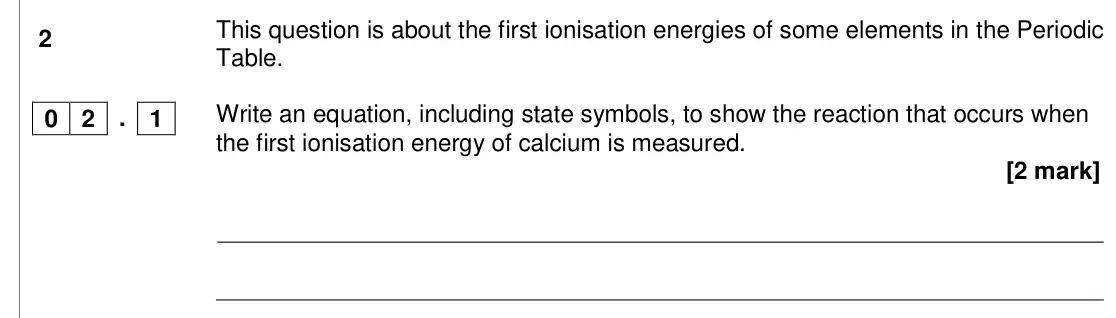
    Original question 02.1: This question is about the first ionisation energies of some elements in the Periodic Table. Write an equation, including state symbols, to show the reaction that occurs when the f

    Loading the question…

  5. Q02.2

    Specimen · Unit 1 · ★★★

    The whole paper ↗
    5
    Original question 02.2: State and explain the general trend in first ionisation energies for the Period 2 elements boron to neon. [3 marks] Trend __________________________________________________________

    Loading the question…

  6. Q02.3

    Specimen · Unit 1 · ★★★

    The whole paper ↗
    6
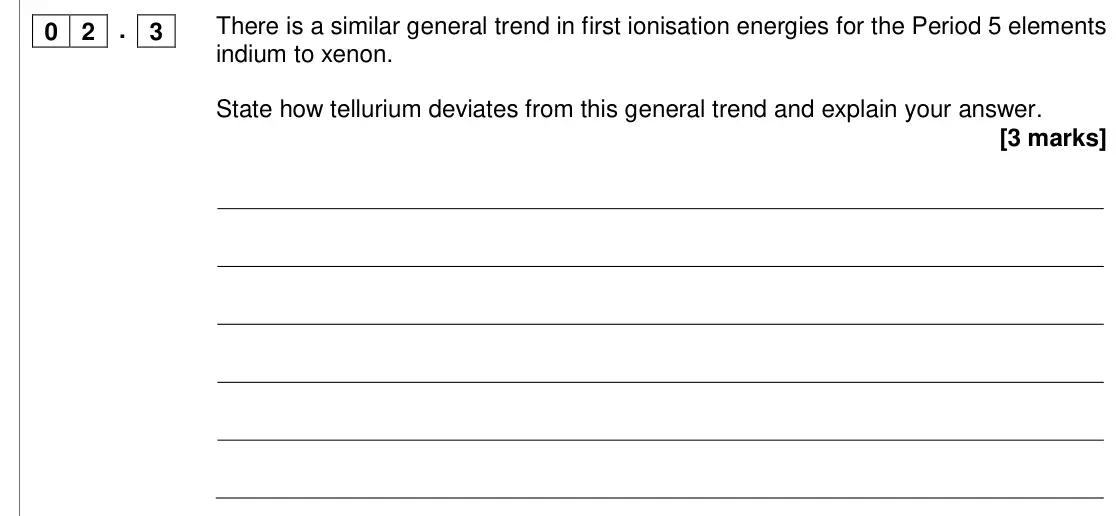
    Original question 02.3: There is a similar general trend in first ionisation energies for the Period 5 elements indium to xenon. State how tellurium deviates from this general trend and explain your answe

    Loading the question…

  7. Q02.4

    Specimen · Unit 1 · ★★

    The whole paper ↗
    7
    Original question 02.4: Suggest why the first ionisation energy of xenon is lower than the first ionisation energy of krypton. [1 mark] 0 2 . 4 5

    Loading the question…

  8. Q02.5

    Specimen · Unit 1 · ★

    The whole paper ↗
    8
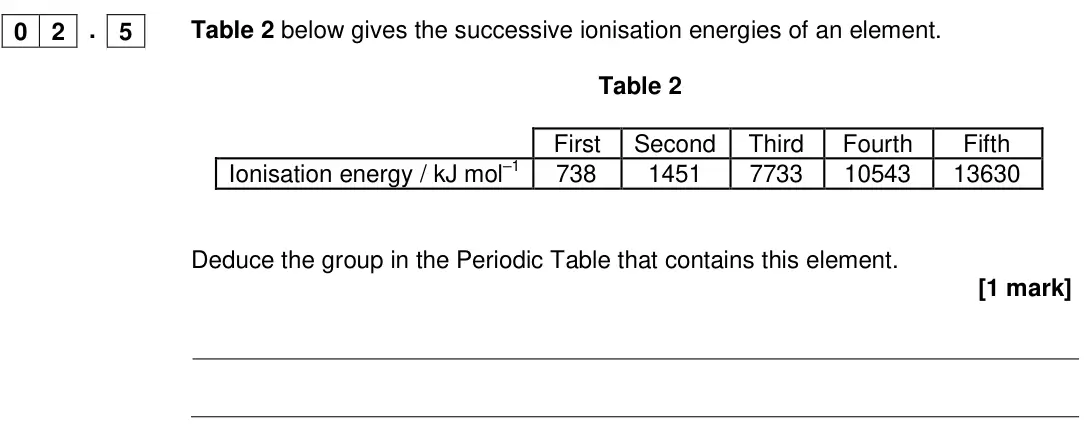
    Original question 02.5: Table 2 below gives the successive ionisation energies of an element. Table 2 First Second Third Fourth Fifth Ionisation energy / kJ mol–1 738 1451 7733 10543 13630 Deduce the grou

    Loading the question…

  9. Q02.6

    Specimen · Unit 1 · ★

    The whole paper ↗
    9
    Original question 02.6: Identify the element that has a 5+ ion with an electron configuration of 1s2 2s2 2p6 3s2 3p6 3d104s2 4p6 4d10 [1 mark] 0 2 . 6 6

    Loading the question…

  10. Q03

    Specimen · Unit 5 · ★

    The whole paper ↗
    10
    Original question 03: Which of these elements has the highest second ionisation energy? [1 mark] A Na B Mg C Ne D Ar 0 3

    Loading the question…

    Your answer
  11. Q09

    Specimen · Unit 5 · ★

    The whole paper ↗
    11
    Original question 09: Which change requires the largest amount of energy? [1 mark] A He+(g) He2+(g) + e– B Li(g) Li+(g) + e– C Mg+(g) Mg2+(g) + e– D N(g) N+(g) + e– 0 9

    Loading the question…

    Your answer
All 11 questions on Atomic structure, as a list
  1. Specimen, Unit 1, Q01.1 (4 marks): A sample of magnesium consisting of three isotopes has a relative atomic mass of 24.31. Table 1 gives the relative abundance of two of the isotopes. Table 1 Mass number of isotope
  2. Specimen, Unit 1, Q01.2 (2 marks): A sample of magnesium consisting of three isotopes has a relative atomic mass of 24.31. Table 1 gives the relative abundance of two of the isotopes. Table 1 Mass number of isotope
  3. Specimen, Unit 1, Q01.3 (2 marks): A sample of magnesium consisting of three isotopes has a relative atomic mass of 24.31. Table 1 gives the relative abundance of two of the isotopes. Table 1 Mass number of isotope
  4. Specimen, Unit 1, Q02.1 (2 marks): This question is about the first ionisation energies of some elements in the Periodic Table. Write an equation, including state symbols, to show the reaction that occurs when the f
  5. Specimen, Unit 1, Q02.2 (3 marks): State and explain the general trend in first ionisation energies for the Period 2 elements boron to neon. [3 marks] Trend __________________________________________________________
  6. Specimen, Unit 1, Q02.3 (3 marks): There is a similar general trend in first ionisation energies for the Period 5 elements indium to xenon. State how tellurium deviates from this general trend and explain your answe
  7. Specimen, Unit 1, Q02.4 (1 mark): Suggest why the first ionisation energy of xenon is lower than the first ionisation energy of krypton. [1 mark] 0 2 . 4 5
  8. Specimen, Unit 1, Q02.5 (1 mark): Table 2 below gives the successive ionisation energies of an element. Table 2 First Second Third Fourth Fifth Ionisation energy / kJ mol–1 738 1451 7733 10543 13630 Deduce the grou
  9. Specimen, Unit 1, Q02.6 (1 mark): Identify the element that has a 5+ ion with an electron configuration of 1s2 2s2 2p6 3s2 3p6 3d104s2 4p6 4d10 [1 mark] 0 2 . 6 6
  10. Specimen, Unit 5, Q03 (1 mark): Which of these elements has the highest second ionisation energy? [1 mark] A Na B Mg C Ne D Ar 0 3
  11. Specimen, Unit 5, Q09 (1 mark): Which change requires the largest amount of energy? [1 mark] A He+(g) He2+(g) + e– B Li(g) Li+(g) + e– C Mg+(g) Mg2+(g) + e– D N(g) N+(g) + e– 0 9

Questions, mark schemes and examiner’s reports are © OxfordAQA, from their published past papers. Plumi isn’t affiliated with any exam board. Want whole papers? OxfordAQA International A Level Chemistry past papers.

The Plumi iPad app also offers exam-style questions with AI feedback on your handwritten working.