 plumi
Rate equations: OxfordAQA International A Level Chemistry questions
OxfordAQA International A Level Chemistry past-paper questions on 3.1.11 Rate equations, Official specimen papers for Units 1–5, with mark schemes and examiner’s reports where available.
Past paper difficulty
Paper
All papers
Exam
All years
Calculations
Loading the full question list…
Q01.1
The whole paper ↗Q01.2
The whole paper ↗Q01.3
The whole paper ↗Q01.4
The whole paper ↗Q01.5
The whole paper ↗Q01.6
The whole paper ↗Q01.7
The whole paper ↗



All 8 questions on Rate equations, as a list
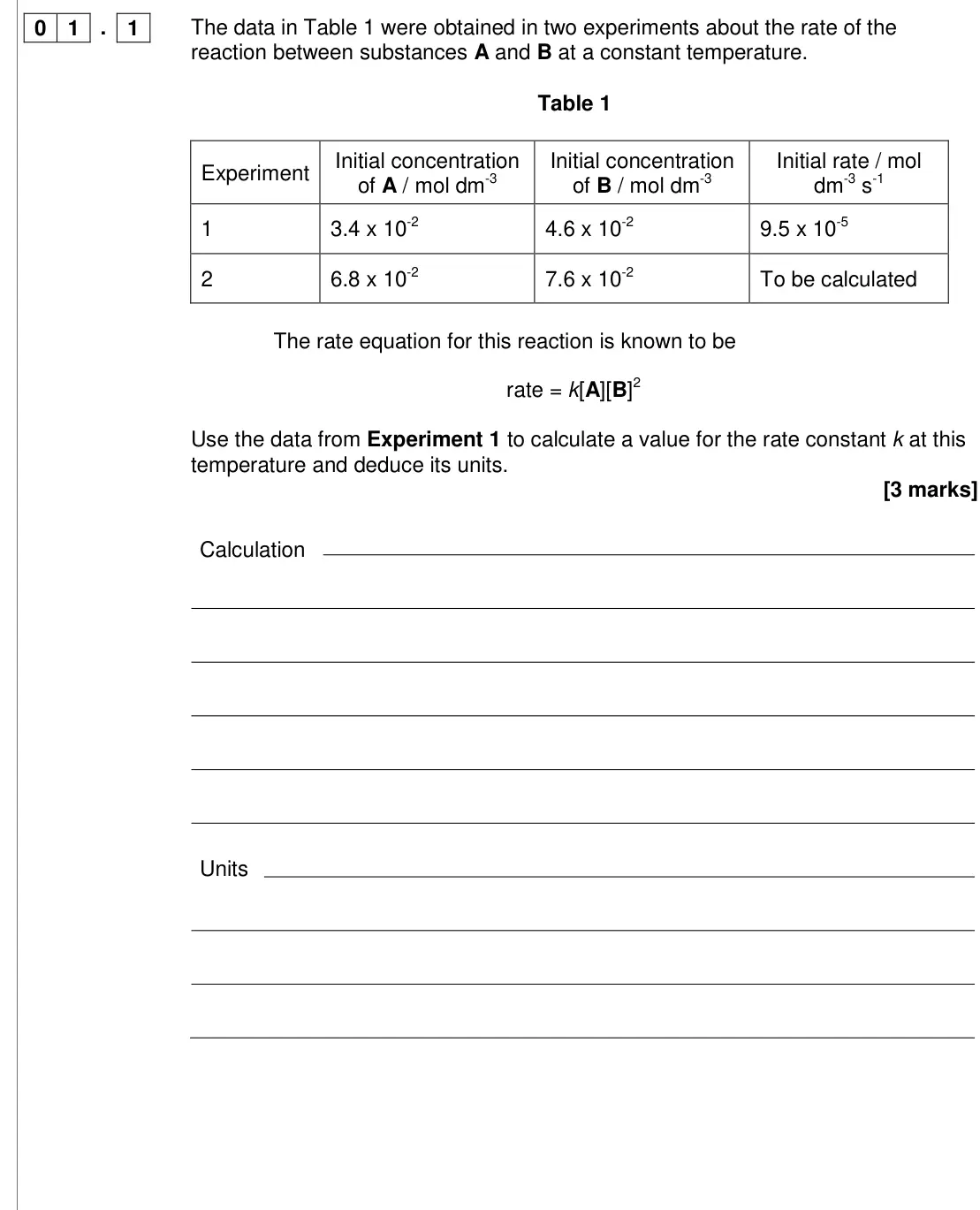
- Specimen, Unit 4, Q01.1 (3 marks): The data in Table 1 were obtained in two experiments about the rate of the reaction between substances A and B at a constant temperature. Table 1 Experiment Initial concentration o
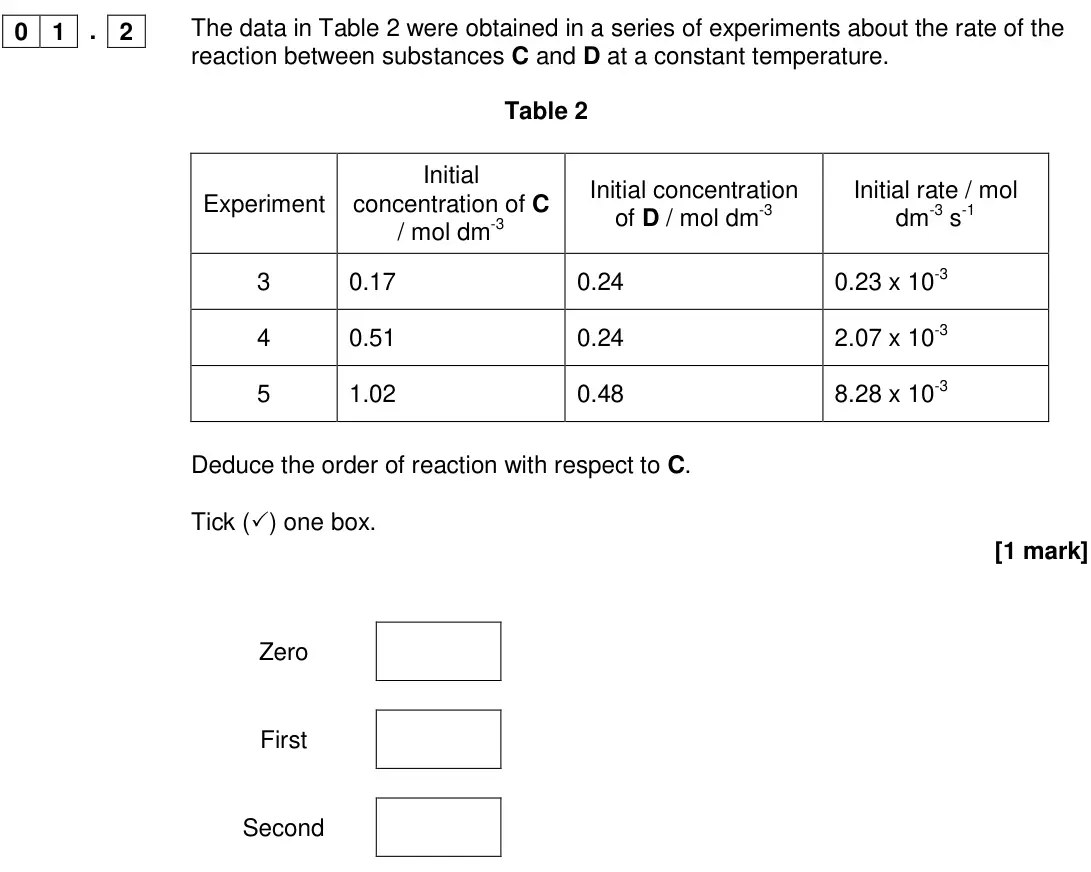
- Specimen, Unit 4, Q01.2 (1 mark): The data in Table 2 were obtained in a series of experiments about the rate of the reaction between substances C and D at a constant temperature. Table 2 Experiment Initial concent
- Specimen, Unit 4, Q01.3 (1 mark): Deduce the order of reaction with respect to D. Tick () one box. [1 mark] Zero First Second 0 1 . 3
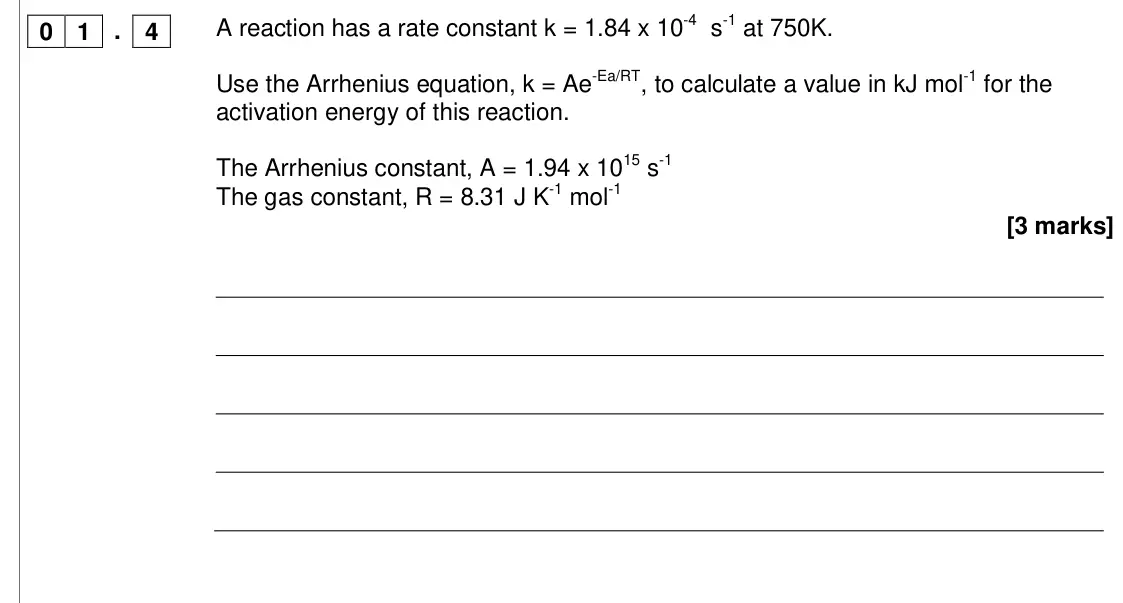
- Specimen, Unit 4, Q01.4 (3 marks): A reaction has a rate constant k = 1.84 x 10⁻⁴ s-1 at 750K. Use the Arrhenius equation, k = Ae-Ea/RT, to calculate a value in kJ mol-1 for the activation energy of this reaction. T
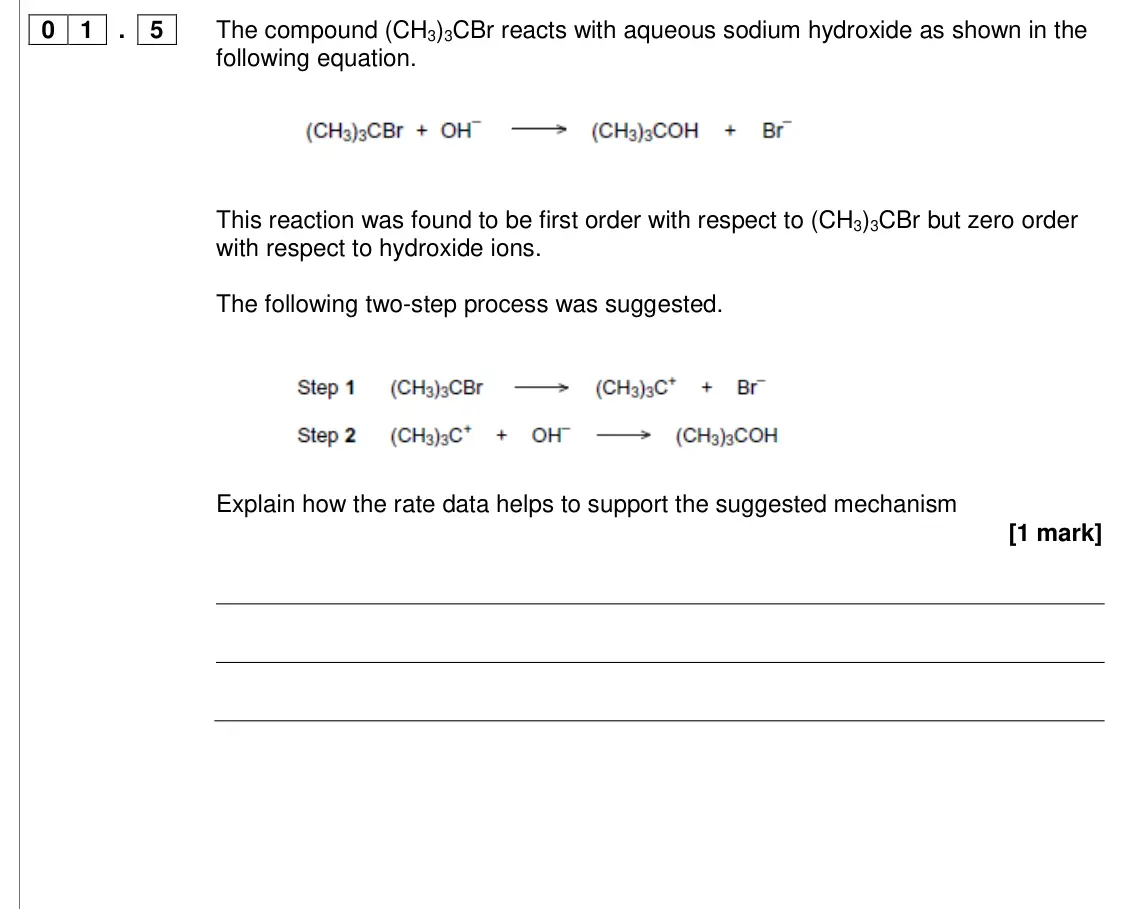
- Specimen, Unit 4, Q01.5 (1 mark): 0 1 . 5 The compound (CH3)3CBr reacts with aqueous sodium hydroxide as shown in the following equation. This reaction was found to be first order with respect to (CH3)3CBr but zero
- Specimen, Unit 4, Q01.6 (1 mark): Outline a mechanism for Step 1 using a curly arrow. [1 mark] 0 1 . 6
- Specimen, Unit 4, Q01.7 (2 marks): Suggest how the rate of the reaction between (CH3)3CCl would compare with the rate of the reaction in Question 01.6. Explain your answer. [2 marks] 0 1 . 7 6
- Specimen, Unit 5, Q13 (1 mark): The rate equation for the hydrogenation of ethene C2H4(g) + H2(g) C2H6(g) is Rate = k[C2H4][H2] At a fixed temperature, the reaction mixture is compressed to triple the original pr
Questions, mark schemes and examiner’s reports are © OxfordAQA, from their published past papers. Plumi isn’t affiliated with any exam board. Want whole papers? OxfordAQA International A Level Chemistry past papers.
The Plumi iPad app also offers exam-style questions with AI feedback on your handwritten working.