 plumi
Energetics: OxfordAQA International A Level Chemistry questions
OxfordAQA International A Level Chemistry past-paper questions on 3.1.4 Energetics, Official specimen papers for Units 1–5, with mark schemes and examiner’s reports where available.
Past paper difficulty
Paper
All papers
Exam
All years
Calculations
Loading the full question list…
Q05.1
The whole paper ↗Q05.2
The whole paper ↗Q05.3
The whole paper ↗Q05.4
The whole paper ↗Q06.1
The whole paper ↗Q06.2
The whole paper ↗Q06.3
The whole paper ↗Q07.1
The whole paper ↗Q07.2
The whole paper ↗Q01.1
The whole paper ↗Q01.2
The whole paper ↗







All 11 questions on Energetics, as a list
- Specimen, Unit 1, Q05.1 (2 marks): This question is about enthalpy changes. 0 5 . 1 Define the term standard enthalpy of formation, ΔfHo [2 marks] 5
- Specimen, Unit 1, Q05.2 (1 mark): 0 5 . 2 State Hess’s law. [1 mark]
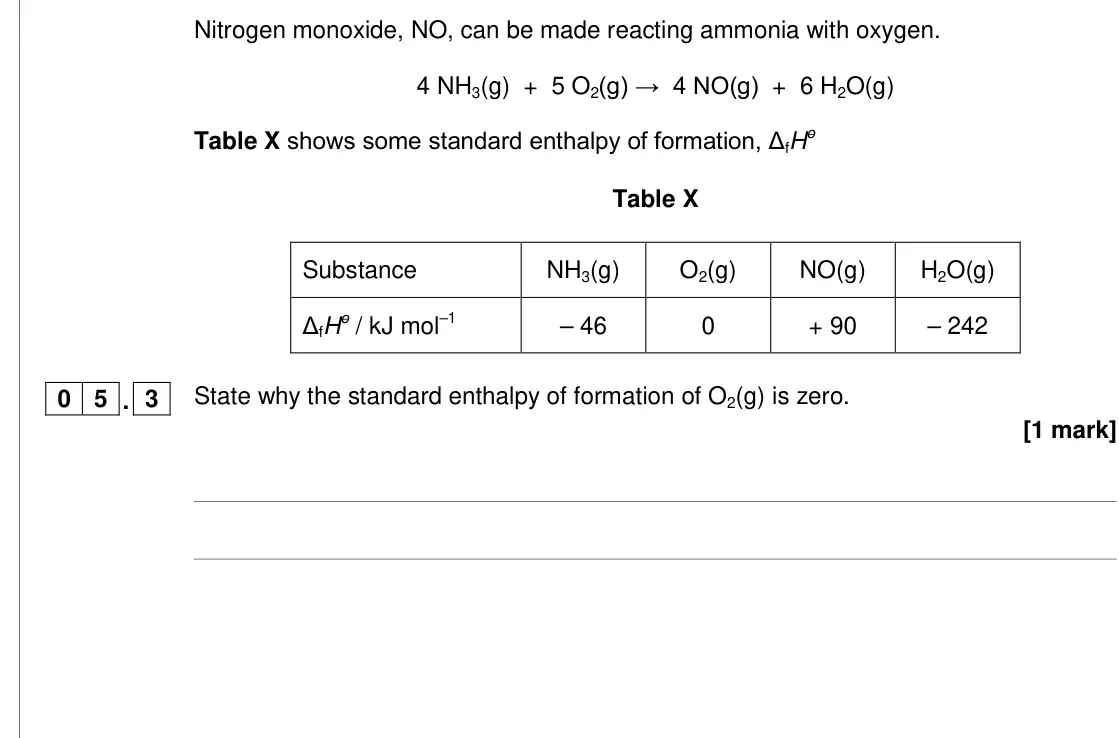
- Specimen, Unit 1, Q05.3 (1 mark): Nitrogen monoxide, NO, can be made reacting ammonia with oxygen. 4 NH3(g) + 5 O2(g) → 4 NO(g) + 6 H2O(g) Table X shows some standard enthalpy of formation, ΔfHo Table X Substance N
- Specimen, Unit 1, Q05.4 (2 marks): 0 5 . 4 Use Table X and the equation to calculate the enthalpy change for the reaction of ammonia with oxygen to form nitrogen monoxide. [2 marks] Enthalpy change = kJ mol–1 Barium
- Specimen, Unit 1, Q06.1 (1 mark): Write an equation for this reaction. [1 mark] 0 6 . 1
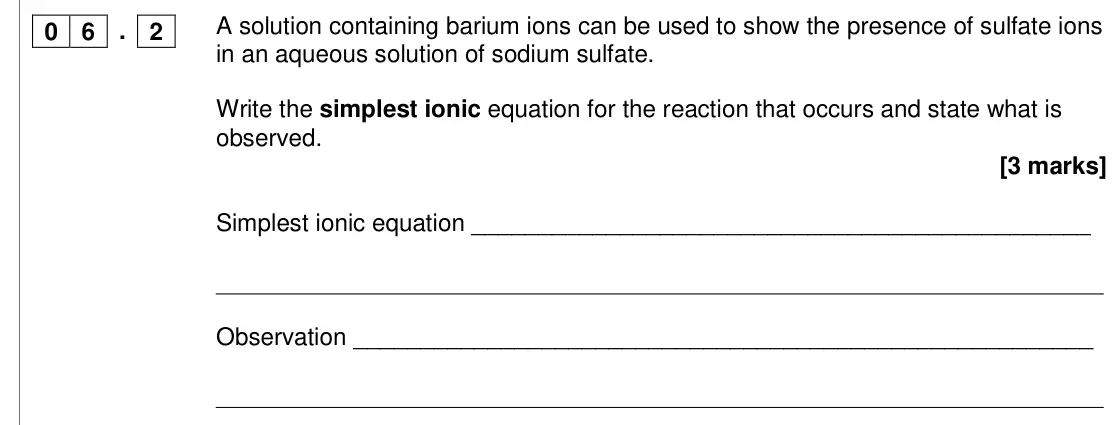
- Specimen, Unit 1, Q06.2 (3 marks): A solution containing barium ions can be used to show the presence of sulfate ions in an aqueous solution of sodium sulfate. Write the simplest ionic equation for the reaction that
- Specimen, Unit 1, Q06.3 (1 mark): State one use of barium sulfate in medicine. Explain why this use is possible, given that solutions containing barium ions are poisonous. [1 mark] Use _____________________________
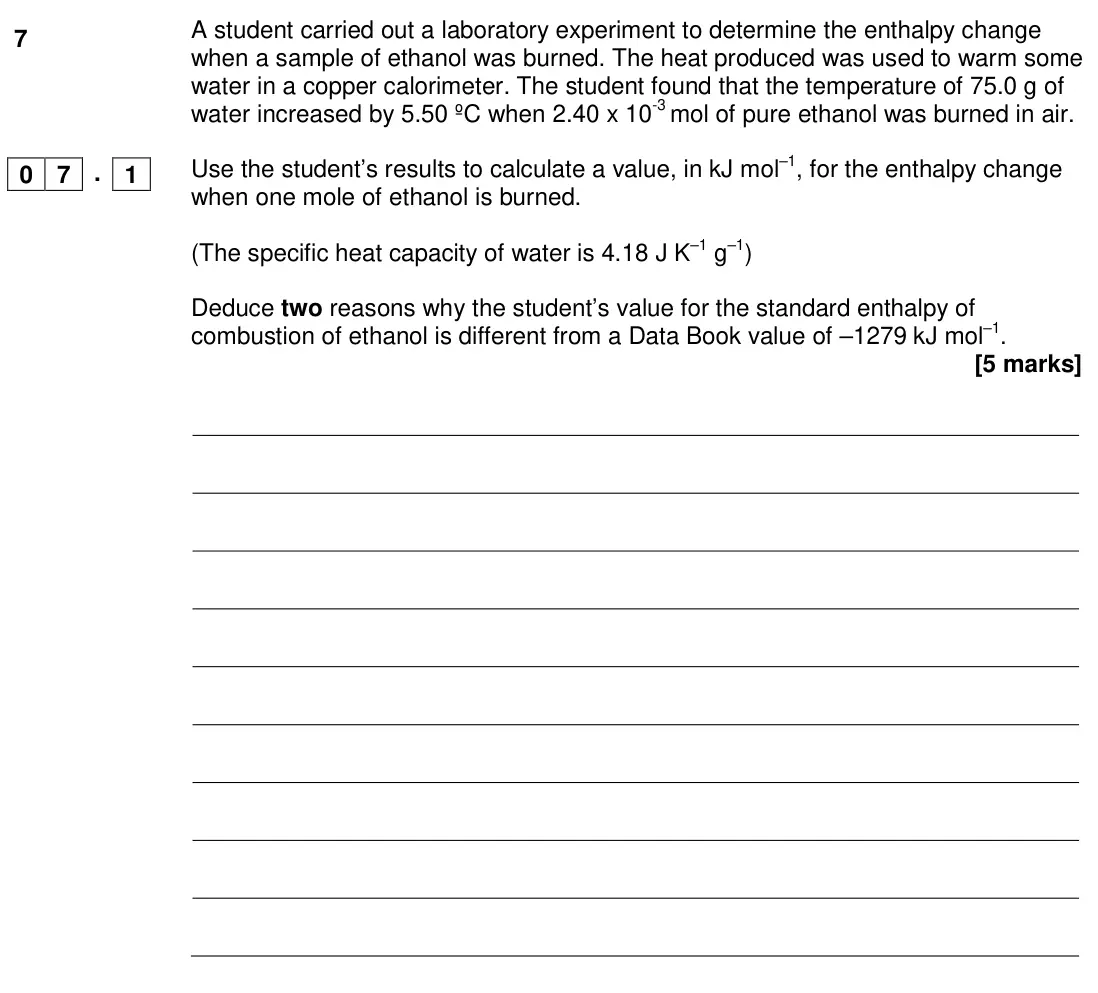
- Specimen, Unit 1, Q07.1 (5 marks): A student carried out a laboratory experiment to determine the enthalpy change when a sample of ethanol was burned. The heat produced was used to warm some water in a copper calori
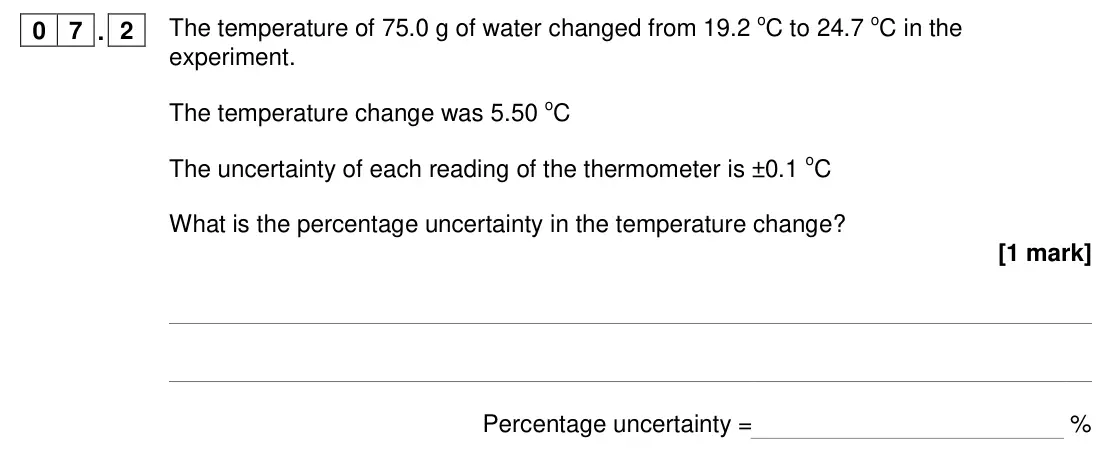
- Specimen, Unit 1, Q07.2 (1 mark): 0 7 . 2 The temperature of 75.0 g of water changed from 19.2 oC to 24.7 oC in the experiment. The temperature change was 5.50 oC The uncertainty of each reading of the thermometer
- Specimen, Unit 3, Q01.1 (2 marks): 0 1 This question is about bond enthalpy. 0 1 . 1 Define the term mean bond enthalpy. [2 marks]
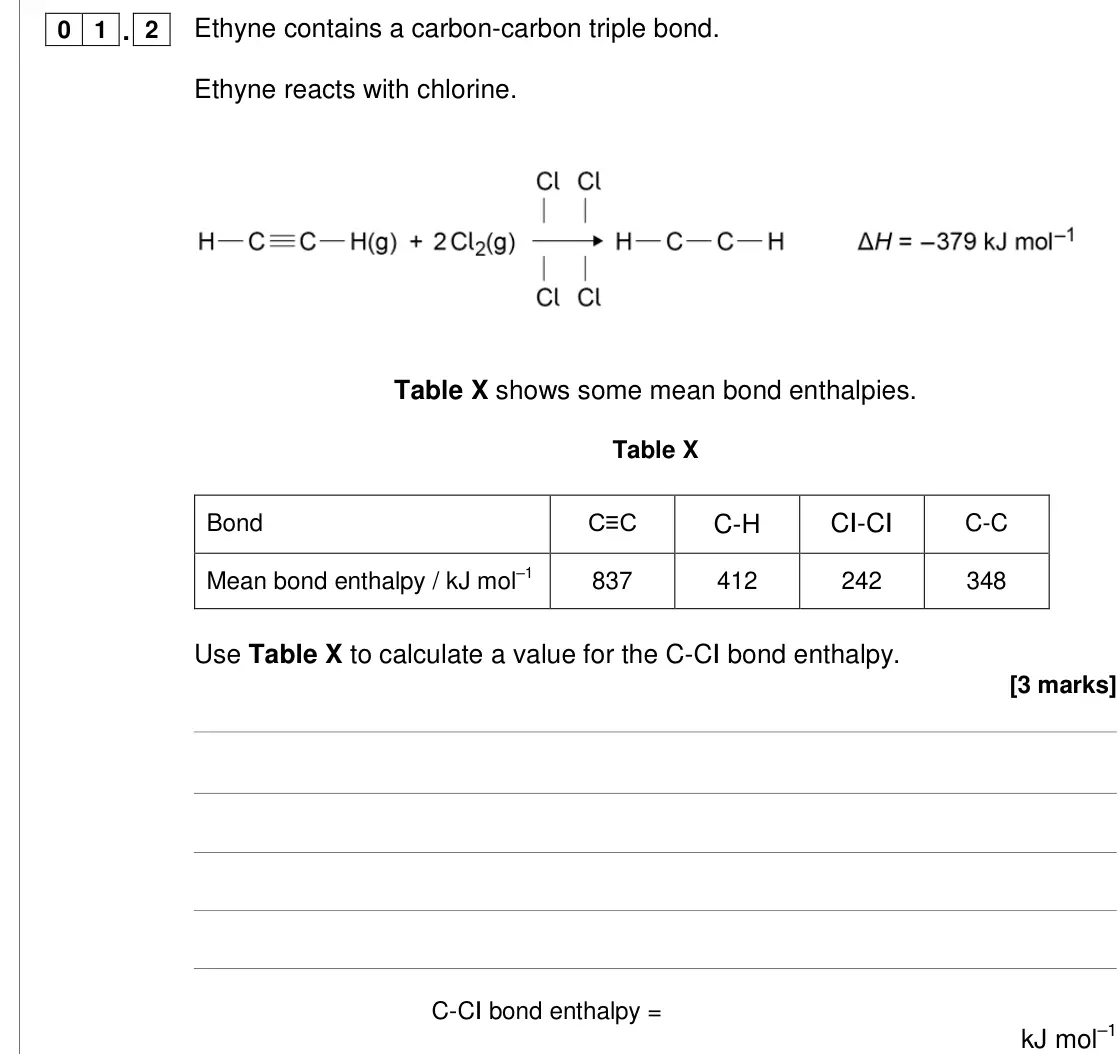
- Specimen, Unit 3, Q01.2 (3 marks): 0 1 This question is about bond enthalpy. 0 1 . 2 Ethyne contains a carbon-carbon triple bond. Ethyne reacts with chlorine. Table X shows some mean bond enthalpies. Table X Bond C≡
Questions, mark schemes and examiner’s reports are © OxfordAQA, from their published past papers. Plumi isn’t affiliated with any exam board. Want whole papers? OxfordAQA International A Level Chemistry past papers.
The Plumi iPad app also offers exam-style questions with AI feedback on your handwritten working.