Skip to content

Eduqas A‑Level Chemistry questions by topic

Every question from every Eduqas A-Level Chemistry paper, 2016–2025, part by part. Filter by topic, paper or year, open the mark scheme under any question, and download a set as a PDF.

Find questions1,513
Topics Pick as many as you like. Open one to choose its sub-topics.

Year 1 · AS

Year 2 · A‑Level only

Calculations

1,513 questions

  1. Q1

    June 2025 · Component 1

    2 marks
    The whole paper ↗
    June 2025 Component 1, question 1: State the colours observed in flame tests for compounds containing the following ions. [2] Potassium ions ……… …………………………………………….. Lithium ions ……… …………………………………
  2. Q2

    June 2025 · Component 1

    2 marks
    The whole paper ↗
    June 2025 Component 1, question 2: Write the equation for the enthalpy of formation of ethanol. [2] Include state symbols.
  3. Q3(a)

    June 2025 · Component 1

    1 mark
    The whole paper ↗
    June 2025 Component 1, question 3(a): State how catalysts act to increase the rate of a chemical reaction. [1]
  4. Q3(b)

    June 2025 · Component 1

    1 mark
    The whole paper ↗
    June 2025 Component 1, question 3(b): State what is meant by the term heterogeneous in this context. [1]
  5. Q4

    June 2025 · Component 1

    2 marks
    The whole paper ↗
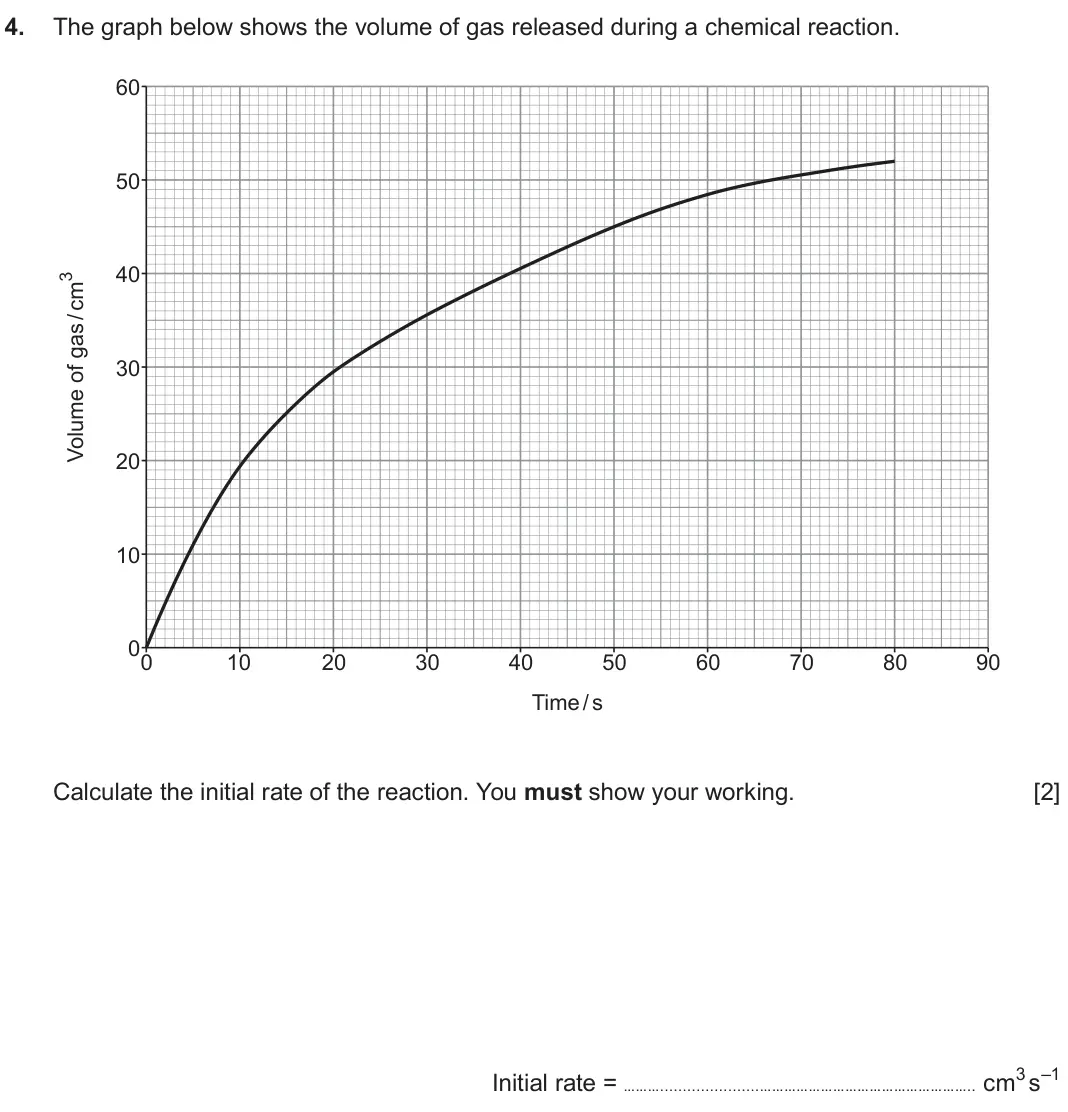
    June 2025 Component 1, question 4: The graph below shows the volume of gas released during a chemical reaction. 60 50 40 30 20 10 0 0 10 20 30 40 50 60 70 80 90 Time/s Calculate the initial rate
  6. Q5(a)

    June 2025 · Component 1

    1 mark
    The whole paper ↗
    June 2025 Component 1, question 5(a): Write an equation for a reaction that shows that carbon dioxide is an acidic oxide. [1]
  7. Q5(b)

    June 2025 · Component 1

    1 mark
    The whole paper ↗
    June 2025 Component 1, question 5(b): State what is meant by the term amphoteric. [1]
  8. Q6

    June 2025 · Component 1

    2 marks
    The whole paper ↗
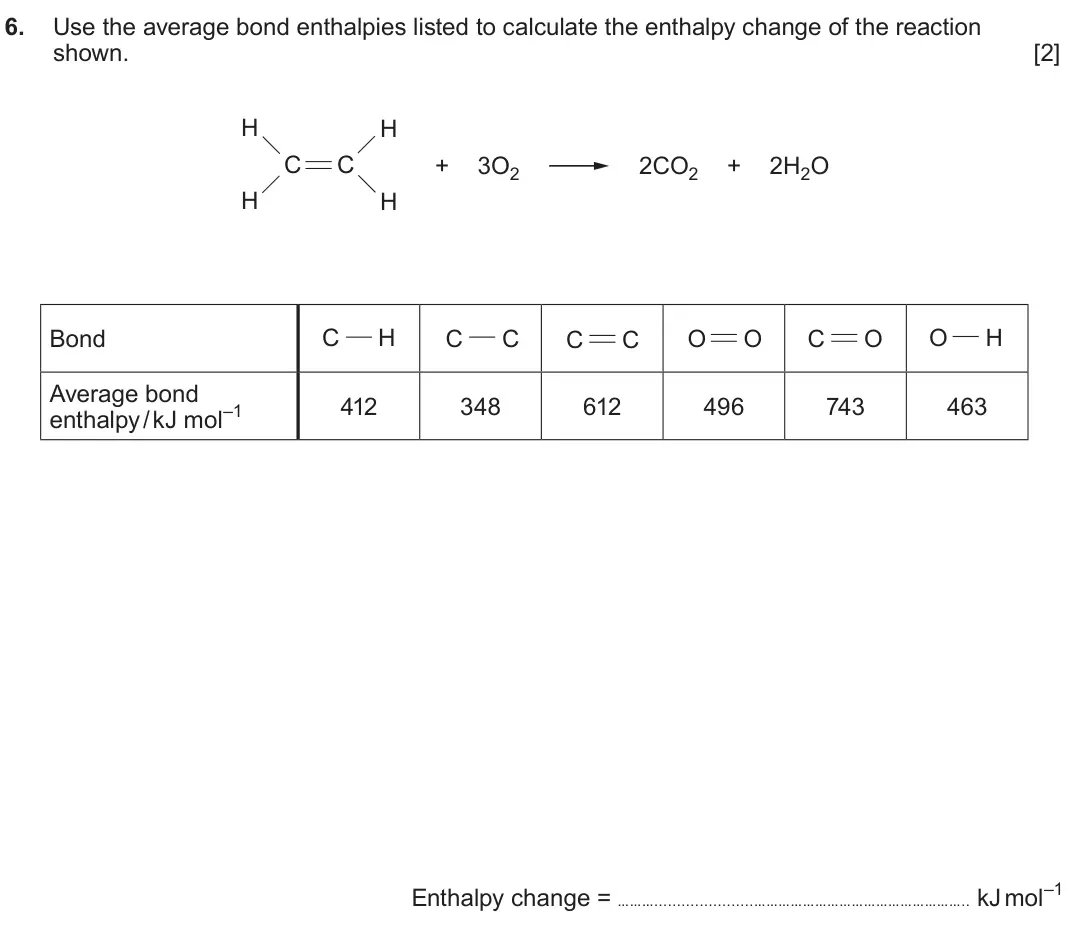
    June 2025 Component 1, question 6: Use the average bond enthalpies listed to calculate the enthalpy change of the reaction shown. [2] H H C C + 3O2 2CO2 + 2H2O H H Bond C H C C C C O O C O O H Av
  9. Q7

    June 2025 · Component 1

    1 mark
    The whole paper ↗
    June 2025 Component 1, question 7: State what is meant by the term dynamic equilibrium. [1]
  10. Q8(a)

    June 2025 · Component 1

    1 mark
    The whole paper ↗
    June 2025 Component 1, question 8(a): Identify the type of particle emitted in this process. [1]
  11. Q8(b)

    June 2025 · Component 1

    1 mark
    The whole paper ↗
    June 2025 Component 1, question 8(b): State how this particle would be affected by an electric field. [1]
  12. Q9(a)(i)

    June 2025 · Component 1

    2 marks
    The whole paper ↗
    June 2025 Component 1, question 9(a)(i): Explain how the dark lines form and why they get closer together. [2]
  13. Q9(a)(ii)

    June 2025 · Component 1

    3 marks
    The whole paper ↗
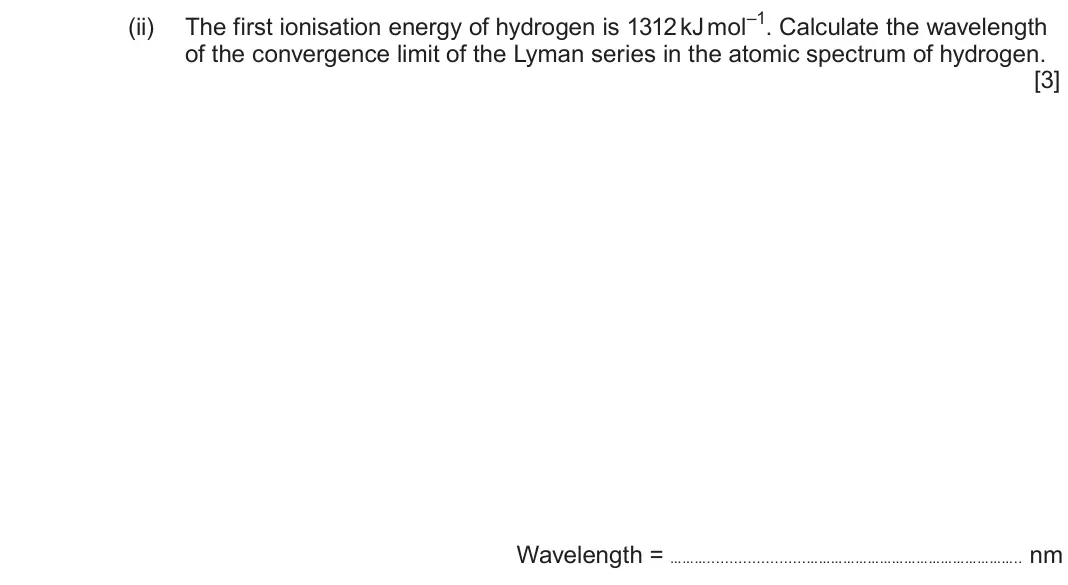
    June 2025 Component 1, question 9(a)(ii): The first ionisation energy of hydrogen is 1312 kJ mol–1. Calculate the wavelength of the convergence limit of the Lyman series in the atomic spectrum of hydrog
  14. Q9(b)(i)

    June 2025 · Component 1

    2 marks
    The whole paper ↗
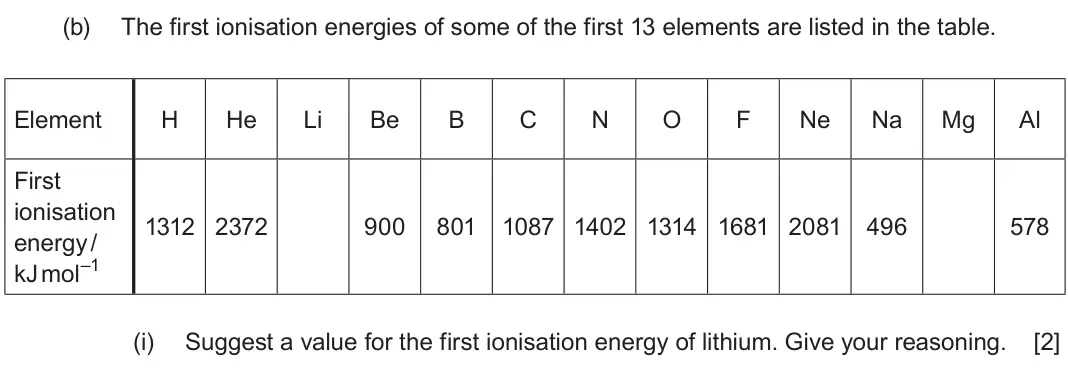
    June 2025 Component 1, question 9(b)(i): Suggest a value for the first ionisation energy of lithium. Give your reasoning. [2]
  15. Q9(b)(ii)

    June 2025 · Component 1

    3 marks
    The whole paper ↗
    June 2025 Component 1, question 9(b)(ii): Suggest a value for the first ionisation energy of magnesium. Explain your answer. [3]
  16. Q9(c)(i)

    June 2025 · Component 1

    1 mark
    The whole paper ↗
    June 2025 Component 1, question 9(c)(i): Give the difference between strong and weak acids. [1]
  17. Q9(c)(ii)

    June 2025 · Component 1

    4 marks
    The whole paper ↗
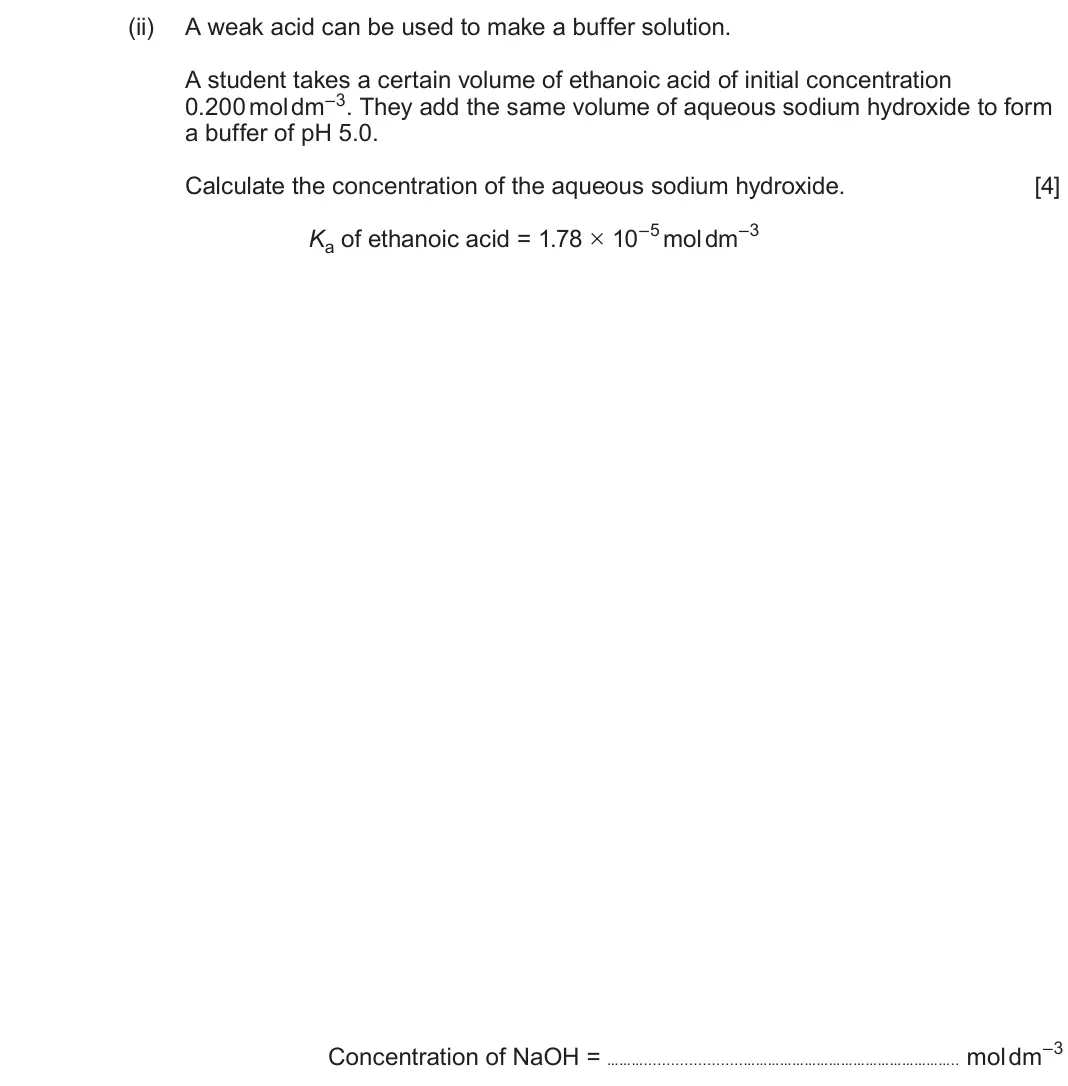
    June 2025 Component 1, question 9(c)(ii): A weak acid can be used to make a buffer solution. A student takes a certain volume of ethanoic acid of initial concentration 0.200 mol dm–3. They add the same
  18. Q9(d)

    June 2025 · Component 1

    6 marks
    The whole paper ↗
    June 2025 Component 1, question 9(d): Hydrogen bonding is one type of intermolecular force. Explain what is meant by hydrogen bonding and how it affects the properties of water. You may include diag
  19. Q10(a)

    June 2025 · Component 1

    1 mark
    The whole paper ↗
    June 2025 Component 1, question 10(a): State why these elements are classed as part of the p-block. [1]
  20. Q10(b)(i)

    June 2025 · Component 1

    1 mark
    The whole paper ↗
    June 2025 Component 1, question 10(b)(i): Identify the most electronegative element in the table. [1]

Questions, mark schemes and examiner’s reports are © WJEC Eduqas, from their published past papers. Plumi isn’t affiliated with any exam board. Want whole papers? Every Eduqas A-Level Chemistry paper.

Rather write your answers by hand on iPad? Plumi marks them against the same mark schemes.