 plumi
Thermodynamics: OxfordAQA International A Level Chemistry questions
OxfordAQA International A Level Chemistry past-paper questions on 3.1.8 Thermodynamics, Official specimen papers for Units 1–5, with mark schemes and examiner’s reports where available.
Past paper difficulty
Paper
All papers
Exam
All years
Calculations
Loading the full question list…
Q02.1
The whole paper ↗Q02.2
The whole paper ↗Q02.3
The whole paper ↗Q02.4
The whole paper ↗Q02.5
The whole paper ↗Q02.6
The whole paper ↗Q03.1
The whole paper ↗Q03.2
The whole paper ↗Q03.3
The whole paper ↗Q03.4
The whole paper ↗Q03.5
The whole paper ↗Q03.6
The whole paper ↗







All 12 questions on Thermodynamics, as a list
- Specimen, Unit 3, Q02.1 (1 mark): Write an equation for the process that has an enthalpy change equal to the electron affinity of fluorine. [1 mark] 0 2 . 1
- Specimen, Unit 3, Q02.2 (2 marks): In terms of electrostatic forces, suggest why the electron affinity of fluorine has a negative value. [2 marks] 0 2 . 2
- Specimen, Unit 3, Q02.3 (3 marks): Complete the Born–Haber cycle for silver fluoride by adding the missing species on the dotted lines. [3 marks] 0 2 . 3
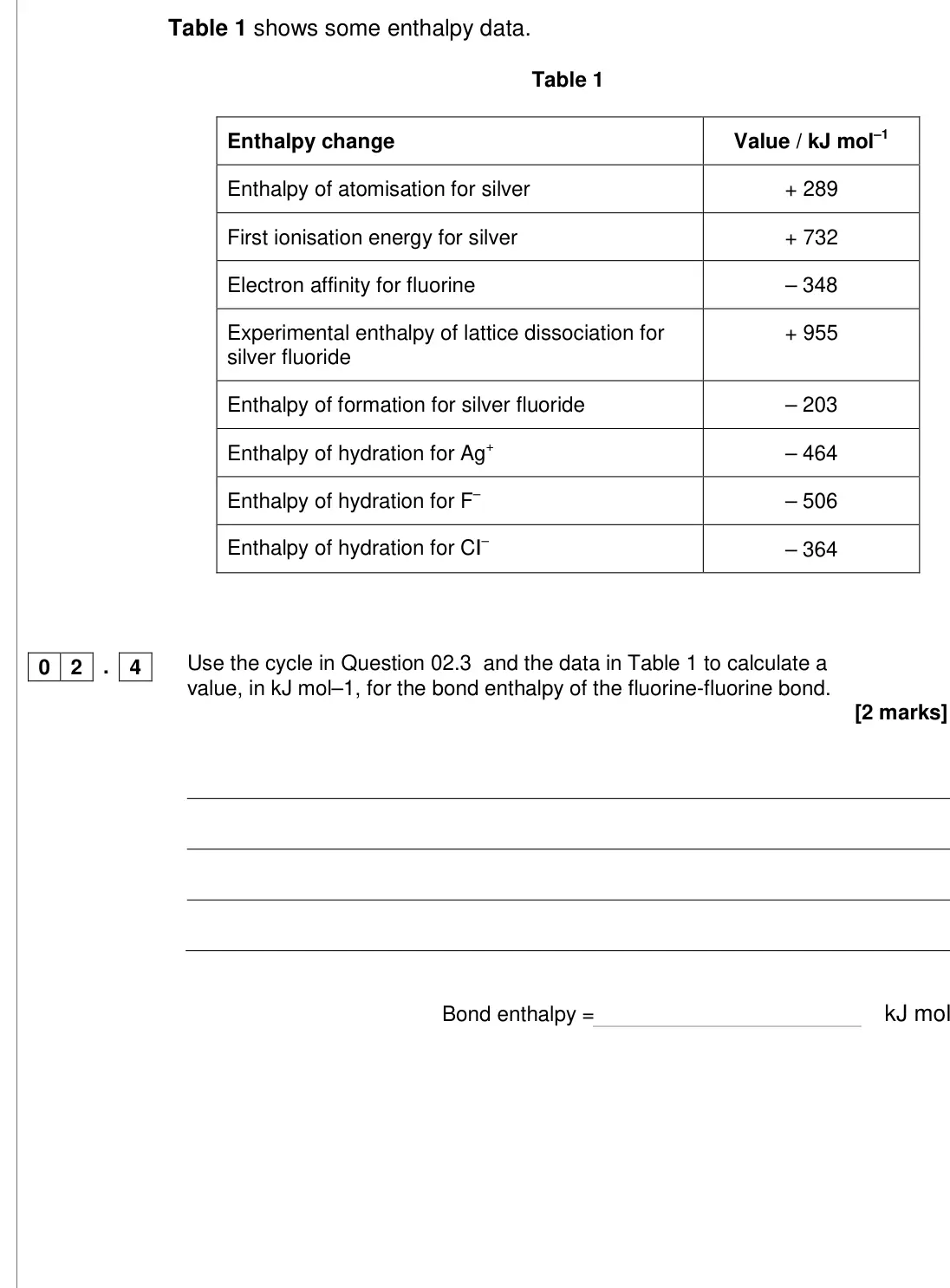
- Specimen, Unit 3, Q02.4 (2 marks): Table 1 shows some enthalpy data. Table 1 Enthalpy change Value / kJ mol–1 Enthalpy of atomisation for silver + 289 First ionisation energy for silver + 732 Electron affinity for f
- Specimen, Unit 3, Q02.5 (2 marks): 0 2 . 5 Use data from Table 1 to calculate a value for the enthalpy of hydration of silver fluoride. [2 marks] Enthalpy of hydration = kJ mol–1
- Specimen, Unit 3, Q02.6 (2 marks): 0 2 . 6 Use data from Table 1 to explain why the value for the enthalpy of hydration of the fluoride ion is more negative than that for the chloride ion. [2 marks] 6
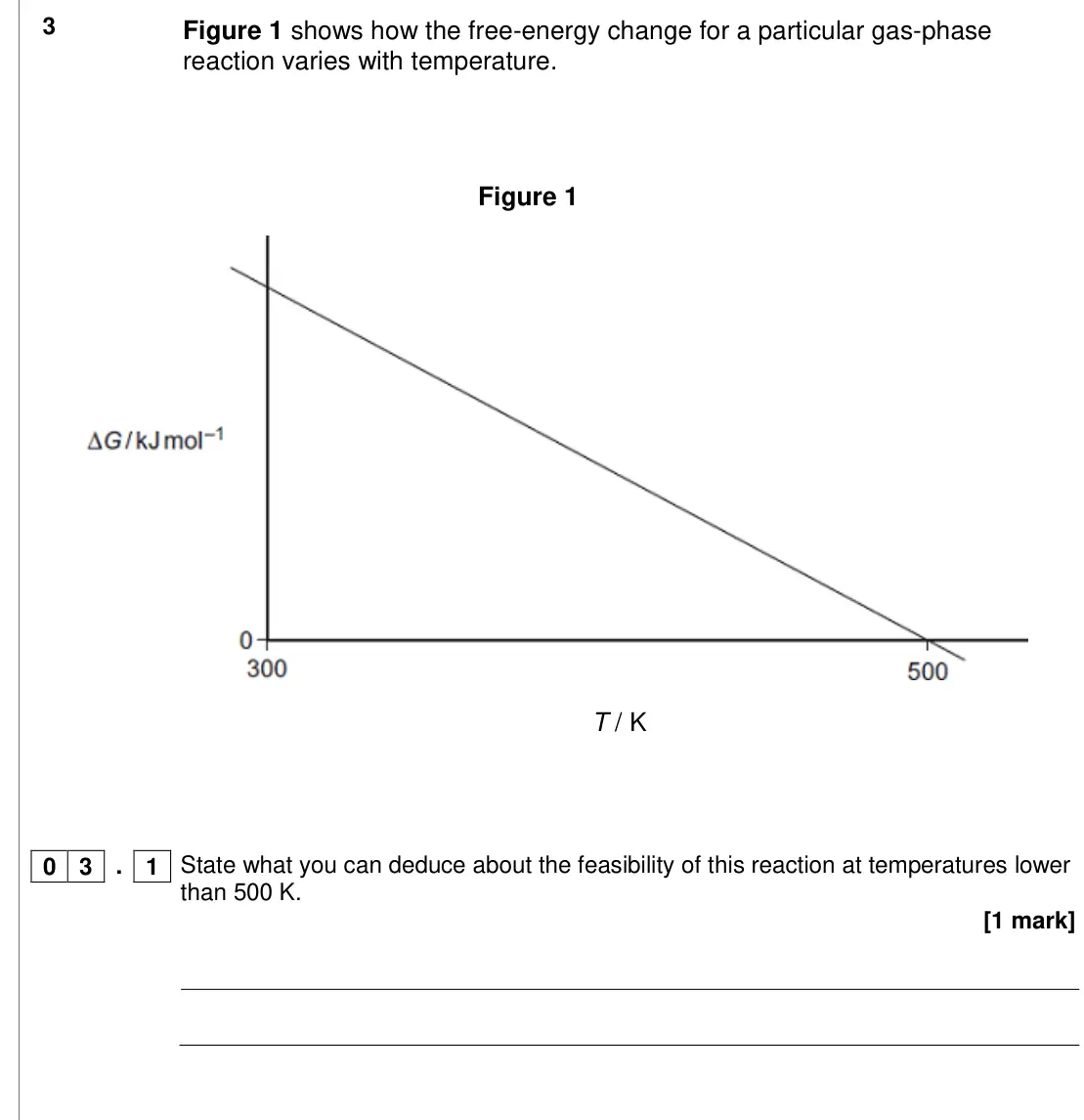
- Specimen, Unit 3, Q03.1 (1 mark): Figure 1 shows how the free-energy change for a particular gas-phase reaction varies with temperature. Figure 1 T / K State what you can deduce about the feasibility of this reacti
- Specimen, Unit 3, Q03.2 (1 mark): Deduce the thermodynamic term value that can be found from the gradient of this graph using the mathematical equation for a straight line: y= mx + c [1 mark] 0 3 . 2
- Specimen, Unit 3, Q03.3 (1 mark): Explain why the magnitude of ΔG decreases as T increases in this reaction. [1 mark] The following reaction becomes feasible at temperatures above 5440 K. H2O(g) H2(g) + ½ O2(g) 0 3
- Specimen, Unit 3, Q03.4 (1 mark): The entropies of the species involved are shown in Table 2. Table 2 H2O(g) H2(g) O2(g) S / J K−1 mol−1 189 131 205 Calculate the entropy change ΔS for this reaction. [1 mark] 0 3 .
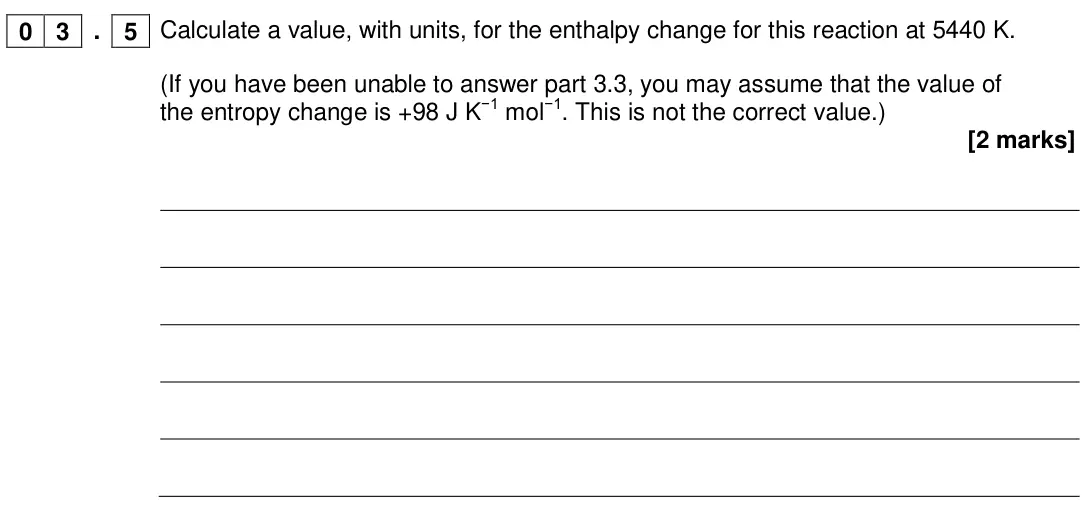
- Specimen, Unit 3, Q03.5 (2 marks): Calculate a value, with units, for the enthalpy change for this reaction at 5440 K. (If you have been unable to answer part 3.3, you may assume that the value of the entropy change
- Specimen, Unit 3, Q03.6 (1 mark): Which one of the following equations below represents a reaction that is feasible at all temperatures? [1 mark] Tick ( ) one box. P(s) → Q(s) + R(g) endothermic 2L(g) + M(g) → 2N(g
Questions, mark schemes and examiner’s reports are © OxfordAQA, from their published past papers. Plumi isn’t affiliated with any exam board. Want whole papers? OxfordAQA International A Level Chemistry past papers.
The Plumi iPad app also offers exam-style questions with AI feedback on your handwritten working.