 plumi
Amount of substance: OxfordAQA International A Level Chemistry questions
OxfordAQA International A Level Chemistry past-paper questions on 3.1.2 Amount of substance, Official specimen papers for Units 1–5, with mark schemes and examiner’s reports where available.
Past paper difficulty
Paper
All papers
Exam
All years
Calculations
Loading the full question list…
Q03.1
The whole paper ↗Q03.2
The whole paper ↗Q03.3
The whole paper ↗Q03.4
The whole paper ↗Q03.5
The whole paper ↗Q07.3
The whole paper ↗Q01.2
The whole paper ↗Q01.3
The whole paper ↗Q01.4
The whole paper ↗Q01.5
The whole paper ↗Q02.2
The whole paper ↗







All 16 questions on Amount of substance, as a list
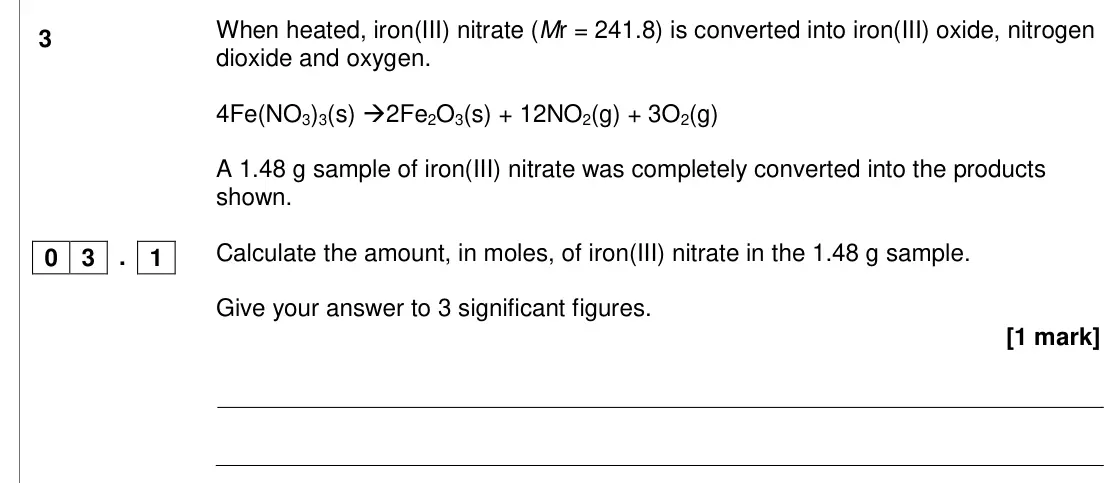
- Specimen, Unit 1, Q03.1 (1 mark): When heated, iron(III) nitrate (Mr = 241.8) is converted into iron(III) oxide, nitrogen dioxide and oxygen. 4Fe(NO3)3(s) 2Fe2O3(s) + 12NO2(g) + 3O2(g) A 1.48 g sample of iron(III)
- Specimen, Unit 1, Q03.2 (1 mark): Calculate the amount, in moles, of oxygen gas produced in this reaction. [1 mark] 0 3 . 2
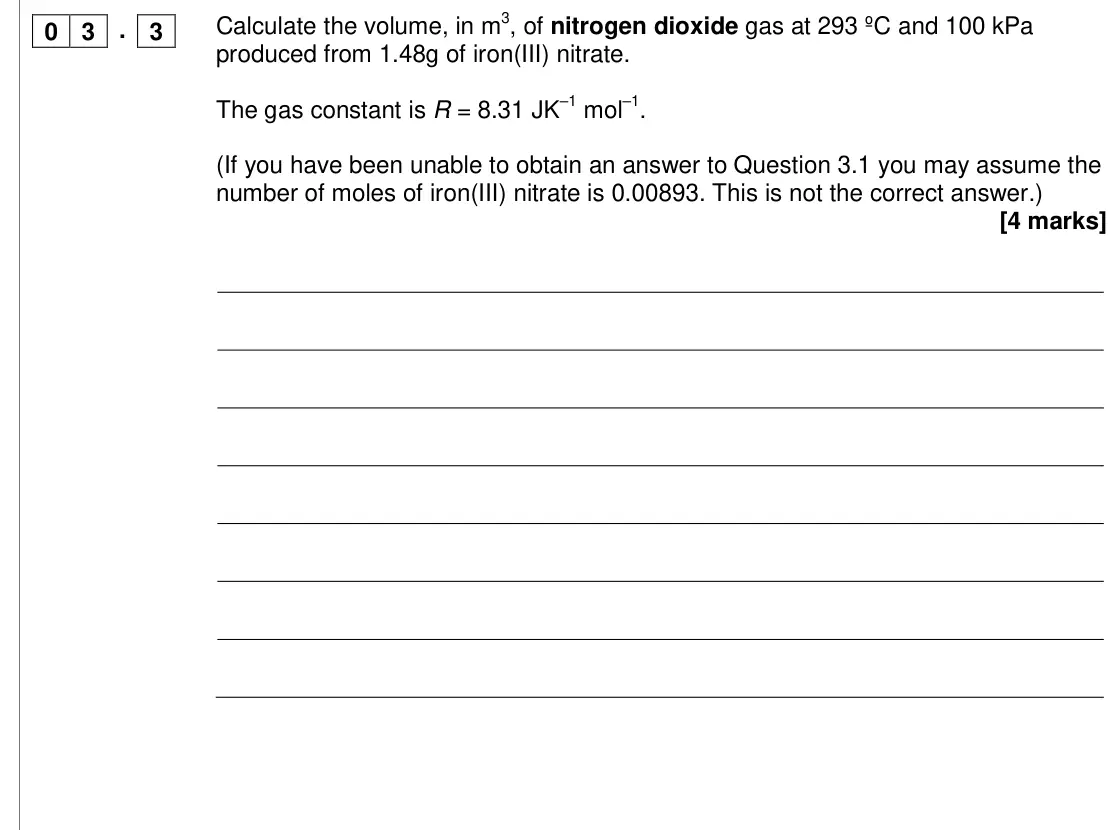
- Specimen, Unit 1, Q03.3 (4 marks): Calculate the volume, in m3, of nitrogen dioxide gas at 293 ºC and 100 kPa produced from 1.48g of iron(III) nitrate. The gas constant is R = 8.31 JK–1 mol–1. (If you have been unab
- Specimen, Unit 1, Q03.4 (1 mark): Suggest a name for this type of reaction that iron(III) nitrate undergoes. [1 mark] 0 3 . 4
- Specimen, Unit 1, Q03.5 (1 mark): Suggest why the iron(III) oxide obtained is pure. Assume a complete reaction. [1 mark] 0 3 . 5 8
- Specimen, Unit 1, Q07.3 (1 mark): 0 7 . 3 Suggest one way that the student could reduce the percentage uncertainty in the temperature change, using the same apparatus as this experiment. [1 mark] 5
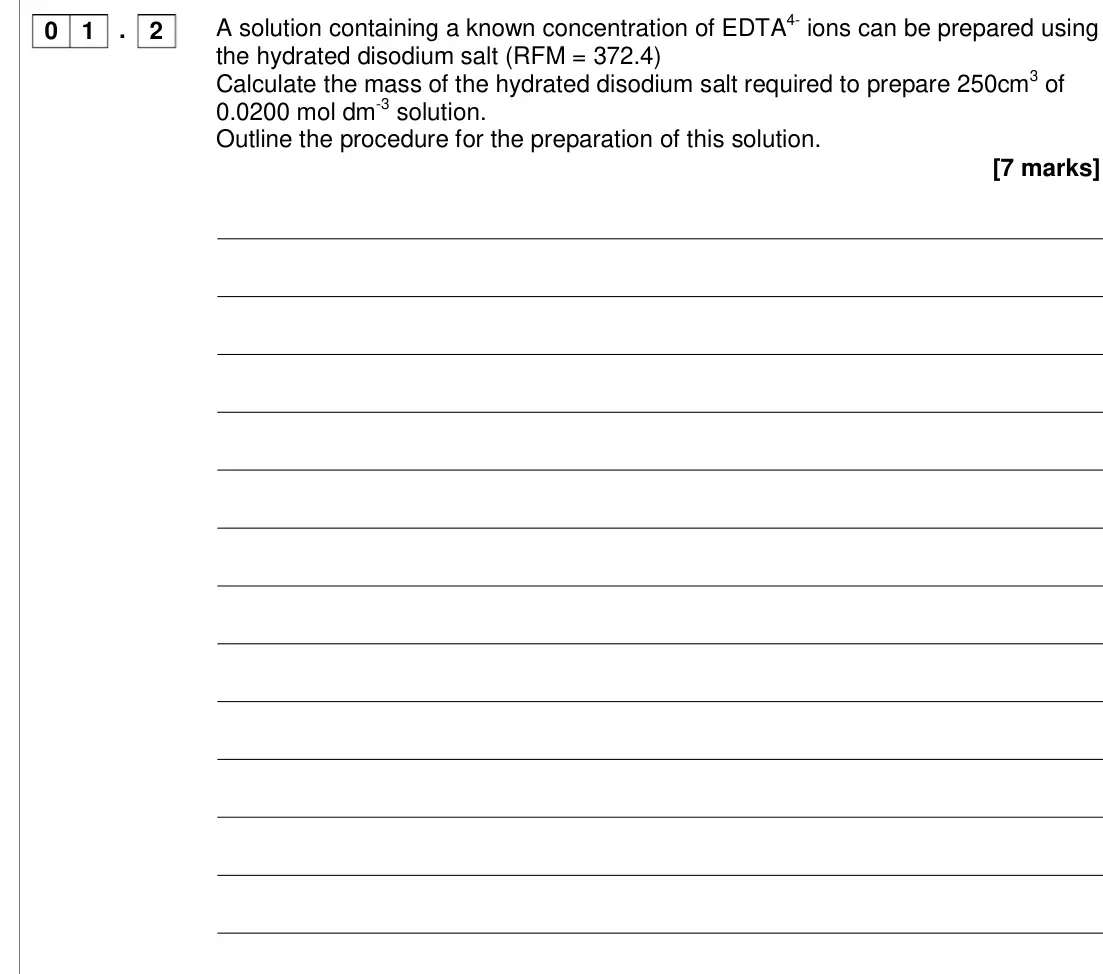
- Specimen, Unit 5, Q01.2 (7 marks): Water that reacts with soap to form a scum is called Hard Water. Hardness is caused by the presence of dissolved calcium or magnesium ions. The hardness of a sample of water can be
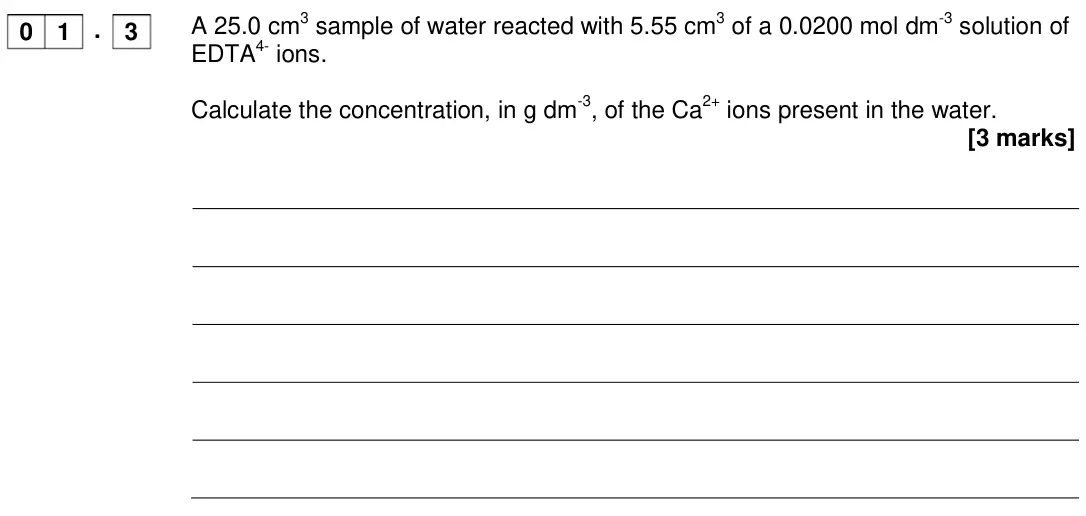
- Specimen, Unit 5, Q01.3 (3 marks): Water that reacts with soap to form a scum is called Hard Water. Hardness is caused by the presence of dissolved calcium or magnesium ions. The hardness of a sample of water can be
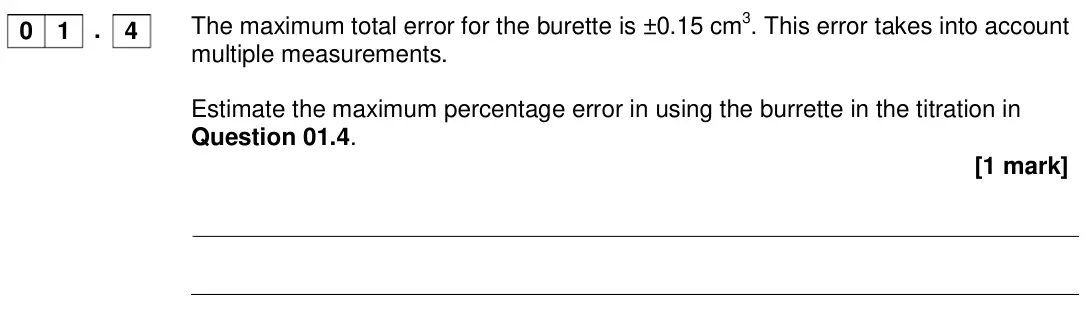
- Specimen, Unit 5, Q01.4 (1 mark): Water that reacts with soap to form a scum is called Hard Water. Hardness is caused by the presence of dissolved calcium or magnesium ions. The hardness of a sample of water can be
- Specimen, Unit 5, Q01.5 (1 mark): Water that reacts with soap to form a scum is called Hard Water. Hardness is caused by the presence of dissolved calcium or magnesium ions. The hardness of a sample of water can be
- Specimen, Unit 5, Q02.2 (3 marks): Calculate the maximum mass of benzocaine that can be formed by the reaction of 4-aminobenzoic acid (Mr = 137.0) with excess ethanol. [3 marks] 0 2 . 2
- Specimen, Unit 5, Q05 (1 mark): Which of the following contains the most chloride ions? [1 mark] A 10 cm 3 of 3.30 × 10 –2 mol dm –3 aluminium chloride solution B 20 cm 3 of 5.00 × 10 –2 mol dm –3 calcium chlorid
- Specimen, Unit 5, Q10 (1 mark): A sample of 2.18 g of oxygen gas has a volume of 1870 cm3 at a pressure of 101 kPa. What is the temperature of the gas? The gas constant is R = 8.31 J K–1 mol–1. [1 mark] A 167 K B
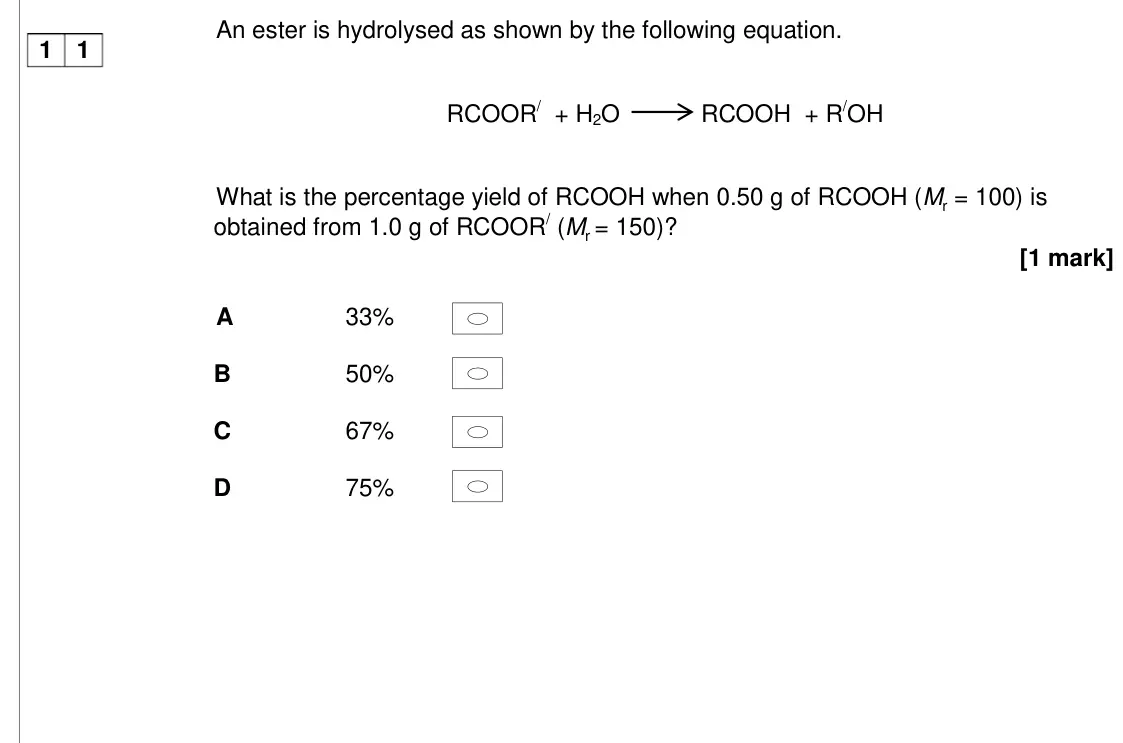
- Specimen, Unit 5, Q11 (1 mark): An ester is hydrolysed as shown by the following equation. RCOOR/ + H2O RCOOH + R/OH What is the percentage yield of RCOOH when 0.50 g of RCOOH (Mr = 100) is obtained from 1.0 g of
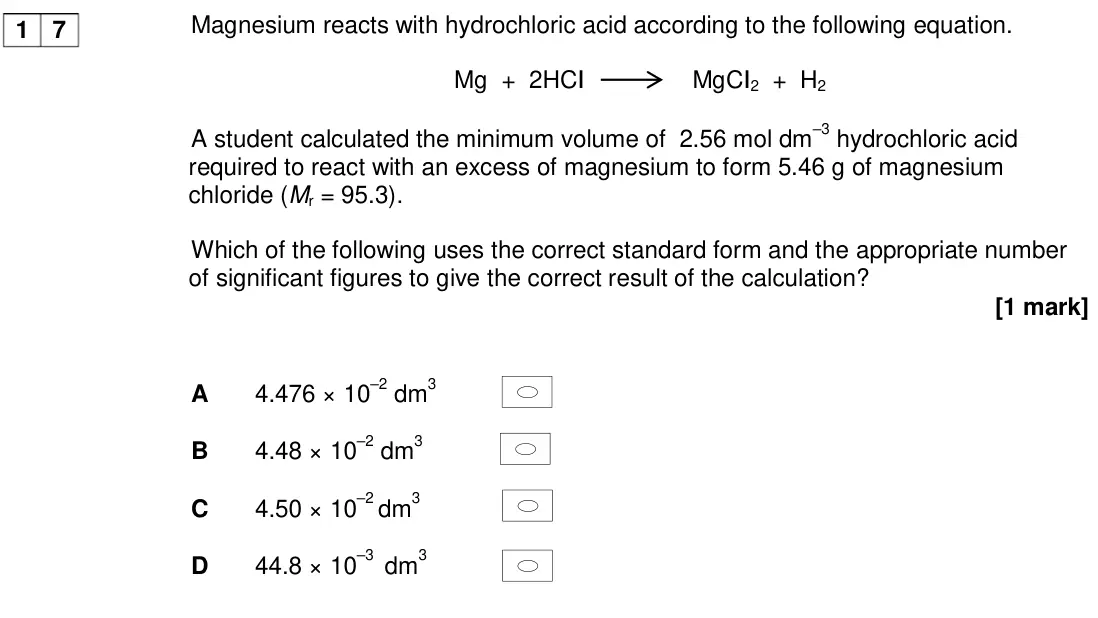
- Specimen, Unit 5, Q17 (1 mark): Magnesium reacts with hydrochloric acid according to the following equation. Mg + 2HCl MgCl2 + H2 A student calculated the minimum volume of 2.56 mol dm –3 hydrochloric acid requir
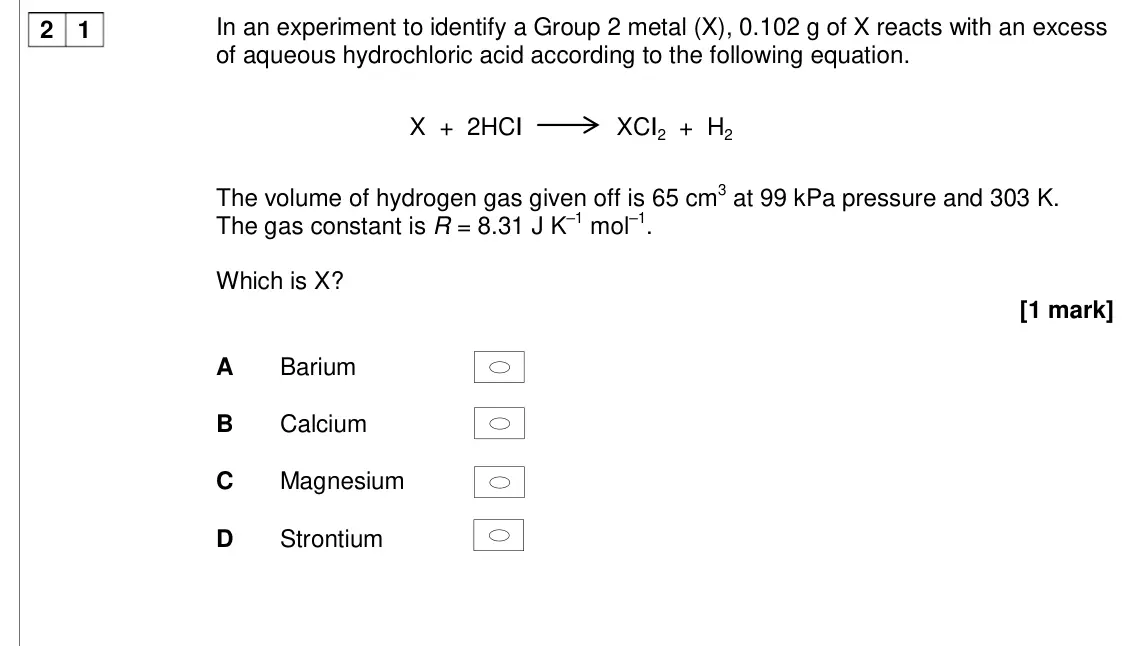
- Specimen, Unit 5, Q21 (1 mark): In an experiment to identify a Group 2 metal (X), 0.102 g of X reacts with an excess of aqueous hydrochloric acid according to the following equation. X + 2HCl XCl2 + H2 The volume
Questions, mark schemes and examiner’s reports are © OxfordAQA, from their published past papers. Plumi isn’t affiliated with any exam board. Want whole papers? OxfordAQA International A Level Chemistry past papers.
The Plumi iPad app also offers exam-style questions with AI feedback on your handwritten working.