 plumi
Acids and bases: OxfordAQA International A Level Chemistry questions
OxfordAQA International A Level Chemistry past-paper questions on 3.1.10 Acids and bases, Official specimen papers for Units 1–5, with mark schemes and examiner’s reports where available.
Past paper difficulty
Paper
All papers
Exam
All years
Calculations
Loading the full question list…
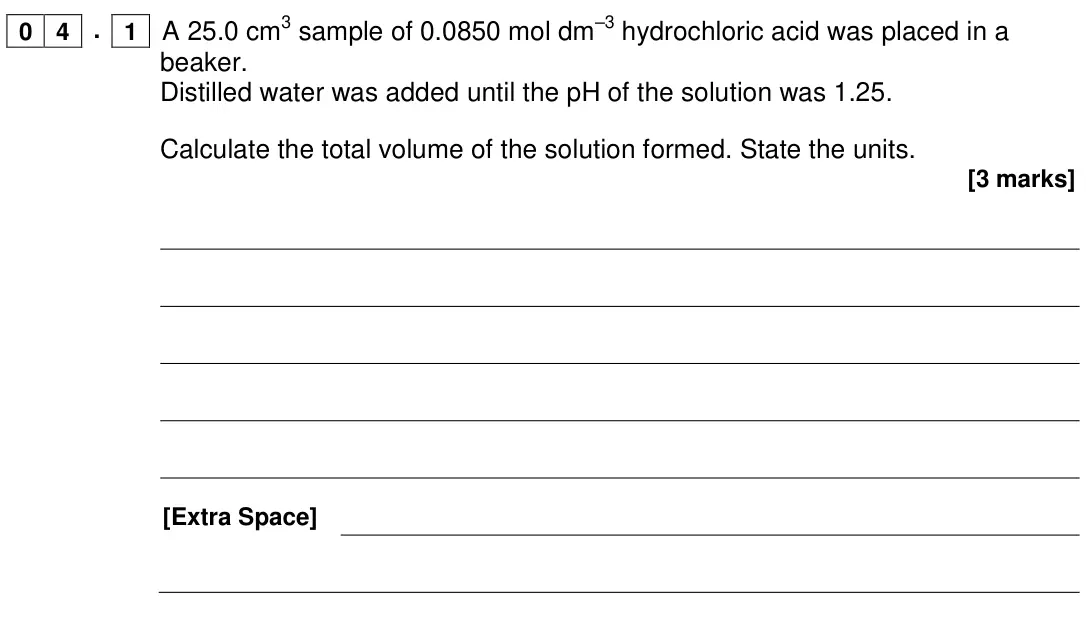
Q04.1
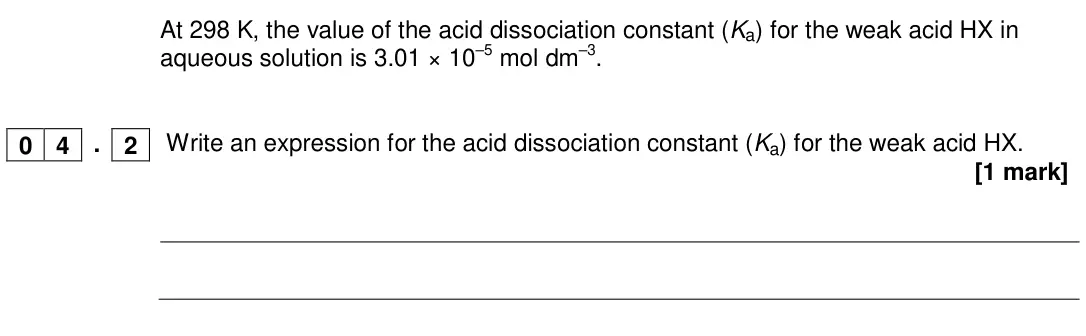
The whole paper ↗Q04.2
The whole paper ↗Q04.3
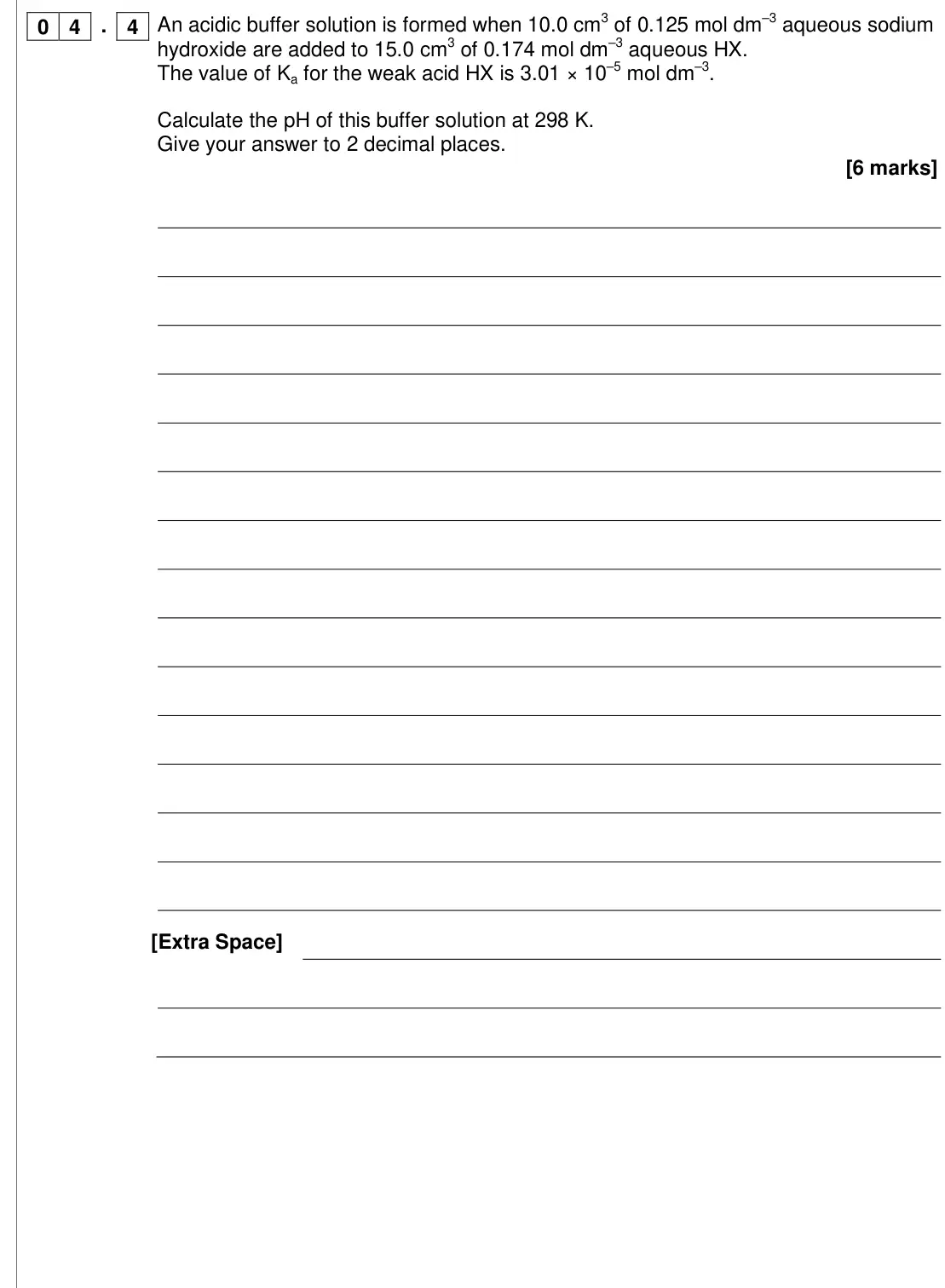
The whole paper ↗Q04.4
The whole paper ↗



All 7 questions on Acids and bases, as a list
- Specimen, Unit 3, Q04.1 (3 marks): A 25.0 cm3 sample of 0.0850 mol dm–3 hydrochloric acid was placed in a beaker. Distilled water was added until the pH of the solution was 1.25. Calculate the total volume of the so
- Specimen, Unit 3, Q04.2 (1 mark): At 298 K, the value of the acid dissociation constant (Ka) for the weak acid HX in aqueous solution is 3.01 × 10⁻⁵ mol dm–3. Write an expression for the acid dissociation constant
- Specimen, Unit 3, Q04.3 (3 marks): Calculate the pH of a 0.174 mol dm–3 solution of HX at this temperature. Give your answer to 2 decimal places. [3 marks] 0 4 . 3 [Extra Space] 0
- Specimen, Unit 3, Q04.4 (6 marks): An acidic buffer solution is formed when 10.0 cm3 of 0.125 mol dm–3 aqueous sodium hydroxide are added to 15.0 cm3 of 0.174 mol dm–3 aqueous HX. The value of Ka for the weak acid H
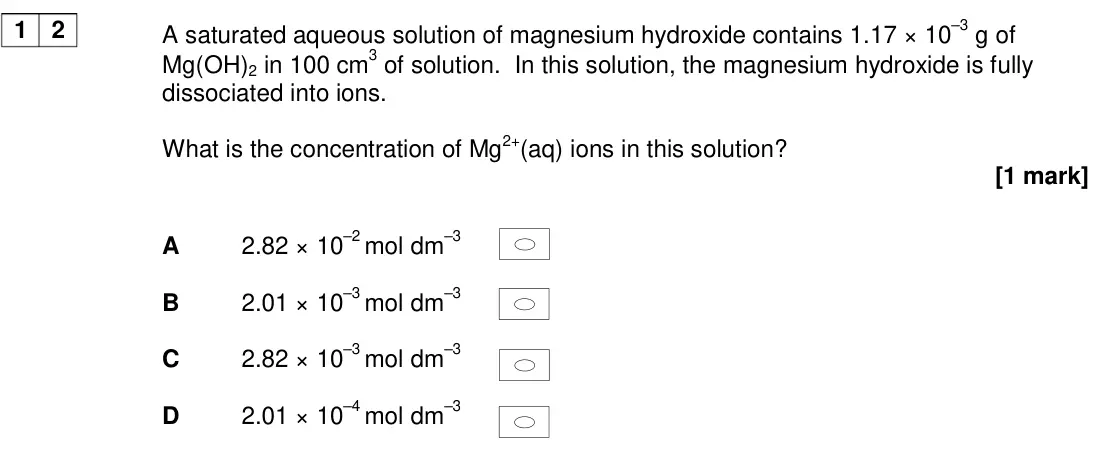
- Specimen, Unit 5, Q12 (1 mark): A saturated aqueous solution of magnesium hydroxide contains 1.17 × 10 –3 g of Mg(OH)2 in 100 cm 3 of solution. In this solution, the magnesium hydroxide is fully dissociated into
- Specimen, Unit 5, Q15 (1 mark): What is the pH of a 0.020 mol dm–3 solution of a diprotic acid which is completely dissociated? [1 mark] A 1.00 B 1.40 C 1.70 D 4.00 1 5 3
- Specimen, Unit 5, Q16 (1 mark): The acid dissociation constant, Ka, of a weak acid HA has the value 2.56 × 10⁻⁴ mol dm–3 What is the pH of a 4.25 × 10⁻³ mol dm-3 solution of HA? [1 mark] A 5.96 B 3.59 C 2.98 D 2.
Questions, mark schemes and examiner’s reports are © OxfordAQA, from their published past papers. Plumi isn’t affiliated with any exam board. Want whole papers? OxfordAQA International A Level Chemistry past papers.
The Plumi iPad app also offers exam-style questions with AI feedback on your handwritten working.