 plumi
Bonding: OxfordAQA International A Level Chemistry questions
OxfordAQA International A Level Chemistry past-paper questions on 3.1.3 Bonding, Official specimen papers for Units 1–5, with mark schemes and examiner’s reports where available.
Past paper difficulty
Paper
All papers
Exam
All years
Calculations
Loading the full question list…
Q04.1
The whole paper ↗Q04.2
The whole paper ↗Q04.3
The whole paper ↗Q04.4
The whole paper ↗Q04.5
The whole paper ↗Q04.6
The whole paper ↗Q04.7
The whole paper ↗Q04.8
The whole paper ↗Q09.1
The whole paper ↗


All 9 questions on Bonding, as a list
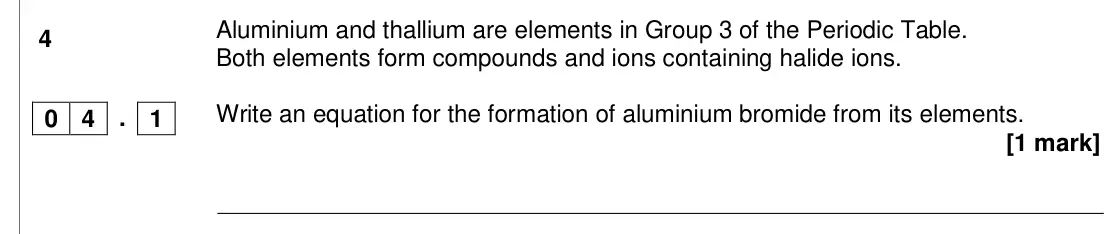
- Specimen, Unit 1, Q04.1 (1 mark): Aluminium and thallium are elements in Group 3 of the Periodic Table. Both elements form compounds and ions containing halide ions. Write an equation for the formation of aluminium
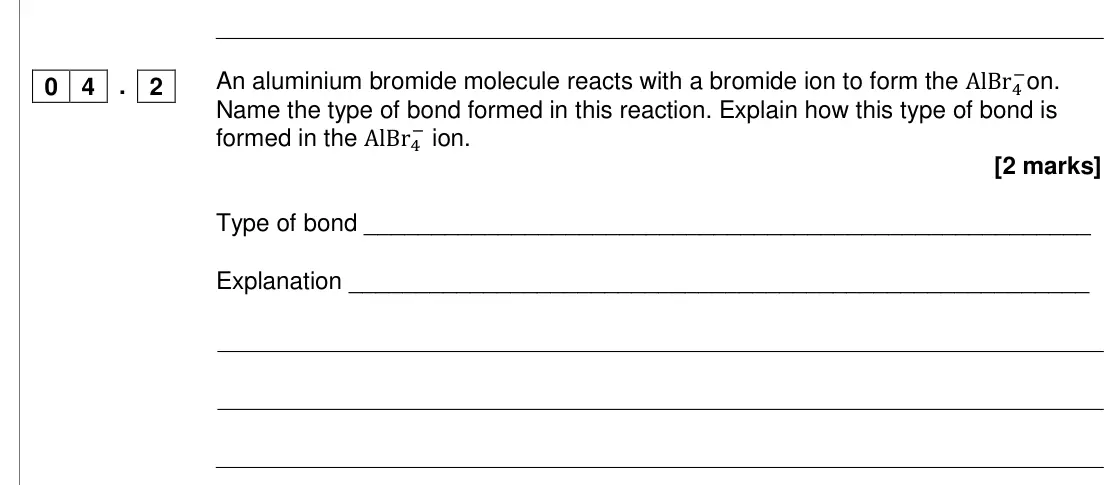
- Specimen, Unit 1, Q04.2 (2 marks): An aluminium bromide molecule reacts with a bromide ion to form the AlBr4 −on. Name the type of bond formed in this reaction. Explain how this type of bond is formed in the AlBr4 −
- Specimen, Unit 1, Q04.3 (1 mark): Aluminium bromide has a relative molecular mass of 533.4 in the gas phase. Deduce the formula of the aluminium compound that has a relative molecular mass of 533.4 [1 mark] 0 4 . 3
- Specimen, Unit 1, Q04.4 (1 mark): Deduce the name or formula of a compound that has the same number of atoms, the same number of electrons and the same shape as the AlBr4 −ion. [1 mark] 0 4 . 4 9
- Specimen, Unit 1, Q04.5 (2 marks): Draw and name the shape of the TlF5 2− ion. [2 marks] Shape of the TlF5 2− ion. Name of shape ____________________________________________________ 0 4 . 5
- Specimen, Unit 1, Q04.6 (1 mark): Draw the shape of the TlF5 2− ion. [1 mark] 𝐓𝐓𝐅𝟓𝟐 0 4 . 6
- Specimen, Unit 1, Q04.7 (1 mark): Explain why the 𝐓𝐓𝐓𝐓𝐅𝐅𝟓𝟓 𝟐𝟐−ion has the shape that you have drawn in part (f)(i). [1 mark] 0 4 . 7
- Specimen, Unit 1, Q04.8 (1 mark): Which one of the first, second or third ionisations of thallium produces an ion with the electron configuration [Xe] 5d106s1? Tick ( ) one box. [1 mark] First Second Third 0 4 . 8
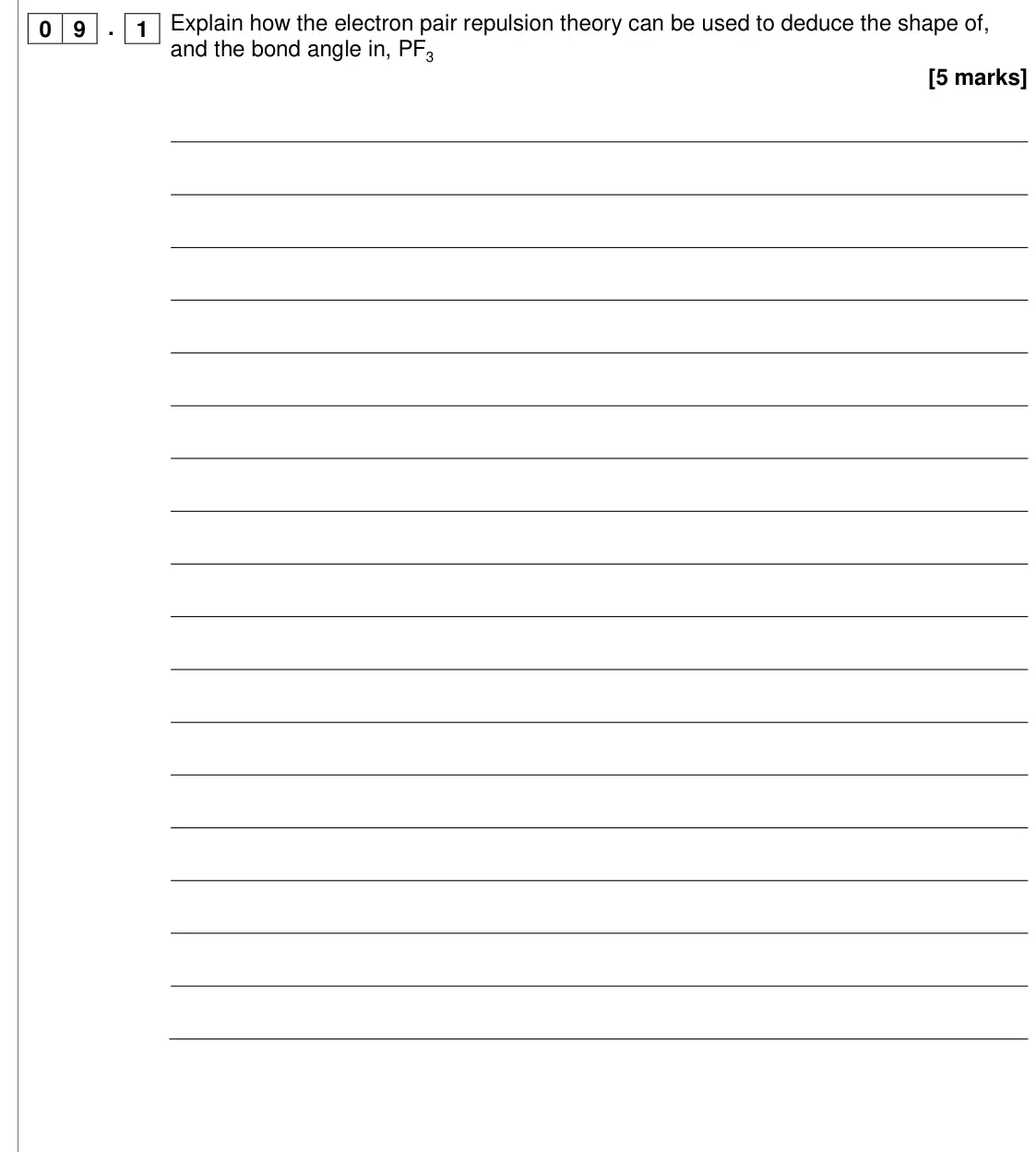
- Specimen, Unit 3, Q09.1 (5 marks): Explain how the electron pair repulsion theory can be used to deduce the shape of, and the bond angle in, PF3 [5 marks] END OF QUESTIONS 0 9 . 1 9 Permission to reproduce all copyr
Questions, mark schemes and examiner’s reports are © OxfordAQA, from their published past papers. Plumi isn’t affiliated with any exam board. Want whole papers? OxfordAQA International A Level Chemistry past papers.
The Plumi iPad app also offers exam-style questions with AI feedback on your handwritten working.