 plumi
Legacy F325: Equilibria, Energetics and Elements: OCR A‑Level Chemistry A questions
OCR A-Level Chemistry A past-paper questions on L.F325 Legacy F325: Equilibria, Energetics and Elements, 2010–2025, with mark schemes and examiner’s reports where available.
Previous-specification questions for extra practice. Content and exam requirements may differ from your current course.
All papers
All years
Loading the full question list…
Q1(a)
The whole paper ↗1
Q1(b)(i)
The whole paper ↗2
Q1(b)(ii)
The whole paper ↗3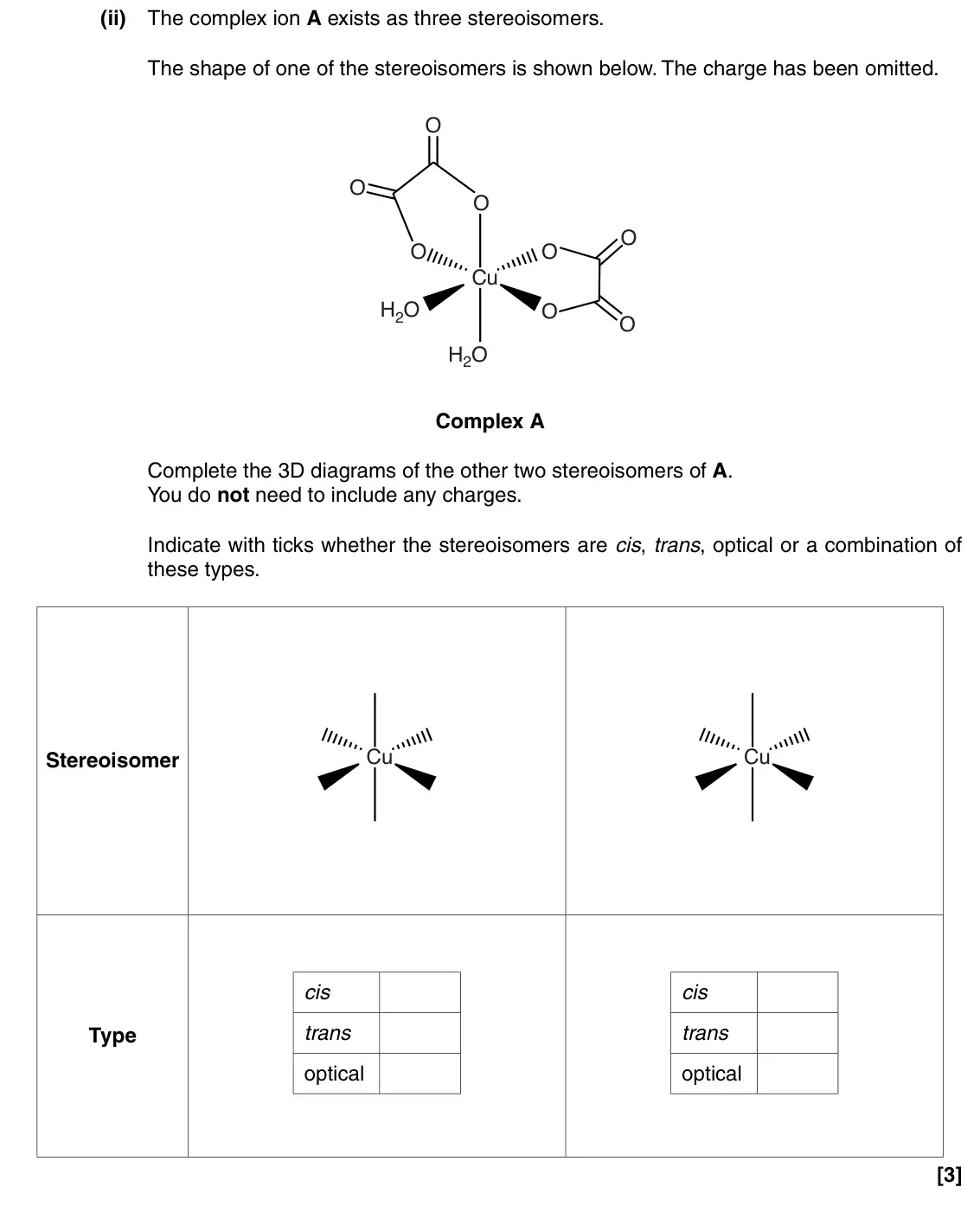
Q1(b)(iii)
The whole paper ↗4
Q2(a)
The whole paper ↗5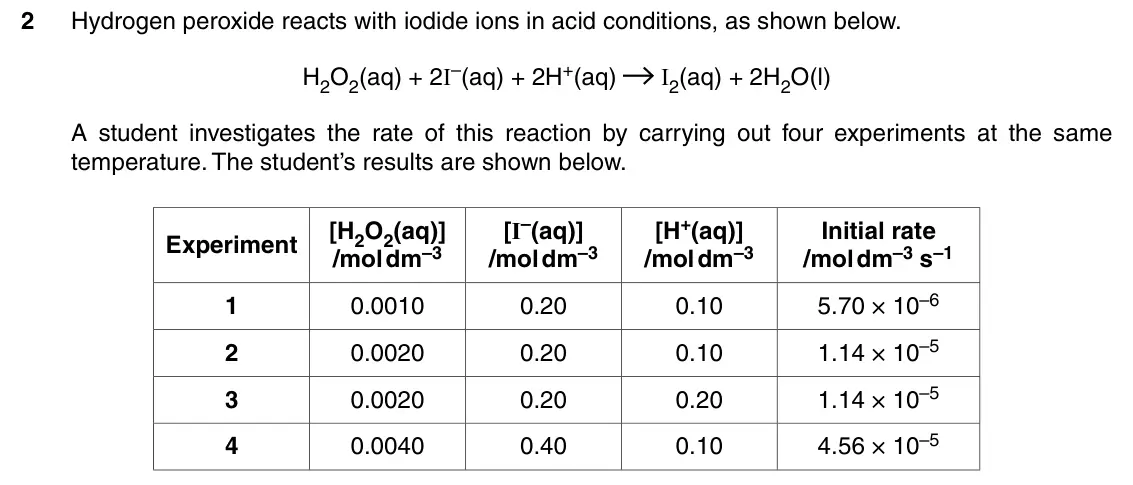

Q2(b)
The whole paper ↗6
Q2(c)(i)
The whole paper ↗7
Q2(c)(ii)
The whole paper ↗8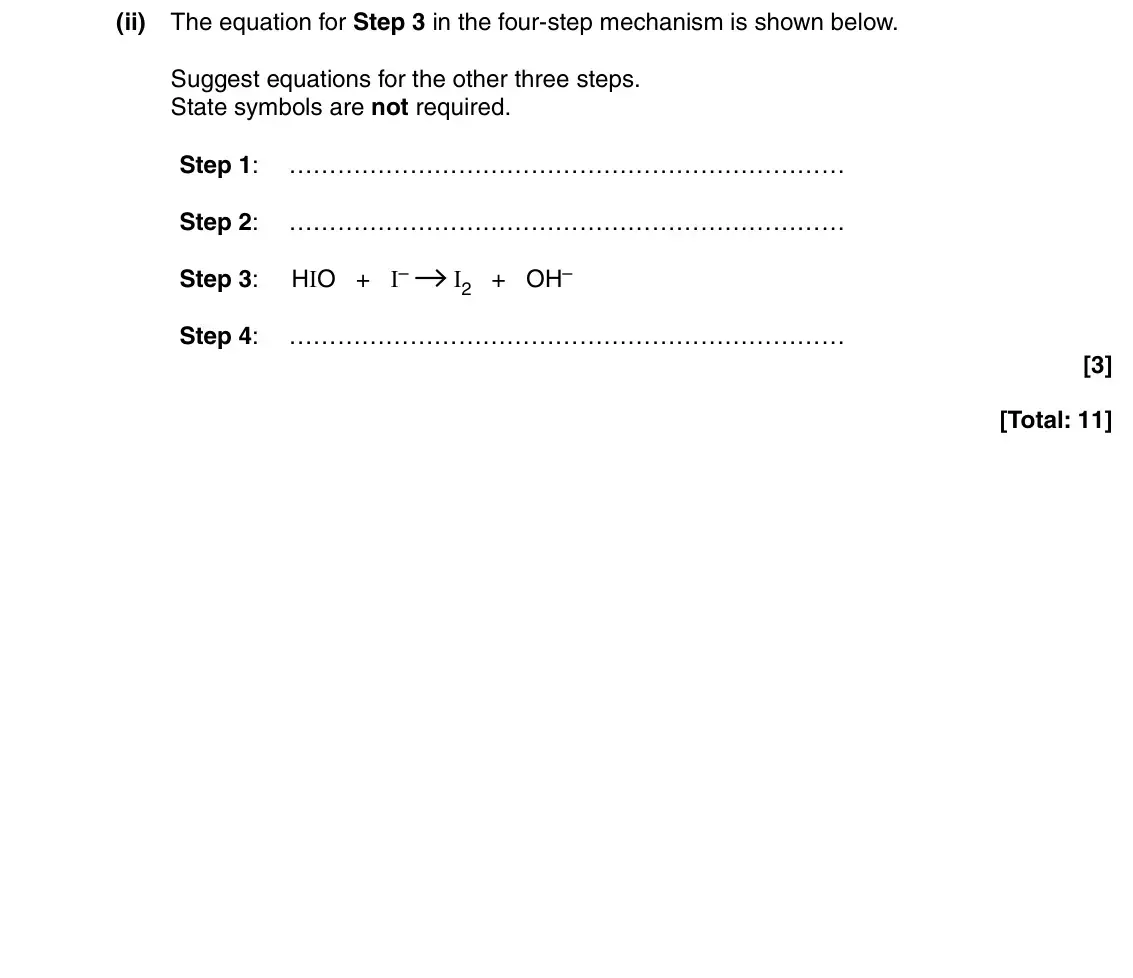
Q3(a)
The whole paper ↗9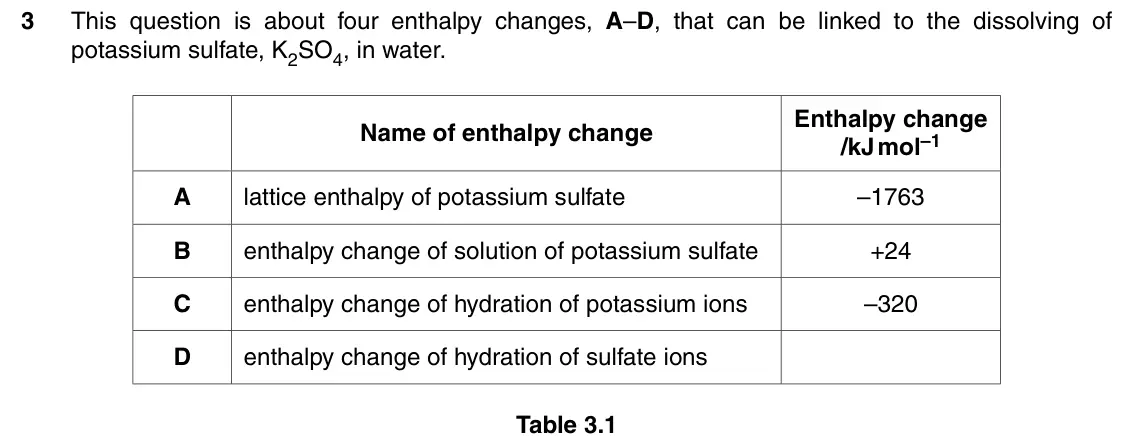

Q3(b)(i)
The whole paper ↗10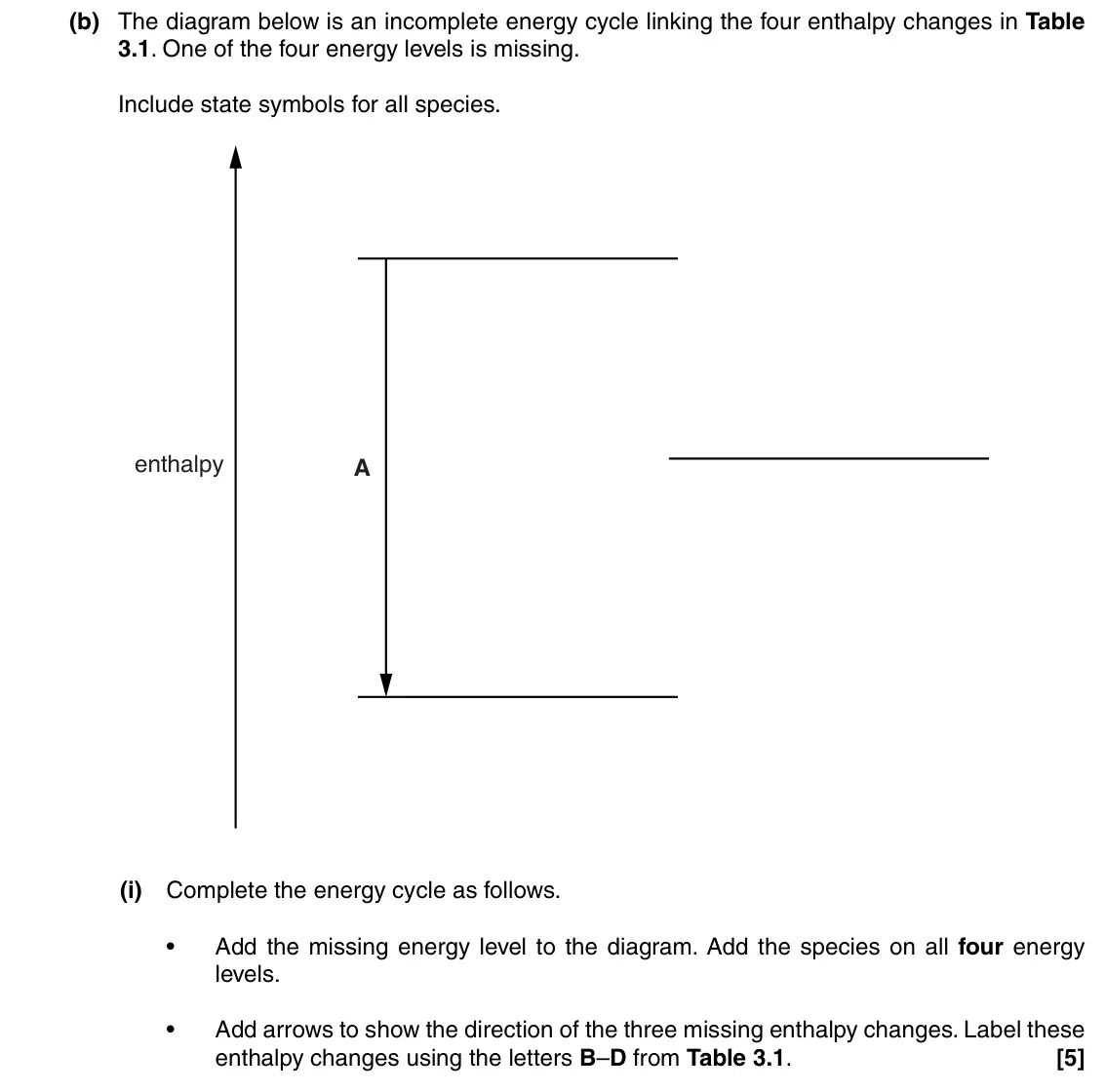
Q3(b)(ii)
The whole paper ↗11
Q3(c)(i)
The whole paper ↗12
Q3(c)(ii)
The whole paper ↗13
Q4(a)
The whole paper ↗14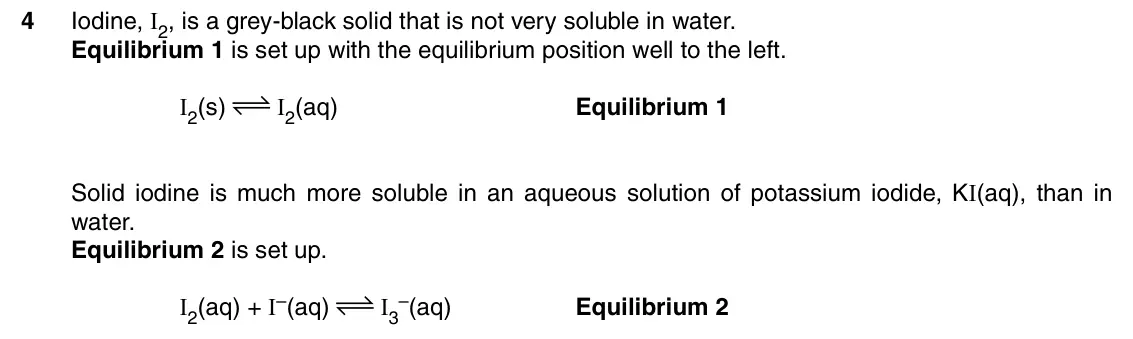

Q4(b)
The whole paper ↗15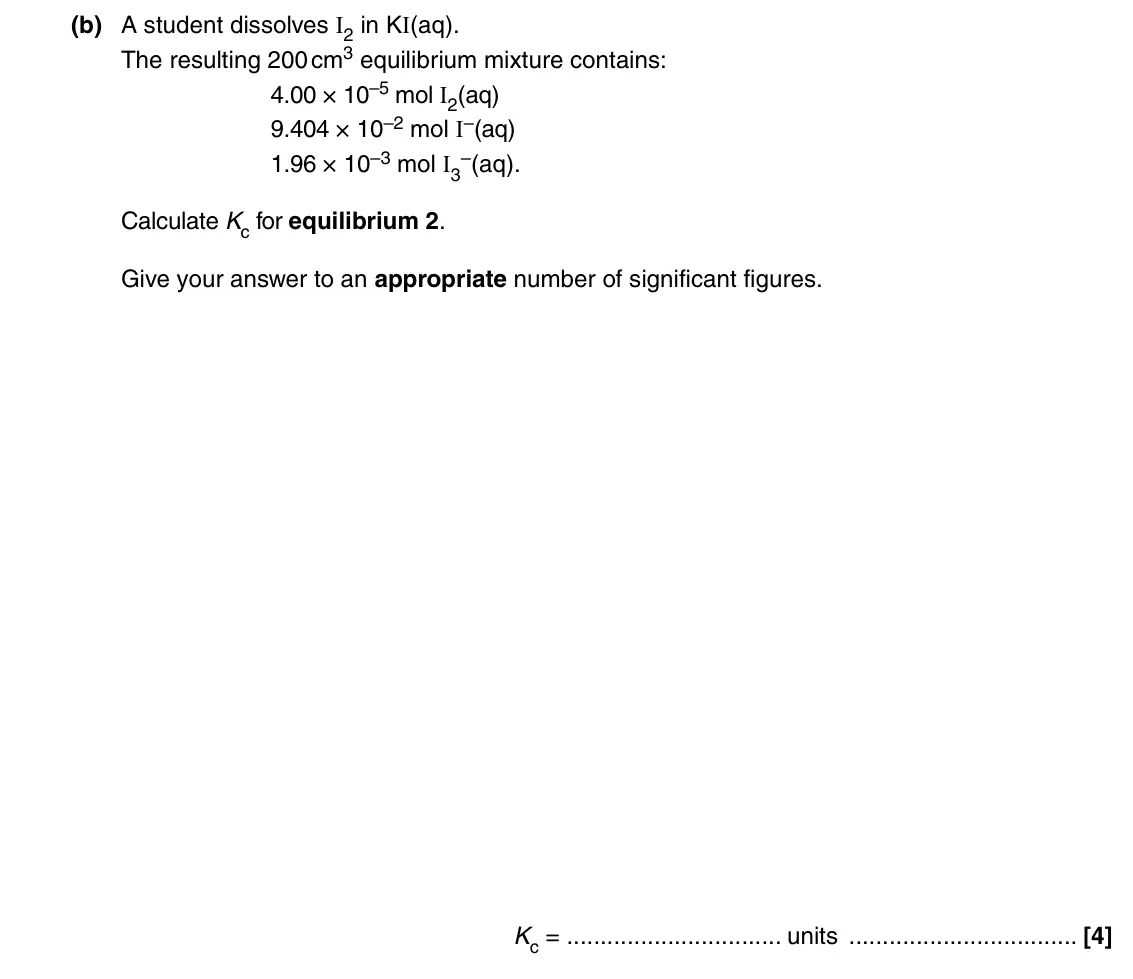
Q4(c)
The whole paper ↗16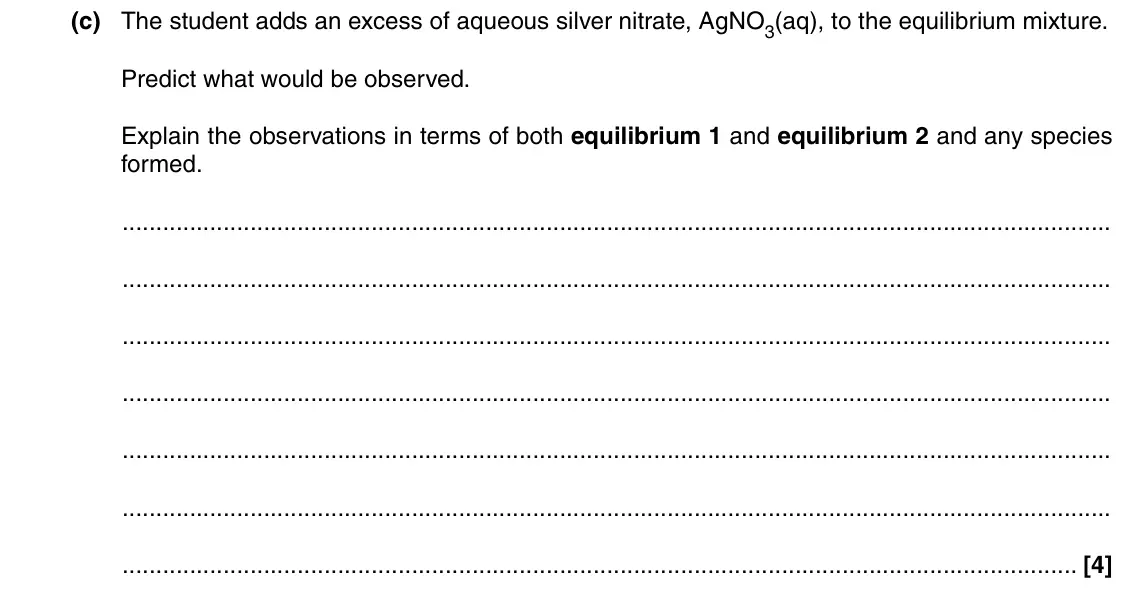
Q4(d)
The whole paper ↗17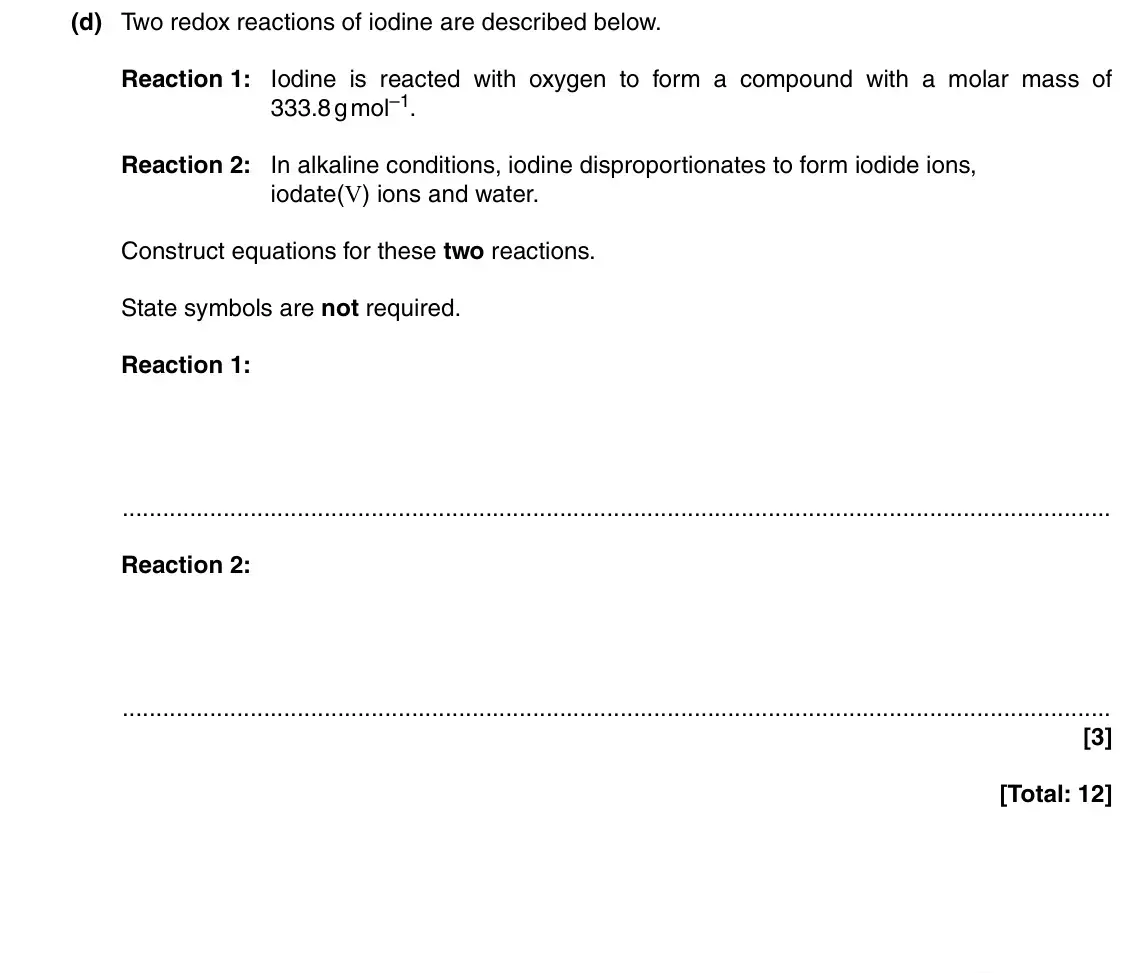
Q5(a)
The whole paper ↗18

Q5(b)
The whole paper ↗19
Q5(c)(i)
The whole paper ↗20
All 394 questions on Legacy F325: Equilibria, Energetics and Elements, as a list
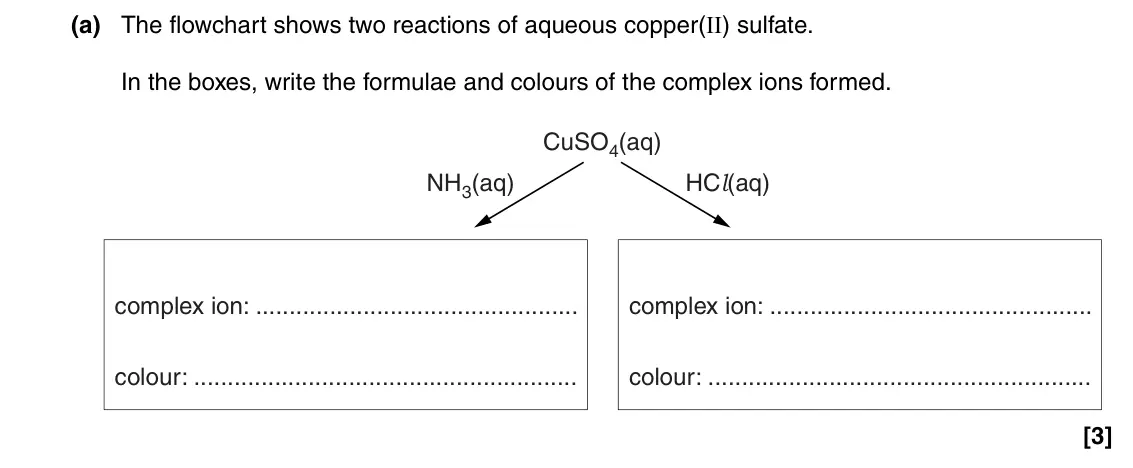
- June 2016, Legacy F325, Q1(a) (3 marks): The flowchart shows two reactions of aqueous copper(II) sulfate. In the boxes, write the formulae and colours of the complex ions formed. CuSO4(aq) HCl(aq) NH3(
- June 2016, Legacy F325, Q1(b)(i) (1 mark): What is meant by the term bidentate ligand ? [1]
- June 2016, Legacy F325, Q1(b)(ii) (3 marks): The complex ion A exists as three stereoisomers. The shape of one of the stereoisomers is shown below. The charge has been omitted. O O O O O O Cu H2O O O H2O C
- June 2016, Legacy F325, Q1(b)(iii) (2 marks): What is the empirical formula, including the charge, of the complex ion A? [2] [Total: 9]
- June 2016, Legacy F325, Q2(a) (6 marks): The rate equation is: rate = k [H2O2(aq)] [I–(aq)] • Show that the student’s results support this rate equation. • Calculate the rate constant, k, for this reac
- June 2016, Legacy F325, Q2(b) (1 mark): The student concluded that H+(aq) ions act as a catalyst. Explain why the student’s conclusion is not correct. [1]
- June 2016, Legacy F325, Q2(c)(i) (1 mark): State what is meant by the term rate-determining step. [1]
- June 2016, Legacy F325, Q2(c)(ii) (3 marks): The equation for Step 3 in the four-step mechanism is shown below. Suggest equations for the other three steps. State symbols are not required. Step 1: Step 2:
- June 2016, Legacy F325, Q3(a) (2 marks): Define the term enthalpy change of hydration. [2]
- June 2016, Legacy F325, Q3(b)(i) (5 marks): Complete the energy cycle as follows. • Add the missing energy level to the diagram. Add the species on all four energy levels. • Add arrows to show the directi
- June 2016, Legacy F325, Q3(b)(ii) (1 mark): Calculate the enthalpy change of hydration of sulfate ions. ΔH = kJ mol–1 [1]
- June 2016, Legacy F325, Q3(c)(i) (1 mark): Suggest, in terms of the states of the particles involved, why this entropy change is positive. [1]
- June 2016, Legacy F325, Q3(c)(ii) (3 marks): Explain, using a calculation, why K2SO4 dissolves in water at 25 °C, despite the enthalpy change of solution being endothermic. [3] [Total: 12]
- June 2016, Legacy F325, Q4(a) (1 mark): Suggest why I2 is not very soluble in water. [1]
- June 2016, Legacy F325, Q4(b) (4 marks): A student dissolves I2 in KI(aq). The resulting 200 cm3 equilibrium mixture contains: 4.00 × 10⁻⁵ mol I2(aq) 9.404 × 10⁻² mol I–(aq) 1.96 × 10⁻³ mol I3 –(aq). C
- June 2016, Legacy F325, Q4(c) (4 marks): The student adds an excess of aqueous silver nitrate, AgNO3(aq), to the equilibrium mixture. Predict what would be observed. Explain the observations in terms o
- June 2016, Legacy F325, Q4(d) (3 marks): Two redox reactions of iodine are described below. Reaction 1: Iodine is reacted with oxygen to form a compound with a molar mass of 333.8 g mol–1. Reaction 2:
- June 2016, Legacy F325, Q5(a) (1 mark): Write the expression for Ka for HNO2(aq). [1]
- June 2016, Legacy F325, Q5(b) (2 marks): Calculate the pH of 0.120 mol dm–3 HNO2(aq). Give your answer to two decimal places. pH = [2]
- June 2016, Legacy F325, Q5(c)(i) (4 marks): Calculate the pH of the buffer solution. Give your answer to two decimal places. pH = [4]
- June 2016, Legacy F325, Q5(c)(ii) (4 marks): Explain how this buffer solution controls pH when: a small amount of HCl (aq) is added • • a small amount of NaOH(aq) is added. In your answer, include the equa
- June 2016, Legacy F325, Q5(d)(i) (1 mark): Explain whether the dissociation of water is an exothermic or endothermic process. [1]
- June 2016, Legacy F325, Q5(d)(ii) (2 marks): Predict, using a calculation, whether a pH of 7 at 60 °C is neutral, acidic or alkaline. [2]
- June 2016, Legacy F325, Q5(d)(iii) (1 mark): pKw , pKa and pH are logarithmic scales. Calculate pKw at 60 °C. Give your answer to two decimal places. pKw = [1]
- June 2016, Legacy F325, Q5(d)(iv) (3 marks): 20.0 cm3 of 0.0270 mol dm–3 NaOH is diluted with water and the solution made up to 100 cm3 at 60 °C. Calculate the pH of the diluted solution of NaOH at 60 °C.
- June 2016, Legacy F325, Q6(a) (2 marks): Define the term standard electrode potential. Include all standard conditions in your answer. [2]
- June 2016, Legacy F325, Q6(b)(i) (5 marks): Draw a labelled diagram to show how the student could have set up this cell to measure the standard cell potential. On your diagram, • show the charge carriers
- June 2016, Legacy F325, Q6(b)(ii) (1 mark): What is the standard cell potential of this cell? standard cell potential = V [1]
- June 2016, Legacy F325, Q6(c) (6 marks): Explain what is meant by the terms oxidising agent and reducing agent. Illustrate your answer by predicting reactions from redox systems 1–6 in which Cr3+(aq) b
- June 2016, Legacy F325, Q7(a)(i) (3 marks): In C, D and E, nickel has the +2 oxidation state. Suggest the formulae of C, D and E. Complex ion C: Solid D: Complex ion E: [3]
- June 2016, Legacy F325, Q7(a)(ii) (4 marks): Write equations, and name the types of reaction, for the formation of D and E. Formation of solid D from aqueous nickel(II) sulfate. Equation: Type of reaction:
- June 2016, Legacy F325, Q7(b)(i) (1 mark): Name the shape of [Au(CN)2]–. [1]
- June 2016, Legacy F325, Q7(b)(ii) (2 marks): Using oxidation numbers, show that a redox reaction takes place. [2]
- June 2016, Legacy F325, Q7(b)(iii) (2 marks): Construct the overall equation for this reaction. State symbols are not required. [2]
- June 2016, Legacy F325, Q7(b)(iv) (1 mark): Some owners of gold mines remove cyanide ions from waste by adding oxidising agents, such as chlorate(I) ions, before discharge into watercourses. The overall e
- June 2016, Legacy F325, Q8(a) (2 marks): Complete the electron configuration of copper in 1s2 Cu(HCOO)2•xH2O: copper(I) iodide: 1s2 [2]
- June 2016, Legacy F325, Q8(b) (1 mark): Choose a suitable copper compound for step 1, and write the full equation for the reaction that would take place to form Cu(HCOO)2(aq). State symbols are not re
- June 2016, Legacy F325, Q8(c) (1 mark): Write an ionic equation, including state symbols, for the reaction in step 3. [1]
- June 2016, Legacy F325, Q8(d) (2 marks): In step 4, the student adds a solution to observe the end point accurately. Name the solution and state the colour change at the end point. Solution added: Colo
- June 2016, Legacy F325, Q8(e) (5 marks): Determine the value of x in Cu(HCOO)2•xH2O. Show your working. [5] [Total: 11]
- June 2015, Legacy F325, Q1(a) (1 mark): What is the oxidation number of Cr in the complex ion [CrOCl5]2–? [1]
- June 2015, Legacy F325, Q1(b) (1 mark): Write the equation for a reaction catalysed by a named transition element, compound or ion. Equation: Catalyst: [1]
- June 2015, Legacy F325, Q1(c)(i) (1 mark): State what is meant by a bidentate ligand. [1]
- June 2015, Legacy F325, Q1(c)(ii) (1 mark): What is the molecular formula of the bidentate ligand B? [1]
- June 2015, Legacy F325, Q1(c)(iii) (2 marks): Draw a possible structure for B and explain how B is able to act as a bidentate ligand. [2]
- June 2015, Legacy F325, Q1(c)(iv) (1 mark): What is the coordination number of complex ion A? [1]
- June 2015, Legacy F325, Q1(c)(v) (1 mark): Complete the 3-D diagrams of the shapes of the optical isomers of complex ion A. You can show the bidentate ligand simply as 3+ 3+ Ni Ni [1]
- June 2015, Legacy F325, Q1(d) (6 marks): Describe the reactions of EITHER aqueous copper(II) ions OR aqueous cobalt(II) ions with: • aqueous sodium hydroxide • excess aqueous ammonia • hydrochloric aci
- June 2015, Legacy F325, Q2(a) (4 marks): The rate equation for this reaction is: rate = k[H2(g)][NO(g)]2 The concentration of NO(g) is changed and a rate–concentration graph is plotted. 9.0 8.0 7.0 6.0
- June 2015, Legacy F325, Q2(b)(i) (2 marks): Using the axes below, sketch two graphs of the results. Label the graphs as follows: • L for the lower temperature • H for the higher temperature. initial rate
- June 2015, Legacy F325, Q2(b)(ii) (1 mark): State the effect of the higher temperature on the rate constant, k. [1]
- June 2015, Legacy F325, Q2(c) (2 marks): The reaction can also be shown as being first order with respect to H2(g) by continuous monitoring of [H2(g)] during the course of the reaction. • Using the axe
- June 2015, Legacy F325, Q2(d)(i) (1 mark): On the dotted line below, write the equation for step 3. step 1: 2NO N2O2 fast step 2: H2 + N2O2 N2O + H2O slow step 3: fast [1]
- June 2015, Legacy F325, Q2(d)(ii) (1 mark): Explain why this mechanism is consistent with the rate equation rate = k[H2(g)][NO(g)]2. [1] [Total: 11]
- June 2015, Legacy F325, Q3(a)(i) (1 mark): Why does the reaction have a negative entropy change? [1]
- June 2015, Legacy F325, Q3(a)(ii) (2 marks): Standard entropies are shown in the table below. substance CS2(g) CH4(g) H2S(g) S o / J K–1 mol–1 238 186 206 Calculate the standard entropy for H2. S o = J K–1
- June 2015, Legacy F325, Q3(a)(iii) (3 marks): Explain, with a calculation, whether this reaction is feasible at 25 °C. Show your working. [3]
- June 2015, Legacy F325, Q3(a)(iv) (2 marks): Explain, with a calculation, the significance of temperatures above 1154 °C for this reaction. [2]
- June 2015, Legacy F325, Q3(b)(i) (6 marks): Determine the concentrations of SO2, O2 and SO3 present at equilibrium and calculate Kc for this reaction. Kc = units [6]
- June 2015, Legacy F325, Q3(b)(ii) (1 mark): Explain what would happen to the pressure as the system was allowed to reach equilibrium. [1]
- June 2015, Legacy F325, Q3(b)(iii) (1 mark): The value of Kc for this equilibrium decreases with increasing temperature. Predict the sign of the enthalpy change for the forward reaction. State the effect o
- June 2015, Legacy F325, Q3(b)(iv) (3 marks): The chemist repeated the experiment at the same temperature with 1.00 mol SO2 and an excess of O2. The gas mixture was still compressed to a volume of 250 cm3.
- June 2015, Legacy F325, Q4(a) (1 mark): C2H5COOH is a weak Brønsted–Lowry acid. What is meant by a weak acid and Brønsted–Lowry acid ? [1]
- June 2015, Legacy F325, Q4(b) (2 marks): Calculate the pH of 0.500 mol dm–3 potassium hydroxide. pH = [2]
- June 2015, Legacy F325, Q4(c)(i) (1 mark): Write the expression for Ka for C2H5COOH. [1]
- June 2015, Legacy F325, Q4(c)(ii) (3 marks): Calculate the pH of the diluted solution. pH = [3]
- June 2015, Legacy F325, Q4(d)(i) (1 mark): Write the full equation for the reaction of aqueous propanoic acid with sodium carbonate. [1]
- June 2015, Legacy F325, Q4(d)(ii) (1 mark): Write the ionic equation for the reaction of aqueous propanoic acid with aqueous potassium hydroxide. [1]
- June 2015, Legacy F325, Q4(e)(i) (1 mark): Calculate the pH of this buffer solution. Give your answer to two decimal places. pH = [1]
- June 2015, Legacy F325, Q4(e)(ii) (2 marks): A small amount of aqueous ammonia, NH3(aq), is added to the buffer solution. Explain, in terms of equilibrium, how the buffer solution would respond to the adde
- June 2015, Legacy F325, Q4(e)(iii) (4 marks): The student adds 6.075 g Mg to 1.00 dm3 of this buffer solution. Calculate the pH of the new buffer solution. Give your answer to two decimal places pH = [4] [T
- June 2015, Legacy F325, Q5(a)(i) (4 marks): The incomplete Born–Haber cycle below can be used to determine the lattice enthalpy of iron(II) iodide. In the boxes, write the species present at each stage in
- June 2015, Legacy F325, Q5(a)(ii) (2 marks): Define the term lattice enthalpy. [2]
- June 2015, Legacy F325, Q5(a)(iii) (2 marks): Calculate the lattice enthalpy of iron(II) iodide. lattice enthalpy = kJ mol–1 [2]
- June 2015, Legacy F325, Q5(b)(i) (2 marks): Complete the electron configurations for Fe2+ and Br–. Fe2+: 1s2 Br–: 1s2 [2]
- June 2015, Legacy F325, Q5(b)(ii) (3 marks): Predict the products of reacting Fe(s) separately with I2(aq), Br2(aq) and Cl 2(aq). Explain your predictions using the electrode potential data above. [3]
- June 2015, Legacy F325, Q5(c) (3 marks): Fe2+ ions can be used to test for NO3 – ions. In this test, aqueous iron(II) sulfate is added to a solution containing NO3 – ions, followed by slow addition of
- June 2015, Legacy F325, Q6(a) (1 mark): List the three redox systems in order by adding the labels C, D and E to the table below. redox E o system Most negative Least negative [1]
- June 2015, Legacy F325, Q6(b)(i) (1 mark): What is the pH of the solution in a standard hydrogen half-cell? pH = [1]
- June 2015, Legacy F325, Q6(b)(ii) (2 marks): Explain, in terms of electrode potentials and equilibrium, why the pH of the solution in the hydrogen half-cell decreases as this cell delivers current. [2]
- June 2015, Legacy F325, Q6(b)(iii) (1 mark): Write the equation for the overall cell reaction that takes place in this cell. [1]
- June 2015, Legacy F325, Q6(c)(i) (1 mark): Complete the equation for this equilibrium and label the conjugate acid–base pairs. CN– + H2O + [1]
- June 2015, Legacy F325, Q6(c)(ii) (1 mark): Explain, in terms of equilibrium, why acidic conditions should not be used with cells containing CN–(aq) ions. [1]
- June 2015, Legacy F325, Q6(d)(i) (1 mark): State one important difference between a fuel cell and a modern storage cell. [1]
- June 2015, Legacy F325, Q6(d)(ii) (1 mark): Suggest one advantage of using ethanol, rather than hydrogen, in a fuel cell for vehicles. [1]
- June 2015, Legacy F325, Q6(d)(iii) (1 mark): The overall reaction in a DEFC is the same as for the complete combustion of ethanol. Write the equation for the overall reaction in a DEFC. [1]
- June 2015, Legacy F325, Q6(d)(iv) (1 mark): Deduce the half-equation for the reaction at the oxygen electrode in a DEFC. [1]
- June 2015, Legacy F325, Q6(d)(v) (2 marks): Using oxidation numbers, show that oxidation and reduction take place in a DEFC. Oxidation: Reduction: [2] [Total: 13]
- June 2015, Legacy F325, Q7(a) (2 marks): In Step 1 Na2O and NaFeO2 react with water forming an alkaline solution containing a brown precipitate. This is not a redox reaction. Write equations for: • the
- June 2015, Legacy F325, Q7(b) (6 marks): Determine the percentage, by mass, of chromium in the ore. Give your answer to one decimal place. [6]
- June 2015, Legacy F325, Q7(c) (3 marks): This part refers to Step 2 of the method. In the redox reaction between I– ions, CrO4 2– ions and H2 O: 2– ions, are reduced to chromium(III) ions, Cr3+ • CrO4
- June 2014, Legacy F325, Q1(a)(i) (3 marks): The incomplete Born–Haber cycle below can be used to determine the lattice enthalpy of potassium sulfide. In the boxes, write the species present at each stage
- June 2014, Legacy F325, Q1(a)(ii) (2 marks): Define, in words, the term lattice enthalpy. [2]
- June 2014, Legacy F325, Q1(a)(iii) (2 marks): Using the Born–Haber cycle, calculate the lattice enthalpy of potassium sulfide. lattice enthalpy = kJ mol–1 [2]
- June 2014, Legacy F325, Q1(b) (3 marks): Several ionic radii are shown below. Na+ K+ Rb+ Cl – Br– I– Ion Radius / pm 95 133 148 181 195 216 Predict the order of melting points for NaBr, KI and RbCl fro
- June 2014, Legacy F325, Q2(a)(i) (1 mark): The freezing of water. increase or decrease explanation [1]
- June 2014, Legacy F325, Q2(a)(ii) (1 mark): The reaction of calcium carbonate with hydrochloric acid. increase or decrease explanation [1]
- June 2014, Legacy F325, Q2(a)(iii) (1 mark): The formation of O3(g) from O2(g). increase or decrease explanation [1]
- June 2014, Legacy F325, Q2(b) (2 marks): The enthalpy and entropy changes of a reaction both have a negative sign. Discuss how the feasibility of this reaction will change as the temperature increases.
- June 2014, Legacy F325, Q2(c)(i) (2 marks): Calculate the free energy change, ΔG, in kJ mol–1, for this reaction at 25 °C. Show your working. ΔG at 25 °C = kJ mol–1 [2]
- June 2014, Legacy F325, Q2(c)(ii) (2 marks): Calculate the minimum temperature, in K, at which this reaction becomes feasible. Show your working. minimum temperature = K [2] [Total: 9]
- June 2014, Legacy F325, Q3(a) (1 mark): Write an expression for Kc for this equilibrium. [1]
- June 2014, Legacy F325, Q3(b)(i) (1 mark): Calculate the amount, in mol, of H2 in the equilibrium mixture. amount of H2 = mol [1]
- June 2014, Legacy F325, Q3(b)(ii) (3 marks): Calculate the equilibrium constant, Kc, at this temperature, including units. Give your answer to three significant figures. Kc = units [3]
- June 2014, Legacy F325, Q3(b)(iii) (1 mark): Calculate the amount, in mol, of CH4 that the chemist originally added to the container. amount of CH4 = mol [1]
- June 2014, Legacy F325, Q3(c) (3 marks): The chemist repeats the experiment three times. In each experiment the chemist makes one change but uses the same initial amount of CH4. Complete the table to s
- June 2014, Legacy F325, Q3(d) (1 mark): In this manufacture of ethyne, hydrogen is also produced. To improve the atom economy of the process, it is important to make use of the hydrogen. For example,
- June 2014, Legacy F325, Q4(a)(i) (1 mark): What is the overall order of reaction? [1]
- June 2014, Legacy F325, Q4(a)(ii) (2 marks): A proposed mechanism for this reaction takes place in several steps. Suggest two reasons why it is unlikely that this reaction could take place in one step. [2]
- June 2014, Legacy F325, Q4(b) (2 marks): On the rate–concentration graphs below, sketch lines to show the relationship between initial –(aq) and H+(aq). rate and concentration for IO3 initial rate/ ini
- June 2014, Legacy F325, Q4(c)(i) (2 marks): Complete the table by adding the missing initial rates in the boxes. [ I–(aq)] –(aq)] [H+(aq)] [ IO3 Initial rate / mol dm–3 / mol dm–3 / mol dm–3 / mol dm–3 s–
- June 2014, Legacy F325, Q4(c)(ii) (3 marks): Calculate the rate constant, k, for this reaction. Include units. Give your answer to two significant figures. k = units [3]
- June 2014, Legacy F325, Q4(c)(iii) (3 marks): The student repeats Experiment 1 using 0.020 mol dm–3 methanoic acid, HCOOH(aq) (pKa = 3.75), instead of 0.020 mol dm–3 HCl (aq) as a source of H+(aq). Determin
- June 2014, Legacy F325, Q5(a) (6 marks): Explain why two of the Period 4 d-block elements (Sc–Zn) are not also transition elements. In your answer you should link full electron configurations to your e
- June 2014, Legacy F325, Q5(b)(i) (2 marks): Explain how ethanediamine is able to act as a bidentate ligand. [2]
- June 2014, Legacy F325, Q5(b)(ii) (1 mark): Write the formula of complex ion A. [1]
- June 2014, Legacy F325, Q5(b)(iii) (1 mark): What is the coordination number of cobalt in complex ion A? [1]
- June 2014, Legacy F325, Q5(b)(iv) (3 marks): Complex ion A has cis and trans stereoisomers. One of these stereoisomers also has an optical isomer. Draw 3-D diagrams to show the three stereoisomers. [3] Que
- June 2014, Legacy F325, Q5(c)(i) (2 marks): Explain how ligand substitution reactions allow haemoglobin to transport oxygen in blood. [2]
- June 2014, Legacy F325, Q5(c)(ii) (1 mark): Write an expression for the stability constant, Kstab, for the equilibrium involved in the transport of oxygen by haemoglobin. Use the simplified species in equ
- June 2014, Legacy F325, Q5(c)(iii) (2 marks): In the presence of carbon monoxide, less oxygen is transported in the blood. Suggest why, in terms of bond strength and stability constants. [2] [Total: 18]
- June 2014, Legacy F325, Q6(a) (2 marks): An acid–base equilibrium is set up when ethanoic acid is added to water. Write the equation for the equilibrium that would be set up and label the two conjugate
- June 2014, Legacy F325, Q6(b)(i) (1 mark): How can an aqueous solution of an acid contain hydroxide ions? [1]
- June 2014, Legacy F325, Q6(b)(ii) (2 marks): Calculate the concentration of hydroxide ions in this solution of ethanoic acid. concentration of hydroxide ions = mol dm–3 [2]
- June 2014, Legacy F325, Q6(c)(i) (1 mark): Write a full equation for the reaction between ethanoic acid and solid calcium carbonate. [1]
- June 2014, Legacy F325, Q6(c)(ii) (1 mark): Explain why this buffer solution has formed. [1]
- June 2014, Legacy F325, Q6(c)(iii) (5 marks): Explain how this buffer solution controls pH when either an acid or an alkali is added. In your answer you should explain how the equilibrium system allows the
- June 2014, Legacy F325, Q6(d) (5 marks): A biochemist plans to make up a buffer solution with a pH of 5.000. The biochemist adds solid sodium ethanoate, CH3COONa, to 400 cm3 of 0.200 mol dm–3 ethanoic
- June 2014, Legacy F325, Q7(a) (2 marks): Define the term standard electrode potential. Include all standard conditions in your answer. [2]
- June 2014, Legacy F325, Q7(b)(i) (1 mark): Write down the equation for the overall cell reaction. [1]
- June 2014, Legacy F325, Q7(b)(ii) (3 marks): Explain, in terms of equilibrium, why the cell potential increases. [3]
- June 2014, Legacy F325, Q7(c)(i) (1 mark): State one advantage of using hydrogen as a fuel compared with conventional fuels. [1]
- June 2014, Legacy F325, Q7(c)(ii) (1 mark): In vehicles, hydrogen can be stored on the surface of a solid material or within a solid material. State one other way that hydrogen can be stored as a fuel for
- June 2014, Legacy F325, Q7(d)(i) (1 mark): The standard electrode potential for the O2 / OH– redox system is +0.40 V. The standard cell potential of an aluminium–oxygen cell is 2.71 V. What is the standa
- June 2014, Legacy F325, Q7(d)(ii) (2 marks): Construct the overall cell equation for an aluminium–oxygen cell. [2] [Total: 11]
- June 2014, Legacy F325, Q8(a) (2 marks): Construct an equation for the oxidation of iron(III) oxide (step 1). [2]
- June 2014, Legacy F325, Q8(b) (1 mark): Write an ionic equation for the formation of barium ferrate(VI) (step 2). Include state symbols. [1]
- June 2014, Legacy F325, Q8(c) (2 marks): In step 3, what is the reducing agent? Explain your answer in terms of electrons. reducing agent explanation [2]
- June 2014, Legacy F325, Q8(d) (4 marks): The solid sample of barium ferrate(VI) obtained in step 2 is impure. Determine the percentage, by mass, of barium ferrate(VI) in the 0.437 g of solid formed in
- June 2014, Legacy F325, Q8(e) (3 marks): When the solution is not alkaline, ferrate(VI) ions react with water. The reaction forms a gas with a density of 1.333 × 10⁻³ g cm–3, measured at room temperatu
- June 2013, Legacy F325, Q1(a) (2 marks): Define, in words, the term lattice enthalpy. [2]
- June 2013, Legacy F325, Q1(b)(i) (2 marks): Complete the Born–Haber cycle by adding the species present on the two dotted lines. Include state symbols. +798 kJ mol–1 step G –141 kJ mol–1 step F +1145 kJ m
- June 2013, Legacy F325, Q1(b)(ii) (3 marks): Name the enthalpy changes for the following steps in the Born–Haber cycle. • step A • step C • step G [3]
- June 2013, Legacy F325, Q1(b)(iii) (2 marks): Calculate the lattice enthalpy of calcium oxide. answer = kJ mol–1 [2]
- June 2013, Legacy F325, Q1(c) (3 marks): Describe and explain the factors that affect the values of lattice enthalpies. [3] [Total: 12]
- June 2013, Legacy F325, Q2(a)(i) (1 mark): What is meant by the half-life of a reaction? [1]
- June 2013, Legacy F325, Q2(a)(ii) (2 marks): Confirm the order of reaction with respect to C6H5N2Cl. Show your working on the graph. [2]
- June 2013, Legacy F325, Q2(a)(iii) (1 mark): What would be the effect, if any, on the half-life of this reaction of doubling the initial concentration of C6H5N2Cl ? [1]
- June 2013, Legacy F325, Q2(b)(i) (3 marks): Using the graph and this rate equation, determine the rate of reaction after 40 s. Show your working on the graph. rate = units [3]
- June 2013, Legacy F325, Q2(b)(ii) (2 marks): Calculate the rate constant, k, for this reaction and give its units. k = units [2]
- June 2013, Legacy F325, Q2(c) (1 mark): The order of this reaction with respect to H2O is effectively zero. Explain why. [1] [Total: 10]
- June 2013, Legacy F325, Q3(a) (5 marks): Calculate the equilibrium constant, Kc, including units, if any, for this equilibrium. Give your answer to three significant figures. Kc = units [5]
- June 2013, Legacy F325, Q3(b)(i) (2 marks): The chemist uses 3.00 × 10⁻³ mol H2(g) instead of 2.00 × 10⁻³ mol H2(g). Predict whether the amounts of H2(g), I2(g) and HI(g) in the equilibrium mixture would
- June 2013, Legacy F325, Q3(b)(ii) (1 mark): The chemist heats the mixture to a higher temperature at constant pressure. Explain whether the value of Kc would be greater, smaller or the same. [1]
- June 2013, Legacy F325, Q3(b)(iii) (1 mark): The chemist increases the pressure of the mixture at constant temperature. Explain whether the value of Kc would be greater, smaller or the same. [1] [Total: 9]
- June 2013, Legacy F325, Q4(a) (5 marks): 0.14 mol dm–3 solutions of hydrochloric acid, HCl, and chloric(I) acid, HClO (pKa = 7.43), have different pH values. Explain why the pH values are different and
- June 2013, Legacy F325, Q4(b) (2 marks): Aluminium powder is added to aqueous ethanoic acid, CH3COOH. Write full and ionic equations for the reaction that takes place. full equation ionic equation [2]
- June 2013, Legacy F325, Q4(c) (2 marks): Calculate the pH of a 0.40 mol dm–3 solution of NaOH. [2]
- June 2013, Legacy F325, Q4(d)(i) (7 marks): Explain what is meant by the term buffer solution. Describe how a buffer solution based on methanoic acid can act as a buffer. In your answer you should explain
- June 2013, Legacy F325, Q4(d)(ii) (6 marks): A chemist prepares a buffer solution by mixing together the following: 200 cm3 of 3.20 mol dm–3 HCOOH (Ka = 1.70 × 10⁻⁴ mol dm–3) and 800 cm3 of 0.500 mol dm–3
- June 2013, Legacy F325, Q5(a) (1 mark): Write an equation for the formation of solid A. [1]
- June 2013, Legacy F325, Q5(b) (1 mark): In Experiment 1, write an ionic equation for the formation of precipitate B. [1]
- June 2013, Legacy F325, Q5(c)(i) (2 marks): write an equation for the formation of complex ion C [2]
- June 2013, Legacy F325, Q5(c)(ii) (1 mark): state the type of reaction taking place. [1]
- June 2013, Legacy F325, Q5(d)(i) (2 marks): write an equation for the formation of complex ion E [2]
- June 2013, Legacy F325, Q5(d)(ii) (1 mark): state the type of reaction taking place. [1]
- June 2013, Legacy F325, Q5(e) (3 marks): In Experiment 4, optical isomers F and G are formed. Show the 3-D shapes of F and G. In your diagrams, show the ligand atoms that are bonded to the metal ions a
- June 2013, Legacy F325, Q5(f) (1 mark): In a separate experiment, iron metal is heated with potassium nitrate, KNO3, a strong oxidising agent. A reaction takes place and the resulting mixture is poure
- June 2013, Legacy F325, Q6(a)(i) (2 marks): Calculate the standard entropy of glucose. S o = J K–1 mol–1 [2]
- June 2013, Legacy F325, Q6(a)(ii) (2 marks): Calculate ΔG, in kJ mol–1, at 25 °C. Show all your working. ΔG = kJ mol–1 [2]
- June 2013, Legacy F325, Q6(a)(iii) (1 mark): Explain why this reaction is not feasible at any temperature. [1]
- June 2013, Legacy F325, Q6(b) (2 marks): Although the reaction between CO2 and H2O to form C6H12O6 and O2 appears not to be feasible, plants are able to make the reaction take place spontaneously by ph
- June 2013, Legacy F325, Q7(a) (2 marks): Define the term standard electrode potential. Include all standard conditions in your answer. [2]
- June 2013, Legacy F325, Q7(b) (1 mark): An electrochemical cell can be made based on redox systems 1 and 2. Write down the standard cell potential of this cell. standard cell potential = V [1]
- June 2013, Legacy F325, Q7(c)(i) (3 marks): Write the overall equation for each predicted reaction. [3]
- June 2013, Legacy F325, Q7(c)(ii) (2 marks): Give two reasons why it is uncertain whether reactions predicted from E o values may actually take place. [2]
- June 2013, Legacy F325, Q7(d) (4 marks): of this question. E o / V Redox system Mg2+(aq) + 2e– 1 Mg(s) –2.37 Cu2+(aq) + 2e– 2 Cu(s) +0.34 Al3+(aq) + 3e– Al(s) 3 –1.66 Fe3+(aq) + e– Fe2+(aq) 4 +0.77 I2(
- June 2013, Legacy F325, Q7(e)(i) (1 mark): What is the oxidising agent in this reaction? Explain your answer. [1]
- June 2013, Legacy F325, Q7(e)(ii) (2 marks): Construct an equation for this reaction. [2] [Total: 15]
- June 2013, Legacy F325, Q8(a) (2 marks): Complete the electron configurations of nickel as the element and in the +2 oxidation state. 1s2 2s22p6 nickel as the element: 1s2 2s22p6 [2] nickel in the +2 o
- June 2013, Legacy F325, Q8(b)(i) (1 mark): State and explain the role of ammonia in step 2 of this experiment. [1]
- June 2013, Legacy F325, Q8(b)(ii) (1 mark): State the coordination number of Ni in Ni(DMG)2. [1]
- June 2013, Legacy F325, Q8(b)(iii) (1 mark): Why does the Ni(DMG)2 complex have no overall charge? [1]
- June 2013, Legacy F325, Q8(b)(iv) (1 mark): Draw the structure of dimethylglyoxime, DMGH. [1]
- June 2013, Legacy F325, Q8(c) (7 marks): Determine a possible formula of the hydrated nickel(II) salt. Your answer must show relevant working. [7] [Total: 13]
- June 2012, Legacy F325, Q1(a) (2 marks): Define the term lattice enthalpy. [2]
- June 2012, Legacy F325, Q1(b)(i) (4 marks): On the four dotted lines, add the species present, including state symbols. Li+(g) + F–(g) LiF(s) [4]
- June 2012, Legacy F325, Q1(b)(ii) (2 marks): Calculate the lattice enthalpy of lithium fluoride. lattice enthalpy = kJ mol–1 [2]
- June 2012, Legacy F325, Q1(c) (1 mark): The change that produces lattice enthalpy is spontaneous but has a negative entropy change. Why is this change able to take place spontaneously? [1]
- June 2012, Legacy F325, Q1(d) (3 marks): The lattice enthalpies of sodium fluoride, sodium chloride and magnesium fluoride are shown below. lattice enthalpy / kJ mol–1 compound sodium fluoride –918 sod
- June 2012, Legacy F325, Q2(a)(i) (1 mark): Write the Kc expression for this equilibrium. [1]
- June 2012, Legacy F325, Q2(a)(ii) (1 mark): What are the units of this equilibrium constant? [1]
- June 2012, Legacy F325, Q2(a)(iii) (4 marks): Determine the value of Kc for this equilibrium mixture. Show all your working. Kc = [4]
- June 2012, Legacy F325, Q2(a)(iv) (1 mark): What does your value of Kc suggest about the position of equilibrium in this experiment? [1]
- June 2012, Legacy F325, Q2(b)(i) (1 mark): What is the effect, if any, on the value of Kc? Explain your answer. [1]
- June 2012, Legacy F325, Q2(b)(ii) (2 marks): Explain why it is difficult to predict what would happen to the position of equilibrium after these changes in temperature and pressure. [2] [Total: 10]
- June 2012, Legacy F325, Q3(a)(i) (1 mark): Write the expression for the acid dissociation constant of butanoic acid. [1]
- June 2012, Legacy F325, Q3(a)(ii) (1 mark): Calculate the pKa of butanoic acid. pKa = [1]
- June 2012, Legacy F325, Q3(a)(iii) (3 marks): Calculate the pH of the 0.250 mol dm–3 butanoic acid. Give your answer to two decimal places. pH = [3]
- June 2012, Legacy F325, Q3(b)(i) (1 mark): Write the ionic equation for the reaction between aqueous butanoic acid and magnesium. [1]
- June 2012, Legacy F325, Q3(b)(ii) (1 mark): Write the ionic equation for the reaction between aqueous butanoic acid and aqueous sodium carbonate. [1]
- June 2012, Legacy F325, Q3(c)(i) (2 marks): Explain why a buffer solution forms. [2]
- June 2012, Legacy F325, Q3(c)(ii) (5 marks): Calculate the pH of the buffer solution. The Ka of butanoic acid is 1.51 × 10⁻⁵ mol dm–3. Give your answer to two decimal places. pH = [5]
- June 2012, Legacy F325, Q3(d) (2 marks): The student adds methanoic acid, HCOOH (Ka = 1.82 × 10⁻⁴ mol dm–3), to butanoic acid. A reaction takes place to form an equilibrium mixture containing two acid–
- June 2012, Legacy F325, Q4(a)(i) (8 marks): Determine the rate equation and rate constant for the reaction of NO2(g) and O3(g). In your answer you should make clear how your conclusions fit with the exper
- June 2012, Legacy F325, Q4(a)(ii) (2 marks): Suggest a possible two-step mechanism for this reaction. [2]
- June 2012, Legacy F325, Q4(b)(i) (2 marks): Explain why this reaction has a negative entropy change. [2]
- June 2012, Legacy F325, Q4(b)(ii) (3 marks): Calculate the value of ΔG, in kJ mol–1, at 25 °C for the reaction of NO2 with O3. ΔG = kJ mol–1 [3]
- June 2012, Legacy F325, Q4(b)(iii) (2 marks): State and explain how the feasibility of this reaction will change with increasing temperature. [2] [Total: 17]
- June 2012, Legacy F325, Q5(a) (4 marks): Define the term transition element. Show that iron fits this definition by use of full electron configurations of iron as the element and in its common oxidatio
- June 2012, Legacy F325, Q5(b) (6 marks): Describe one precipitation reaction and one ligand substitution reaction of copper in the +2 oxidation state. Your answer should include reagents, relevant obse
- June 2012, Legacy F325, Q5(c)(i) (2 marks): Use oxidation states to show that this is a redox reaction. [2]
- June 2012, Legacy F325, Q5(c)(ii) (2 marks): Write an equation for the reaction of platinum metal with aqua regia. [2]
- June 2012, Legacy F325, Q5(d) (3 marks): Ammonium hexachloroplatinate, (NH4)2PtCl 6, is a complex of platinum used in platinum plating. Ammonium hexachloroplatinate contains the hexachloroplatinate ion
- June 2012, Legacy F325, Q5(e)(i) (2 marks): What is meant by a bidentate ligand ? [2]
- June 2012, Legacy F325, Q5(e)(ii) (2 marks): In the boxes below, show the structures of the two bidentate ligands in oxaliplatin. [2] [Total: 21]
- June 2012, Legacy F325, Q6(a)(i) (3 marks): Draw a labelled diagram to show how the student could have set up this cell to measure its standard cell potential. [3]
- June 2012, Legacy F325, Q6(a)(ii) (1 mark): Write down the overall cell reaction. [1]
- June 2012, Legacy F325, Q6(a)(iii) (1 mark): Write down the standard cell potential. standard cell potential = V [1]
- June 2012, Legacy F325, Q6(b) (1 mark): Select from Table 6.1, the strongest oxidising agent. [1]
- June 2012, Legacy F325, Q6(c) (2 marks): Using the redox systems in Table 6.1, construct an equation for a reaction between acidified dichromate(VI) ions and methanoic acid, HCOOH. Rather than using [O
- June 2012, Legacy F325, Q6(d)(i) (2 marks): Explain, in terms of their electrode potentials, why ‘chromium is more reactive than copper’ in this reaction. [2]
- June 2012, Legacy F325, Q6(d)(ii) (1 mark): When this experiment was carried out, the student observed some bubbles of a gas. Suggest an explanation for this observation. [1]
- June 2012, Legacy F325, Q6(e)(i) (1 mark): Predict the standard cell potential of a DFAFC. standard cell potential = V [1]
- June 2012, Legacy F325, Q6(e)(ii) (2 marks): Suggest two advantages of using methanoic acid as the fuel in a fuel cell rather than hydrogen. [2] [Total: 14]
- June 2012, Legacy F325, Q7(a) (2 marks): In step 1, a redox reaction takes place. Add the correct number of electrons to the correct sides of the incomplete oxidation and reduction half-equations shown
- June 2012, Legacy F325, Q7(b) (3 marks): In step 2, an equilibrium is set up. 2–(aq) + 2H2O(l) –(aq) + MnO2(s) + 4OH–(aq) 3MnO4 2MnO4 The equilibrium position can be shifted by bubbling carbon dioxide
- June 2012, Legacy F325, Q7(c) (5 marks): Aqueous potassium manganate(VII), KMnO4, in acidic conditions can be used in analysis. A student analyses a sample of sodium sulfite, Na2SO3, using the followin
- January 2012, Legacy F325, Q1(a) (9 marks): Determine the orders with respect to I2, (CH3)2CO and HCl, the rate equation and the rate constant for the reaction. Explain all of your reasoning.
- January 2012, Legacy F325, Q1(b) (2 marks): The student then investigates the reaction of hydrogen, H2, and iodine monochloride, ICl. The equation for this reaction is shown below. H2(g) + 2ICl(g) 2HCl(g)
- January 2012, Legacy F325, Q2(a) (2 marks): Define the term lattice enthalpy. [2]
- January 2012, Legacy F325, Q2(b)(i) (3 marks): On the Born–Haber cycle, write the correct letter from Table 2.1 in each box. 2Na+(g) + O2–(g) 2Na+(g) + O(g) + 2e– 2Na+(g) + O–(g) + e– 2Na(g) + O(g) 2Na(g) +1
- January 2012, Legacy F325, Q2(b)(ii) (2 marks): Calculate the lattice enthalpy of sodium oxide, G. answer = kJ mol–1 [2]
- January 2012, Legacy F325, Q2(c) (3 marks): Explain why it is difficult to predict whether the lattice enthalpy of magnesium sulfide would be more or less exothermic than the lattice enthalpy of sodium ox
- January 2012, Legacy F325, Q2(d)(i) (1 mark): Suggest why this is very difficult. [1]
- January 2012, Legacy F325, Q2(d)(ii) (3 marks): The student thought that he could determine the lattice enthalpy of Na2CO3 using a Born–Haber cycle that links lattice enthalpy with enthalpy change of solution
- January 2012, Legacy F325, Q3(a) (2 marks): In its complexes, the common oxidation numbers of cobalt are +2 and +3. Complete the electron configurations of cobalt as the element and in the +3 oxidation st
- January 2012, Legacy F325, Q3(b) (1 mark): State one property of cobalt(II) and cobalt(III), other than their ability to form complex ions, which is typical of ions of a transition element. [1]
- January 2012, Legacy F325, Q3(c) (1 mark): Complex ions contain ligands. State the meaning of the term ligand. [1]
- January 2012, Legacy F325, Q3(d)(i) (2 marks): Aqueous cobalt(II) sulfate, CoSO4(aq), reacts with aqueous sodium hydroxide. transition element species formed: type of reaction: [2]
- January 2012, Legacy F325, Q3(d)(ii) (2 marks): Aqueous cobalt(II) sulfate, CoSO4(aq), reacts with concentrated hydrochloric acid. transition element species formed: type of reaction: [2]
- January 2012, Legacy F325, Q3(e)(i) (4 marks): Complete the diagrams below to suggest possible structures for the complex ion in complexes A to D. 3+ 2+ Co Co complex ion in A complex ion in B + + Co Co comp
- January 2012, Legacy F325, Q3(e)(ii) (3 marks): Chemists provided evidence for the formulae of these complexes from their reactions with aqueous silver nitrate. Aqueous silver nitrate reacts with aqueous hali
- January 2012, Legacy F325, Q4(a)(i) (1 mark): What is the difference between a strong acid and a weak acid? [1]
- January 2012, Legacy F325, Q4(a)(ii) (1 mark): What is the expression for the acid dissociation constant, Ka, of nitrous acid, HNO2? [1]
- January 2012, Legacy F325, Q4(a)(iii) (2 marks): Calculate the pH of 0.375 mol dm–3 nitrous acid, HNO2. Give your answer to two decimal places. pH = [2]
- January 2012, Legacy F325, Q4(a)(iv) (2 marks): A student suggests that an acid–base equilibrium is set up when nitric acid is mixed with nitrous acid. Complete the equation for the equilibrium that would be
- January 2012, Legacy F325, Q4(b)(i) (1 mark): Explain what is meant by the term Brønsted–Lowry base. [1]
- January 2012, Legacy F325, Q4(b)(ii) (3 marks): Calculate the pH of 0.0400 mol dm–3 Ca(OH)2. Give your answer to two decimal places. pH = [3]
- January 2012, Legacy F325, Q4(c) (2 marks): Aqueous calcium hydroxide is added to nitrous acid, HNO2. Write the overall equation and the ionic equation for the reaction that takes place. overall: ionic: [
- January 2012, Legacy F325, Q4(d)(i) (5 marks): Explain how the carbonic acid–hydrogencarbonate mixture acts as a buffer in the control of blood pH. In your answer you should explain how equilibrium allows th
- January 2012, Legacy F325, Q4(d)(ii) (5 marks): Healthy blood at a pH of 7.40 has a hydrogencarbonate : carbonic acid ratio of 10.5 : 1. A patient is admitted to hospital. The patient’s blood pH is measured a
- January 2012, Legacy F325, Q5(a)(i) (3 marks): Draw a labelled diagram to show how the student could have set up Cell A, based on redox systems 1 and 2, to measure the standard cell potential. [3]
- January 2012, Legacy F325, Q5(a)(ii) (2 marks): For each standard cell below, • what would be the standard cell potential? • what would be the sign of the Ni electrode? Cell A based on redox system 1 and 2: s
- January 2012, Legacy F325, Q5(b) (3 marks): The student left each cell in (a) connected for a length of time. For each cell, the student weighed the nickel electrode before connecting the cell and after t
- January 2012, Legacy F325, Q5(c)(i) (1 mark): Deduce the half-equation at the other electrode. [1]
- January 2012, Legacy F325, Q5(c)(ii) (1 mark): State a method, other than absorption, that is being developed to store hydrogen for possible use as a fuel in cars. [1] [Total: 10]
- January 2012, Legacy F325, Q6(a) (1 mark): Write down the equation that links the free energy change with the enthalpy change and temperature. [1]
- January 2012, Legacy F325, Q6(b) (2 marks): You are provided with equations for five processes. For each process, predict the sign of ΔS. process sign of ΔS 2CO(g) + O2(g) 2CO2(g) NaCl(s) + (aq) NaCl(aq)
- January 2012, Legacy F325, Q6(c) (2 marks): Ammonia can be oxidised as shown in the equation below. 4NH3(g) + 5O2(g) 4NO(g) + 6H2O(g) Standard entropies are given in the table below. substance NH3(g) O2(g
- January 2012, Legacy F325, Q6(d) (2 marks): The exothermic reaction below occurs spontaneously at low temperatures but does not occur at very high temperatures. 2SO2(g) + O2(g) 2SO3(g) Explain why. [2]
- January 2012, Legacy F325, Q6(e) (3 marks): An ore of iron contains iron(III) oxide, Fe2O3. Iron is extracted from this ore by heating with carbon. The equation below shows one of the reactions which take
- January 2012, Legacy F325, Q7(a) (5 marks): Calculate the value for Kc under these conditions. [5]
- January 2012, Legacy F325, Q7(b) (3 marks): The experiment is repeated but the pressure in the container is doubled. Explain in terms of Kc the effect on the concentrations of NO2 and N2O4 when the mixtur
- January 2012, Legacy F325, Q8(a) (1 mark): Write an equation for the reaction between iron(III) oxide and concentrated hydrochloric acid, occurring in Stage 1. [1]
- January 2012, Legacy F325, Q8(b) (2 marks): Write equations for the reactions involving iron ions in Stages 2 and 5. Stage 2 . Stage 5 . [2]
- January 2012, Legacy F325, Q8(c) (5 marks): Calculate the percentage by mass of iron in the haematite ore. percentage iron = % [5]
- January 2012, Legacy F325, Q8(d) (2 marks): Aqueous potassium manganate(VII), KMnO4(aq), is not suitable for titrating the solution in this method. Aqueous potassium dichromate(VI), K2Cr2O7(aq), is used i
- June 2011, Legacy F325, Q1(a) (2 marks): Magnesium chloride has a lattice enthalpy of –2493 kJ mol–1. Define in words the term lattice enthalpy. [2]
- June 2011, Legacy F325, Q1(b)(i) (1 mark): Why is the enthalpy change of hydration of chloride ions exothermic? [1]
- June 2011, Legacy F325, Q1(b)(ii) (2 marks): In this part, you will use the Born–Haber cycle to determine the enthalpy change of hydration of magnesium ions. On the two dotted lines, add the species presen
- June 2011, Legacy F325, Q1(b)(iii) (2 marks): Calculate the enthalpy change of hydration of magnesium ions. answer = kJ mol–1 [2]
- June 2011, Legacy F325, Q1(c) (2 marks): The enthalpy change of hydration of magnesium ions is more exothermic than the enthalpy change of hydration of calcium ions. Explain why. . [2] [Total: 9]
- June 2011, Legacy F325, Q2(a) (3 marks): In Stage 2, explain why the equilibrium mixture is both cooled and put under pressure. [3]
- June 2011, Legacy F325, Q2(b) (2 marks): Construct an equation for • the reaction that takes place in Stage 1 • the first reaction that takes place in Stage 3. Stage 1: Stage 3: [2]
- June 2011, Legacy F325, Q2(c)(i) (1 mark): Write an expression for Kc for this equilibrium. [1]
- June 2011, Legacy F325, Q2(c)(ii) (5 marks): Calculate the equilibrium constant, Kc, including units, for this equilibrium. Kc = units [5] [Total: 11]
- June 2011, Legacy F325, Q3 (9 marks): In aqueous solution, methanoic acid, HCOOH, reacts with bromine, Br2. 2H+(aq) + 2Br –(aq) + CO2(g) HCOOH(aq) + Br2(aq) A student carried out an investigation on
- June 2011, Legacy F325, Q4(a)(i) (1 mark): What is meant by the term Brønsted–Lowry acid ? [1]
- June 2011, Legacy F325, Q4(a)(ii) (2 marks): What is meant by the strength of an acid? In your answer, include an equation for one of the acids in Table 4.1. [2]
- June 2011, Legacy F325, Q4(a)(iii) (1 mark): Place the four acids in Table 4.1 in order of increasing strength. weakest acid strongest acid [1]
- June 2011, Legacy F325, Q4(a)(iv) (1 mark): Aqueous benzoic acid was mixed with aqueous lactic acid. An equilibrium mixture was formed containing conjugate acid–base pairs. Complete the equilibrium below
- June 2011, Legacy F325, Q4(b)(i) (1 mark): Write an equation for this reaction. [1]
- June 2011, Legacy F325, Q4(b)(ii) (1 mark): Write an ionic equation for this reaction. [1]
- June 2011, Legacy F325, Q4(c) (4 marks): The pH of an acid solution can be calculated from its pKa value. Calculate the pH of a 0.0150 mol dm–3 solution of pyruvic acid at 25 °C. Show all your working.
- June 2011, Legacy F325, Q4(d)(i) (1 mark): Draw the structure of oxalic acid. [1]
- June 2011, Legacy F325, Q4(d)(ii) (2 marks): Predict the equations that give rise to each dissociation. pKa = 1.23 pKa = 4.19 [2]
- June 2011, Legacy F325, Q4(e) (6 marks): The ‘magic tang’ in many sweets is obtained by use of acid buffers. A sweet manufacturer carried out tasting tests with consumers and identified the acid taste
- June 2011, Legacy F325, Q5(a) (2 marks): The table below shows five processes. Each process has either an increase in entropy or a decrease in entropy. For each process, tick (✓) the appropriate box. i
- June 2011, Legacy F325, Q5(b) (2 marks): At 1 atm (101 kPa) pressure, ice melts into water at 0 °C. Complete the table below using the symbols ‘+’, ‘–’ or ‘0’ to show the sign of ΔH and ΔS for the melt
- June 2011, Legacy F325, Q5(c)(i) (2 marks): Calculate the standard entropy change, in J K–1 mol–1, for this reaction of natural gas with steam. ΔS o = J K–1 mol–1 [2]
- June 2011, Legacy F325, Q5(c)(ii) (1 mark): State two large-scale uses for the hydrogen produced. 1. 2. [1]
- June 2011, Legacy F325, Q5(d) (4 marks): Ammonium chloride, NH4Cl, can dissociate to form ammonia, NH3, and hydrogen chloride, HCl. NH4Cl (s) NH3(g) + HCl (g) At 298 K, ΔH = +176 kJ mol–1 and ΔG = +91.
- June 2011, Legacy F325, Q6(a) (7 marks): Using the information about nickel above, explain the meaning of the terms d-block element, transition element, ligand and complex ion. Include electron structu
- June 2011, Legacy F325, Q6(b)(i) (2 marks): Draw a 3-D diagram for the [Ni(H2O)6]2+ ion. Show a value for the bond angles on your diagram. [2]
- June 2011, Legacy F325, Q6(b)(ii) (2 marks): Suggest the formulae of A and B. A B [2]
- June 2011, Legacy F325, Q6(b)(iii) (1 mark): Deduce the formula of C. C [1]
- June 2011, Legacy F325, Q6(b)(iv) (2 marks): Write an equation for the formation of C from [Ni(H2O)6]2+. [2]
- June 2011, Legacy F325, Q6(c)(i) (1 mark): What is the molecular formula of 2,2'-bipyridine? [1]
- June 2011, Legacy F325, Q6(c)(ii) (1 mark): What is the coordination number of the [Ni(bipy)2]2+ complex ion? [1]
- June 2011, Legacy F325, Q6(c)(iii) (2 marks): 2,2'-Bipyridine forms a complex with the transition metal ruthenium with the formula [Ru(bipy)3]2+. This complex exists as two stereoisomers. Draw 3-D diagrams
- June 2011, Legacy F325, Q6(c)(iv) (3 marks): 4,4'-Bipyridine (4,4'-bipy) can also form complexes with transition metal ions. Because of its structure, 4,4'-bipyridine can bridge between metal ions to form
- June 2011, Legacy F325, Q7(a) (2 marks): Define the term standard electrode potential, including all standard conditions in your answer. [2]
- June 2011, Legacy F325, Q7(b) (1 mark): What is the standard cell potential of a NiCd cell? answer = V [1]
- June 2011, Legacy F325, Q7(c)(i) (2 marks): Construct the overall cell reaction that takes place during discharge of a NiCd cell. [2]
- June 2011, Legacy F325, Q7(c)(ii) (2 marks): Using oxidation numbers, show the species that have been oxidised and reduced during discharge of a NiCd cell. oxidation reduction [2]
- June 2011, Legacy F325, Q7(d)(i) (1 mark): Suggest the reactions that take place in the NiCd cell during the recharging process. [1]
- June 2011, Legacy F325, Q7(d)(ii) (2 marks): As the cell approaches full charge, the aqueous KOH electrolyte starts to decompose, forming hydrogen gas at one electrode and oxygen gas at the other electrode
- June 2011, Legacy F325, Q8 (9 marks): Brass is an alloy which contains copper. The percentage of copper in brass can be determined using the steps below. Step 1 2.80 g of brass is reacted with an ex
- January 2011, Legacy F325, Q1(a) (3 marks): In one of the experiments, the chemist reacts together: 1.2 × 10⁻² mol dm–3 H2(g) • 6.0 × 10⁻³ mol dm–3 NO(g) • The initial rate of this reaction is 3.6 × 10⁻²
- January 2011, Legacy F325, Q1(b)(i) (1 mark): The concentration of H2(g) is doubled. [1]
- January 2011, Legacy F325, Q1(b)(ii) (1 mark): The concentration of NO(g) is halved. [1]
- January 2011, Legacy F325, Q1(b)(iii) (1 mark): The concentrations of H2(g) and NO(g) are both increased by four times. [1]
- January 2011, Legacy F325, Q1(c)(i) (1 mark): Explain, with a reason, what happens to the initial rate of reaction. [1]
- January 2011, Legacy F325, Q1(c)(ii) (1 mark): State what happens to the rate constant. [1]
- January 2011, Legacy F325, Q1(d) (2 marks): This overall reaction between hydrogen and nitrogen monoxide takes place by a two-step mechanism. The first step is much slower than the second step. Suggest a
- January 2011, Legacy F325, Q2(a) (2 marks): Complete the electron structures of: 1s22s22p6 an atom of Fe: an ion of Fe2+: 1s22s22p6 [2]
- January 2011, Legacy F325, Q2(b) (1 mark): State one property of Fe2+, other than the ability to form complex ions, which is typical of an ion of a transition element. [1]
- January 2011, Legacy F325, Q2(c) (2 marks): Aqueous iron(II) sulfate takes part in redox reactions. Using oxidation numbers, show that both reduction and oxidation have taken place in the redox reaction o
- January 2011, Legacy F325, Q2(d) (2 marks): Hexaaquairon(II) ions, [Fe(H2O)6]2+, take part in a ligand substitution reaction with ammonia. [Fe(H2O)6]2+(aq) + 6NH3(aq) [Fe(NH3)6]2+(aq) + 6H2O(l) Write an e
- January 2011, Legacy F325, Q2(e)(i) (2 marks): Explain how ligand substitutions allow haemoglobin to transport oxygen in the blood. [2]
- January 2011, Legacy F325, Q2(e)(ii) (2 marks): In the presence of carbon monoxide, less oxygen is transported in the blood. In terms of stability constants, suggest why. [2]
- January 2011, Legacy F325, Q2(f)(i) (1 mark): Platin is a neutral complex. Explain why platin is neutral. [1]
- January 2011, Legacy F325, Q2(f)(ii) (3 marks): Draw diagrams of the two stereoisomers of platin and describe its bonding. [3]
- January 2011, Legacy F325, Q2(f)(iii) (1 mark): Describe the action of platin in the treatment of cancer patients. [1]
- January 2011, Legacy F325, Q2(g) (2 marks): The use of platin in medicine can cause unpleasant side effects for patients. In the search for alternatives, chemists often start with the current drug and mod
- January 2011, Legacy F325, Q3(a)(i) (1 mark): Write the equation for the reaction that takes place in the titration. [1]
- January 2011, Legacy F325, Q3(a)(ii) (2 marks): Determine the concentration, in mol dm–3, of the NaOH. concentration of NaOH = mol dm–3 [2]
- January 2011, Legacy F325, Q3(a)(iii) (1 mark): The student decided to carry out this titration using an acid–base indicator. What important factor does the student need to consider when deciding on the most
- January 2011, Legacy F325, Q3(b)(i) (1 mark): What is the expression for the acid dissociation constant, Ka, of glycolic acid? [1]
- January 2011, Legacy F325, Q3(b)(ii) (3 marks): Calculate Ka for glycolic acid. Ka = units [3]
- January 2011, Legacy F325, Q3(b)(iii) (1 mark): Calculate the percentage molar dissociation of the glycolic acid. percentage dissociation = % [1]
- January 2011, Legacy F325, Q3(c) (7 marks): A buffer of glycolic acid and ammonium glycolate is used in a facial cleanser. Explain, using equations, • how a solution containing glycolic acid and glycolate
- January 2011, Legacy F325, Q3(d) (2 marks): Ammonium thioglycolate, HSCH2COONH4, is the ammonium salt of thioglycolic acid, HSCH2COOH. When ammonium thioglycolate is dissolved in water, an acid–base equil
- January 2011, Legacy F325, Q3(e) (2 marks): Ammonium thioglycolate is used by hairdressers to perm hair. Hair is a protein and its shape is largely the result of cross-linked disulfide bonds, –S–S–. The f
- January 2011, Legacy F325, Q4(a)(i) (3 marks): Draw a labelled diagram to show how the standard electrode potential of a Sn4+/Sn2+ redox system could be measured. [3]
- January 2011, Legacy F325, Q4(a)(ii) (5 marks): Using the information in Table 4.1, write equations for the reactions that are feasible. Suggest two reasons why these reactions may not actually take place. [5
- January 2011, Legacy F325, Q4(b)(i) (1 mark): Write an equation for the complete combustion of methanol. [1]
- January 2011, Legacy F325, Q4(b)(ii) (1 mark): Deduce the half-equation for the reaction that takes place at the positive electrode in a methanol fuel cell. [1]
- January 2011, Legacy F325, Q4(b)(iii) (2 marks): State two advantages of vehicles using fuel cells compared with the combustion of conventional fossil fuels. [2]
- January 2011, Legacy F325, Q4(b)(iv) (1 mark): Suggest one advantage of using methanol, rather than hydrogen, in a fuel cell for vehicles. Justify your answer. [1] [Total: 13]
- January 2011, Legacy F325, Q5(a) (4 marks): You are provided with equations for four processes. A 2SO2(g) + O2(g) 2SO3(g) B H2O(l) H2O(g) C H2(g) + ½O2(g) H2O(l) D 2C(s) + O2(g) 2CO(g) For each process, e
- January 2011, Legacy F325, Q5(b) (7 marks): Calcium oxide, CaO, is used to make cement. Calcium oxide is manufactured by the thermal decomposition of calcium carbonate. CaO(s) + CO2(g) ΔH = +178 kJ mol–1
- January 2011, Legacy F325, Q6(a)(i) (1 mark): Write the expression for Kw. [1]
- January 2011, Legacy F325, Q6(a)(ii) (2 marks): Calculate the OH–(aq) concentration in an aqueous solution of hydrochloric acid with a pH of 4.37 at 25 °C. Give your answer to two significant figures. OH– con
- January 2011, Legacy F325, Q6(b)(i) (1 mark): Using Fig. 6.1, explain whether the dissociation of water is an exothermic or endothermic process. [1]
- January 2011, Legacy F325, Q6(b)(ii) (3 marks): Determine the pH of pure water at body temperature, 37 °C. pH = [3]
- January 2011, Legacy F325, Q6(b)(iii) (1 mark): Many experimental measurements use published data, such as Kw, measured at 25 °C. Often these measurements have been taken at different temperatures, especially
- January 2011, Legacy F325, Q6(c) (6 marks): The reverse reaction of the dissociation of water is called neutralisation. Plan an experiment that a student could carry out to measure the enthalpy change of
- January 2011, Legacy F325, Q6(d) (4 marks): When dissolved in water, the enthalpy change of solution of the salt potassium fluoride, KF, is –15 kJ mol–1. The salt rubidium fluoride, RbF, has an enthalpy c
- January 2011, Legacy F325, Q6(e) (2 marks): A student hurt his ankle whilst playing football. The physiotherapist applied a cold pack to soothe the pain. The cold pack is made of two separated compartment
- January 2011, Legacy F325, Q7(a)(i) (4 marks): Calculate the DOC of the sample of river water, in mg dm–3. DOC = mg dm–3 [4]
- January 2011, Legacy F325, Q7(a)(ii) (1 mark): Comment on whether there is enough dissolved oxygen in the river water for fish to survive. [1]
- January 2011, Legacy F325, Q7(b)(i) (1 mark): Predict the formula of the colourless gas. [1]
- January 2011, Legacy F325, Q7(b)(ii) (2 marks): Write an equation for the oxidation of aqueous iodide ions by aqueous nitrate(III) ions. Hydroxide ions are produced in this reaction. [2] [Total: 8]
- June 2010, Legacy F325, Q1(a) (3 marks): On the cycle below, write the correct letter in each empty box. Mg2+(g) + 2Cl(g) + 2e– Mg2+(g) + 2Cl –(g) Mg+(g) + 2Cl(g) + e– Mg(g) + 2Cl(g) Mg(g) + Cl2(g) Mg(
- June 2010, Legacy F325, Q1(b) (2 marks): Use the Born–Haber cycle to calculate the lattice enthalpy of magnesium chloride. answer = kJ mol–1 [2]
- June 2010, Legacy F325, Q1(c) (3 marks): Magnesium chloride has stronger ionic bonds than sodium chloride. Explain why. [3] [Total: 8]
- June 2010, Legacy F325, Q2(a) (1 mark): Balance the ionic equation for this reaction. – + Br– + H+ Br O3 Br2 + H2O [1]
- June 2010, Legacy F325, Q2(b) (9 marks): The student investigated how different concentrations of Br O3 reaction. –(aq)] is shown below. A graph of initial rate against [Br O3 initial rate / mol dm–3 s
- June 2010, Legacy F325, Q3(a) (4 marks): Propanoic acid, CH3CH2COOH, is a naturally occurring weak acid. The equation for the dissociation of propanoic acid is shown below. H+(aq) + CH3CH2COO–(aq) CH3C
- June 2010, Legacy F325, Q3(b) (2 marks): The student measured the pH of a solution of sodium hydroxide at 25 °C. The measured pH was 13.46. Calculate the concentration of the aqueous sodium hydroxide.
- June 2010, Legacy F325, Q3(c) (7 marks): A student made a buffer solution by mixing an excess of propanoic acid to an aqueous solution of sodium hydroxide at 25 °C. This buffer solution contains an equ
- June 2010, Legacy F325, Q3(d) (2 marks): A student added nitric acid to propanoic acid. A reaction took place to form an equilibrium mixture containing two acid–base pairs. Complete the equilibrium bel
- June 2010, Legacy F325, Q3(e)(i) (1 mark): Write an equation for the reaction of aqueous propanoic acid with magnesium. [1]
- June 2010, Legacy F325, Q3(e)(ii) (1 mark): Write an ionic equation for the reaction of aqueous propanoic acid with aqueous sodium carbonate. [1] [Total: 17]
- June 2010, Legacy F325, Q4(a)(i) (3 marks): Draw a labelled diagram to show how this cell can be set up in the laboratory. [3]
- June 2010, Legacy F325, Q4(a)(ii) (1 mark): State the charge carriers that transfer current through the wire, through the solution. [1]
- June 2010, Legacy F325, Q4(a)(iii) (1 mark): Write down the overall cell reaction. [1]
- June 2010, Legacy F325, Q4(a)(iv) (1 mark): Write down the cell potential. cell potential V [1]
- June 2010, Legacy F325, Q4(b)(i) (1 mark): a species which oxidises Fe2+(aq) to Fe3+(aq), [1]
- June 2010, Legacy F325, Q4(b)(ii) (1 mark): a species which reduces Fe3+(aq) to Fe2+(aq) but does not reduce Ag+(aq) to Ag(s). [1]
- June 2010, Legacy F325, Q4(c) (5 marks): Fuel cells are a type of electrochemical cell being developed as a potential source of energy in the future. • State one important difference between a fuel cel
- June 2010, Legacy F325, Q5(a)(i) (1 mark): Write an expression for Kc for this equilibrium. [1]
- June 2010, Legacy F325, Q5(a)(ii) (1 mark): Deduce the units of Kc for this equilibrium. [1]
- June 2010, Legacy F325, Q5(b) (4 marks): A research chemist was investigating methods to improve the synthesis of ammonia from nitrogen and hydrogen at 500 °C. • The chemist mixed together nitrogen and
- June 2010, Legacy F325, Q5(c)(i) (2 marks): Explain in terms of le Chatelier’s principle why the equilibrium yield of ammonia increased. [2]
- June 2010, Legacy F325, Q5(c)(ii) (3 marks): Explain in terms of Kc why the equilibrium yield of ammonia increased. [3]
- June 2010, Legacy F325, Q5(d)(i) (1 mark): Much of the hydrogen is obtained by reacting together natural gas (methane) and steam. Construct an equation for this reaction. [1]
- June 2010, Legacy F325, Q5(d)(ii) (1 mark): Natural gas is a fossil fuel and the annual production of ammonia accounts for about 2% of all methane consumption. In the future, as fossil fuels become more d
- June 2010, Legacy F325, Q5(e)(i) (6 marks): Show that the formation of ammonia from nitrogen and hydrogen gases should be feasible at room temperature (25 °C). [6]
- June 2010, Legacy F325, Q5(e)(ii) (2 marks): Explain, in terms of entropy, why this reaction is not feasible at very high temperatures. [2]
- June 2010, Legacy F325, Q5(e)(iii) (1 mark): Suggest why a temperature of 400–500 °C is used for ammonia production, despite the reaction being feasible at room temperature. [1] [Total: 22]
- June 2010, Legacy F325, Q6(a)(i) (1 mark): a Cr atom, [1]
- June 2010, Legacy F325, Q6(a)(ii) (1 mark): a Cr3+ ion. [1]
- June 2010, Legacy F325, Q6(b) (3 marks): An acidified solution containing orange Cr2O7 form a solution containing Zn2+ ions and blue Cr2+ ions. The unbalanced half-equations are shown below. Zn2+ + e–
- June 2010, Legacy F325, Q6(c)(i) (1 mark): What type of reaction has taken place? [1]
- June 2010, Legacy F325, Q6(c)(ii) (2 marks): Suggest an equation for this reaction. [2]
- June 2010, Legacy F325, Q6(d)(i) (1 mark): What is meant by the term ligand ? [1]
- June 2010, Legacy F325, Q6(d)(ii) (2 marks): How is the picolinate ion able to act as a bidentate ligand? [2]
- June 2010, Legacy F325, Q6(d)(iii) (3 marks): Why does Cr(C6H4NO2)3 exist as a mixture of stereoisomers? Draw diagrams of the stereoisomers as part of your answer. [3]
- June 2010, Legacy F325, Q6(e) (8 marks): Compound A is an orange ionic compound of chromium with the percentage composition by mass N, 11.11%; H, 3.17%; Cr, 41.27%; O, 44.45%. Compound A does not have
- June 2010, Legacy F325, Q7(a) (2 marks): Deduce the simplest whole number half-equation for the oxidation of H2O2 under these conditions. [2]
- June 2010, Legacy F325, Q7(b) (6 marks): The student diluted 25.0 cm3 of a solution of hydrogen peroxide with water and made the solution up to 250.0 cm3. The student titrated 25.0 cm3 of this solution
Questions, mark schemes and examiner’s reports are © OCR, from their published past papers. Plumi isn’t affiliated with any exam board. Want whole papers? OCR A-Level Chemistry A past papers, or our free OCR-style practice pack.
The Plumi iPad app also offers exam-style questions with AI feedback on your handwritten working.