 plumi
A‑Level Chemistry A practice pack, OCR-style
30 exam-style questions across Periodic Table, Elements and Physical Chemistry, Synthesis and Analytical Techniques and Unified Chemistry, climbing from easy to super hard, with a full mark scheme. Free to download, no sign-up.
- 30questions
- 370marks
- ~8hin 3 sittings
- H432OCR specification
You need the Data Sheet for Chemistry A (the data you need are on pages 2 to 4), a calculator and a ruler. OCR-style practice written by Plumi. Not produced or endorsed by OCR.

Every question, before you download.
Three sections, ten questions each. Each one starts with a warm-up and ends with three stretch-and-challenge questions.
- Section A · 131 marksPeriodic Table, Elements and Physical Chemistry
Modules 2, 3 and 5, with practical skills
- Section B · 123 marksSynthesis and Analytical Techniques
Modules 2, 4 and 6, with practical skills
- Section C · 116 marksUnified Chemistry
Synoptic questions across all modules, with practical skills
All 30 questions
- Easy
- Medium
- Hard
- Super hard
| Q | Level | Topic | Marks |
|---|---|---|---|
| Section A: Periodic Table, Elements and Physical Chemistry | |||
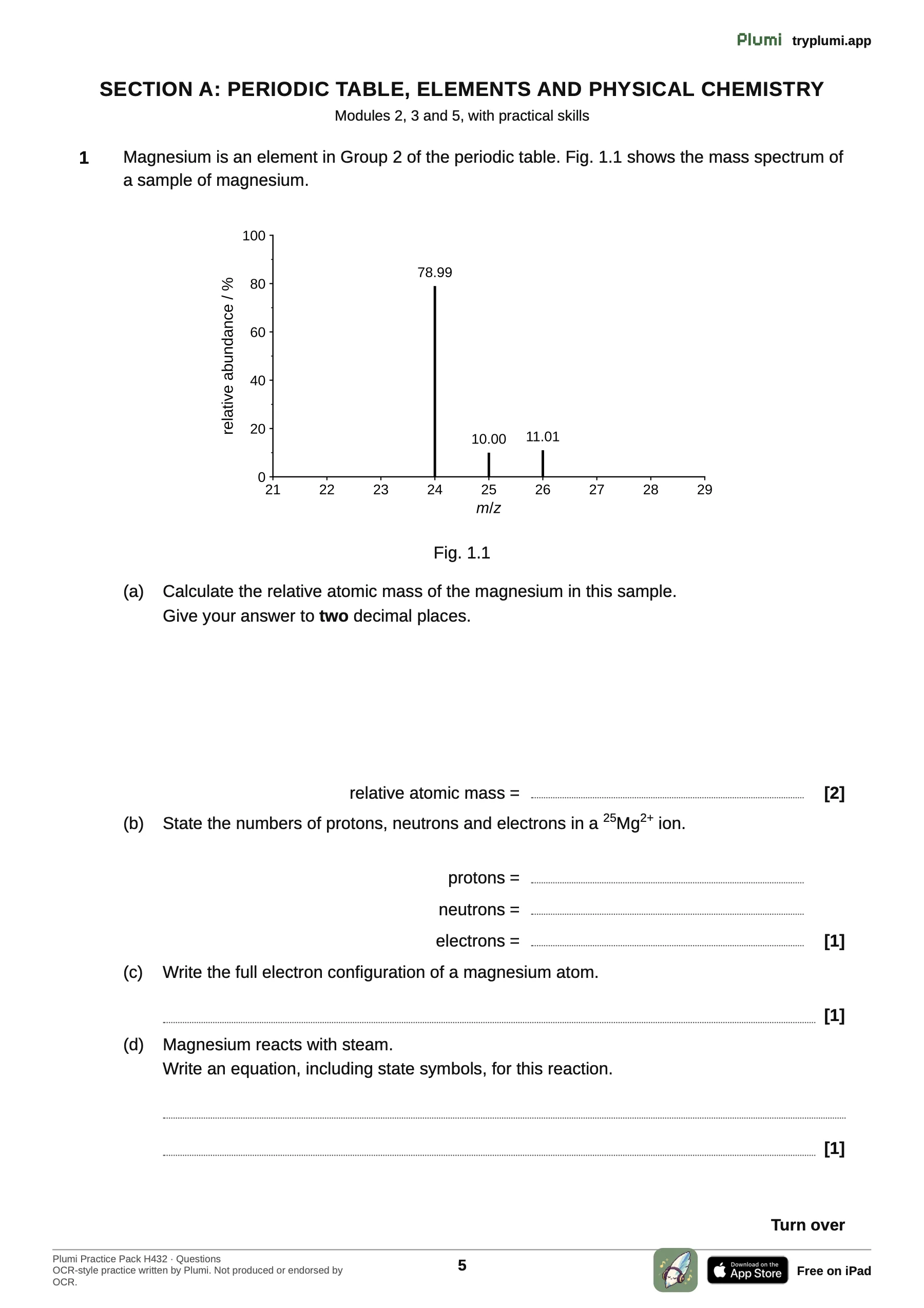
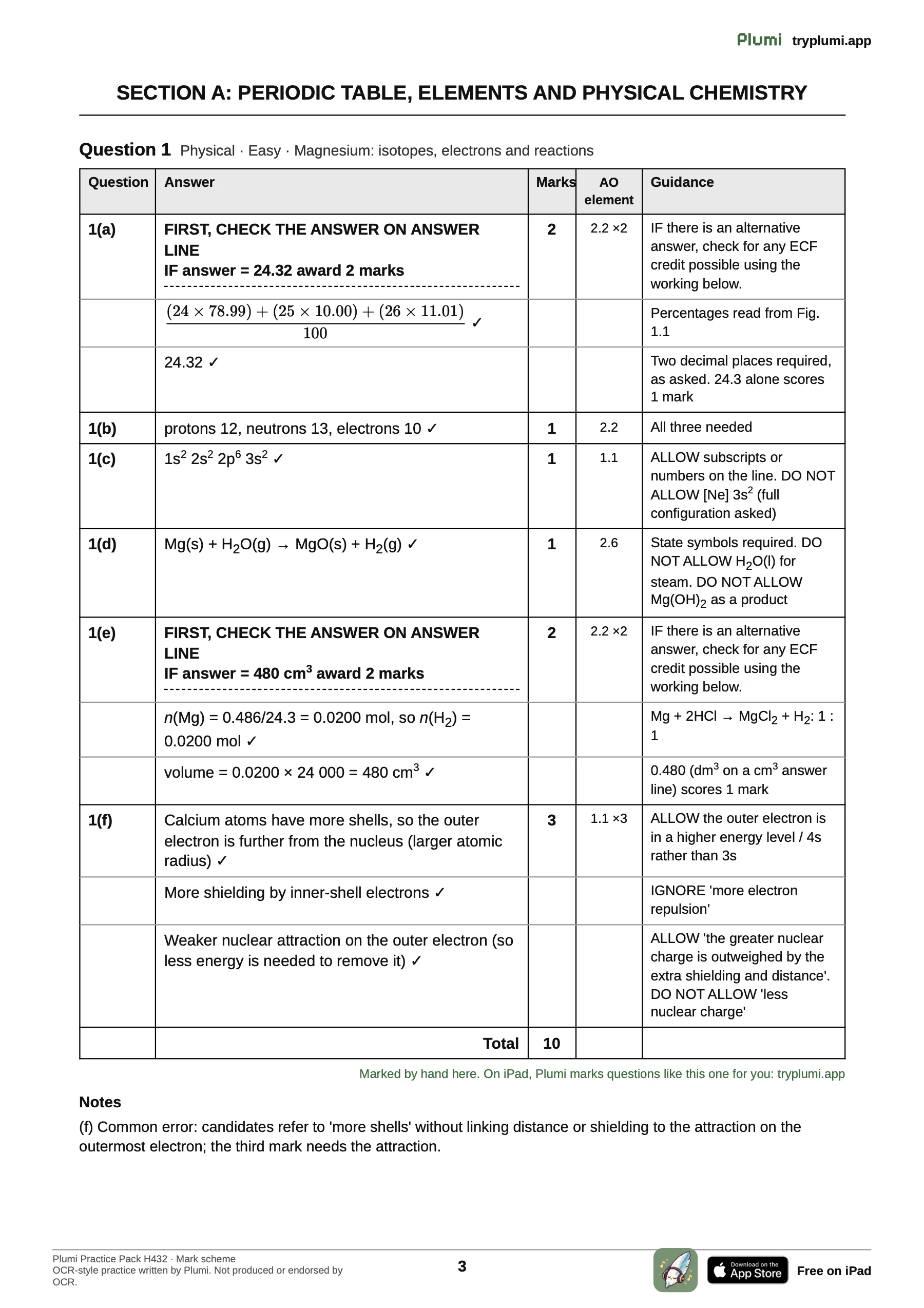
| 1 | Easy | Magnesium: isotopes, electrons and reactions · 2.1.1, 2.2.1, 3.1.2, 2.1.3, 3.1.1 | 10 |
| 2 | Medium | Hess’s law: hydrating anhydrous copper(II) sulfate · 3.2.1, 1.1.3, 1.1.4 | 11 |
| 3 | Medium | Equilibrium in the gas phase: N2O4 and NO2 · 5.1.2, 2.1.3, 3.2.3 | 12 |
| 4 | Medium | Group 2: hydrated barium chloride and barium hydroxide · 2.1.3, 3.1.2, 3.1.4, 5.1.3, 1.1.4 | 11 |
| 5 | Hard | Rates: the iodination of propanone · 5.1.1 | 14 |
| 6 | Hard | Transition elements: cobalt complexes · 5.3.1, 3.2.3, 5.2.2 | 15 |
| 7 | Hard | Electrode potentials: the oxidation states of vanadium · 2.1.5, 5.2.3, 5.3.1 | 12 |
| 8 | Super hard | Lattice enthalpy, entropy and solubility: KCl and LiF · 5.2.1, 5.2.2 | 14 |
| 9 | Super hard | Rates practical: decomposition of benzenediazonium ions · 5.1.1, 2.1.3, 1.1.1 | 16 |
| 10 | Super hard | Acids and buffers: identifying a weak acid from its titration curve · 5.1.3, 2.1.4 | 16 |
| Section B: Synthesis and Analytical Techniques | |||
| 11 | Easy | Alkenes: isomers of C4H8 · 4.1.1, 4.1.3, 2.1.3 | 9 |
| 12 | Medium | Alcohols: oxidising butan-1-ol · 4.2.1, 4.2.3, 4.2.4, 2.1.3, 2.2.2 | 11 |
| 13 | Medium | Haloalkanes: rates of hydrolysis and ozone depletion · 4.2.2, 4.1.1 | 11 |
| 14 | Medium | Aromatic chemistry: nitrating methyl benzoate · 6.1.1, 6.2.5, 2.1.3 | 11 |
| 15 | Hard | Carbonyl compounds: identifying isomers and nucleophilic addition · 6.1.2, 6.2.4, 6.2.2, 6.3.2, 4.2.1, 4.1.3 | 15 |
| 16 | Hard | Amino acids and chromatography: hydrolysing aspartame · 6.2.2, 6.2.3, 6.3.1, 6.1.3, 1.1.4 | 14 |
| 17 | Hard | Synthesis: making paracetamol from phenol · 6.1.1, 6.2.1, 6.1.3, 2.1.3, 6.3.1 | 14 |
| 18 | Super hard | Combined techniques: identifying an ester · 2.1.3, 4.2.4, 6.3.2 | 14 |
| 19 | Super hard | Organic synthesis: planning a route to an amide · 6.2.4, 6.2.1, 6.1.3, 6.2.5, 6.3.2 | 12 |
| 20 | Super hard | Polyesters: analysing a copolymer used for dissolving stitches · 6.2.3, 6.1.3, 6.3.2, 2.1.4 | 12 |
| Section C: Unified Chemistry | |||
| 21 | Easy | Practical skills: the concentration of ethanoic acid in vinegar · 2.1.4, 1.1.3, 1.1.4, 2.1.3 | 9 |
| 22 | Medium | Halogens and redox titrations: the strength of bleach · 3.1.3, 2.1.5, 5.2.3, 2.1.3 | 10 |
| 23 | Medium | Bonding and intermolecular forces · 2.2.2 | 12 |
| 24 | Medium | Gases and energetics: identifying a volatile hydrocarbon · 2.1.3, 3.2.1, 4.1.1, 6.3.2 | 11 |
| 25 | Hard | Equilibrium and titration: forming ethyl ethanoate · 3.2.3, 5.1.2, 6.1.3, 2.1.4 | 11 |
| 26 | Hard | Transition metals and colorimetry: copper in brass · 5.3.1, 2.1.5, 2.1.4, 1.1.3, 2.1.3 | 12 |
| 27 | Hard | Redox and energy: the direct ethanol fuel cell · 5.2.3, 3.2.1, 2.1.3 | 10 |
| 28 | Super hard | Synthesis and analysis: the purity of aspirin · 6.1.3, 2.1.4, 2.1.3, 6.2.5 | 14 |
| 29 | Super hard | Thermodynamics and equilibrium: manufacturing methanol · 5.2.2, 5.1.2, 3.2.3 | 14 |
| 30 | Super hard | Transition metal analysis: a green iron complex salt · 5.2.3, 5.3.1, 2.1.3 | 13 |
| Total | 370 | ||
Set out like the real thing.
Every number in the mark scheme was independently re-checked by Plumi.
How a Plumi pack compares
What you get in a Plumi pack, beside what a typical paid practice pack gives you.
- Every answer checked twice
Each numerical answer in the mark schemes was re-checked, not just worked out and trusted. Each pack says how, on its page.
- Mark schemes like the real ones
M1, A1 and B1 marks, what to allow, error carried forward, and a note on the slip most students make.
- Easy to super hard
Each section climbs from a warm-up to three stretch-and-challenge questions, like the end of a real paper.
| What you get | Plumi pack | Typical paid pack |
|---|---|---|
| Price | Free, no sign-up | Usually paid |
| Questions | 30, across every part of the course | Often one paper’s worth |
| Mark scheme | Every mark, with what to allow and error carried forward | Often answers only |
| Common slips | A note on each question saying where marks are lost | Rarely |
| Answers re-checked | Every numerical answer | Rarely |
| Difficulty | Labelled Easy to Super hard, question by question | Rarely labelled |
More practice
Questions
Are these real past papers?
No. Plumi wrote every question in the style of the board’s papers, to its specification, with a mark scheme in the board’s style. They are not produced or endorsed by the exam board. For the board’s own papers, see our past papers pages.
Are they really free?
Yes. Download the questions and the mark scheme, print them or write on them on a tablet. There is nothing to sign up for.
How should I use a pack?
Sit one section at a time, timed and by hand. Mark it with the scheme, read the note on each question you dropped, and come back to those a week later. Each section takes about two to three hours.
Can Plumi mark my answers?
On iPad, yes: Plumi marks handwritten answers to questions like these against each question’s own mark scheme. The packs themselves are for marking by hand, and the scheme tells you everything you need.