 plumi
Legacy F321: Atoms, Bonds and Groups: OCR A‑Level Chemistry A questions
OCR A-Level Chemistry A past-paper questions on L.F321 Legacy F321: Atoms, Bonds and Groups, 2010–2025, with mark schemes and examiner’s reports where available.
Previous-specification questions for extra practice. Content and exam requirements may differ from your current course.
All papers
All years
Loading the full question list…
Q1(a)(i)
The whole paper ↗1

Q1(a)(ii)
The whole paper ↗2
Q1(b)
The whole paper ↗3
Q1(c)(i)
The whole paper ↗4
Q1(c)(ii)
The whole paper ↗5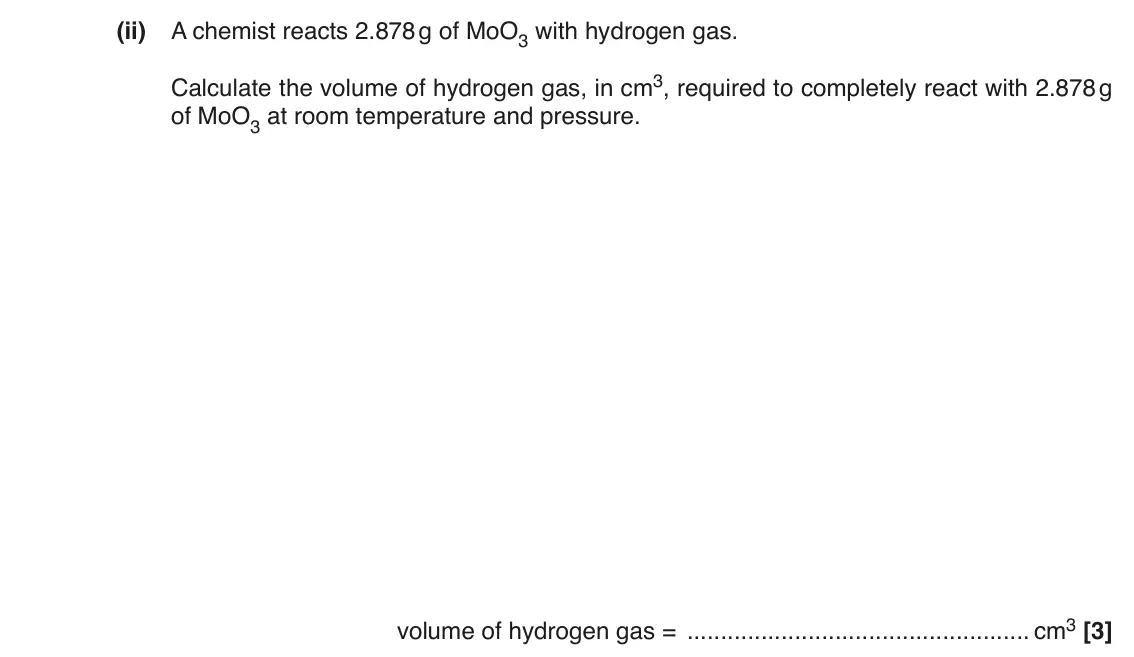
Q1(d)
The whole paper ↗6
Q1(e)
The whole paper ↗7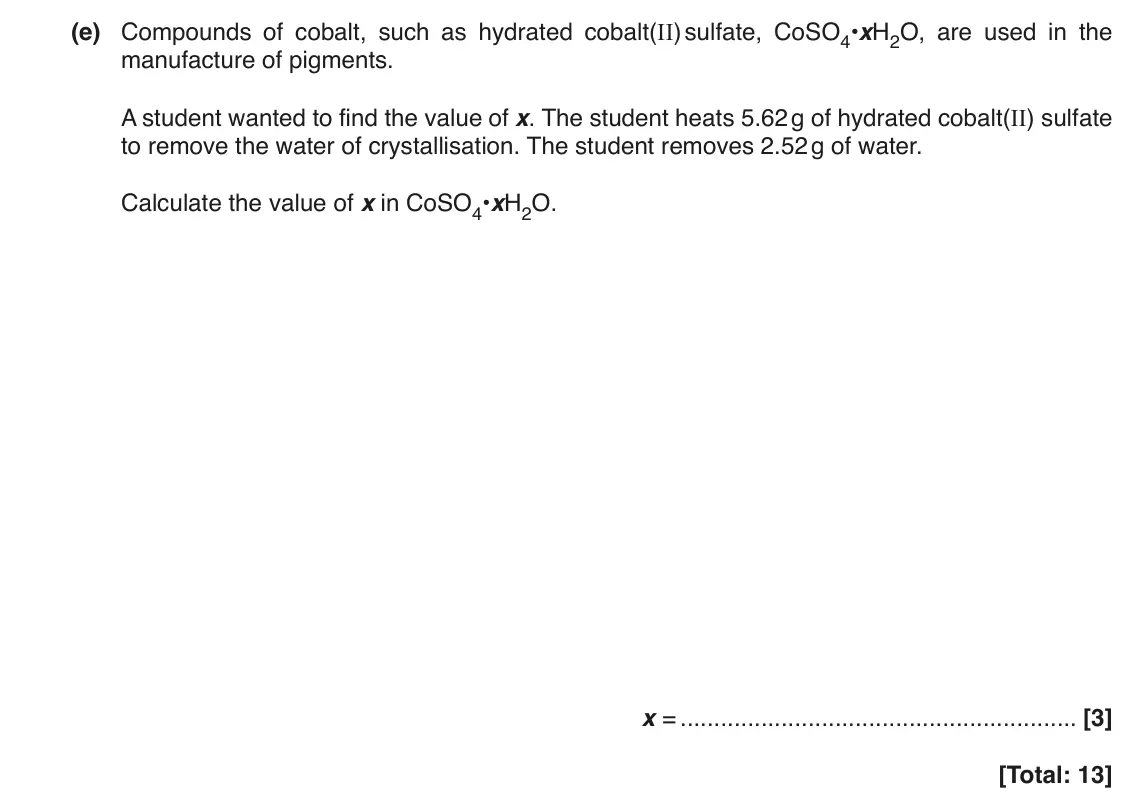
Q2(a)(i)
The whole paper ↗8
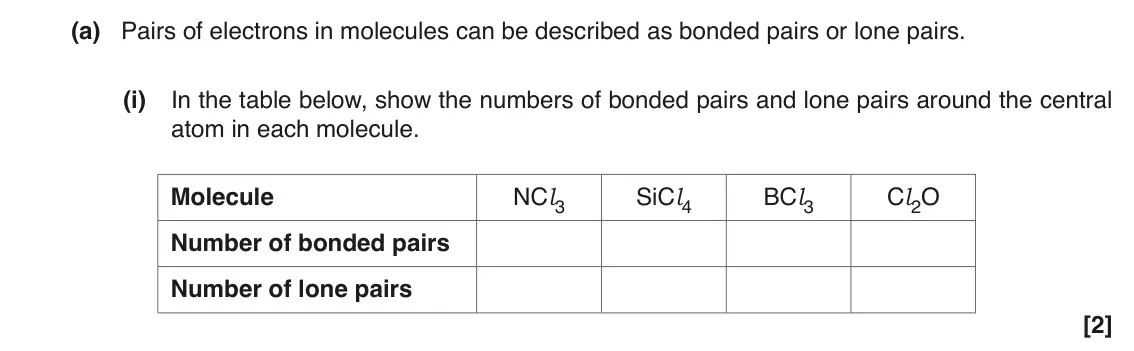
Q2(a)(ii)
The whole paper ↗9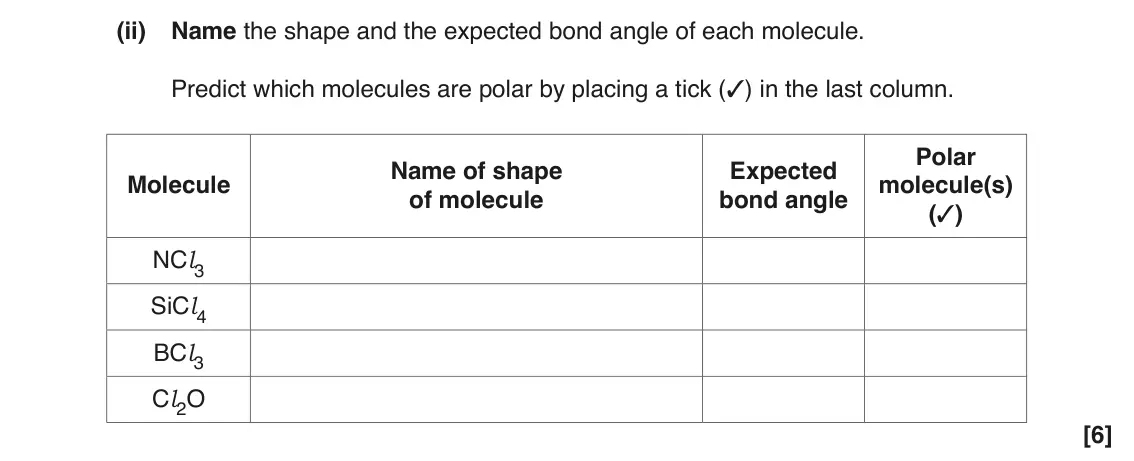
Q2(b)
The whole paper ↗10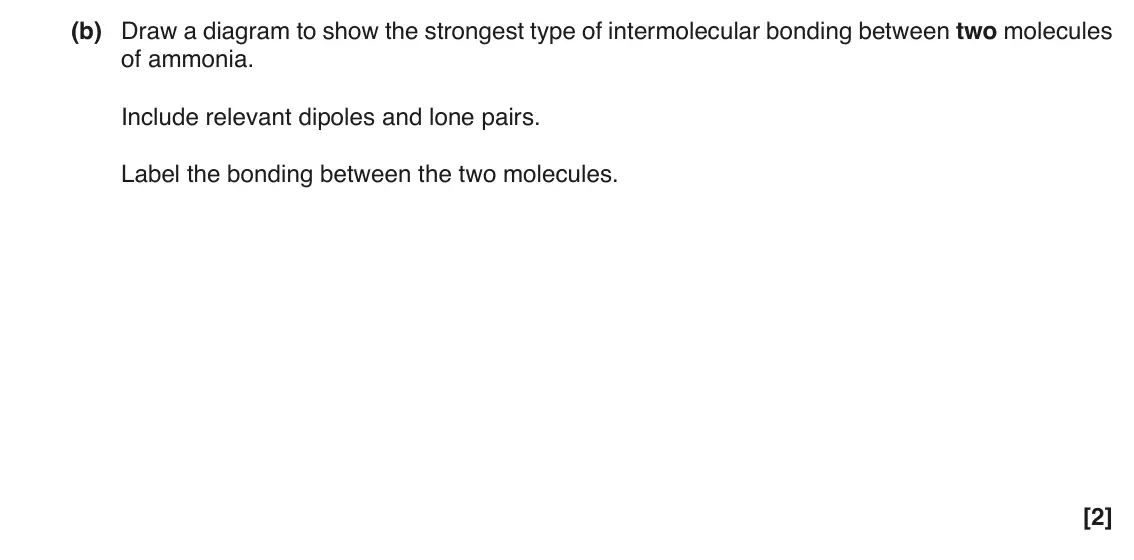
Q2(c)(i)
The whole paper ↗11
Q2(c)(ii)
The whole paper ↗12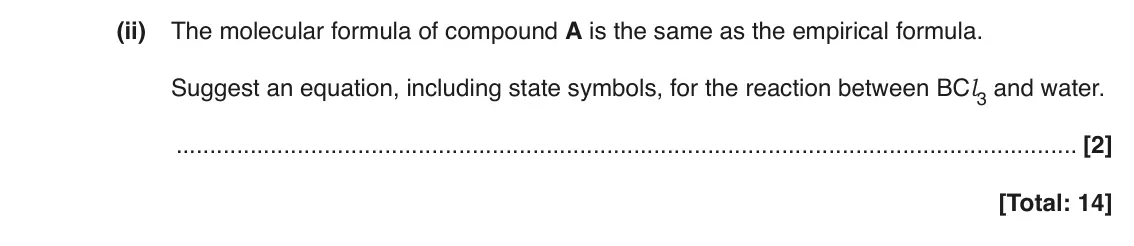
Q3(a)
The whole paper ↗13
Q3(b)
The whole paper ↗14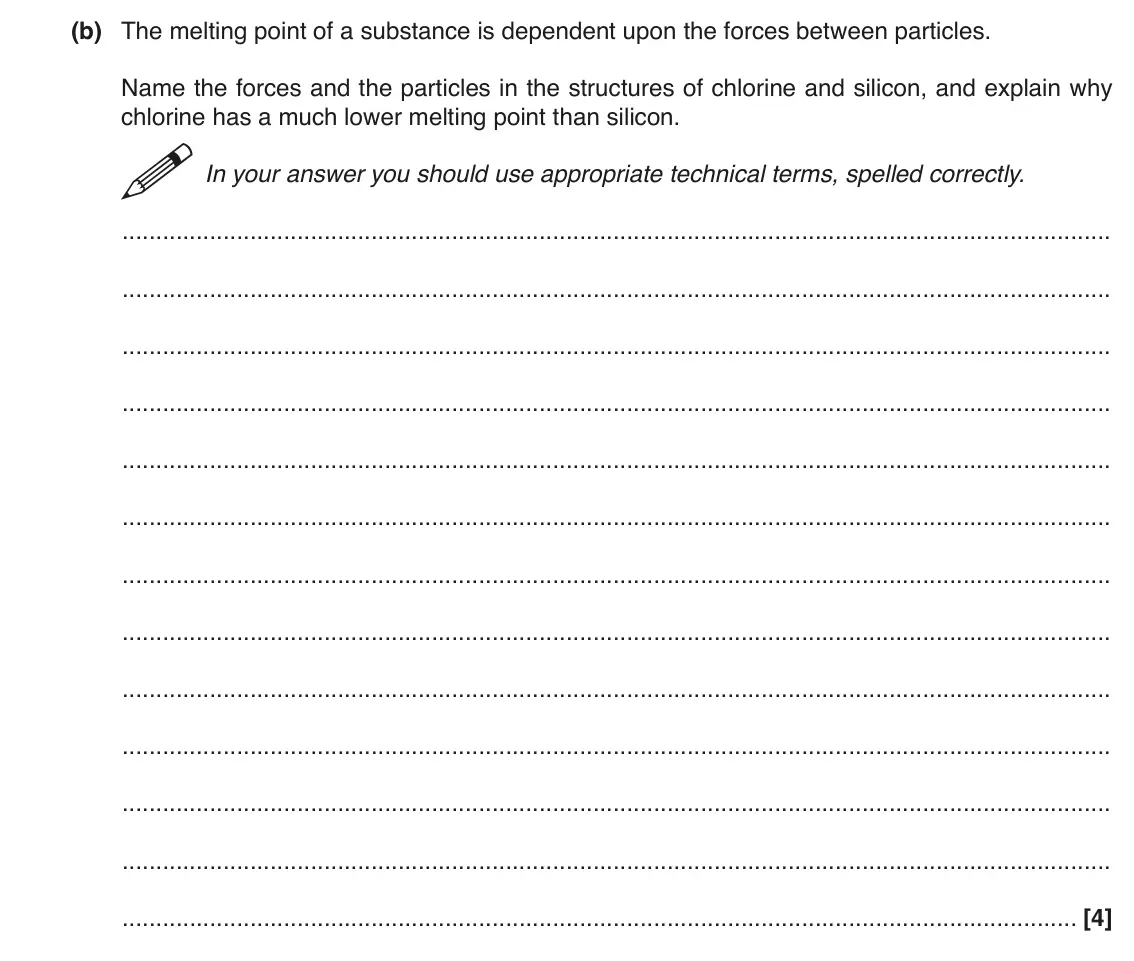
Q3(c)(i)
The whole paper ↗15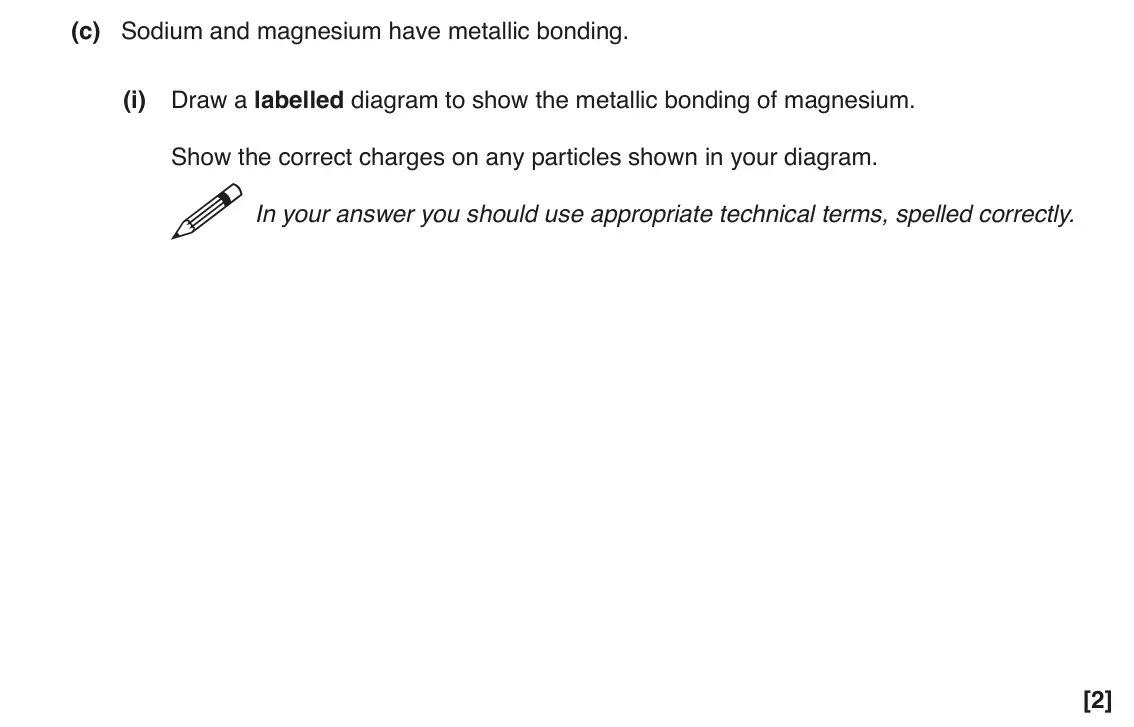
Q3(c)(ii)
The whole paper ↗16
Q3(d)
The whole paper ↗17
Q4(a)
The whole paper ↗18
Q4(b)(i)
The whole paper ↗19
Q4(b)(ii)
The whole paper ↗20
All 325 questions on Legacy F321: Atoms, Bonds and Groups, as a list
- June 2017, Legacy F321, Q1(a)(i) (1 mark): Explain what is meant by the term isotopes? [1]
- June 2017, Legacy F321, Q1(a)(ii) (2 marks): Complete the table for an atom and an ion of molybdenum. Protons Neutrons Electrons 98Mo 54 40 [2]
- June 2017, Legacy F321, Q1(b) (1 mark): Which isotope is used as the standard measurement of relative isotopic mass? [1]
- June 2017, Legacy F321, Q1(c)(i) (2 marks): Using oxidation numbers, show what has been oxidised and what has been reduced in this reaction. oxidised reduced [2]
- June 2017, Legacy F321, Q1(c)(ii) (3 marks): A chemist reacts 2.878 g of MoO3 with hydrogen gas. Calculate the volume of hydrogen gas, in cm3, required to completely react with 2.878 g of MoO3 at room temp
- June 2017, Legacy F321, Q1(d) (1 mark): Complete the electron configuration of a cobalt atom. 1s2 [1]
- June 2017, Legacy F321, Q1(e) (3 marks): Compounds of cobalt, such as hydrated cobalt(II) sulfate, CoSO4•xH2O, are used in the manufacture of pigments. A student wanted to find the value of x. The stud
- June 2017, Legacy F321, Q2(a)(i) (2 marks): In the table below, show the numbers of bonded pairs and lone pairs around the central atom in each molecule. Molecule NCl3 SiCl4 BCl3 Cl2O Number of bonded pai
- June 2017, Legacy F321, Q2(a)(ii) (6 marks): Name the shape and the expected bond angle of each molecule. Predict which molecules are polar by placing a tick (✓) in the last column. Polar Name of shape Exp
- June 2017, Legacy F321, Q2(b) (2 marks): Draw a diagram to show the strongest type of intermolecular bonding between two molecules of ammonia. Include relevant dipoles and lone pairs. Label the bonding
- June 2017, Legacy F321, Q2(c)(i) (2 marks): Calculate the empirical formula of compound A. empirical formula = [2]
- June 2017, Legacy F321, Q2(c)(ii) (2 marks): The molecular formula of compound A is the same as the empirical formula. Suggest an equation, including state symbols, for the reaction between BCl3 and water.
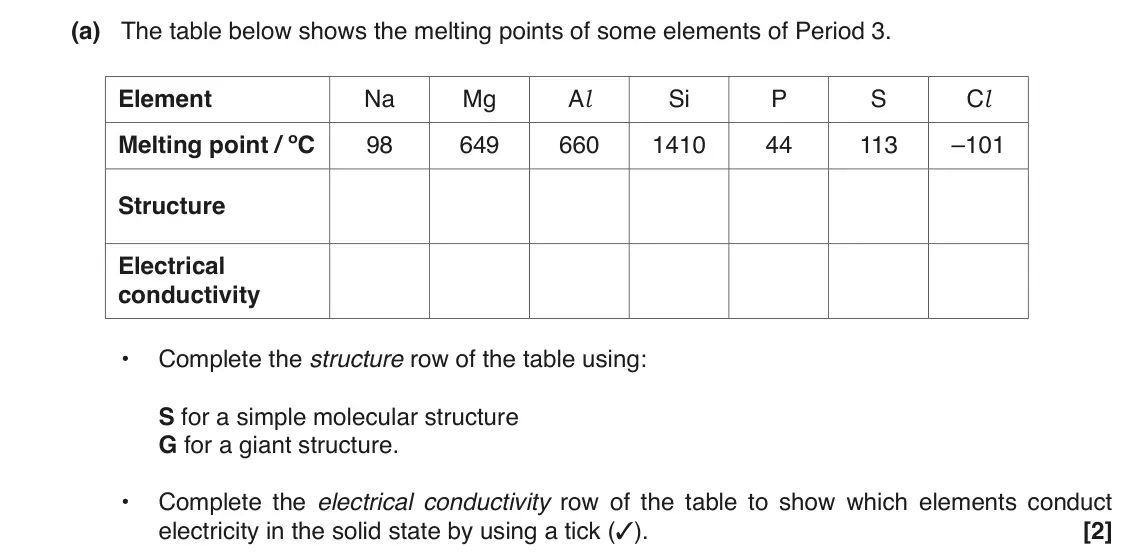
- June 2017, Legacy F321, Q3(a) (2 marks): The table below shows the melting points of some elements of Period 3. Element Na Mg Al Si P S Cl Melting point / ºC 98 649 660 1410 44 113 –101 Structure Elect
- June 2017, Legacy F321, Q3(b) (4 marks): The melting point of a substance is dependent upon the forces between particles. Name the forces and the particles in the structures of chlorine and silicon, an
- June 2017, Legacy F321, Q3(c)(i) (2 marks): Draw a labelled diagram to show the metallic bonding of magnesium. Show the correct charges on any particles shown in your diagram. In your answer you should us
- June 2017, Legacy F321, Q3(c)(ii) (4 marks): Explain why the melting point of magnesium is higher than that of sodium. In your answer, refer to the particles and the forces acting between them. [4]
- June 2017, Legacy F321, Q3(d) (1 mark): In the Periodic Table, elements show periodicity. Explain what is meant by the term periodicity. [1] [Total: 13]
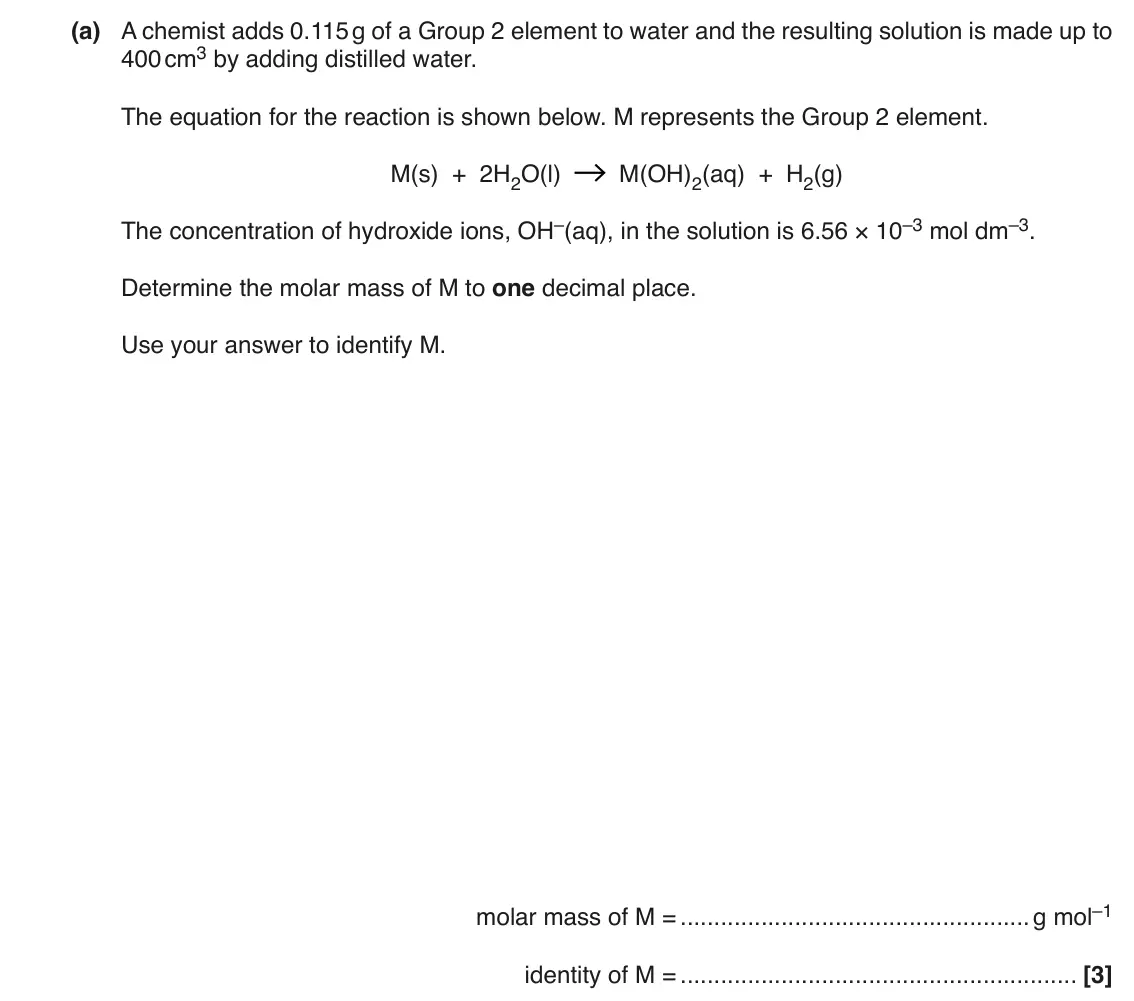
- June 2017, Legacy F321, Q4(a) (3 marks): A chemist adds 0.115 g of a Group 2 element to water and the resulting solution is made up to 400 cm3 by adding distilled water. The equation for the reaction i
- June 2017, Legacy F321, Q4(b)(i) (1 mark): Describe what the student would see. [1]
- June 2017, Legacy F321, Q4(b)(ii) (1 mark): Write an ionic equation, including state symbols, for the reaction taking place. [1]
- June 2017, Legacy F321, Q4(c)(i) (4 marks): Write the formulae of the substances A – D in the boxes. Heat Ba(s) air (s) solid A H2O(I) HCl(aq) Ba(OH)2(aq) (aq) solution B CO2(g) AgNO3(aq) (s) (s) precipit
- June 2017, Legacy F321, Q4(c)(ii) (1 mark): Suggest the formula of the other substance formed when AgNO3(aq) is added to solution B. [1]
- June 2017, Legacy F321, Q4(d)(i) (3 marks): Define, in words, the term first ionisation energy. [3]
- June 2017, Legacy F321, Q4(d)(ii) (1 mark): Write an equation, including state symbols, for the second ionisation energy of strontium. [1]
- June 2017, Legacy F321, Q4(d)(iii) (6 marks): A chemist investigates the trend in reactivity of the Group 2 elements by adding each element to separate samples of dilute hydrochloric acid. • Describe what t
- June 2016, Legacy F321, Q1(a) (2 marks): Atoms of nitrogen consist of protons, neutrons and electrons. Complete the table below. Position within the Particle Relative mass Relative charge atom Proton N
- June 2016, Legacy F321, Q1(b)(i) (1 mark): State, in words, the 3D shape of an s-orbital and a p-orbital. s-orbital p-orbital [1]
- June 2016, Legacy F321, Q1(b)(ii) (2 marks): Describe the relative energies of the 2s orbital and each of the three 2p orbitals in a nitrogen atom. [2]
- June 2016, Legacy F321, Q1(c) (1 mark): Draw a ‘dot-and-cross’ diagram to show the bonding in a nitrogen molecule. Show outer electrons only. [1]
- June 2016, Legacy F321, Q1(d) (2 marks): Calculate the amount, in mol, of nitrogen atoms in 5.117 × 10²⁰ nitrogen molecules. Give your answer in standard form. amount of nitrogen atoms = mol [2]
- June 2016, Legacy F321, Q1(e)(i) (1 mark): State the oxidation number of nitrogen in each oxide in the table below. Oxidation number of Oxide nitrogen N2O3 NO NO2 [1]
- June 2016, Legacy F321, Q1(e)(ii) (1 mark): Name this type of redox reaction. In your answer you should use appropriate technical terms spelled correctly. [1]
- June 2016, Legacy F321, Q1(f)(i) (1 mark): State what is meant by the term molecular formula. [1]
- June 2016, Legacy F321, Q1(f)(ii) (1 mark): Suggest the empirical formula of the acid formed. empirical formula of acid = [1] [Total: 12]
- June 2016, Legacy F321, Q2(a) (1 mark): Solid chlorine and solid bromine have a similar structure. Name this structure. [1]
- June 2016, Legacy F321, Q2(b)(i) (3 marks): Explain how van der Waals’ forces arise between halogen molecules. [3]
- June 2016, Legacy F321, Q2(b)(ii) (2 marks): The boiling points of chlorine and bromine are shown in the table. Halogen Boiling point / °C chlorine –34 bromine 59 Explain why bromine has a higher boiling p
- June 2016, Legacy F321, Q2(c) (5 marks): A student carries out test-tube experiments to prove the trend in reactivity of halogens. The student is provided with the following solutions: • bromine water
- June 2016, Legacy F321, Q3(a) (1 mark): The elements in these two periods show a repeating pattern in chemical and physical properties. What is the name given to this repeating pattern of properties?
- June 2016, Legacy F321, Q3(b) (3 marks): State the element in Table 3.1 with: • the lowest first ionisation energy • the lowest fourth ionisation energy • the lowest boiling point [3]
- June 2016, Legacy F321, Q3(c) (1 mark): Gallium, atomic number 31, is in Period 4 of the Periodic Table. Gallium is a Group 3 element. Predict the formula of a gallium ion. [1]
- June 2016, Legacy F321, Q3(d) (3 marks): The melting points of the Period 3 metals sodium and magnesium are shown below. Metal Melting point / °C sodium 98 magnesium 649 Explain the differences in the
- June 2016, Legacy F321, Q3(e) (3 marks): When magnesium nitrate, Mg(NO3)2, is heated, it decomposes as shown. 2Mg(NO3)2(s) 2MgO(s) + 4NO2(g) + O2(g) A student heats 2.966 g of Mg(NO3)2, which decompose
- June 2016, Legacy F321, Q3(f)(i) (1 mark): Give the formula and the name of the compound formed between fluorine and sulfur which has octahedral molecules. Formula Name [1]
- June 2016, Legacy F321, Q3(f)(ii) (2 marks): Fluorine reacts with aqueous sodium hydroxide to form the oxide F2O. Two other products are also formed. One product is an ionic compound with a relative formul
- June 2016, Legacy F321, Q3(g)(i) (1 mark): Fluorine is the most electronegative element. Indicate any dipoles on the molecule of F2O below using partial charges. F O F [1]
- June 2016, Legacy F321, Q3(g)(ii) (1 mark): Suggest the shape of the F2O molecule and the F–O–F bond angle. Shape Bond angle [1]
- June 2016, Legacy F321, Q3(g)(iii) (1 mark): What is the oxidation number of oxygen in F2O? Include the sign in your answer. [1] [Total: 17]
- June 2016, Legacy F321, Q4(a) (1 mark): Complete the electron configuration of a zinc atom. 1s2 [1]
- June 2016, Legacy F321, Q4(b)(i) (3 marks): Define the term relative atomic mass. [3]
- June 2016, Legacy F321, Q4(b)(ii) (2 marks): Calculate the relative atomic mass of zinc in this sample. Give your answer to two decimal places. relative atomic mass of zinc = [2]
- June 2016, Legacy F321, Q4(c)(i) (1 mark): Describe what the student would see during this reaction. [1]
- June 2016, Legacy F321, Q4(c)(ii) (1 mark): Write the equation for the reaction between ZnCO3 and dilute hydrochloric acid. [1]
- June 2016, Legacy F321, Q4(d)(i) (2 marks): A student reacts magnesium with aqueous copper(II) sulfate. Mg(s) + CuSO4(aq) Cu(s) + MgSO4(aq) Explain, in terms of numbers of electron transferred, the redox
- June 2016, Legacy F321, Q4(d)(ii) (2 marks): The student also noticed that the magnesium started fizzing. The student thought the fizzing was due to the magnesium reacting with water in the mixture. Write
- June 2016, Legacy F321, Q4(e) (4 marks): A student reacts 35.0 cm3 of 3.00 × 10⁻² mol dm–3 H2SO4(aq) with an excess of Al. An equation for this reaction is shown. 2Al (s) + 3H2SO4(aq) Al2(SO4)3(aq) + 3
- June 2016, Legacy F321, Q4(f)(i) (1 mark): Identify a compound of calcium that could be used to convert a soil pH from 5.8 to 7.5. [1]
- June 2016, Legacy F321, Q4(f)(ii) (1 mark): Calcium phosphide, Ca3P2, is an ionic compound used in rat poison. Calcium phosphide can be prepared by reacting calcium metal with phosphorus, P4. Write the eq
- June 2016, Legacy F321, Q4(f)(iii) (2 marks): Draw a ‘dot-and-cross ’ diagram to show the bonding in calcium phosphide, Ca3P2. Show outer electrons only. [2] [Total: 20]
- June 2015, Legacy F321, Q1(a) (2 marks): Cerium, atomic number 58, is a metal. Complete the table to show the relative charge of each particle and the number of each particle found in a 140Ce2+ ion. Nu
- June 2015, Legacy F321, Q1(b)(i) (1 mark): Identify the second product. [1]
- June 2015, Legacy F321, Q1(b)(ii) (2 marks): Write the formula of cerium(III) sulfate and, explain what has happened to the cerium in this reaction in terms of the number of electrons transferred. Formula
- June 2015, Legacy F321, Q1(b)(iii) (1 mark): How has a salt been formed in this reaction? [1]
- June 2015, Legacy F321, Q1(c) (2 marks): Europium, atomic number 63, reacts with oxygen at room temperature. 4Eu + 3O2 2Eu2O3 Calculate the volume of oxygen, in cm3, required to fully react with 9.12 g
- June 2015, Legacy F321, Q1(d)(i) (1 mark): State what is meant by the term empirical formula. [1]
- June 2015, Legacy F321, Q1(d)(ii) (2 marks): Determine the empirical formula of the compound. Show your working. Empirical formula = [2]
- June 2015, Legacy F321, Q1(e)(i) (1 mark): State the number of electrons in the fourth shell of ytterbium. [1]
- June 2015, Legacy F321, Q1(e)(ii) (1 mark): How many orbitals are there in the third shell of ytterbium? [1] [Total: 13]
- June 2015, Legacy F321, Q2(a) (1 mark): Aluminium will combine directly with fluorine. Write the equation for the reaction between aluminium and fluorine. [1]
- June 2015, Legacy F321, Q2(b)(i) (2 marks): Describe what is meant by the term ionic lattice, in terms of the type and arrangement of particles present. [2]
- June 2015, Legacy F321, Q2(b)(ii) (2 marks): Draw a ‘dot-and-cross ’ diagram for aluminium fluoride. Show outer electrons only. [2]
- June 2015, Legacy F321, Q2(c)(i) (1 mark): What is meant by the term covalent bond ? [1]
- June 2015, Legacy F321, Q2(c)(ii) (1 mark): Draw a ‘dot-and-cross ’ diagram to show the bonding in a boron tribromide molecule. Show outer electrons only. [1]
- June 2015, Legacy F321, Q2(d) (5 marks): State whether the following substances conduct electricity when solid or molten, and explain your answers in terms of the particles involved: • aluminium • alum
- June 2015, Legacy F321, Q2(e)(i) (1 mark): Write the equation for the third ionisation energy of aluminium. Include state symbols. [1]
- June 2015, Legacy F321, Q2(e)(ii) (2 marks): On the axes below, add crosses to show the 13 successive ionisation energies of aluminium. The value for the first ionisation energy has been completed for you.
- June 2015, Legacy F321, Q3(a) (2 marks): Chlorine can be made by the redox reaction below. MnO2(s) + 4HCl(aq) MnCl2(aq) + 2H2O(l) + Cl2(g) Using oxidation numbers, show what has been oxidised and what
- June 2015, Legacy F321, Q3(b) (1 mark): Complete the electron configuration of a manganese atom. 1s2 [1]
- June 2015, Legacy F321, Q3(c) (1 mark): Chlorine gas can be added to a cold, dilute alkaline solution to form bleach. Write the equation for this reaction. [1]
- June 2015, Legacy F321, Q3(d)(i) (1 mark): State what the student would observe. [1]
- June 2015, Legacy F321, Q3(d)(ii) (1 mark): Write the ionic equation for this reaction. Include state symbols. [1]
- June 2015, Legacy F321, Q3(e)(i) (2 marks): Chlorine is more electronegative than carbon and hydrogen, which have approximately equal electronegativity values. Explain what is meant by the term electroneg
- June 2015, Legacy F321, Q3(e)(ii) (2 marks): Draw a 3-D diagram of a molecule of CH2Cl2. Use partial charges to indicate polar bonds. [2]
- June 2015, Legacy F321, Q3(e)(iii) (1 mark): Explain why a CH2Cl2 molecule is polar. [1]
- June 2015, Legacy F321, Q3(f) (1 mark): Bromine has two isotopes, Br–79 and Br–81. The relative atomic mass of bromine is 79.9. Calculate the percentage of Br–79 atoms in a sample of bromine. Answer =
- June 2015, Legacy F321, Q4(a)(i) (1 mark): Calculate the amount, in mol, of H2SO4 used to neutralise only the NaOH in 25.0 cm3 of solution X. Amount = mol [1]
- June 2015, Legacy F321, Q4(a)(ii) (1 mark): Calculate the concentration, in mol dm–3, of NaOH in solution X. Concentration = mol dm–3 [1]
- June 2015, Legacy F321, Q4(b)(i) (2 marks): Calculate the amount, in mol, of NaHCO3 in the 200 cm3 of solution X. Amount = mol [2]
- June 2015, Legacy F321, Q4(b)(ii) (1 mark): Calculate the mass of NaHCO3 in the 200 cm3 of solution X. Give your answer to three significant figures. Mass = g [1] [Total: 5]
- June 2015, Legacy F321, Q5(a)(i) (1 mark): Write the equation for reaction 1. [1]
- June 2015, Legacy F321, Q5(a)(ii) (1 mark): What type of reaction is reaction 2? [1]
- June 2015, Legacy F321, Q5(b) (2 marks): Calcium hydroxide is both a base and an alkali. Refer to any relevant ions in your answer. Explain what is meant by the terms base and alkali. Base Alkali [2]
- June 2015, Legacy F321, Q5(c) (2 marks): A student prepared some calcium hydroxide by adding a small piece of calcium to a large excess of water. Describe what the student would observe and write the e
- June 2015, Legacy F321, Q5(d) (2 marks): A student prepares a solution of calcium nitrate from calcium carbonate. What reagent would the student need to use? Write the equation for the reaction. Reagen
- June 2015, Legacy F321, Q6(a) (2 marks): State how and explain why the attraction between nuclei and outermost electrons in gaseous atoms varies across Period 3. [2]
- June 2015, Legacy F321, Q6(b) (5 marks): The table shows the boiling points of ammonia, fluorine and bromine. Boiling point / °C ammonia, NH3 – 33 fluorine, F2 – 188 bromine, Br2 59 Explain the differe
- June 2014, Legacy F321, Q1(a) (1 mark): Complete the table below to show where antimony is found in the Periodic Table. Period Block [1]
- June 2014, Legacy F321, Q1(b)(i) (1 mark): What is meant by the term isotopes? [1]
- June 2014, Legacy F321, Q1(b)(ii) (1 mark): Different isotopes of antimony have the same chemical properties. Explain why. [1]
- June 2014, Legacy F321, Q1(b)(iii) (1 mark): Complete the table below to show the atomic structure of 121Sb. Protons Neutrons Electrons [1]
- June 2014, Legacy F321, Q1(c)(i) (3 marks): Define the term relative atomic mass. [3]
- June 2014, Legacy F321, Q1(c)(ii) (1 mark): A sample of antimony, Ar = 121.8, was analysed and was found to consist of 60% 121Sb and one other isotope. Determine the mass number of the other isotope in th
- June 2014, Legacy F321, Q1(d)(i) (3 marks): Predict the shape of a molecule of SbCl3. Explain your answer. name of shape: explanation: [3]
- June 2014, Legacy F321, Q1(d)(ii) (2 marks): SbCl3 molecules are polar. Explain why. [2] [Total: 13]
- June 2014, Legacy F321, Q2(a) (2 marks): A compound used as a fertiliser has the following composition by mass: C, 20.00%; H, 6.67%; N, 46.67%; O, 26.66%. Calculate the empirical formula of this compou
- June 2014, Legacy F321, Q2(b) (2 marks): A salt used as a fertiliser has the empirical formula H4N2O3. Suggest the formulae of the ions present in this salt. [2]
- June 2014, Legacy F321, Q2(c)(i) (1 mark): Suggest the formula of the acid used to prepare Ca3(PO4)2. [1]
- June 2014, Legacy F321, Q2(c)(ii) (1 mark): Name a base which could be used to prepare Ca3(PO4)2. [1] [Total: 6]
- June 2014, Legacy F321, Q3(a) (1 mark): In terms of electron transfer, explain whether aluminium is being oxidised or reduced. [1]
- June 2014, Legacy F321, Q3(b) (2 marks): Calculate the volume of hydrogen gas formed, in dm3, at room temperature and pressure. volume of hydrogen gas formed = dm3 [2]
- June 2014, Legacy F321, Q3(c) (2 marks): Calculate the mass of Al Cl3 formed. Give your answer to three significant figures. mass of Al Cl3 formed = g [2]
- June 2014, Legacy F321, Q3(d) (2 marks): Calculate the volume, in cm3, of 1.20 mol dm–3 hydrochloric acid needed to react completely with 0.0800 mol of aluminium. volume = cm3 [2] [Total: 7]
- June 2014, Legacy F321, Q4(a)(i) (2 marks): Complete the diagram below to show hydrogen bonding between the H2O molecule shown and one other H2O molecule. Include relevant dipoles and lone pairs. Label th
- June 2014, Legacy F321, Q4(a)(ii) (4 marks): State and explain two anomalous properties of ice caused by hydrogen bonding. 1 2 [4]
- June 2014, Legacy F321, Q4(b) (1 mark): Draw a ‘dot-and-cross’ diagram to show the bonding in CO2. Show outer electrons only. [1]
- June 2014, Legacy F321, Q4(c) (1 mark): Silicon dioxide, SiO2, has the same structure and bonding as diamond. State the structure and bonding in SiO2. [1]
- June 2014, Legacy F321, Q4(d) (5 marks): Describe and explain the electrical conductivity of sodium oxide, Na2O, and sodium in their solid and molten states. In your answer you should use appropriate t
- June 2014, Legacy F321, Q5(a) (3 marks): Elements in the Periodic Table show a periodic trend in atomic radius. State and explain the trend in atomic radius from Li to F. In your answer you should use
- June 2014, Legacy F321, Q5(b)(i) (1 mark): Complete the electron configuration of a bromide ion. 1s2 [1]
- June 2014, Legacy F321, Q5(b)(ii) (1 mark): A student adds a small volume of aqueous silver nitrate to an aqueous solution of bromide ions in a test-tube. The student then adds a similar volume of dilute
- June 2014, Legacy F321, Q5(b)(iii) (1 mark): Write an ionic equation for any precipitation reaction which occurs in the student’s tests. Include state symbols. [1]
- June 2014, Legacy F321, Q5(c)(i) (2 marks): Chlorine reacts with aqueous sodium hydroxide to form bleach. Write the equation and state the conditions for this reaction. equation conditions [2]
- June 2014, Legacy F321, Q5(c)(ii) (3 marks): Under different conditions, chlorine reacts differently with aqueous sodium hydroxide. A disproportionation reaction takes place as shown below. 3Cl2(g) + 6NaOH
- June 2014, Legacy F321, Q6(a)(i) (1 mark): Write the equation for the thermal decomposition of calcium carbonate. Include state symbols. [1]
- June 2014, Legacy F321, Q6(a)(ii) (1 mark): Write the formula of the Group 2 carbonate which decomposes at the highest temperature. [1]
- June 2014, Legacy F321, Q6(b) (3 marks): Hydrated strontium chloride, SrCl2•6H2O, has a molar mass of 266.6 g mol–1. A student heats 5.332 g of SrCl2•6H2O. The SrCl2•6H2O loses some of its water of cry
- June 2014, Legacy F321, Q6(c)(i) (3 marks): Write equations for Reaction 1 and Reaction 2. Ignore state symbols. Reaction 1: Reaction 2: [3]
- June 2014, Legacy F321, Q6(c)(ii) (1 mark): Predict the structure and bonding of Ba3N2. [1]
- June 2014, Legacy F321, Q6(c)(iii) (1 mark): BaO2 formed in Reaction 3 contains barium and peroxide ions. The peroxide ion has the structure [O–O]2–. Suggest a ‘dot-and-cross’ diagram for BaO2. Show outer
- June 2013, Legacy F321, Q1(a)(i) (2 marks): Define the term relative isotopic mass. [2]
- June 2013, Legacy F321, Q1(a)(ii) (2 marks): Complete the table below for an atom and an ion of two different isotopes of potassium. Protons Neutrons Electrons 39K 19 22 18 [2]
- June 2013, Legacy F321, Q1(b) (1 mark): Complete the electron configuration of a silicon atom. 1s2 [1]
- June 2013, Legacy F321, Q1(c)(i) (3 marks): Silicon reacts with chlorine to form molecules of silicon tetrachloride, SiCl4. How many molecules are present in 8.505 g of SiCl4? answer = molecules [3]
- June 2013, Legacy F321, Q1(c)(ii) (2 marks): Potassium reacts with chlorine to form an ionic lattice of potassium chloride, KCl. A diagram of part of the potassium chloride lattice is shown below. Add labe
- June 2013, Legacy F321, Q2(a)(i) (2 marks): State the formulae of the two main ions present in the solution of Al2(SO4)3. and [2]
- June 2013, Legacy F321, Q2(a)(ii) (2 marks): Write an equation for the reaction of aluminium oxide, Al2O3, with sulfuric acid. Include state symbols. [2]
- June 2013, Legacy F321, Q2(a)(iii) (1 mark): What does ‘•x H2O’ represent in the formula Al2(SO4)3•x H2O? [1]
- June 2013, Legacy F321, Q2(a)(iv) (3 marks): The student heats 12.606 g of Al2(SO4)3•x H2O crystals to constant mass. The anhydrous aluminium sulfate formed has a mass of 6.846 g. Use the student’s results
- June 2013, Legacy F321, Q2(b)(i) (2 marks): Write the equation for the reaction between chlorine and water. Explain why the damp litmus paper turns a red colour as a result of this reaction. [2]
- June 2013, Legacy F321, Q2(b)(ii) (1 mark): Bleach is made by reacting chlorine with cold dilute aqueous sodium hydroxide. Suggest the formula of the ion responsible for bleaching. [1] [Total: 11]
- June 2013, Legacy F321, Q3(a)(i) (3 marks): Using oxidation numbers, explain why this is a disproportionation reaction. [3]
- June 2013, Legacy F321, Q3(a)(ii) (2 marks): A chemist reacts 1.86 g of P4 with excess NaOH(aq). Calculate the volume of phosphine gas, in cm3, produced at room temperature and pressure, RTP. volume of pho
- June 2013, Legacy F321, Q3(b) (1 mark): Phosphine gas burns in air to form an oxide of phosphorus, P4O10, and water. Write the equation for this reaction. [1]
- June 2013, Legacy F321, Q3(c)(i) (1 mark): Why is Na3PO4 described as a salt of H3PO4? [1]
- June 2013, Legacy F321, Q3(c)(ii) (1 mark): Calculate the amount, in moles, of H3PO4 in 15.0 cm3 of 0.100 mol dm–3 H3PO4. amount = mol [1]
- June 2013, Legacy F321, Q3(c)(iii) (1 mark): The equation for the preparation of Na3PO4 from NaOH and H3PO4 is shown below. 3NaOH(aq) + H3PO4(aq) Na3PO4(aq) + 3H2O(l) Calculate the volume of 0.200 mol dm–3
- June 2013, Legacy F321, Q3(d)(i) (2 marks): Complete the table below to show the main intermolecular forces present in NH3 and PH3. Group 5 hydride Main intermolecular force NH3 PH3 [2]
- June 2013, Legacy F321, Q3(d)(ii) (1 mark): Suggest why PH3 has a lower boiling point than NH3. [1]
- June 2013, Legacy F321, Q3(e)(i) (1 mark): A covalent bond is a shared pair of electrons. What is a dative covalent bond? [1]
- June 2013, Legacy F321, Q3(e)(ii) (2 marks): Draw a ‘dot-and-cross’ diagram to show the bonding in H3NBF3. Label the dative covalent bond in your diagram. Show outer electrons only. [2]
- June 2013, Legacy F321, Q3(e)(iii) (2 marks): The F–B–F bond angle in BF3 is different from the F–B–F bond angle in H3NBF3. Complete the table to predict the F–B–F bond angles in BF3 and in H3NBF3. F–B–F bo
- June 2013, Legacy F321, Q3(e)(iv) (3 marks): The H–N–H bond angle in NH3 is 107°. A student predicted that the H–N–H bond angle in H3NBF3 is larger. Explain why the student might expect the H–N–H bond angl
- June 2013, Legacy F321, Q4(a) (5 marks): Describe and explain the trend in reactivity of Group 2 elements with chlorine as the group is descended. In your answer you should use appropriate technical te
- June 2013, Legacy F321, Q4(b)(i) (1 mark): State the reagent that the student would need to add to the solution of calcium iodide. [1]
- June 2013, Legacy F321, Q4(b)(ii) (1 mark): What observation would show that the solution contained iodide ions? [1]
- June 2013, Legacy F321, Q4(b)(iii) (1 mark): Write an ionic equation, including state symbols, for the reaction that took place. [1]
- June 2013, Legacy F321, Q4(b)(iv) (1 mark): The student is provided with an aqueous solution of calcium bromide that is contaminated with calcium iodide. The student carries out the same chemical test but
- June 2013, Legacy F321, Q5(a)(i) (3 marks): Explain the trend across Period 2 shown in Table 5.1. In your answer, you should use appropriate technical terms, spelled correctly. [3]
- June 2013, Legacy F321, Q5(a)(ii) (1 mark): Solid carbon exists in two forms, diamond and graphite. Explain why it is unnecessary to refer to carbon as either diamond or graphite in Table 5.1. [1]
- June 2013, Legacy F321, Q5(b) (6 marks): Lithium, carbon (in the form of diamond) and fluorine have very different melting points. These differences in melting points are the result of different types
- June 2012, Legacy F321, Q1(a) (3 marks): Define the term relative atomic mass. [3]
- June 2012, Legacy F321, Q1(b) (2 marks): Calculate the relative atomic mass of the sample of sulfur. Give your answer to two decimal places. answer = [2]
- June 2012, Legacy F321, Q1(c) (2 marks): John Dalton, an early 19th century scientist, believed that elements were made up of tiny particles called atoms which could not be divided. Nowadays, chemists
- June 2012, Legacy F321, Q1(d) (2 marks): Solid sulfur exists as a lattice of S8 molecules. Each S8 molecule is a ring of eight atoms. How many atoms of sulfur are there in 0.0120 mol of S8 molecules? a
- June 2012, Legacy F321, Q1(e)(i) (3 marks): Describe how van der Waals’ forces arise. [3]
- June 2012, Legacy F321, Q1(e)(ii) (1 mark): Suggest why there are no other intermolecular forces in solid sulfur. [1]
- June 2012, Legacy F321, Q1(f) (1 mark): Sodium thiosulfate is a compound of sulfur used to develop photographs. Hydrated sodium thiosulfate has the formula Na2S2O3•5H2O. What is the oxidation number o
- June 2012, Legacy F321, Q1(g)(i) (1 mark): What does the term anhydrous mean? [1]
- June 2012, Legacy F321, Q1(g)(ii) (1 mark): What is the relative formula mass of Na2S2O3•5H2O? [1]
- June 2012, Legacy F321, Q1(g)(iii) (2 marks): Calculate the expected mass of anhydrous sodium thiosulfate that forms. mass = g [2]
- June 2012, Legacy F321, Q1(h)(i) (2 marks): Explain why a molecule of SF6 has an octahedral shape. [2]
- June 2012, Legacy F321, Q1(h)(ii) (3 marks): Fluorine has a higher electronegativity than sulfur, yet SF6 molecules are non-polar. Explain what is meant by the term electronegativity and suggest why SF6 mo
- June 2012, Legacy F321, Q2(a) (1 mark): What is the name of the term used to describe the repeating patterns in the Periodic Table? [1]
- June 2012, Legacy F321, Q2(b) (6 marks): Melting points show a trend across a period. The table below shows the melting points of three elements in Period 3 of the Periodic Table. element aluminium sil
- June 2012, Legacy F321, Q2(c)(i) (1 mark): Draw a sketch graph to show the general trend in ionisation energy across Period 3. ionisation energy Na Mg Al Si P S Cl Ar [1]
- June 2012, Legacy F321, Q2(c)(ii) (1 mark): Draw a sketch graph to show the general trend in atomic radius across Period 3. atomic radius Na Mg Al Si P S Cl Ar [1] [Total: 9]
- June 2012, Legacy F321, Q3(a) (1 mark): Complete the electron configuration of a magnesium atom. 1s2 [1]
- June 2012, Legacy F321, Q3(b)(i) (2 marks): Write an equation to represent the second ionisation energy of magnesium. Include state symbols. [2]
- June 2012, Legacy F321, Q3(b)(ii) (3 marks): Magnesium has a greater second ionisation energy than strontium. Explain why. In your answer, you should use appropriate technical terms spelled correctly. [3]
- June 2012, Legacy F321, Q3(c)(i) (2 marks): Write the formulae of the aqueous ions formed when this reaction takes place. [2]
- June 2012, Legacy F321, Q3(c)(ii) (1 mark): In terms of electron transfer, explain why strontium has been oxidised. [1]
- June 2012, Legacy F321, Q3(c)(iii) (1 mark): Suggest two compounds which could be reacted together to produce Sr(OH)2. [1]
- June 2012, Legacy F321, Q3(d)(i) (1 mark): The systematic name for SrSO3 is strontium sulfate(IV). Why does the number (IV) have to be used here rather than simply naming this compound as strontium sulfa
- June 2012, Legacy F321, Q3(d)(ii) (1 mark): Suggest the formula of the acid used to form SrSO3. [1] [Total: 12]
- June 2012, Legacy F321, Q4(a)(i) (1 mark): Write an equation to show how HClO can form in drinking water. [1]
- June 2012, Legacy F321, Q4(a)(ii) (1 mark): Some scientists believe that chlorine compounds should not be present in drinking water. Suggest one reason why scientists may be worried by the presence of the
- June 2012, Legacy F321, Q4(b)(i) (1 mark): State the type of reaction that has taken place. [1]
- June 2012, Legacy F321, Q4(b)(ii) (1 mark): Write the ionic equation for this reaction. Include state symbols. [1]
- June 2012, Legacy F321, Q4(c)(i) (1 mark): Calculate the amount, in moles, of AgCl that forms. The molar mass of AgCl = 143.4 g mol–1. answer = mol [1]
- June 2012, Legacy F321, Q4(c)(ii) (3 marks): Deduce the amount, in moles, of the Group 2 chloride that the student dissolves. Hence deduce the relative atomic mass and the identity of the Group 2 metal. Gi
- June 2012, Legacy F321, Q4(d)(i) (1 mark): What is a dative covalent (coordinate) bond? [1]
- June 2012, Legacy F321, Q4(d)(ii) (1 mark): Give the formulae of the ions present in NH4Cl. [1]
- June 2012, Legacy F321, Q4(d)(iii) (2 marks): Draw a ‘dot-and-cross’ diagram to show the bonding in NH4Cl. Show the outer electrons only. [2] FOR QUESTION 4(e)
- June 2012, Legacy F321, Q4(e)(i) (1 mark): This is an example of a redox reaction. What other type of reaction takes place? [1]
- June 2012, Legacy F321, Q4(e)(ii) (3 marks): The teacher heats 0.824 g of KClO3. Calculate the volume of oxygen produced, in cm3, measured at room temperature and pressure. Give your answer to the nearest
- January 2012, Legacy F321, Q1(a)(i) (2 marks): Define the term relative isotopic mass. [2]
- January 2012, Legacy F321, Q1(a)(ii) (1 mark): Complete the table to show the number of sub-atomic particles in an atom of iodine-127 and in an atom of iodine-131. protons neutrons electrons iodine-127 53 io
- January 2012, Legacy F321, Q1(b)(i) (2 marks): Calculate the mass of KI, in µg, that would be needed to supply the GDA of iodide ions. Give your answer to three significant figures. answer = µg [2]
- January 2012, Legacy F321, Q1(b)(ii) (1 mark): Apart from reasons of cost, suggest why some countries do not add KI to table salt. [1]
- January 2012, Legacy F321, Q1(c)(i) (1 mark): Write the ionic equation for this reaction. [1]
- January 2012, Legacy F321, Q1(c)(ii) (2 marks): At room temperature, chlorine is a gas and iodine is a solid. When heated together, chlorine reacts with iodine to form iodine monochloride, ICl. ICl has a high
- January 2012, Legacy F321, Q2(a) (2 marks): Describe a chemical test which the student could have carried out to prove that the filtrate contains aqueous chloride ions. [2]
- January 2012, Legacy F321, Q2(b) (2 marks): A friend of the student suggested that solid X was calcium oxide. State one reason why the student’s friend was incorrect and suggest a possible identity of sol
- January 2012, Legacy F321, Q2(c)(i) (1 mark): What is meant by the term hydrated calcium chloride? [1]
- January 2012, Legacy F321, Q2(c)(ii) (2 marks): Determine the formula of the hydrated calcium chloride. You must show your working. formula = [2]
- January 2012, Legacy F321, Q2(d) (2 marks): Calcium chloride can also be formed by directly reacting calcium with chlorine gas. Draw a ‘dot-and-cross ’ diagram to show the bonding in calcium chloride. Sho
- January 2012, Legacy F321, Q2(e) (2 marks): The student decided to prepare barium bromide, BaBr2, by directly reacting barium with bromine gas. The student was unsure whether this preparation would be mor
- January 2012, Legacy F321, Q3(a)(i) (1 mark): Explain what is meant by the term orbital. [1]
- January 2012, Legacy F321, Q3(a)(ii) (1 mark): Complete the electron configuration below, in terms of sub-shells, for an atom of sulfur. 1s2 [1]
- January 2012, Legacy F321, Q3(a)(iii) (1 mark): How many full orbitals are in an atom of sulfur? [1]
- January 2012, Legacy F321, Q3(b) (1 mark): One mole of sulfur atoms has a mass of 32.1 g. What is meant by one mole of substance? [1]
- January 2012, Legacy F321, Q3(c) (3 marks): Ionisation energies provide evidence for the order of elements in the modern Periodic Table. Define the term first ionisation energy. [3]
- January 2012, Legacy F321, Q3(d)(i) (3 marks): Explain why there is an increase in first ionisation energy between F and Ne. [3]
- January 2012, Legacy F321, Q3(d)(ii) (3 marks): Explain why there is a decrease in first ionisation energy between Ne and Na. [3] [Total: 13]
- January 2012, Legacy F321, Q4(a) (2 marks): Complete the table. solid melting point / °C type of lattice K 63 giant metallic KBr 734 H2O 0 [2]
- January 2012, Legacy F321, Q4(b) (6 marks): Explain why there is a difference in the melting points of K, KBr and H2O. In your answer you should refer to the types of particle, the types of forces between
- January 2012, Legacy F321, Q4(c) (3 marks): Potassium metal reacts with water. 2K(s) + 2H2O(l) 2KOH(aq) + H2(g) 0.2346 g of potassium is reacted with excess water. Calculate the volume of gas formed. The
- January 2012, Legacy F321, Q5(a)(i) (1 mark): Why can ammonium sulfate be described as a salt? [1]
- January 2012, Legacy F321, Q5(a)(ii) (3 marks): A student was given 400 cm3 of aqueous ammonia solution, NH3(aq). The student was asked to determine how many moles of NH3 had been dissolved to prepare the sol
- January 2012, Legacy F321, Q5(b) (4 marks): The hydrazine molecule, H2N–NH2, is covalent. Predict the H–N–H bond angle in a hydrazine molecule. Explain your answer. [4]
- January 2012, Legacy F321, Q5(c)(i) (1 mark): Write the formula of the negative ion that is formed when hydrazine reacts with water. [1]
- January 2012, Legacy F321, Q5(c)(ii) (1 mark): Suggest the formula of a positive ion which might form when hydrazine reacts with water. [1] FOR QUESTION 5(d)
- January 2012, Legacy F321, Q5(d)(i) (3 marks): Using oxidation numbers, explain why the above equation represents a redox reaction. [3]
- January 2012, Legacy F321, Q5(d)(ii) (1 mark): What is the name for NaCl O? [1]
- January 2012, Legacy F321, Q5(d)(iii) (2 marks): The overall reaction takes place in two stages. • In the first stage NH2Cl is produced. • In the second stage N2H4 is produced. Some of the hydrazine reacts wit
- June 2011, Legacy F321, Q1(a) (1 mark): A model used by chemists includes the relative charges, the relative masses and the distribution of the sub-atomic particles making up the atom. Complete the ta
- June 2011, Legacy F321, Q1(b) (3 marks): Early studies of ionisation energies helped scientists to develop a model for the electron structure of the atom. Define the term first ionisation energy. [3]
- June 2011, Legacy F321, Q1(c) (3 marks): A modern model of the atom arranges electrons into orbitals, sub-shells and shells. Complete the following table showing the maximum number of electrons which c
- June 2011, Legacy F321, Q1(d) (1 mark): The modern Periodic Table arranges the elements in order of their atomic number. When arranged in this order the elements show periodicity. Explain what is mean
- June 2011, Legacy F321, Q1(e)(i) (1 mark): An element with an isotope that can be represented as 14 6X. [1]
- June 2011, Legacy F321, Q1(e)(ii) (1 mark): The element which has the strongest metallic bonding in Period 3. [1]
- June 2011, Legacy F321, Q1(e)(iii) (1 mark): The element which forms a 3– ion with the same electron structure as Ne. [1]
- June 2011, Legacy F321, Q1(e)(iv) (1 mark): The element which has the smallest third ionisation energy. [1]
- June 2011, Legacy F321, Q1(e)(v) (1 mark): The element with the first six successive ionisation energies shown below, in kJ mol–1. 738 1451 7733 10541 13629 17995 [1] [Total: 13]
- June 2011, Legacy F321, Q2(a) (1 mark): Write the equation for the action of heat on the magnesium carbonate present in tube A. [1]
- June 2011, Legacy F321, Q2(b)(i) (2 marks): Write the equation for the reaction of magnesium carbonate in tube B with dilute hydrochloric acid. Include state symbols. [2]
- June 2011, Legacy F321, Q2(b)(ii) (2 marks): State one similarity and one difference the student would see between the reactions in the two tubes. similarity difference [2]
- June 2011, Legacy F321, Q2(b)(iii) (1 mark): From the solution in each tube, the student obtained crystals with the formula MgCl2•6H2O. Calculate the relative formula mass of MgCl2•6H2O. Give your answer t
- June 2011, Legacy F321, Q2(b)(iv) (2 marks): Draw a ‘dot-and-cross’ diagram to show the bonding in MgCl2. Show outer electrons only. [2]
- June 2011, Legacy F321, Q2(c) (2 marks): A compound containing magnesium, silicon and oxygen is also present in rock types in Italy. A sample of this compound weighing 5.27 g was found to have the foll
- June 2011, Legacy F321, Q2(d)(i) (1 mark): Calculate the amount, in mol, of HCl used. amount = mol [1]
- June 2011, Legacy F321, Q2(d)(ii) (1 mark): Determine the amount, in mol, of Mg(OH)2 present in the tablet. amount = mol [1]
- June 2011, Legacy F321, Q2(d)(iii) (3 marks): Determine the percentage by mass of Mg(OH)2 present in the tablet. answer = % [3] [Total: 15]
- June 2011, Legacy F321, Q3(a) (1 mark): Bleach can be made by reacting chlorine with cold aqueous sodium hydroxide. A solution of bleach contains the chlorate compound NaClO. Write the equation for th
- June 2011, Legacy F321, Q3(b)(i) (1 mark): Give the systematic name for NaClO3. [1]
- June 2011, Legacy F321, Q3(b)(ii) (3 marks): When heated, NaClO3 disproportionates as shown in the equation below. 4NaClO3 3NaClO4 + NaCl Using oxidation numbers, explain why this is a disproportionation r
- June 2011, Legacy F321, Q3(c)(i) (2 marks): State one valid reason that supports the scientists’ case and state one reason why chlorine should be added to drinking water. [2]
- June 2011, Legacy F321, Q3(c)(ii) (1 mark): Draw a ‘dot-and-cross’ diagram to show the bonding in a molecule of CH3Cl. Show outer electrons only. [1]
- June 2011, Legacy F321, Q3(c)(iii) (1 mark): Name the shape of a molecule of CH3Cl . [1]
- June 2011, Legacy F321, Q3(d) (4 marks): A sample of brine is a concentrated aqueous solution of sodium chloride, NaCl(aq). Describe a simple chemical test that you could carry out to show that brine c
- June 2011, Legacy F321, Q4(a)(i) (1 mark): Explain why ZnCl2 is a salt. [1]
- June 2011, Legacy F321, Q4(a)(ii) (1 mark): Predict the formula of the zinc salt that could be formed by adding an excess of zinc to phosphoric(V) acid, H3PO4. [1]
- June 2011, Legacy F321, Q4(b) (5 marks): Group 2 elements also react with dilute hydrochloric acid. Describe and explain the trend in reactivity of the Group 2 elements with dilute hydrochloric acid as
- June 2011, Legacy F321, Q5(a) (3 marks): Giant metallic lattices conduct electricity. Giant ionic lattices do not. If a giant ionic lattice is melted, the molten ionic compound will conduct electricity
- June 2011, Legacy F321, Q5(b)(i) (2 marks): Draw a diagram to show hydrogen bonding between two molecules of NH3 in a solid lattice. Include relevant dipoles and lone pairs. [2]
- June 2011, Legacy F321, Q5(b)(ii) (2 marks): Suggest why ice has a higher melting point than solid ammonia. [2]
- June 2011, Legacy F321, Q5(c) (5 marks): Solid SiO2 melts at 2230 °C. Solid SiCl4 melts at –70 °C. Neither of the liquids formed conducts electricity. Suggest the type of lattice structure in solid SiO
- January 2011, Legacy F321, Q1(a) (1 mark): In terms of sub-atomic particles, what is the difference between these isotopes of rubidium? [1]
- January 2011, Legacy F321, Q1(b) (3 marks): Define the term relative atomic mass. [3]
- January 2011, Legacy F321, Q1(c) (2 marks): Calculate the relative atomic mass of the sample of rubidium. Give your answer to two decimal places. answer = [2]
- January 2011, Legacy F321, Q1(d) (1 mark): Both rubidium, a Group 1 element, and strontium, a Group 2 element, have their outermost electrons in the 5s orbital. What 3-D shape is the 5s orbital? [1]
- January 2011, Legacy F321, Q1(e)(i) (1 mark): Write an equation to represent the second ionisation energy of strontium. Include state symbols. [1]
- January 2011, Legacy F321, Q1(e)(ii) (3 marks): Why is the first ionisation energy of strontium larger than the first ionisation energy of rubidium? In your answer you should use appropriate technical terms s
- January 2011, Legacy F321, Q1(e)(iii) (2 marks): Why is the second ionisation energy of rubidium larger than the second ionisation energy of strontium? [2] [Total: 13]
- January 2011, Legacy F321, Q2(a)(i) (1 mark): Calculate the amount, in mol, of HxA used. amount = mol [1]
- January 2011, Legacy F321, Q2(a)(ii) (1 mark): Calculate the amount, in mol, of NaOH used. amount = mol [1]
- January 2011, Legacy F321, Q2(a)(iii) (1 mark): Deduce the value for x in the formula of tartaric acid, HxA. x = [1]
- January 2011, Legacy F321, Q2(b)(i) (2 marks): A student prepares a solution of copper(II) nitrate, Cu(NO3)2, by adding, with stirring, an excess of copper(II) oxide to some hot dilute nitric acid. Construct
- January 2011, Legacy F321, Q2(b)(ii) (1 mark): Copper(II) nitrate has ionic bonding. What is meant by the term ionic bonding? [1]
- January 2011, Legacy F321, Q2(b)(iii) (1 mark): Explain why a solution of copper(II) nitrate conducts electricity. [1]
- January 2011, Legacy F321, Q2(b)(iv) (1 mark): What is the oxidation number of nitrogen in Cu(NO3)2? [1]
- January 2011, Legacy F321, Q2(c) (1 mark): Hydrated crystals of copper(II) nitrate can be prepared by allowing water to evaporate from a solution of copper(II) nitrate. Hydrated copper(II) nitrate has th
- January 2011, Legacy F321, Q3(a) (2 marks): What is meant by the term electronegativity? [2]
- January 2011, Legacy F321, Q3(b) (1 mark): Show, using δ+ and δ– symbols, the permanent dipoles on each of the following bonds. N—F N—Br [1]
- January 2011, Legacy F321, Q3(c)(i) (1 mark): State the shape of a molecule of SF6. [1]
- January 2011, Legacy F321, Q3(c)(ii) (5 marks): Using outer electron shells only, draw ‘dot-and-cross’ diagrams for molecules of BF3 and NH3. Use your diagrams to explain why a molecule of BF3 has bond angles
- January 2011, Legacy F321, Q3(c)(iii) (2 marks): Molecules of BF3 contain polar bonds, but the molecules are non-polar. Suggest an explanation for this difference. [2] [Total: 11]
- January 2011, Legacy F321, Q4(a) (2 marks): State one use of calcium hydroxide in agriculture and suggest why the amount of calcium hydroxide used should not be excessive. [2]
- January 2011, Legacy F321, Q4(b)(i) (1 mark): Calculate the mass of calcium that the student added. mass of calcium = g [1]
- January 2011, Legacy F321, Q4(b)(ii) (1 mark): Calculate the volume of hydrogen gas, in dm3, produced in this reaction at room temperature and pressure, RTP. volume of hydrogen gas = dm3 [1]
- January 2011, Legacy F321, Q4(b)(iii) (2 marks): The student transferred the contents of the beaker to a 250 cm3 volumetric flask and water was added to make the solution up to 250 cm3. Calculate the concentra
- January 2011, Legacy F321, Q4(c)(i) (1 mark): Explain why. [1]
- January 2011, Legacy F321, Q4(c)(ii) (1 mark): Suggest one other difference the student would observe between the reactions of water with calcium and of water with barium. [1] [Total: 8]
- January 2011, Legacy F321, Q5(a)(i) (3 marks): Describe how van der Waals’ forces arise. [3]
- January 2011, Legacy F321, Q5(a)(ii) (3 marks): State and explain the trend in the boiling points of chlorine, bromine and iodine. [3]
- January 2011, Legacy F321, Q5(b) (1 mark): The halogen astatine does not exist in large enough quantities to observe any of its reactions. Why would astatine be expected to react similarly to other halog
- January 2011, Legacy F321, Q5(c)(i) (6 marks): The student added bromine water to aqueous solutions of sodium chloride and sodium iodide in separate test-tubes. The student then added an organic solvent, cyc
- January 2011, Legacy F321, Q5(c)(ii) (1 mark): Suggest why the student carried out the reactions in a well ventilated area. [1]
- January 2011, Legacy F321, Q5(d)(i) (1 mark): Complete and balance the equation for the reaction of fluorine with water. F2(g) + H2O(l) + O2(g) [1]
- January 2011, Legacy F321, Q5(d)(ii) (2 marks): Using oxidation numbers, show what has been oxidised and what has been reduced in this reaction. [2]
- January 2011, Legacy F321, Q5(e)(i) (1 mark): Complete the electron structure of the gallium atom. 1s2 [1]
- January 2011, Legacy F321, Q5(e)(ii) (1 mark): Use Mendeleev’s prediction to suggest the empirical formula of gallium fluoride. [1] [Total: 19]
- June 2010, Legacy F321, Q1(a)(i) (1 mark): Complete the table. [1]
- June 2010, Legacy F321, Q1(a)(ii) (1 mark): In terms of sub-atomic particles, how would atoms of 120Sn differ from atoms of 118Sn? [1]
- June 2010, Legacy F321, Q1(b) (3 marks): The relative atomic mass of tin is 118.7. Define the term relative atomic mass. [3]
- June 2010, Legacy F321, Q1(c) (2 marks): A bronze-age shield found on Dartmoor contained 2.08 kg of tin. Calculate the number of tin atoms in this bronze shield. Give your answer to three significant f
- June 2010, Legacy F321, Q1(d) (2 marks): Tin ore, known as cassiterite, contains an oxide of tin. This oxide contains 78.8% tin by mass. Calculate the empirical formula of this oxide. You must show you
- June 2010, Legacy F321, Q2(a)(i) (2 marks): State the formulae of two ions released when sulfuric acid is in aqueous solution. [2]
- June 2010, Legacy F321, Q2(a)(ii) (3 marks): A student adds a sample of solid potassium carbonate, K2CO3, to an excess of dilute sulfuric acid. Describe what the student would see and write the equation fo
- June 2010, Legacy F321, Q2(b)(i) (1 mark): Calculate the amount, in moles, of H2SO4 used. answer = mol [1]
- June 2010, Legacy F321, Q2(b)(ii) (1 mark): Determine the amount, in moles, of NaOH in the 25.0 cm3 used. answer = mol [1]
- June 2010, Legacy F321, Q2(b)(iii) (3 marks): Calculate the percentage, by mass, of NaOH in the impure caustic soda. answer = [3] [Total: 10]
- June 2010, Legacy F321, Q3(a) (1 mark): Complete the table below to show the order in which the next two sub-shells are filled. 1s 2s 2p 3s 3p 4s increasing energy [1]
- June 2010, Legacy F321, Q3(b)(i) (1 mark): What is meant by an orbital ? [1]
- June 2010, Legacy F321, Q3(b)(ii) (1 mark): State the total number of electrons occupying the p orbitals in one chlorine atom. answer = [1]
- June 2010, Legacy F321, Q3(c) (1 mark): How many electrons are there in one ion of Ca2+? answer = [1]
- June 2010, Legacy F321, Q3(d)(i) (2 marks): State all the ionisation numbers that involve the removal of an electron from s sub-shells. [2]
- June 2010, Legacy F321, Q3(d)(ii) (2 marks): Write the equation that represents the third ionisation energy of Al. Include state symbols. [2] [Total: 8]
- June 2010, Legacy F321, Q4(a)(i) (2 marks): Complete the table to show the expected colours. [2]
- June 2010, Legacy F321, Q4(a)(ii) (1 mark): Write the ionic equation for the reaction taking place in experiment 2. [1]
- June 2010, Legacy F321, Q4(a)(iii) (1 mark): These three experiments alone are unable to confirm the order of reactivity for Cl 2, Br2 and I2. Suggest one further displacement reaction which could be carri
- June 2010, Legacy F321, Q4(b)(i) (3 marks): Using oxidation numbers, explain why this reaction is an example of disproportionation. [3]
- June 2010, Legacy F321, Q4(b)(ii) (1 mark): State one benefit for public health, of the reaction between chlorine gas and water. [1]
- June 2010, Legacy F321, Q4(c)(i) (1 mark): What type of reaction is this? [1]
- June 2010, Legacy F321, Q4(c)(ii) (2 marks): What volume of CO2, in dm3, would have been given off when measured at room temperature and pressure? The molar mass of MgCO3 = 84.3 g mol–1 answer = dm3 [2]
- June 2010, Legacy F321, Q4(c)(iii) (1 mark): The student repeated the experiment a further three times, using the same number of moles of CaCO3, SrCO3 and BaCO3. What trend in the behaviour of the Group 2
- June 2010, Legacy F321, Q5(a) (3 marks): Lithium has a giant metallic structure and a boiling point of 1342 °C. Describe, with the aid of a labelled diagram, the structure and bonding in lithium and ex
- June 2010, Legacy F321, Q5(b)(i) (1 mark): Draw a ‘dot-and-cross ’ diagram to show the bonding in a fluorine molecule. Show the outer electrons only. [1]
- June 2010, Legacy F321, Q5(b)(ii) (2 marks): Explain why fluorine has a low boiling point. [2]
- June 2010, Legacy F321, Q5(c)(i) (2 marks): Draw a ‘dot-and-cross ’ diagram to show the bonding in lithium fluoride. Show the outer electrons only. [2]
- June 2010, Legacy F321, Q5(c)(ii) (2 marks): Explain why lithium fluoride conducts electricity when molten but not when solid. [2]
- June 2010, Legacy F321, Q5(d)(i) (1 mark): Suggest an equation for this reaction. [1]
- June 2010, Legacy F321, Q5(d)(ii) (4 marks): Name the shape of, and state the bond angles in, a BF3 molecule. Explain why BF3 has this shape. In your answer, you should use appropriate technical terms spel
- June 2010, Legacy F321, Q5(e) (2 marks): Nitrogen can also form a fluoride, NF3, which has a permanent dipole. Explain why NF3 has a permanent dipole. [2]
- June 2010, Legacy F321, Q5(f) (4 marks): Describe and explain the trend in atomic radii of the elements Li to F across Period 2 of the Periodic Table. In your answer, you should use appropriate technic
Questions, mark schemes and examiner’s reports are © OCR, from their published past papers. Plumi isn’t affiliated with any exam board. Want whole papers? OCR A-Level Chemistry A past papers, or our free OCR-style practice pack.
The Plumi iPad app also offers exam-style questions with AI feedback on your handwritten working.