 plumi
Free energy and feasibility: OCR A‑Level Chemistry A questions
OCR A-Level Chemistry A past-paper questions on 5.2.2.2 Free energy and feasibility, 2016–2025, with mark schemes and examiner’s reports where available.
Paper
All papers
Exam
All years
Calculations
Q17(b)
The whole paper ↗
Q16(a)(i)
The whole paper ↗
Q16(a)(ii)
The whole paper ↗Q18(c)(ii)
The whole paper ↗
Q17(c)(ii)
The whole paper ↗
Q17(c)(iii)
The whole paper ↗- Your answer
Q20(b)(i)
The whole paper ↗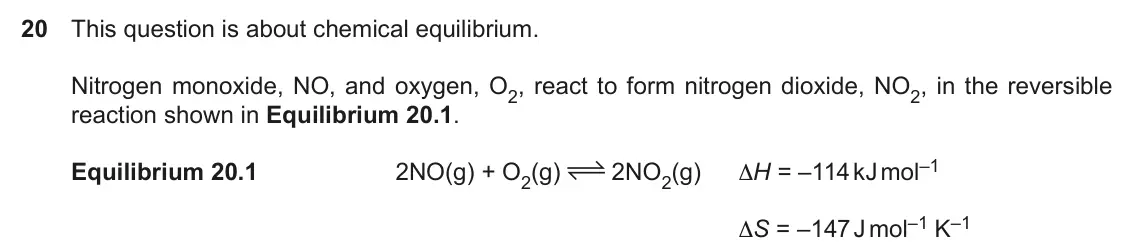
Q20(b)(ii)
The whole paper ↗Q17(c)
The whole paper ↗
Q17(d)
The whole paper ↗Q5(c)
The whole paper ↗
Q19(a)(ii)
The whole paper ↗
Q5(b)
The whole paper ↗
Q18(a)
The whole paper ↗
Q18(b)(iii)
The whole paper ↗
All 16 questions on Free energy and feasibility, as a list
- June 2025, Paper 1, Q17(b) (3 marks): Carbon can also reduce Fe2O3(s) to iron as shown in Equilibrium 17.2. Fe2O3(s) + 3C(g) 3CO(g) + 2Fe(s) Equilibrium 17.2 ΔH = +491 kJ mol–1 ΔS = +543 J K–1 mol–1
- June 2024, Paper 1, Q16(a)(i) (4 marks): Give your answer to 3 significant figures. ∆G = kJ mol–1 [4]
- June 2024, Paper 1, Q16(a)(ii) (1 mark): The decomposition of hydrogen peroxide shown in Reaction 16.1 is feasible. Suggest why Reaction 16.1 does not take place at 25 °C despite being feasible. [1]
- June 2023, Paper 1, Q18(c)(ii) (5 marks): Reaction 2 is repeated: C2H5OH(g) C2H4(g) + H2O(g) Reaction 2 The Gibbs equation is shown below. ∆G = ∆H – T∆S The enthalpy change, ∆H, and the entropy change,
- June 2022, Paper 1, Q17(c)(ii) (3 marks): The free energy change, ∆G, of Reaction 17.2 is –2672 kJ mol–1 at 25 °C. Calculate the enthalpy change, ∆H, of Reaction 17.2, in kJ mol–1. ∆H = kJ mol–1 [3]
- June 2022, Paper 1, Q17(c)(iii) (2 marks): A student concludes that Reaction 17.2 is feasible at all temperatures. Explain whether the student is correct or not. [2]
- November 2021, Paper 1, Q11 (1 mark): The feasibility of a chemical reaction depends on the temperature and the signs of ΔH and ΔS. Which row has signs for ΔH and ΔS for a reaction that is feasible
- November 2021, Paper 1, Q20(b)(i) (2 marks): Show that the formation of NO2 in Equilibrium 20.1 is feasible at 25 °C. [2]
- November 2021, Paper 1, Q20(b)(ii) (1 mark): Determine the maximum temperature, in K, for feasibility. Give your answer to an appropriate number of significant figures. maximum temperature = K [1]
- November 2020, Paper 1, Q17(c) (5 marks): Standard entropy values are given below. Substance CO(g) H2(g) CH3OH(g) Sө/ J K−1 mol−1 198 131 238 A chemist proposed producing methanol at 525 K using equilib
- November 2020, Paper 1, Q17(d) (3 marks): At 298 K, the free energy change, ∆G, for the production of methanol in equilibrium 1 is −2.48 × 10⁴ J mol−1. ∆G is linked to Kp by the relationship: ∆G = −RT l
- November 2020, Paper 3, Q5(c) (4 marks): Plot a graph of ln Kp against 1 T using the axes provided on the opposite page. Use your graph and equation 5.1 to determine ∆H, in kJ mol−1, for this equilibri
- June 2019, Paper 1, Q19(a)(ii) (4 marks): Some standard entropy values are given below. Substance H2S(g) O2(g) SO2(g) H2O(l) Sө / J K−1 mol−1 206 205 248 70 Using calculations, explain whether Reaction
- June 2019, Paper 3, Q5(b) (4 marks): The standard enthalpy change of reaction, ∆rH o , and the standard free energy change, ∆G o , for converting anhydrous sodium thiosulfate to hydrated sodium thi
- June 2017, Paper 1, Q18(a) (4 marks): The Gibbs’ equation is shown below. ∆G = ∆H – T∆S A chemist investigates a reaction to determine how ∆G varies with T. The results are shown in Fig. 18.1. + ΔG
- June 2017, Paper 1, Q18(b)(iii) (3 marks): The forward reaction in equilibrium 18.1 is only feasible at high temperatures. • Show that the forward reaction is not feasible at 25 °C. • Calculate the minim
Questions, mark schemes and examiner’s reports are © OCR, from their published past papers. Plumi isn’t affiliated with any exam board. Want whole papers? OCR A-Level Chemistry A past papers, or our free OCR-style practice pack.
The Plumi iPad app also offers exam-style questions with AI feedback on your handwritten working.