 plumi
Dynamic equilibrium and le Chatelier's principle: OCR A‑Level Chemistry A questions
OCR A-Level Chemistry A past-paper questions on 3.2.3.1 Dynamic equilibrium and le Chatelier's principle, 2016–2025, with mark schemes and examiner’s reports where available.
Paper
All papers
Exam
All years
Calculations
Q3(a)
The whole paper ↗
- Your answer
Q23(a)
The whole paper ↗
- Your answer
Q23(a)(i)
The whole paper ↗
Q23(a)(ii)
The whole paper ↗- Your answer
Q24(a)
The whole paper ↗
Q24(b)
The whole paper ↗Q24(c)(ii)
The whole paper ↗Q4(a)
The whole paper ↗
Q4(b)(ii)
The whole paper ↗- Your answer
- Your answer
Q20(a)
The whole paper ↗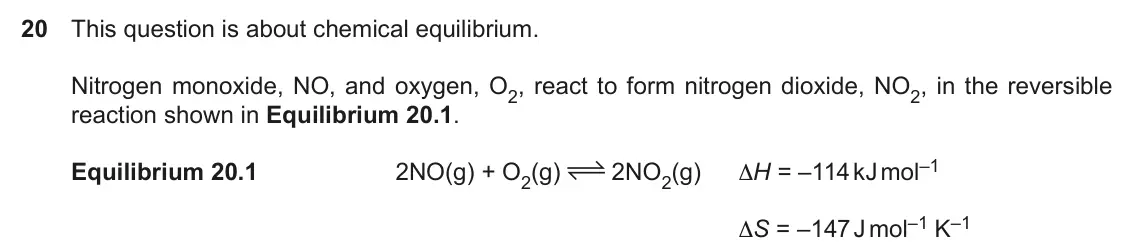
- Your answer
Q22(b)
The whole paper ↗
- Your answer
Q17(a)
The whole paper ↗
- Your answer
All 29 questions on Dynamic equilibrium and le Chatelier's principle, as a list
- June 2025, Paper 3, Q3(a) (5 marks): Methanol, CH3OH, can be made industrially by the reaction of carbon monoxide, CO, with hydrogen, H2, in the presence of a catalyst. This is a reversible reactio
- June 2025, AS Paper 1, Q12 (1 mark): Hydrogen and iodine react in the reaction below. H2(g) + I2(g) 2HI(g) Which row is correct when pressure is increased? Rate of reaction Equilibrium yield of HI
- June 2025, AS Paper 1, Q23(a) (2 marks): State two features of a dynamic equilibrium. 1 2 [2]
- June 2024, Paper 1, Q11 (1 mark): The reversible reaction between hydrogen and iodine to form hydrogen iodide is H2(g) + I2(g) 2HI(g) The graph shows how the concentrations of the reactants and
- June 2024, AS Paper 1, Q23(a)(i) (2 marks): This is an example of a dynamic equilibrium. State 2 features of a dynamic equilibrium. 1 2 [2]
- June 2024, AS Paper 1, Q23(a)(ii) (3 marks): State and explain the conditions of temperature and pressure that would produce a large equilibrium yield of NH3. [3]
- June 2023, Paper 1, Q15 (1 mark): Chlorine trifluoride can be decomposed into its elements forming the equilibrium mixture below. ∆H = +318 kJ mol–1 2Cl F3(g) Cl 2(g) + 3F2(g) colourless green y
- June 2023, AS Paper 1, Q24(a) (1 mark): Why is Equilibrium 24.1 a homogeneous equilibrium? [1]
- June 2023, AS Paper 1, Q24(b) (5 marks): Le Chatelier’s principle can be used to predict how different conditions affect the equilibrium position in Equilibrium 24.1. Explain how changing pressure, tem
- June 2023, AS Paper 1, Q24(c)(ii) (1 mark): In the industrial production of SO3, an excess of O2(g) is used rather than a 2:1 proportion of SO2(g) to O2(g) which would match the stochiometry in Equilibriu
- June 2022, Paper 3, Q4(a) (4 marks): The students are supplied with the equilibrium mixture in Equilibrium 4.1 at room temperature. One student heats 20 cm3 of the mixture to 50 °C. • The other stu
- June 2022, Paper 3, Q4(b)(ii) (3 marks): Explain the changes in concentration of CoCl 4 Refer to Equilibrium 4.1 in your answer. [3]
- June 2022, AS Paper 1, Q12 (1 mark): Which prediction can be made using le Chatelier’s principle? A The effect of a catalyst on the reaction rate. B The effect of a catalyst on the equilibrium posi
- November 2021, Paper 1, Q9 (1 mark): An equilibrium system is shown below. CO(g) + NO2(g) CO2(g) + NO(g) Different amounts of CO, NO2, CO2 and NO are added to four containers, as shown below. Conta
- November 2021, Paper 1, Q20(a) (1 mark): A dynamic equilibrium exists in a closed system. State one other feature of a dynamic equilibrium. [1]
- November 2021, AS Paper 1, Q12 (1 mark): Which statement about dynamic equilibrium is not correct? A A catalyst increases the rate of both forward and reverse reactions by the same amount. B Dynamic eq
- November 2021, AS Paper 1, Q22(b) (4 marks): Explain how le Chatelier’s principle can be used to predict the conditions of pressure and temperature for a maximum equilibrium yield of hydrogen in Equilibriu
- November 2020, Paper 1, Q13 (1 mark): Which statement(s) is/are correct when a catalyst is added to a system in dynamic equilibrium? 1 The rates of the forward and reverse reactions increase by the
- November 2020, Paper 1, Q17(a) (3 marks): Predict the conditions of pressure and temperature that would give the maximum equilibrium yield of CH3OH in equilibrium 1. Explain your answer. [3]
- November 2020, AS Paper 1, Q12 (1 mark): Hydrogen gas can be produced as shown below. CO(g) + 3H2(g) ∆H = +206 kJ mol−1 CH4(g) + H2O(g) Which conditions produce the greatest equilibrium yield of hydrog
- November 2020, AS Paper 2, Q4(b)(iv) (2 marks): The temperature of the equilibrium mixture is increased above 400 °C while keeping the pressure constant. State and explain the effect on the equilibrium concen
- June 2019, AS Paper 1, Q13 (1 mark): A catalyst is added to a system in equilibrium. What is the effect on the rates of the forward and reverse reactions? A There is no effect on the rate in either
- June 2019, AS Paper 1, Q24(a)(i) (4 marks): Explain how le Chatelier’s principle can be used to predict the conditions of temperature and pressure for a maximum equilibrium yield of ammonia. [4]
- June 2018, Paper 3, Q2(c)(ii) (2 marks): Explain the observations and predict whether the formation of the blue colour is exothermic or endothermic. [2]
- June 2018, AS Paper 1, Q13 (1 mark): The reversible reaction below is at equilibrium. 2SO3(g) ∆H = −197 kJ mol−1 2SO2(g) + O2(g) Which changes in pressure and temperature would shift the equilibriu
- June 2018, AS Paper 2, Q4(c) (5 marks): Predict the conditions of temperature and pressure for a maximum equilibrium yield of nitrogen monoxide in equilibrium 4.1. • Explain your prediction in terms o
- June 2017, Paper 1, Q20(a) (4 marks): Hydrogen gas is manufactured by the chemical industry using the reaction of methane and steam. This is a reversible reaction, shown in equilibrium 20.1 below. 3
- June 2017, AS Paper 1, Q13 (1 mark): The reversible reaction below is allowed to reach equilibrium. ΔH = –9.4 kJ mol–1 H2(g) + I2(g) 2HI(g) Which change in conditions would be expected to shift the
- June 2016, AS Paper 1, Q25(a) (5 marks): Le Chatelier’s principle can be used to predict how different conditions affect the equilibrium position. • Using le Chatelier’s principle, show that a low temp
Questions, mark schemes and examiner’s reports are © OCR, from their published past papers. Plumi isn’t affiliated with any exam board. Want whole papers? OCR A-Level Chemistry A past papers, or our free OCR-style practice pack.
The Plumi iPad app also offers exam-style questions with AI feedback on your handwritten working.