 plumi
Intermolecular forces and hydrogen bonding: OCR A‑Level Chemistry A questions
OCR A-Level Chemistry A past-paper questions on 2.2.2.5 Intermolecular forces and hydrogen bonding, 2016–2025, with mark schemes and examiner’s reports where available.
Paper
All papers
Exam
All years
Calculations
- Your answer
- Your answer
Q1(b)(i)
The whole paper ↗
Q1(b)(iii)
The whole paper ↗Q1(c)(i)
The whole paper ↗- Your answer
Q1(a)
The whole paper ↗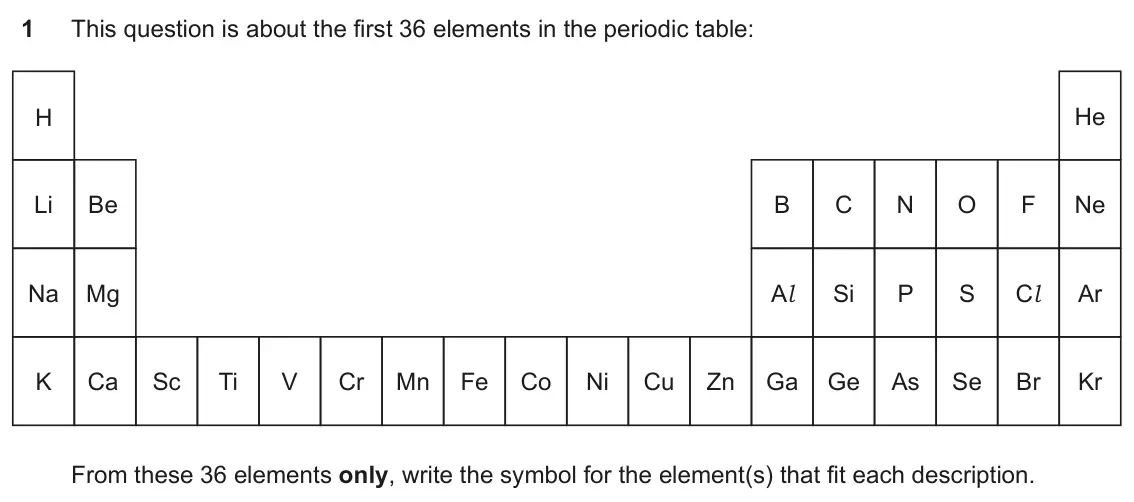
Q1(a)(i)
The whole paper ↗
Q17(b)(ii)
The whole paper ↗
Q1(c)
The whole paper ↗
- Your answer
Q1(b)(i)
The whole paper ↗
- Your answer
Q3(c)(ii)
The whole paper ↗
Q3(d)(ii)
The whole paper ↗
Q16(c)(i)
The whole paper ↗
Q16(c)(ii)
The whole paper ↗Q1(a)
The whole paper ↗
Q4(a)
The whole paper ↗
All 19 questions on Intermolecular forces and hydrogen bonding, as a list
- June 2025, Paper 1, Q7 (1 mark): The table below shows the boiling points of some hydrogen halides. Hydrogen halide Boiling point / K HCl 188 HBr 206 238 HI What is the best explanation for the
- June 2024, Paper 1, Q2 (1 mark): Water has the anomalous properties below. • Water has relatively high melting and boiling points. • Ice is less dense than water. Which statement explains these
- June 2024, AS Paper 2, Q1(b)(i) (2 marks): Complete the diagram below to show hydrogen bonding between the H2O molecule shown and another H2O molecule. Include relevant dipoles and lone pairs. Label the
- June 2024, AS Paper 2, Q1(b)(iii) (1 mark): One unusual property of H2O is that ice floats on water. Explain why ice has a lower density than water. [1]
- June 2024, AS Paper 2, Q1(c)(i) (2 marks): Suggest why solid ammonia has a lower melting point than ice. [2]
- June 2023, Paper 1, Q13 (1 mark): Which substance(s) has/have induced dipole–dipole interactions (London forces) in the solid state? 1 C2H6 2 H2O 3 Si A 1, 2 and 3 B Only 1 and 2 C Only 2 and 3
- June 2023, Paper 3, Q1(a) (1 mark): The three elements that, when in a molecule, can form hydrogen bonds with other suitable molecules. [1]
- June 2022, Paper 3, Q1(a)(i) (2 marks): The boiling point of NH3 is –33 °C. The boiling point of NH4NO3 is 210 °C. Explain why there is a large difference in boiling points. [2]
- November 2021, Paper 2, Q17(b)(ii) (2 marks): The boiling point of the lubricating oil can be increased by increasing the number of repeat units. Explain this statement. [2]
- November 2021, Paper 3, Q1(c) (3 marks): The electronegativities of H, C, N and F, and the boiling points of methane, ammonia and hydrogen fluoride are shown below. Electronegativity H: 2.1 C: 2.5 N: 3
- November 2021, AS Paper 1, Q1 (1 mark): Which compound has the highest boiling point? A ethanol B heptane C sodium chloride D water Your answer [1]
- November 2020, Paper 3, Q1(b)(i) (4 marks): The table shows the structures and boiling points of three amines, which are structural isomers of C3H9N. Amine CH3CH2CH2NH2 (CH3)2CHNH2 (CH3)3N NH2 Skeletal fo
- November 2020, AS Paper 1, Q3 (1 mark): Which statement explains why ice is less dense than water? A Hydrogen bonds are stronger in ice than in water. B Hydrogen bonds hold H2O molecules apart in ice.
- November 2020, AS Paper 2, Q3(c)(ii) (3 marks): The boiling points of H2O and H2Se are shown below. Compound Boiling point /°C H2O 100 H2Se –41 Explain why H2O has a higher boiling point than H2Se. [3]
- June 2018, AS Paper 2, Q3(d)(ii) (1 mark): Suggest whether the enthalpy change of vaporisation of bromine is exothermic or endothermic. Explain your answer. [1]
- June 2017, Paper 1, Q16(c)(i) (2 marks): Explain why the boiling point of PH3 is lower than the boiling point of NH3. [2]
- June 2017, Paper 1, Q16(c)(ii) (2 marks): Explain why the boiling point of PH3 is lower than the boiling point of AsH3. [2]
- June 2017, Paper 3, Q1(a) (3 marks): The H–O–H bond angle in ice is about 109° but about 105° in gaseous H2O. Explain why there is this difference. [3]
- June 2017, AS Paper 2, Q4(a) (2 marks): Methanol, CH3OH, is soluble in water because it has polar bonds. Pauling electronegativity values for carbon, oxygen and hydrogen are shown below. Element Elect
Questions, mark schemes and examiner’s reports are © OCR, from their published past papers. Plumi isn’t affiliated with any exam board. Want whole papers? OCR A-Level Chemistry A past papers, or our free OCR-style practice pack.
The Plumi iPad app also offers exam-style questions with AI feedback on your handwritten working.