 plumi
Ligand substitution and haemoglobin: OCR A‑Level Chemistry A questions
OCR A-Level Chemistry A past-paper questions on 5.3.1.4 Ligand substitution and haemoglobin, 2016–2025, with mark schemes and examiner’s reports where available.
Paper
All papers
Exam
All years
Calculations
Q22(b)(i)
The whole paper ↗
Q22(c)
The whole paper ↗Q22(b)(ii)
The whole paper ↗
Q4(c)(i)
The whole paper ↗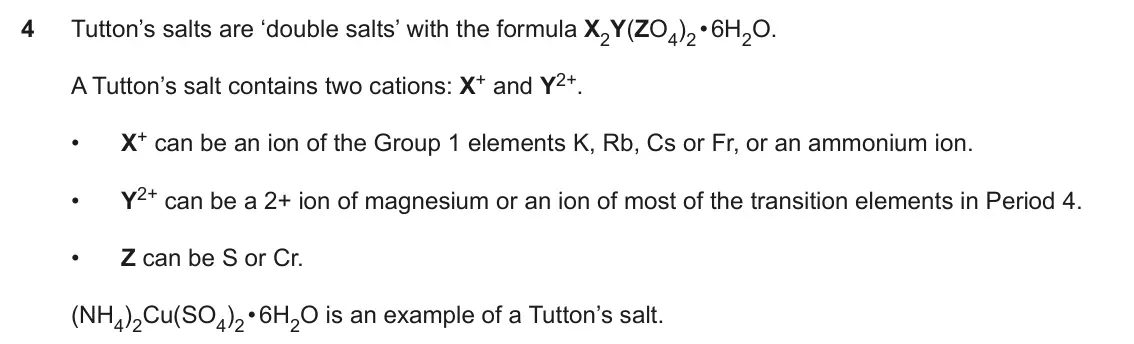
Q22(c)
The whole paper ↗
Q17(b)(ii)
The whole paper ↗
Q17(b)
The whole paper ↗
Q18(a)(i)
The whole paper ↗
Q21(d)
The whole paper ↗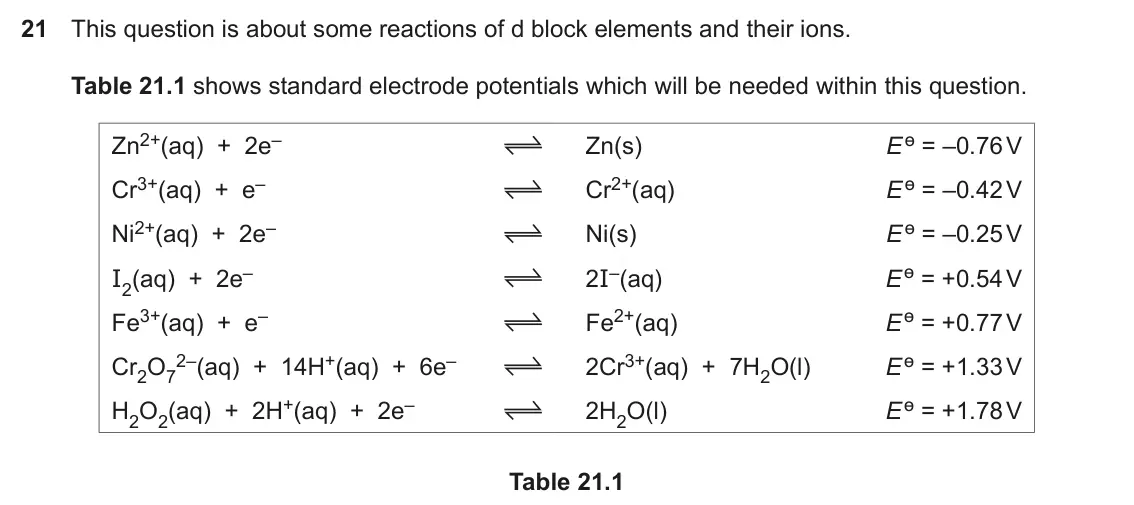
Q2(c)(i)
The whole paper ↗
Q2(c)(ii)
The whole paper ↗Q4(a)(ii)
The whole paper ↗
Q23(a)(i)
The whole paper ↗
Q23(a)(ii)
The whole paper ↗
All 15 questions on Ligand substitution and haemoglobin, as a list
- June 2024, Paper 1, Q22(b)(i) (3 marks): Suggest the formulae of A, B and C. Complex ion A: Solid B: Complex ion C: [3]
- June 2024, Paper 1, Q22(c) (5 marks): Red blood cells contain haemoglobin which transports oxygen around the body. For efficient transportation of oxygen, healthy human blood must be maintained at a
- June 2023, Paper 1, Q22(b)(ii) (2 marks): Describe ligand substitution reactions using either copper or chromium ions as examples. Include equations. [2]
- June 2023, Paper 3, Q4(c)(i) (1 mark): The student adds an excess of aqueous ammonia to their aqueous solution of Tutton’s salt. A deep blue solution forms. The complex ion responsible for the deep b
- June 2022, Paper 1, Q22(c) (6 marks): This question is about reactions of transition metal compounds. (c)* This question is about copper and copper compounds. Experiment 1 Hydrochloric acid, HCl (aq
- November 2021, Paper 1, Q17(b)(ii) (6 marks): This question is about d-block elements. (ii)* Determine the formulae of A and B. Write the ionic equation for the ligand substitution and show 3D structures fo
- November 2020, Paper 3, Q2 (6 marks): 2* Transition metal ions can bond to ligands to form complex ions with different shapes. Explain what is meant by the terms ligand, coordination number and liga
- June 2019, Paper 1, Q17(b) (3 marks): Red blood cells contain haemoglobin. Explain using ligand substitutions: • how haemoglobin transports oxygen around the body • why carbon monoxide is toxic. [3]
- June 2019, Paper 1, Q18(a)(i) (1 mark): What is the formula of the complex ion in the purple solution that forms in Experiment 1? [1]
- June 2018, Paper 1, Q21(d) (6 marks): This question is about some reactions of d block elements and their ions. Table 21.1 shows standard electrode potentials which will be needed within this questi
- June 2018, Paper 3, Q2(c)(i) (1 mark): Write the equilibrium equation for the reaction that takes place when the colour of the solution changes. [1]
- June 2018, Paper 3, Q2(c)(ii) (2 marks): Explain the observations and predict whether the formation of the blue colour is exothermic or endothermic. [2]
- June 2018, Paper 3, Q4(a)(ii) (2 marks): Cis-platin is prepared in a ligand substitution reaction which takes place in multiple steps. The equation for the final step forming cis-platin is shown below.
- June 2017, Paper 1, Q23(a)(i) (5 marks): In the boxes, write down the formulae of the species responsible for the observations. yellow solution Reaction 1 HCl(aq) NH3(aq) [Cu(H2O)6]2+ pale blue solutio
- June 2017, Paper 1, Q23(a)(ii) (2 marks): Name the type of reaction for Reaction 1 and Reaction 2. Reaction 1 Reaction 2 [2]
Questions, mark schemes and examiner’s reports are © OCR, from their published past papers. Plumi isn’t affiliated with any exam board. Want whole papers? OCR A-Level Chemistry A past papers, or our free OCR-style practice pack.
The Plumi iPad app also offers exam-style questions with AI feedback on your handwritten working.