 plumi
Aromatic chemistry: AQA A‑Level Chemistry questions
Every AQA A-Level Chemistry exam question on 3.3.10 Aromatic chemistry, 2016–2025, with its mark scheme and examiner’s report.
Find questions2,301
Calculations
Q05.1
The whole paper ↗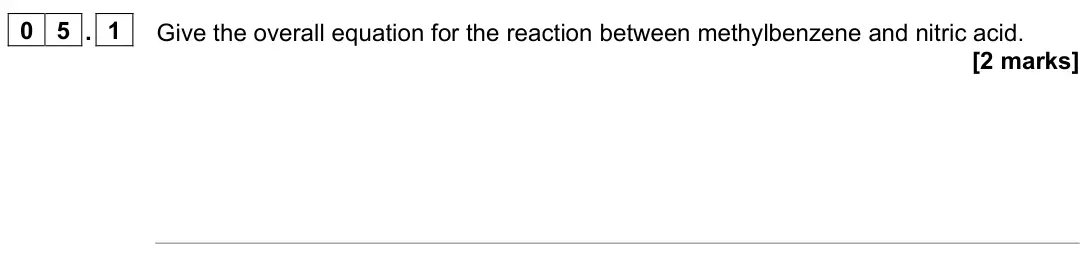
Q05.3
The whole paper ↗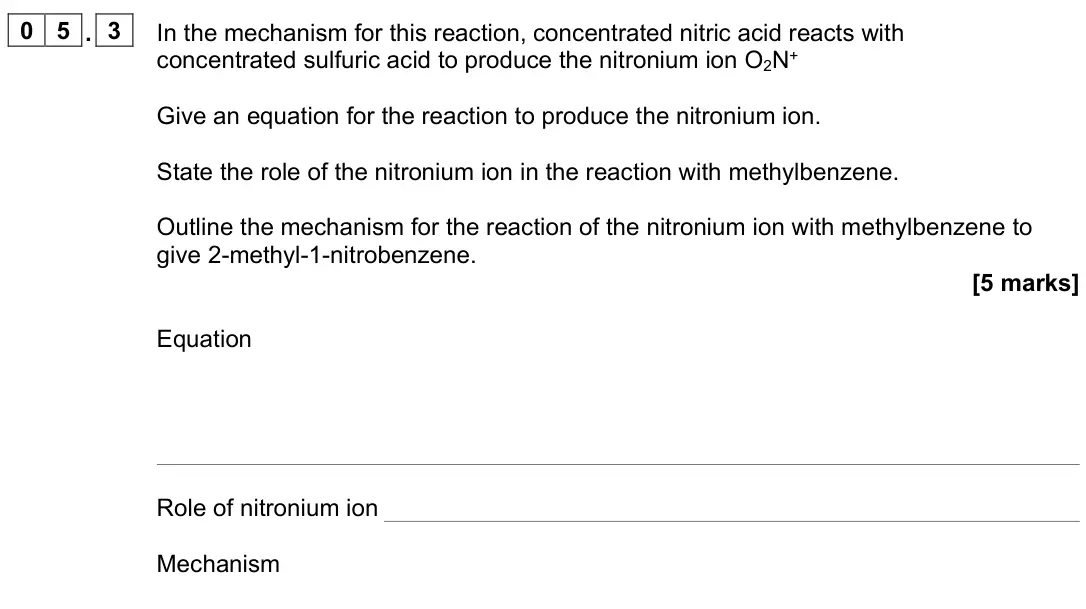
Q10.1
The whole paper ↗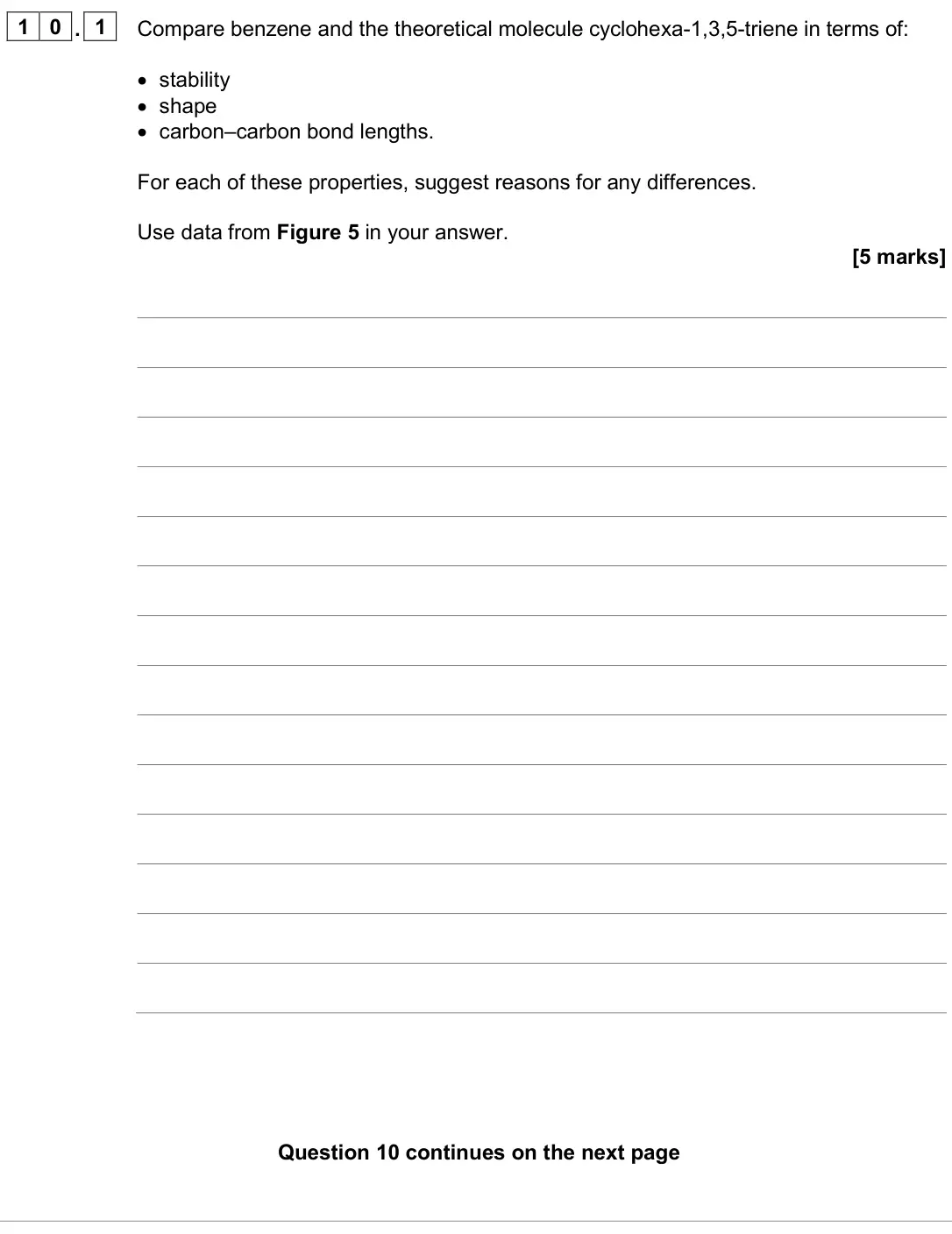
Q10.2
The whole paper ↗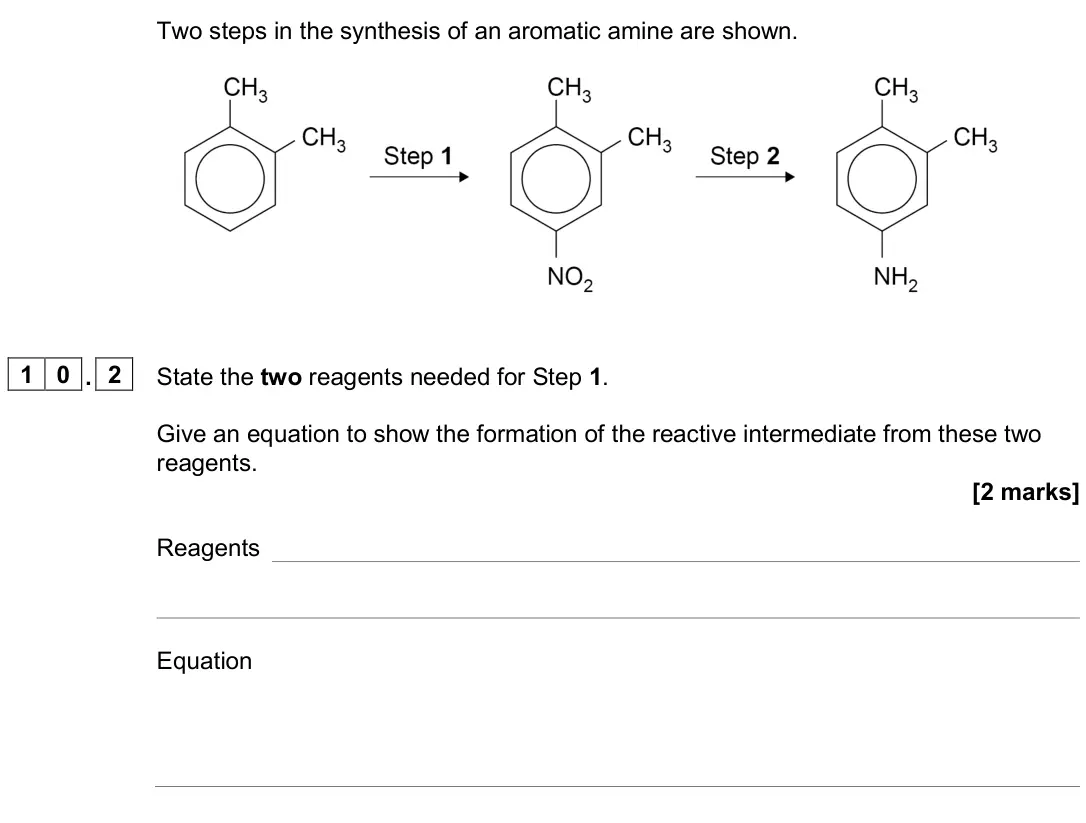
Q10.3
The whole paper ↗
Q03.2
The whole paper ↗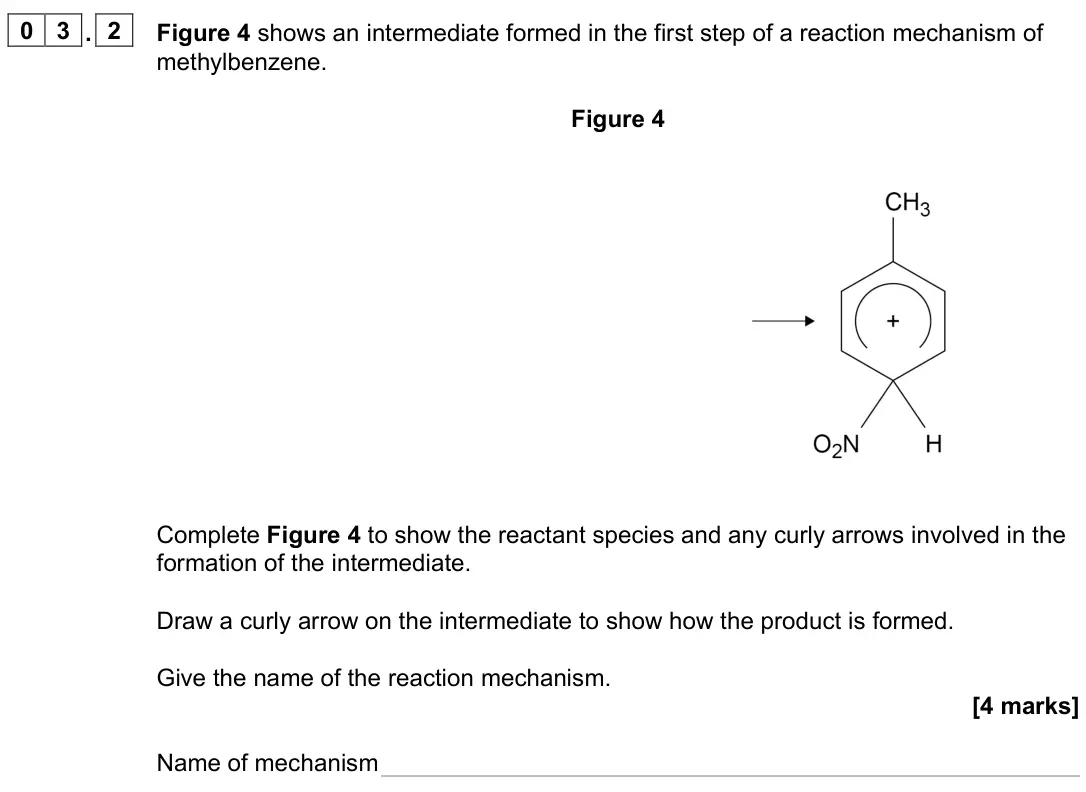
Q08.1
The whole paper ↗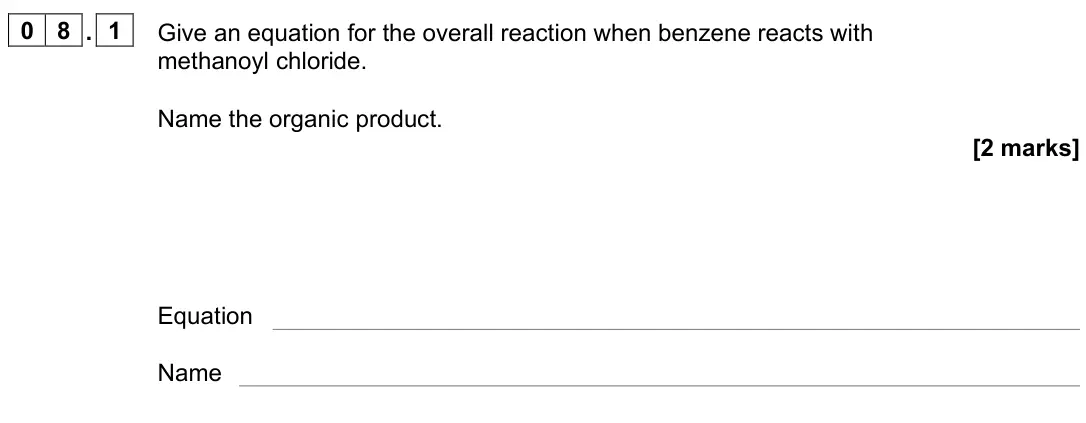
Q08.2
The whole paper ↗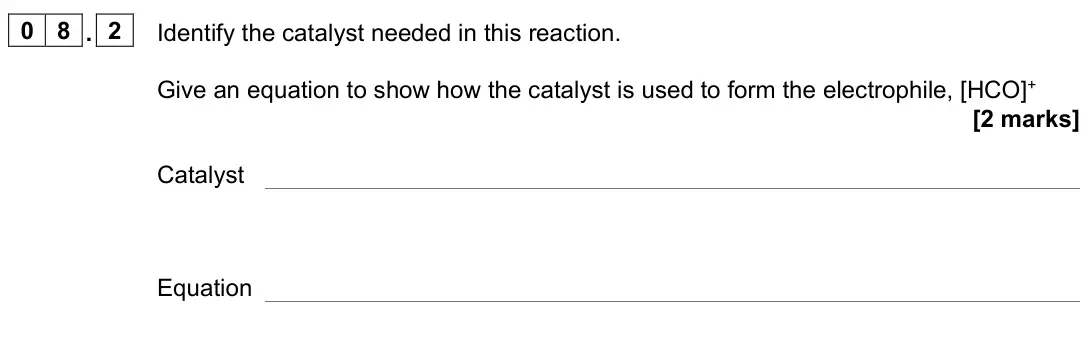
Q08.3
The whole paper ↗
Q10.1
The whole paper ↗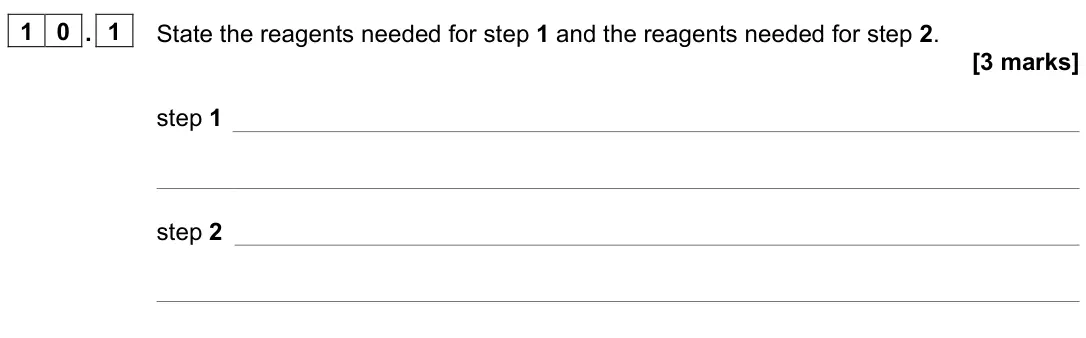
Q04.1
The whole paper ↗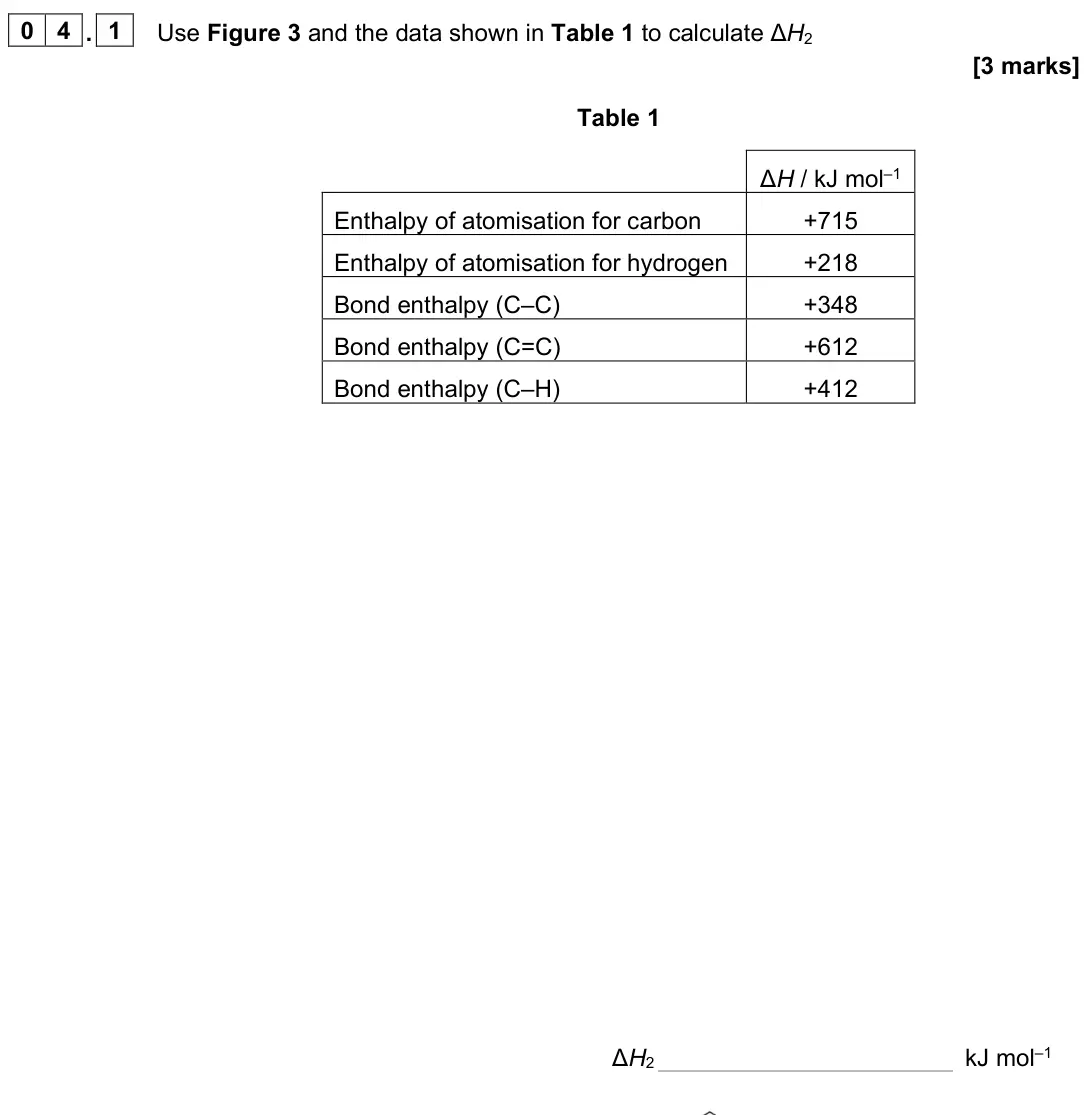
Q04.2
The whole paper ↗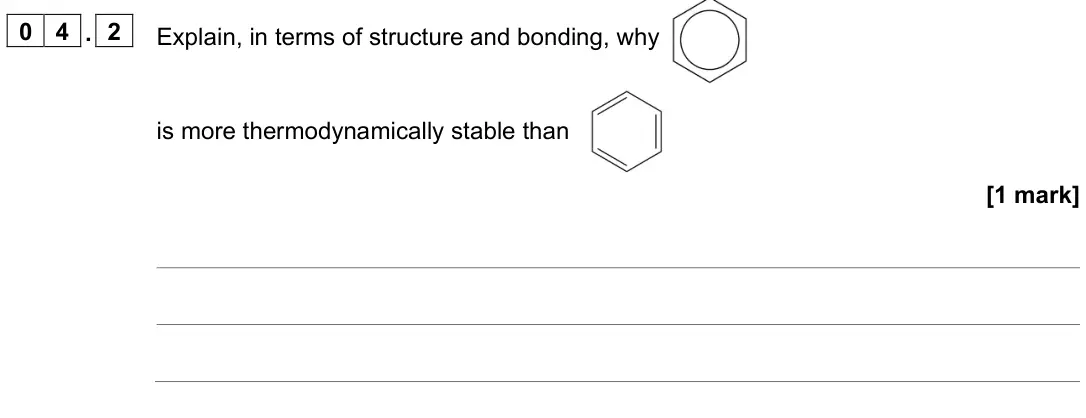
Q04.3
The whole paper ↗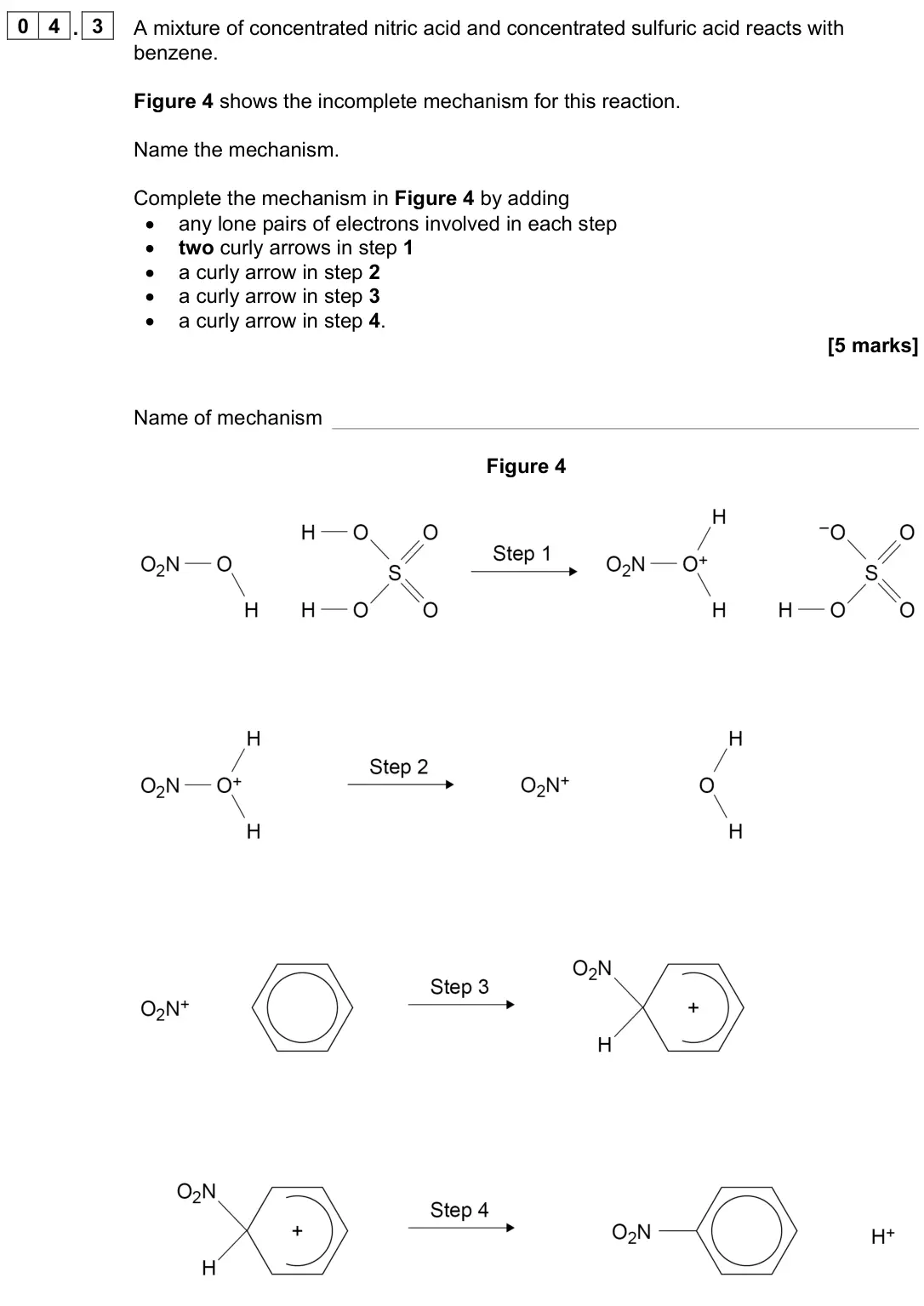
Q06.1
The whole paper ↗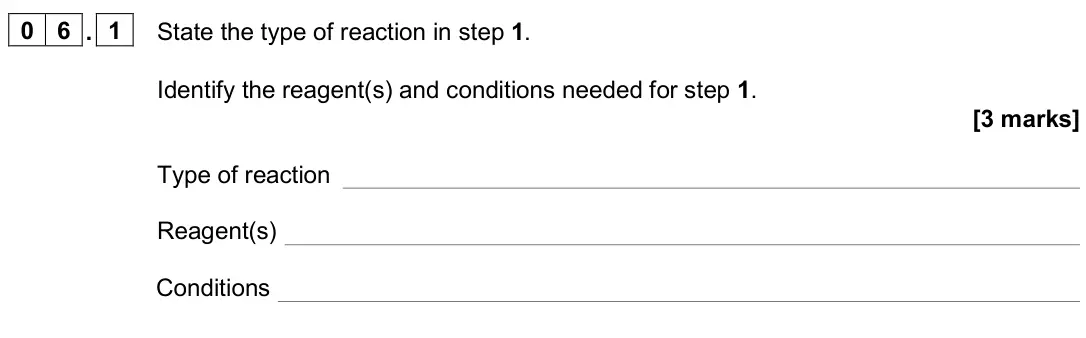

Q06.1
The whole paper ↗
Q06.2
The whole paper ↗
Q07.1
The whole paper ↗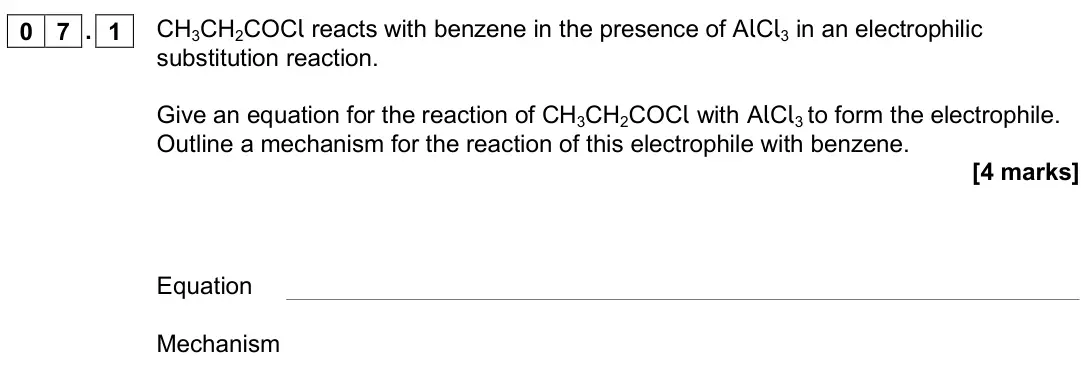
All 25 questions on Aromatic chemistry, as a list
- June 2025, Paper 2, Q05.1 (2 marks): Give the overall equation for the reaction between methylbenzene and nitric acid. [2 marks]
- June 2025, Paper 2, Q05.3 (5 marks): In the mechanism for this reaction, concentrated nitric acid reacts with concentrated sulfuric acid to produce the nitronium ion O2N+ Give an equation for the r
- June 2024, Paper 2, Q10.1 (5 marks): Compare benzene and the theoretical molecule cyclohexa-1,3,5-triene in terms of: • stability • shape • carbon–carbon bond lengths. For each of these properties,
- June 2024, Paper 2, Q10.2 (2 marks): State the two reagents needed for Step 1. Give an equation to show the formation of the reactive intermediate from these two reagents. [2 marks] Reagents Equati
- June 2024, Paper 2, Q10.3 (3 marks): Outline a mechanism for Step 1. [3 marks]
- June 2023, Paper 2, Q03.2 (4 marks): Figure 4 shows an intermediate formed in the first step of a reaction mechanism of methylbenzene. Figure 4 Complete Figure 4 to show the reactant species and an
- June 2022, Paper 2, Q08.1 (2 marks): Give an equation for the overall reaction when benzene reacts with methanoyl chloride. Name the organic product. [2 marks] Equation Name
- June 2022, Paper 2, Q08.2 (2 marks): Identify the catalyst needed in this reaction. Give an equation to show how the catalyst is used to form the electrophile, [HCO]+ [2 marks] Catalyst Equation
- June 2022, Paper 2, Q08.3 (3 marks): Outline the mechanism for the reaction of benzene with the electrophile, [HCO]+ [3 marks]
- June 2022, Paper 2, Q10.1 (3 marks): State the reagents needed for step 1 and the reagents needed for step 2. [3 marks] step 1 step 2
- November 2021, Paper 2, Q04.1 (3 marks): Use Figure 3 and the data shown in Table 1 to calculate ΔH2 [3 marks] Table 1 ΔH / kJ mol–1 Enthalpy of atomisation for carbon +715 Enthalpy of atomisation for
- November 2021, Paper 2, Q04.2 (1 mark): is more thermodynamically stable than [1 mark]
- November 2021, Paper 2, Q04.3 (5 marks): A mixture of concentrated nitric acid and concentrated sulfuric acid reacts with benzene. Figure 4 shows the incomplete mechanism for this reaction. Name the me
- November 2020, Paper 2, Q06.1 (3 marks): State the type of reaction in step 1. Identify the reagent(s) and conditions needed for step 1. [3 marks] Type of reaction Reagent(s) Conditions
- June 2019, Paper 2, Q08.1 (1 mark): Name the mechanism of the reaction in Step 1. [1 mark]
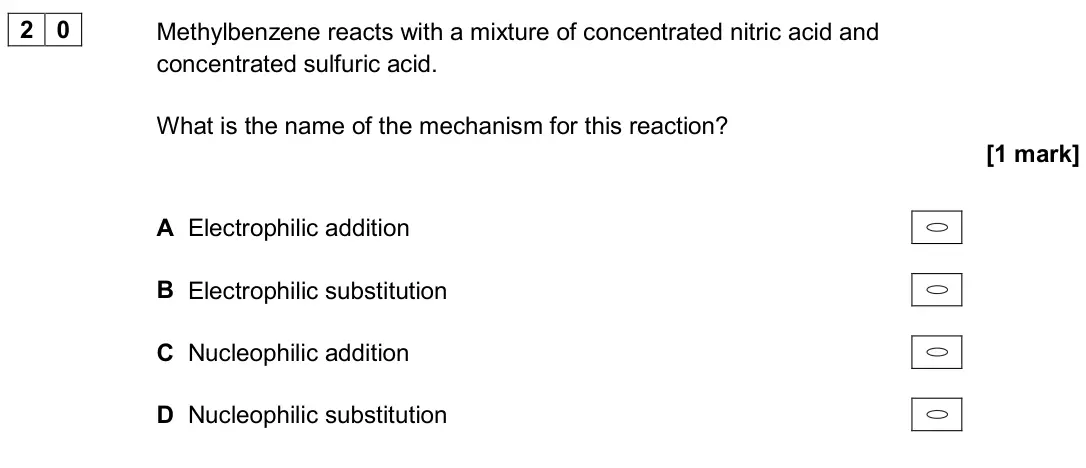
- June 2019, Paper 3, Q20 (1 mark): Methylbenzene reacts with a mixture of concentrated nitric acid and concentrated sulfuric acid. What is the name of the mechanism for this reaction? [1 mark] A
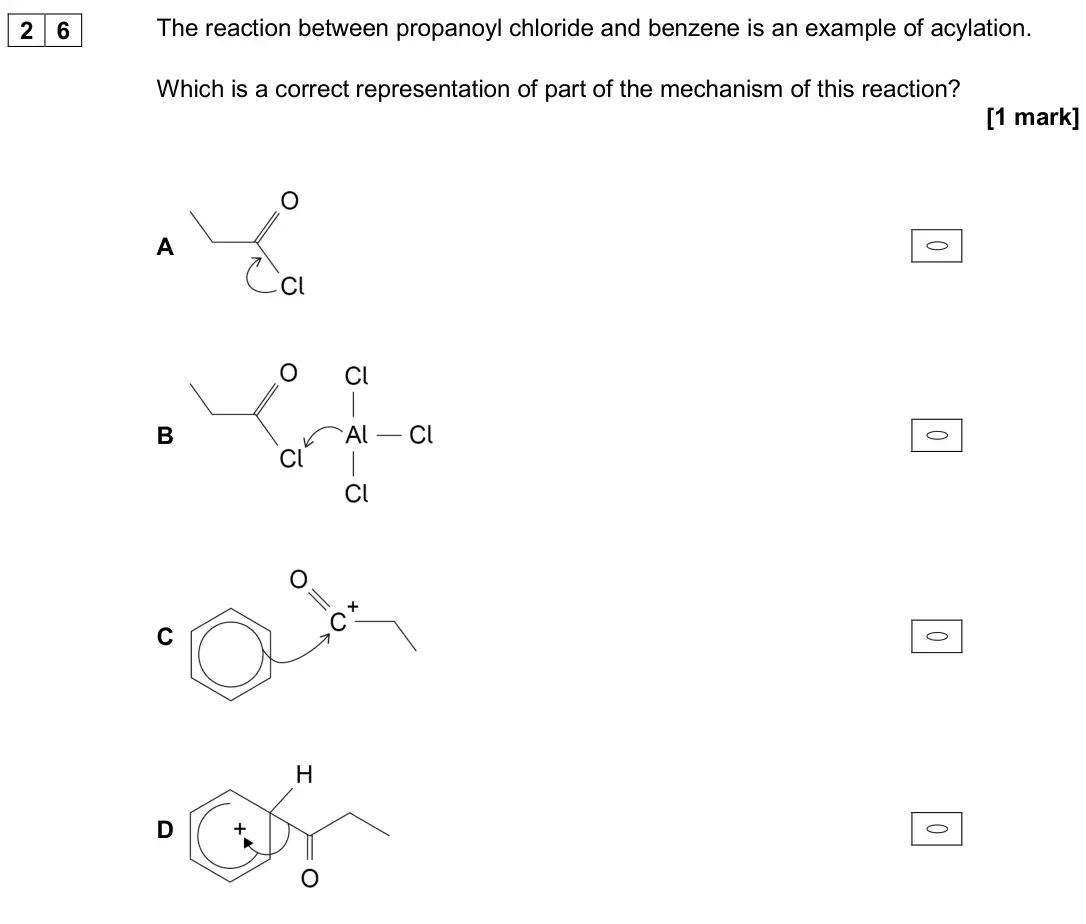
- June 2019, Paper 3, Q26 (1 mark): The reaction between propanoyl chloride and benzene is an example of acylation. Which is a correct representation of part of the mechanism of this reaction? [1
- June 2018, Paper 2, Q06.1 (6 marks): Explain the bonding in and the shape of a benzene molecule. Compare the stability of benzene with that of the hypothetical cyclohexa-1,3,5-triene molecule. Use
- June 2018, Paper 2, Q06.2 (3 marks): The enthalpy of hydrogenation of cyclohexa-1,3-diene is not exactly double that of cyclohexene. Suggest a value for the enthalpy of hydrogenation of cyclohexa-1
- June 2018, Paper 2, Q07.1 (4 marks): CH3CH2COCl reacts with benzene in the presence of AlCl3 in an electrophilic substitution reaction. Give an equation for the reaction of CH3CH2COCl with AlCl3 to
- June 2018, Paper 3, Q23 (1 mark): The nitration of benzene uses a nitrating mixture of concentrated nitric acid and concentrated sulfuric acid. HNO3 + 2H2SO4 NO2 + + H3O+ + 2HSO4 – Which state
- June 2017, Paper 2, Q08.1 (1 mark): Nitrobenzene reacts when heated with a mixture of concentrated nitric acid an concentrated sulfuric acid to form a mixture of three isomeric dinitrobenzenes. Wr
- June 2017, Paper 2, Q08.2 (4 marks): Name and outline a mechanism for the reaction of this species with nitrobenzene to form 1,3-dinitrobenzene. [4 marks Name of mechanism Mechanism
- Specimen, Paper 2, Q09.5 (1 mark): A reagent for step 2 is a mixture of concentrated nitric acid and concentrated sulfuric acid, which react together to form a reactive intermediate. Write an equ
- Specimen, Paper 2, Q09.6 (1 mark): Name a mechanism for the reaction in step 2. [1 mark] 0 9 . 6
Questions, mark schemes and examiner’s reports are © AQA, from their published past papers. Plumi isn’t affiliated with any exam board. Want whole papers? Every AQA A-Level Chemistry paper.
Rather write your answers by hand on iPad? Plumi marks them against the same mark schemes.