 plumi
Organic synthesis: AQA A‑Level Chemistry questions
Every AQA A-Level Chemistry exam question on 3.3.14 Organic synthesis, 2016–2025, with its mark scheme and examiner’s report.
Find questions2,301
Calculations
Q04.1
The whole paper ↗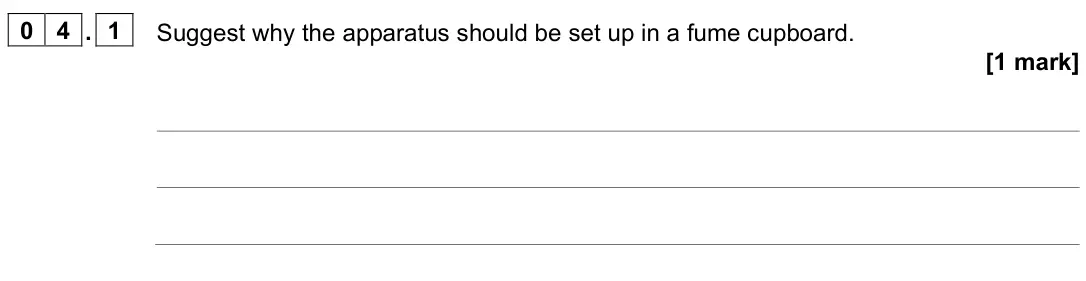
Q04.3
The whole paper ↗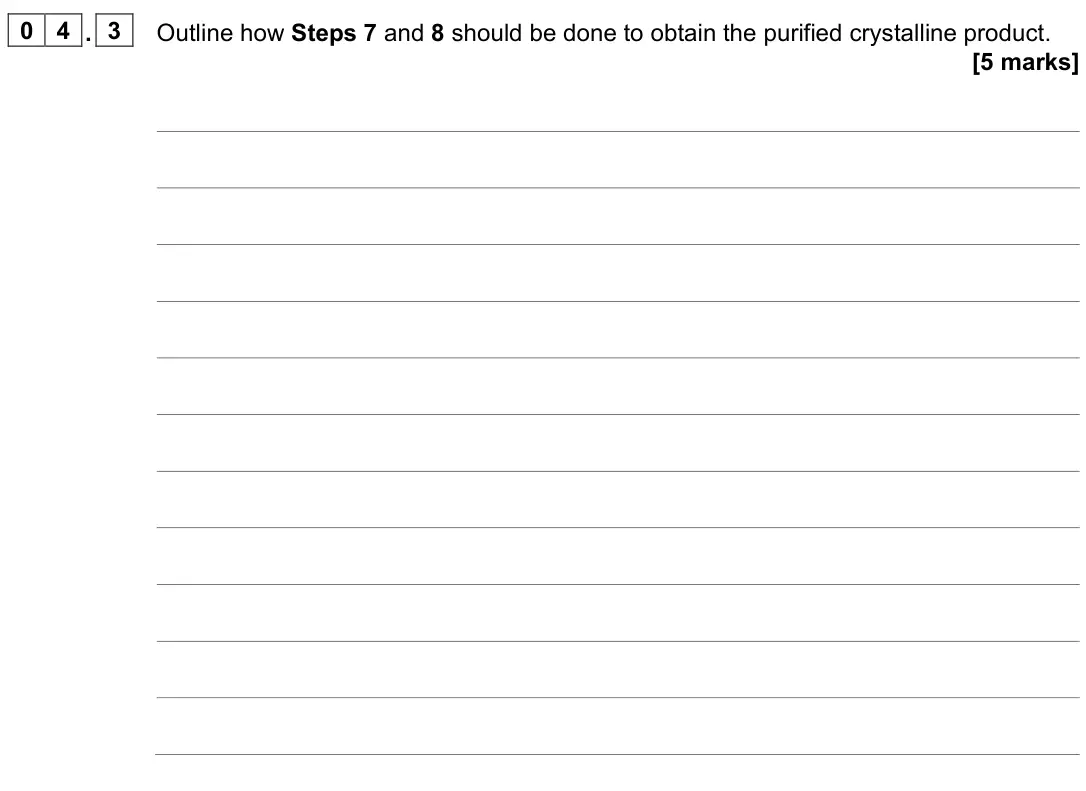
Q04.4
The whole paper ↗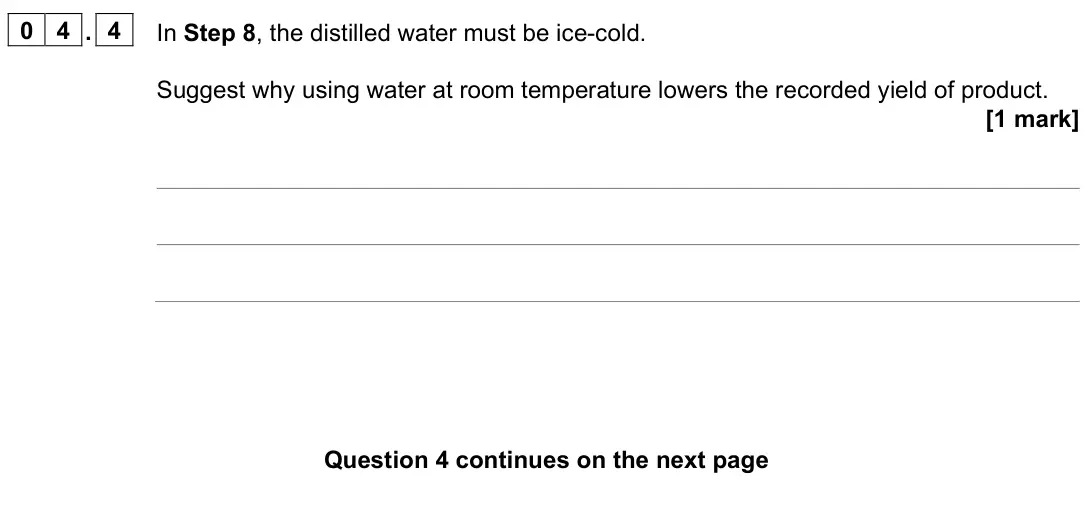
Q04.5
The whole paper ↗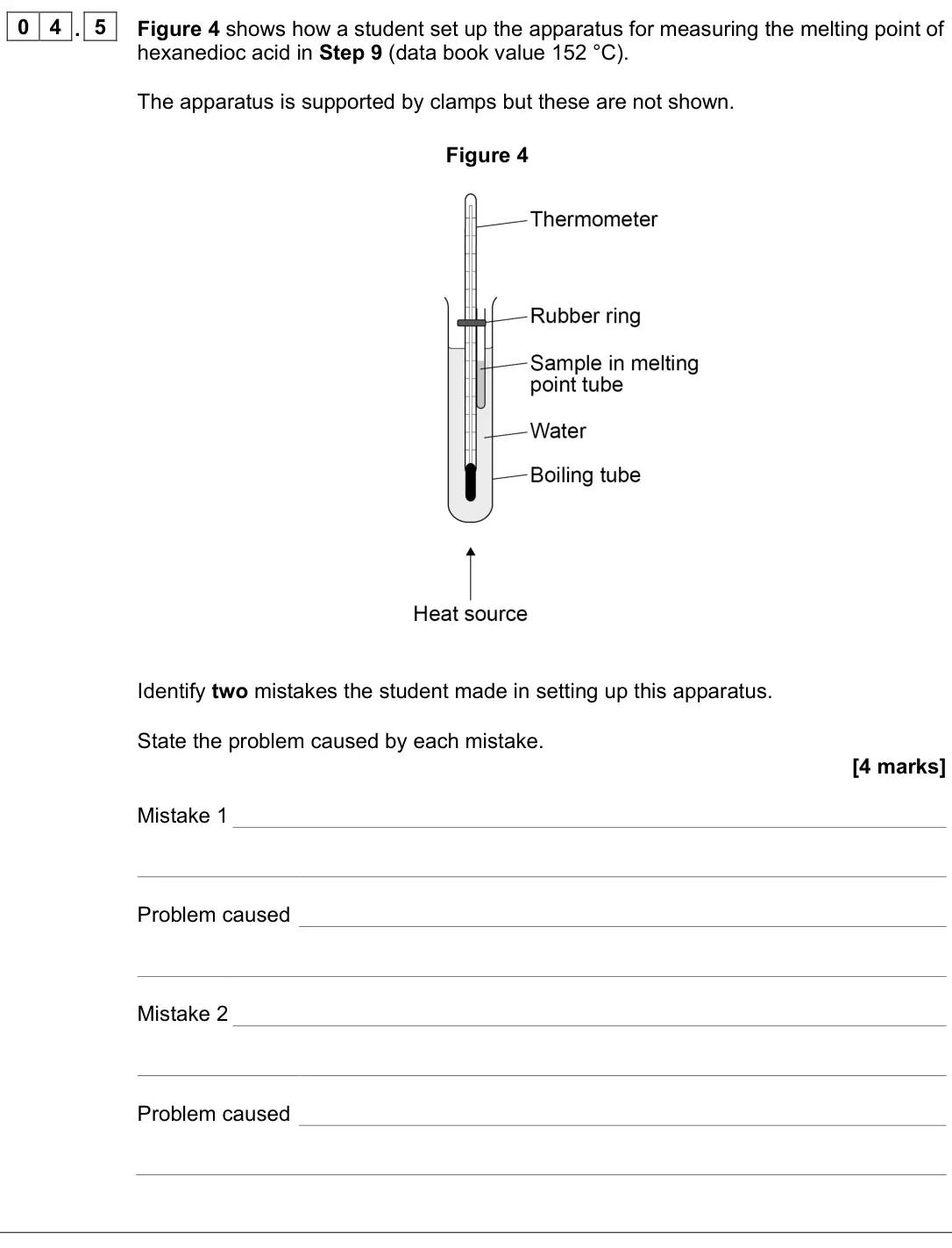
Q04.6
The whole paper ↗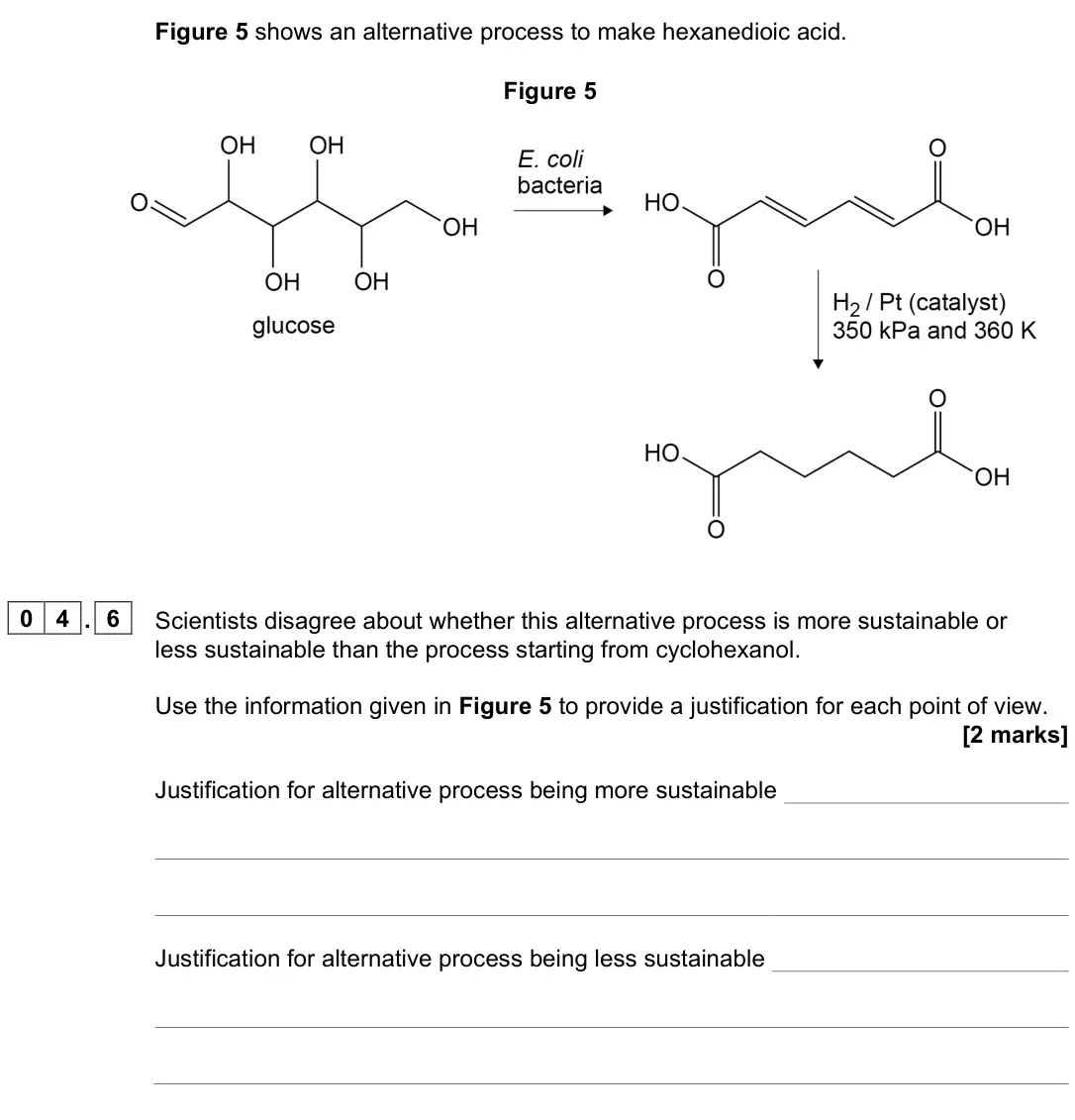
Q01.6
The whole paper ↗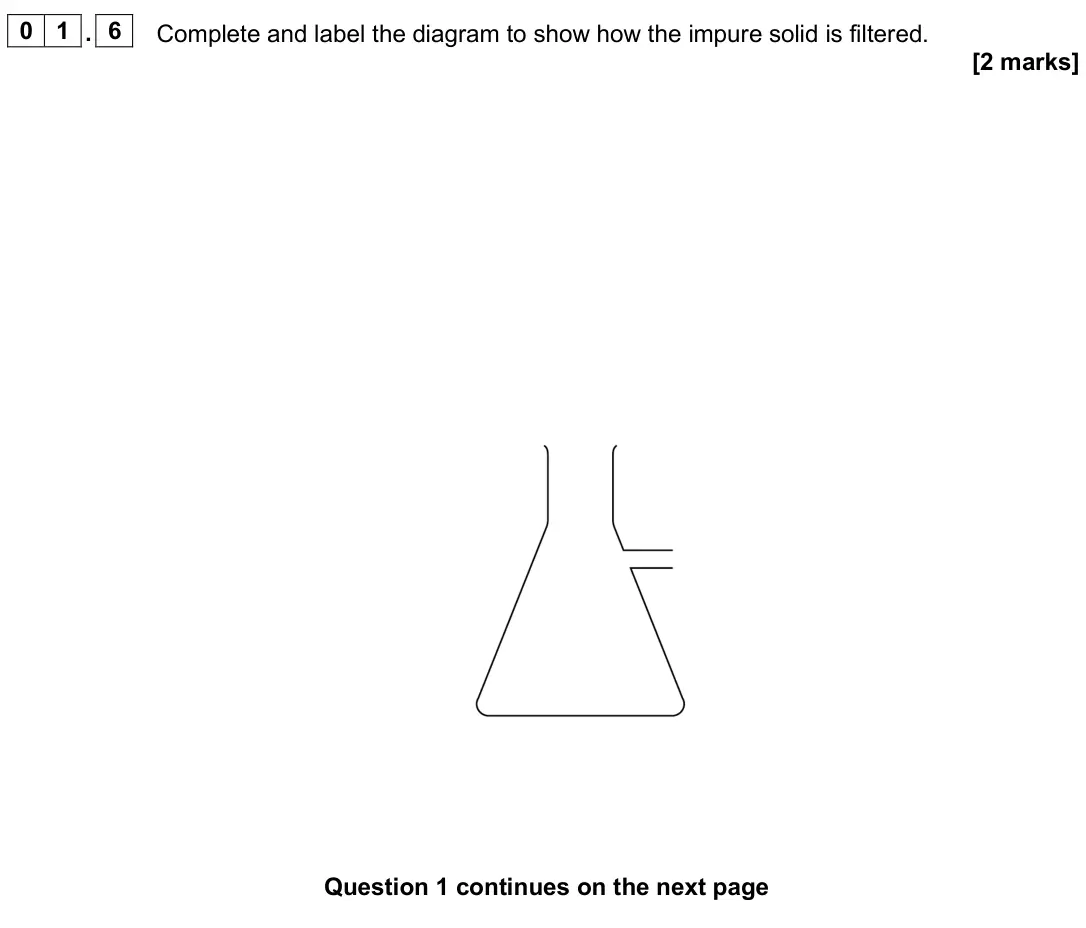
Q01.7
The whole paper ↗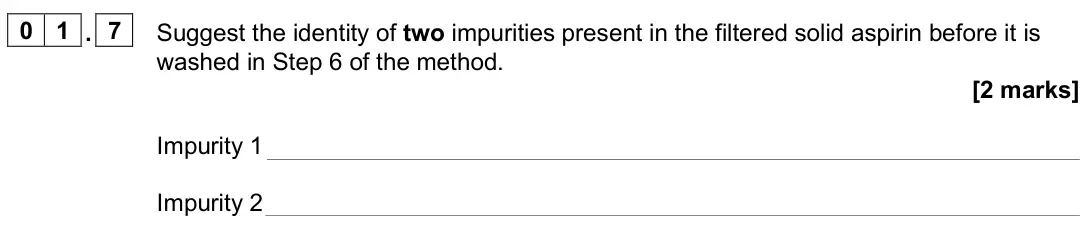
Q01.8
The whole paper ↗
Q01.9
The whole paper ↗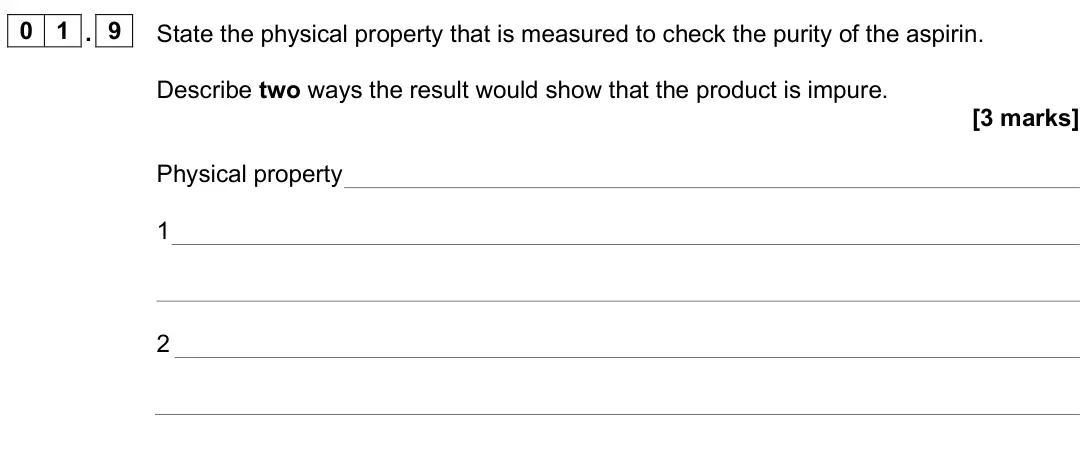
Q08.4
The whole paper ↗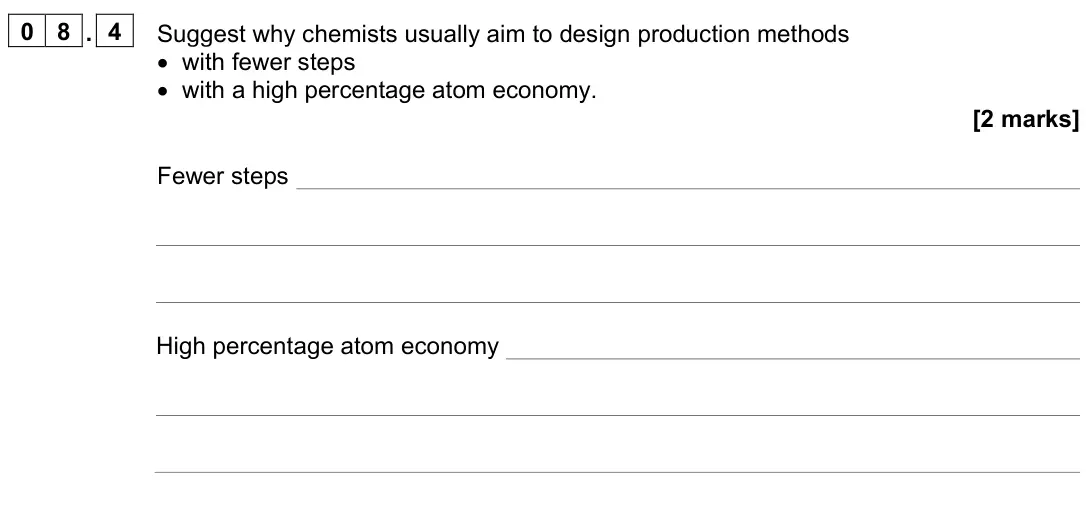
Q04.1
The whole paper ↗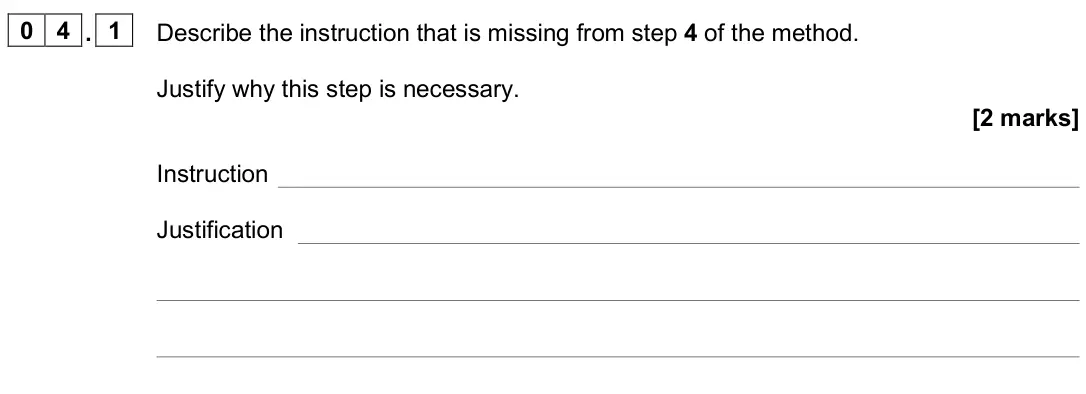
Q04.2
The whole paper ↗
Q04.3
The whole paper ↗
Q04.6
The whole paper ↗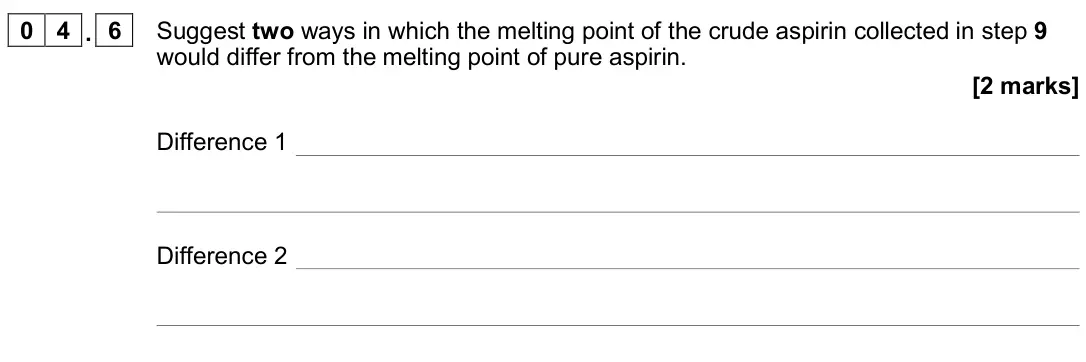
Q04.7
The whole paper ↗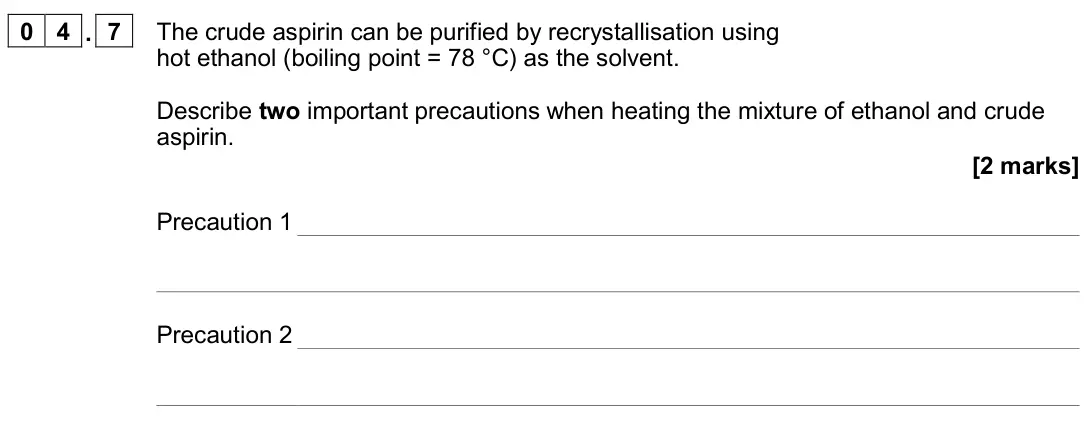
Q04.8
The whole paper ↗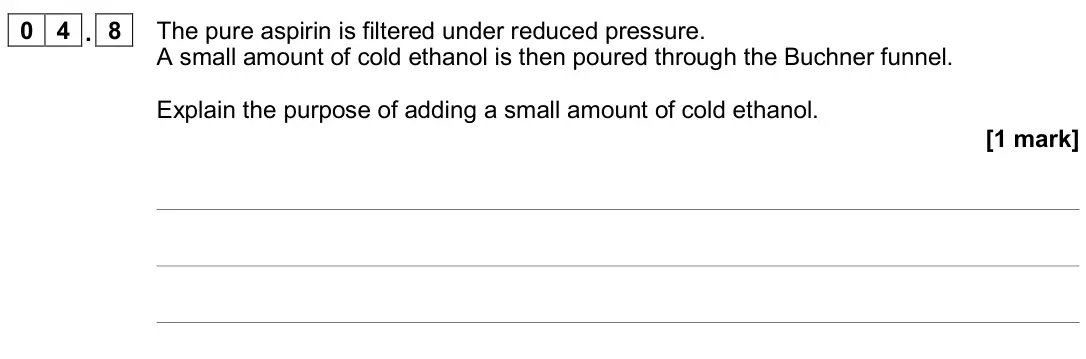
Q04.9
The whole paper ↗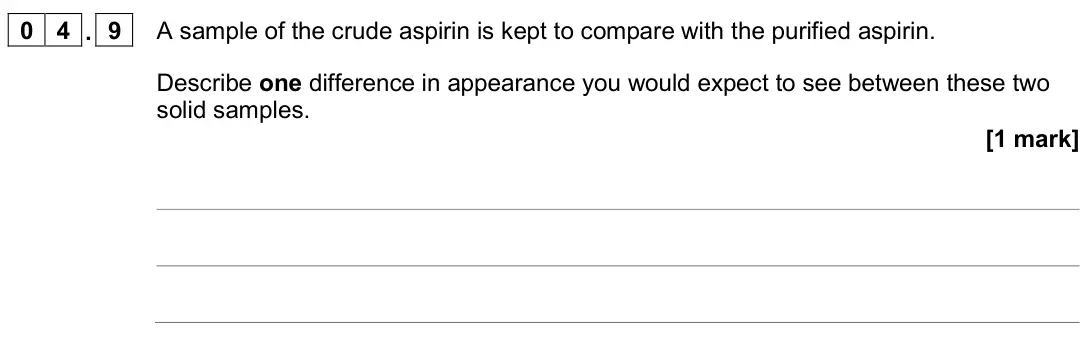
All 25 questions on Organic synthesis, as a list
- June 2025, Paper 2, Q04.1 (1 mark): Suggest why the apparatus should be set up in a fume cupboard. [1 mark]
- June 2025, Paper 2, Q04.3 (5 marks): Outline how Steps 7 and 8 should be done to obtain the purified crystalline product. [5 marks]
- June 2025, Paper 2, Q04.4 (1 mark): In Step 8, the distilled water must be ice-cold. Suggest why using water at room temperature lowers the recorded yield of product. [1 mark]
- June 2025, Paper 2, Q04.5 (4 marks): Figure 4 shows how a student set up the apparatus for measuring the melting point of hexanedioc acid in Step 9 (data book value 152 °C). The apparatus is suppor
- June 2025, Paper 2, Q04.6 (2 marks): Scientists disagree about whether this alternative process is more sustainable or less sustainable than the process starting from cyclohexanol. Use the informat
- June 2024, Paper 3, Q01.6 (2 marks): Complete and label the diagram to show how the impure solid is filtered. [2 marks]
- June 2024, Paper 3, Q01.7 (2 marks): Suggest the identity of two impurities present in the filtered solid aspirin before it is washed in Step 6 of the method. [2 marks] Impurity 1 Impurity 2
- June 2024, Paper 3, Q01.8 (6 marks): Describe the recrystallisation process used to purify the aspirin. Include the method and apparatus used. [6 marks]
- June 2024, Paper 3, Q01.9 (3 marks): State the physical property that is measured to check the purity of the aspirin. Describe two ways the result would show that the product is impure. [3 marks] P
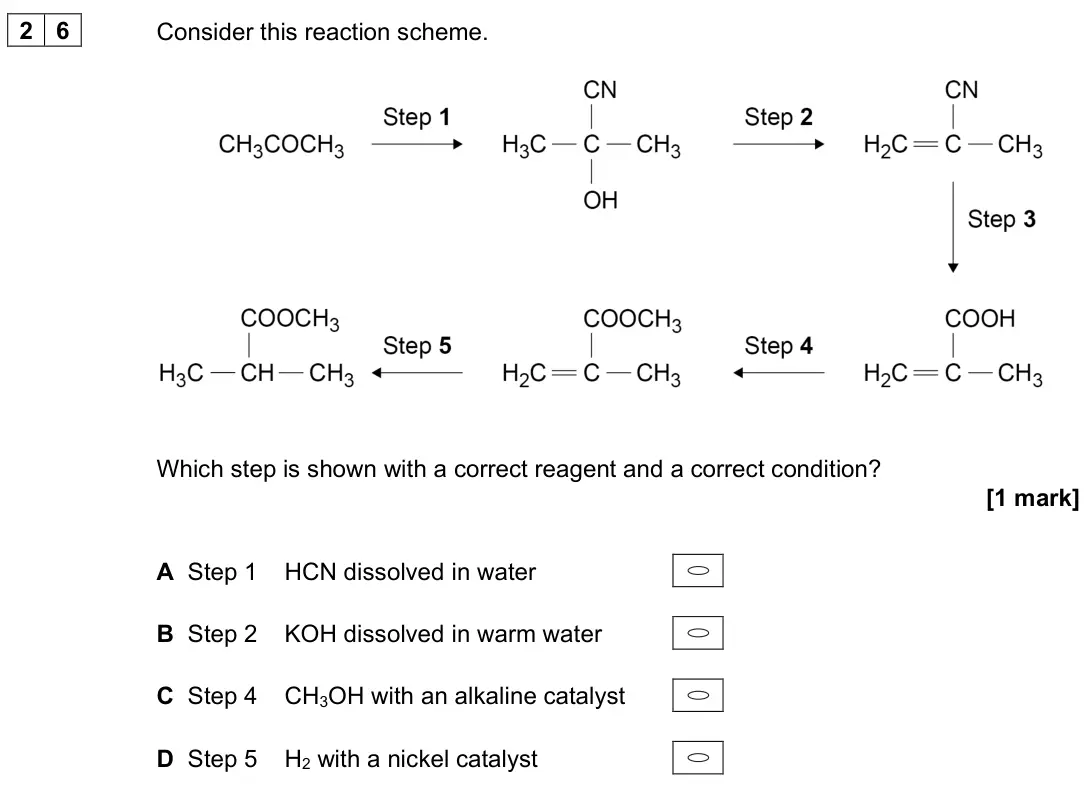
- June 2023, Paper 3, Q26 (1 mark): Consider this reaction scheme. Which step is shown with a correct reagent and a correct condition? [1 mark] A Step 1 HCN dissolved in water B Step 2 KOH dissolv
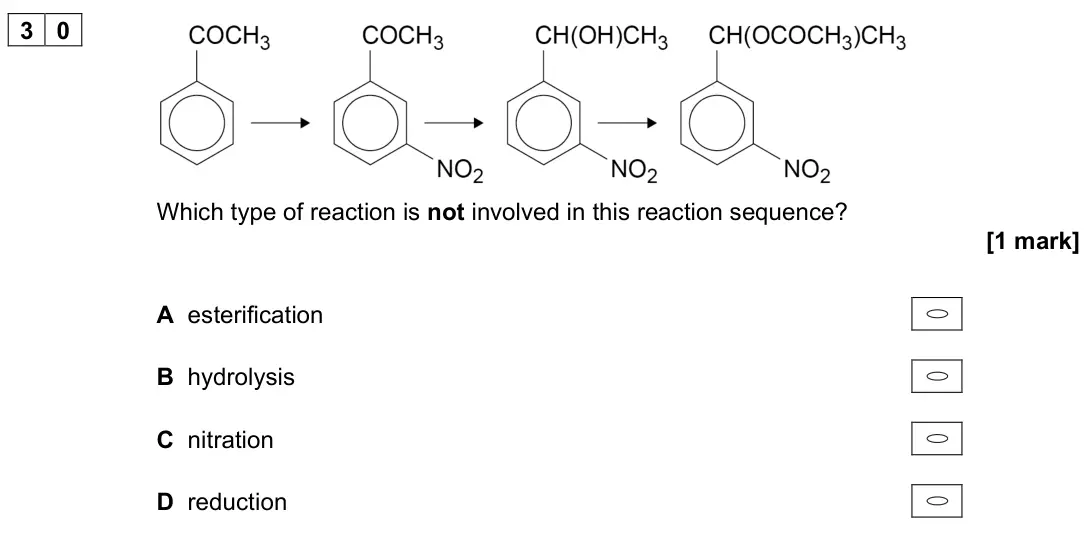
- June 2022, Paper 3, Q30 (1 mark): Which type of reaction is not involved in this reaction sequence? [1 mark] A esterification B hydrolysis C nitration D reduction
- November 2021, Paper 2, Q08.4 (2 marks): Suggest why chemists usually aim to design production methods • with fewer steps • with a high percentage atom economy. [2 marks] Fewer steps High percentage at
- November 2020, Paper 2, Q04.1 (2 marks): Describe the instruction that is missing from step 4 of the method. Justify why this step is necessary. [2 marks] Instruction Justification
- November 2020, Paper 2, Q04.2 (1 mark): Suggest a suitable piece of apparatus to measure out the ethanoic anhydride in step 5. [1 mark]
- November 2020, Paper 2, Q04.3 (1 mark): Identify a hazard of using concentrated phosphoric acid in step 6. [1 mark]
- November 2020, Paper 2, Q04.6 (2 marks): Suggest two ways in which the melting point of the crude aspirin collected in step 9 would differ from the melting point of pure aspirin. [2 marks] Difference 1
- November 2020, Paper 2, Q04.7 (2 marks): The crude aspirin can be purified by recrystallisation using hot ethanol (boiling point = 78 °C) as the solvent. Describe two important precautions when heating
- November 2020, Paper 2, Q04.8 (1 mark): The pure aspirin is filtered under reduced pressure. A small amount of cold ethanol is then poured through the Buchner funnel. Explain the purpose of adding a s
- November 2020, Paper 2, Q04.9 (1 mark): A sample of the crude aspirin is kept to compare with the purified aspirin. Describe one difference in appearance you would expect to see between these two soli
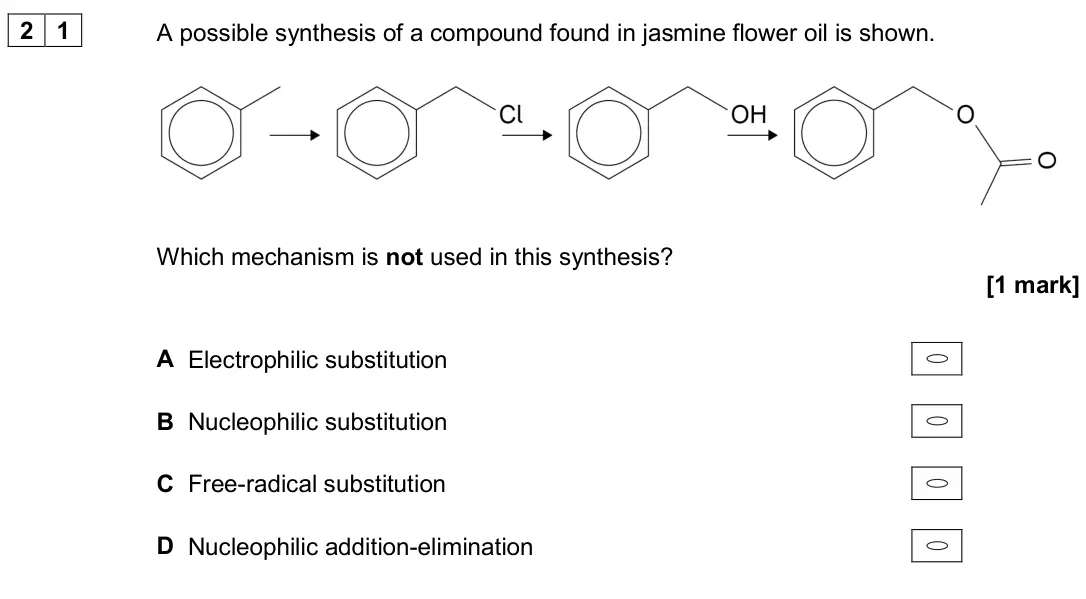
- June 2019, Paper 3, Q21 (1 mark): A possible synthesis of a compound found in jasmine flower oil is shown. Which mechanism is not used in this synthesis? [1 mark] A Electrophilic substitution B
- June 2019, Paper 3, Q34 (1 mark): Which compound can be purified by forming a hot aqueous solution that recrystallises on cooling? [1 mark] A Cyclohexene B Ethanoic acid C Phenylamine D Benzoic
- June 2017, Paper 2, Q11.2 (5 marks): Amine F can be prepared in a three-step synthesis starting from methylbenzene. Suggest the structures of the two intermediate compounds. For each step, give rea
- June 2017, Paper 3, Q03.8 (6 marks): After the solid benzoic acid has been filtered off, it can be purified. Describe the method that the student should use to purify the benzoic acid. [6 marks] 12
- Specimen, Paper 2, Q09.2 (4 marks): The minimum quantity of hot water was used The flask was cooled to room temperature before the crystals were filtered off The crystals were compressed in the fu
- Specimen, Paper 2, Q09.3 (2 marks): 5
Questions, mark schemes and examiner’s reports are © AQA, from their published past papers. Plumi isn’t affiliated with any exam board. Want whole papers? Every AQA A-Level Chemistry paper.
Rather write your answers by hand on iPad? Plumi marks them against the same mark schemes.