 plumi
Alcohols: AQA A‑Level Chemistry questions
Every AQA A-Level Chemistry exam question on 3.3.5 Alcohols, 2016–2025, with its mark scheme and examiner’s report.
Find questions2,301
Calculations
Q04.2
The whole paper ↗
Q05.1
The whole paper ↗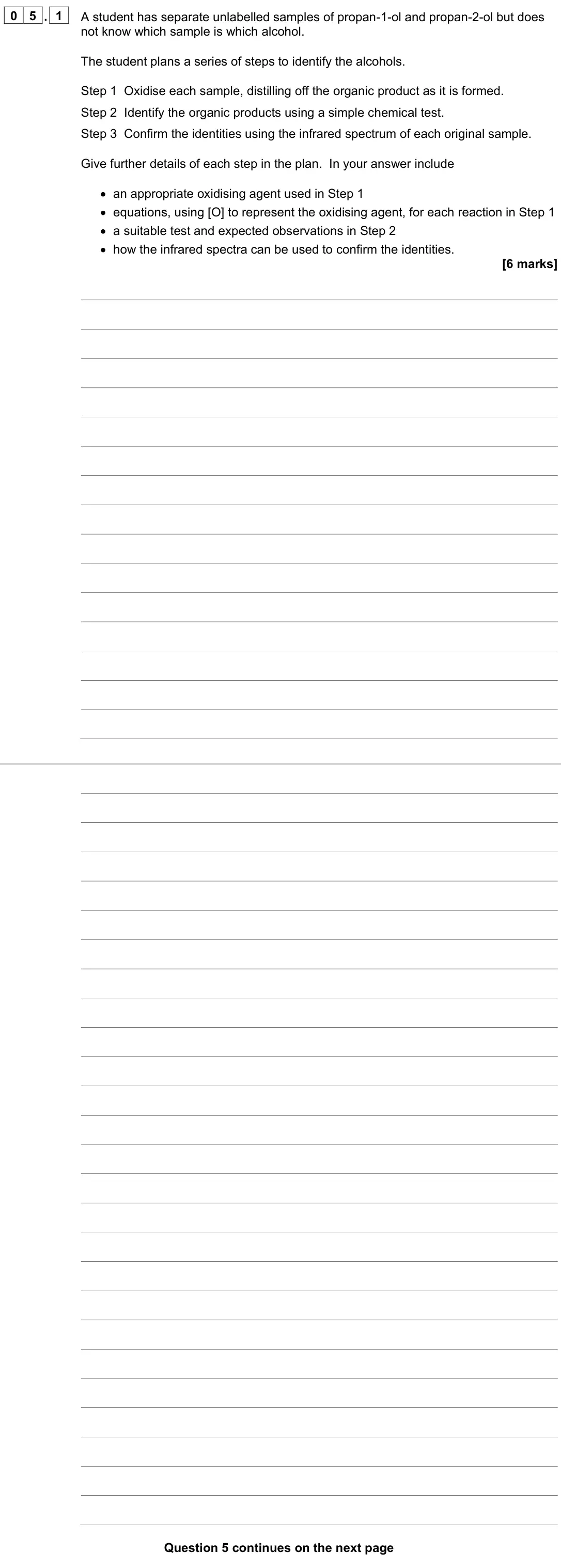
Q05.2
The whole paper ↗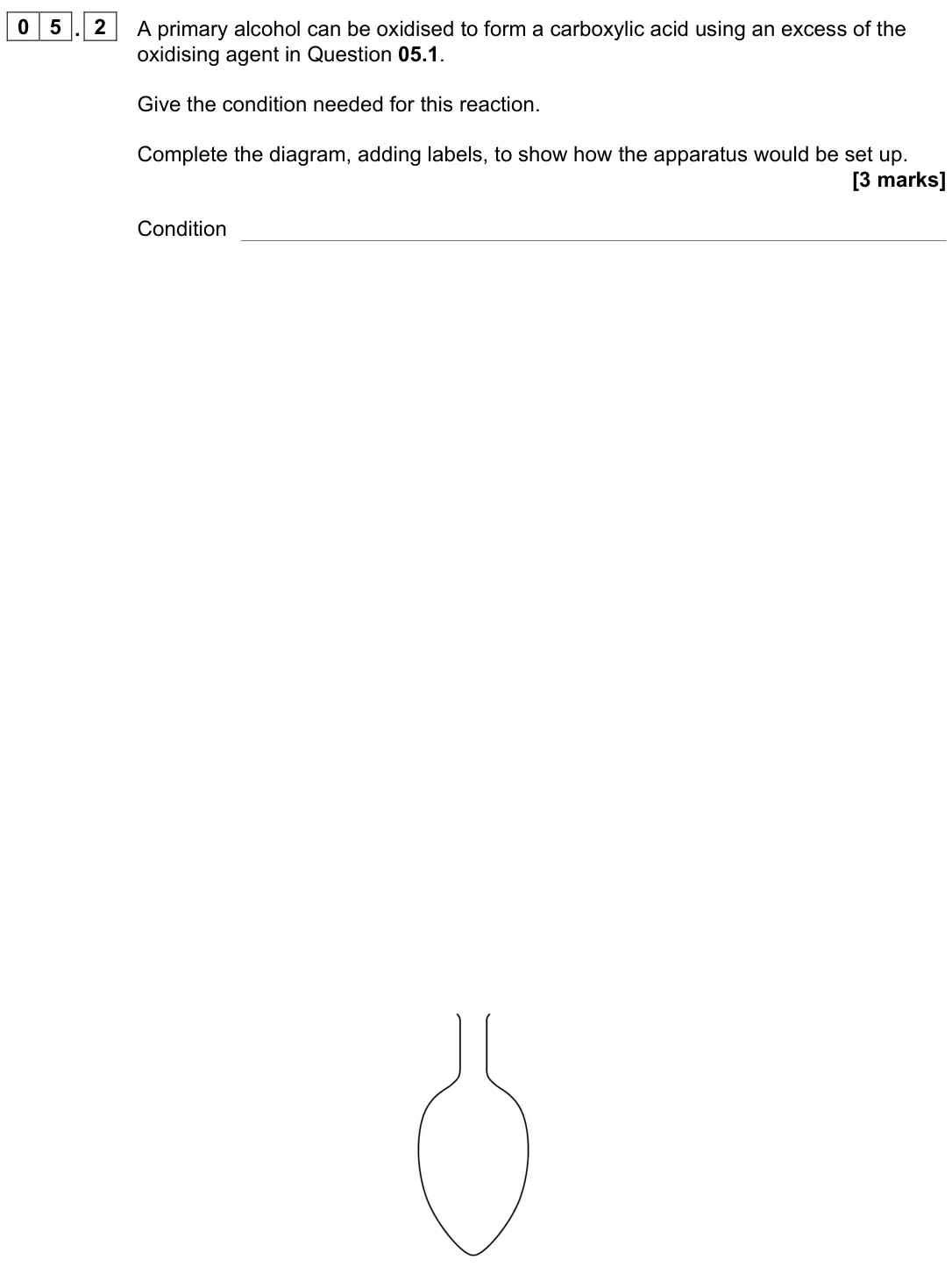
Q05.3
The whole paper ↗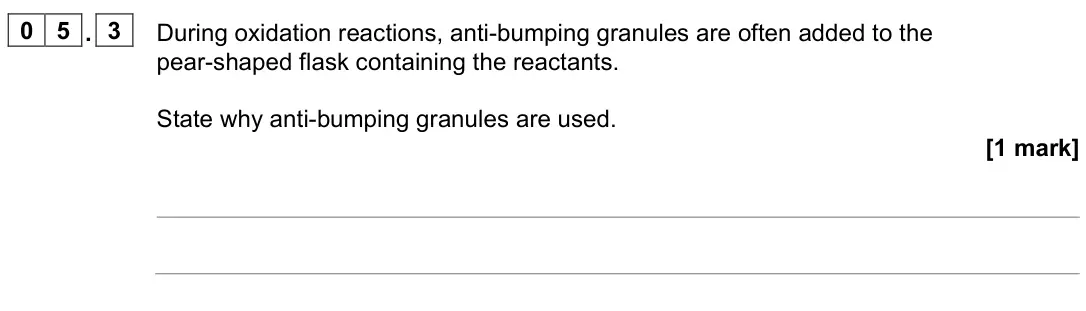
Q06.4
The whole paper ↗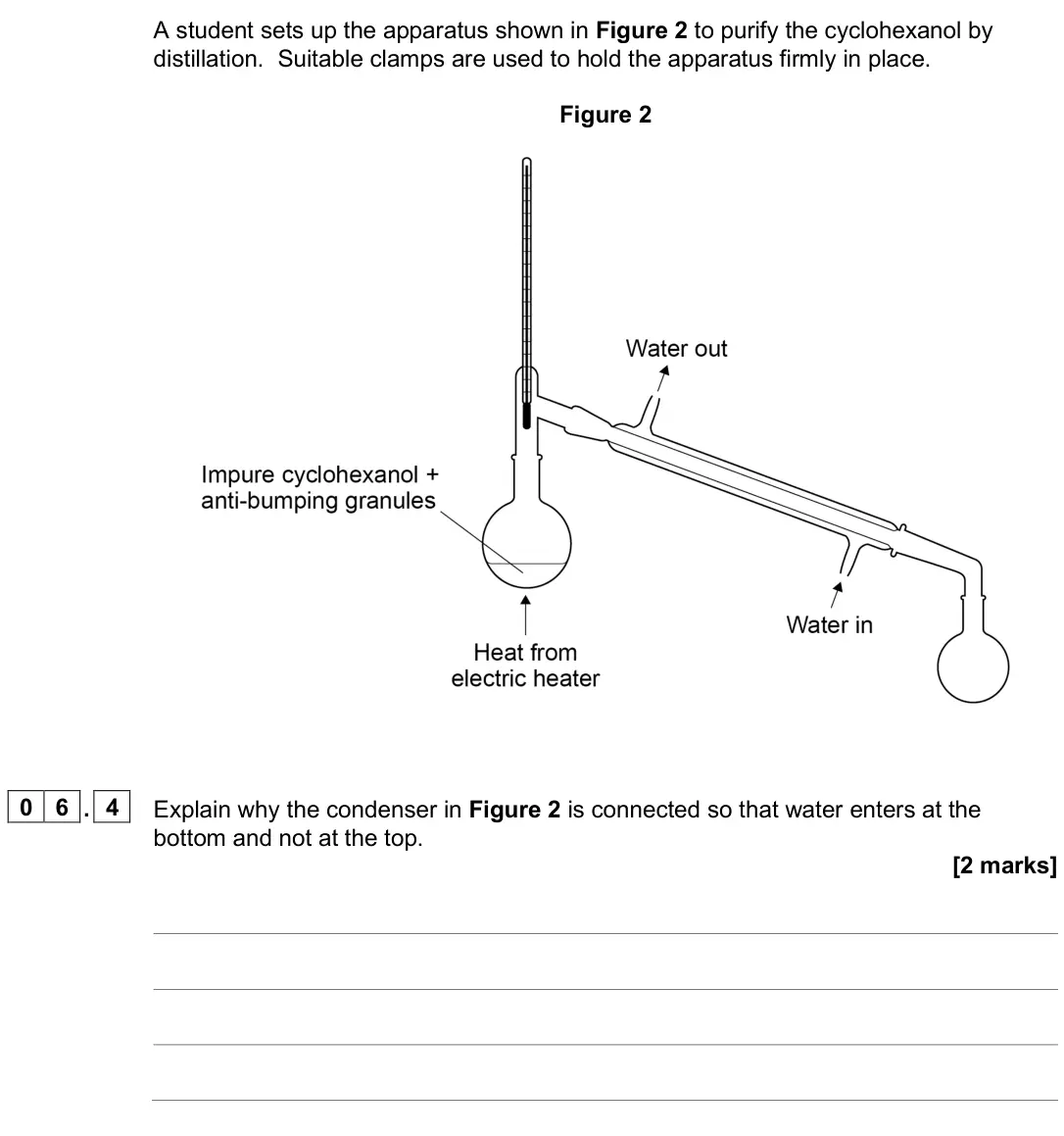
Q06.5
The whole paper ↗
Q06.6
The whole paper ↗
Q06.7
The whole paper ↗
Q06.8
The whole paper ↗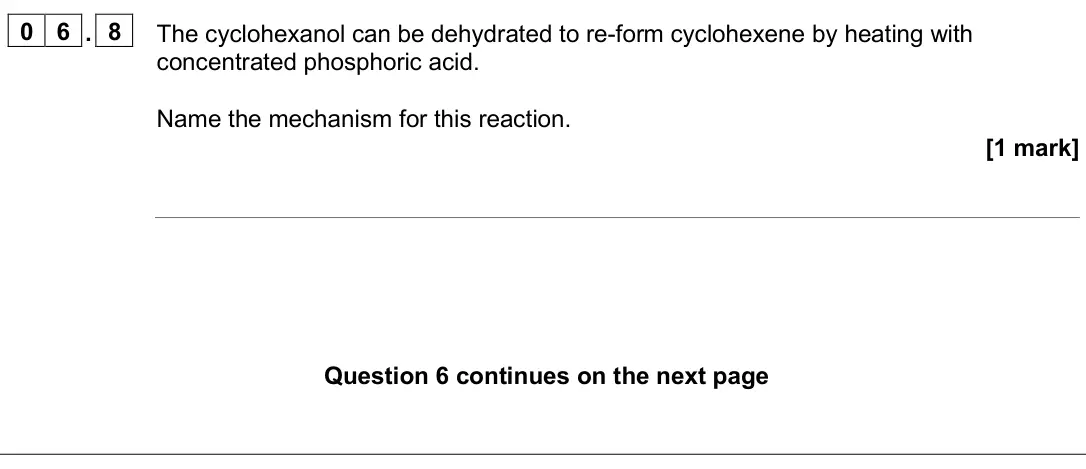
Q06.9
The whole paper ↗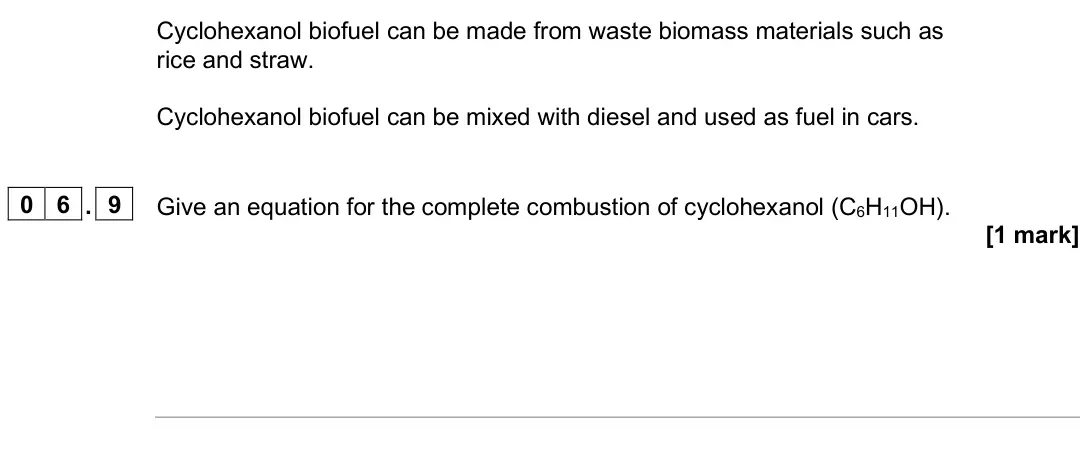
Q06.10
The whole paper ↗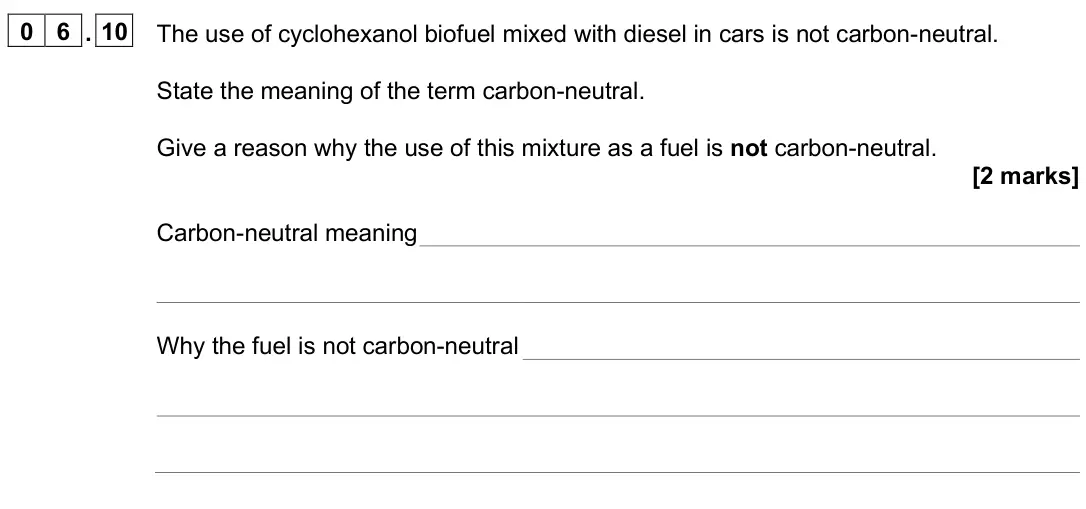
Q07.1
The whole paper ↗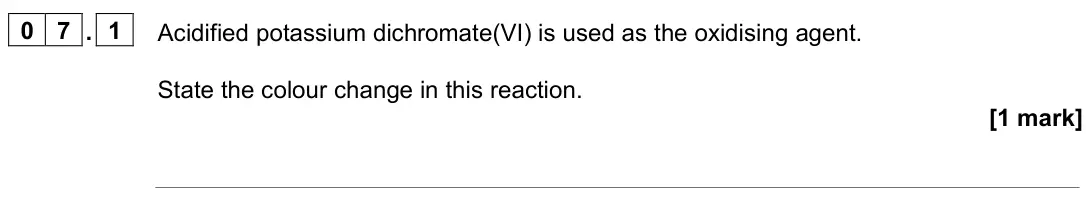
Q07.2
The whole paper ↗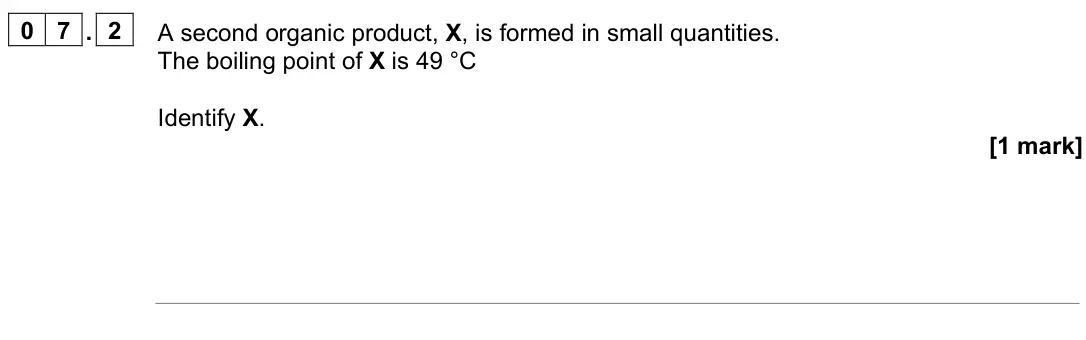
Q06.4
The whole paper ↗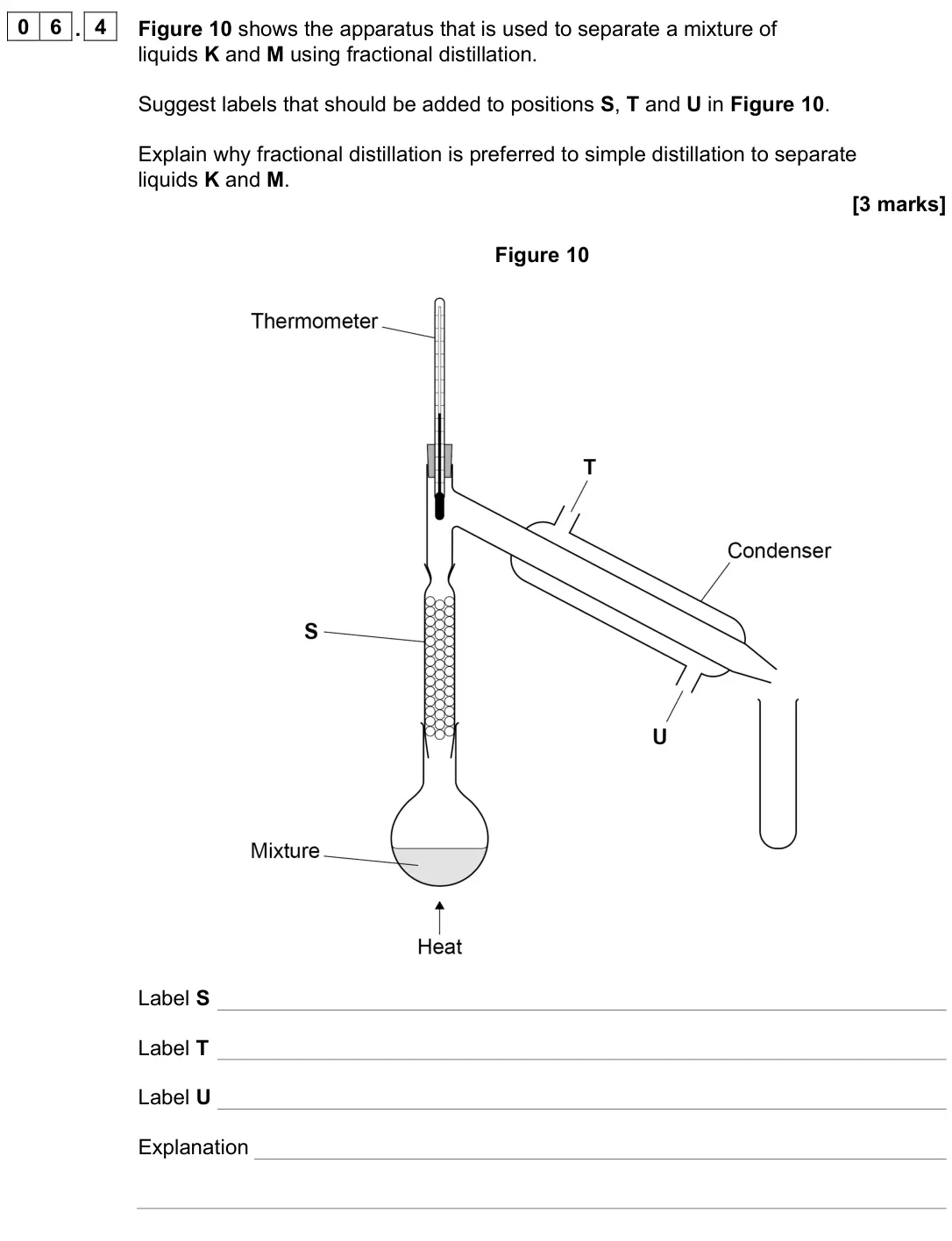
Q02.1
The whole paper ↗
All 102 questions on Alcohols, as a list
- June 2025, Paper 2, Q04.2 (1 mark): Deduce the role of the concentrated nitric acid in the reaction. [1 mark]
- June 2025, Paper 3, Q05.1 (6 marks): A student has separate unlabelled samples of propan-1-ol and propan-2-ol but does not know which sample is which alcohol. The student plans a series of steps to
- June 2025, Paper 3, Q05.2 (3 marks): A primary alcohol can be oxidised to form a carboxylic acid using an excess of the oxidising agent in Question 05.1. Give the condition needed for this reaction
- June 2025, Paper 3, Q05.3 (1 mark): During oxidation reactions, anti-bumping granules are often added to the pear-shaped flask containing the reactants. State why anti-bumping granules are used. [
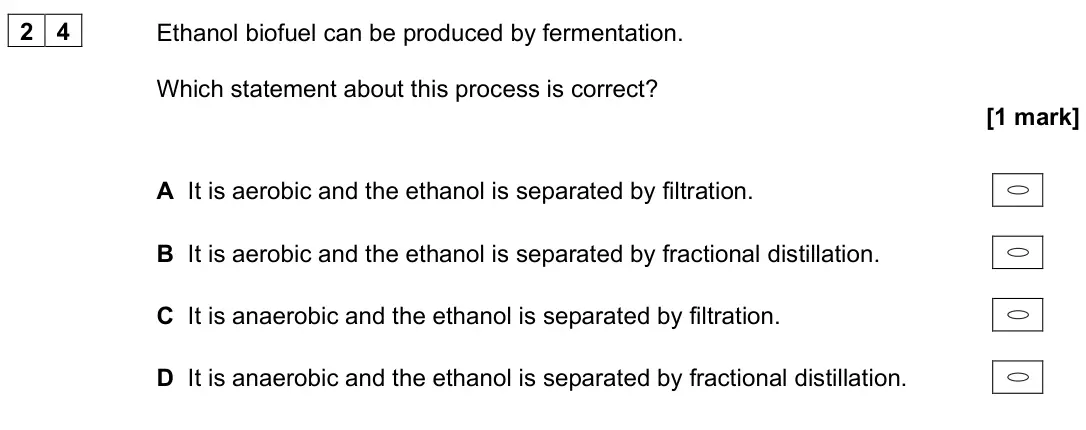
- June 2025, Paper 3, Q24 (1 mark): Ethanol biofuel can be produced by fermentation. Which statement about this process is correct? [1 mark] A It is aerobic and the ethanol is separated by filtrat
- June 2025, AS Paper 2, Q06.4 (2 marks): Explain why the condenser in Figure 2 is connected so that water enters at the bottom and not at the top. [2 marks]
- June 2025, AS Paper 2, Q06.5 (1 mark): The flask heated in Figure 2 contains anti-bumping granules. State why these are used. [1 mark]
- June 2025, AS Paper 2, Q06.6 (1 mark): Suggest why the flask in Figure 2 is heated with an electric heater, rather than a Bunsen burner. [1 mark]
- June 2025, AS Paper 2, Q06.7 (2 marks): State why the apparatus set up in Figure 2 is dangerous. State how this problem could be solved. [2 marks] Why the apparatus is dangerous How to solve the probl
- June 2025, AS Paper 2, Q06.8 (1 mark): The cyclohexanol can be dehydrated to re-form cyclohexene by heating with concentrated phosphoric acid. Name the mechanism for this reaction. [1 mark]
- June 2025, AS Paper 2, Q06.9 (1 mark): Give an equation for the complete combustion of cyclohexanol (C6H11OH). [1 mark]
- June 2025, AS Paper 2, Q06.10 (2 marks): The use of cyclohexanol biofuel mixed with diesel in cars is not carbon-neutral. State the meaning of the term carbon-neutral. Give a reason why the use of this
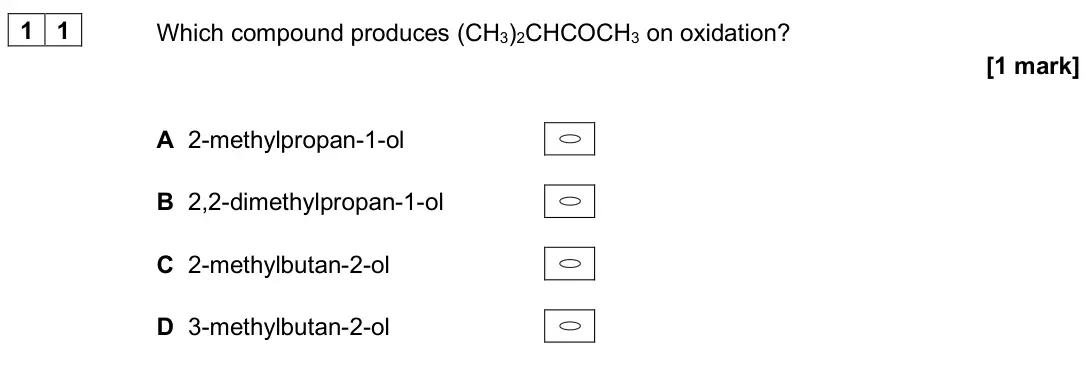
- June 2025, AS Paper 2, Q11 (1 mark): Which compound produces (CH3)2CHCOCH3 on oxidation? [1 mark] A 2-methylpropan-1-ol B 2,2-dimethylpropan-1-ol C 2-methylbutan-2-ol D 3-methylbutan-2-ol
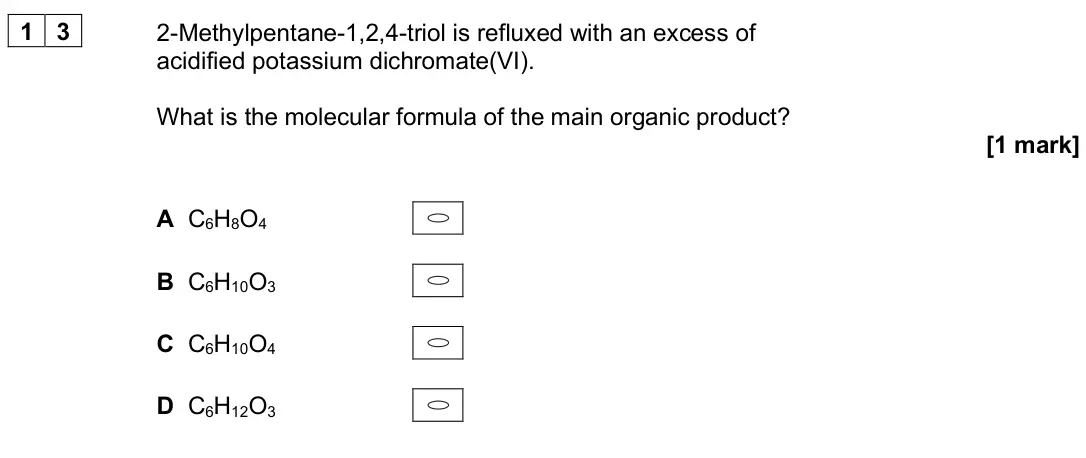
- June 2025, AS Paper 2, Q13 (1 mark): 2-Methylpentane-1,2,4-triol is refluxed with an excess of acidified potassium dichromate(VI). What is the molecular formula of the main organic product? [1 mark
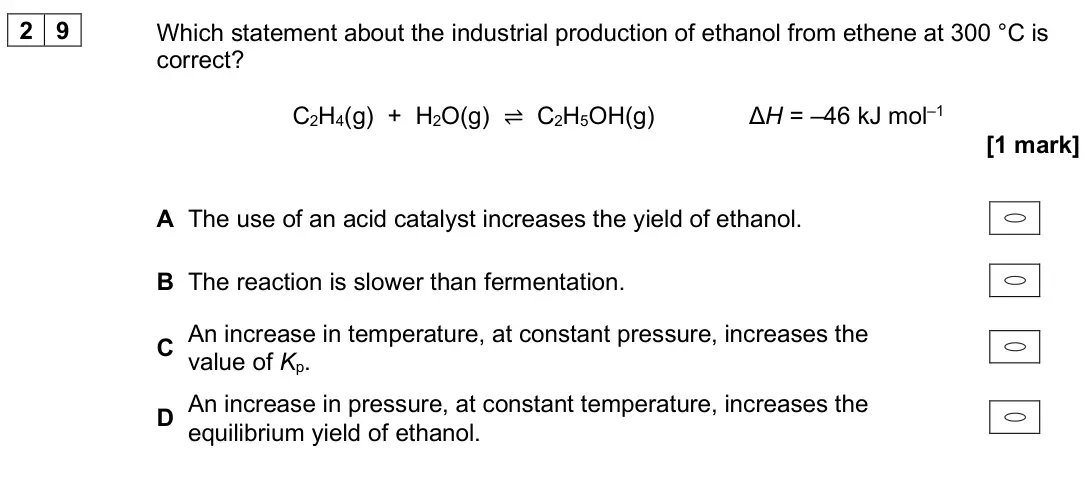
- June 2024, Paper 3, Q29 (1 mark): Which statement about the industrial production of ethanol from ethene at 300 °C is correct? C2H4(g) + H2O(g) ⇌ C2H5OH(g) ΔH = –46 kJ mol–1 [1 mark] A The use o
- June 2024, AS Paper 2, Q07.1 (1 mark): Acidified potassium dichromate(VI) is used as the oxidising agent. State the colour change in this reaction. [1 mark]
- June 2024, AS Paper 2, Q07.2 (1 mark): A second organic product, X, is formed in small quantities. The boiling point of X is 49 °C Identify X. [1 mark]
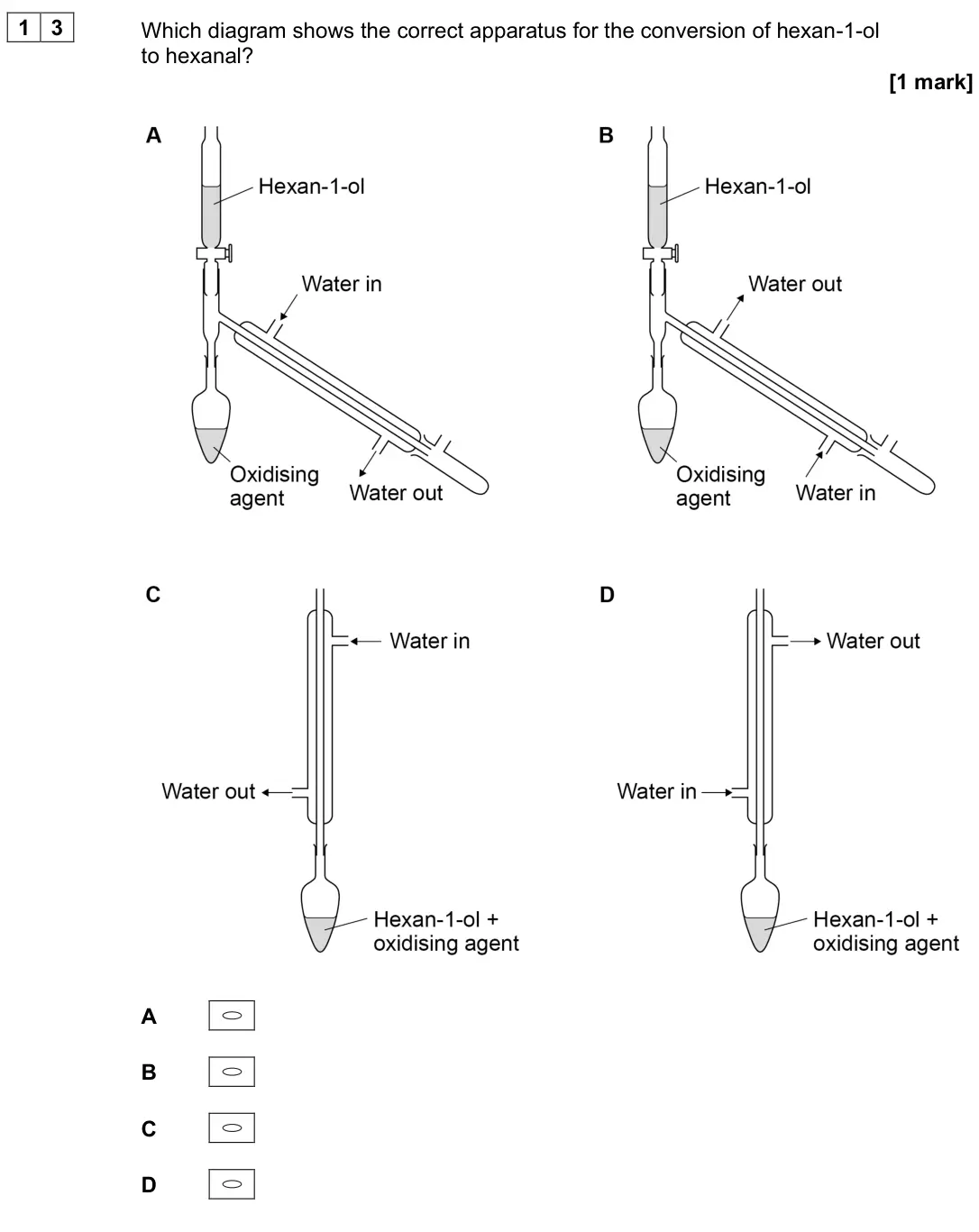
- June 2024, AS Paper 2, Q13 (1 mark): Which diagram shows the correct apparatus for the conversion of hexan-1-ol to hexanal? [1 mark] A B C D
- June 2023, Paper 2, Q06.4 (3 marks): Figure 10 shows the apparatus that is used to separate a mixture of liquids K and M using fractional distillation. Suggest labels that should be added to positi
- June 2023, Paper 3, Q02.1 (1 mark): Draw the displayed formula of an unbranched position isomer of pentan-2-ol that can be dehydrated to form a single alkene. [1 mark]
- June 2023, Paper 3, Q02.2 (1 mark): Draw the skeletal formula of a chain isomer of pentan-2-ol that can be dehydrated to form a mixture of alkenes. [1 mark]
- June 2023, Paper 3, Q02.4 (1 mark): Another isomer of pentan-2-ol is an alcohol that is not dehydrated when heated with concentrated sulfuric acid. Draw the structure of this isomer. [1 mark]
- June 2023, Paper 3, Q02.5 (3 marks): An incomplete mechanism for the dehydration of a compound is shown. Complete the mechanism for this reaction by drawing two curly arrows on the intermediate. Na
- June 2023, Paper 3, Q02.6 (1 mark): An isomer of the final product can also form in the reaction in Question 02.5. Draw the structure of this isomer. [1 mark]
- June 2023, Paper 3, Q32 (1 mark): Which is a correct equation for the oxidation of 1-phenylethanol? [O] represents oxygen from an oxidising agent. [1 mark] A C6H5CH2CH2OH + 2 [O] → C6H5CH2COOH +
- June 2023, AS Paper 2, Q02.7 (1 mark): Petrol sold in the UK contains 10% bioethanol. Bioethanol is ethanol made from crops by fermentation and is considered to be carbon-neutral. State what is meant
- June 2023, AS Paper 2, Q07.1 (2 marks): Explain why the water should enter the condenser at the bottom and not at the top. [2 marks]
- June 2023, AS Paper 2, Q07.2 (4 marks): Name and complete the mechanism for this reaction. [4 marks] Name of mechanism
- June 2023, AS Paper 2, Q22 (1 mark): The alcohol CH3CH2CH2OH can be oxidised. Which compound cannot be produced by oxidation of this alcohol? [1 mark] A CO2 B CH3COCH3 C CH3CH2CHO D CH3CH2COOH
- June 2022, Paper 2, Q05.1 (2 marks): It is important to wear eye protection and a lab coat when completing this experiment. Suggest, with a reason, one other appropriate safety precaution for this
- June 2022, Paper 2, Q05.2 (1 mark): Give a reason for adding the distilled water in steps c and f. [1 mark]
- June 2022, Paper 2, Q05.3 (1 mark): Give a reason for adding anhydrous magnesium sulfate in step h. [1 mark]
- June 2022, Paper 2, Q05.4 (2 marks): Complete and label the diagram of the apparatus used to filter the mixture under reduced pressure in step i. [2 marks]
- June 2022, Paper 2, Q05.5 (2 marks): Identify the most likely organic impurity, other than hex-1-ene, in the distillate collected in step j. Suggest one reason why it could be difficult to remove t
- June 2022, Paper 2, Q05.6 (4 marks): Calculate the mass, in g, of hexan-2-ol formed from 11.0 cm3 of hex-1-ene if the yield is 31.0% Give your answer to 1 decimal place. Density of hex-1-ene = 0.67
- June 2022, Paper 3, Q24 (1 mark): Which statement is not correct for both primary and secondary alcohols? [1 mark] A They are easily oxidised to carboxylic acids by acidified K2Cr2O7 solution. B
- June 2022, Paper 3, Q31 (1 mark): Which pair of reagents does not produce ethanol? [1 mark] A CH3CH2Br and NaOH(aq) B CH3COOCH3 and NaOH(aq) C HCOOCH2CH3 and NaOH(aq) D CH3CHO and NaBH4(aq)
- June 2022, Paper 3, Q34 (1 mark): Which compound can be dehydrated to form an alkene? [1 mark] A CH3CHO B CH3COOH C CH3CH2OH D CH3COOCH3
- June 2022, AS Paper 2, Q07.1 (4 marks): The ethanol produced by fermentation of glucose may be regarded as a carbon-neutral fuel. Justify this statement. Include the relevant chemical equations in you
- June 2022, AS Paper 2, Q07.2 (1 mark): Suggest why ethanol produced in Europe using silverskin from South America is less likely to be carbon-neutral than ethanol produced from crops grown in Europe.
- June 2022, AS Paper 2, Q12 (1 mark): Which alcohol when dehydrated forms a mixture of alkenes? [1 mark] A propan-1-ol B propan-2-ol C pentan-1-ol D pentan-2-ol
- June 2022, AS Paper 2, Q15 (1 mark): Which compound produces (CH3)2CHCOCH3 when oxidised? [1 mark] A 2-methylpropan-1-ol B 2,2-dimethylpropanol C 2-methylbutan-2-ol D 3-methylbutan-2-ol
- November 2021, Paper 2, Q02.6 (6 marks): Bioethanol is used as an alternative to fossil fuels. This statement appeared on a website. “The fact that bioethanol is a carbon-neutral fuel outweighs the env
- November 2021, Paper 2, Q08.1 (2 marks): State the type of reaction in step 1. Give the name of the reagent needed for step 1. [2 marks] Type of reaction Reagent
- November 2021, Paper 3, Q06.1 (2 marks): Give two reasons why the apparatus shown in Figure 4 is not safe. [2 marks] 1 2
- November 2021, Paper 3, Q06.2 (1 mark): Give one additional reagent that is needed to form any propanoic acid. [1 mark]
- November 2021, Paper 3, Q06.3 (2 marks): State two more mistakes in the way the apparatus is set up in Figure 4. [2 marks] 1 2
- November 2021, Paper 3, Q06.4 (1 mark): State the purpose of the small glass beads in the flask in Figure 4. [1 mark]
- November 2021, Paper 3, Q06.5 (4 marks): After correcting the mistakes, the student heats a reaction mixture containing 6.50 g of propan-1-ol with an excess of the oxidising agent. The propanoic acid s
- November 2021, Paper 3, Q26 (1 mark): Which compound is produced when 1-phenylethanol reacts with acidified potassium dichromate(VI)? [1 mark] A C6H5CH2CH2OH B C6H5CH2CHO C C6H5COCH3 D C6H5CH(OH)CH3
- November 2021, AS Paper 2, Q03.1 (6 marks): Figure 2 shows the apparatus set up by a student to make propanone by this method. Suitable clamps are used to hold all the apparatus firmly in place. Figure 2
- November 2021, AS Paper 2, Q07.2 (4 marks): Prop-2-en-1-ol can also be formed from HOCH2CH2CH2OH in the presence of an acid catalyst. HOCH2CH2CH2OH ⟶ CH2=CHCH2OH + H2O Name and outline a mechanism for thi
- November 2021, AS Paper 2, Q19 (1 mark): Which statement is not correct about the industrial production of ethanol from ethene at 300 °C? C2H4(g) + H2O(g) ⇌ C2H5OH(g) ΔH = −46 kJ mol–1 [1 mark] A The r
- November 2020, Paper 2, Q03.1 (2 marks): Identify the isomer(s) that would react when warmed with acidified potassium dichromate(VI). State the expected observation when acidified potassium dichromate(
- November 2020, Paper 2, Q06.3 (3 marks): The organic product of step 2 is reacted with concentrated sulfuric acid in step 3. Outline the mechanism for step 3. [3 marks]
- November 2020, Paper 3, Q25 (1 mark): Which compound reacts to form a ketone when warmed with an acidified solution of potassium dichromate(VI)? [1 mark] A CH3CH2CH2OH B (CH3)2CHOH C CH3CH2CHO D (CH
- November 2020, AS Paper 2, Q04.2 (5 marks): Pent-1-ene is formed by the elimination of water from pentan-2-ol. State the reagent and condition for this reaction. Outline the mechanism for this reaction. [
- November 2020, AS Paper 2, Q07.2 (2 marks): Ethanedioic acid is formed by the oxidation of ethane-1,2-diol (HOCH2CH2OH). State suitable reagent(s) and a condition for this reaction. [2 marks] Reagent(s) C
- November 2020, AS Paper 2, Q18 (1 mark): Which statement is correct about the production and use of ethanol as a biofuel? [1 mark] A Biofuel ethanol is produced by the fermentation of glucose in the pr
- June 2019, Paper 2, Q02.1 (2 marks): Complete the diagram of the apparatus used to distil the cyclohexene from the reaction mixture at 83 °C. [2 marks]
- June 2019, Paper 2, Q02.2 (1 mark): The distillate was shaken with saturated sodium chloride solution. The cyclohexene was separated from the aqueous solution using a separating funnel. State why
- June 2019, Paper 2, Q02.3 (1 mark): The cyclohexene separated in Question 02.2 was obtained as a cloudy liquid. The student dried this cyclohexene by adding a few lumps of anhydrous calcium chlori
- June 2019, Paper 2, Q02.4 (5 marks): In this preparation, the student added an excess of concentrated phosphoric acid to 14.4 g of cyclohexanol (Mr = 100.0). The student obtained 4.15 cm3 of cycloh
- June 2019, Paper 2, Q06.1 (3 marks): Give a reagent and observations for a test-tube reaction to distinguish between 2-methylbutan-1-ol and 2-methylbutan-2-ol. [3 marks] Reagent Observation with 2-
- June 2019, Paper 3, Q04.3 (2 marks): 2-Hydroxypropanenitrile can be used in the synthesis of the monomer, acrylonitrile, CH2=CHCN Suggest a suitable reagent and conditions for the conversion of 2-h
- June 2019, Paper 3, Q22 (1 mark): Which compound is formed when 1-phenylethanol reacts with acidified potassium dichromate(VI)? [1 mark] A C6H5CH2CH2OH B C6H5CH2CHO C C6H5COCH3 D C6H5CH2COOH
- June 2019, Paper 3, Q32 (1 mark): In the UK industrial ethanol is now produced by the direct hydration of ethene. This process has largely replaced the fermentation method. Which is a likely rea
- June 2019, AS Paper 2, Q08.1 (3 marks): Calculate the minimum volume, in cm3, of 0.40 mol dm–3 potassium dichromate(VI) solution needed to oxidise 6.0 cm3 of propan-1-ol to propanal. Mr of propan-1-ol
- June 2019, AS Paper 2, Q08.2 (3 marks): The reaction is done in a pear-shaped flask. Complete the diagram to show the assembled apparatus needed to prepare propanal from propan-1-ol in this way. Label
- June 2019, AS Paper 2, Q18 (1 mark): Which compound can be oxidised to form (CH3)2CHCOCH3? [1 mark] A 2-methylpropan-1-ol B 2,2-dimethylpropanol C 2-methylbutan-2-ol D 3-methylbutan-2-ol
- June 2019, AS Paper 2, Q20 (1 mark): Which alcohol forms a mixture of alkenes when dehydrated? [1 mark] A propan-1-ol B propan-2-ol C pentan-1-ol D pentan-2-ol
- June 2018, Paper 2, Q03.1 (3 marks): Explain, with reference to intermolecular forces, why distillation allows propanal to be separated from the other organic compounds in this reaction mixture. [3
- June 2018, Paper 2, Q03.2 (2 marks): Give two ways of maximising the yield of propanal obtained by distillation of the reaction mixture. [2 marks] 1 2
- June 2018, Paper 2, Q03.5 (4 marks): A mixture of isomeric alkenes is produced when pentan-2-ol is dehydrated in the presence of hot concentrated sulfuric acid. Pent-1-ene is one of the isomers pro
- June 2018, Paper 3, Q03.3 (1 mark): Suggest why sodium carbonate solution was used to wash the distillate. [1 mark]
- June 2018, Paper 3, Q03.4 (1 mark): Explain why it is important to open the tap of the separating funnel periodically. [1 mark]
- June 2018, Paper 3, Q03.5 (1 mark): Give a property of anhydrous calcium chloride, other than its ability to absorb water, that makes it suitable as a drying agent in this preparation. [1 mark]
- June 2018, Paper 3, Q03.6 (2 marks): Describe the apparatus used to remove the drying agent by filtration under reduced pressure. Your description of the apparatus can be either a labelled diagram
- June 2018, Paper 3, Q11 (1 mark): Which statement is correct about both 2-methylbutan-1-ol and 2-methylbutan-2-ol? [1 mark] A They can be formed by alkaline hydrolysis of esters. B They can be o
- June 2018, AS Paper 2, Q12 (1 mark): Which statement is not correct about the industrial preparation of ethanol by the hydration of ethene at 300 °C? C2H4(g) + H2O(g) ⇌ C2H5OH(g) ∆H = – 46 kJ mol–1
- June 2017, Paper 3, Q02.5 (3 marks): Butan-2-ol reacts with concentrated sulfuric acid to form a mixture of three isomeric alkenes. Two of the alkenes are stereoisomers. Draw the skeletal formula o
- June 2017, Paper 3, Q02.6 (3 marks): A by-product of the reaction of butan-2-ol with concentrated sulfuric acid has the molecular formula C4H8O Name this by-product, identify the role of the sulfur
- June 2017, AS Paper 2, Q07.1 (4 marks): Complete the mechanism for the conversion of 2-methylcyclohexanol into 1-methylcyclohexene via carbocation D by drawing • the structure of the missing intermedi
- June 2017, AS Paper 2, Q07.2 (1 mark): Draw the structure of a different cyclic alkene formed from carbocation D. [1 mark]
- June 2017, AS Paper 2, Q07.3 (2 marks): Carbocation D can undergo a type of reaction called a rearrangement to form carbocation E. In this reaction, a hydrogen atom and its bonding pair of electrons m
- June 2017, AS Paper 2, Q07.4 (1 mark): As a result of the rearrangement in Question 7.3, a third alkene is formed in this reaction. Draw the structure of this third alkene. [1 mark]
- June 2017, AS Paper 2, Q07.5 (6 marks): Cyclohexene is prepared by the dehydration of cyclohexanol using concentrated phosphoric acid as a catalyst. The structure of concentrated phosphoric acid is sh
- June 2017, AS Paper 2, Q17 (1 mark): Which alcohol can be oxidised by acidified potassium dichromate(VI) but cannot be dehydrated by heating with concentrated sulfuric acid? [1 mark] A 2,3-dimethyl
- June 2016, AS Paper 2, Q06.1 (1 mark): Draw the skeletal formula of propane-1,2-diol. [1 mark]
- June 2016, AS Paper 2, Q06.2 (2 marks): Write an equation for this oxidation reaction of propane-1,2-diol under reflux, using [O] to represent the oxidizing agent. Show the displayed formula of the or
- June 2016, AS Paper 2, Q06.3 (2 marks): Draw a labelled diagram to show how you would set up apparatus for refluxing. [2 marks]
- June 2016, AS Paper 2, Q06.4 (1 mark): Anti-bumping granules are placed in the flask when refluxing. Suggest why these granules prevent bumping. [1 mark]
- June 2016, AS Paper 2, Q06.5 (1 mark): Draw the structure of a different organic product formed when the acidified potassium dichromate(VI) is not in excess. [1 mark]
- Specimen, Paper 2, Q04.2 (1 mark): Draw the structure of the organic product, B, formed when A is oxidised in the reaction with acidified potassium dichromate(VI). [1 mark] 0 4 . 2
- Specimen, Paper 2, Q04.3 (1 mark): Two isomeric alkenes, C and D, are formed when A is dehydrated in the reaction with concentrated sulfuric acid. Name the mechanism for this dehydration reaction
- Specimen, Paper 2, Q04.4 (2 marks): Isomer C Isomer D 3
- Specimen, Paper 2, Q04.7 (1 mark): Draw the structure of the isomer of A that is not oxidised by acidified potassium dichromate(VI). [1 mark] 0 4 . 7
- Specimen, Paper 2, Q04.8 (1 mark): Draw the structure of the isomer of A that cannot be dehydrated to form an alkene by reaction with concentrated sulfuric acid. [1 mark] 0 4 . 8
- Specimen, Paper 3, Q01.1 (3 marks): In order to ensure that the oxidation to ethanoic acid is complete, the reaction is carried out under reflux. Describe what happens when a reaction mixture is r
- Specimen, Paper 3, Q01.2: 3
- Specimen, Paper 3, Q01.3 (5 marks): The boiling points of the organic compounds in a reaction mixture are shown in Table 1. Table 1 Compound ethanol ethanal ethanoic acid Boiling point / °C 78 21
- Specimen, Paper 3, Q01.4 (2 marks): Use your knowledge of structure and bonding to explain why it is possible to separat ethanal in this way. [2 mark 0 1 . 4
Questions, mark schemes and examiner’s reports are © AQA, from their published past papers. Plumi isn’t affiliated with any exam board. Want whole papers? Every AQA A-Level Chemistry paper.
Rather write your answers by hand on iPad? Plumi marks them against the same mark schemes.