 plumi
Optical isomerism: AQA A‑Level Chemistry questions
Every AQA A-Level Chemistry exam question on 3.3.7 Optical isomerism, 2016–2025, with its mark scheme and examiner’s report.
Find questions2,301
Calculations
Q06.2
The whole paper ↗
Q08.4
The whole paper ↗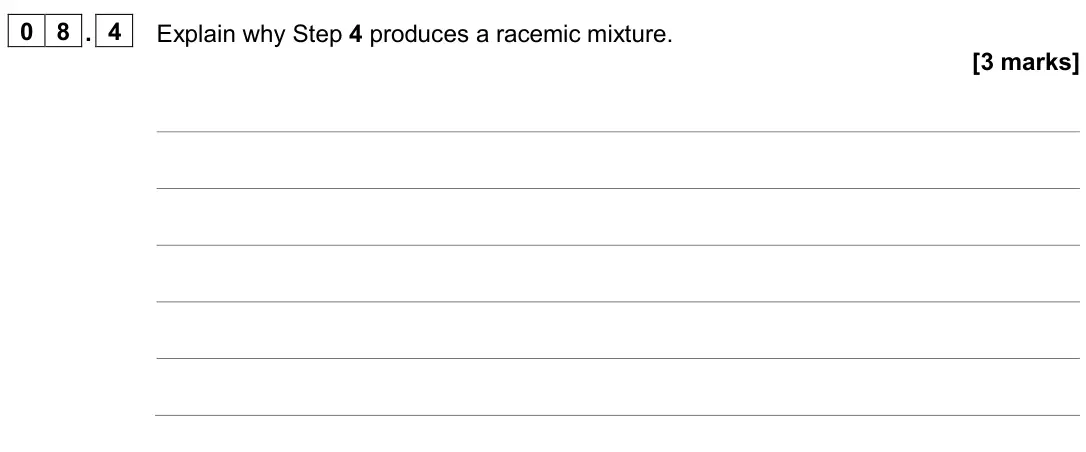
Q03.6
The whole paper ↗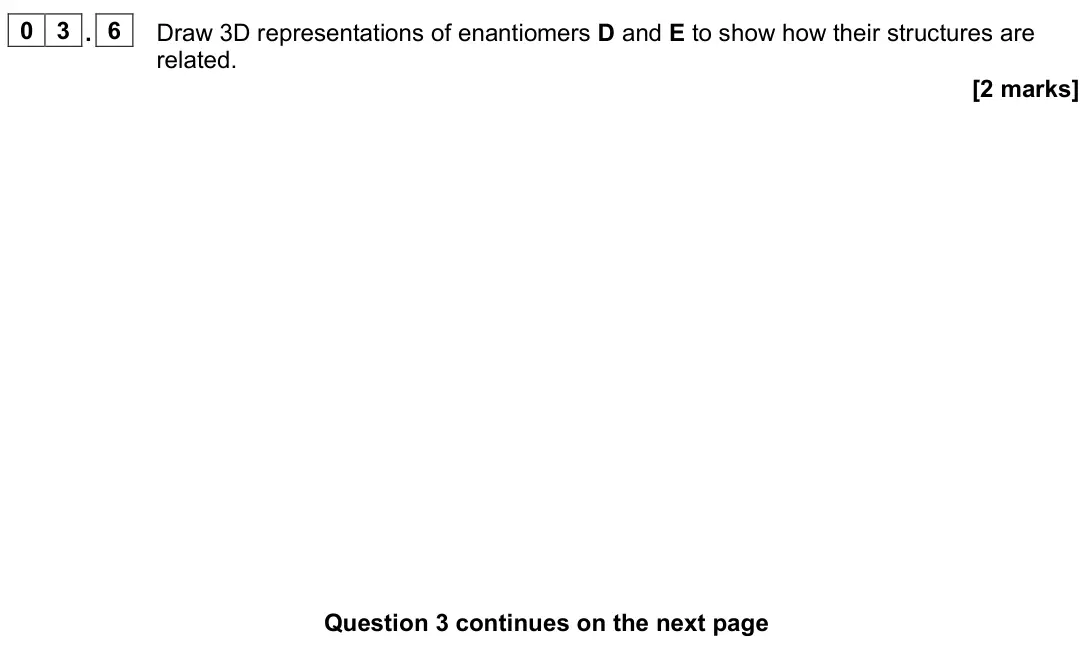
Q06.1
The whole paper ↗
Q06.2
The whole paper ↗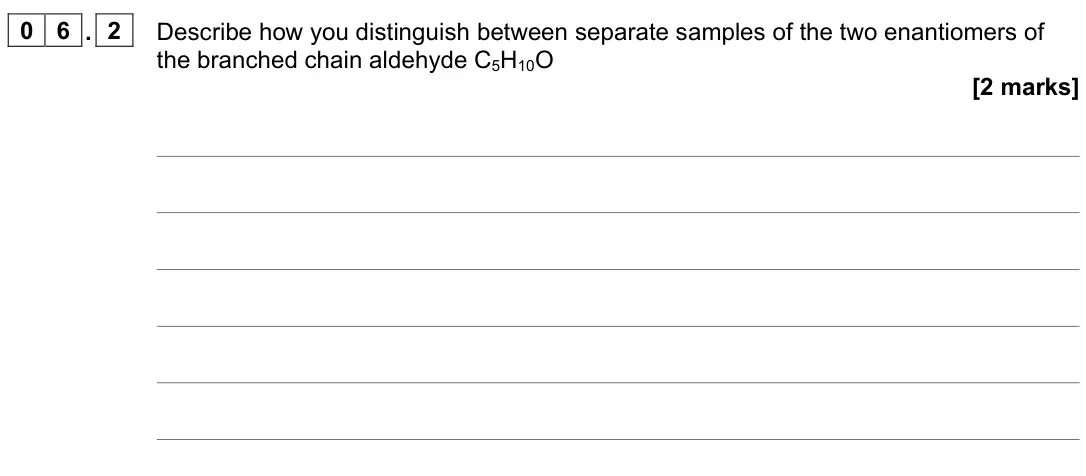
Q06.3
The whole paper ↗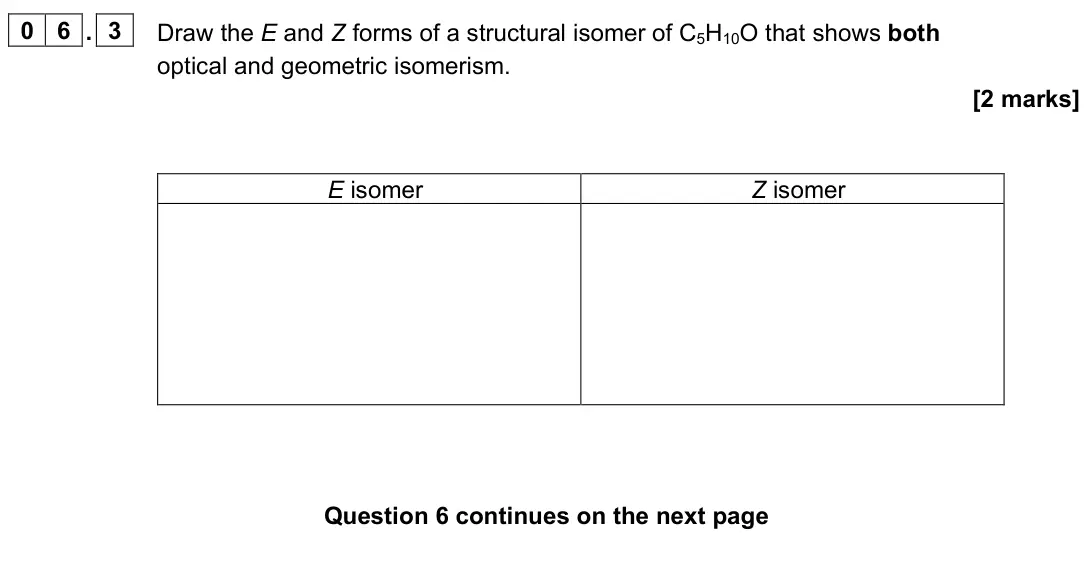
Q02.1
The whole paper ↗
Q02.4
The whole paper ↗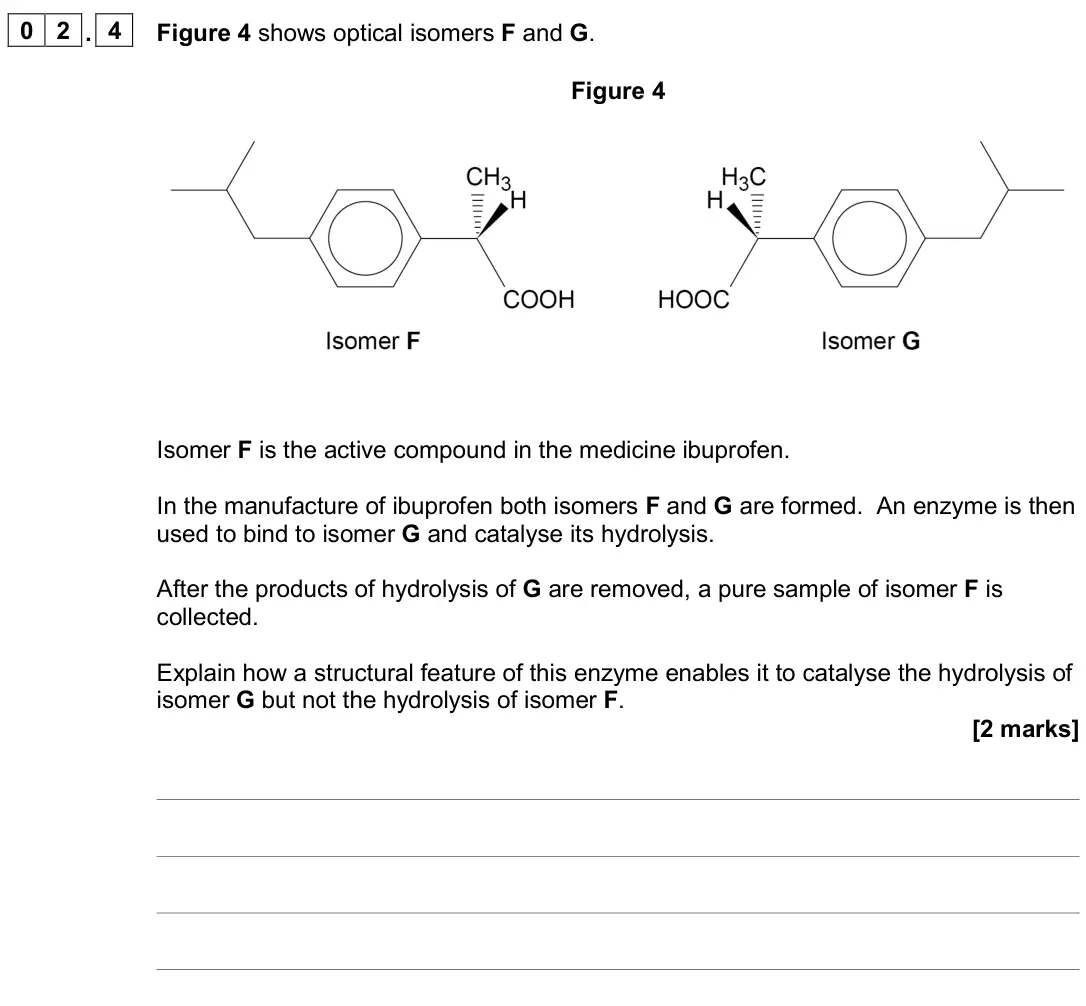
Q01.5
The whole paper ↗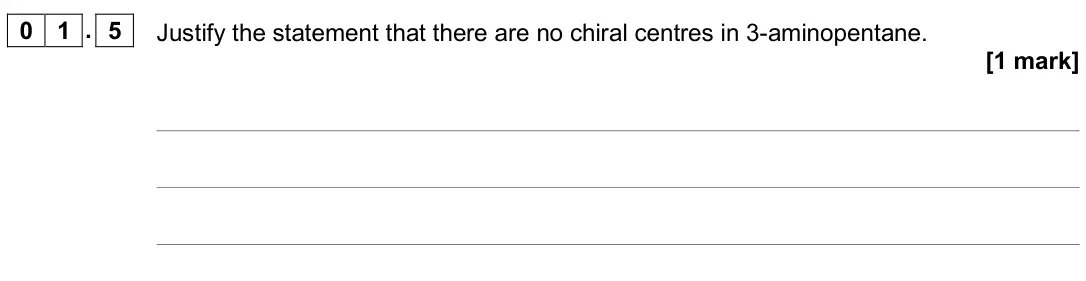
Q04.2
The whole paper ↗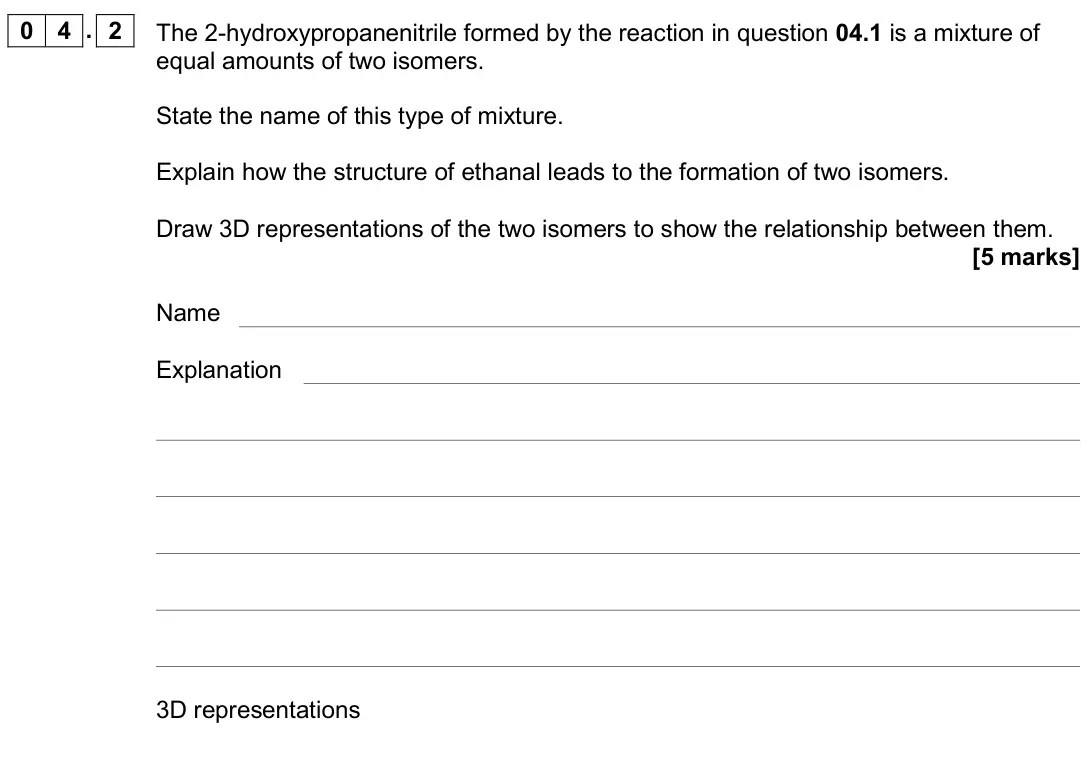
Q04.2
The whole paper ↗
Q04.3
The whole paper ↗
Q04.4
The whole paper ↗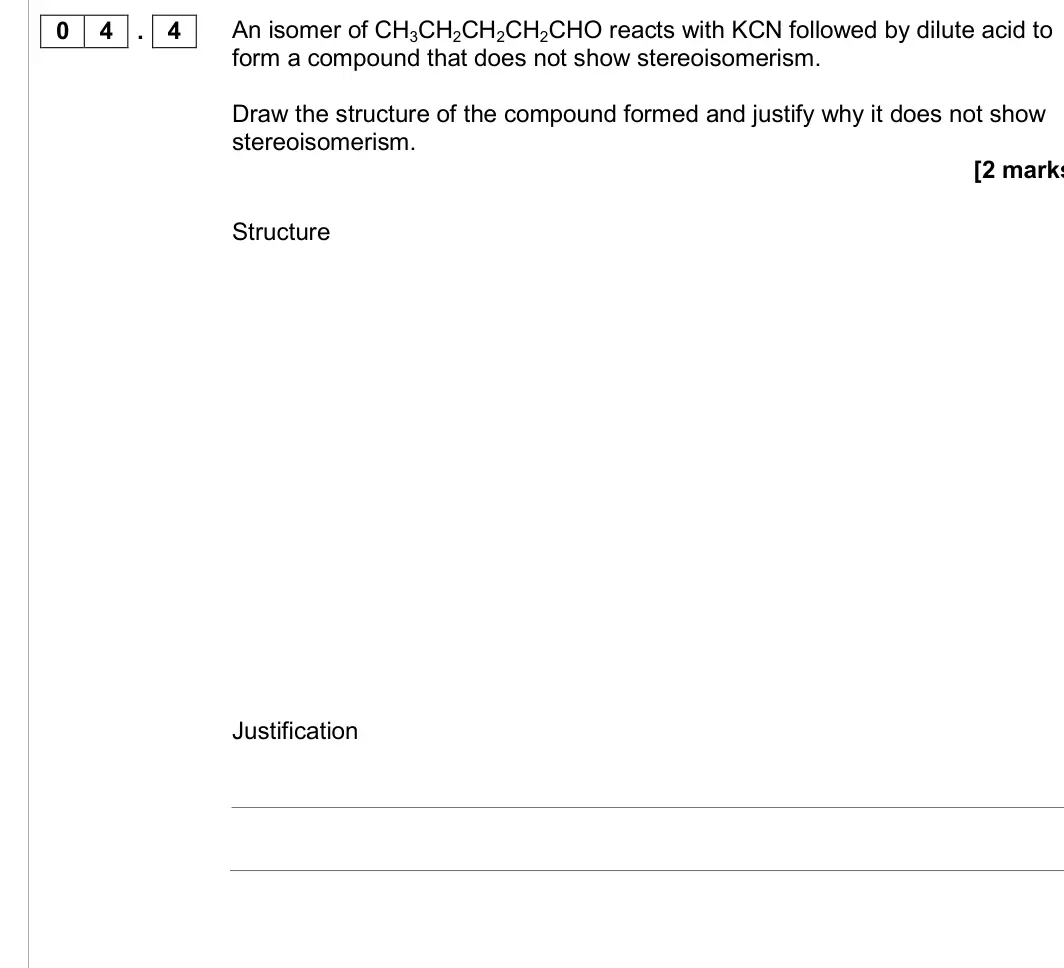
Q03.5
The whole paper ↗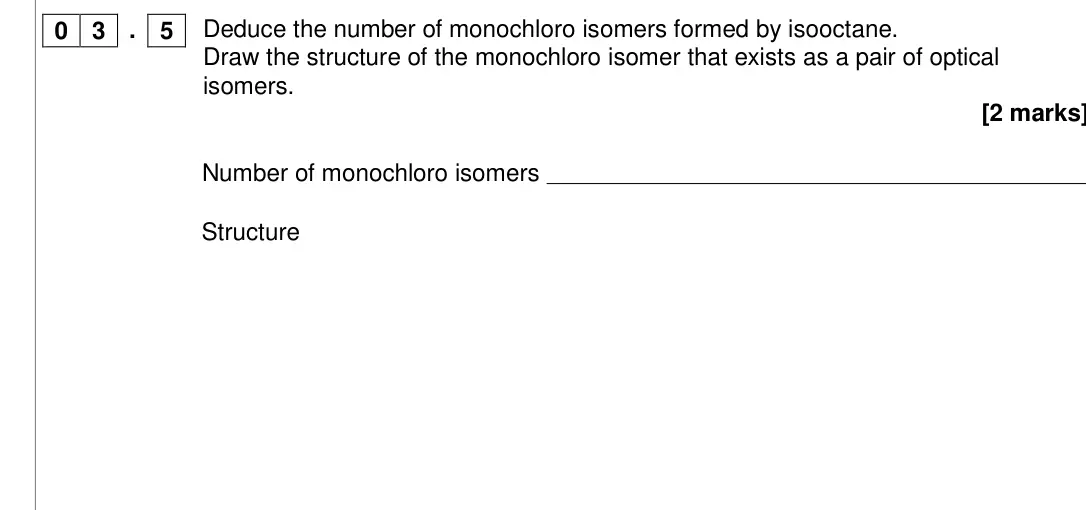
Q11.2
The whole paper ↗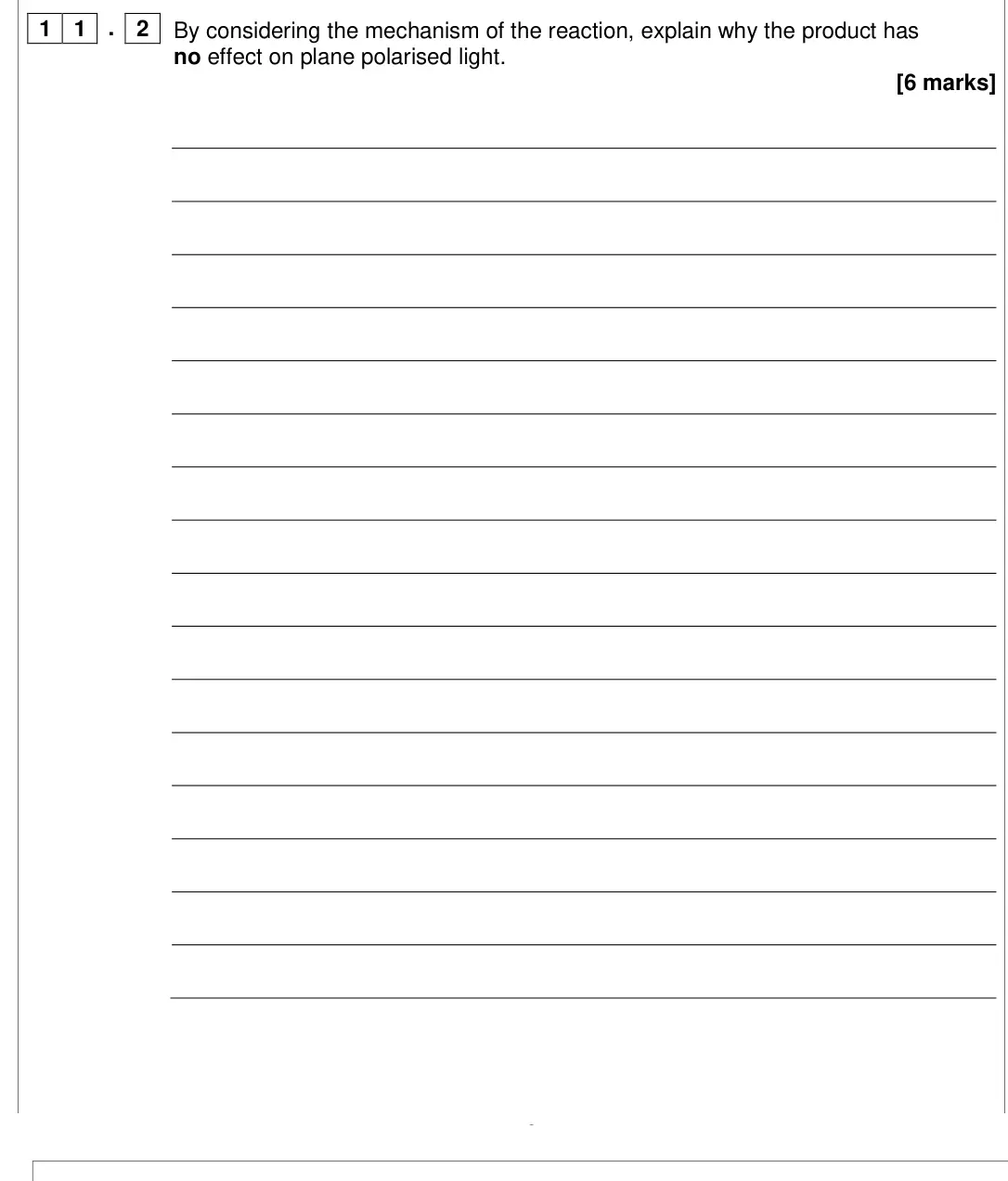
Q12.3
The whole paper ↗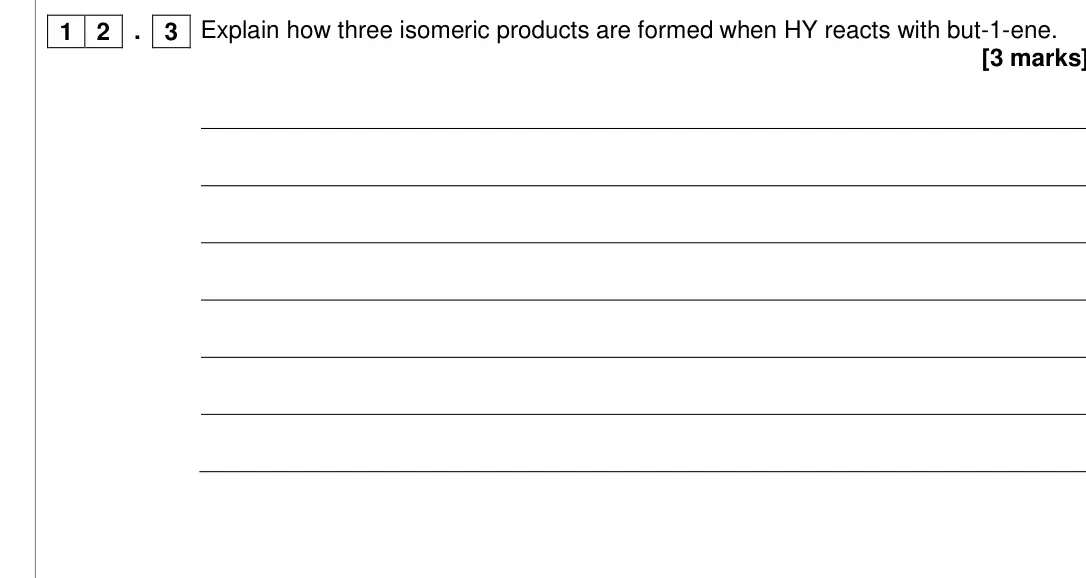
All 20 questions on Optical isomerism, as a list
- June 2024, Paper 2, Q06.2 (1 mark): Isomer V has an asymmetric carbon atom. Deduce the structure of V. [1 mark]
- June 2024, Paper 2, Q08.4 (3 marks): Explain why Step 4 produces a racemic mixture. [3 marks]
- June 2022, Paper 3, Q03.6 (2 marks): Draw 3D representations of enantiomers D and E to show how their structures are related. [2 marks]
- November 2021, Paper 2, Q06.1 (1 mark): Draw the skeletal formula of a branched chain aldehyde with molecular formula C5H10O that is optically active. [1 mark]
- November 2021, Paper 2, Q06.2 (2 marks): Describe how you distinguish between separate samples of the two enantiomers of the branched chain aldehyde C5H10O [2 marks]
- November 2021, Paper 2, Q06.3 (2 marks): Draw the E and Z forms of a structural isomer of C5H10O that shows both optical and geometric isomerism. [2 marks] E isomer Z isomer
- November 2020, Paper 2, Q02.1 (1 mark): Draw a circle around any chiral centre(s) in Figure 3. [1 mark]
- November 2020, Paper 2, Q02.4 (2 marks): Figure 4 shows optical isomers F and G. Figure 4 Isomer F is the active compound in the medicine ibuprofen. In the manufacture of ibuprofen both isomers F and G
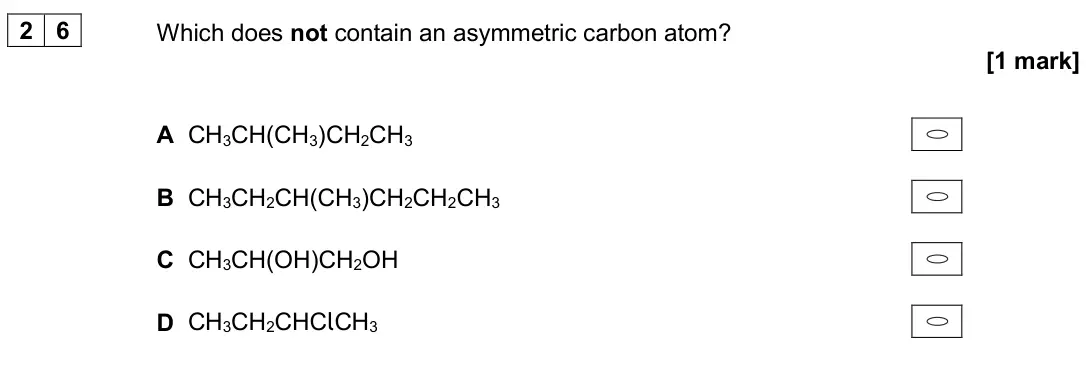
- November 2020, Paper 3, Q26 (1 mark): Which does not contain an asymmetric carbon atom? [1 mark] A CH3CH(CH3)CH2CH3 B CH3CH2CH(CH3)CH2CH2CH3 C CH3CH(OH)CH2OH D CH3CH2CHClCH3
- June 2019, Paper 2, Q01.5 (1 mark): Justify the statement that there are no chiral centres in 3-aminopentane. [1 mark]
- June 2019, Paper 3, Q04.2 (5 marks): The 2-hydroxypropanenitrile formed by the reaction in question 04.1 is a mixture of equal amounts of two isomers. State the name of this type of mixture. Explai
- June 2017, Paper 2, Q04.2 (2 marks): Describe how you would distinguish between separate samples of the two stereoisomers of CH3CH2CH2CH2CH(OH)CN [2 marks
- June 2017, Paper 2, Q04.3 (3 marks): Explain why the reaction produces a racemic mixture. [3 marks
- June 2017, Paper 2, Q04.4 (2 marks): An isomer of CH3CH2CH2CH2CHO reacts with KCN followed by dilute acid to form a compound that does not show stereoisomerism. Draw the structure of the compound f
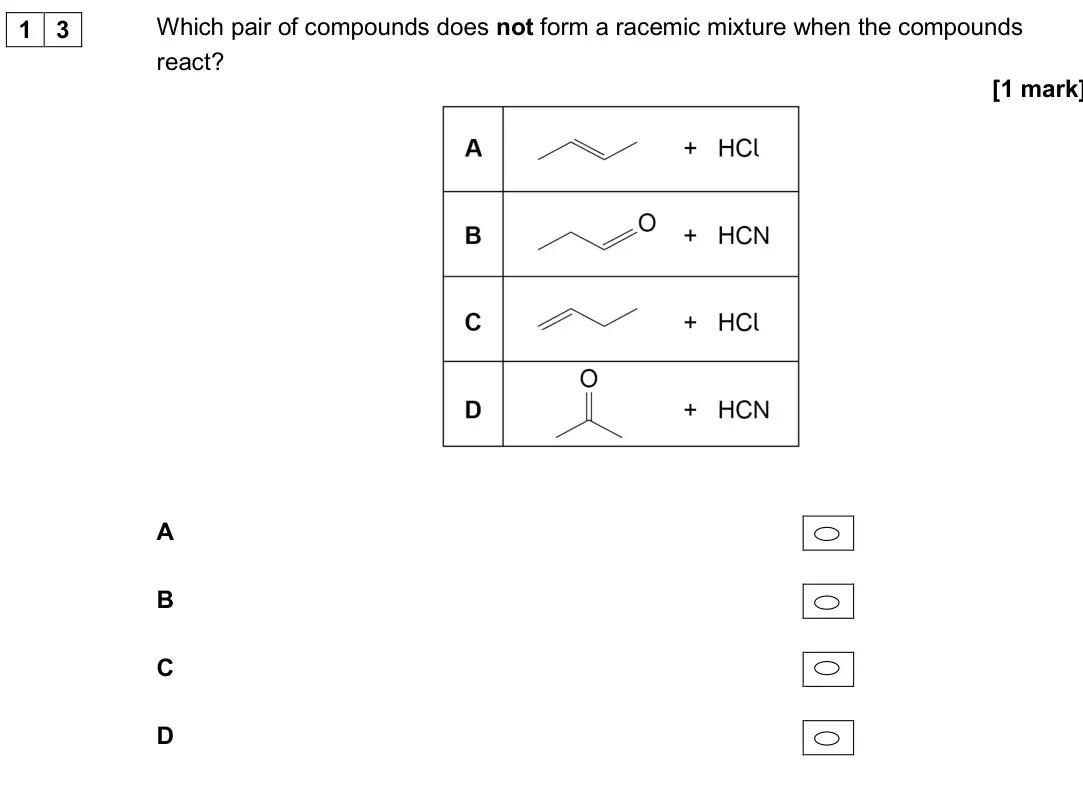
- June 2017, Paper 3, Q13 (1 mark): Which pair of compounds does not form a racemic mixture when the compounds react? [1 mark] A B C D
- Specimen, Paper 2, Q03.5 (2 marks): Number of monochloro isomers Structure
- Specimen, Paper 2, Q11.2 (6 marks): 9
- Specimen, Paper 2, Q12.3 (3 marks): 12 But-1-ene reacts with a reagent of the form HY to form a saturated compound. Explain how three isomeric products are formed when HY reacts with but-1-ene. [3
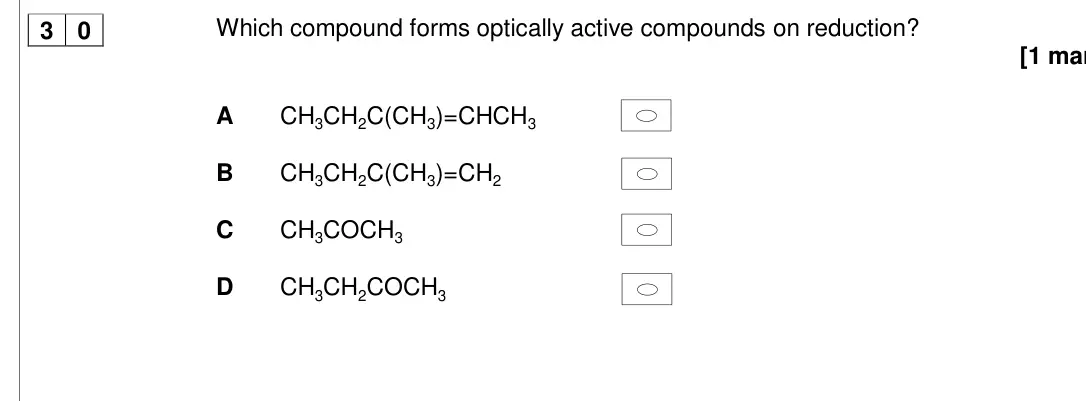
- Specimen, Paper 3, Q30: Which compound forms optically active compounds on reduction? [1 mar A CH3CH2C(CH3)=CHCH3 B CH3CH2C(CH3)=CH2 C CH3COCH3 D CH3CH2COCH3 3 0
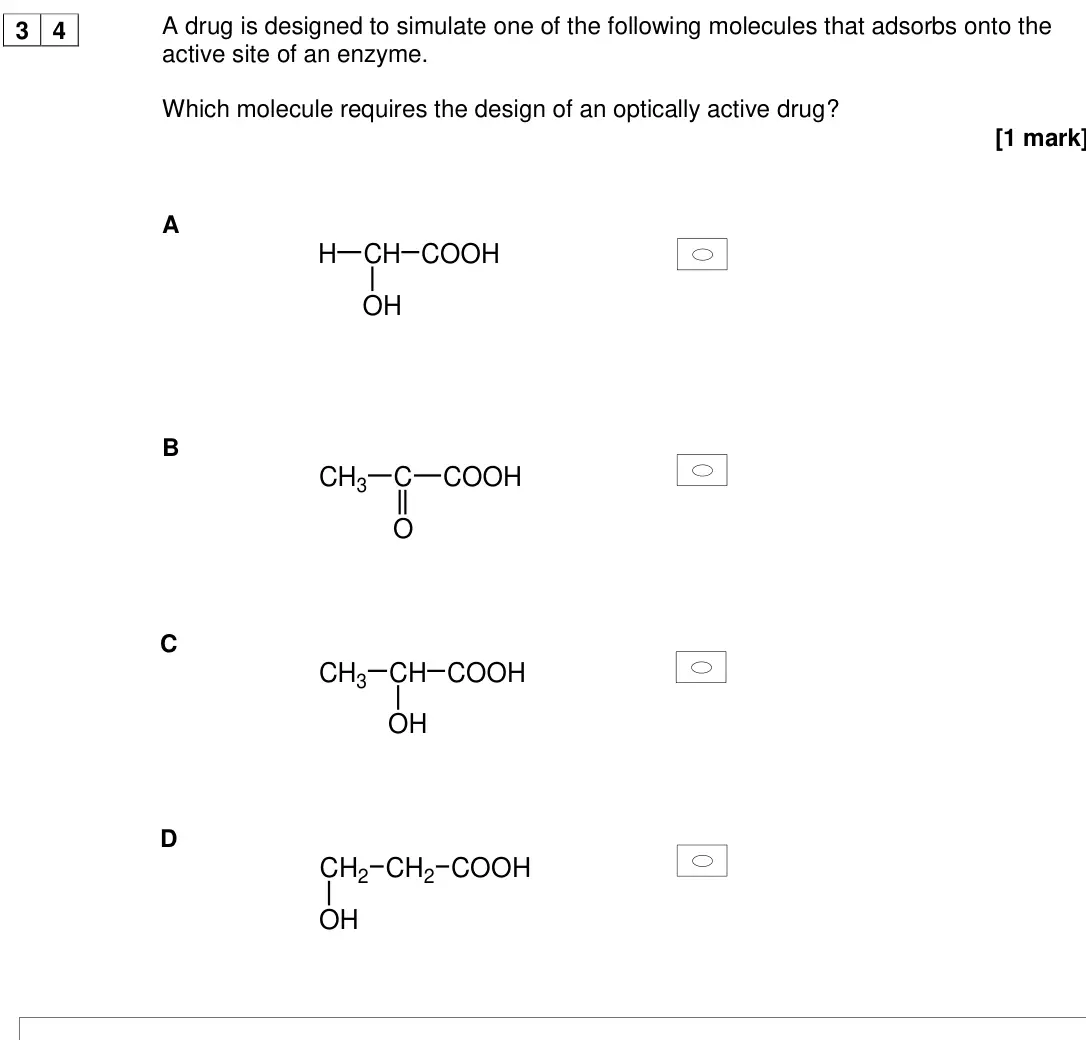
- Specimen, Paper 3, Q34 (1 mark): A drug is designed to simulate one of the following molecules that adsorbs onto the active site of an enzyme. Which molecule requires the design of an optically
Questions, mark schemes and examiner’s reports are © AQA, from their published past papers. Plumi isn’t affiliated with any exam board. Want whole papers? Every AQA A-Level Chemistry paper.
Rather write your answers by hand on iPad? Plumi marks them against the same mark schemes.