 plumi
Chromatography: AQA A‑Level Chemistry questions
Every AQA A-Level Chemistry exam question on 3.3.16 Chromatography, 2016–2025, with its mark scheme and examiner’s report.
Find questions2,301
Calculations
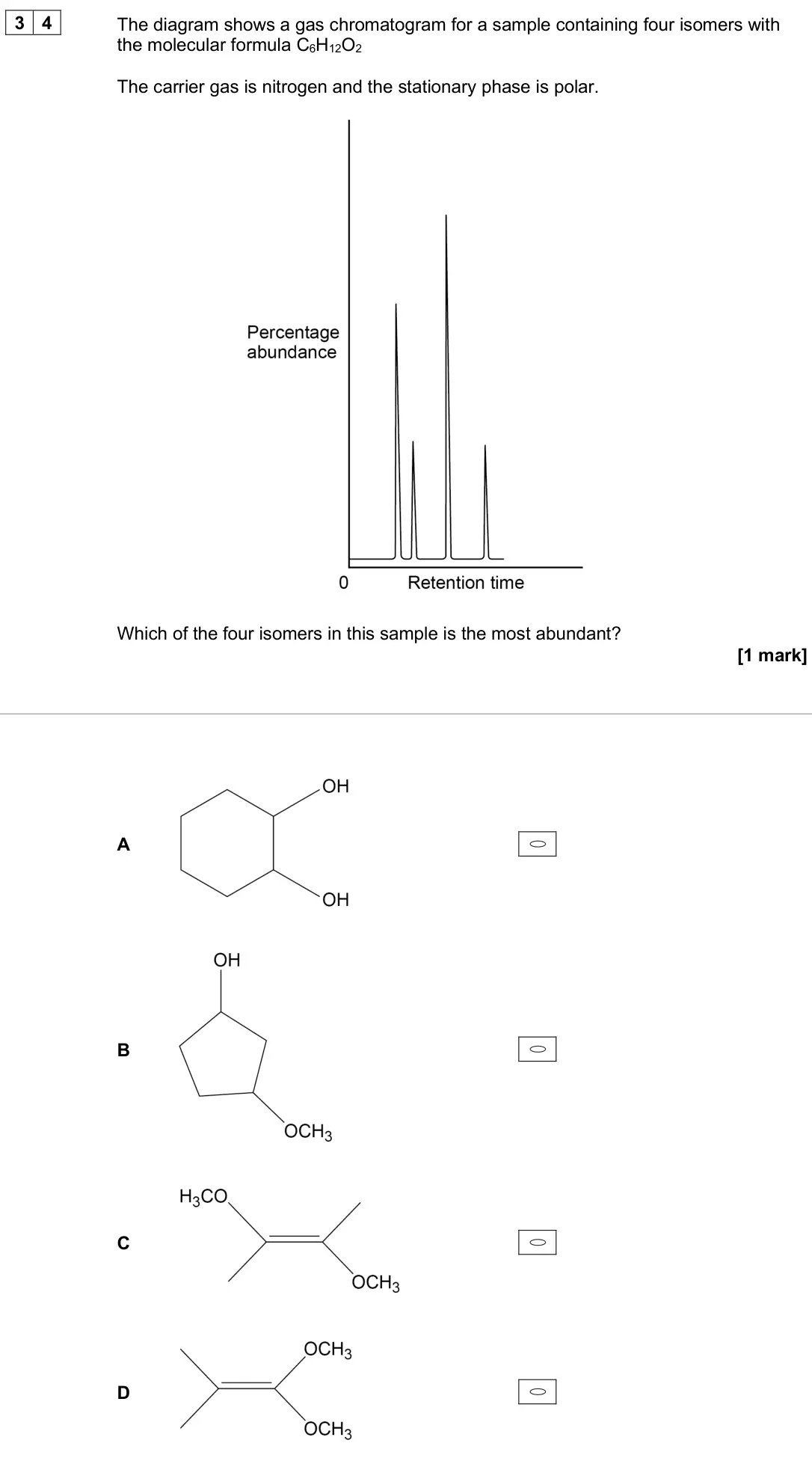
Q03.4
The whole paper ↗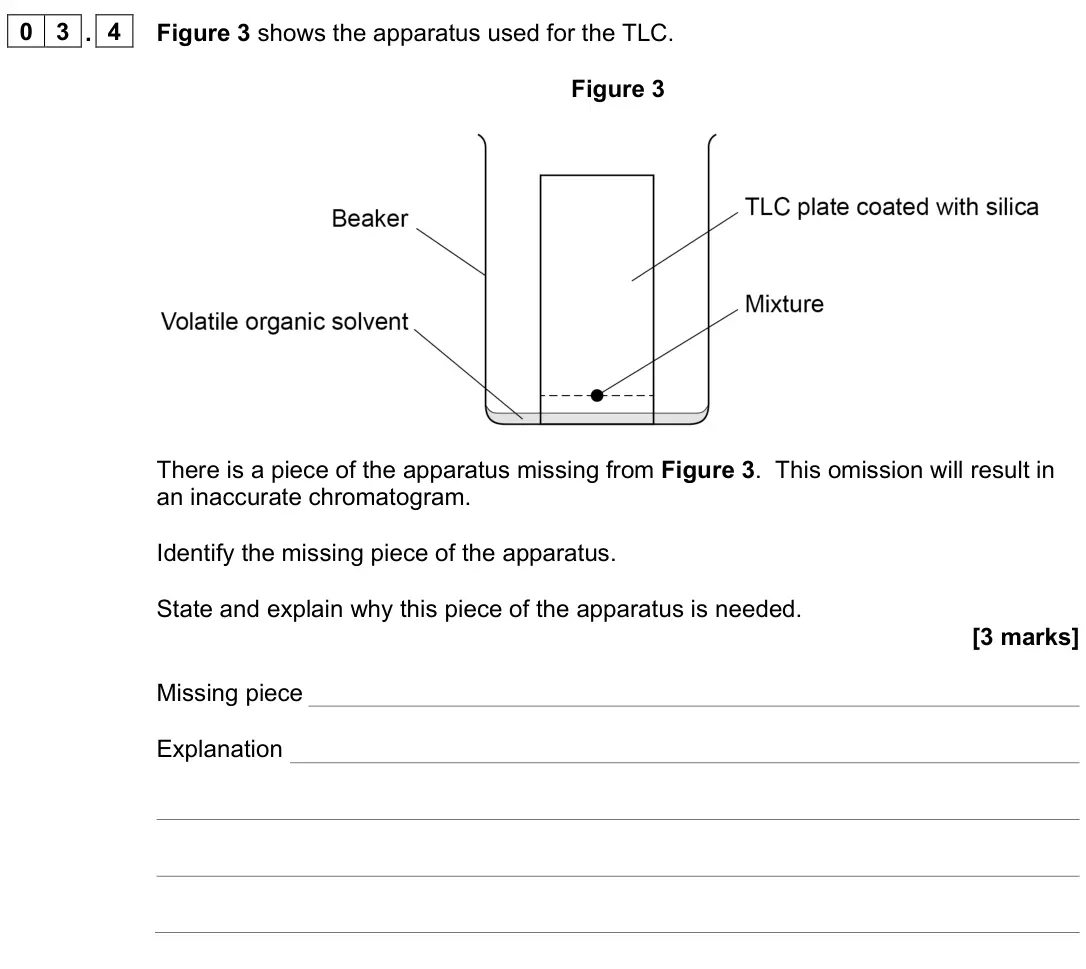
Q03.5
The whole paper ↗
Q03.6
The whole paper ↗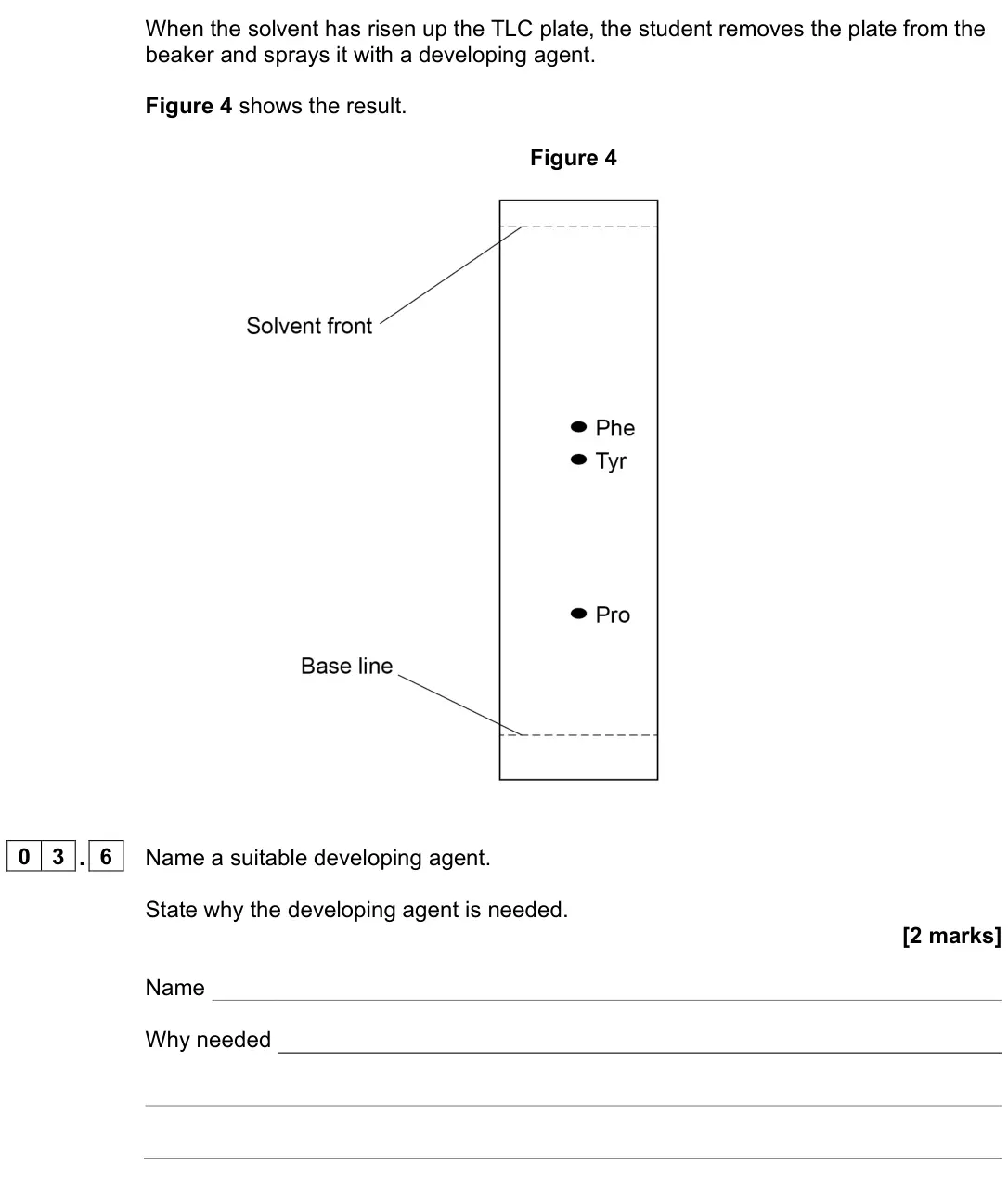
Q03.7
The whole paper ↗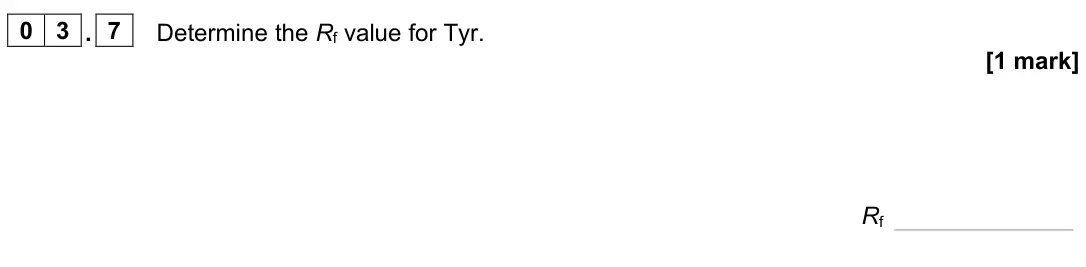
Q02.1
The whole paper ↗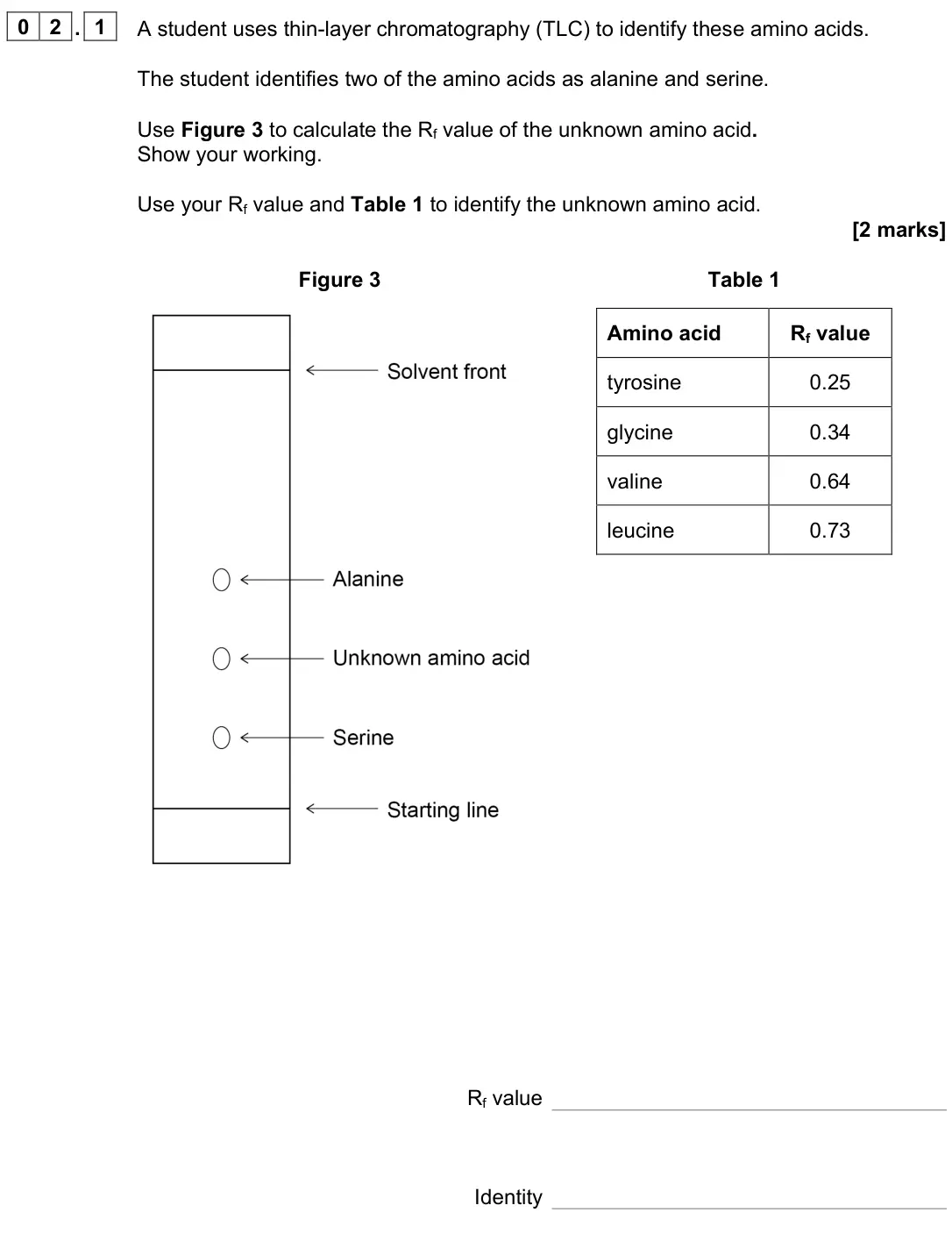
Q02.2
The whole paper ↗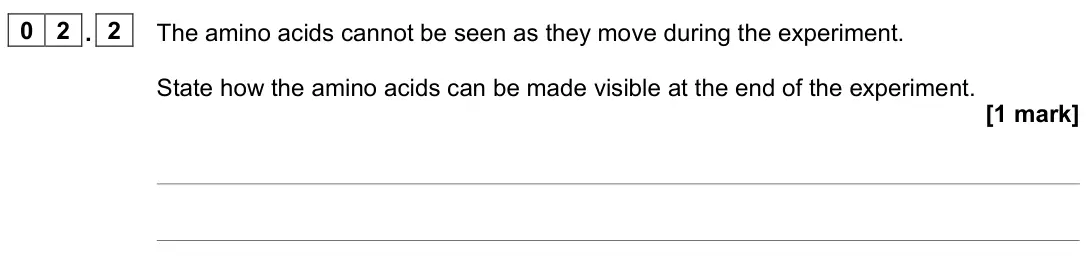
Q02.3
The whole paper ↗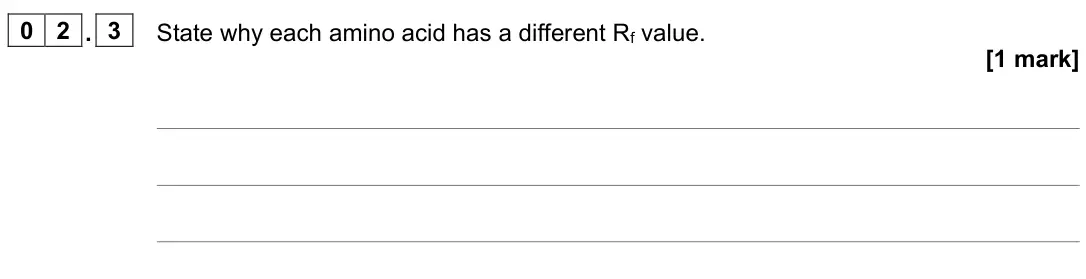
Q09.2
The whole paper ↗
Q09.4
The whole paper ↗
Q03.7
The whole paper ↗
Q08.3
The whole paper ↗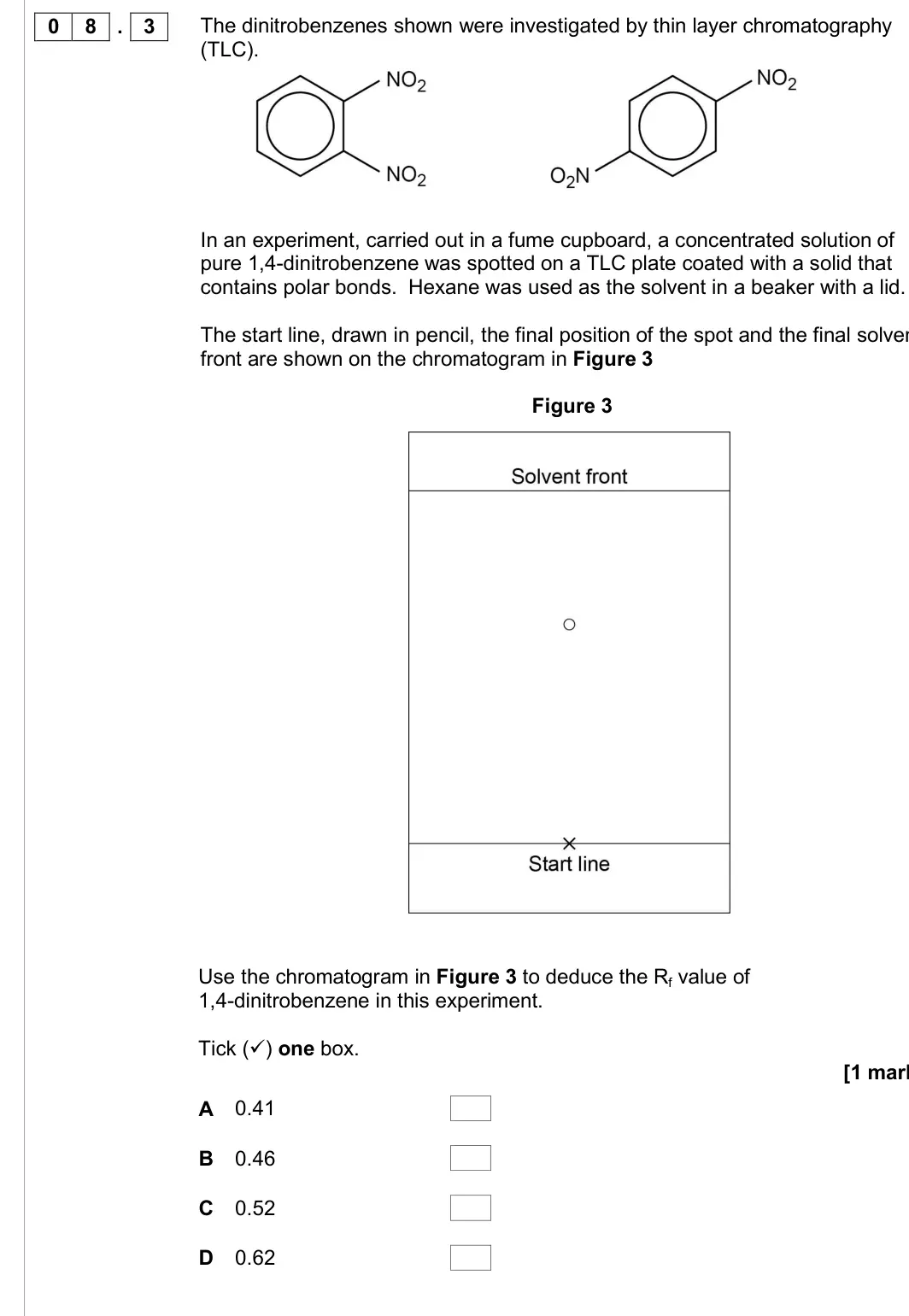
Q08.4
The whole paper ↗
Q08.5
The whole paper ↗
Q08.6
The whole paper ↗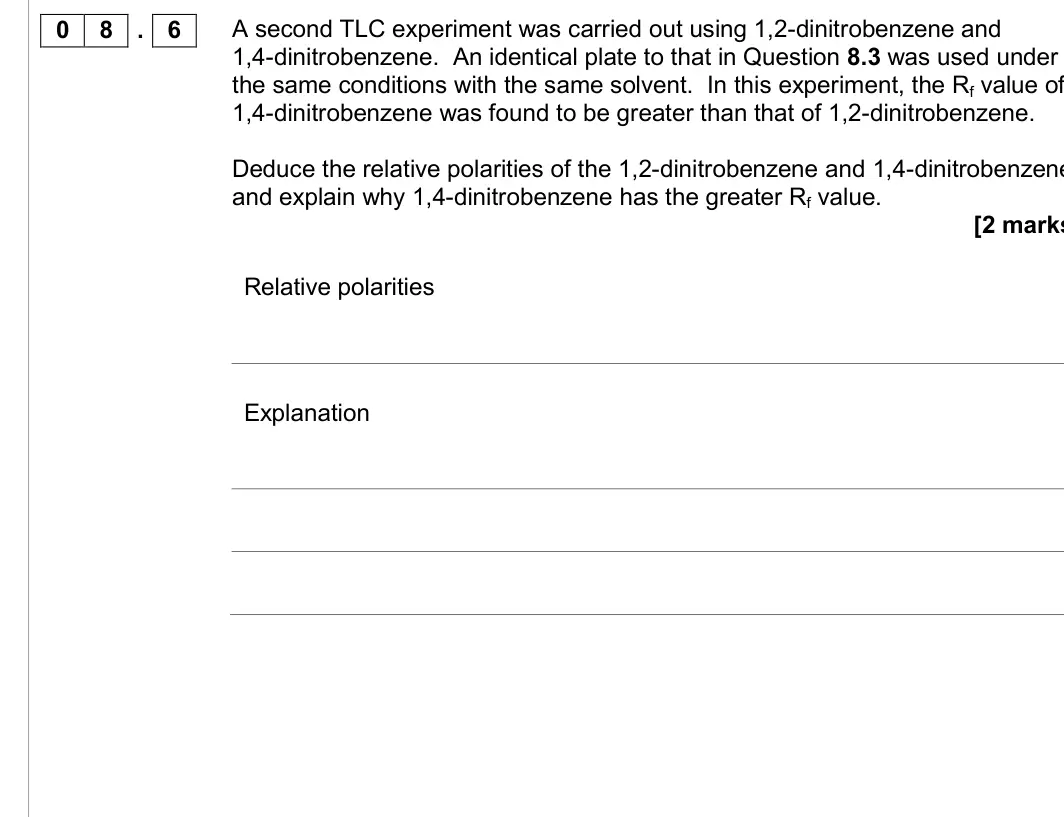
Q08.7
The whole paper ↗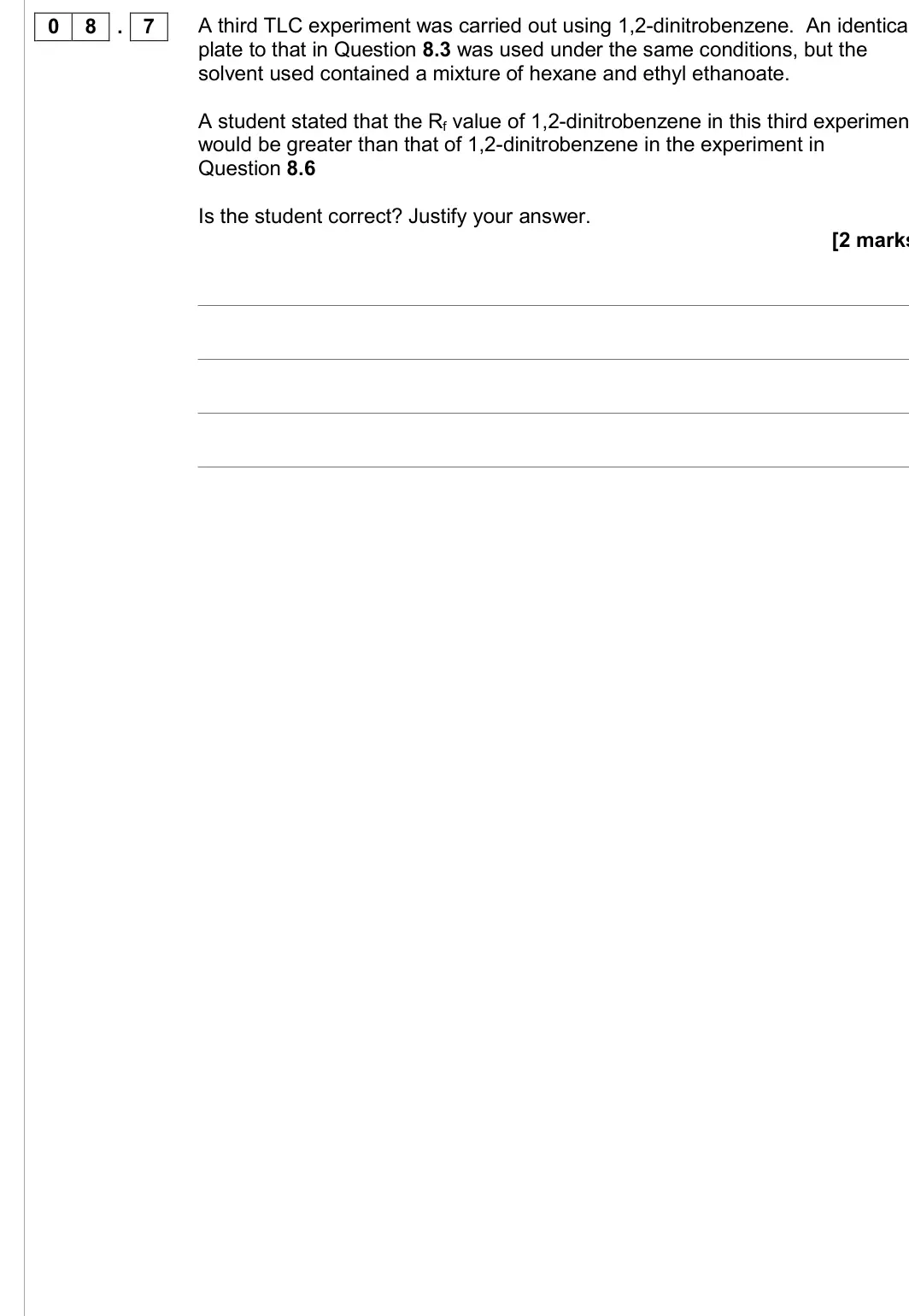
Q03.1
The whole paper ↗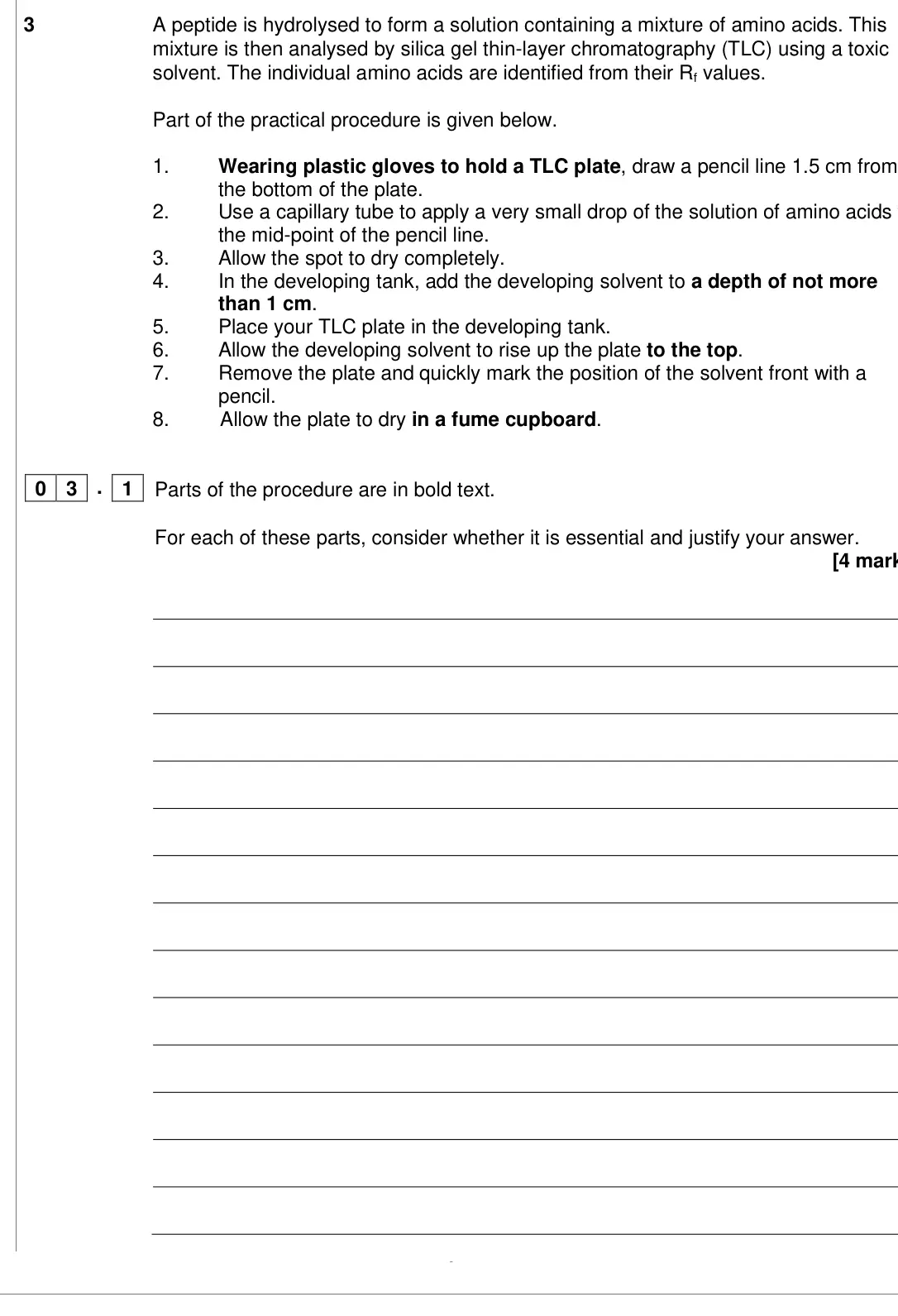
Q03.2
The whole paper ↗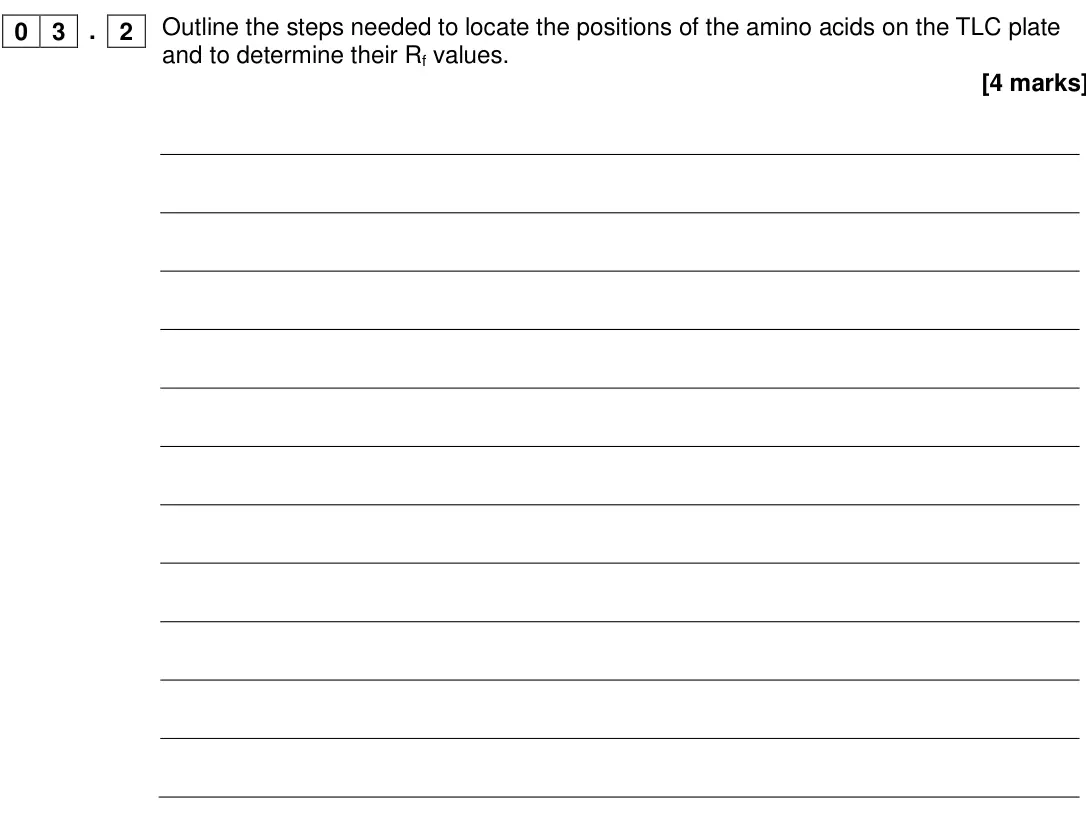
Q03.3
The whole paper ↗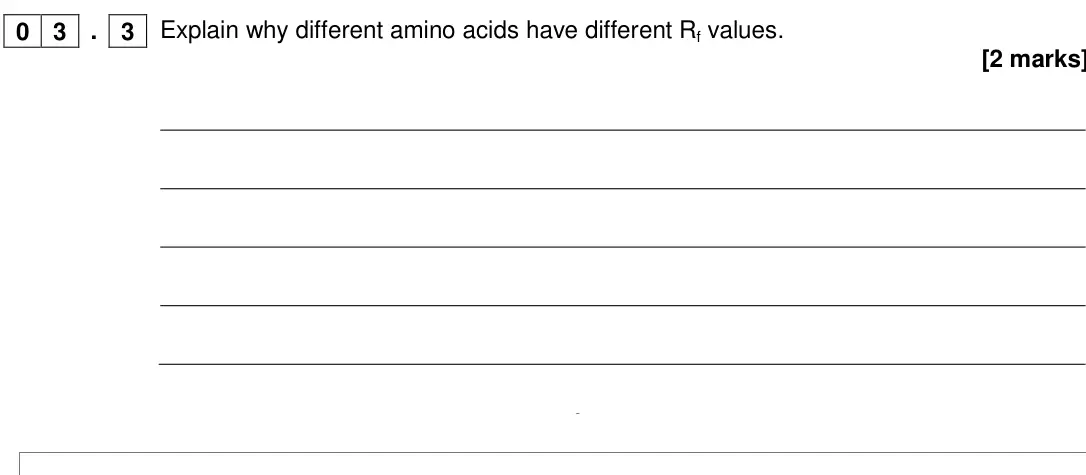
All 20 questions on Chromatography, as a list
- June 2024, Paper 3, Q34 (1 mark): The diagram shows a gas chromatogram for a sample containing four isomers with the molecular formula C6H12O2 The carrier gas is nitrogen and the stationary phas
- June 2023, Paper 3, Q03.4 (3 marks): Figure 3 shows the apparatus used for the TLC. Figure 3 There is a piece of the apparatus missing from Figure 3. This omission will result in an inaccurate chro
- June 2023, Paper 3, Q03.5 (1 mark): State why the amino acids separate on the TLC plate. [1 mark]
- June 2023, Paper 3, Q03.6 (2 marks): Name a suitable developing agent. State why the developing agent is needed. [2 marks] Name Why needed
- June 2023, Paper 3, Q03.7 (1 mark): Determine the Rf value for Tyr. [1 mark] Rf
- November 2021, Paper 3, Q02.1 (2 marks): A student uses thin-layer chromatography (TLC) to identify these amino acids. The student identifies two of the amino acids as alanine and serine. Use Figure 3
- November 2021, Paper 3, Q02.2 (1 mark): The amino acids cannot be seen as they move during the experiment. State how the amino acids can be made visible at the end of the experiment. [1 mark]
- November 2021, Paper 3, Q02.3 (1 mark): State why each amino acid has a different Rf value. [1 mark]
- June 2019, Paper 2, Q09.2 (1 mark): Suggest how the positions of the amino acids on the TLC plate were located. [1 mark]
- June 2019, Paper 2, Q09.3 (1 mark): Deduce the minimum number of amino acids present in the original mixture. [1 mark]
- June 2019, Paper 2, Q09.4 (1 mark): Suggest why it was necessary to use two different solvents. [1 mark]
- June 2018, Paper 3, Q03.7 (2 marks): A sample of cyclohexene has been contaminated with cyclohexanol. The cyclohexene can be separated from the cyclohexanol by column chromatography. Silica gel is
- June 2017, Paper 2, Q08.3 (1 mark): The dinitrobenzenes shown were investigated by thin layer chromatography (TLC). In an experiment, carried out in a fume cupboard, a concentrated solution of pur
- June 2017, Paper 2, Q08.4 (1 mark): State in general terms what determines the distance travelled by a spot in TLC [1 mark
- June 2017, Paper 2, Q08.5 (1 mark): To obtain the chromatogram, the TLC plate was held by the edges and placed in the solvent in the beaker in the fume cupboard. The lid was then replaced on the b
- June 2017, Paper 2, Q08.6 (2 marks): A second TLC experiment was carried out using 1,2-dinitrobenzene and 1,4-dinitrobenzene. An identical plate to that in Question 8.3 was used under the same cond
- June 2017, Paper 2, Q08.7 (2 marks): A third TLC experiment was carried out using 1,2-dinitrobenzene. An identica plate to that in Question 8.3 was used under the same conditions, but the solvent u
- Specimen, Paper 3, Q03.1 (4 marks): 9
- Specimen, Paper 3, Q03.2 (4 marks): Outline the steps needed to locate the positions of the amino acids on the TLC plate and to determine their Rf values. [4 marks] 0 3 . 2
- Specimen, Paper 3, Q03.3 (2 marks): 0
Questions, mark schemes and examiner’s reports are © AQA, from their published past papers. Plumi isn’t affiliated with any exam board. Want whole papers? Every AQA A-Level Chemistry paper.
Rather write your answers by hand on iPad? Plumi marks them against the same mark schemes.