 plumi
Polymers: AQA A‑Level Chemistry questions
Every AQA A-Level Chemistry exam question on 3.3.12 Polymers, 2016–2025, with its mark scheme and examiner’s report.
Find questions2,301
Calculations
Q03.7
The whole paper ↗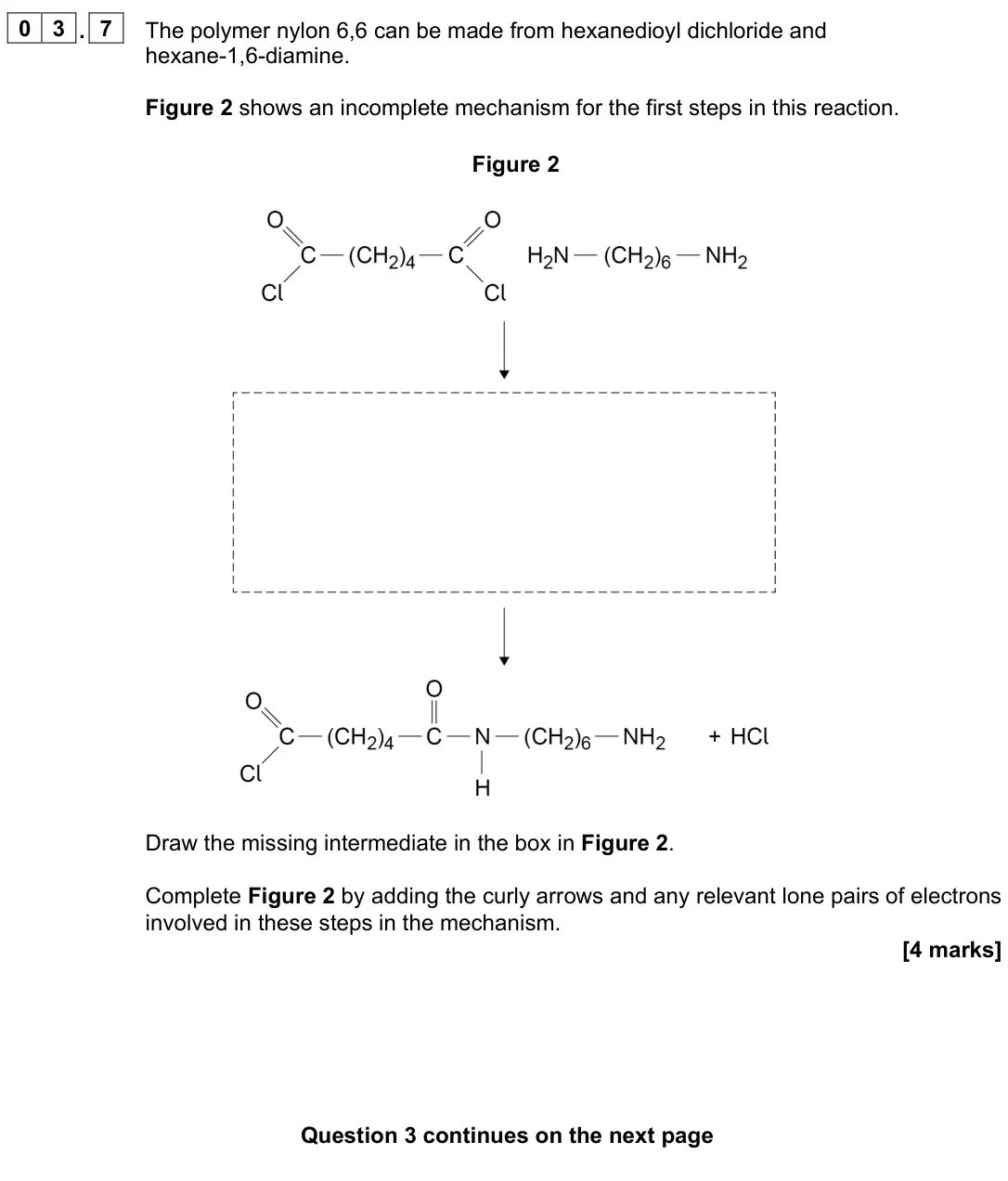
Q03.8
The whole paper ↗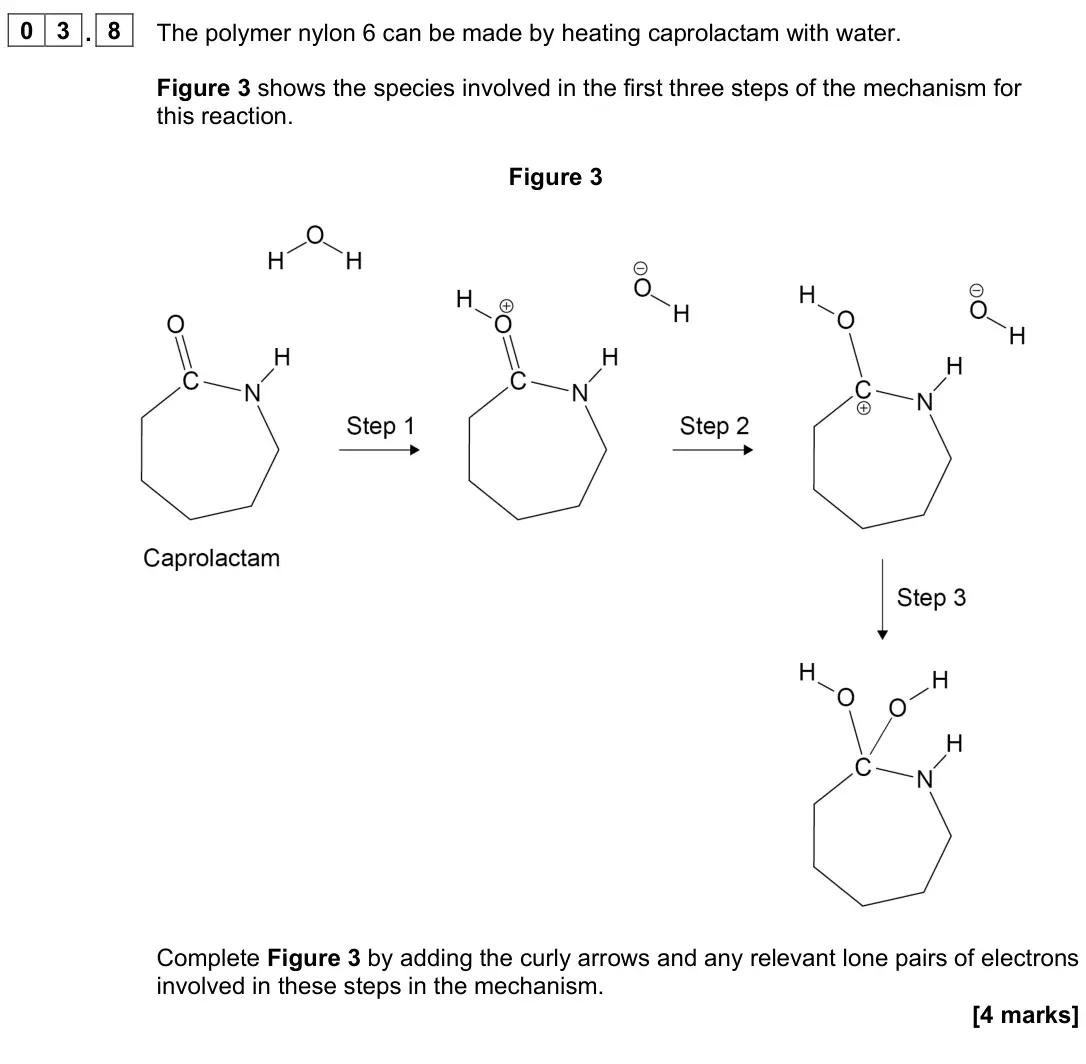
Q04.5
The whole paper ↗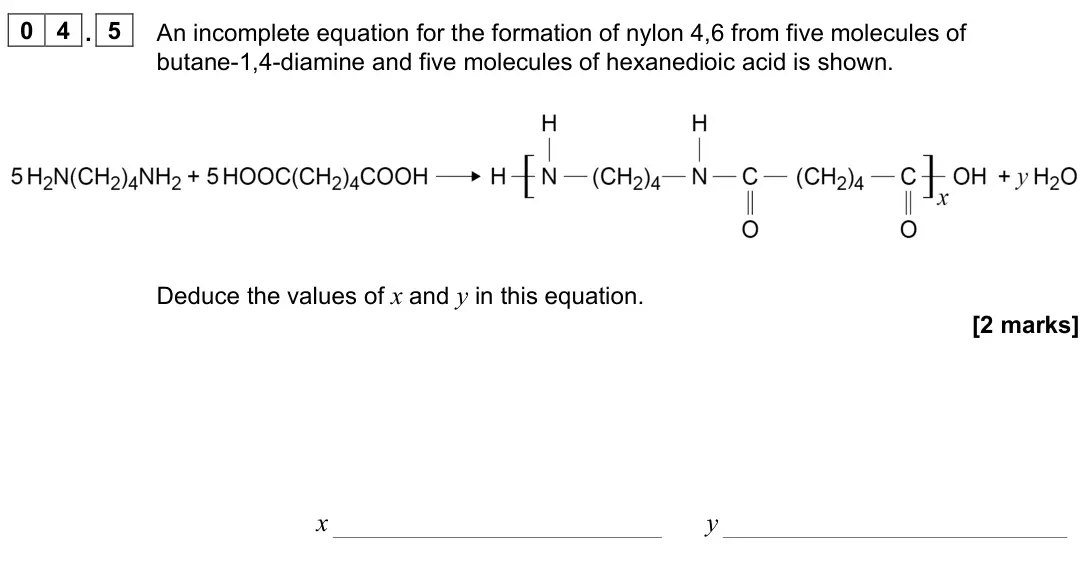
Q04.6
The whole paper ↗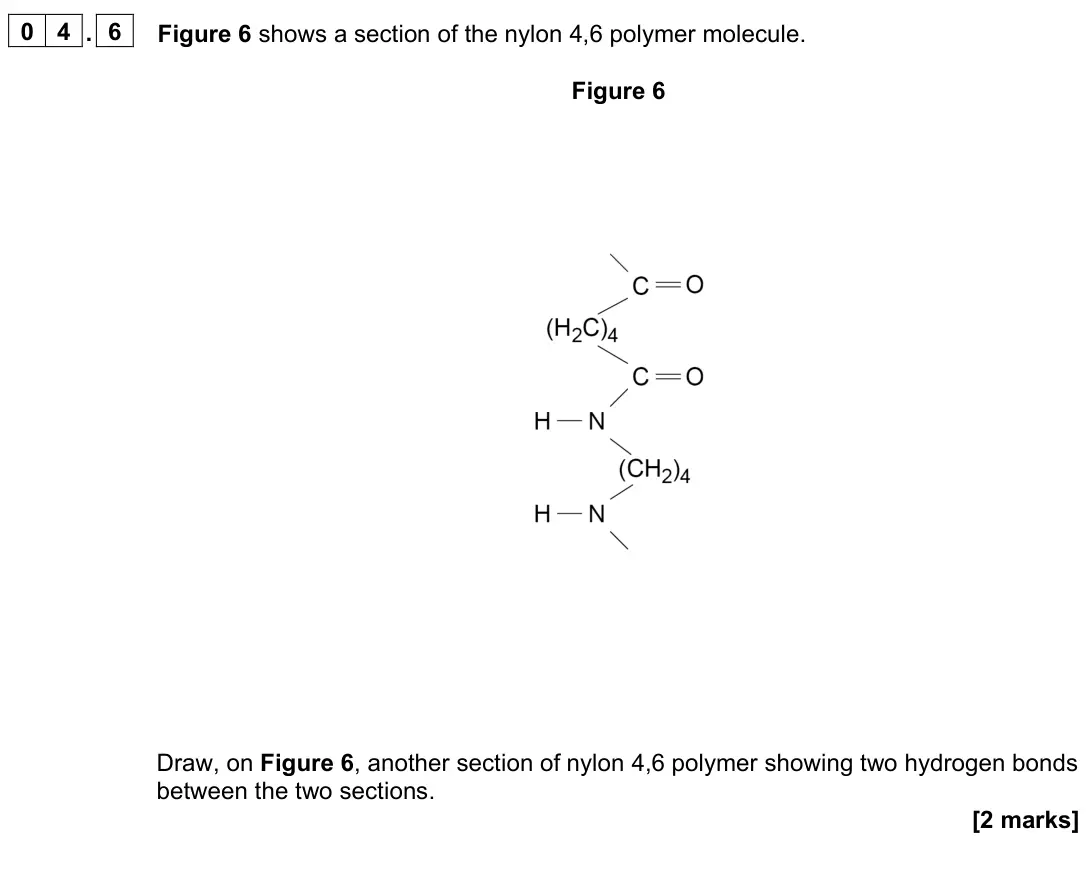
Q03.4
The whole paper ↗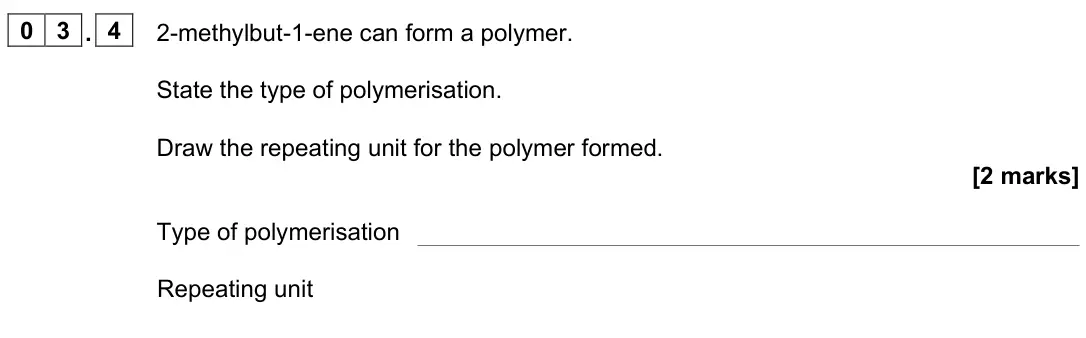
Q01.1
The whole paper ↗
Q01.2
The whole paper ↗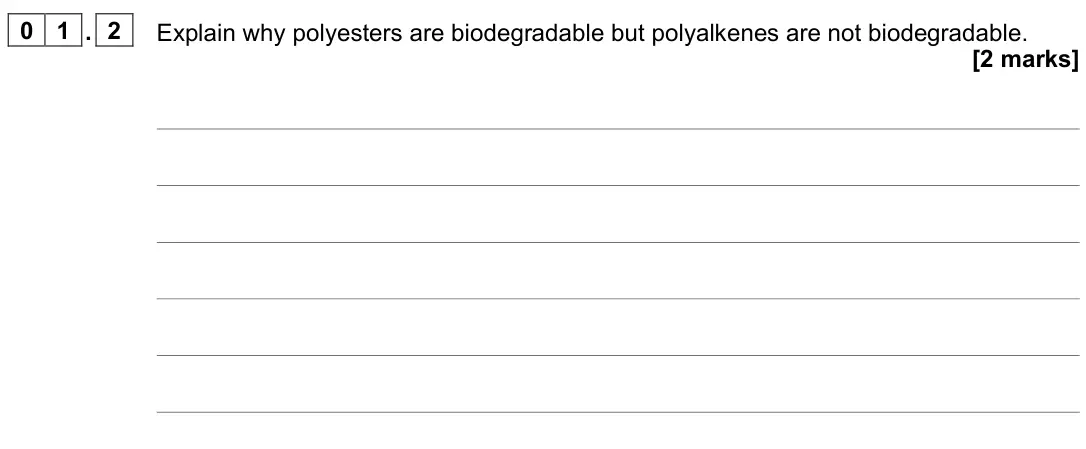
Q03.2
The whole paper ↗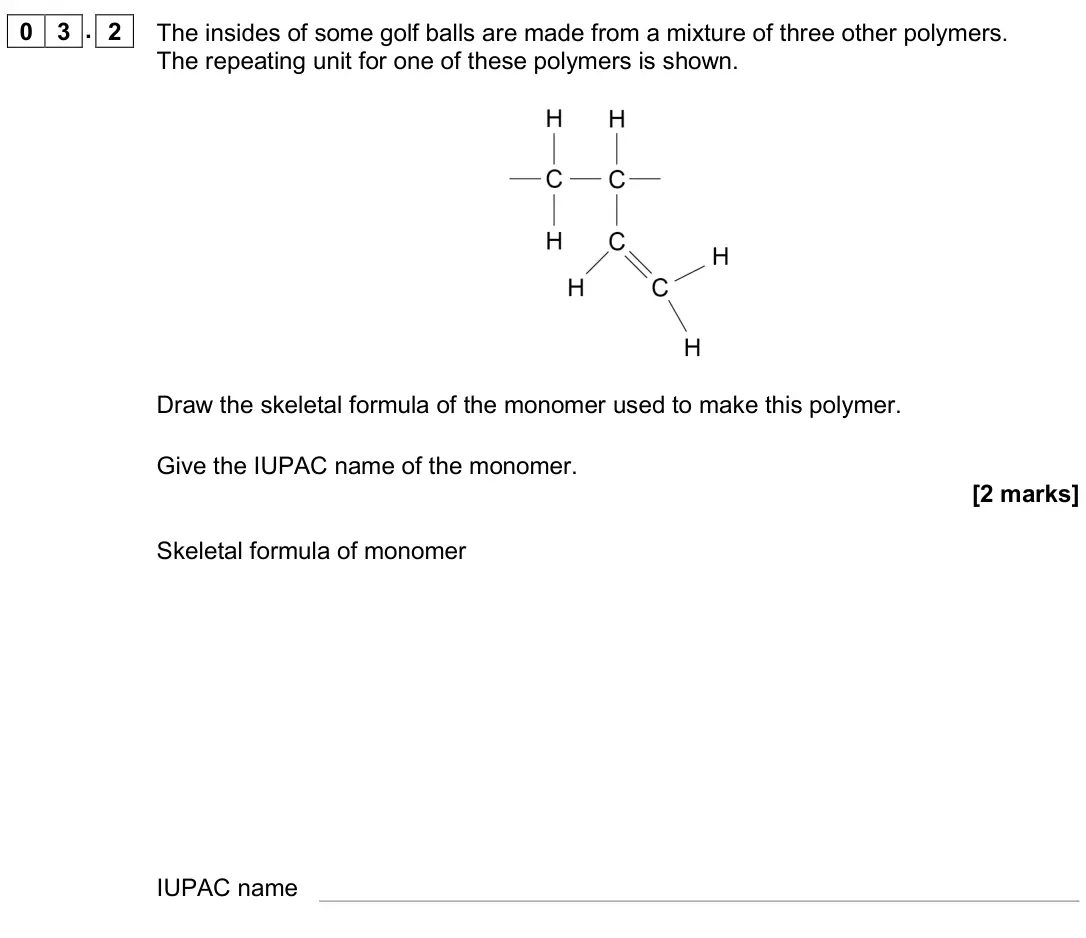
Q03.3
The whole paper ↗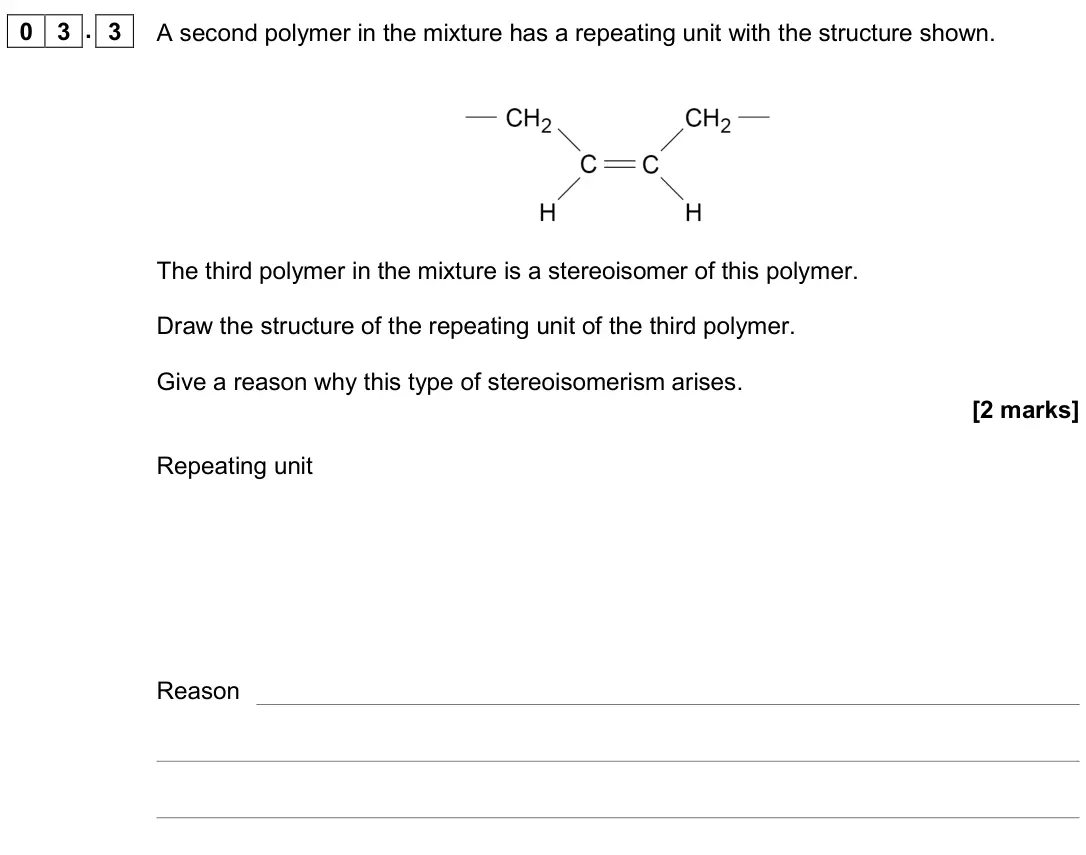
Q03.4
The whole paper ↗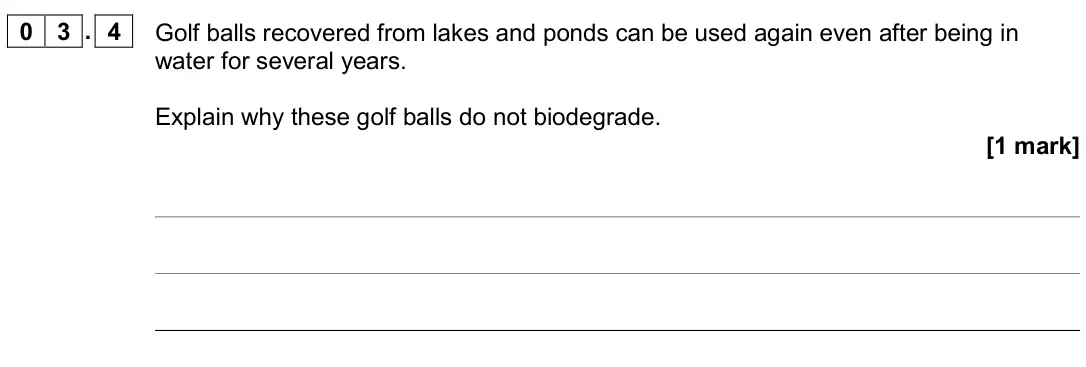
All 29 questions on Polymers, as a list
- June 2025, Paper 2, Q03.7 (4 marks): The polymer nylon 6,6 can be made from hexanedioyl dichloride and hexane-1,6-diamine. Figure 2 shows an incomplete mechanism for the first steps in this reactio
- June 2025, Paper 2, Q03.8 (4 marks): The polymer nylon 6 can be made by heating caprolactam with water. Figure 3 shows the species involved in the first three steps of the mechanism for this reacti
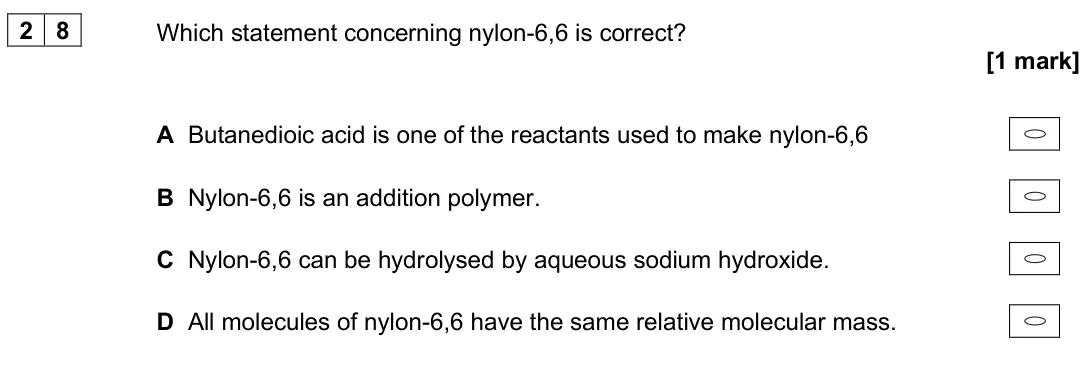
- June 2024, Paper 3, Q28 (1 mark): Which statement concerning nylon-6,6 is correct? [1 mark] A Butanedioic acid is one of the reactants used to make nylon-6,6 B Nylon-6,6 is an addition polymer.
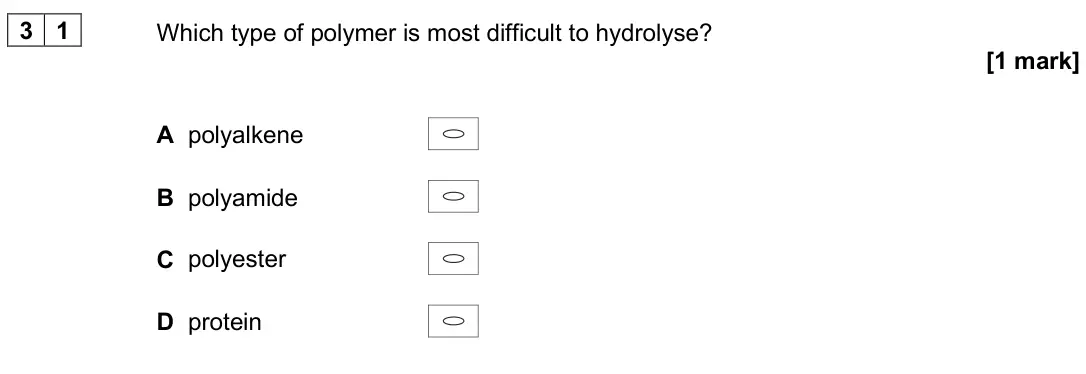
- June 2024, Paper 3, Q31 (1 mark): Which type of polymer is most difficult to hydrolyse? [1 mark] A polyalkene B polyamide C polyester D protein
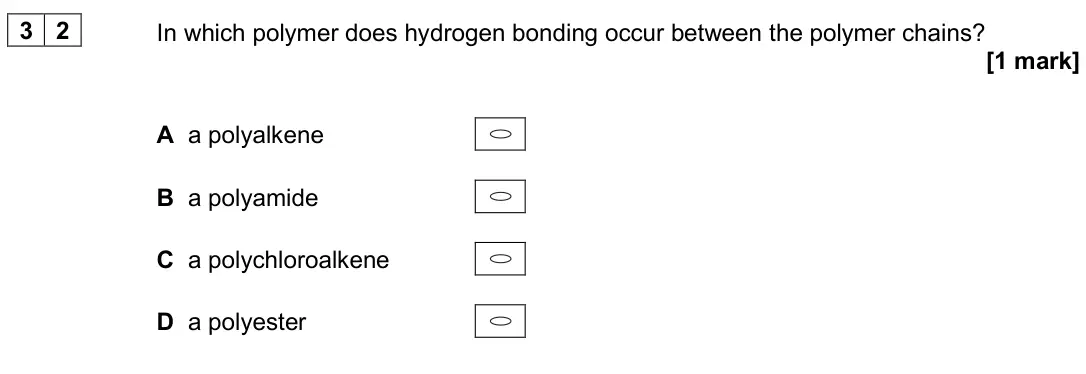
- June 2024, Paper 3, Q32 (1 mark): In which polymer does hydrogen bonding occur between the polymer chains? [1 mark] A a polyalkene B a polyamide C a polychloroalkene D a polyester
- June 2023, Paper 2, Q04.5 (2 marks): An incomplete equation for the formation of nylon 4,6 from five molecules of butane-1,4-diamine and five molecules of hexanedioic acid is shown. Deduce the valu
- June 2023, Paper 2, Q04.6 (2 marks): Figure 6 shows a section of the nylon 4,6 polymer molecule. Figure 6 Draw, on Figure 6, another section of nylon 4,6 polymer showing two hydrogen bonds between
- June 2022, Paper 2, Q03.4 (2 marks): 2-methylbut-1-ene can form a polymer. State the type of polymerisation. Draw the repeating unit for the polymer formed. [2 marks] Type of polymerisation Repeati
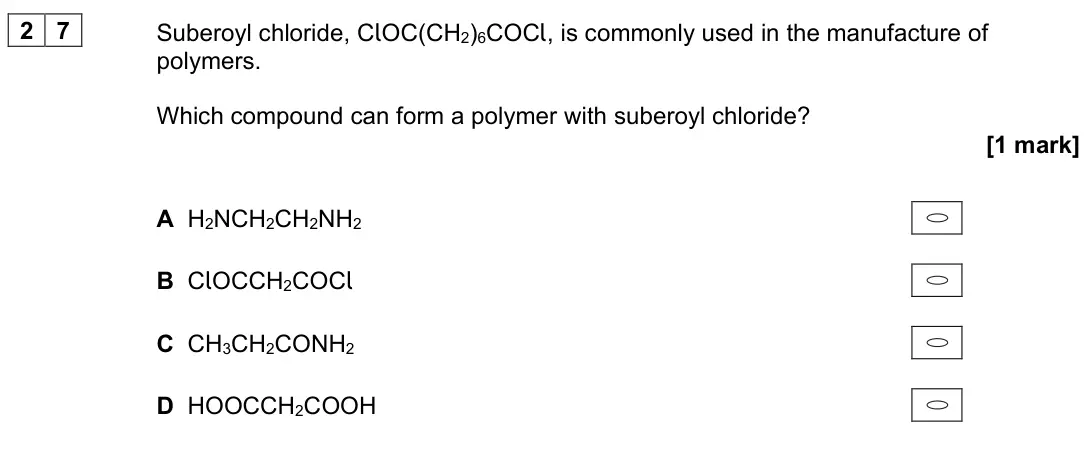
- June 2022, Paper 3, Q27 (1 mark): Suberoyl chloride, ClOC(CH2)6COCl, is commonly used in the manufacture of polymers. Which compound can form a polymer with suberoyl chloride? [1 mark] A H2NCH2C
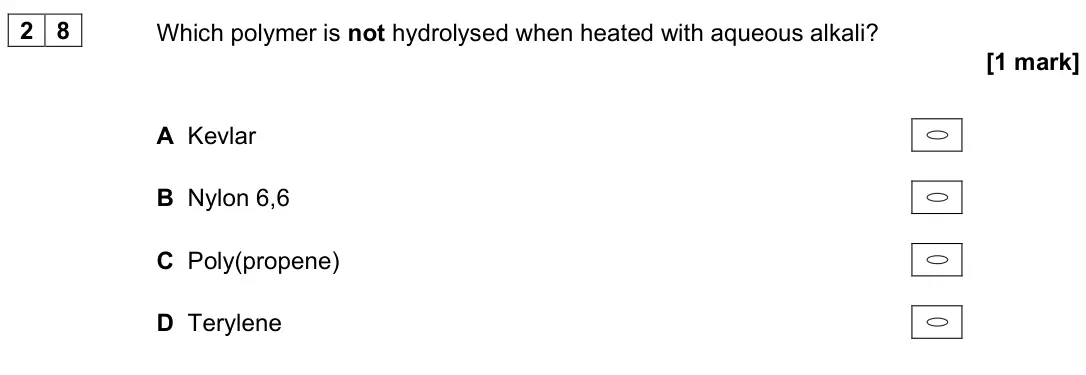
- June 2022, Paper 3, Q28 (1 mark): Which polymer is not hydrolysed when heated with aqueous alkali? [1 mark] A Kevlar B Nylon 6,6 C Poly(propene) D Terylene
- November 2021, Paper 3, Q01.1 (2 marks): Ethanedioic acid reacts with propane-1,3-diol (HOCH2CH2CH2OH) to form a polyester. Draw the repeating unit of this polyester. [2 marks]
- November 2021, Paper 3, Q01.2 (2 marks): Explain why polyesters are biodegradable but polyalkenes are not biodegradable. [2 marks]
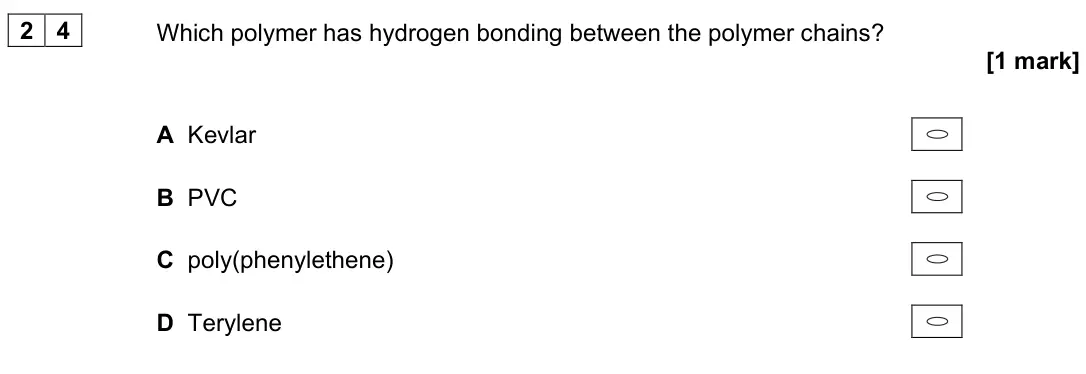
- November 2021, Paper 3, Q24 (1 mark): Which polymer has hydrogen bonding between the polymer chains? [1 mark] A Kevlar B PVC C poly(phenylethene) D Terylene
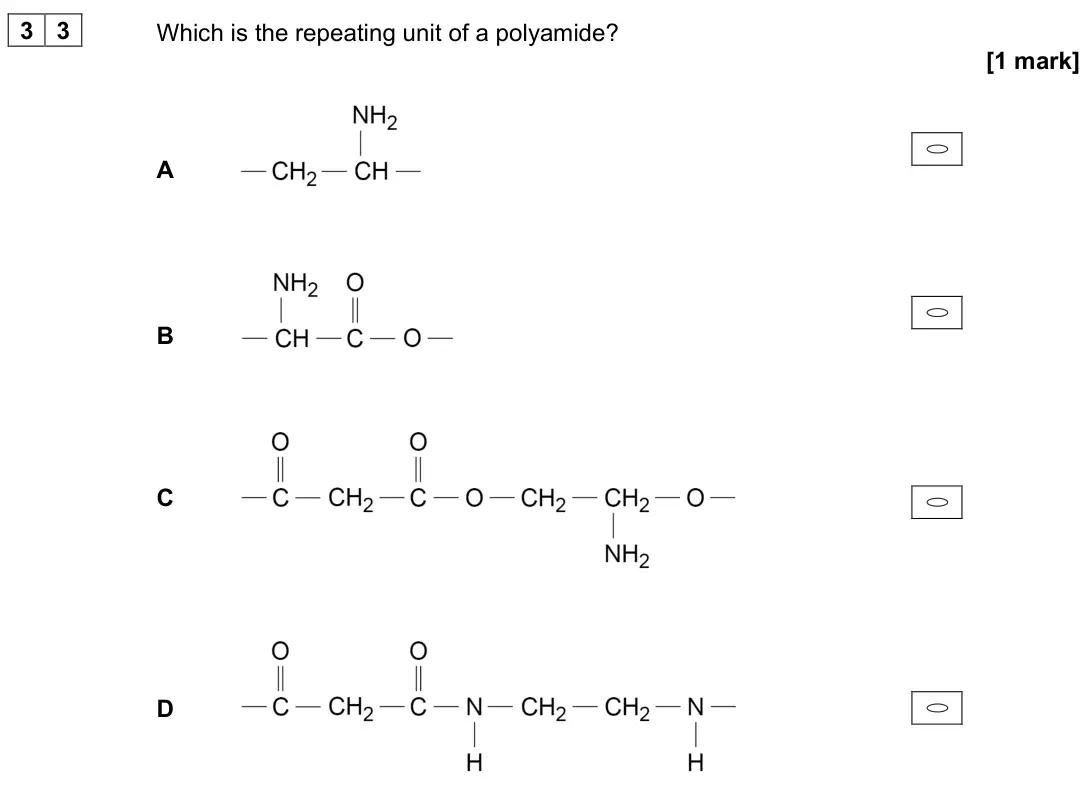
- November 2021, Paper 3, Q33 (1 mark): Which is the repeating unit of a polyamide? [1 mark] A B C D
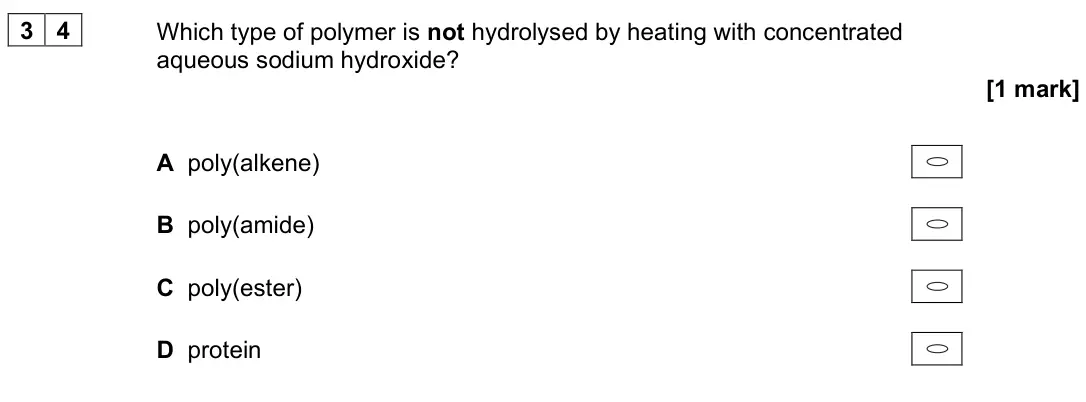
- November 2021, Paper 3, Q34 (1 mark): Which type of polymer is not hydrolysed by heating with concentrated aqueous sodium hydroxide? [1 mark] A poly(alkene) B poly(amide) C poly(ester) D protein
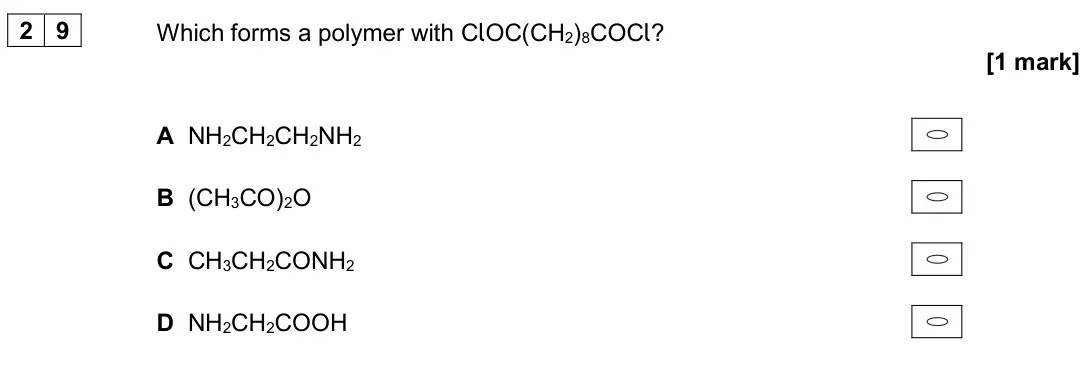
- November 2020, Paper 3, Q29 (1 mark): Which forms a polymer with ClOC(CH2)8COCl? [1 mark] A NH2CH2CH2NH2 B (CH3CO)2O C CH3CH2CONH2 D NH2CH2COOH
- June 2019, Paper 2, Q03.2 (2 marks): The insides of some golf balls are made from a mixture of three other polymers. The repeating unit for one of these polymers is shown. Draw the skeletal formula
- June 2019, Paper 2, Q03.3 (2 marks): A second polymer in the mixture has a repeating unit with the structure shown. The third polymer in the mixture is a stereoisomer of this polymer. Draw the stru
- June 2019, Paper 2, Q03.4 (1 mark): Golf balls recovered from lakes and ponds can be used again even after being in water for several years. Explain why these golf balls do not biodegrade. [1 mark
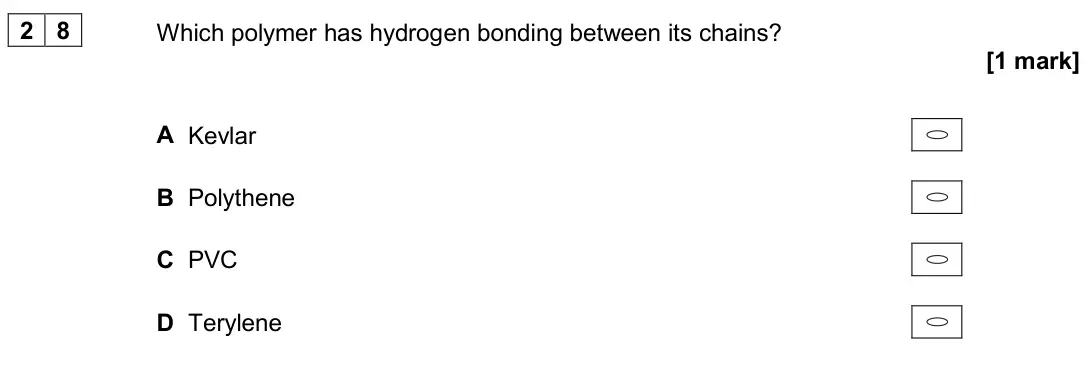
- June 2019, Paper 3, Q28 (1 mark): Which polymer has hydrogen bonding between its chains? [1 mark] A Kevlar B Polythene C PVC D Terylene
- June 2018, Paper 2, Q11.2 (1 mark): Draw the structure of the isomer of C6H16N2 used to make nylon 6,6 [1 mark]
- June 2018, Paper 3, Q21 (1 mark): The repeating unit of a polymer is shown. Which monomer or pair of monomers could be used to make this polymer? [1 mark] A ClOC(CH2)4NH2 only B ClOC(CH2)4COCl o
- June 2018, Paper 3, Q22 (1 mark): The structure of part of a polyester chain is shown. Which statement correctly explains why plastics made from this polyester only soften at high temperatures?
- June 2017, Paper 2, Q10.6 (3 marks): The action of heat on 5-hydroxyhexanoic acid can lead to two different products. On gentle heating, 5-hydroxyhexanoic acid loses water to form a cyclic compound
- June 2017, Paper 2, Q10.7 (3 marks): Isomer U is shown. The polymer formed by U and the polymer formed by 5-hydroxyhexanoic acid in Question 10.6 both contain ester groups that can be hydrolysed. D
- June 2017, Paper 3, Q25 (1 mark): Which compound can form a polymer without needing another reagent? [1 mark] A HOCH2CH2OH B HOOCCH2CH2COOH C HOCH2CH2COCl D ClCH2CH2COOH
- Specimen, Paper 2, Q07.2 (2 marks): Structure of compound 1 Structure of compound 2
- Specimen, Paper 2, Q07.3 (3 marks): Advantage Justification 8
- Specimen, Paper 3, Q33 (1 mark): Which compound can polymerise by reaction with itself? [1 mark] A NH2CH2CH2NH2 B CH3CH2CONH2 C HOOCCH2COOH D NH2CH2COCl 3 3
Questions, mark schemes and examiner’s reports are © AQA, from their published past papers. Plumi isn’t affiliated with any exam board. Want whole papers? Every AQA A-Level Chemistry paper.
Rather write your answers by hand on iPad? Plumi marks them against the same mark schemes.