 plumi
Aldehydes and ketones: AQA A‑Level Chemistry questions
Every AQA A-Level Chemistry exam question on 3.3.8 Aldehydes and ketones, 2016–2025, with its mark scheme and examiner’s report.
Find questions2,301
Calculations
Q05.2
The whole paper ↗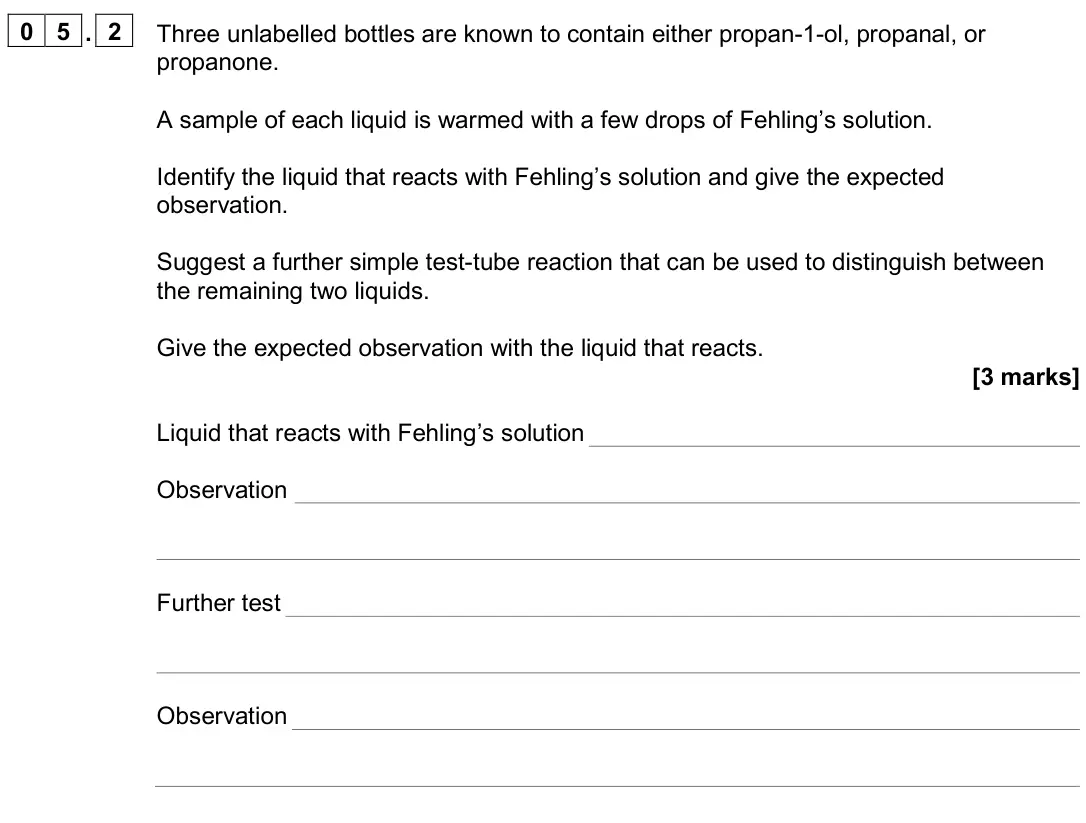
Q08.3
The whole paper ↗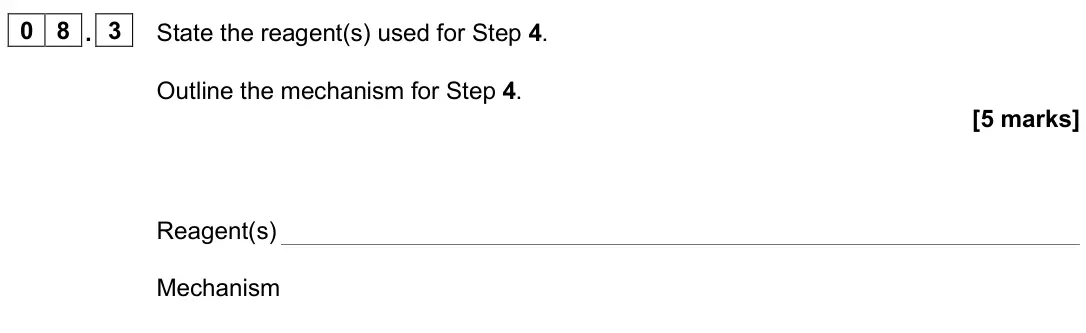
Q08.4
The whole paper ↗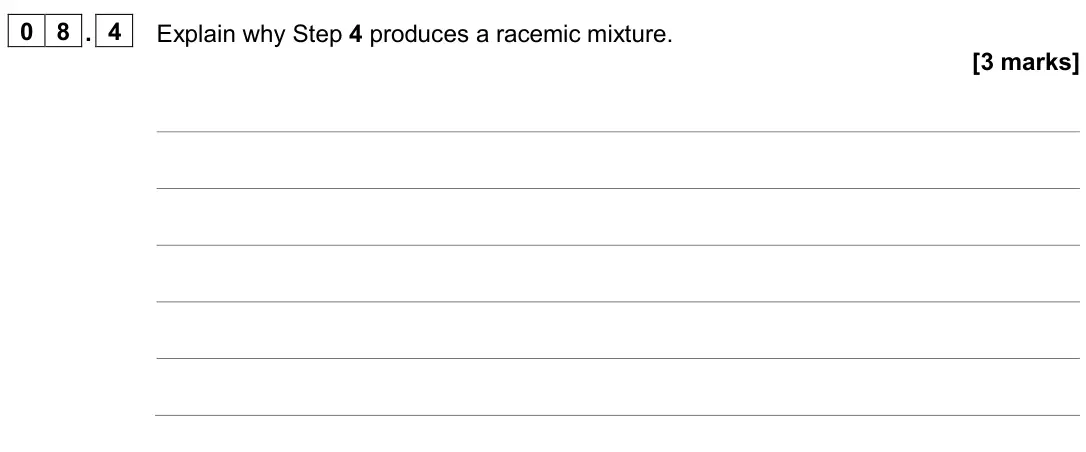
Q03.3
The whole paper ↗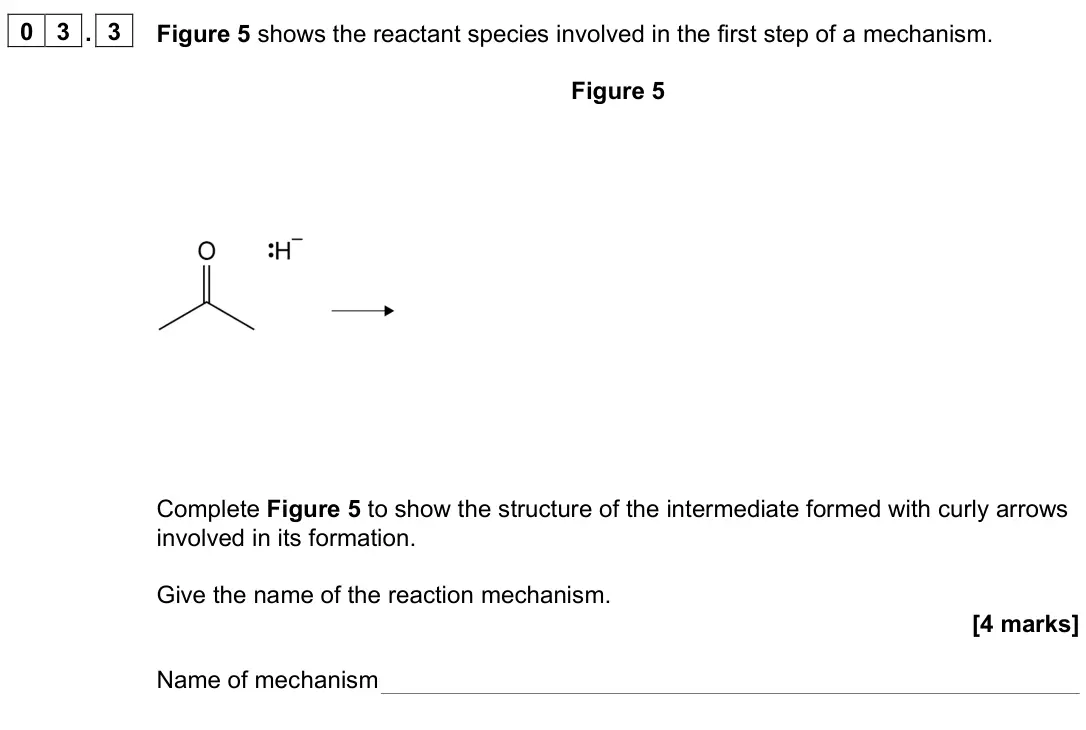
Q01.8
The whole paper ↗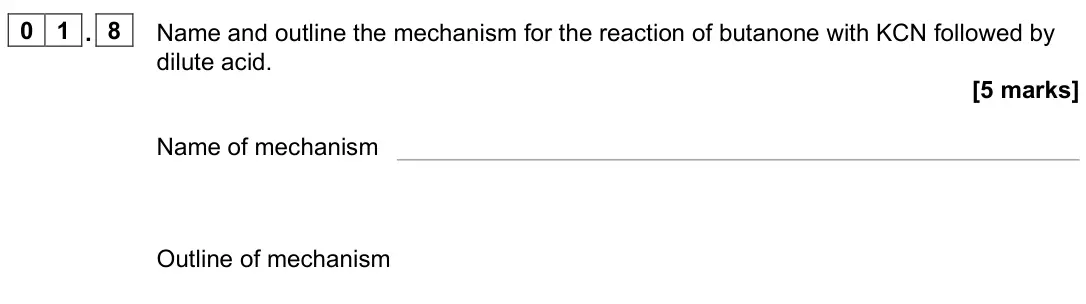
Q03.1
The whole paper ↗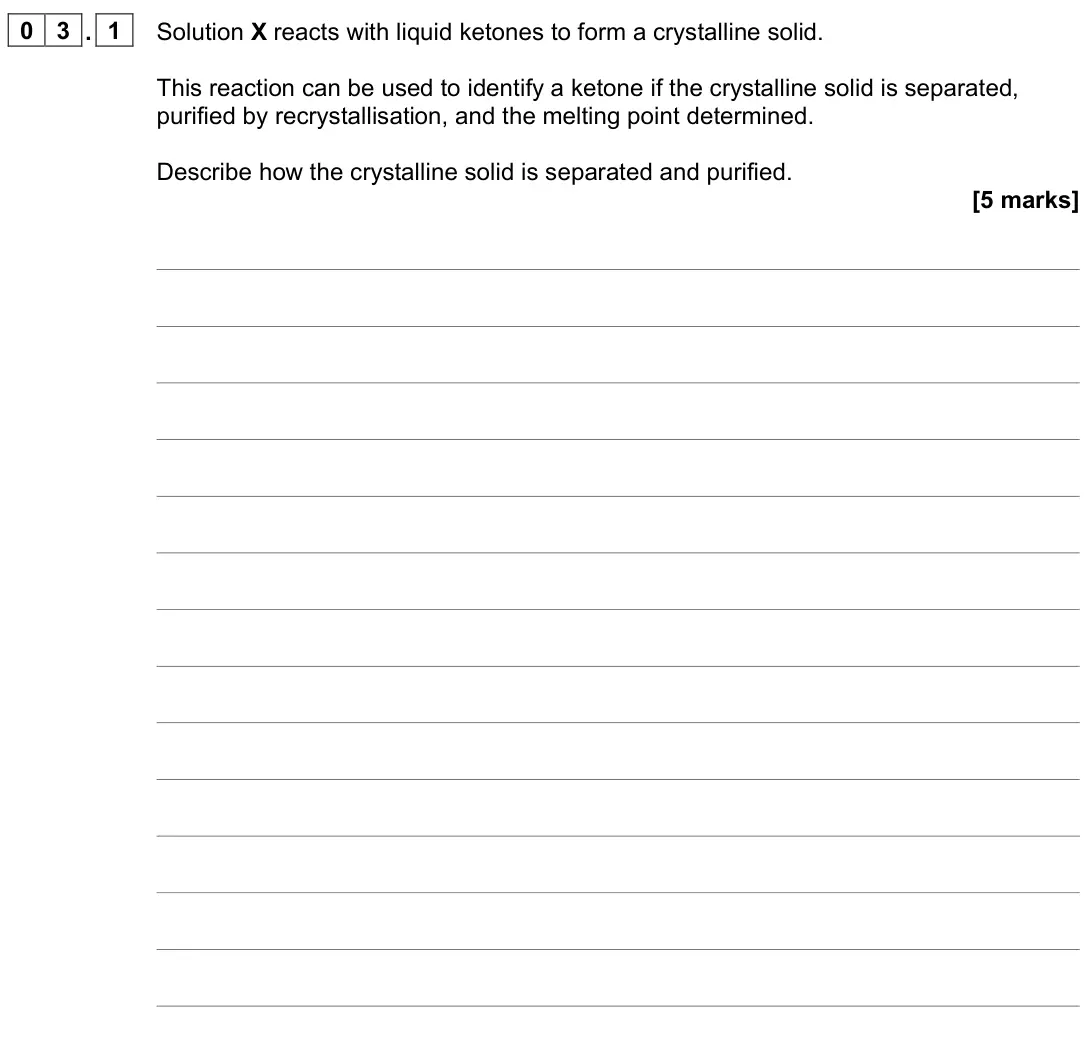
Q03.2
The whole paper ↗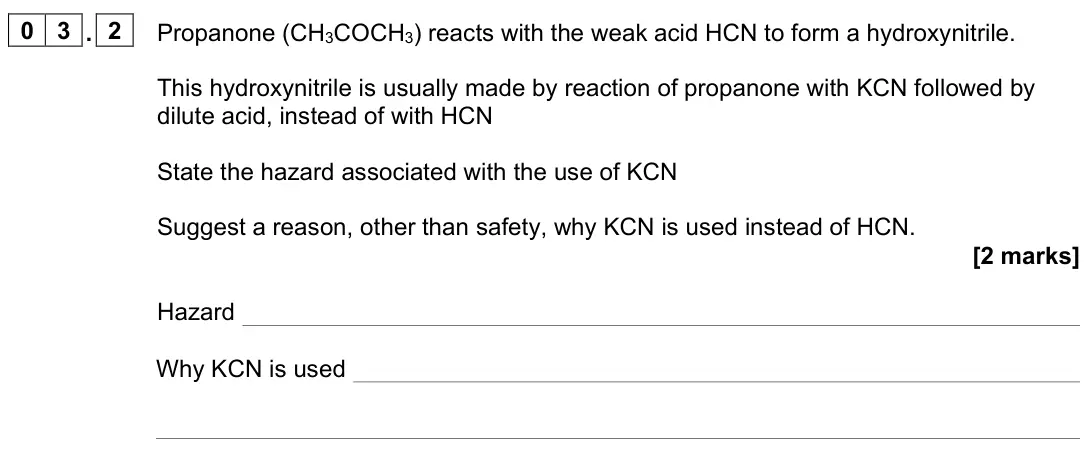
Q03.3
The whole paper ↗
Q03.2
The whole paper ↗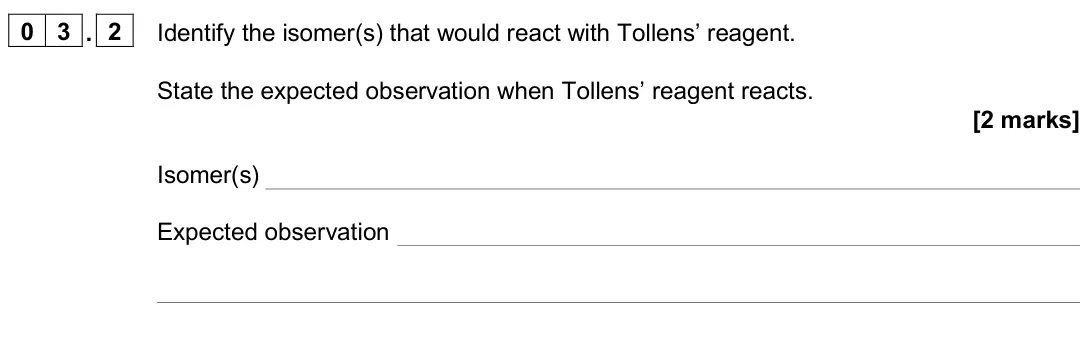
Q06.2
The whole paper ↗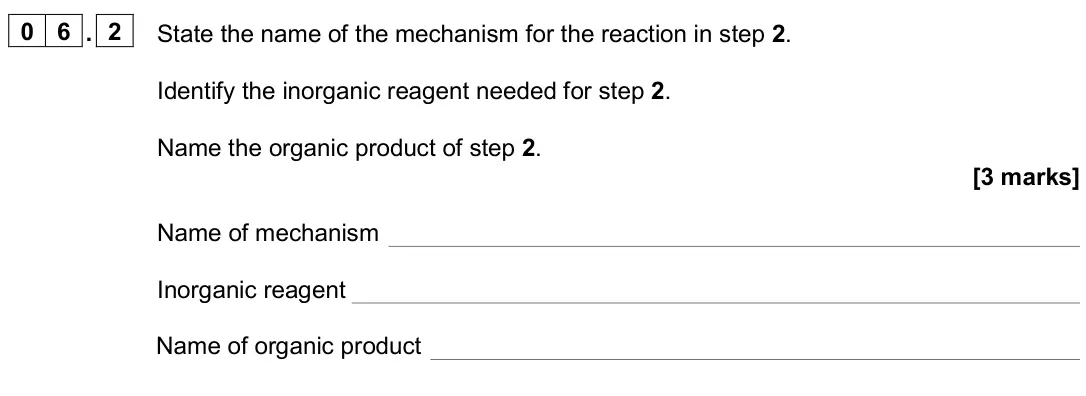
Q09.5
The whole paper ↗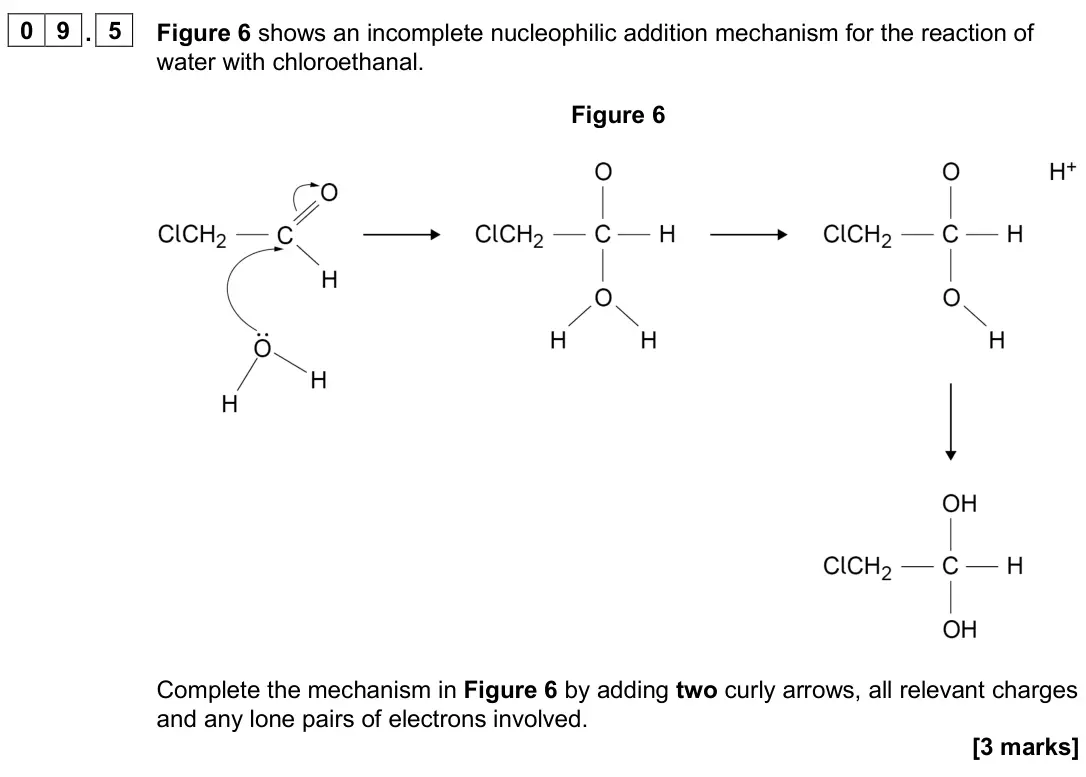
Q09.6
The whole paper ↗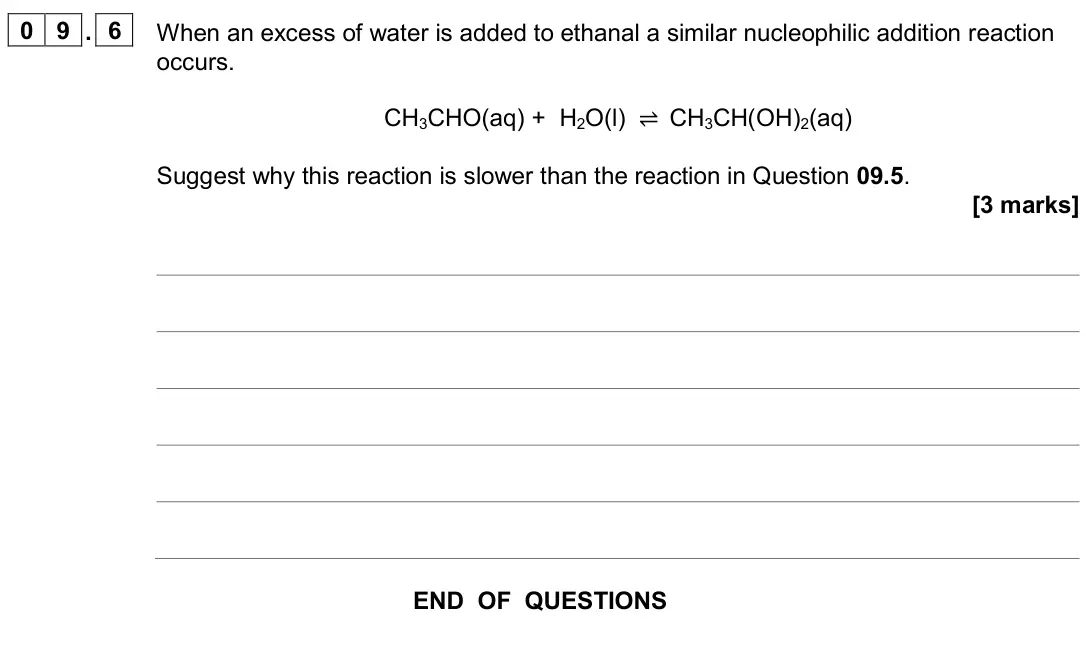
Q13.1
The whole paper ↗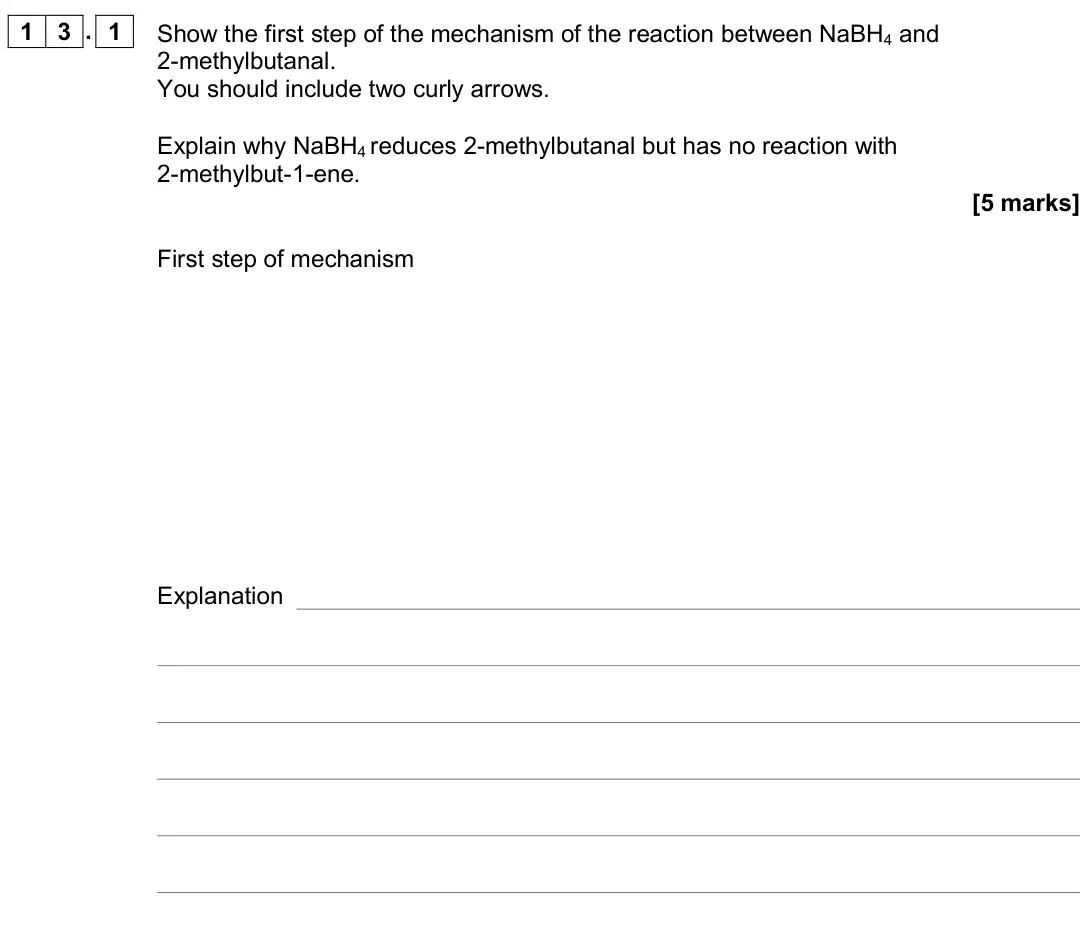
Q13.2
The whole paper ↗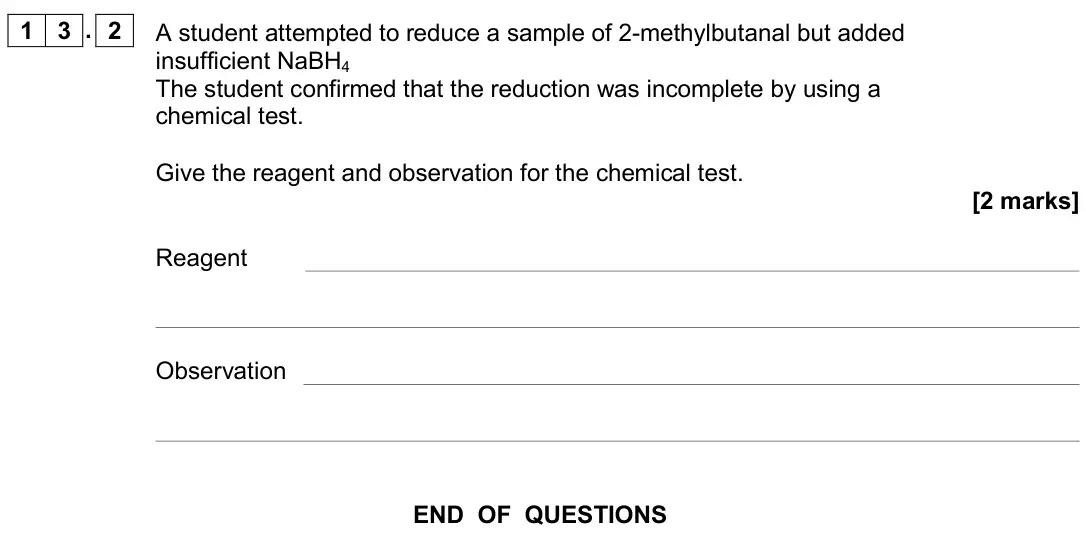
Q04.1
The whole paper ↗
Q04.2
The whole paper ↗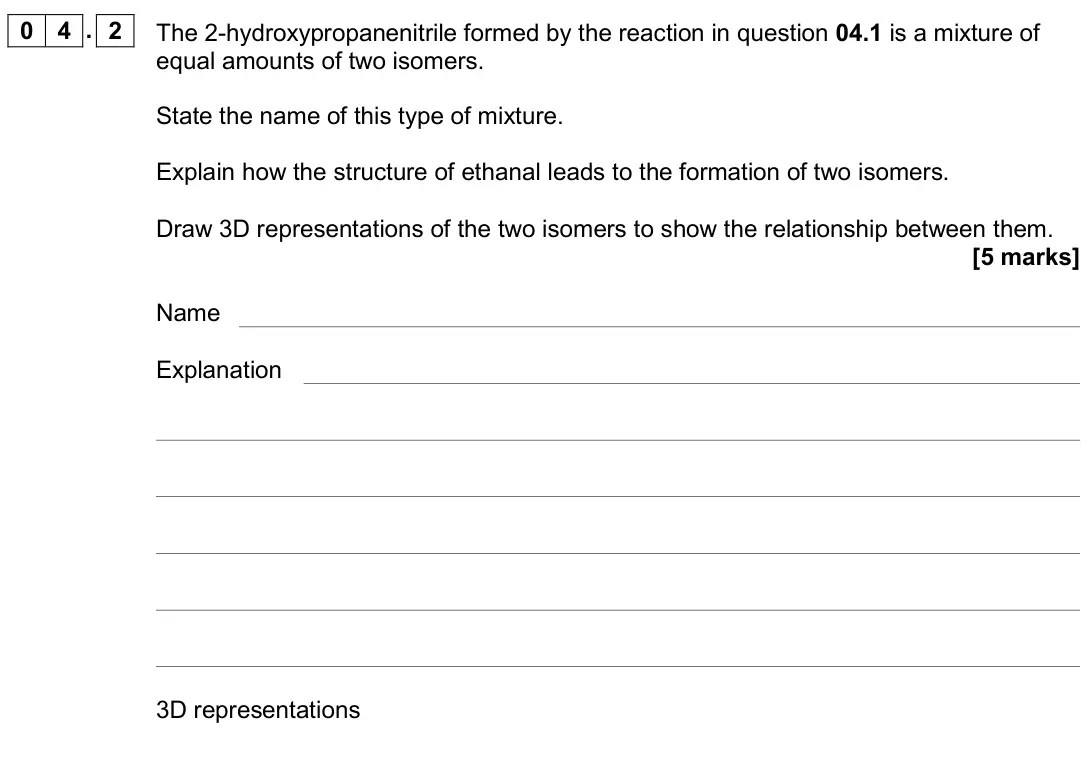
Q02.4
The whole paper ↗
Q07.2
The whole paper ↗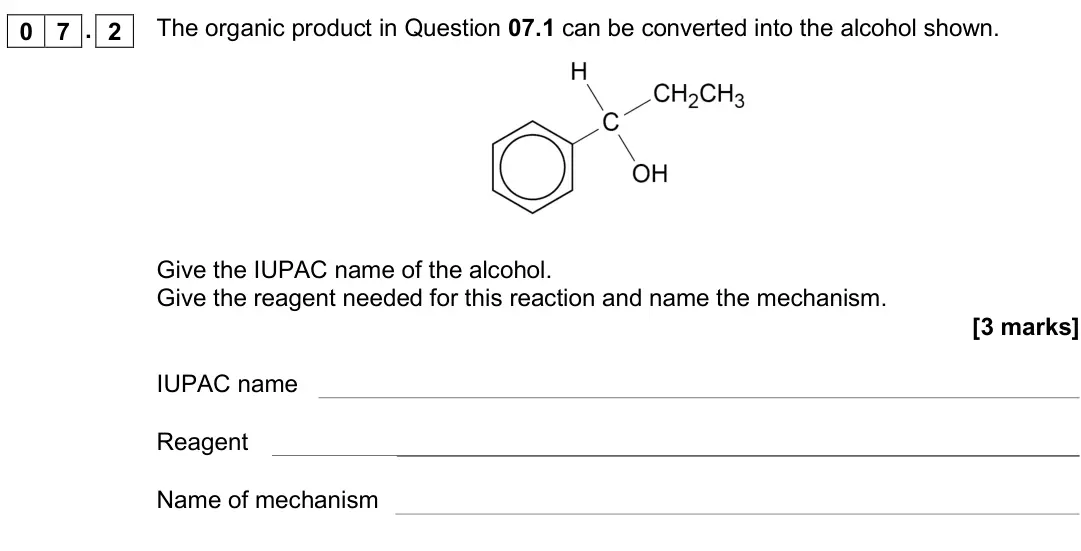
All 33 questions on Aldehydes and ketones, as a list
- June 2024, Paper 2, Q05.2 (3 marks): Three unlabelled bottles are known to contain either propan-1-ol, propanal, or propanone. A sample of each liquid is warmed with a few drops of Fehling’s soluti
- June 2024, Paper 2, Q08.3 (5 marks): State the reagent(s) used for Step 4. Outline the mechanism for Step 4. [5 marks] Reagent(s) Mechanism
- June 2024, Paper 2, Q08.4 (3 marks): Explain why Step 4 produces a racemic mixture. [3 marks]
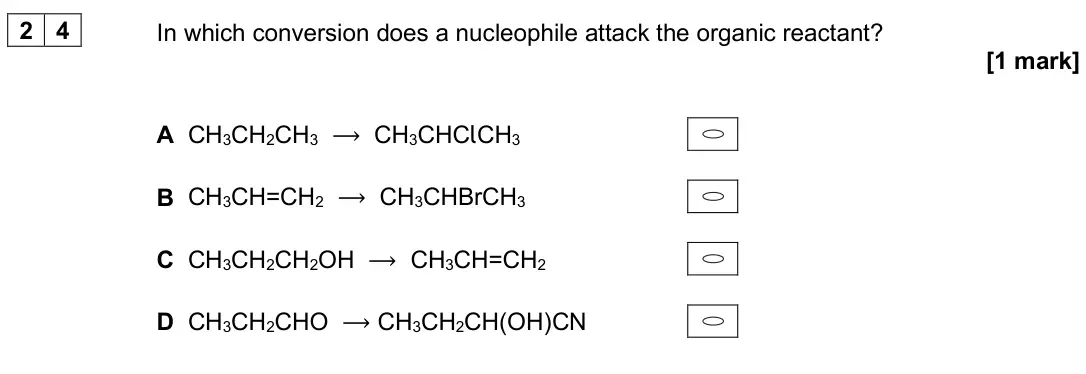
- June 2024, Paper 3, Q24 (1 mark): In which conversion does a nucleophile attack the organic reactant? [1 mark] A CH3CH2CH3 ⟶ CH3CHClCH3 B CH3CH=CH2 ⟶ CH3CHBrCH3 C CH3CH2CH2OH ⟶ CH3CH=CH2 D CH3CH
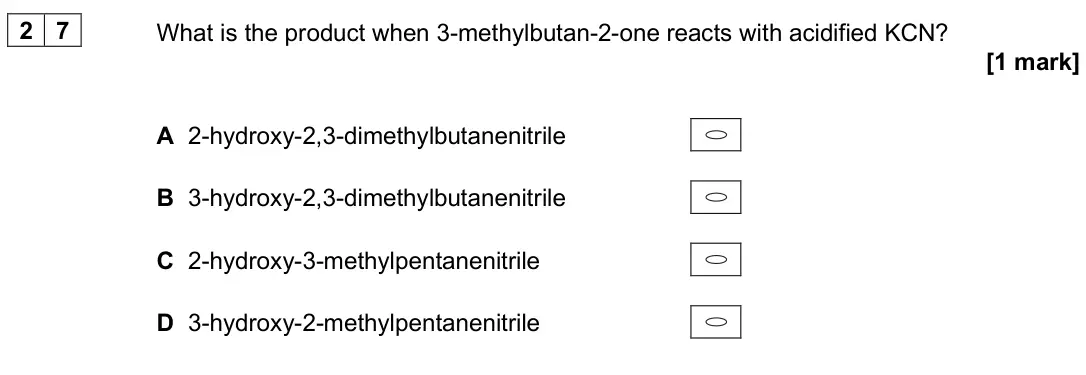
- June 2024, Paper 3, Q27 (1 mark): What is the product when 3-methylbutan-2-one reacts with acidified KCN? [1 mark] A 2-hydroxy-2,3-dimethylbutanenitrile B 3-hydroxy-2,3-dimethylbutanenitrile C 2
- June 2023, Paper 2, Q03.3 (4 marks): Figure 5 shows the reactant species involved in the first step of a mechanism. Figure 5 Complete Figure 5 to show the structure of the intermediate formed with
- June 2022, Paper 2, Q01.8 (5 marks): Name and outline the mechanism for the reaction of butanone with KCN followed by dilute acid. [5 marks] Name of mechanism Outline of mechanism
- November 2021, Paper 3, Q03.1 (5 marks): Solution X reacts with liquid ketones to form a crystalline solid. This reaction can be used to identify a ketone if the crystalline solid is separated, purifie
- November 2021, Paper 3, Q03.2 (2 marks): Propanone (CH3COCH3) reacts with the weak acid HCN to form a hydroxynitrile. This hydroxynitrile is usually made by reaction of propanone with KCN followed by d
- November 2021, Paper 3, Q03.3 (4 marks): Outline the mechanism for the reaction of propanone with KCN followed by dilute acid. [4 marks]
- November 2020, Paper 2, Q03.2 (2 marks): Identify the isomer(s) that would react with Tollens’ reagent. State the expected observation when Tollens’ reagent reacts. [2 marks] Isomer(s) Expected observa
- November 2020, Paper 2, Q06.2 (3 marks): State the name of the mechanism for the reaction in step 2. Identify the inorganic reagent needed for step 2. Name the organic product of step 2. [3 marks] Name
- November 2020, Paper 2, Q09.5 (3 marks): Figure 6 shows an incomplete nucleophilic addition mechanism for the reaction of water with chloroethanal. Figure 6 Complete the mechanism in Figure 6 by adding
- November 2020, Paper 2, Q09.6 (3 marks): When an excess of water is added to ethanal a similar nucleophilic addition reaction occurs. CH3CHO(aq) + H2O(l) ⇌ CH3CH(OH)2(aq) Suggest why this reaction is s
- June 2019, Paper 2, Q13.1 (5 marks): Show the first step of the mechanism of the reaction between NaBH4 and 2-methylbutanal. You should include two curly arrows. Explain why NaBH4 reduces 2-methylb
- June 2019, Paper 2, Q13.2 (2 marks): A student attempted to reduce a sample of 2-methylbutanal but added insufficient NaBH4 The student confirmed that the reduction was incomplete by using a chemic
- June 2019, Paper 3, Q04.1 (1 mark): Name the mechanism for the reaction between potassium cyanide and ethanal. [1 mark]
- June 2019, Paper 3, Q04.2 (5 marks): The 2-hydroxypropanenitrile formed by the reaction in question 04.1 is a mixture of equal amounts of two isomers. State the name of this type of mixture. Explai
- June 2018, Paper 2, Q02.4 (2 marks): Compound Z has the empirical formula C3H4NO Give the structure of Compound Z. Suggest the reagent for Reaction 3. [2 marks] Structure Reagent for Reaction 3
- June 2018, Paper 2, Q07.2 (3 marks): The organic product in Question 07.1 can be converted into the alcohol shown. Give the IUPAC name of the alcohol. Give the reagent needed for this reaction and
- June 2018, Paper 3, Q28 (1 mark): How many structural isomers with the molecular formula C5H10O react with Tollens’ reagent? [1 mark] A 3 B 4 C 5 D 6
- June 2017, Paper 2, Q04.1 (1 mark): Give the IUPAC name of CH3CH2CH2CH2CH(OH)CN [1 mark
- June 2017, Paper 2, Q04.3 (3 marks): Explain why the reaction produces a racemic mixture. [3 marks
- June 2017, Paper 2, Q04.4 (2 marks): An isomer of CH3CH2CH2CH2CHO reacts with KCN followed by dilute acid to form a compound that does not show stereoisomerism. Draw the structure of the compound f
- June 2017, Paper 3, Q13 (1 mark): Which pair of compounds does not form a racemic mixture when the compounds react? [1 mark] A B C D
- June 2017, Paper 3, Q21 (1 mark): In concentrated alkali, propanone reacts with hydroxide ions to form an equilibrium mixture as shown. Which curly arrow does not appear in the mechanism of this
- June 2017, Paper 3, Q23 (1 mark): Which alcohol could not be produced by the reduction of an aldehyde or a ketone? [1 mark] A 2,2-dimethylpropan-1-ol B 2-methylbutan-2-ol C 3-methylbutan-2-ol D
- June 2016, AS Paper 2, Q09 (1 mark): Which of the following compounds would form an orange-red precipitate when heated with Fehling’s solution? [1 mark] A CH3CH2CN B CH3CH2COOH C CH3CHO D CH3COCH3
- Specimen, Paper 2, Q11.1 (1 mark): 11 Butanone is reduced in a two-step reaction using NaBH4 followed by dilute hydrochloric acid. Write an overall equation for the reduction of butanone using [H
- Specimen, Paper 2, Q11.2 (6 marks): 9
- Specimen, Paper 3, Q01.5 (5 marks): 5
- Specimen, Paper 3, Q29: Which alcohol could not be produced by the reduction of an aldehyde or a ketone [1 mar A 2-methylbutan-1-ol B 2-methylbutan-2-ol C 3-methylbutan-1-ol D 3-methyl
- Specimen, Paper 3, Q30: Which compound forms optically active compounds on reduction? [1 mar A CH3CH2C(CH3)=CHCH3 B CH3CH2C(CH3)=CH2 C CH3COCH3 D CH3CH2COCH3 3 0
Questions, mark schemes and examiner’s reports are © AQA, from their published past papers. Plumi isn’t affiliated with any exam board. Want whole papers? Every AQA A-Level Chemistry paper.
Rather write your answers by hand on iPad? Plumi marks them against the same mark schemes.