 plumi
Nuclear magnetic resonance spectroscopy: AQA A‑Level Chemistry questions
Every AQA A-Level Chemistry exam question on 3.3.15 Nuclear magnetic resonance spectroscopy, 2016–2025, with its mark scheme and examiner’s report.
Find questions2,301
Calculations
Q06.1
The whole paper ↗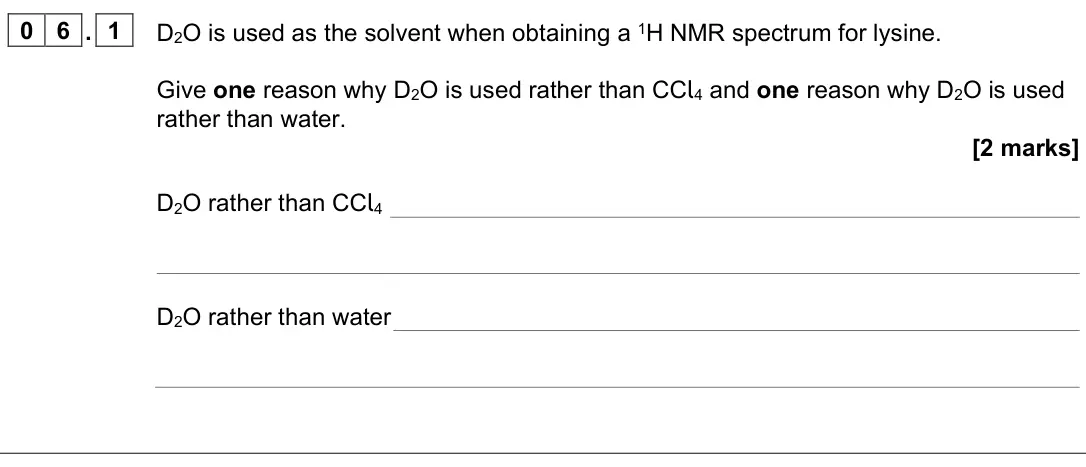
Q07.2
The whole paper ↗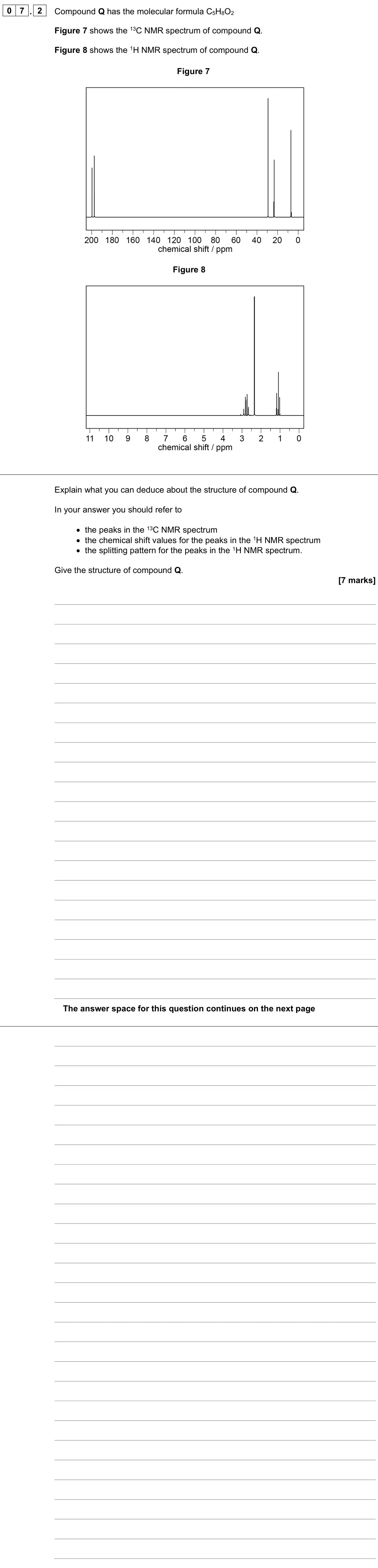
Q03.2
The whole paper ↗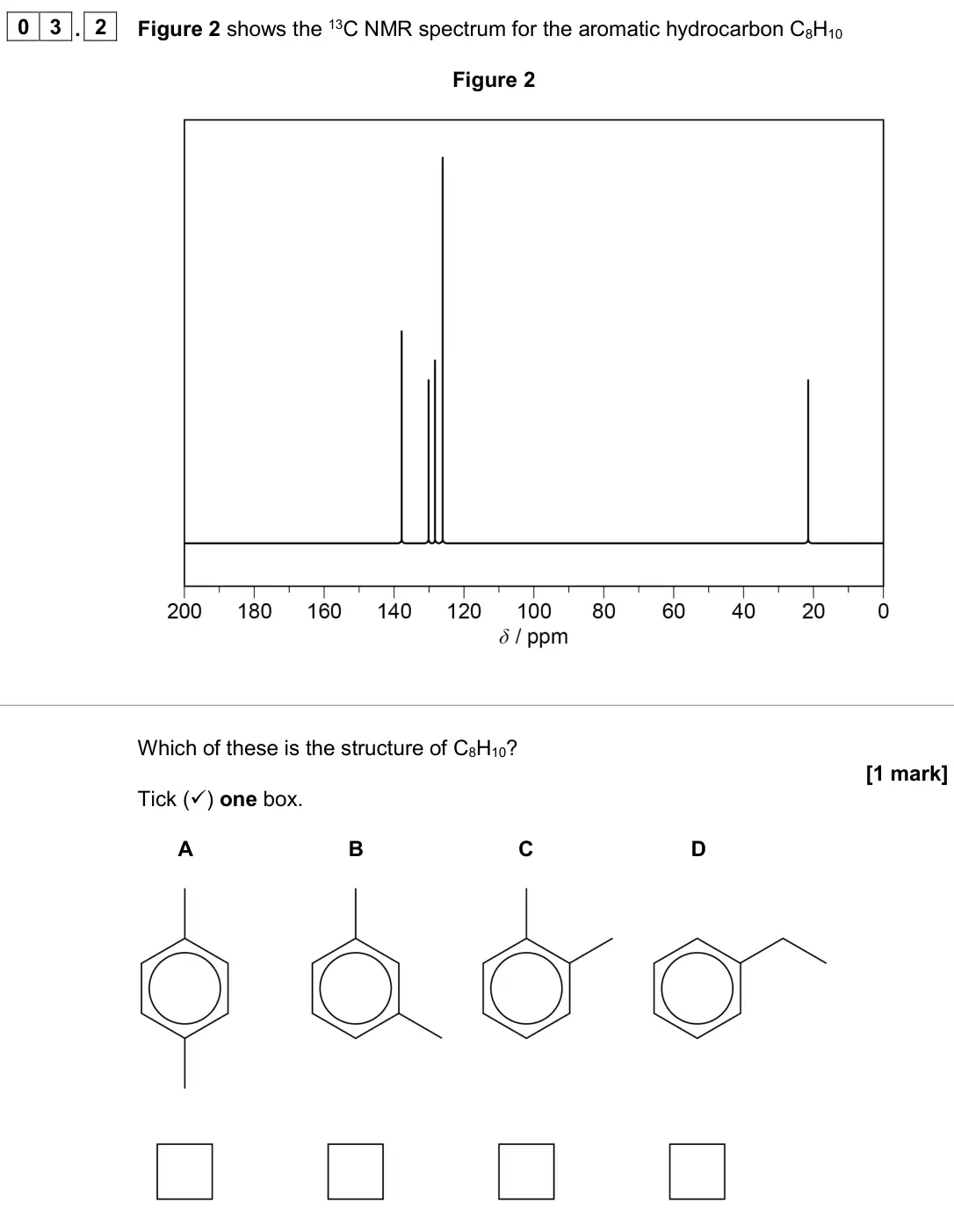
Q06.3
The whole paper ↗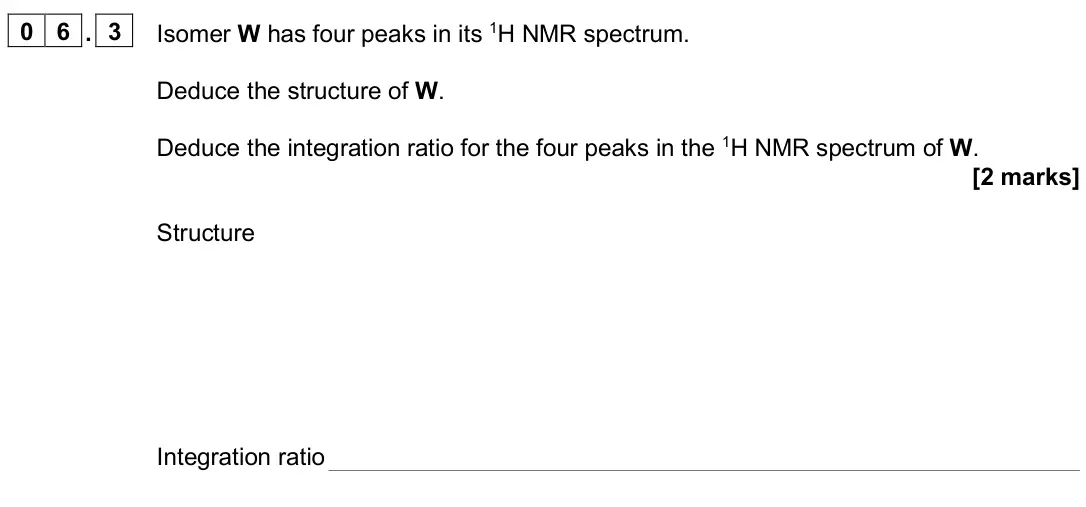
Q06.4
The whole paper ↗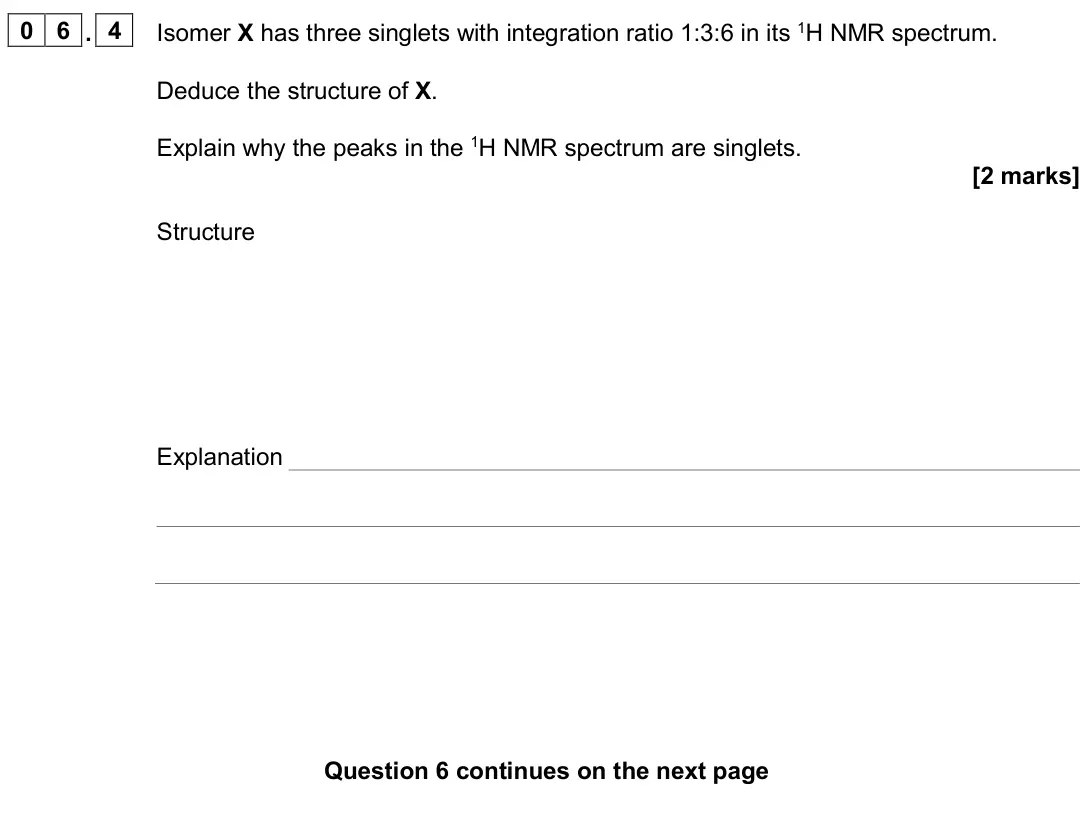
Q06.5
The whole paper ↗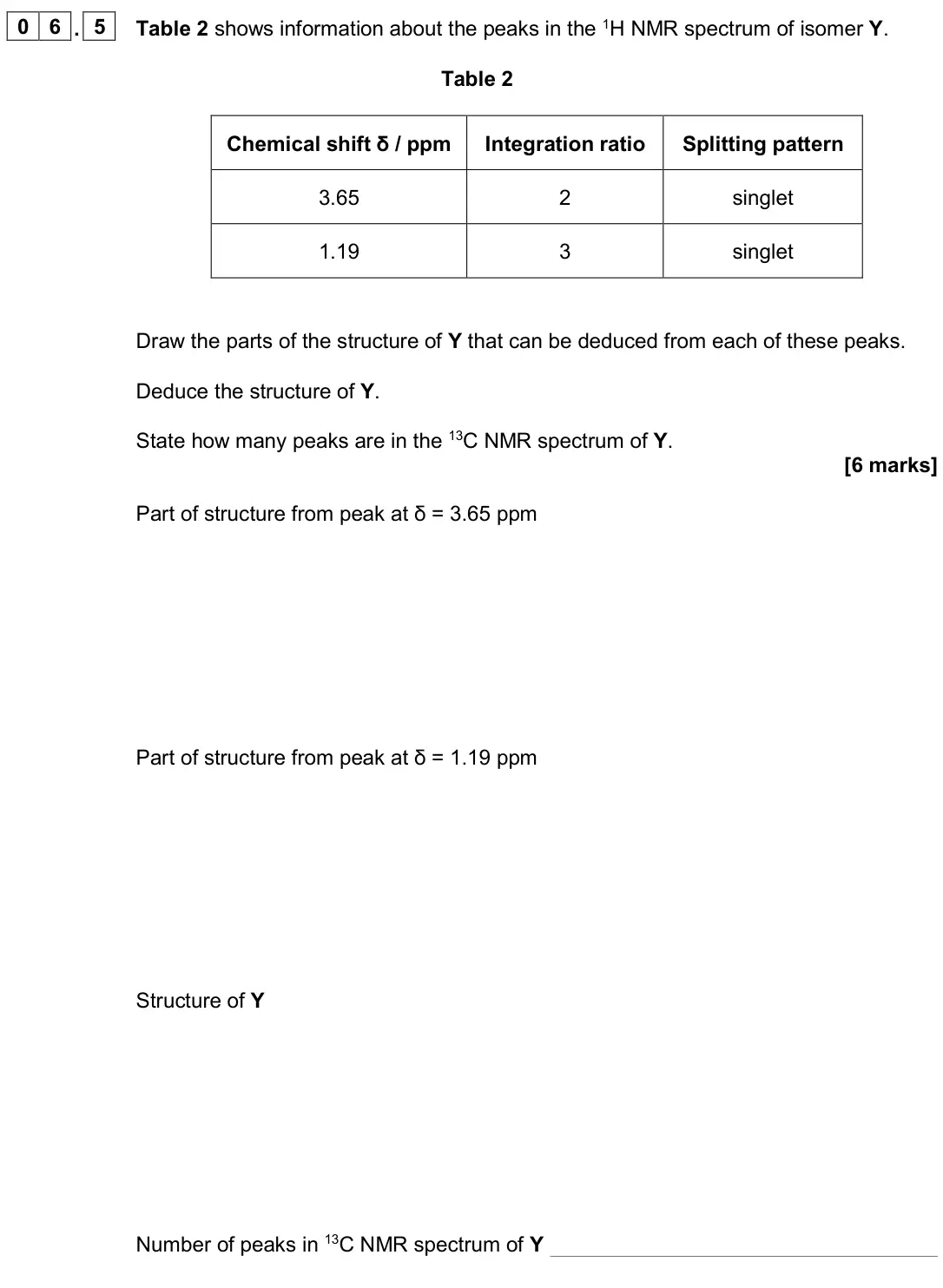
Q05.2
The whole paper ↗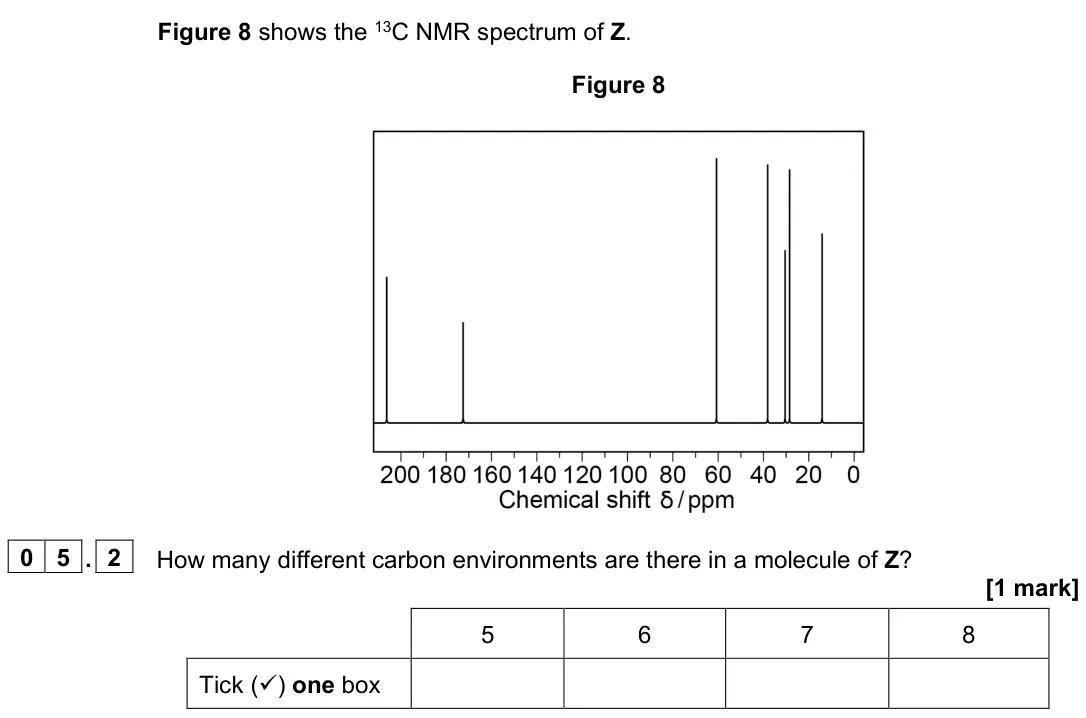
Q05.3
The whole paper ↗
Q05.4
The whole paper ↗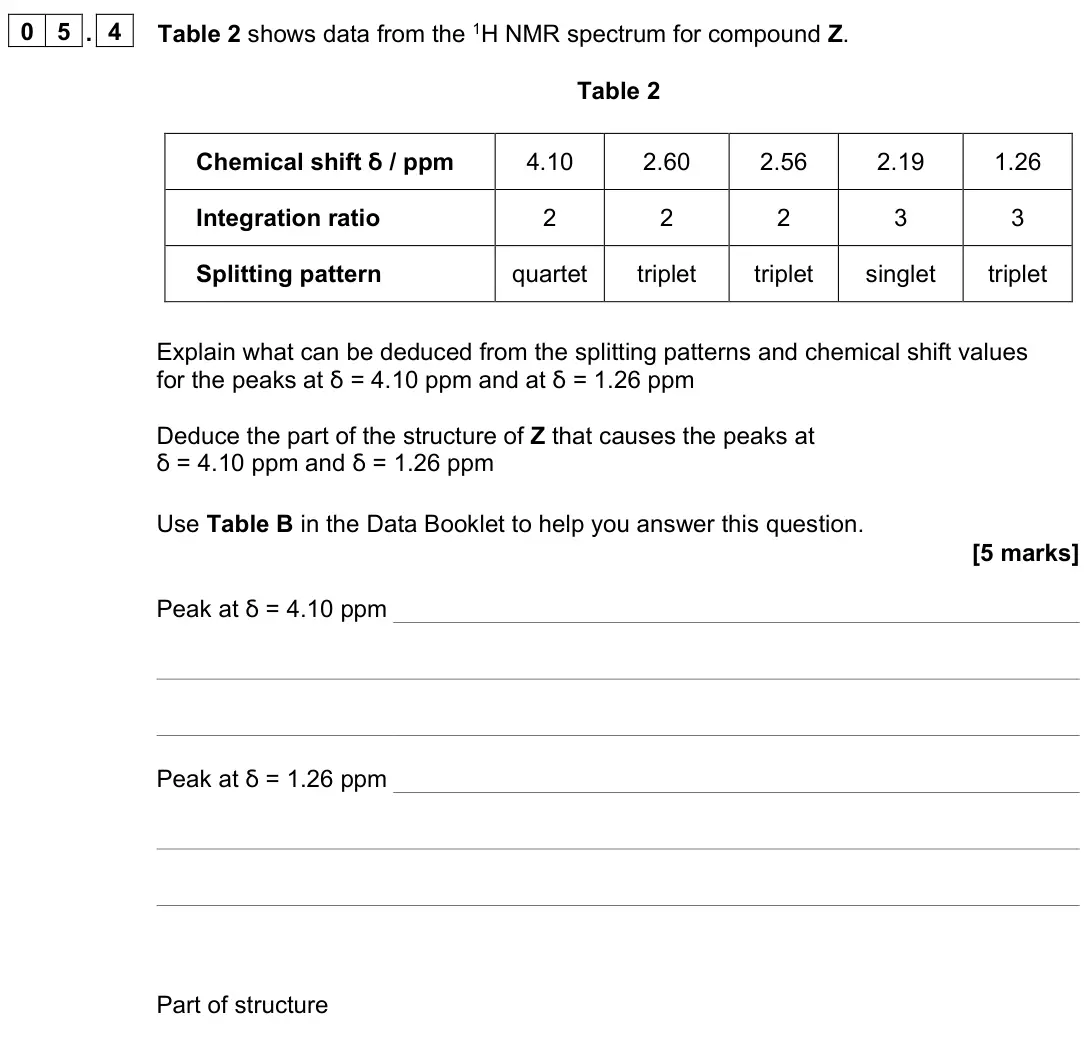
Q05.5
The whole paper ↗
Q05.6
The whole paper ↗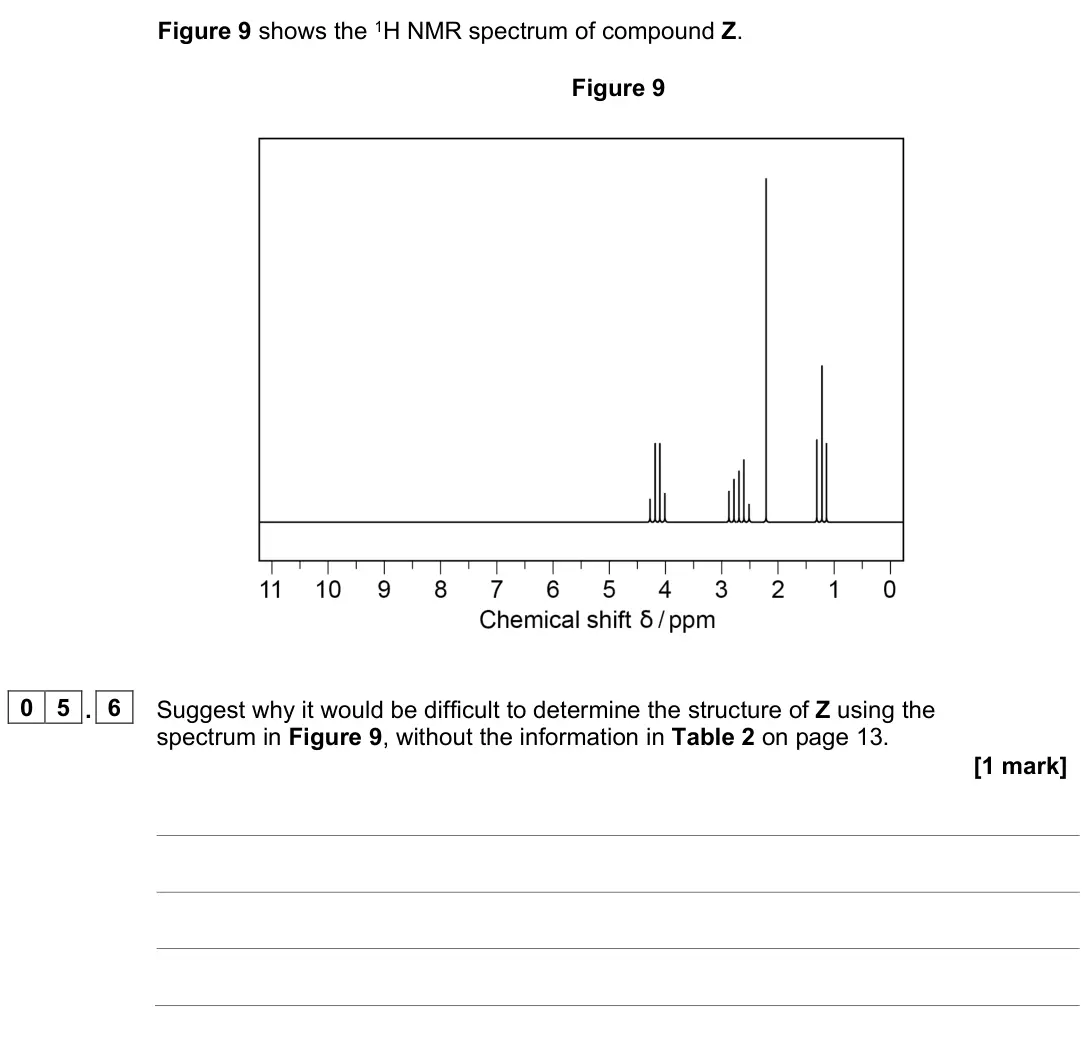
Q05.7
The whole paper ↗
Q06.4
The whole paper ↗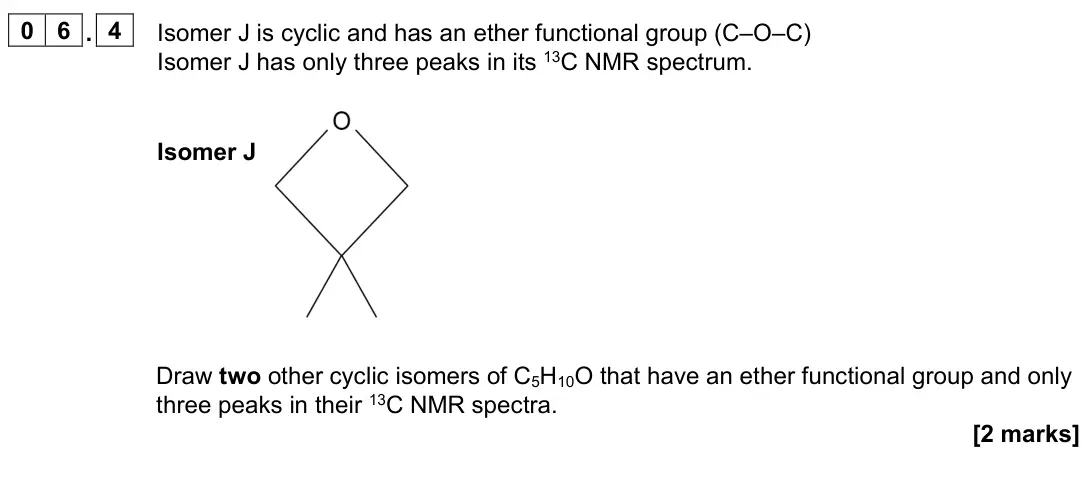
Q07.3
The whole paper ↗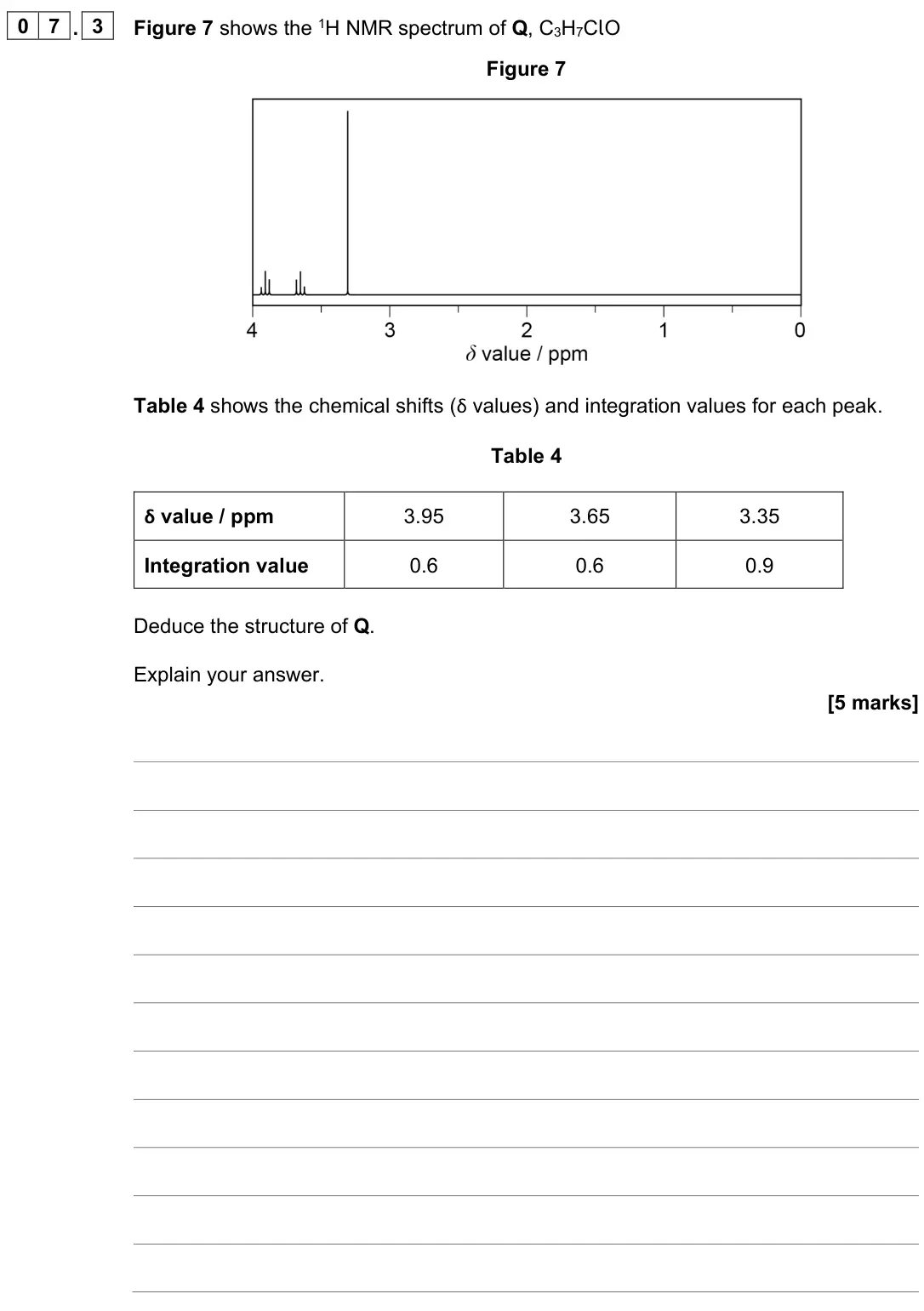
Q07.1
The whole paper ↗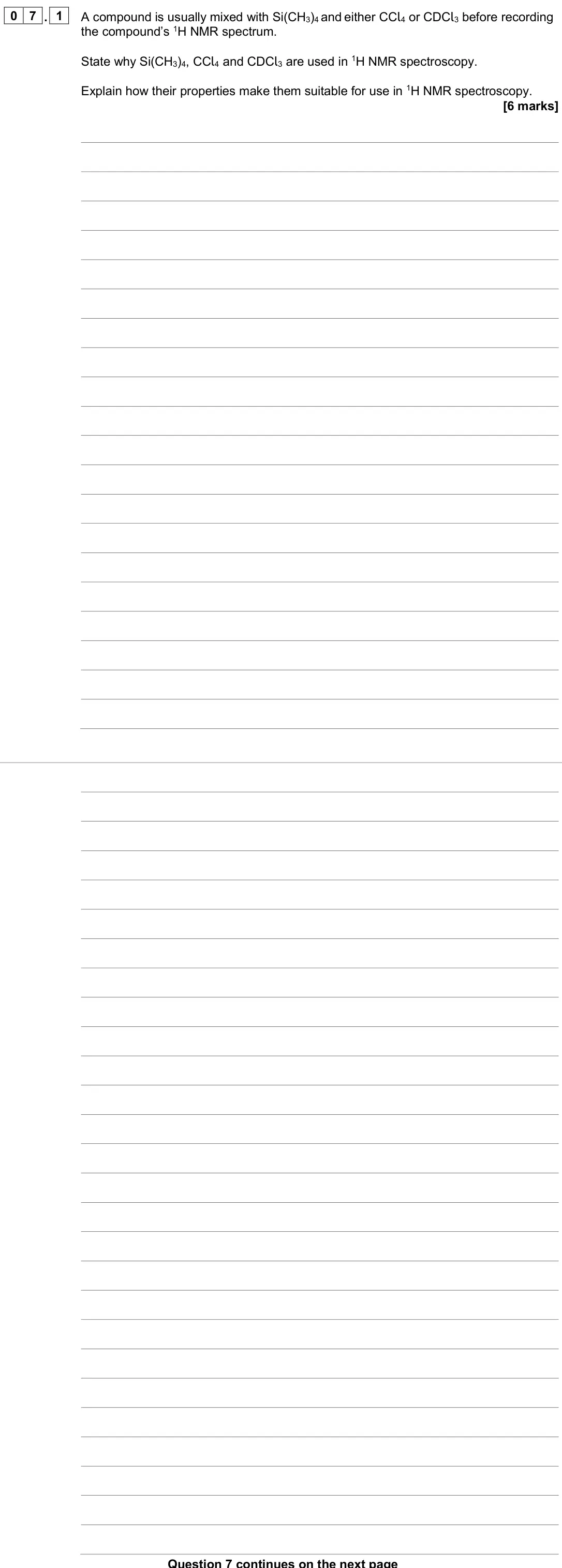
Q07.2
The whole paper ↗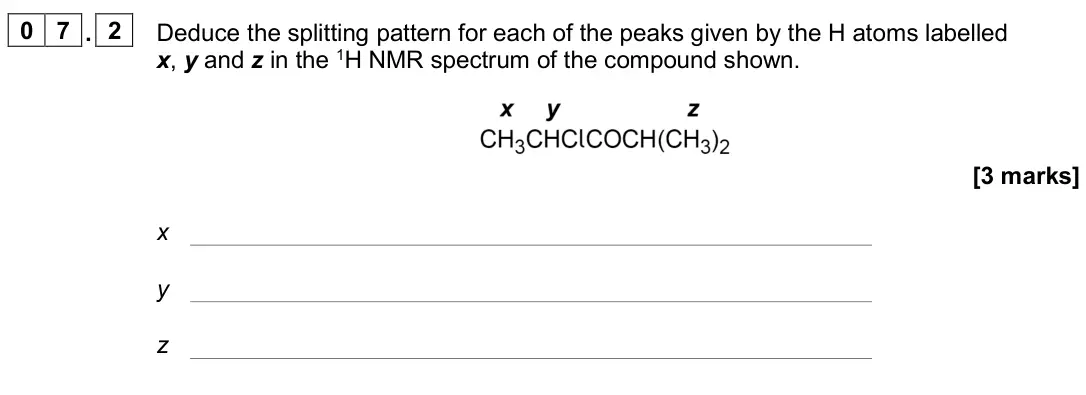
Q07.3
The whole paper ↗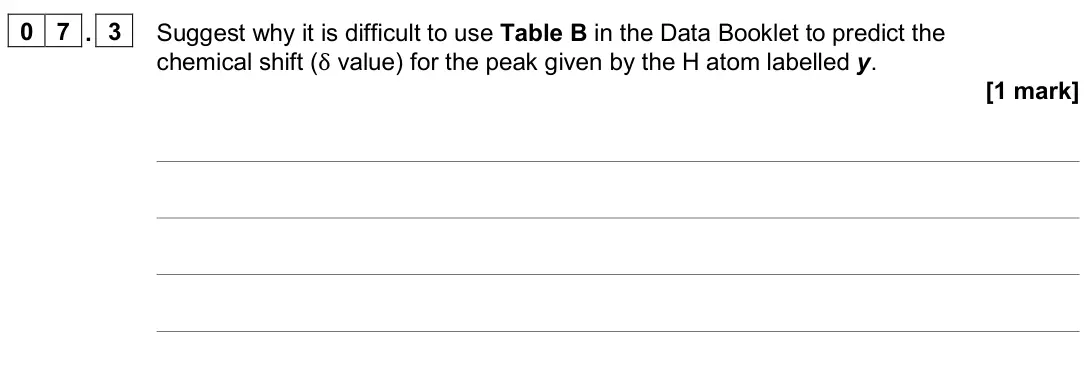
Q07.4
The whole paper ↗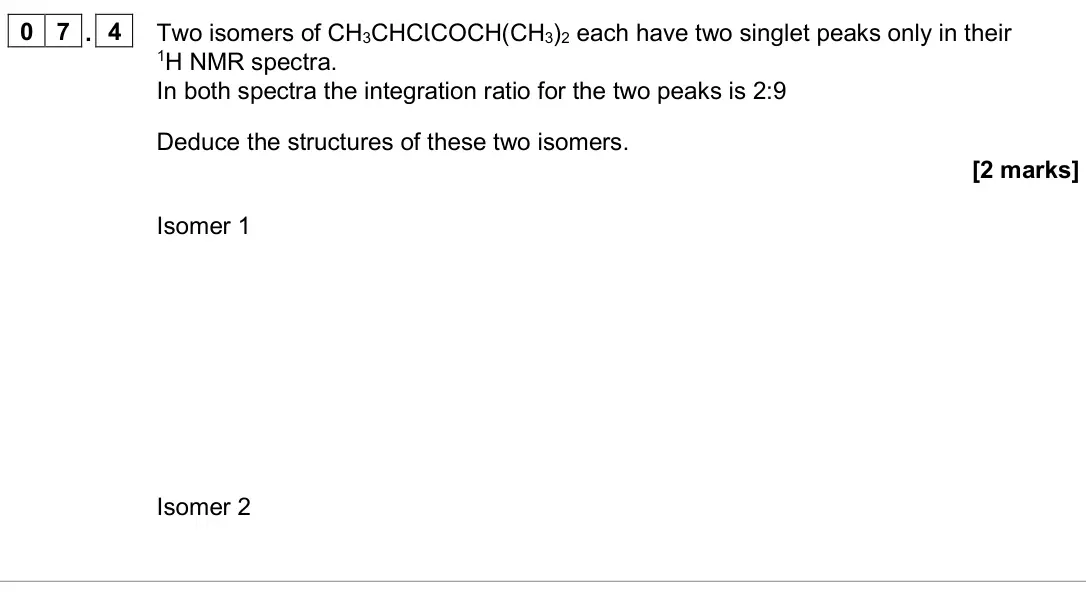
All 35 questions on Nuclear magnetic resonance spectroscopy, as a list
- June 2025, Paper 2, Q06.1 (2 marks): D2O is used as the solvent when obtaining a 1H NMR spectrum for lysine. Give one reason why D2O is used rather than CCl4 and one reason why D2O is used rather t
- June 2025, Paper 2, Q07.2 (7 marks): Compound Q has the molecular formula C5H8O2 Figure 7 shows the 13C NMR spectrum of compound Q. Figure 8 shows the 1H NMR spectrum of compound Q. Figure 7 Figure
- June 2024, Paper 2, Q03.2 (1 mark): Figure 2 shows the 13C NMR spectrum for the aromatic hydrocarbon C8H10 Figure 2 Which of these is the structure of C8H10? [1 mark] Tick () one box. A B C D
- June 2024, Paper 2, Q06.3 (2 marks): Isomer W has four peaks in its 1H NMR spectrum. Deduce the structure of W. Deduce the integration ratio for the four peaks in the 1H NMR spectrum of W. [2 marks
- June 2024, Paper 2, Q06.4 (2 marks): Isomer X has three singlets with integration ratio 1:3:6 in its 1H NMR spectrum. Deduce the structure of X. Explain why the peaks in the 1H NMR spectrum are sin
- June 2024, Paper 2, Q06.5 (6 marks): Table 2 shows information about the peaks in the 1H NMR spectrum of isomer Y. Table 2 Chemical shift δ / ppm Integration ratio Splitting pattern 3.65 2 singlet
- June 2023, Paper 2, Q05.2 (1 mark): How many different carbon environments are there in a molecule of Z? [1 mark] 5 6 7 8 Tick () one box
- June 2023, Paper 2, Q05.3 (1 mark): State the type of carbon environment that causes the peak at ẟ = 174 ppm Use Table C in the Data Booklet to help you answer this question. [1 mark]
- June 2023, Paper 2, Q05.4 (5 marks): Table 2 shows data from the 1H NMR spectrum for compound Z. Table 2 Chemical shift ẟ / ppm 4.10 2.60 2.56 2.19 1.26 Integration ratio 2 2 2 3 3 Splitting patter
- June 2023, Paper 2, Q05.5 (1 mark): Deduce the part of the structure of Z that causes the peak at ẟ = 2.19 ppm [1 mark] Part of structure
- June 2023, Paper 2, Q05.6 (1 mark): Suggest why it would be difficult to determine the structure of Z using the spectrum in Figure 9, without the information in Table 2 on page 13. [1 mark]
- June 2023, Paper 2, Q05.7 (1 mark): Deduce the structure of Z. [1 mark]
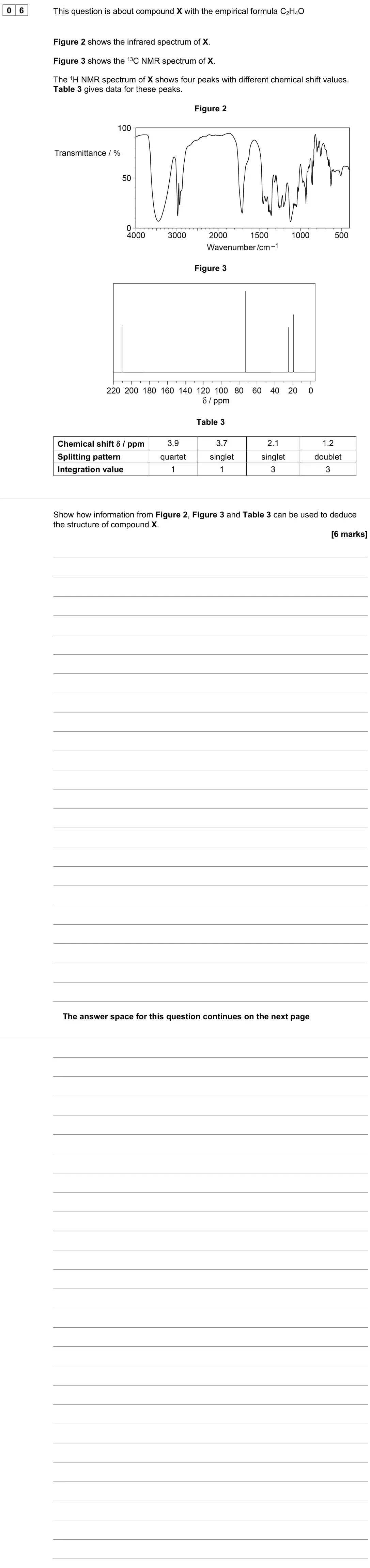
- June 2022, Paper 2, Q06 (6 marks): This question is about compound X with the empirical formula C2H4O Figure 2 shows the infrared spectrum of X. Figure 3 shows the 13C NMR spectrum of X. The 1H N
- November 2021, Paper 2, Q06.4 (2 marks): Isomer J is cyclic and has an ether functional group (C–O–C) Isomer J has only three peaks in its 13C NMR spectrum. Isomer J Draw two other cyclic isomers of C5
- November 2021, Paper 2, Q07.3 (5 marks): Figure 7 shows the 1H NMR spectrum of Q, C3H7ClO Figure 7 Table 4 shows the chemical shifts (δ values) and integration values for each peak. Table 4 δ value / p
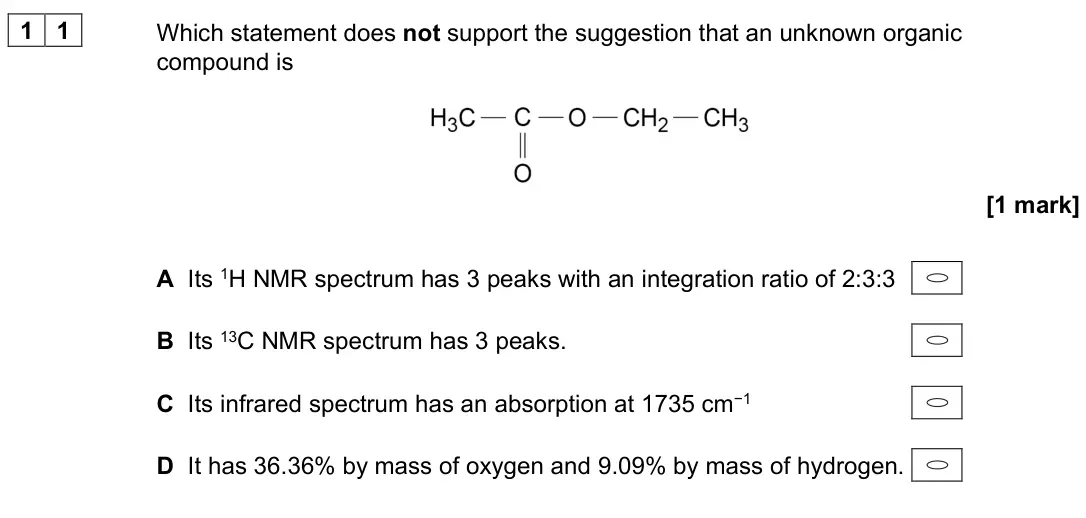
- November 2021, Paper 3, Q11 (1 mark): Which statement does not support the suggestion that an unknown organic compound is [1 mark] A Its 1H NMR spectrum has 3 peaks with an integration ratio of 2:3:
- November 2020, Paper 2, Q07.1 (6 marks): A compound is usually mixed with Si(CH3)4 and either CCl4 or CDCl3 before recording the compound’s 1H NMR spectrum. State why Si(CH3)4, CCl4 and CDCl3 are used
- November 2020, Paper 2, Q07.2 (3 marks): Deduce the splitting pattern for each of the peaks given by the H atoms labelled x, y and z in the 1H NMR spectrum of the compound shown. [3 marks] x y z
- November 2020, Paper 2, Q07.3 (1 mark): Suggest why it is difficult to use Table B in the Data Booklet to predict the chemical shift (δ value) for the peak given by the H atom labelled y. [1 mark]
- November 2020, Paper 2, Q07.4 (2 marks): Two isomers of CH3CHClCOCH(CH3)2 each have two singlet peaks only in their 1H NMR spectra. In both spectra the integration ratio for the two peaks is 2:9 Deduce
- November 2020, Paper 2, Q08.4 (1 mark): State the number of peaks you would expect in the 13C NMR spectrum for H3Y [1 mark]
- June 2019, Paper 2, Q06.2 (2 marks): Compounds A and B both have the molecular formula C4H8Br2 A has a singlet, a triplet and a quartet in its 1H NMR spectrum. B has only two singlets in its 1H NMR
- June 2019, Paper 2, Q06.3 (2 marks): Compounds C and D both have the molecular formula C6H3Br3 C has two peaks in its 13C NMR spectrum. D has four peaks in its 13C NMR spectrum. Draw a structure fo
- June 2019, Paper 2, Q07.2 (6 marks): Explain how and why isomers X and Y can be distinguished by comparing each of their • boiling points • 13C NMR spectra • infrared spectra. Use data from Tables
- June 2019, Paper 2, Q10.3 (1 mark): Compounds with molecular formula C6H14O2 also have a relative molecular mass of 118 to the nearest whole number. These include the diol shown. Deduce the number
- June 2019, Paper 2, Q10.4 (1 mark): Draw the structure of a different diol also with molecular formula C6H14O2 that has a 1H NMR spectrum that consists of two singlet peaks. [1 mark]
- June 2018, Paper 2, Q11.1 (3 marks): One isomer is shown. Give the number of peaks in the 13C NMR spectrum of this isomer. State and explain the splitting pattern of the peak for the hydrogens labe
- June 2018, Paper 2, Q11.3 (2 marks): Draw the structure of the isomer of C6H16N2 that contains two primary amine groups and has only two peaks in its 13C NMR spectrum. [1 mark] 1 1 . 4 Draw the str
- June 2018, Paper 3, Q16 (1 mark): How many peaks are there in the 13C NMR spectrum of 1,4-dimethylbenzene? [1 mark] A 8 B 4 C 3 D 2
- June 2017, Paper 2, Q10.3 (3 marks): Isomer Q (C6H10O2) is a cyclic compound. The infrared spectrum of Q is shown in Figure 4 and the 13C NMR spectrum of Q is shown in Figure 5. Use these spectra a
- June 2017, Paper 2, Q10.4 (3 marks): Isomers R and S are shown. R S Although the 13C spectra of R and S both show the same number of peaks, the spectra can be used to distinguish between the isomer
- June 2017, Paper 2, Q10.5 (3 marks): Although the 1H spectra of R and S both show the same number of peaks, the spectra can be used to distinguish between the isomers. Justify this statement using
- June 2017, Paper 3, Q29 (1 mark): How many peaks does this compound have in its 13C spectrum? [1 mark] A 5 B 6 C 7 D 8
- Specimen, Paper 2, Q03.2 (1 mark): CORRECT METHOD WRONG METHODS 9
- Specimen, Paper 3, Q35: Which amine has only three peaks in its proton NMR spectrum? [1 mar A Methylamine B Trimethylamine C Diethylamine D Propylamine 3 5
Questions, mark schemes and examiner’s reports are © AQA, from their published past papers. Plumi isn’t affiliated with any exam board. Want whole papers? Every AQA A-Level Chemistry paper.
Rather write your answers by hand on iPad? Plumi marks them against the same mark schemes.