 plumi
Nuclear energy: Eduqas A‑Level Physics questions
Every Eduqas A-Level Physics exam question on 3.8 Nuclear energy, 2016–2025, with its mark scheme and examiner’s report.
Find questions1,592
Calculations
Q8(a)
The whole paper ↗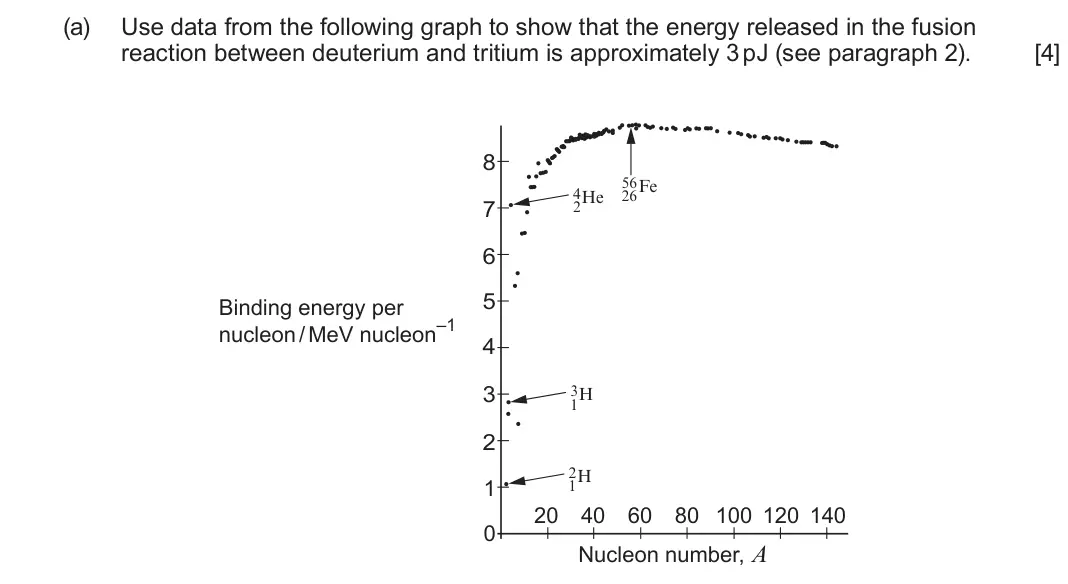
Q8(d)
The whole paper ↗
Q10(c)(ii)
The whole paper ↗
Q12(b)(i)
The whole paper ↗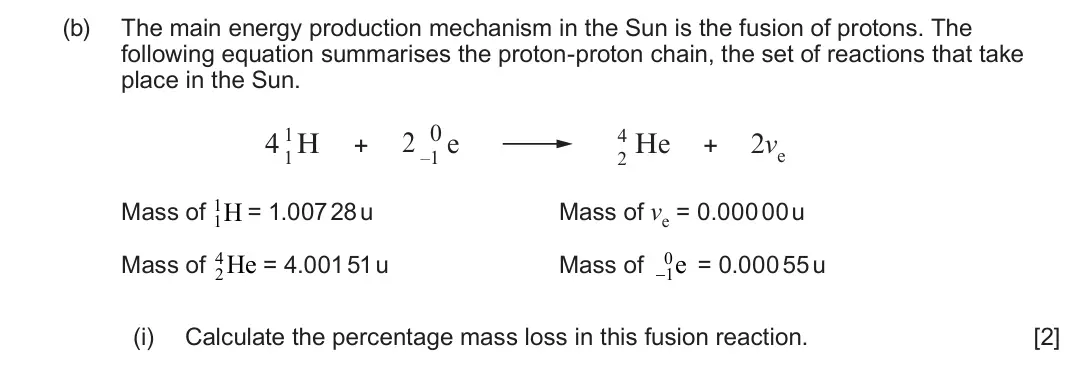
Q12(b)(iv)
The whole paper ↗
Q8(b)
The whole paper ↗
Q7(c)
The whole paper ↗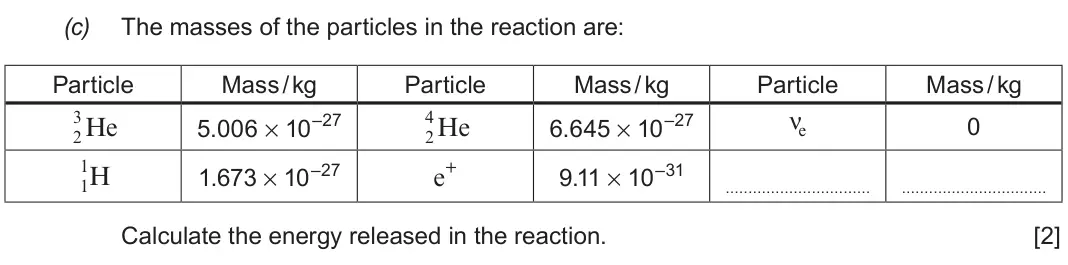
Q7(b)
The whole paper ↗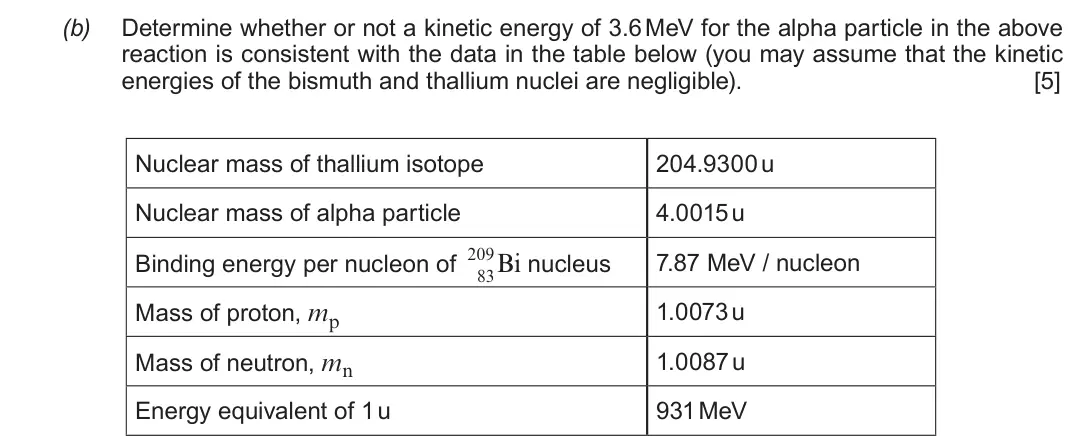
Q5(a)
The whole paper ↗
Q5(b)
The whole paper ↗
Q5(c)
The whole paper ↗
Q5(d)
The whole paper ↗
Q14(a)(ii)
The whole paper ↗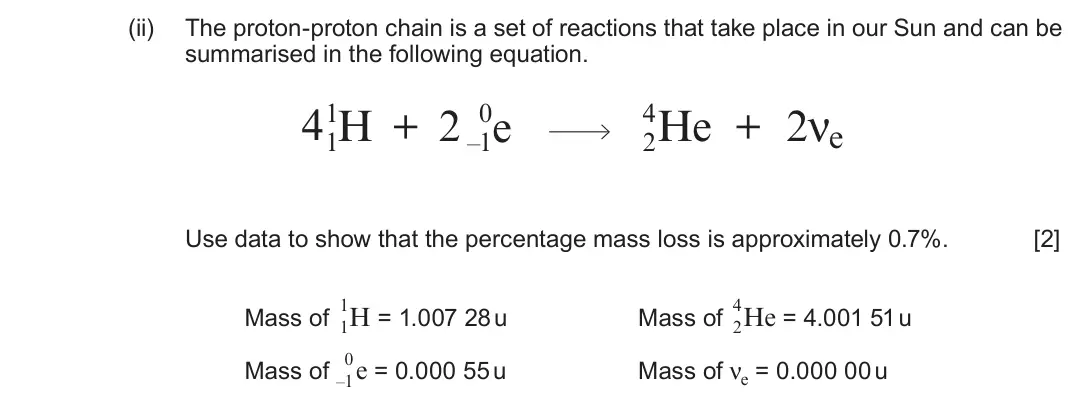
Q14(a)(iii)
The whole paper ↗
Q7(a)
The whole paper ↗
Q3(a)
The whole paper ↗
Q3(b)(i)
The whole paper ↗
Q3(b)(ii)
The whole paper ↗
All 19 questions on Nuclear energy, as a list
- June 2025, Component 1, Q8(a) (4 marks): Read through the following article carefully. Paragraph Laser Fusion 1 Apart from the hydrogen fusion bomb, which actually requires a fission bomb to detonate i
- June 2025, Component 3, Q8(d) (5 marks): The mass of the ∆– particle is 1.323 u, the mass of a neutron is 1.009 u, and the mass of particle X is 0.150 u. From Einstein’s Theory of Relativity, nothing c
- June 2025, Component 3, Q10(c)(ii) (3 marks): During a positron emission tomography (PET) scan, a positron of kinetic energy 2.2 MeV collides with a stationary electron and both are annihilated in the colli
- June 2025, Component 3, Q12(b)(i) (2 marks): Calculate the percentage mass loss in this fusion reaction. [2]
- June 2024, Component 3, Q12(b)(iv) (3 marks): Explain briefly the difficulties associated with producing sustained nuclear fusion power. [3]
- June 2023, Component 3, Q8(b) (3 marks): The unknown particle X is then seen to decay as follows: γ + γ X where each gamma photon has an energy of 67.5 MeV. Calculate the mass of particle X in kg. [3]
- Autumn 2021, Component 3, Q7(c) (2 marks): The masses of the particles in the reaction are: Particle Mass / kg Particle Mass / kg Particle Mass / kg 3 2 He 5.006 × 10⁻²⁷ 4 2 He 6.645 × 10⁻²⁷ νe 0 1 1H 1.
- Autumn 2020, Component 3, Q7(b) (5 marks): Determine whether or not a kinetic energy of 3.6 MeV for the alpha particle in the above reaction is consistent with the data in the table below (you may assume
- June 2019, Component 3, Q5(a) (3 marks): Show that this interaction can only take place if the energy of the gamma photon is greater than 1.02 MeV. [3]
- June 2019, Component 3, Q5(b) (2 marks): The actual energy of the incident gamma photon is 1.03 MeV. Assuming that the kinetic energy of the nucleus after the interaction is negligible, explain briefly
- June 2019, Component 3, Q5(c) (4 marks): Use the kinetic energies of 0.005 MeV and conservation of momentum to show that the speeds of the positron and electron are 4.2 × 10⁷ m s–1 and that the momentu
- June 2019, Component 3, Q5(d) (2 marks): The momentum of the nucleus (4.7 × 10⁻²² kg m s–1) is essential otherwise conservation of momentum would be impossible. Deduce whether or not the assumption in
- June 2019, Component 3, Q14(a)(ii) (2 marks): The proton-proton chain is a set of reactions that take place in our Sun and can be summarised in the following equation. 41 H + 2 0 –1e 4 He + 2νe 1 2 Use data
- June 2019, Component 3, Q14(a)(iii) (2 marks): The Sun can be assumed to have come to the end of its life when it has lost 0.7 % of its mass to radiated energy. Estimate the lifetime of the Sun in years. Tak
- June 2018, Component 3, Q7(a) (2 marks): Explain briefly what is meant by conservation of mass-energy. [2]
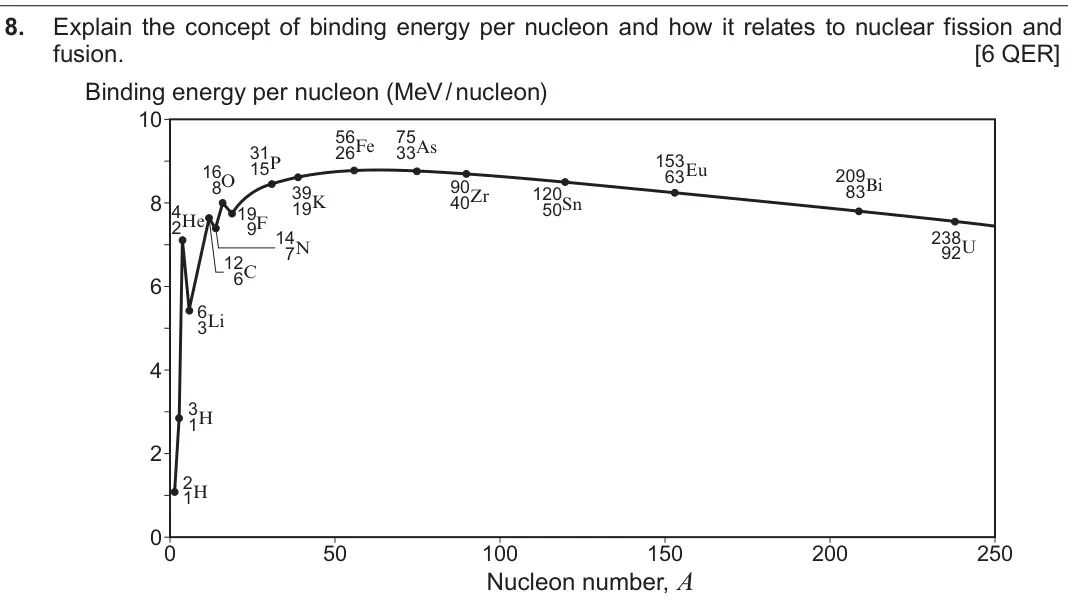
- June 2018, Component 3, Q8 (6 marks): Explain the concept of binding energy per nucleon and how it relates to nuclear fission and fusion. [6 QER] Binding energy per nucleon (MeV / nucleon) 10 56 75
- June 2017, Component 3, Q3(a) (3 marks): Calculate the energy released in the decay of tritium. [3]
- June 2017, Component 3, Q3(b)(i) (3 marks): Calculate the binding energy per nucleon of a tritium nucleus. [3]
- June 2017, Component 3, Q3(b)(ii) (3 marks): The binding energy per nucleon of a helium-3 nucleus (i.e. 2.6 MeV/nucleon) is slightly lower than the answer to (b)(i). How does this show that binding energy
Questions, mark schemes and examiner’s reports are © WJEC Eduqas, from their published past papers. Plumi isn’t affiliated with any exam board. Want whole papers? Every Eduqas A-Level Physics paper.
Rather write your answers by hand on iPad? Plumi marks them against the same mark schemes.