 plumi
Magnetic fields: Eduqas A‑Level Physics questions
Every Eduqas A-Level Physics exam question on 3.9 Magnetic fields, 2016–2025, with its mark scheme and examiner’s report.
Find questions1,592
Calculations
Q4(b)(ii)
The whole paper ↗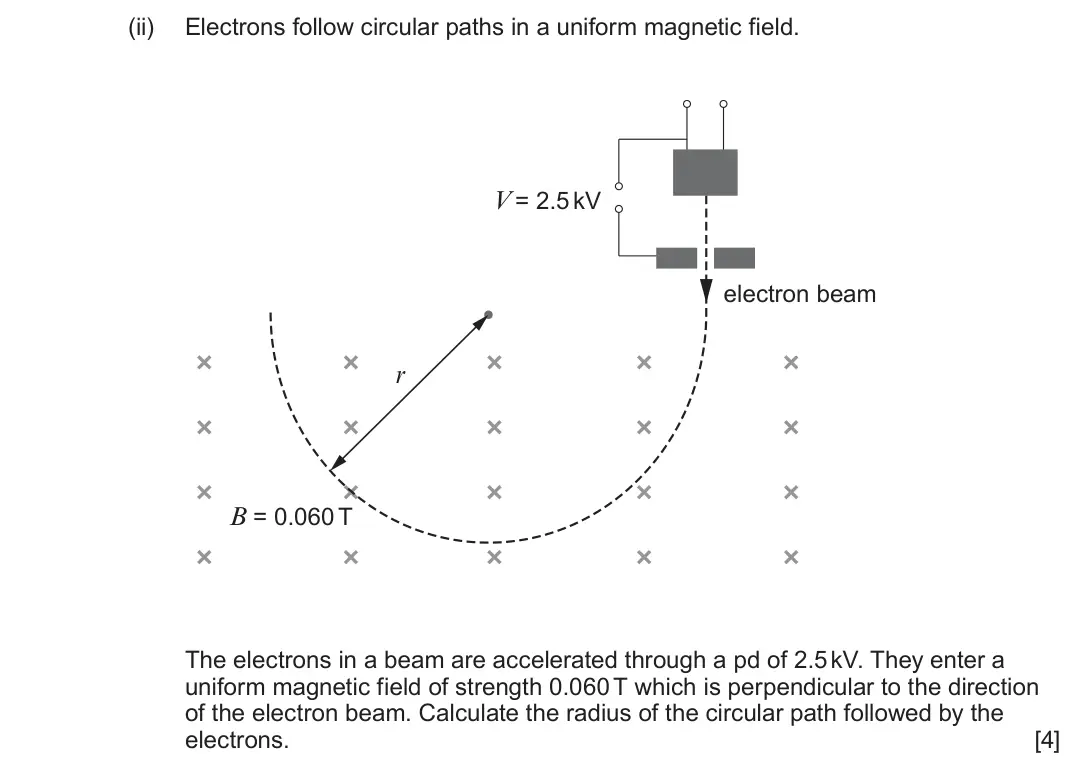
Q4(b)(iii)
The whole paper ↗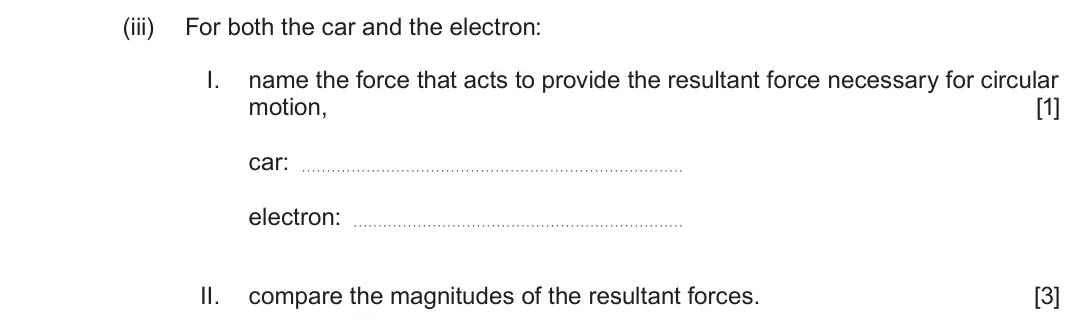
Q7(a)
The whole paper ↗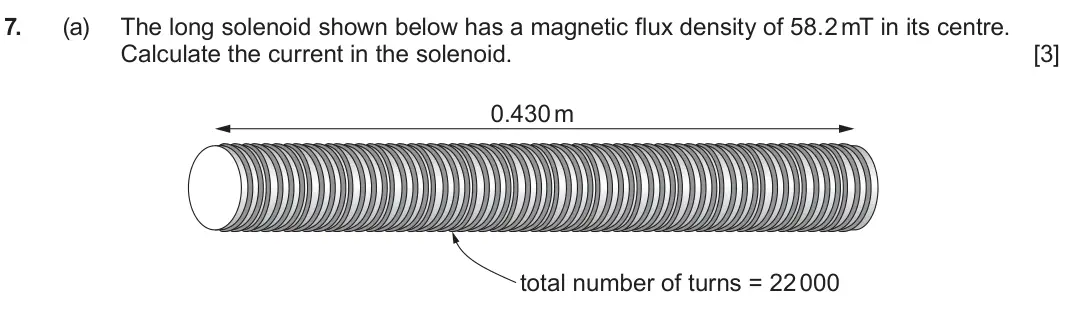
Q7(b)(i)
The whole paper ↗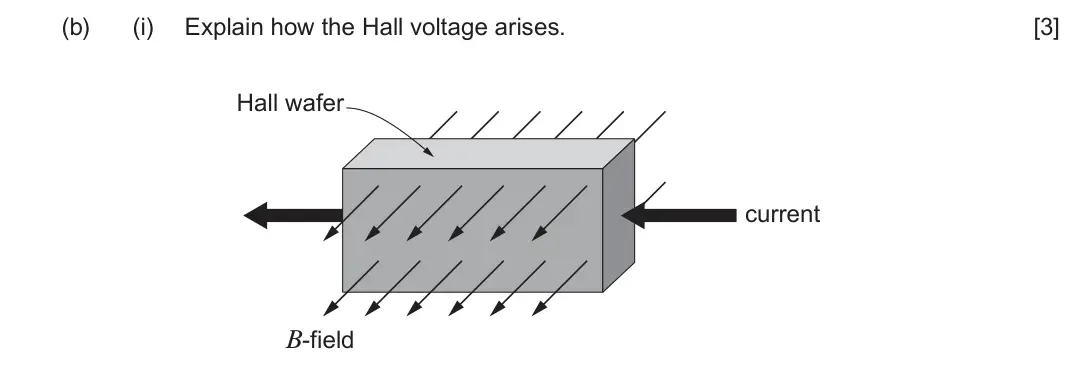
Q7(b)(ii)
The whole paper ↗
Q7(b)(iii)
The whole paper ↗
Q9(a)
The whole paper ↗
Q9(b)
The whole paper ↗
Q9(c)
The whole paper ↗
Q9(d)
The whole paper ↗
Q8(e)
The whole paper ↗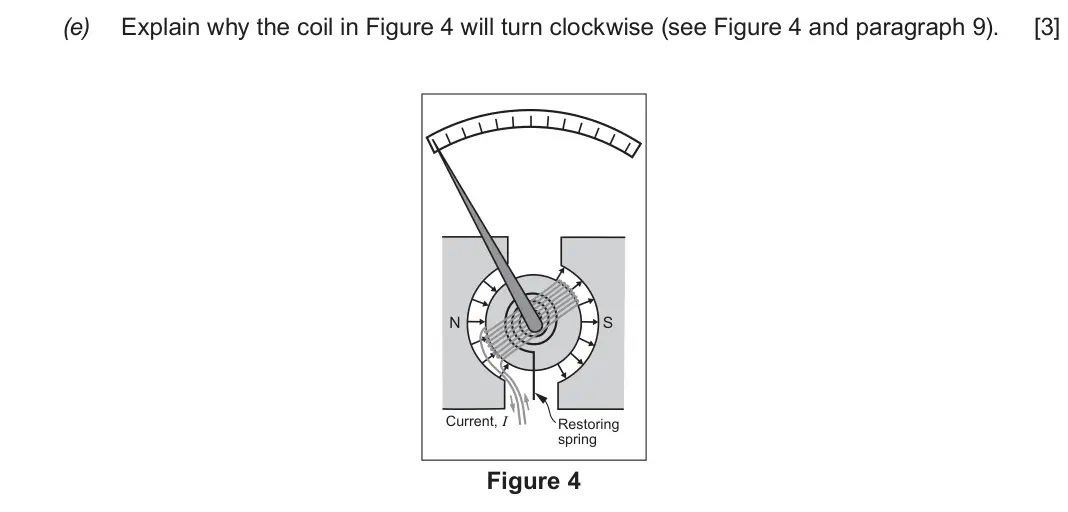
Q8(f)
The whole paper ↗
Q4(a)(i)
The whole paper ↗
Q4(a)(ii)
The whole paper ↗
Q4(b)(i)
The whole paper ↗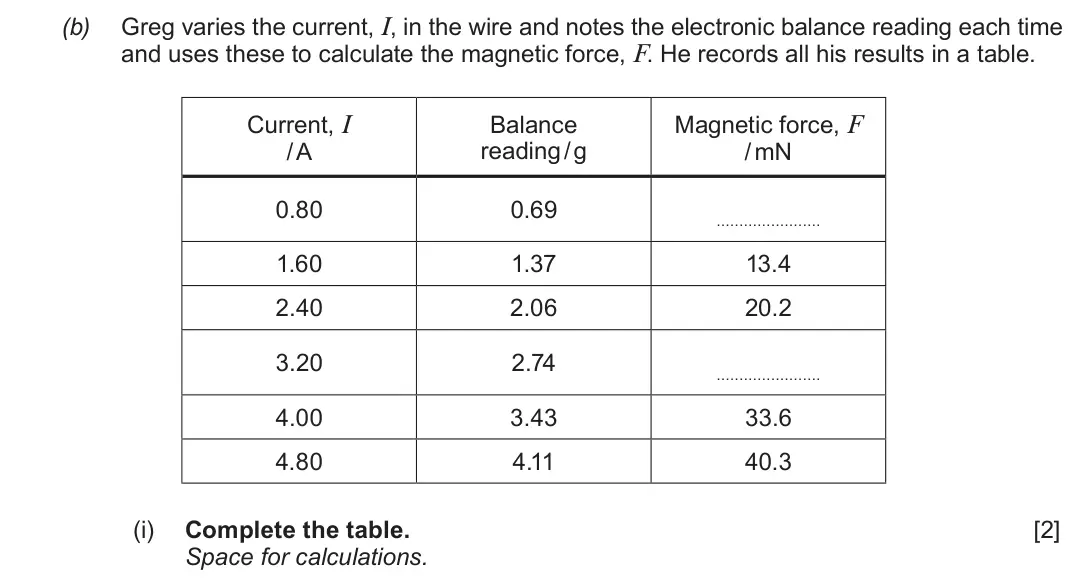
Q4(b)(ii)
The whole paper ↗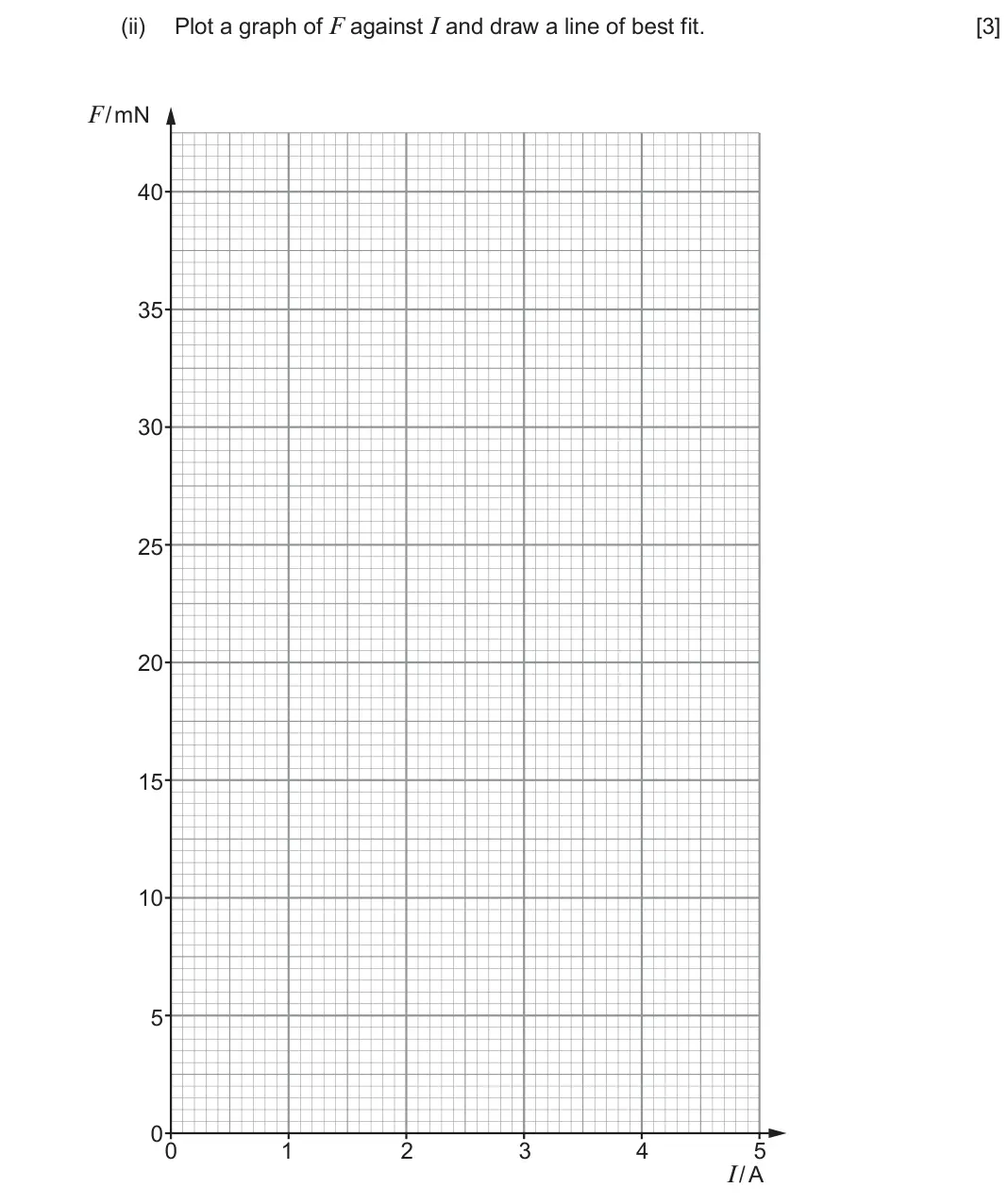
Q4(b)(iii)
The whole paper ↗
Q4(b)(iv)
The whole paper ↗
Q4(b)(v)
The whole paper ↗
Q4(b)(vi)
The whole paper ↗
All 33 questions on Magnetic fields, as a list
- June 2024, Component 1, Q4(b)(ii) (4 marks): Electrons follow circular paths in a uniform magnetic field. V = 2.5 kV electron beam r B = 0.060 T The electrons in a beam are accelerated through a pd of 2.5
- June 2024, Component 1, Q4(b)(iii) (4 marks): For both the car and the electron: I. name the force that acts to provide the resultant force necessary for circular motion, [1] car: electron: II. compare the
- June 2024, Component 3, Q7(a) (3 marks): The long solenoid shown below has a magnetic flux density of 58.2 mT in its centre. Calculate the current in the solenoid. [3] 0.430 m total number of turns = 2
- June 2024, Component 3, Q7(b)(i) (3 marks): Explain how the Hall voltage arises. [3] Hall wafer current B-field
- June 2024, Component 3, Q7(b)(ii) (2 marks): The drift velocity of electrons in a Hall wafer is 13.0 cm s–1 and the width of the Hall wafer is 0.58 cm. Calculate the expected Hall voltage when this Hall wa
- June 2024, Component 3, Q7(b)(iii) (2 marks): The actual measured Hall voltage is significantly below the value in (b)(ii) even though all values quoted are correct. Suggest what a competent experimental ph
- June 2023, Component 3, Q9(a) (2 marks): Place an arrow on the dotted circle to indicate the direction of motion of the alpha particles, and state the name of the rule you used to obtain the direction.
- June 2023, Component 3, Q9(b) (3 marks): Calculate the initial magnetic flux density of the synchrotron to ensure that the alpha particles (4 2He) follow a circular path. [3]
- June 2023, Component 3, Q9(c) (3 marks): Calculate the initial frequency of the pd supplied to the synchrotron. [3]
- June 2023, Component 3, Q9(d) (3 marks): Explain why the kinetic energy (in eV) of the alpha particles in the synchrotron is: kinetic energy (in eV) = 5.3 × 10⁶ + (8 × n × V) where n is the number of o
- Autumn 2021, Component 1, Q8(e) (3 marks): Paragraph 8 Read through the following article carefully. Build Your Own Strainmeter in an A-level Physics Classroom The first questions that need answering are
- Autumn 2021, Component 1, Q8(f) (3 marks): Paragraph 8 Read through the following article carefully. Build Your Own Strainmeter in an A-level Physics Classroom The first questions that need answering are
- Autumn 2021, Component 3, Q4(a)(i) (2 marks): Greg states that the forces on the wire and the magnet are a Newton’s third law pair of forces. Explain briefly why Greg is correct. [2]
- Autumn 2021, Component 3, Q4(a)(ii) (1 mark): The left pole of the magnet is a north pole. Explain how this is consistent with the information above, naming the rule that you used. [1]
- Autumn 2021, Component 3, Q4(b)(i) (2 marks): Complete the table. [2] Space for calculations.
- Autumn 2021, Component 3, Q4(b)(ii) (3 marks): Plot a graph of F against I and draw a line of best fit. [3] F / mN 40 35 30 25 20 15 10 5 0 0 1 2 3 4 5 I / A
- Autumn 2021, Component 3, Q4(b)(iii) (3 marks): Explain to what extent the data show that the force is proportional to the current. [3]
- Autumn 2021, Component 3, Q4(b)(iv) (4 marks): The length of the portion XY of the wire is 5.0 cm. Determine the magnetic flux density, B, of the field between the poles of the magnet and quote it to an appr
- Autumn 2021, Component 3, Q4(b)(v) (2 marks): Nancy claims that the forces on the vertical portions of the wire have not been considered in the answer to part (iv) and that the answer will be inaccurate bec
- Autumn 2021, Component 3, Q4(b)(vi) (2 marks): The value of the magnetic flux density in part (iv) is slightly inaccurate for another reason which has nothing to do with human error or meter inaccuracies. Di
- Autumn 2020, Component 3, Q10(a)(i) (1 mark): A long solenoid has 12 000 turns per metre and carries a current of 3.8 A. Calculate the magnetic flux density at its centre. [1]
- Autumn 2020, Component 3, Q10(a)(ii) (2 marks): Sketch the magnetic field lines due to this long solenoid. [2] current
- Autumn 2020, Component 3, Q10(a)(iii) (1 mark): State how the strength of the magnetic field produced by this solenoid can be increased greatly without increasing the current or changing the dimensions of the
- Autumn 2020, Component 3, Q10(b)(iv) (3 marks): Halfway through the deformation of the copper wire it is in the position shown below. Maria claims that in this position, a “motor effect” force of approximatel
- June 2019, Component 3, Q9(a) (4 marks): The silicon chip shown in the diagram is used as a Hall probe with electrons as the charge carriers. Explain how the Hall voltage arises and which face of the c
- June 2019, Component 3, Q9(c) (3 marks): The Hall voltage, VH, for this chip can be expressed as: VH = kB where k is a constant and B is the magnetic flux density. Calculate a value for k and state its
- June 2018, Component 3, Q9(a) (3 marks): Calculate the final velocity of a helium-4 nucleus (the mass of a helium-4 nucleus is 4u). [3]
- June 2018, Component 3, Q9(b) (3 marks): Calculate the pd between the dees. [3]
- June 2018, Component 3, Q9(c) (3 marks): The uniform magnetic flux density is 0.47 T. Calculate the frequency of the alternating pd applied to the dees. [3]
- June 2017, Component 1, Q7(f) (2 marks): Read through the following article carefully. Cool Physics for Smart Phones by Justino Luis Moreno Paragraph Some meters can be expensive to buy but if you’ve g
- June 2017, Component 3, Q4(a) (3 marks): Show that the length of the wire is approximately 1.5 km. You may assume that the insulation thickness is negligible. [3]
- June 2017, Component 3, Q4(c) (2 marks): Calculate the magnetic field strength, B, inside the solenoid. [2]
- June 2017, Component 3, Q4(d) (3 marks): Explain whether or not the solenoid could produce a magnetic field of 2 T. You should include a calculation to reinforce your answer. [3]
Questions, mark schemes and examiner’s reports are © WJEC Eduqas, from their published past papers. Plumi isn’t affiliated with any exam board. Want whole papers? Every Eduqas A-Level Physics paper.
Rather write your answers by hand on iPad? Plumi marks them against the same mark schemes.