 plumi
Refraction of light: Eduqas A‑Level Physics questions
Every Eduqas A-Level Physics exam question on 3.3 Refraction of light, 2016–2025, with its mark scheme and examiner’s report.
Find questions1,592
Calculations
Q3(a)
The whole paper ↗
Q3(b)
The whole paper ↗
Q3(c)
The whole paper ↗
Q4(a)
The whole paper ↗
Q4(b)(i)
The whole paper ↗
Q4(b)(ii)
The whole paper ↗
Q3(a)(i)
The whole paper ↗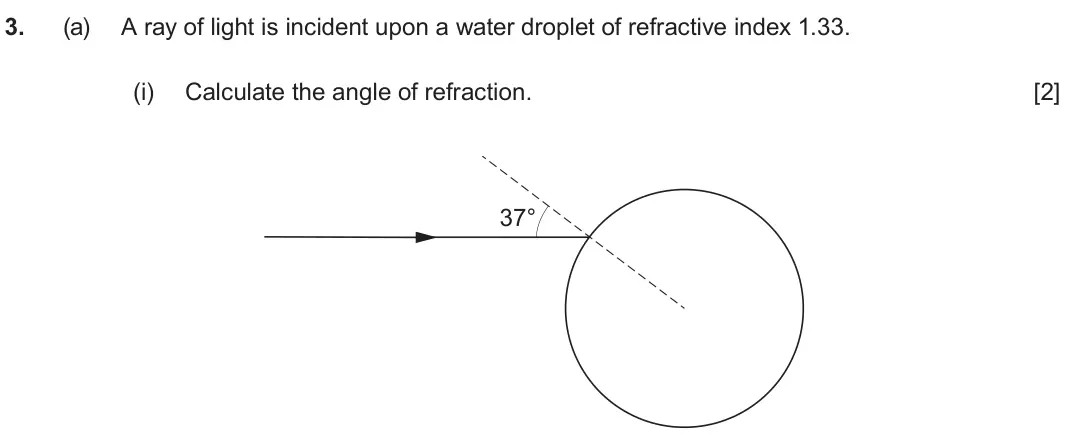
Q3(a)(ii)
The whole paper ↗
Q3(b)(i)
The whole paper ↗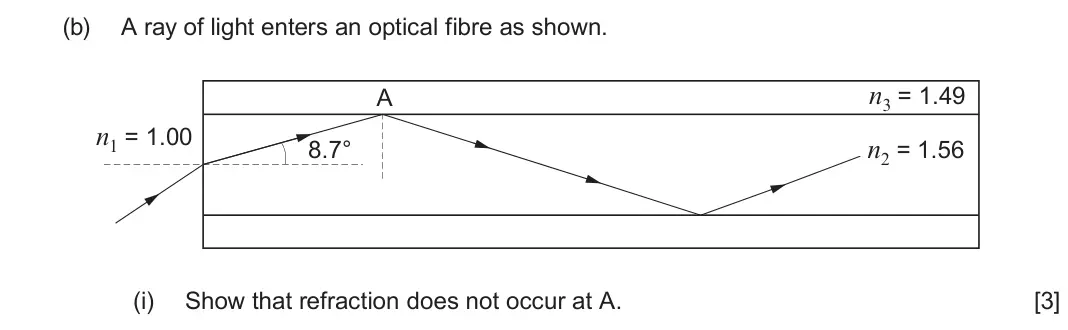
Q3(b)(ii)
The whole paper ↗
Q3(b)(iii)
The whole paper ↗
Q3(a)(i)
The whole paper ↗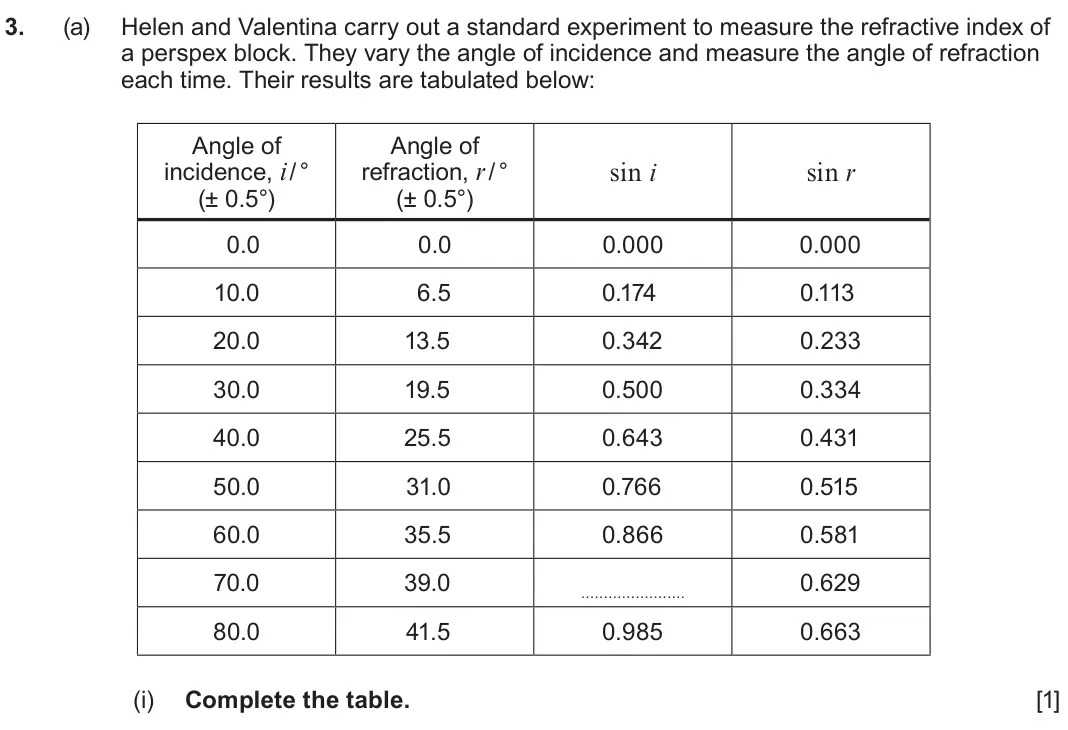
Q3(a)(ii)
The whole paper ↗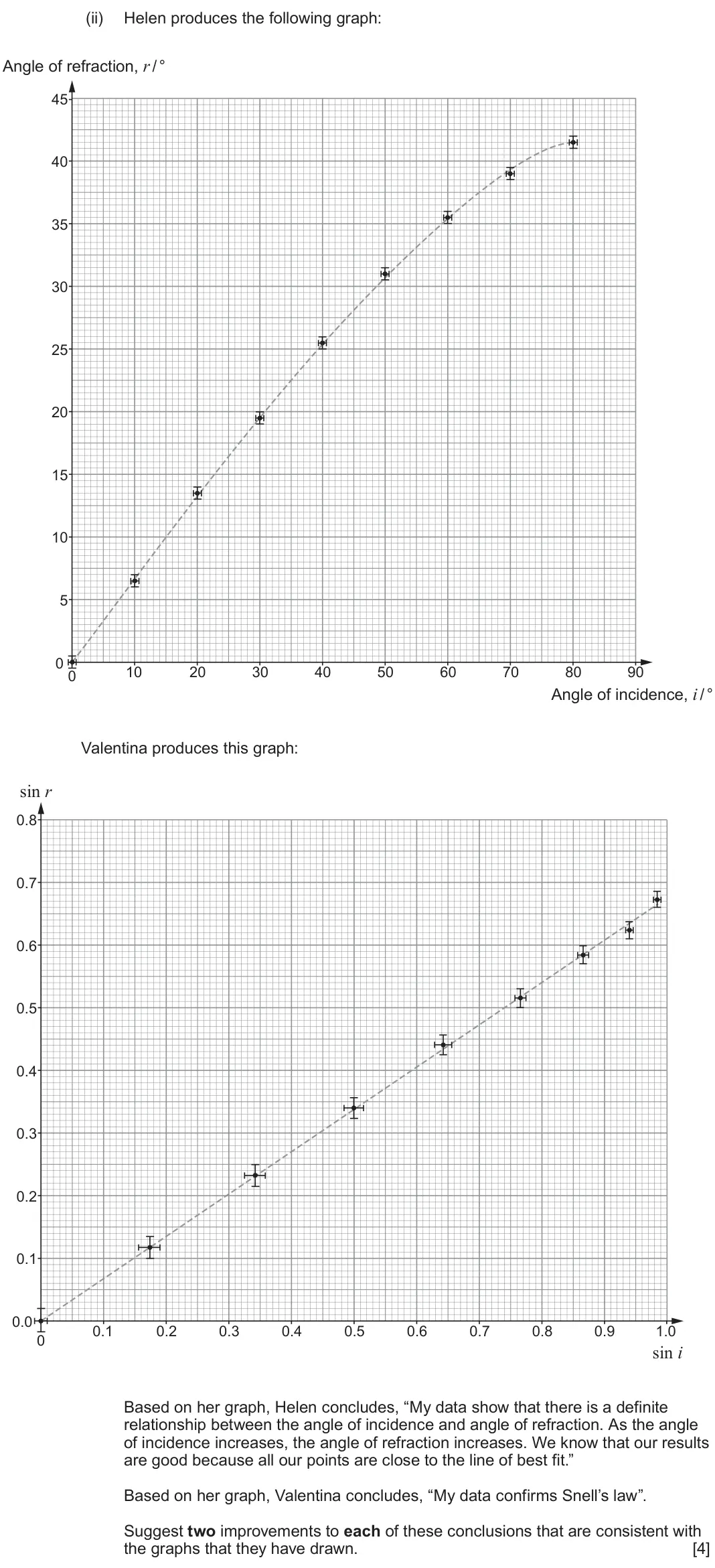
Q3(b)
The whole paper ↗
Q3(i)
The whole paper ↗
Q3(ii)
The whole paper ↗
Q3(iii)
The whole paper ↗
Q3(iv)
The whole paper ↗
Q3(v)
The whole paper ↗
Q3(a)
The whole paper ↗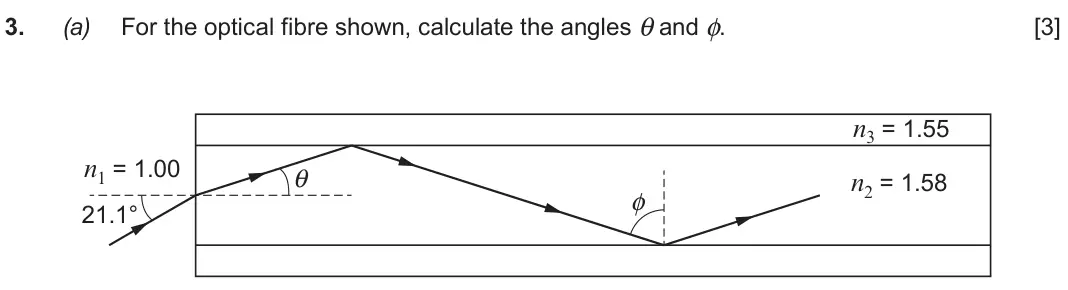
All 45 questions on Refraction of light, as a list
- June 2025, Component 3, Q3(a) (2 marks): Calculate the angle labelled θ in the diagram. [2]
- June 2025, Component 3, Q3(b) (4 marks): Explain why total internal reflection occurs at A. Use calculations to support your answer. [4]
- June 2025, Component 3, Q3(c) (4 marks): The length of the optical fibre is 16.0 km. Calculate the time lag between pulses travelling along the central axis of the optical fibre and pulses travelling v
- June 2025, AS Component 2, Q4(a) (2 marks): Calculate the refractive index of the cladding if the smallest angle, θ, at which total internal reflection can occur is 79 º. [2]
- June 2025, AS Component 2, Q4(b)(i) (3 marks): Calculate the time taken for light to travel straight along the axis of the fibre from one end to the other. [3]
- June 2025, AS Component 2, Q4(b)(ii) (3 marks): Thomas states that the light takes a greater amount of time to travel along the zigzag path (when θ = 79 º) than along the axis. Thomas claims that this causes
- June 2024, Component 3, Q3(a)(i) (2 marks): Calculate the angle of refraction. [2] 37°
- June 2024, Component 3, Q3(a)(ii) (3 marks): Complete the diagram above by showing the ray passing through the droplet and out of the other side. Label the angles with their values. [3]
- June 2024, Component 3, Q3(b)(i) (3 marks): Show that refraction does not occur at A. [3]
- June 2024, Component 3, Q3(b)(ii) (3 marks): Explain how ‘multimode dispersion’ arises and outline the problem that it causes. [3]
- June 2024, Component 3, Q3(b)(iii) (2 marks): Explain how the problem of ‘multimode dispersion’ is solved in practice. [2]
- June 2023, Component 3, Q3(a)(i) (1 mark): Complete the table. [1]
- June 2023, Component 3, Q3(a)(ii) (4 marks): Helen produces the following graph: Angle of refraction, r / ° 45 40 35 30 25 20 15 10 5 0 10 20 30 40 50 60 70 80 90 0 Angle of incidence, i / ° Valentina prod
- June 2023, Component 3, Q3(b) (3 marks): Calculate the best value of the refractive index of the perspex block and explain why you chose this method. [3]
- June 2023, AS Component 2, Q3(i) (2 marks): Complete the columns for sin i and sin r. [2]
- June 2023, AS Component 2, Q3(ii) (4 marks): Plot a graph of sin i (y-axis) against sin r (x-axis). [4]
- June 2023, AS Component 2, Q3(iii) (3 marks): Determine a value for the refractive index, n, of the material of the transparent block. [3]
- June 2023, AS Component 2, Q3(iv) (2 marks): Determine the critical angle for the material-air boundary. [2]
- June 2023, AS Component 2, Q3(v) (2 marks): Calculate the speed of light in the transparent block. [2]
- Autumn 2021, Component 3, Q3(a) (3 marks): For the optical fibre shown, calculate the angles θ and φ. [3] n3 = 1.55 n1 = 1.00 θ n2 = 1.58 φ 21.1°
- Autumn 2021, Component 3, Q3(b) (3 marks): Hence, determine whether the ray shown will travel a long distance along the optical fibre without a rapid drop in intensity. [3]
- Autumn 2021, Component 3, Q3(c)(i) (4 marks): Calculate the time delay between pulses sent along both paths when the length of the optical fibre is 3.5 km. [4]
- Autumn 2021, Component 3, Q3(c)(ii) (2 marks): Hence, calculate the highest number of pulses per second that can be sent along the optical fibre without overlap, explaining your reasoning. [2]
- June 2019, AS Component 2, Q3(a) (3 marks): State what is meant by refraction and use the diagram to explain why refraction occurs. [3]
- June 2019, AS Component 2, Q3(b) (3 marks): By measuring appropriate lengths from the diagram calculate the speed of light in the glass. [3]
- June 2018, Component 3, Q2(a) (2 marks): Show that the angle θ is approximately 10°. [2]
- June 2018, Component 3, Q2(b) (4 marks): Deduce whether or not this light will propagate along the length of the optical fibre with total internal reflection as shown. [4]
- June 2018, AS Component 2, Q6(a)(i) (2 marks): Calculate the critical angle for the core-cladding boundary. [2]
- June 2018, AS Component 2, Q6(a)(ii) (3 marks): A beam of light enters the optical fibre from air at an angle of 15° as shown. Calculate angle A. [3]
- June 2018, AS Component 2, Q6(a)(iii) (2 marks): A technician states that the beam of light entering the fibre from air at an angle of 15° will not travel down the optical fibre. Evaluate whether the technicia
- June 2018, AS Component 2, Q6(b) (3 marks): Calculate the time taken for the light to travel along the axis of a straight optical fibre of length 15 km. [3]
- June 2018, AS Component 2, Q6(c)(i) (1 mark): State how the paths of light in monomode and multimode optical fibres differ. [1]
- June 2018, AS Component 2, Q6(c)(ii) (3 marks): Explain the advantage of monomode optical fibres over multimode optical fibres for communicating a rapid sequence of data encoded as light pulses. [3]
- June 2017, Component 3, Q8(a) (2 marks): Draw the refracted ray and the ray emerging from the glass block on the above diagram. [2]
- June 2017, Component 3, Q8(b)(i) (4 marks): / Refracted angle (r) / sin (i) sin (r) degrees ±1° degrees ±1° 0 0 0.00 ± 0.02 0.00 ± 0.02 20 13 0.34 ± 0.02 0.22 ± 0.02 40 25 0.64 ± 0.01 0.42 ± 0.02 60 34 0.
- June 2017, Component 3, Q8(b)(ii) (4 marks): Determine the refractive index of the block along with a value for its absolute uncertainty, quoting your results to an appropriate number of significant figure
- June 2017, Component 3, Q9 (6 marks): Explain the advantages of monomode optical fibres over multimode optical fibres when transmitting a rapid sequence of pulses. [6 QER]
- June 2017, AS Component 2, Q2(a) (2 marks): Calculate the angle of refraction, θ. [2]
- June 2017, AS Component 2, Q2(b)(i) (2 marks): Calculate the critical angle for a ray of light travelling from oil to water. [2]
- June 2017, AS Component 2, Q2(b)(ii) (2 marks): State and explain what happens to the ray of light in the diagram above when it reaches the boundary with the water. [2]
- June 2017, AS Component 2, Q2(c) (2 marks): Determine the speed of the light in the oil. [2]
- June 2016, AS Component 2, Q6(a) (6 marks): Explain in detail how you would carry out an experiment based on angles to determine the refractive index of glass in the form of a rectangular block. [6 QER]
- June 2016, AS Component 2, Q6(b)(i) (2 marks): Draw on the diagram the continuation of the beam through the prism and out into the air through the hypotenuse. [2]
- June 2016, AS Component 2, Q6(b)(ii) (3 marks): Calculate the angle through which the beam is deviated from its original direction. [3]
- June 2016, AS Component 2, Q6(b)(iii) (3 marks): The prism is placed so that light is incident upon it as shown below. Explain with the aid of a calculation how the light passes through the prism now. [3] 50°
Questions, mark schemes and examiner’s reports are © WJEC Eduqas, from their published past papers. Plumi isn’t affiliated with any exam board. Want whole papers? Every Eduqas A-Level Physics paper.
Rather write your answers by hand on iPad? Plumi marks them against the same mark schemes.