 plumi
Medical physics: Eduqas A‑Level Physics questions
Every Eduqas A-Level Physics exam question on 3.B Medical physics, 2016–2025, with its mark scheme and examiner’s report.
Find questions1,592
Calculations
Q10(a)(i)
The whole paper ↗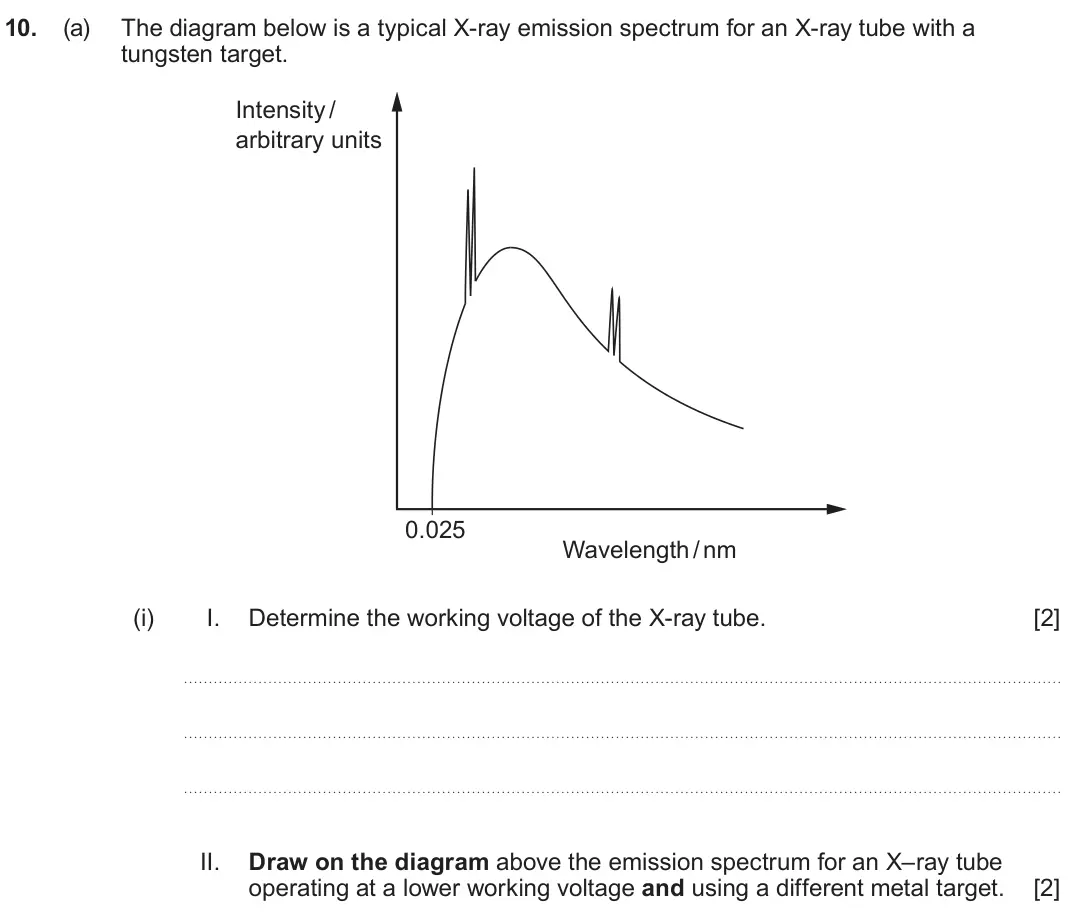
Q10(a)(ii)
The whole paper ↗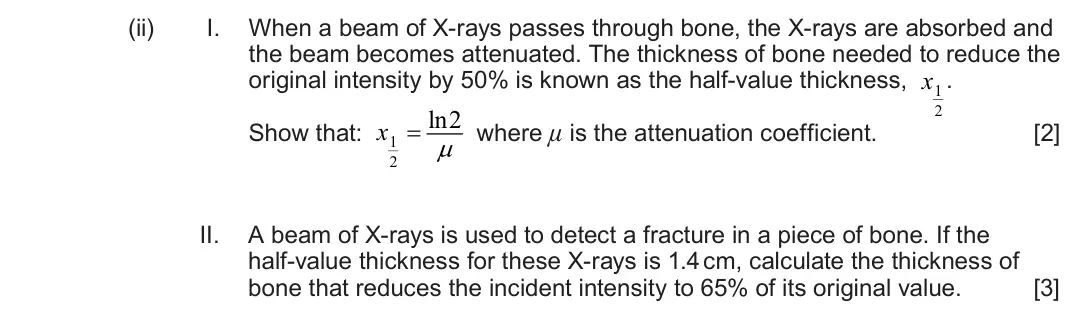
Q10(b)
The whole paper ↗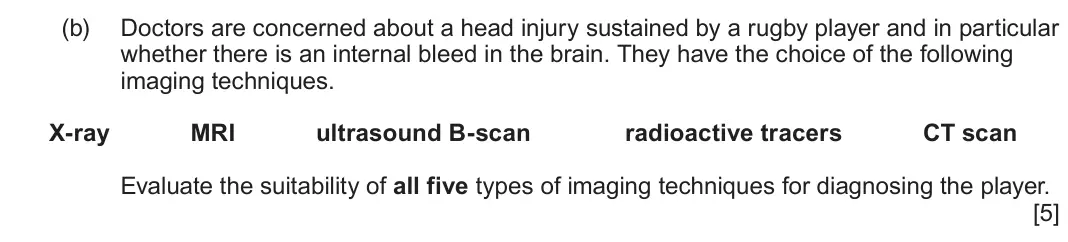
Q10(c)(i)
The whole paper ↗
Q10(c)(ii)
The whole paper ↗
Q10(a)(i)
The whole paper ↗
Q10(a)(ii)
The whole paper ↗
Q10(a)(iii)
The whole paper ↗
Q10(a)(iv)
The whole paper ↗
Q10(b)
The whole paper ↗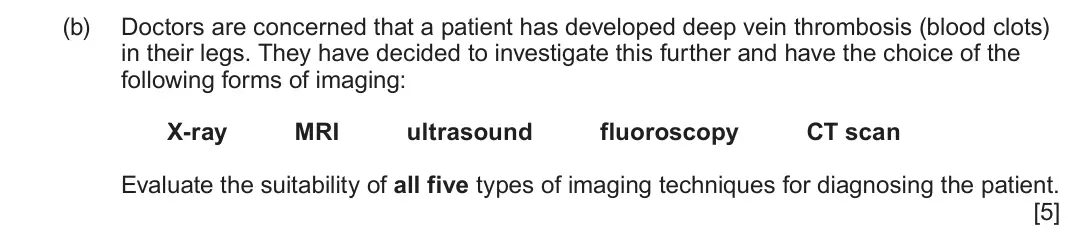
Q10(c)
The whole paper ↗
Q10(d)(i)
The whole paper ↗
Q10(d)(ii)
The whole paper ↗
Q12(a)(i)
The whole paper ↗
Q12(a)(ii)
The whole paper ↗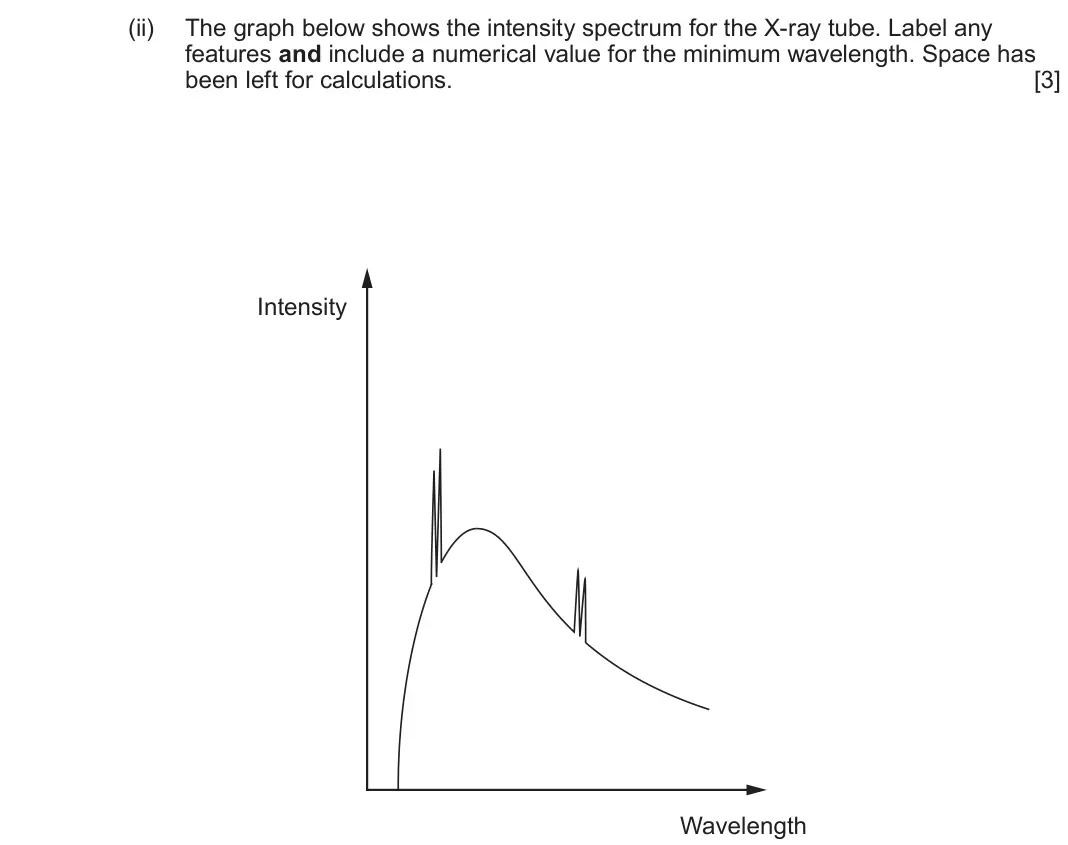
Q12(a)(iii)
The whole paper ↗
Q12(a)(iv)
The whole paper ↗
Q12(b)
The whole paper ↗
Q12(c)
The whole paper ↗
Q12(d)
The whole paper ↗
All 61 questions on Medical physics, as a list
- June 2025, Component 3, Q10(a)(i) (4 marks): I. Determine the working voltage of the X-ray tube. [2] II. Draw on the diagram above the emission spectrum for an X–ray tube operating at a lower working volta
- June 2025, Component 3, Q10(a)(ii) (5 marks): I. When a beam of X-rays passes through bone, the X-rays are absorbed and the beam becomes attenuated. The thickness of bone needed to reduce the original inten
- June 2025, Component 3, Q10(b) (5 marks): Doctors are concerned about a head injury sustained by a rugby player and in particular whether there is an internal bleed in the brain. They have the choice of
- June 2025, Component 3, Q10(c)(i) (3 marks): Explain how a gamma camera detects the gamma rays given off by a technetium-99m source. [3]
- June 2025, Component 3, Q10(c)(ii) (3 marks): During a positron emission tomography (PET) scan, a positron of kinetic energy 2.2 MeV collides with a stationary electron and both are annihilated in the colli
- June 2024, Component 3, Q10(a)(i) (3 marks): Describe the energy changes that occur inside an X-ray tube. [3]
- June 2024, Component 3, Q10(a)(ii) (2 marks): Calculate the frequency of the X-rays at the cut-off wavelength of 48 pm. [2]
- June 2024, Component 3, Q10(a)(iii) (2 marks): The accelerating voltage is 25 kV. Use this value to determine the maximum energy of the X-ray photons in J. [2]
- June 2024, Component 3, Q10(a)(iv) (2 marks): Use the information above to obtain a value for the Planck constant, h. [2]
- June 2024, Component 3, Q10(b) (5 marks): Doctors are concerned that a patient has developed deep vein thrombosis (blood clots) in their legs. They have decided to investigate this further and have the
- June 2024, Component 3, Q10(c) (2 marks): A small volume of Human serum albumin (HSA) labelled with iodine-125 of activity 160 Bq is injected into the bloodstream of a patient. A sample of 0.6 ml of blo
- June 2024, Component 3, Q10(d)(i) (2 marks): Define ‘equivalent dose’ and ‘effective dose’. [2]
- June 2024, Component 3, Q10(d)(ii) (2 marks): The effective dose for alpha particles incident on the skin is 2.2 mSv and the equivalent dose is 0.22 Sv. Determine the tissue weighting factor, WT , for skin.
- June 2023, Component 3, Q12(a)(i) (1 mark): An X-ray tube operating with a power of 7.5 kW has a current of 250 mA. Determine its operating voltage. [1]
- June 2023, Component 3, Q12(a)(ii) (3 marks): The graph below shows the intensity spectrum for the X-ray tube. Label any features and include a numerical value for the minimum wavelength. Space has been lef
- June 2023, Component 3, Q12(a)(iii) (3 marks): On the diagram above, draw an intensity spectrum for the same X-ray tube with an operating voltage of 40 kV; again, include a numerical value for the minimum wa
- June 2023, Component 3, Q12(a)(iv) (2 marks): Discuss if it would be possible to reduce the minimum wavelength to zero. [2]
- June 2023, Component 3, Q12(b) (5 marks): Doctors are concerned that there is a faulty aortic valve in a patient’s heart. They have decided to investigate this further and have the choice of the followi
- June 2023, Component 3, Q12(c) (3 marks): Doctors order further tests to examine the rate of blood flow around the body. To determine this, they use ultrasound at a wavelength of 0.45 mm and angle to th
- June 2023, Component 3, Q12(d) (3 marks): Explain the operation of PET scans; include which part of the electromagnetic spectrum they detect. [3]
- Autumn 2021, Component 3, Q10(a)(i) (2 marks): Determine the kinetic energy in Joule with which an electron hits the target after accelerating through this voltage. [2]
- Autumn 2021, Component 3, Q10(a)(ii) (2 marks): Determine the minimum wavelength of the X-rays. [2]
- Autumn 2021, Component 3, Q10(a)(iii) (2 marks): The X-ray tube has an efficiency of 0.5 % and the anode current is 0.12 A. Calculate the power of the X-rays produced. [2]
- Autumn 2021, Component 3, Q10(b) (2 marks): , of ultrasound reflected at a boundary between two materials of I0 acoustic impedance Z1 and Z2 is given by the equation: IR = (Z2 – Z1)2 I0 (Z2 + Z1)2 Using t
- Autumn 2021, Component 3, Q10(c)(i) (2 marks): A magnetic resonance image (MRI) scanner can be used to detect tumours in a patient’s body. Describe the effect a strong magnetic field has on hydrogen and how
- Autumn 2021, Component 3, Q10(c)(ii) (2 marks): The MRI scanner has a magnetic field of 1.4 T. Determine the wavelength of electromagnetic radiation that should be used to detect the tumour. [2]
- Autumn 2021, Component 3, Q10(d) (3 marks): Explain how PET scanners work. [3]
- Autumn 2021, Component 3, Q10(e) (5 marks): Doctors are concerned that a patient, who has a pacemaker fitted, has developed deep vein thrombosis (DVT) – blood clots in the leg leading to slow blood flow.
- Autumn 2020, Component 3, Q5(c) (3 marks): In 1896, G. Brandes reported that large intensities of high energy X-rays produced a “blue-grey” glow within the eye. This was later confirmed by Willhelm Röntg
- Autumn 2020, Component 3, Q12(a)(i) (1 mark): Draw on the above diagram an intensity spectrum for the same X-ray tube with a higher operating voltage. [1]
- Autumn 2020, Component 3, Q12(a)(ii) (2 marks): If the operating voltage of the tube is 30 000 V, determine the minimum wavelength of the X-rays produced. [2]
- Autumn 2020, Component 3, Q12(a)(iii) (2 marks): If the anode current is 120 mA and the X-ray tube has an efficiency of 0.450 % calculate the rate of production of heat at the anode. [2]
- Autumn 2020, Component 3, Q12(a)(iv) (1 mark): Explain whether it would be possible to reduce the minimum wavelength to zero. [1]
- Autumn 2020, Component 3, Q12(b)(i) (2 marks): An ultrasound probe (A scan) can be used to determine the thickness of a lens in the human eye. Explain how a piezoelectric transducer can be used to produce ul
- Autumn 2020, Component 3, Q12(b)(ii) (3 marks): A typical ultrasound A scan used to determine the thickness of a lens is given in the diagram below. The spike labelled ‘ant lens’ corresponds to the front of t
- Autumn 2020, Component 3, Q12(c)(i) (3 marks): A cerebral haemorrhage (bleed in the brain). [3]
- Autumn 2020, Component 3, Q12(c)(ii) (2 marks): An underactive thyroid gland. [2]
- Autumn 2020, Component 3, Q12(d) (4 marks): An MRI (magnetic resonance imaging) scanner has a magnetic field that varies from 0.80 T to 1.40 T along its length. Calculate the wavelength of electromagnetic
- June 2019, Component 3, Q12(a)(i) (4 marks): Sketch graphs to show how the intensity of X-rays from an X-ray tube varies with wavelength for a tube operating at two different voltages. Label the main featu
- June 2019, Component 3, Q12(a)(ii) (2 marks): The lower voltage tube operates at 20 kV. Determine the velocity with which the electrons strike the target. [2]
- June 2019, Component 3, Q12(a)(iii) (2 marks): Calculate the minimum wavelength of the X-ray photons produced by these electrons. [2]
- June 2019, Component 3, Q12(b)(i) (2 marks): Ultrasound can be used to carry out either an amplitude scan (A-scan) or a brightness scan (B-scan). Explain which of these two methods you would use to determi
- June 2019, Component 3, Q12(b)(ii) (3 marks): An ultrasound scan can be used to indicate the thickness of fat on a person’s body. Typically fat has a density of 930 kg m–3 and an acoustic impedance of 1.35
- June 2019, Component 3, Q12(c)(i) (2 marks): Explain two properties of a radioactive isotope used as a tracer in medicine. [2]
- June 2019, Component 3, Q12(c)(ii) (3 marks): A small volume of Human Serum Albumin (HSA) labelled with iodine-125 of activity 160 Bq is injected into the bloodstream of a patient. A sample of 0.8 cm3 of bl
- June 2019, Component 3, Q12(d) (2 marks): In a magnetic resonance imaging (MRI) scanner a large magnetic field of 1.5 T is used along with short pulses of radio waves. Dr Francis suggests that radio wav
- June 2018, Component 3, Q12(a) (4 marks): When taking an X-ray image of a person’s arm a metal filter is placed between the X-ray tube and the arm, and a lead grid between the arm and the film as shown.
- June 2018, Component 3, Q12(b)(i) (2 marks): Calculate the number of electrons that strike the target element every second. [2]
- June 2018, Component 3, Q12(b)(ii) (3 marks): Calculate the force exerted by the electron beam on the target. [3]
- June 2018, Component 3, Q12(c) (5 marks): You have the choice of the following forms of medical imaging available: MRI scan PET scan ultrasound B-scan CT scan Evaluate the effectiveness of each type of
- June 2018, Component 3, Q12(d)(i) (1 mark): Radioactive tracers can be used to measure the volume of blood in a patient. Describe one other use of radioactive tracers naming the part of the body they are
- June 2018, Component 3, Q12(d)(ii) (3 marks): An isotope of sodium, Na-24, has a half-life of 15 hours and an initial activity of 160 Bq when injected into a patient. Seven hours later a sample of 5 cm3 of
- June 2018, Component 3, Q12(d)(iii) (2 marks): Ultrasound of frequency 3.0 MHz was used to measure the rate of flow of blood. A shift of 0.50 kHz was detected. The measurement was taken at an angle of 30° to
- June 2017, Component 3, Q11(a) (2 marks): Describe briefly how X-rays are produced in an X-ray tube. [2]
- June 2017, Component 3, Q11(b)(i) (3 marks): When a beam of X-rays passes through bone the X-rays are absorbed and the beam becomes attenuated. The thickness of bone needed to reduce the original 1 2 n int
- June 2017, Component 3, Q11(b)(ii) (3 marks): A beam of X-rays is used to detect a fracture in a bone. If the half value thickness for these X-rays in bone is 1.5 cm, calculate the thickness of bone that re
- June 2017, Component 3, Q11(b)(iii) (3 marks): X-ray imaging is not suitable for diagnosing brain tumours. Explain why, and suggest a more suitable technique giving your reasons. [3]
- June 2017, Component 3, Q11(c) (2 marks): An ultrasound probe can be used to check the development of an unborn baby. Explain how a piezoelectric transducer can be used to produce ultrasound. [2]
- June 2017, Component 3, Q11(d)(i) (2 marks): Complete the table by calculating the different values for acoustic impedance. [2]
- June 2017, Component 3, Q11(d)(ii) (3 marks): The fraction of ultrasound reflected at a boundary is given by the reflection coefficient, R, where: 2 ( Z – Z ) R = 2 1 ( Z + Z ) 2 2 1 Between which two tissu
- June 2017, Component 3, Q11(e) (2 marks): A typical MRI scanner operates with a Larmor frequency of 64 MHz. Calculate the magnetic field strength, B, that would be needed to provide this, and state whic
Questions, mark schemes and examiner’s reports are © WJEC Eduqas, from their published past papers. Plumi isn’t affiliated with any exam board. Want whole papers? Every Eduqas A-Level Physics paper.
Rather write your answers by hand on iPad? Plumi marks them against the same mark schemes.