 plumi
Energy and the environment: Eduqas A‑Level Physics questions
Every Eduqas A-Level Physics exam question on 3.D Energy and the environment, 2016–2025, with its mark scheme and examiner’s report.
Find questions1,592
Calculations
Q12(a)
The whole paper ↗
Q12(b)(i)
The whole paper ↗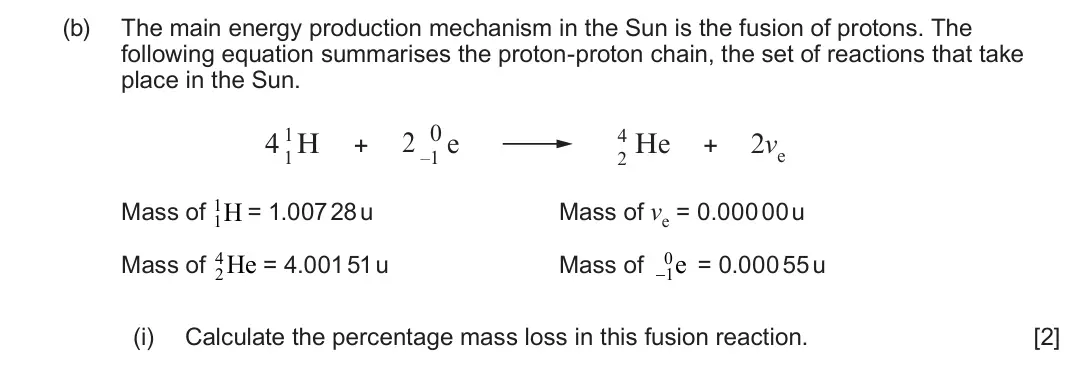
Q12(b)(ii)
The whole paper ↗
Q12(b)(iii)
The whole paper ↗
Q12(c)(i)
The whole paper ↗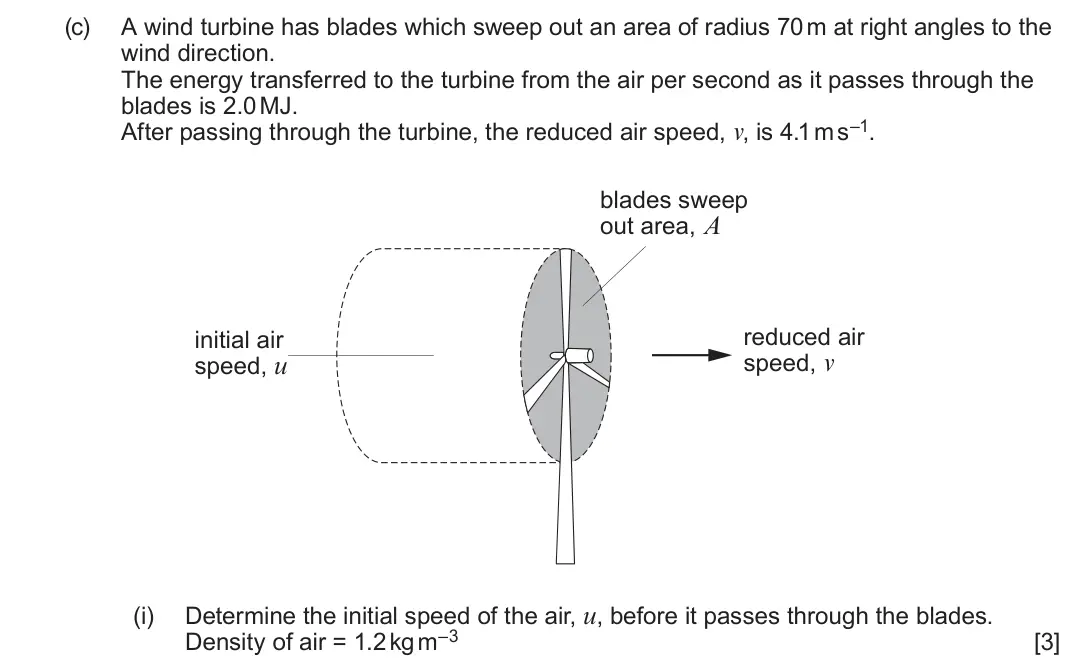
Q12(c)(ii)
The whole paper ↗
Q12(d)(i)
The whole paper ↗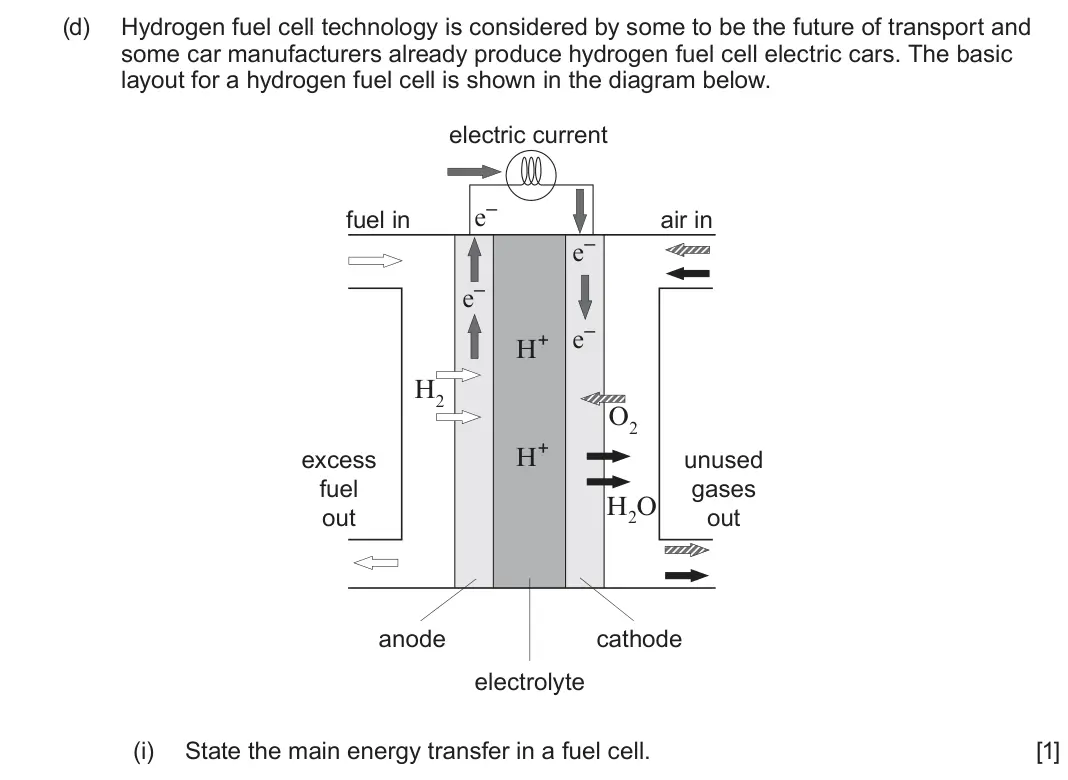
Q12(d)(ii)
The whole paper ↗
Q12(d)(iii)
The whole paper ↗
Q12(d)(iv)
The whole paper ↗
Q12(a)(i)
The whole paper ↗
Q12(a)(ii)
The whole paper ↗
Q12(b)(i)
The whole paper ↗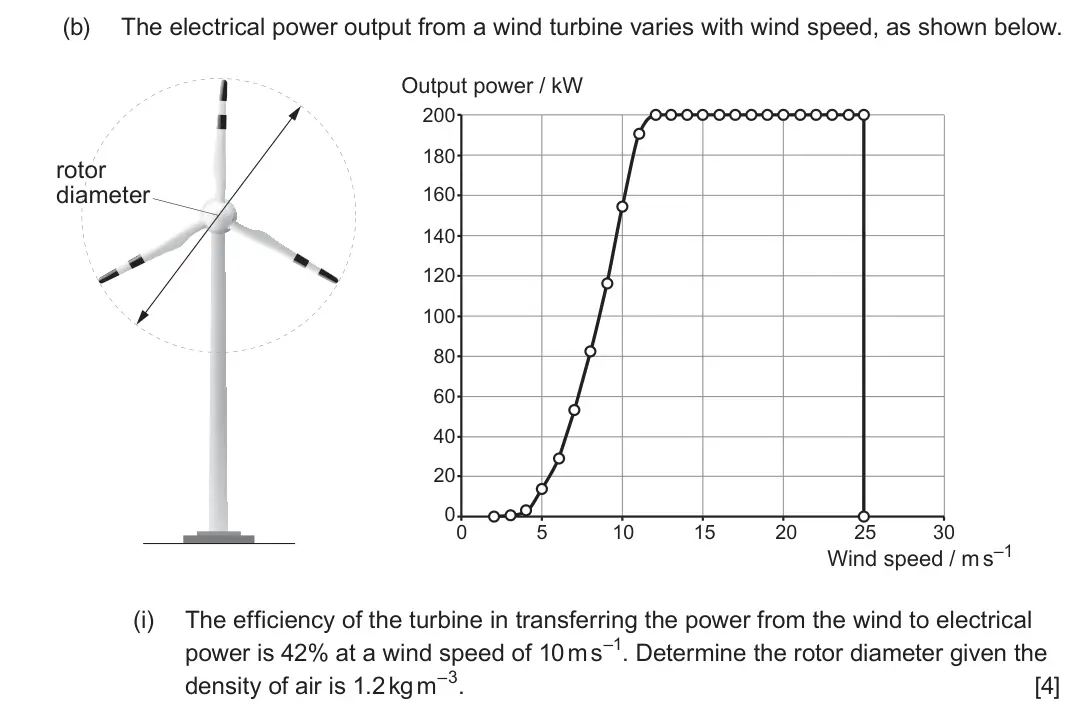
Q12(b)(ii)
The whole paper ↗
Q12(b)(iii)
The whole paper ↗
Q12(b)(iv)
The whole paper ↗
Q12(c)
The whole paper ↗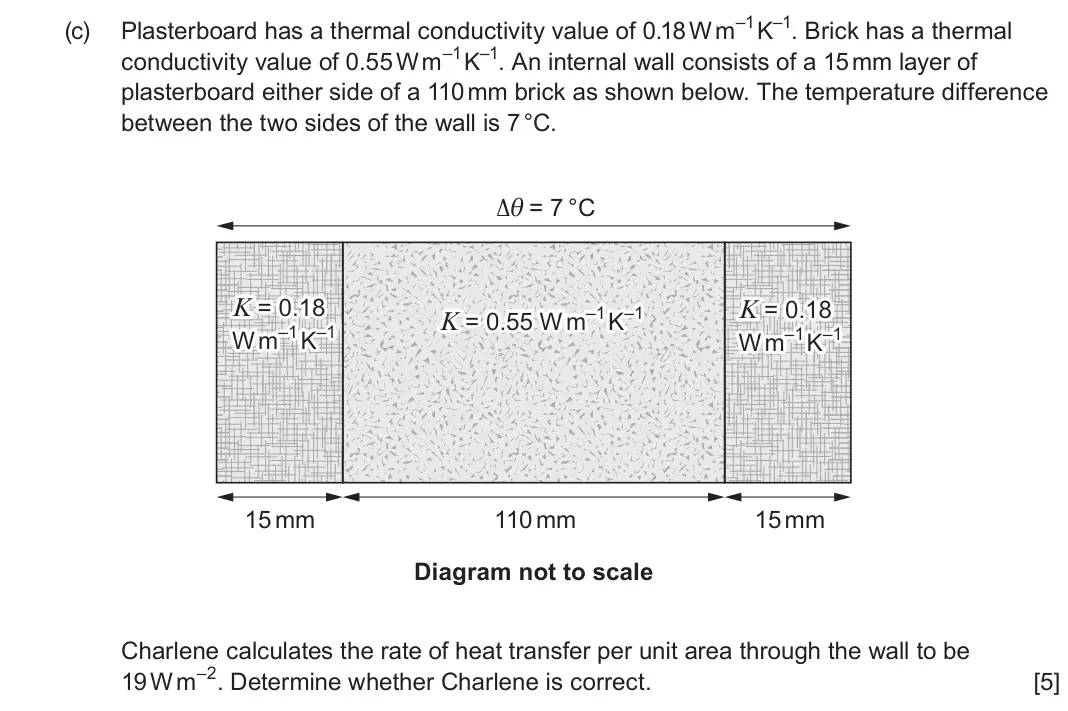
Q14(a)(i)
The whole paper ↗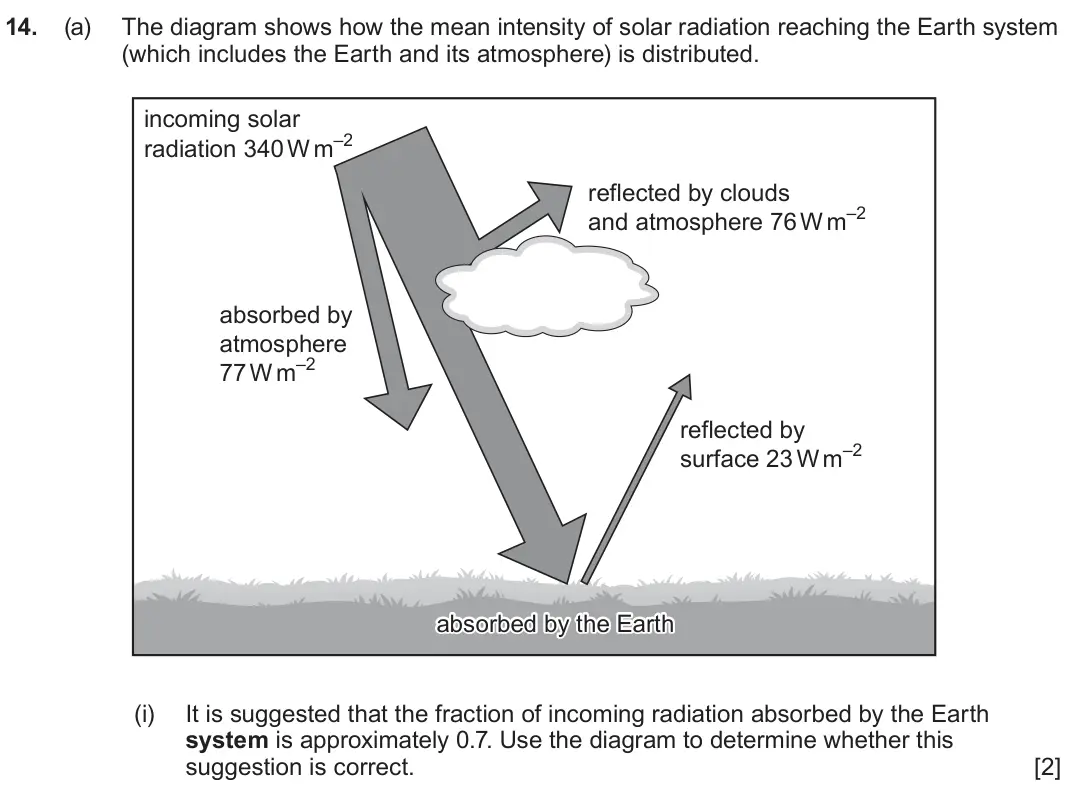
Q14(a)(ii)
The whole paper ↗
Q14(a)(iii)
The whole paper ↗
All 65 questions on Energy and the environment, as a list
- June 2025, Component 3, Q12(a) (1 mark): Solar energy is a renewable energy source. State what is meant by ‘renewable energy source’. [1]
- June 2025, Component 3, Q12(b)(i) (2 marks): Calculate the percentage mass loss in this fusion reaction. [2]
- June 2025, Component 3, Q12(b)(ii) (3 marks): Define the solar constant and calculate its value. Power emitted by the Sun = 3.83 × 1026 W Distance from Sun to Earth = 1.50 × 10⁸ km [3]
- June 2025, Component 3, Q12(b)(iii) (2 marks): The UK government has set a target to increase the mean electrical power generated by solar photovoltaic cells to 70 GW by the year 2035 If the mean annual inte
- June 2025, Component 3, Q12(c)(i) (3 marks): Determine the initial speed of the air, u, before it passes through the blades. Density of air = 1.2 kg m–3 [3]
- June 2025, Component 3, Q12(c)(ii) (3 marks): An energy company claims that it can build an underwater tidal turbine that can generate the same amount of electrical power as a wind turbine, but with blades
- June 2025, Component 3, Q12(d)(i) (1 mark): State the main energy transfer in a fuel cell. [1]
- June 2025, Component 3, Q12(d)(ii) (1 mark): Explain the purpose of the electrolyte. [1]
- June 2025, Component 3, Q12(d)(iii) (1 mark): State the waste product. [1]
- June 2025, Component 3, Q12(d)(iv) (3 marks): Some car manufacturers claim that the use of hydrogen fuel cells will not contribute any CO2 to the atmosphere. Evaluate this claim. [3]
- June 2024, Component 3, Q12(a)(i) (2 marks): A student incorrectly writes the Archimedes principle as: ‘An object wholly immersed in a liquid experiences a force equal to the mass of the fluid dispersed by
- June 2024, Component 3, Q12(a)(ii) (3 marks): Ice has a density of 920 kg m–3 A freshwater iceberg floats in seawater of density 1020 kg m–3. Starting from the Archimedes principle, determine the fraction o
- June 2024, Component 3, Q12(b)(i) (4 marks): The efficiency of the turbine in transferring the power from the wind to electrical power is 42% at a wind speed of 10 m s–1 Determine the rotor diameter given
- June 2024, Component 3, Q12(b)(ii) (2 marks): Account for the low efficiency in transferring the maximum power from the wind to electrical power. [2]
- June 2024, Component 3, Q12(b)(iii) (1 mark): The UK-based JET laboratory produced 59 MW of electrical power for a few seconds through nuclear fusion. Calculate the number of wind turbines needed to produce
- June 2024, Component 3, Q12(b)(iv) (3 marks): Explain briefly the difficulties associated with producing sustained nuclear fusion power. [3]
- June 2024, Component 3, Q12(c) (5 marks): Plasterboard has a thermal conductivity value of 0.18 W m–1 K–1 Brick has a thermal conductivity value of 0.55 W m–1 K–1. An internal wall consists of a 15 mm l
- June 2023, Component 3, Q14(a)(i) (2 marks): It is suggested that the fraction of incoming radiation absorbed by the Earth system is approximately 0.7. Use the diagram to determine whether this suggestion
- June 2023, Component 3, Q14(a)(ii) (2 marks): State what is meant by the greenhouse effect. [2]
- June 2023, Component 3, Q14(a)(iii) (5 marks): The Earth system emits 240 W m–2 of infra-red radiation into space. This is less than the solar radiation that is absorbed and has caused the temperature of the
- June 2023, Component 3, Q14(b) (4 marks): A student tests the efficiency of a photovoltaic solar panel using light with an intensity of 350 W m–2 The student positions the light source at an angle of 62
- June 2023, Component 3, Q14(c)(i) (2 marks): Explain what this statement means. [2]
- June 2023, Component 3, Q14(c)(ii) (5 marks): Charlie replaces part of his uninsulated external wall with patio doors and adds insulation to the remainder of the wall. BEFORE AFTER Diagrams not 2.1 m drawn
- Autumn 2021, Component 3, Q12(a) (3 marks): The graph below shows the radiation received from the Sun at the top of the Earth’s atmosphere as a function of wavelength. Spectral intensity 0 500 1 000 1 500
- Autumn 2021, Component 3, Q12(b)(i) (2 marks): State Archimedes’ principle. [2]
- Autumn 2021, Component 3, Q12(b)(ii) (3 marks): Harry adds a block of ice to a measuring cylinder containing saltwater. This causes the measuring cylinder reading to increase by 100 cm3 The density of saltwat
- Autumn 2021, Component 3, Q12(b)(iii) (2 marks): The block of ice is left to melt. Harry says the ice melting will dilute the saltwater, decreasing its density. He suggests that adding an identical cube of ice
- Autumn 2021, Component 3, Q12(c)(i) (3 marks): An offshore turbine has blades which sweep out an area of radius 82 m. The area swept out by the blades is always at right angles to the wind direction. When th
- Autumn 2021, Component 3, Q12(c)(ii) (2 marks): Under the above conditions the turbine can produce an electrical energy output of 210 MWh in 24 hours. Calculate the efficiency of the electricity production. [
- Autumn 2021, Component 3, Q12(d)(i) (1 mark): Define the U value of a building structure. [1]
- Autumn 2021, Component 3, Q12(d)(ii) (3 marks): A room inside a building has one external wall measuring 5 m × 4 m. The graph below shows how the energy transferred through the wall per second varies with the
- Autumn 2021, Component 3, Q12(d)(iii) (1 mark): The external wall consists of three layers as shown. Concrete block Insulation Brick Bob uses the thermal conductivity values of the three materials to calculat
- Autumn 2020, Component 3, Q14(a)(i) (2 marks): The total power emitted by the Sun is 3.8 × 1026 W. Calculate the intensity of radiation received at the upper atmosphere of planet Earth and state the name giv
- Autumn 2020, Component 3, Q14(a)(ii) (3 marks): A student models the energy balance of planet Earth without its atmosphere. He calculates the theoretical power absorbed by the Earth to be 1.2 × 10¹⁷ W. Assumi
- Autumn 2020, Component 3, Q14(a)(iii) (3 marks): The actual mean surface temperature of the Earth is 287 K. Without calculation, account for this difference in temperature and explain how human activity has fu
- Autumn 2020, Component 3, Q14(b)(i) (3 marks): State and explain the three conditions that are simultaneously required to produce a sustainable fusion reaction. [3]
- Autumn 2020, Component 3, Q14(b)(ii) (2 marks): A fusion test reactor requires a triple product greater than 3.5 × 1028 s K m–3 The plasma has a volume of 70 m3 and contains 2.4 × 10²² particles. If a confine
- Autumn 2020, Component 3, Q14(c)(i) (2 marks): A company manufactures thermal plasterboards using a composite of two different materials. One of the materials is known to have a thermal conductivity value of
- Autumn 2020, Component 3, Q14(c)(ii) (5 marks): Jack investigates the thermal properties of a sample of thermal plasterboard. He produces a graph of temperature against distance as shown below. Material B Mat
- June 2019, Component 3, Q14(a)(i) (1 mark): Solar energy resources are considered to be renewable resources. State what is meant by a renewable energy resource. [1]
- June 2019, Component 3, Q14(a)(ii) (2 marks): The proton-proton chain is a set of reactions that take place in our Sun and can be summarised in the following equation. 41 H + 2 0 –1e 4 He + 2νe 1 2 Use data
- June 2019, Component 3, Q14(a)(iii) (2 marks): The Sun can be assumed to have come to the end of its life when it has lost 0.7 % of its mass to radiated energy. Estimate the lifetime of the Sun in years. Tak
- June 2019, Component 3, Q14(b)(i) (2 marks): Show that the area of the PV cell is approximately 1.3 m2. [2]
- June 2019, Component 3, Q14(b)(ii) (3 marks): The factory roof covers an area of 3.6 × 10⁴ m2 and the factory owner plans for the installation to produce a mean power output of 4.0 MW. It is suggested that
- June 2019, Component 3, Q14(c)(i) (2 marks): Describe what is meant by the enrichment of uranium and explain why it is necessary. [2]
- June 2019, Component 3, Q14(c)(ii) (3 marks): Gaseous diffusion was one of the original methods used to enrich uranium fuel. Uranium hexafluoride gas composing of 235UF6 and 238UF6 moves from a region of hi
- June 2019, Component 3, Q14(c)(iii) (1 mark): State an alternative method for the enrichment of uranium. [1]
- June 2019, Component 3, Q14(d)(i) (2 marks): Describe the purpose of the electrolyte and state the waste product from the reaction. [2]
- June 2019, Component 3, Q14(d)(ii) (2 marks): In order for the fuel cell to be considered to have no CO2 emissions, the sourcing of the hydrogen fuel must be considered. Two possible sources are: • Electrol
- June 2018, Component 3, Q14(a)(i) (1 mark): State the principle of Archimedes. [1]
- June 2018, Component 3, Q14(a)(ii) (4 marks): The Greenland ice sheet is estimated to have an area of 1.5 × 10⁶ km2 and a mean thickness of 2.1 km. I. Show that the mass of the Greenland ice sheet is approx
- June 2018, Component 3, Q14(b)(i) (2 marks): Show that the kinetic energy per second (the power, P) arriving at the blades per second can be given by: P = A ρ u3 1 2 where ρ is the density of the air. [2]
- June 2018, Component 3, Q14(b)(ii) (2 marks): Use the above equation to determine whether doubling the length of the blades or doubling the wind speed would have the greater effect on the power available to
- June 2018, Component 3, Q14(b)(iii) (3 marks): A wind turbine has blades of length 30 m. Wind of speed 8.0 m s–1 arrives at the blades, which is reduced to 5.0 m s–1 after passing through the blades. Calcula
- June 2018, Component 3, Q14(b)(iv) (1 mark): Explain why the actual efficiency of the turbine is less than your answer to (b)(iii). [1]
- June 2018, Component 3, Q14(c)(i) (2 marks): Use an appropriate equation to show that the unit of the coefficient of thermal conductivity, K, is W m–1 K–1 [2]
- June 2018, Component 3, Q14(c)(ii) (3 marks): One room in a house has a floor made of concrete of thickness 120 mm covered by a carpet of thickness 8 mm. The temperature at the upper surface of the carpet i
- June 2018, Component 3, Q14(c)(iii) (2 marks): Without the carpet, thermal energy is conducted through the concrete floor (of dimensions 6 m × 8 m) at a rate of 3.6 kW. The carpet manufacturer claims that fi
- June 2017, Component 3, Q13(a)(i) (2 marks): Assuming that the Earth emits radiation as a black body at a temperature of 288 K, confirm that the peak wavelength of the radiation emitted by the Earth is in
- June 2017, Component 3, Q13(a)(ii) (5 marks): The graphs below show greenhouse gas absorption spectra for methane (CH4), carbon dioxide and water vapour as a function of the wavelength of the radiation inci
- June 2017, Component 3, Q13(b)(i) (3 marks): Assuming the generating process is 85 % efficient, calculate the mass of water passing through the turbines per second. [3]
- June 2017, Component 3, Q13(b)(ii) (2 marks): The power station has a mean annual output of 240 GWh of electrical energy. Calculate the mean time during which the power station is in use per day. Give your
- June 2017, Component 3, Q13(b)(iii) (1 mark): Without considering energy losses, give one reason why this power station would not be able to produce significantly more than 240 GWh of energy per year. [1]
- June 2017, Component 3, Q13(c)(i) (2 marks): The rate of heat transfer through the window is 154 W. Calculate the total rate of heat loss from the room when the external temperature on a windless day is 12
- June 2017, Component 3, Q13(c)(ii) (5 marks): The heat loss through the window is kept low by a thin layer of stationary air in contact with the inside and outside of the window. These layers provide insula
Questions, mark schemes and examiner’s reports are © WJEC Eduqas, from their published past papers. Plumi isn’t affiliated with any exam board. Want whole papers? Every Eduqas A-Level Physics paper.
Rather write your answers by hand on iPad? Plumi marks them against the same mark schemes.