 plumi
Nuclear decay: Eduqas A‑Level Physics questions
Every Eduqas A-Level Physics exam question on 3.6 Nuclear decay, 2016–2025, with its mark scheme and examiner’s report.
Find questions1,592
Calculations
Q5(a)(i)
The whole paper ↗
Q5(a)(ii)
The whole paper ↗
Q5(b)(i)
The whole paper ↗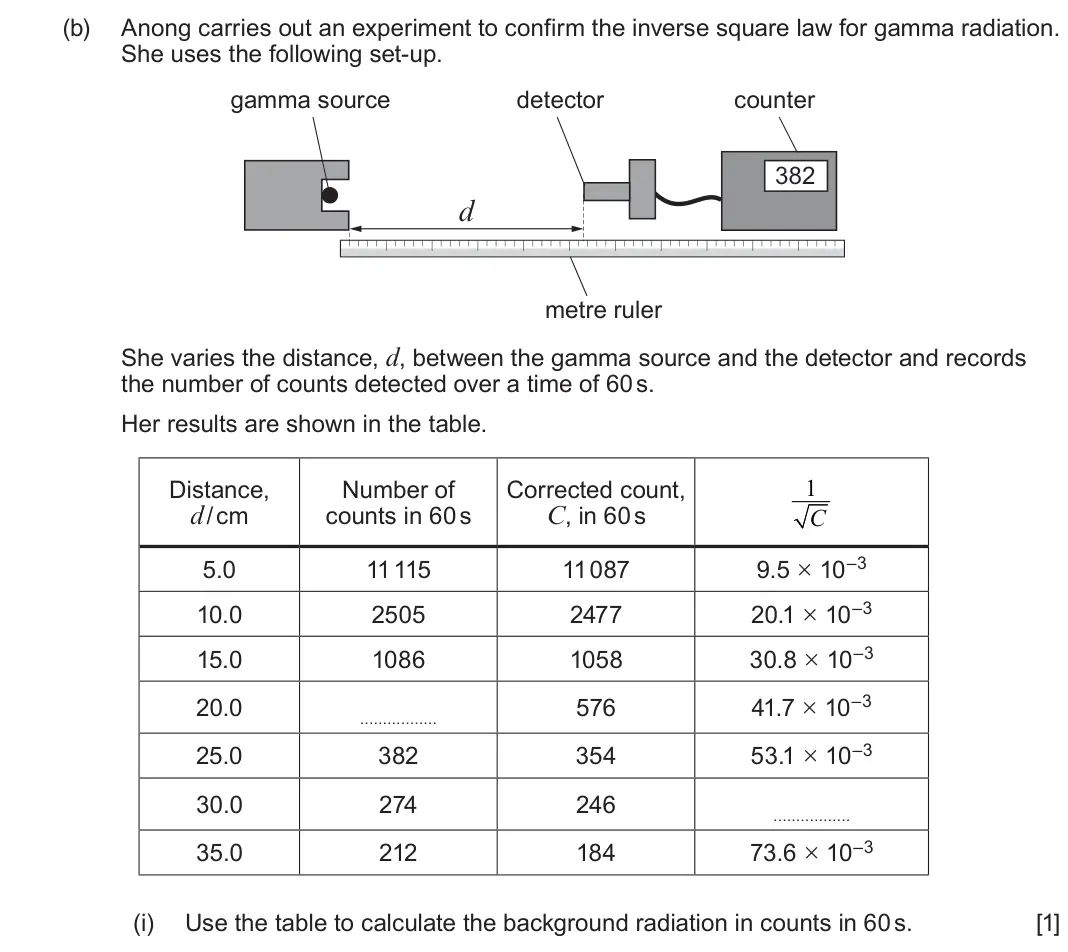
Q5(b)(ii)
The whole paper ↗
Q5(b)(iii)
The whole paper ↗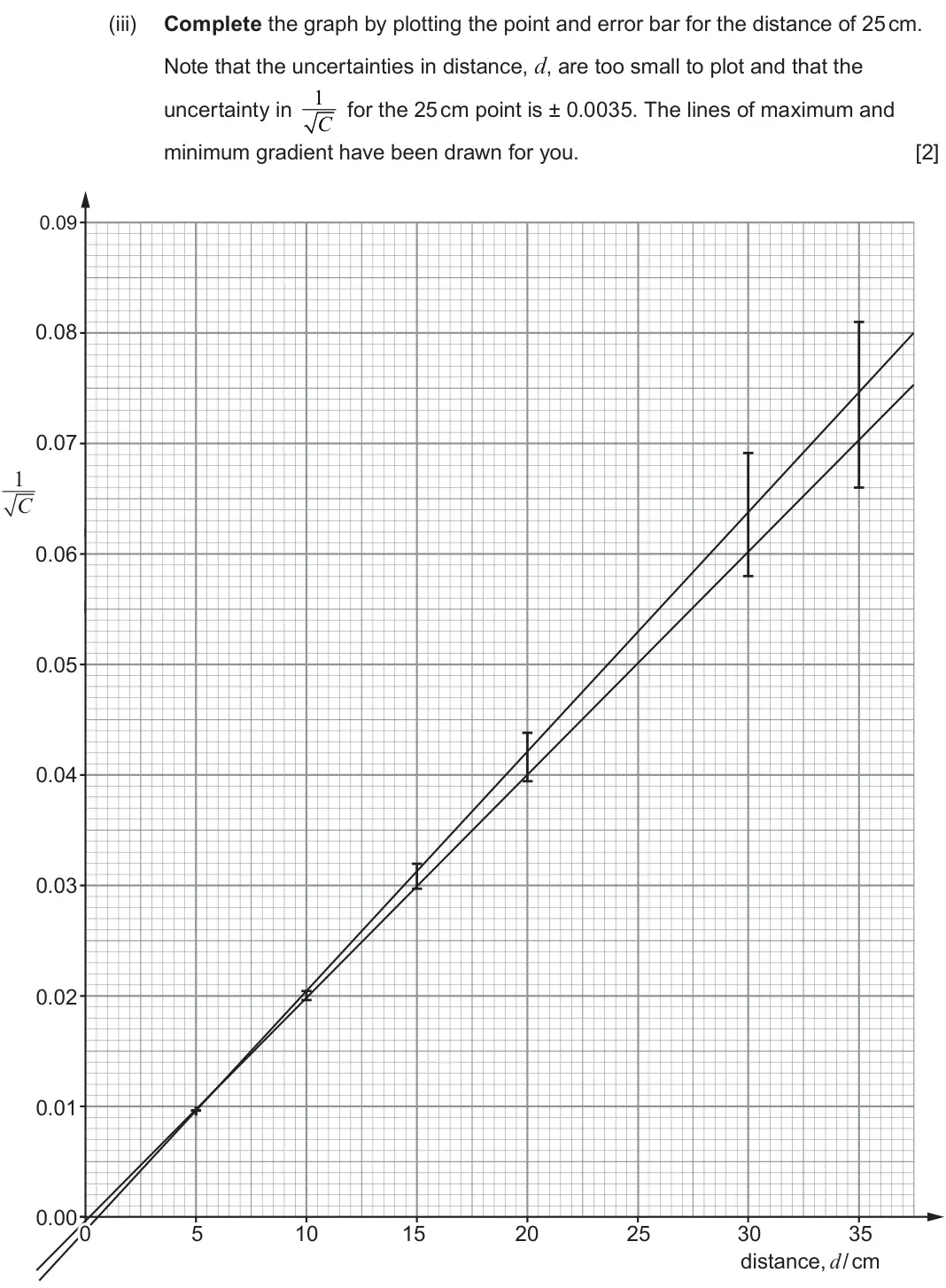
Q5(c)(i)
The whole paper ↗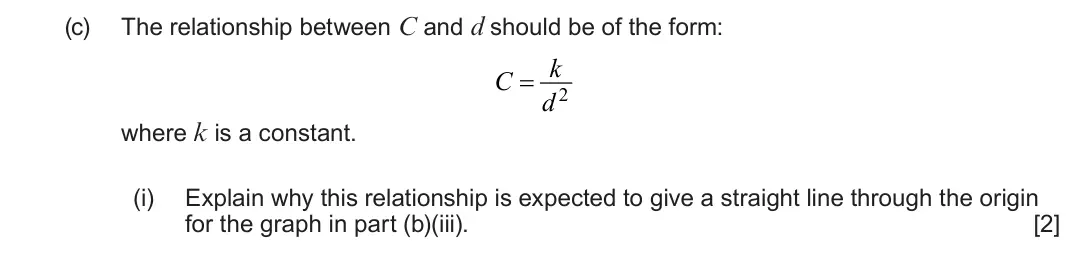
Q5(c)(ii)
The whole paper ↗
Q5(d)
The whole paper ↗
Q5(a)
The whole paper ↗
Q5(b)(i)
The whole paper ↗
Q5(b)(ii)
The whole paper ↗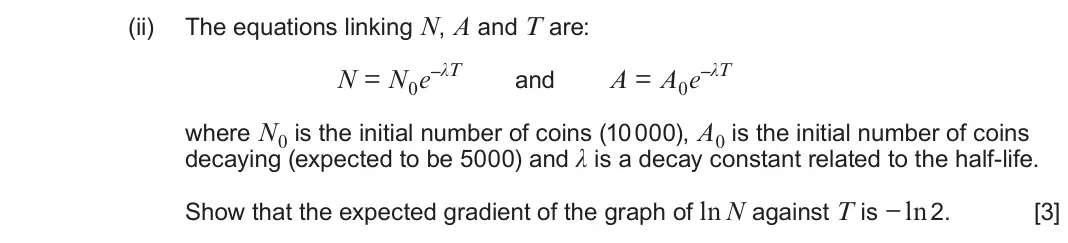
Q5(c)
The whole paper ↗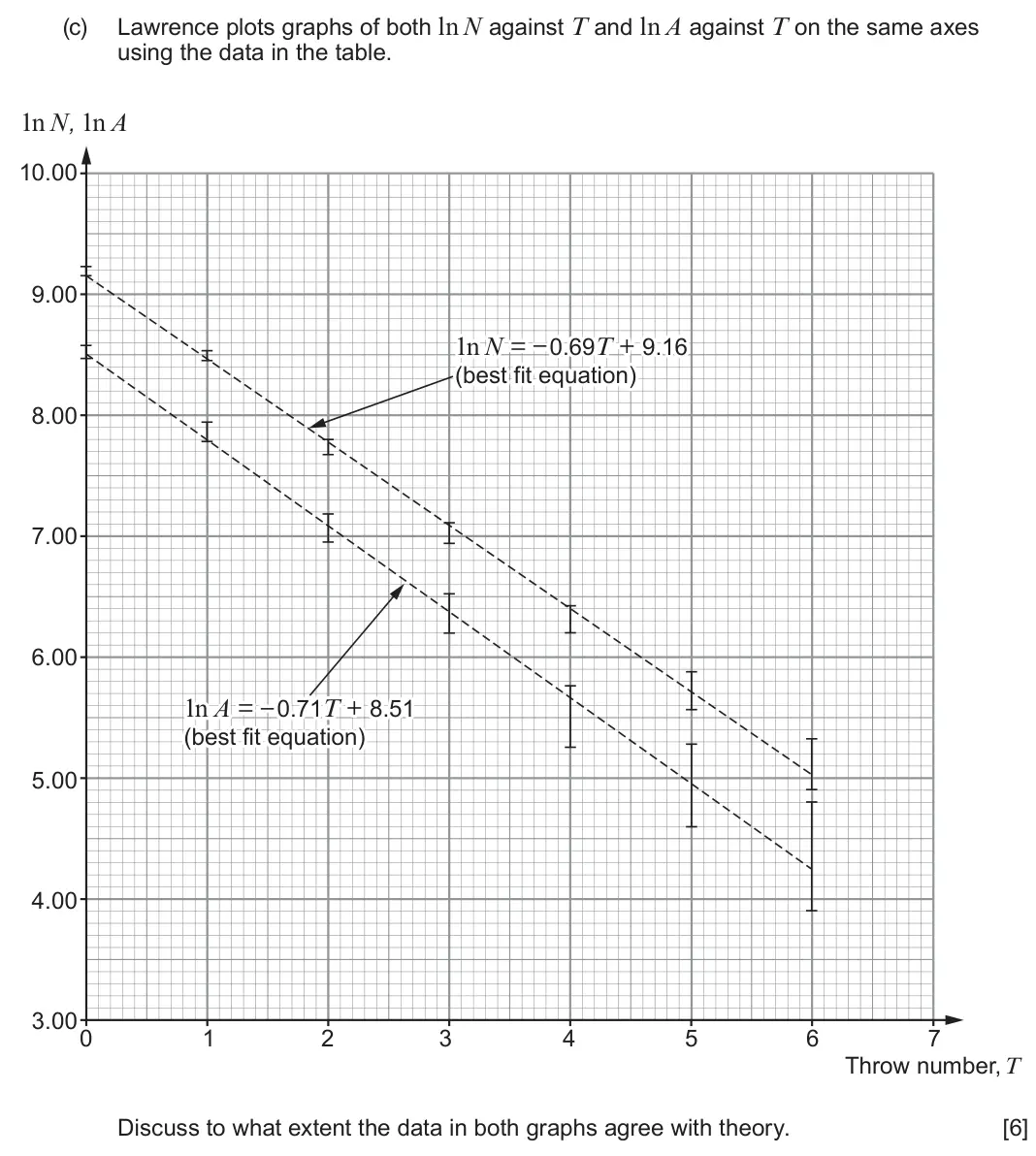
Q5(d)(i)
The whole paper ↗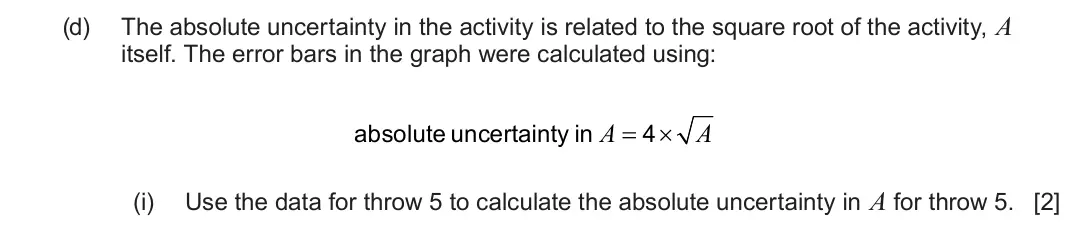
Q5(d)(ii)
The whole paper ↗
Q5(d)(iii)
The whole paper ↗
Q6(b)
The whole paper ↗
Q7(a)(i)
The whole paper ↗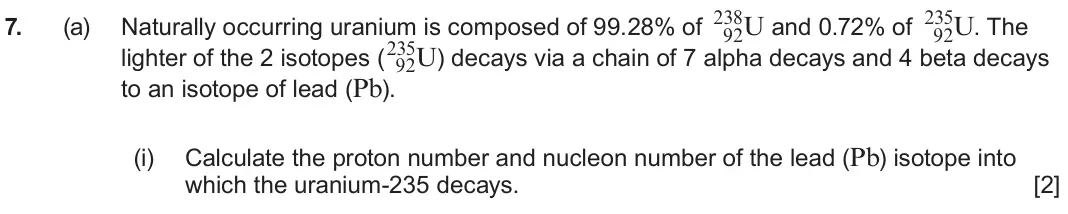
Q7(a)(ii)
The whole paper ↗
Q7(a)(iii)
The whole paper ↗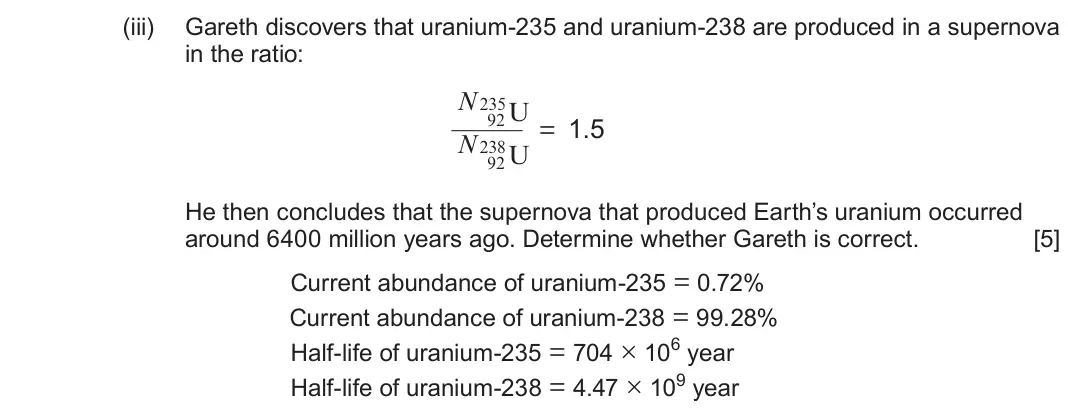
Q7(b)
The whole paper ↗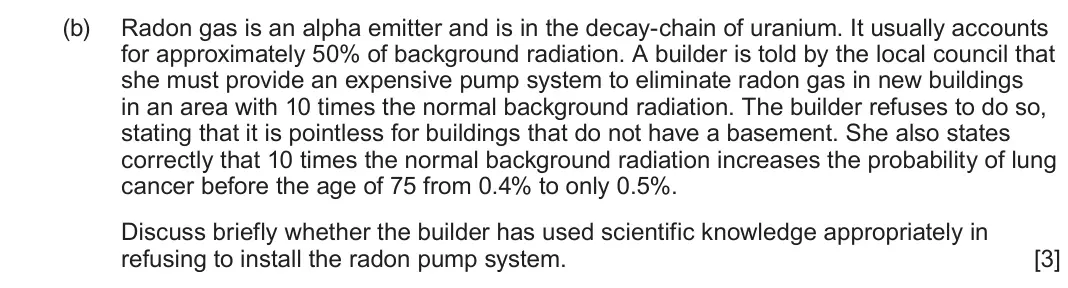
All 40 questions on Nuclear decay, as a list
- June 2025, Component 3, Q5(a)(i) (1 mark): Explain what is meant by activity. [1]
- June 2025, Component 3, Q5(a)(ii) (1 mark): Define the becquerel (Bq). [1]
- June 2025, Component 3, Q5(b)(i) (1 mark): Use the table to calculate the background radiation in counts in 60 s. [1]
- June 2025, Component 3, Q5(b)(ii) (2 marks): Complete the table. [2]
- June 2025, Component 3, Q5(b)(iii) (2 marks): Complete the graph by plotting the point and error bar for the distance of 25 cm. Note that the uncertainties in distance, d, are too small to plot and that the
- June 2025, Component 3, Q5(c)(i) (2 marks): Explain why this relationship is expected to give a straight line through the origin for the graph in part (b)(iii). [2]
- June 2025, Component 3, Q5(c)(ii) (4 marks): Explain to what extent the graph in part (b)(iii) agrees with this theory. Where the graph disagrees with the theory, suggest a reason for this. [4]
- June 2025, Component 3, Q5(d) (4 marks): Anong calculates the area of the window of the detector as 1.27 cm2 She concludes that the activity of the gamma source must be around 18 000 Bq. Explaining you
- June 2024, Component 3, Q5(a) (4 marks): State briefly how he carried out the experiment. [4]
- June 2024, Component 3, Q5(b)(i) (1 mark): State what you would expect the half-life of the 10 p coins to be. [1]
- June 2024, Component 3, Q5(b)(ii) (3 marks): The equations linking N, A and T are: N = N0e–λT and A = A0e–λT where N0 is the initial number of coins (10 000), A0 is the initial number of coins decaying (ex
- June 2024, Component 3, Q5(c) (6 marks): Lawrence plots graphs of both lnN against T and lnA against T on the same axes using the data in the table. 1n N, 1n A 10.00 9.00 1n N = – 0.69T + 9.16 1n N = –
- June 2024, Component 3, Q5(d)(i) (2 marks): Use the data for throw 5 to calculate the absolute uncertainty in A for throw 5. [2]
- June 2024, Component 3, Q5(d)(ii) (3 marks): Hence, determine whether the error bar for throw 5 is correct on the graph of lnA against T. [3]
- June 2024, Component 3, Q5(d)(iii) (2 marks): The error bars gradually increase in size on the graph of lnA against T. Explain what would happen to the error bars if a graph of A against T were plotted. [2]
- June 2023, Component 3, Q6(b) (3 marks): If the half-life of the metastable energy level is 2.4 ms, explain why the equilibrium number of electrons in the metastable energy level is approximately 1.7 ×
- June 2023, Component 3, Q7(a)(i) (2 marks): Calculate the proton number and nucleon number of the lead (Pb) isotope into which the uranium-235 decays. [2]
- June 2023, Component 3, Q7(a)(ii) (4 marks): When uranium-235 decays to lead, the longest half-life by far is the half-life of uranium-235, which is 704 million years (all other half-lives are tiny and neg
- June 2023, Component 3, Q7(a)(iii) (5 marks): Gareth discovers that uranium-235 and uranium-238 are produced in a supernova in the ratio: N235U 92 = 1.5 N238U 92 He then concludes that the supernova that pr
- June 2023, Component 3, Q7(b) (3 marks): Radon gas is an alpha emitter and is in the decay-chain of uranium. It usually accounts for approximately 50% of background radiation. A builder is told by the
- Autumn 2020, Component 3, Q5(a)(i) (3 marks): The background radiation is 0.40 counts per second. Complete the table. [3] Space for calculations.
- Autumn 2020, Component 3, Q5(a)(ii) (1 mark): Complete the graph by plotting the two missing data points. [1] ln(corrected total counts in 10 minutes) 8.50 8.00 7.50 7.00 6.50 6.00 5.50 5.00 0.60 0.80 1.00
- Autumn 2020, Component 3, Q5(a)(iii) (3 marks): Draw a line of best fit and calculate its gradient. [3]
- Autumn 2020, Component 3, Q5(a)(iv) (5 marks): Theory suggests that: 1 count rate ∝ distance2 I. Show that the gradient of the graph should be –2. [2] II. Explain to what extent the results obtained in this
- Autumn 2020, Component 3, Q5(b) (1 mark): Radium-226 also emits other radiation. Suggest a reason for using a 3 mm aluminium plate between the source and the GM tube. [1]
- Autumn 2020, Component 3, Q7(a) (2 marks): The bismuth isotope ( Bi) decays by alpha decay to an isotope of thallium (Tl). Fill in 209 83 the missing numbers for this decay. [2] 209 Bi Tl + He 83
- Autumn 2020, Component 3, Q7(c)(i) (4 marks): The half-life of Bi is 1.9 × 10¹⁹ year. Calculate the activity of 1.00 gram of 209 83 Bi. 209 [4] 83
- Autumn 2020, Component 3, Q7(c)(ii) (2 marks): Determine the number of nuclei in 1.00 gram of Bi which will decay in 5 years. 209 83 [2]
- June 2019, Component 3, Q4(a) (3 marks): It is possible to distinguish between α, β and γ radiation by their different absorption properties. Explain briefly one other method of differentiating between
- June 2019, Component 3, Q4(b)(i) (3 marks): Show that this final count rate is approximately 0.33 cps higher than would be expected from beryllium alone (approximately 1.17 cps). [3]
- June 2019, Component 3, Q4(b)(ii) (4 marks): The discrepancy between the measured count of 1.50 cps and the expected count of 1.17 cps is due to background radiation. Given that the background count rate i
- June 2018, Component 3, Q6(a) (2 marks): A radioactive isotope of thorium decays to a stable lead nucleus ( Pb) via 6 alpha 82 decays and 4 beta decays. Complete the equation below. [2] 208 Th Pb + 6 H
- June 2018, Component 3, Q6(b) (5 marks): The half-life of the thorium nucleus is 14.1 × 10⁹ years. Calculate the activity of 5.0 × 10⁻³ kg of the radioactive thorium (the mass of the thorium atom is ap
- June 2018, Component 3, Q6(c)(i) (4 marks): Use the data to deduce whether or not the number of remaining dice decreases exponentially. [4] A graph is also plotted of the number of dice removed against th
- June 2018, Component 3, Q6(c)(ii) (2 marks): Suggest why there is more scatter in Graph 2 than Graph 1 [2]
- June 2018, Component 3, Q12(d)(ii) (3 marks): An isotope of sodium, Na-24, has a half-life of 15 hours and an initial activity of 160 Bq when injected into a patient. Seven hours later a sample of 5 cm3 of
- June 2017, Component 3, Q2(b)(i) (3 marks): Calculate its half-life in years. [3]
- June 2017, Component 3, Q2(b)(ii) (3 marks): The natural ratio of carbon-14 to carbon-12 is 1.00 × 10⁻¹² i.e. number of 14 6 C nuclei 6 C nuclei = 1.00 × 10⁻¹² number of 12 Calculate the activity of 12 g o
- June 2017, Component 3, Q2(b)(iii) (3 marks): In an old tree found preserved in a peat bog in Ireland, much of the carbon-14 has decayed but the carbon-12 all remains. The ratio of carbon-14 to carbon-12 in
- June 2017, Component 3, Q2(c) (3 marks): Carbon-11 (11 6 C) is proton rich and undergoes positron decay to a stable isotope of boron (B). Complete the following decay equation for carbon-11 Space is pr
Questions, mark schemes and examiner’s reports are © WJEC Eduqas, from their published past papers. Plumi isn’t affiliated with any exam board. Want whole papers? Every Eduqas A-Level Physics paper.
Rather write your answers by hand on iPad? Plumi marks them against the same mark schemes.