 plumi
The physics of sports: Eduqas A‑Level Physics questions
Every Eduqas A-Level Physics exam question on 3.C The physics of sports, 2016–2025, with its mark scheme and examiner’s report.
Find questions1,592
Calculations
Q11(a)(i)
The whole paper ↗
Q11(a)(ii)
The whole paper ↗
Q11(a)(iii)
The whole paper ↗
Q11(a)(iv)
The whole paper ↗
Q11(b)(i)
The whole paper ↗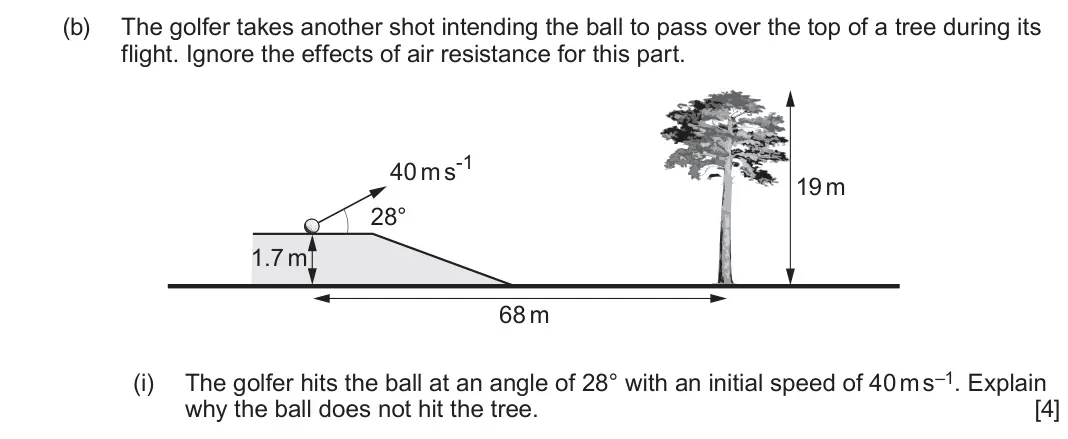
Q11(b)(ii)
The whole paper ↗
Q11(c)
The whole paper ↗
Q11(a)(i)
The whole paper ↗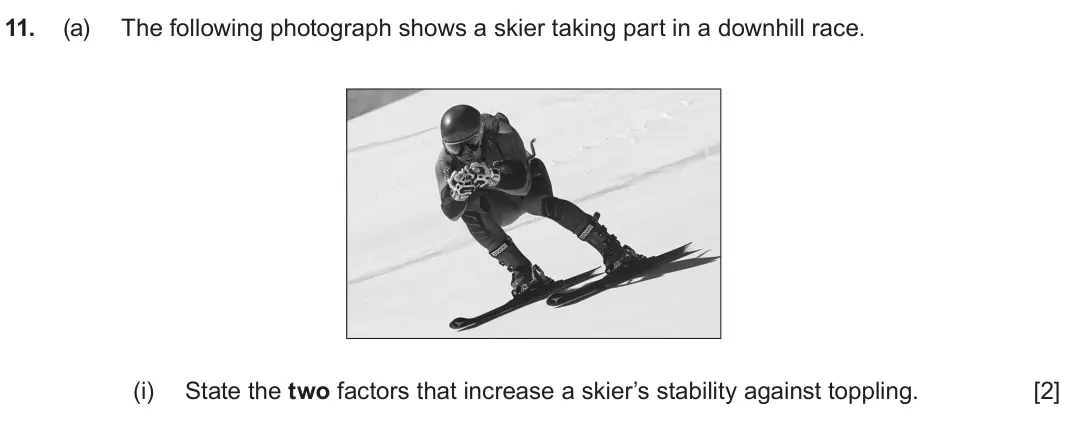
Q11(a)(ii)
The whole paper ↗
Q11(a)(iii)
The whole paper ↗
Q11(b)(i)
The whole paper ↗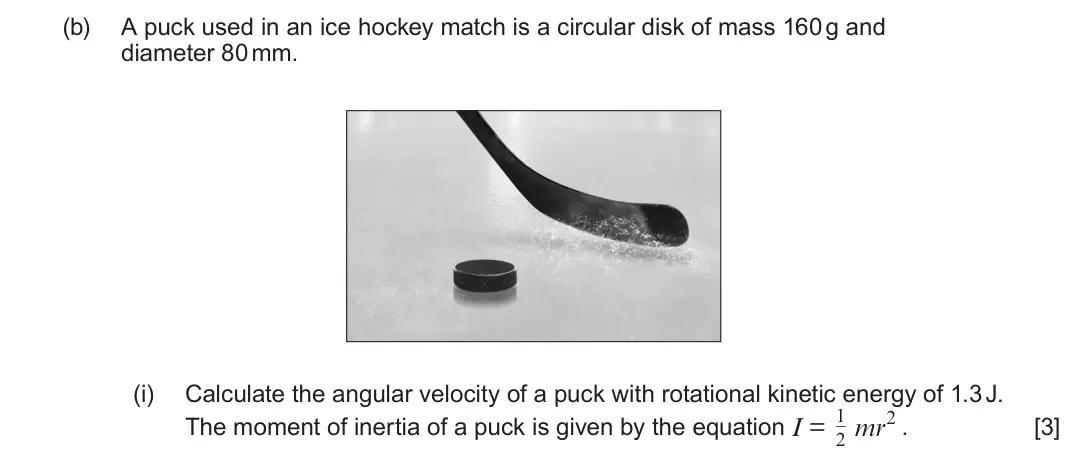
Q11(b)(ii)
The whole paper ↗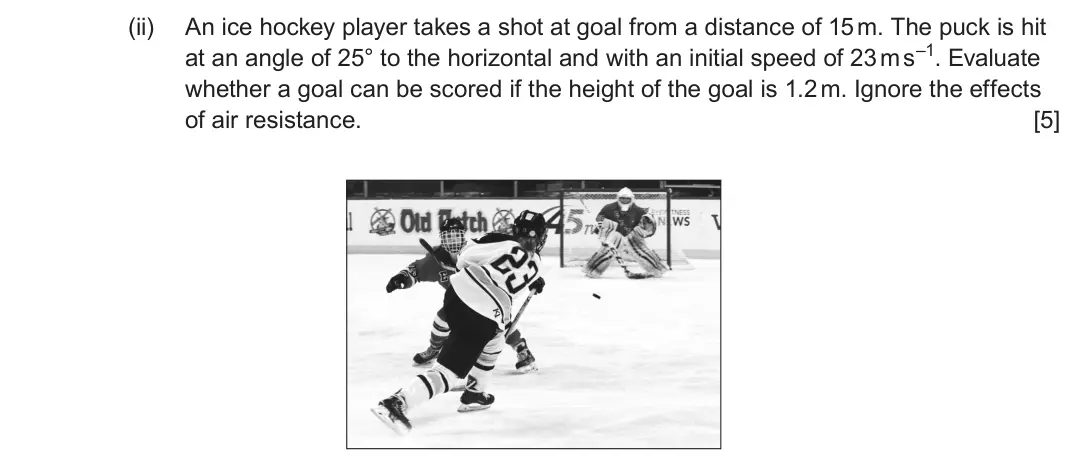
Q11(c)
The whole paper ↗
Q13(a)
The whole paper ↗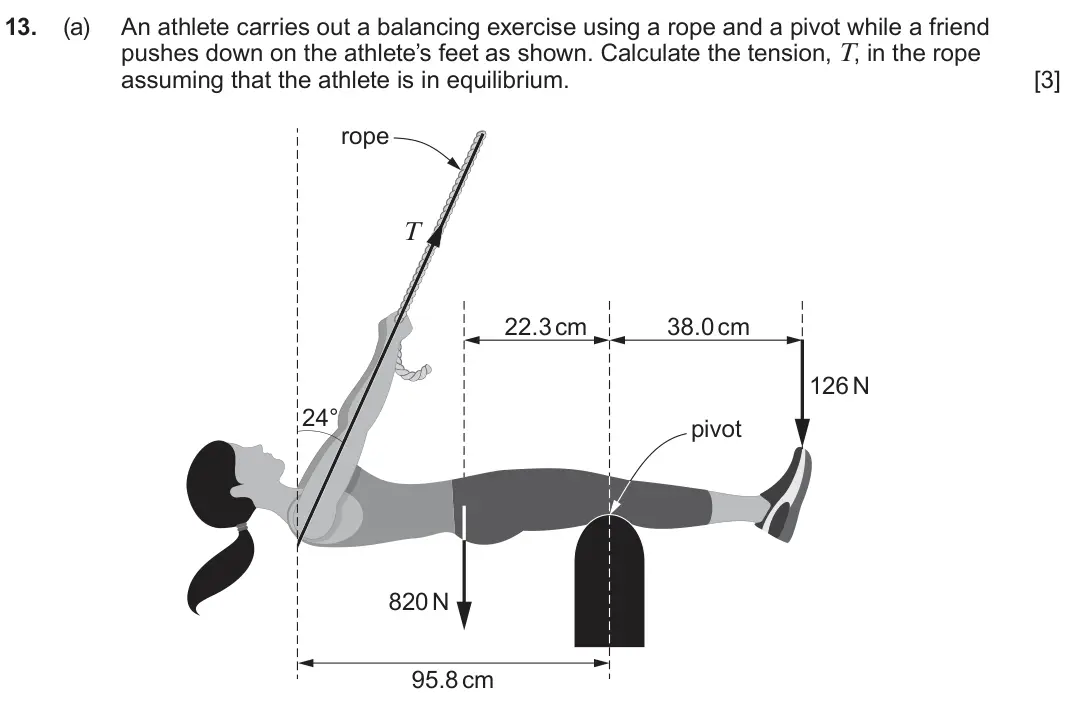
Q13(b)
The whole paper ↗
Q13(c)(i)
The whole paper ↗
Q13(c)(ii)
The whole paper ↗
Q13(d)(i)
The whole paper ↗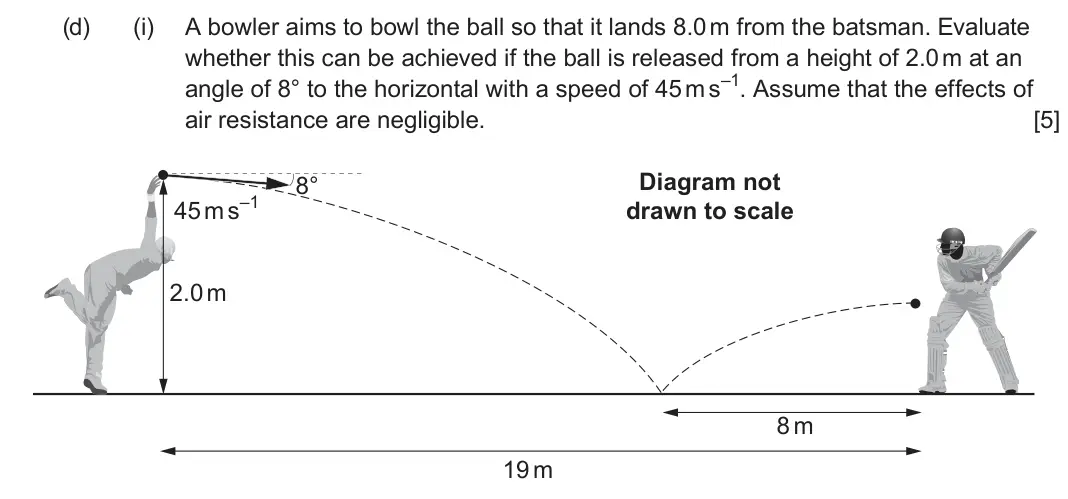
Q13(d)(ii)
The whole paper ↗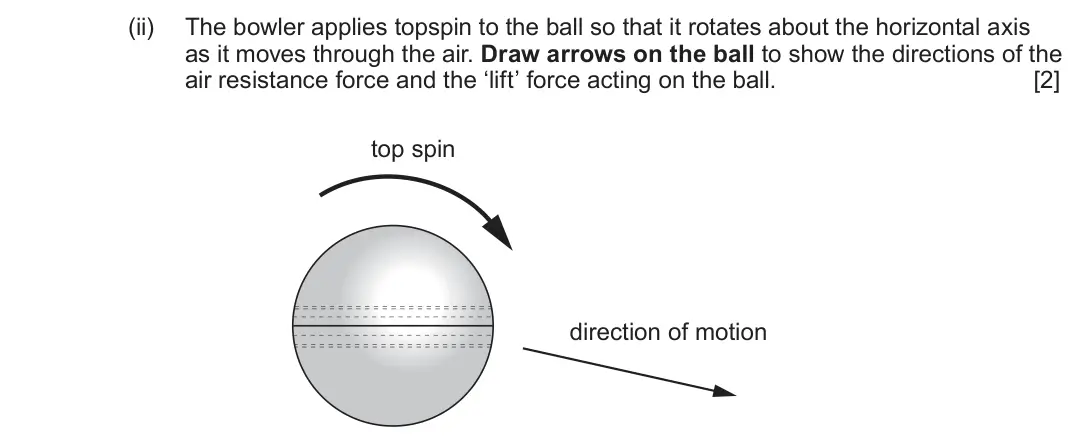
Q13(d)(iii)
The whole paper ↗
All 56 questions on The physics of sports, as a list
- June 2025, Component 3, Q11(a)(i) (2 marks): Explain how the way the golfer stands to hit the ball gives her stability. [2]
- June 2025, Component 3, Q11(a)(ii) (2 marks): Explain what is meant by the statement that “the coefficient of restitution between the club and the ball is 0.830”. [2]
- June 2025, Component 3, Q11(a)(iii) (3 marks): After being hit, the ball spins with an angular velocity of 280 rad s–1. Calculate the torque exerted on the golf ball by the club if it is in contact with the
- June 2025, Component 3, Q11(a)(iv) (2 marks): Discuss whether the principle of conservation of angular momentum can be applied to the system of the ball and the club when the golfer hits the ball. [2]
- June 2025, Component 3, Q11(b)(i) (4 marks): The golfer hits the ball at an angle of 28° with an initial speed of 40 m s–1. Explain why the ball does not hit the tree. [4]
- June 2025, Component 3, Q11(b)(ii) (3 marks): The ball spins with an angular velocity of 195 rad s–1 when travelling through the air. Evaluate whether the rotational kinetic energy can be considered negligi
- June 2025, Component 3, Q11(c) (4 marks): Modern golf equipment leads to golf balls flying further. This means that many old golf courses are now too short. It has been proposed that the design of golf
- June 2024, Component 3, Q11(a)(i) (2 marks): State the two factors that increase a skier’s stability against toppling. [2]
- June 2024, Component 3, Q11(a)(ii) (4 marks): The speed of a downhill skier changes from u to 1.25 u. At the same time, the effective cross-sectional area of the skier changes from A to 0.85 A. Calculate ho
- June 2024, Component 3, Q11(a)(iii) (2 marks): A skier of mass 72 kg moving at a speed of 25 m s–1 crashes into a barrier and is brought to rest in a time of 0.89 s. Determine the force exerted on the skier
- June 2024, Component 3, Q11(b)(i) (3 marks): Calculate the angular velocity of a puck with rotational kinetic energy of 1.3 J. The moment of inertia of a puck is given by the equation I = 1 2 mr2 . [3]
- June 2024, Component 3, Q11(b)(ii) (5 marks): An ice hockey player takes a shot at goal from a distance of 15 m. The puck is hit at an angle of 25° to the horizontal and with an initial speed of 23 m s–1 Ev
- June 2024, Component 3, Q11(c) (4 marks): An ice skater is rotating with both arms outstretched. His arms are now pulled in. Explain why the rate of rotation of the skater will increase. [4]
- June 2023, Component 3, Q13(a) (3 marks): An athlete carries out a balancing exercise using a rope and a pivot while a friend pushes down on the athlete’s feet as shown. Calculate the tension, T, in the
- June 2023, Component 3, Q13(b) (2 marks): State what is meant by the moment of inertia of an object. [2]
- June 2023, Component 3, Q13(c)(i) (3 marks): Calculate the angular momentum of the ball. [3]
- June 2023, Component 3, Q13(c)(ii) (3 marks): The cricket ball is struck by a batsman and the ball acquires a linear speed of 30 m s–1 and an angular velocity of 210 rad s–1 (about its centre). A sports ana
- June 2023, Component 3, Q13(d)(i) (5 marks): A bowler aims to bowl the ball so that it lands 8.0 m from the batsman. Evaluate whether this can be achieved if the ball is released from a height of 2.0 m at
- June 2023, Component 3, Q13(d)(ii) (2 marks): The bowler applies topspin to the ball so that it rotates about the horizontal axis as it moves through the air. Draw arrows on the ball to show the directions
- June 2023, Component 3, Q13(d)(iii) (2 marks): Explain briefly what effect these forces have on the position where the ball lands. [2]
- Autumn 2021, Component 3, Q11(a)(i) (2 marks): Explain which player, A or B, is in a more stable position. [2] Player A Player B
- Autumn 2021, Component 3, Q11(a)(ii) (2 marks): Explain what is meant by the statement that the coefficient of restitution of a netball ball and the floor of the court is 0.8 [2]
- Autumn 2021, Component 3, Q11(a)(iii) (2 marks): Use the data in the table to show that a wood floor surface has the greater coefficient of restitution. [2] Surface Mean drop height / m Mean bounce height / m
- Autumn 2021, Component 3, Q11(b)(i) (3 marks): In a practice match a player applies spin to the ball when passing to a team-mate. A spectator suggests that applying spin has no effect on the flight of the ba
- Autumn 2021, Component 3, Q11(b)(ii) (4 marks): Determine the torque applied to the ball to enable it to spin at a rate of 7.3 rad s–1 from rest in 0.3 s. The mass of the ball is 450 g and diameter 220 mm. Th
- Autumn 2021, Component 3, Q11(b)(iii) (3 marks): During a different pass of the ball; the rotational kinetic energy of the ball is 4.4 J. Determine the number of revolutions per second of the ball. [3]
- Autumn 2021, Component 3, Q11(c)(i) (2 marks): Determine the time of flight for the ball to reach the scoring hoop. [2]
- Autumn 2021, Component 3, Q11(c)(ii) (2 marks): Evaluate whether or not a goal is scored. [2]
- Autumn 2020, Component 3, Q13(a)(i) (2 marks): Explain what is meant by the term moment of inertia of an object. [2]
- Autumn 2020, Component 3, Q13(a)(ii) (3 marks): Calculate the moment of inertia of a cricket ball which has a rotational kinetic energy of 1.47 J if it is spinning at a rate of 30 revolutions per second. [3]
- Autumn 2020, Component 3, Q13(b)(i) (5 marks): The batsman hits the ball with an initial velocity of 25 m s–1 at an angle of 30° to the horizontal. A fielder standing 5.6 m away from the batsman can catch a
- Autumn 2020, Component 3, Q13(b)(ii) (2 marks): Explain why a fielder will move his hands in the direction of motion of the cricket ball when catching. [2]
- Autumn 2020, Component 3, Q13(b)(iii) (2 marks): The coefficient of restitution between the pitch and the ball is 0.37 Determine the bounce height if the ball falls from a height of 2.35 m. [2]
- Autumn 2020, Component 3, Q13(c)(i) (3 marks): Explain why a spinning cricket ball will change direction when moving through the air. Your answer should include the forces acting on the ball during the fligh
- Autumn 2020, Component 3, Q13(c)(ii) (3 marks): Determine the drag force acting on a cricket ball of radius 3.6 cm during flight if the speed of the ball is 24.3 m s–1 and its drag coefficient is 0.76 Density
- June 2019, Component 3, Q13(a) (3 marks): The diagram shows the forces acting on an athlete’s arm as she holds a discus. Calculate the magnitude of the tension, T, provided by the deltoid muscle. [3] De
- June 2019, Component 3, Q13(b)(i) (1 mark): Define angular acceleration. [1]
- June 2019, Component 3, Q13(b)(ii) (2 marks): When thrown, the discus experiences an angular acceleration. It accelerates from rest to 2.3 revolutions per second in a time of 0.27 s. Calculate the angular a
- June 2019, Component 3, Q13(b)(iii) (3 marks): Calculate the mean torque applied to the discus of mass 2.0 kg and radius 11 cm. mr2 The moment of inertia is given by the equation I = . [3] 2
- June 2019, Component 3, Q13(c)(i) (4 marks): Calculate the maximum height attained by the discus if it is thrown with a velocity of 24 m s–1 and an angle of 38° from a height of 1.2 m. Ignore the effects o
- June 2019, Component 3, Q13(c)(ii) (5 marks): Taking the effects of air into account, evaluate whether the horizontal distance travelled by the discus will increase, decrease or remain approximately the sam
- June 2019, Component 3, Q13(c)(iii) (2 marks): A wind tunnel is used to examine the motion of the discus in a wind speed of 20 m s–1 Calculate the factor by which the drag force increases if the speed of the
- June 2018, Component 3, Q13(a) (1 mark): State why the net moment acting on the cyclist is zero. [1]
- June 2018, Component 3, Q13(b)(i) (2 marks): State what is meant by the moment of inertia of an object. [2]
- June 2018, Component 3, Q13(b)(ii) (3 marks): A diver of mass 60 kg and height 1.68 m has an angular momentum of 92.1 kg m2 s–1 at the start of her dive. Her moment of inertia, I, at the start of the dive i
- June 2018, Component 3, Q13(b)(iii) (3 marks): During the dive, the diver tucks in her arms and legs and reduces the moment of inertia to 2.7 kg m2. Calculate the final angular velocity of the diver. [3]
- June 2018, Component 3, Q13(c)(i) (3 marks): Calculate the resultant torque on the wheel of the car during the braking process. [3]
- June 2018, Component 3, Q13(c)(ii) (3 marks): Determine the total rotational kinetic energy lost by the wheels of the car during the above braking process assuming all the wheels have the same moment of ine
- June 2018, Component 3, Q13(d) (5 marks): During a Grand Prix a driver loses control of the car when approaching a bend and crashes but escapes with minor injuries. The speed reduces from 213 km hr –1 t
- June 2017, Component 3, Q12(a)(i) (3 marks): At the start of a tennis game, a player serves the ball with an initial velocity of 44 m s–1 at an angle of 7° to the horizontal as shown below. The maximum hor
- June 2017, Component 3, Q12(a)(ii) (2 marks): The tennis ball has a mass of 0.056 kg and is momentarily at rest before being hit by the racquet. Determine the mean force exerted by the racquet on the ball i
- June 2017, Component 3, Q12(b)(i) (2 marks): The coefficient of restitution between the ball and the floor is 0.74 Explain what this statement means. [2]
- June 2017, Component 3, Q12(b)(ii) (3 marks): Determine the second bounce height of a tennis ball if the ball is dropped from a height of 1.95 m (the coefficient of restitution between the ball and the floo
- June 2017, Component 3, Q12(c)(i) (4 marks): During the game, the player plays a shot and applies spin to the ball. Explain how the ball will travel through the air by discussing the forces acting on the b
- June 2017, Component 3, Q12(c)(ii) (4 marks): The ball is hit with a velocity of 16.4 m s–1 and spins at a rate of 3 500 revolutions per minute. Determine the total kinetic energy of the ball if the diamete
- June 2017, Component 3, Q12(c)(iii) (2 marks): Determine the drag force acting on the ball if the drag coefficient for a tennis ball is 0.53 and the density of air is 1.2 kg m–3 [2]
Questions, mark schemes and examiner’s reports are © WJEC Eduqas, from their published past papers. Plumi isn’t affiliated with any exam board. Want whole papers? Every Eduqas A-Level Physics paper.
Rather write your answers by hand on iPad? Plumi marks them against the same mark schemes.