 plumi
Electromagnetic induction: Eduqas A‑Level Physics questions
Every Eduqas A-Level Physics exam question on 3.10 Electromagnetic induction, 2016–2025, with its mark scheme and examiner’s report.
Find questions1,592
Calculations
Q6(a)
The whole paper ↗
Q6(b)(i)
The whole paper ↗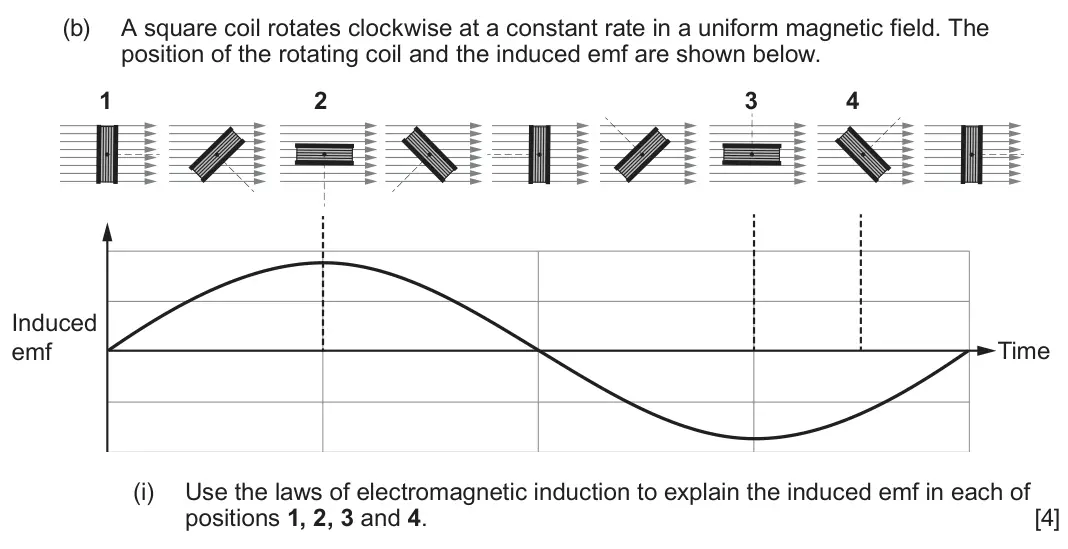
Q6(b)(ii)
The whole paper ↗
Q8(f)
The whole paper ↗
Q8(g)
The whole paper ↗
Q8(a)
The whole paper ↗
Q10(a)(i)
The whole paper ↗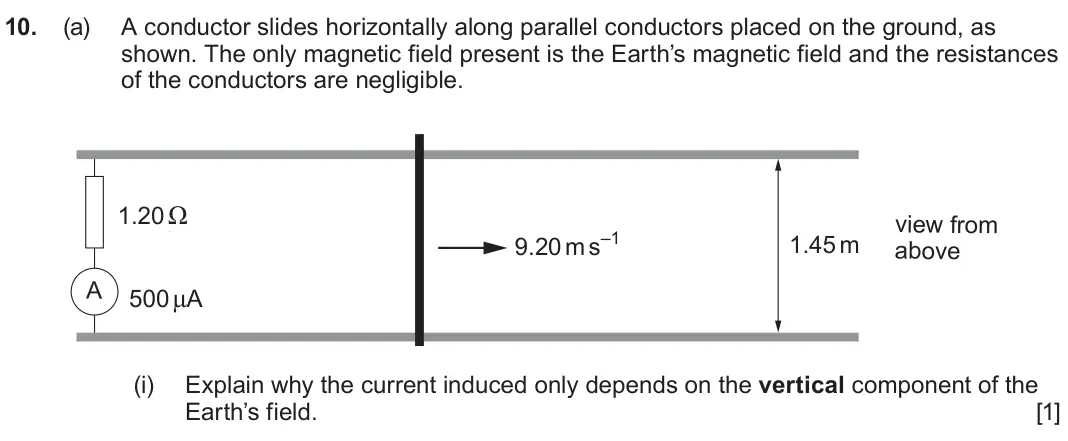
Q10(a)(ii)
The whole paper ↗
Q10(a)(iii)
The whole paper ↗
Q10(b)
The whole paper ↗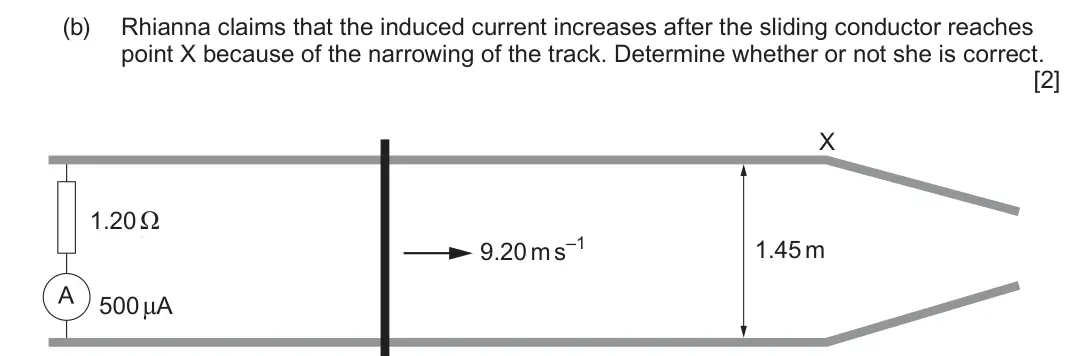
Q8(a)
The whole paper ↗
Q8(b)(i)
The whole paper ↗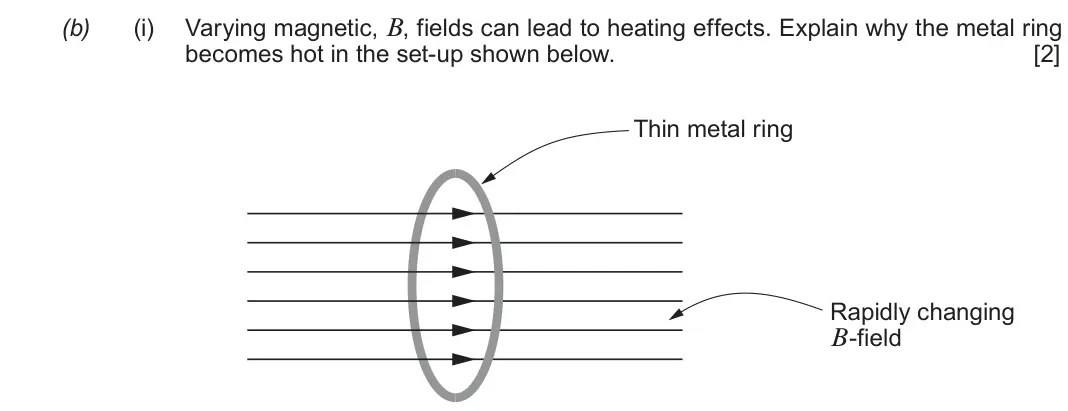
Q8(b)(ii)
The whole paper ↗
Q9(a)(i)
The whole paper ↗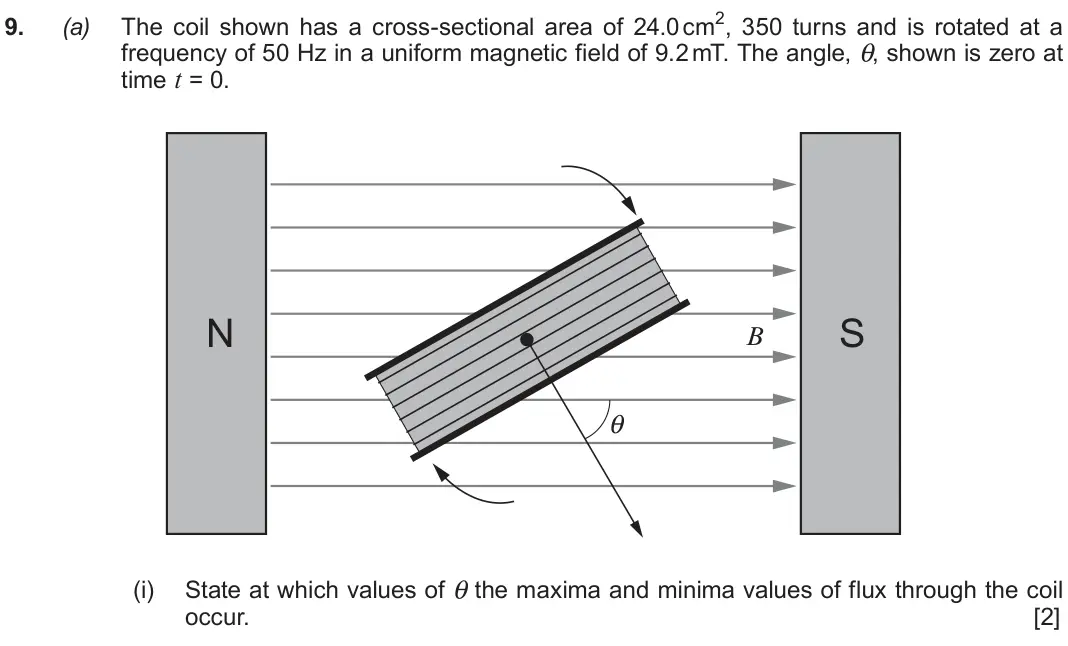
Q9(a)(ii)
The whole paper ↗
Q9(a)(iii)
The whole paper ↗
Q10(b)(i)
The whole paper ↗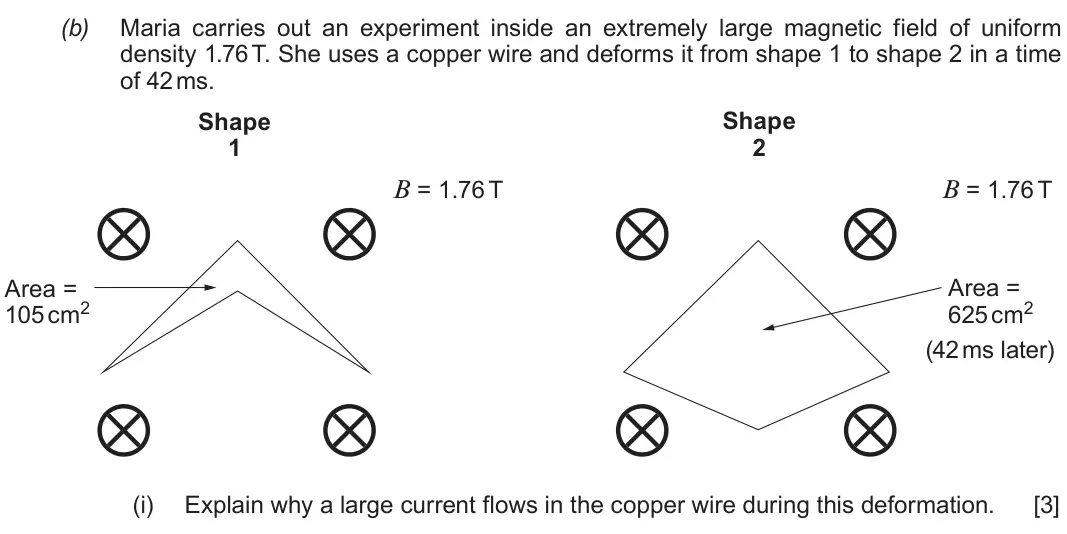
Q10(b)(ii)
The whole paper ↗
Q10(b)(iii)
The whole paper ↗
Q10(a)
The whole paper ↗
All 30 questions on Electromagnetic induction, as a list
- June 2025, Component 3, Q6(a) (3 marks): State the two laws of electromagnetic induction: the laws of Faraday and Lenz. [3]
- June 2025, Component 3, Q6(b)(i) (4 marks): Use the laws of electromagnetic induction to explain the induced emf in each of positions 1, 2, 3 and 4 [4]
- June 2025, Component 3, Q6(b)(ii) (2 marks): Use the laws of electromagnetic induction to explain how the graph would change if the rotation rate were doubled. [2]
- June 2024, Component 1, Q8(f) (5 marks): Read through the following article carefully. Paragraph Some Physics of Music 1 When stationary waves are produced on a string, only certain frequencies are all
- June 2024, Component 1, Q8(g) (2 marks): Read through the following article carefully. Paragraph Some Physics of Music 1 When stationary waves are produced on a string, only certain frequencies are all
- June 2024, Component 3, Q8(a) (5 marks): Explain why the magnet reaches a low terminal velocity while inside the copper tube. [5]
- June 2023, Component 3, Q10(a)(i) (1 mark): Explain why the current induced only depends on the vertical component of the Earth’s field. [1]
- June 2023, Component 3, Q10(a)(ii) (2 marks): In the northern hemisphere, the vertical component of the Earth’s field is downwards. Explain the direction of the induced current in the circuit. [2]
- June 2023, Component 3, Q10(a)(iii) (3 marks): Calculate the vertical component of the Earth’s magnetic flux density. [3]
- June 2023, Component 3, Q10(b) (2 marks): Rhianna claims that the induced current increases after the sliding conductor reaches point X because of the narrowing of the track. Determine whether or not sh
- Autumn 2021, Component 3, Q8(a) (3 marks): State Faraday’s law and Lenz’s law of electromagnetic induction. [3]
- Autumn 2021, Component 3, Q8(b)(i) (2 marks): Varying magnetic, B, fields can lead to heating effects. Explain why the metal ring becomes hot in the set-up shown below. [2] Thin metal ring Rapidly changing
- Autumn 2021, Component 3, Q8(b)(ii) (3 marks): Calculate the current in the ring if the rate of change of the B-field is 67 T s–1, the ring has a radius of 7.0 cm and a resistance of 0.087 Ω. [3]
- Autumn 2021, Component 3, Q9(a)(i) (2 marks): State at which values of θ the maxima and minima values of flux through the coil occur. [2]
- Autumn 2021, Component 3, Q9(a)(ii) (2 marks): Explain at which value of θ the maximum induced emf occurs. [2]
- Autumn 2021, Component 3, Q9(a)(iii) (3 marks): Calculate the induced emf when t = 2.5 ms. [3]
- Autumn 2020, Component 3, Q10(b)(i) (3 marks): Explain why a large current flows in the copper wire during this deformation. [3]
- Autumn 2020, Component 3, Q10(b)(ii) (2 marks): Explain how you can deduce that this current flows anticlockwise. [2]
- Autumn 2020, Component 3, Q10(b)(iii) (3 marks): Calculate the mean current flowing in the copper wire given that its resistance is 6.75 × 10⁻³Ω. [3]
- June 2019, Component 3, Q10(a) (2 marks): Show clearly how this value for the flux linkage is obtained. [2]
- June 2019, Component 3, Q10(b) (1 mark): Explain why the induced emf is zero when θ = 0. [1]
- June 2019, Component 3, Q10(c) (2 marks): The flux linkage of the coil for the angles θ = 85° and θ = 95° are 0.11 Wb turn and –0.11 Wb turn respectively. The coil rotates 10° in a time of 5.8 ms. Calcu
- June 2018, Component 3, Q10(a) (4 marks): Explain why the motion of the pendulum is damped. [4]
- June 2018, Component 3, Q10(b) (2 marks): Explain what, if anything, would happen to the motion of the pendulum if the bar magnet were reversed. [2]
- June 2018, Component 3, Q10(d) (3 marks): The maximum current induced in the silver ring is 5.5 A. Calculate the maximum rate at which the magnetic flux density inside the ring changes. [3]
- June 2017, Component 3, Q5(a)(i) (2 marks): Explain why a current is detected by the ammeter. [2]
- June 2017, Component 3, Q5(a)(ii) (1 mark): Explain why the current is independent of the horizontal component of the Earth's magnetic field. [1]
- June 2017, Component 3, Q5(b) (3 marks): Use Faraday's law to derive the expression for the current: [3] I = Bl R vv
- June 2017, Component 3, Q5(c)(i) (4 marks): Without drawing a graph, explain whether or not the data are consistent with the equation: [4] Bl I = v R
- June 2017, Component 3, Q5(c)(ii) (6 marks): Use the data in the table with the smallest percentage uncertainties to calculate the vertical component of the Earth’s magnetic field, B, together with its abs
Questions, mark schemes and examiner’s reports are © WJEC Eduqas, from their published past papers. Plumi isn’t affiliated with any exam board. Want whole papers? Every Eduqas A-Level Physics paper.
Rather write your answers by hand on iPad? Plumi marks them against the same mark schemes.