 plumi
Circular motion: Eduqas A‑Level Physics questions
Every Eduqas A-Level Physics exam question on 1.5 Circular motion, 2016–2025, with its mark scheme and examiner’s report.
Find questions1,592
Calculations
Q4(a)
The whole paper ↗
Q4(b)(i)
The whole paper ↗
Q4(b)(ii)
The whole paper ↗
Q4(c)
The whole paper ↗
Q7(b)(ii)
The whole paper ↗
Q4(a)
The whole paper ↗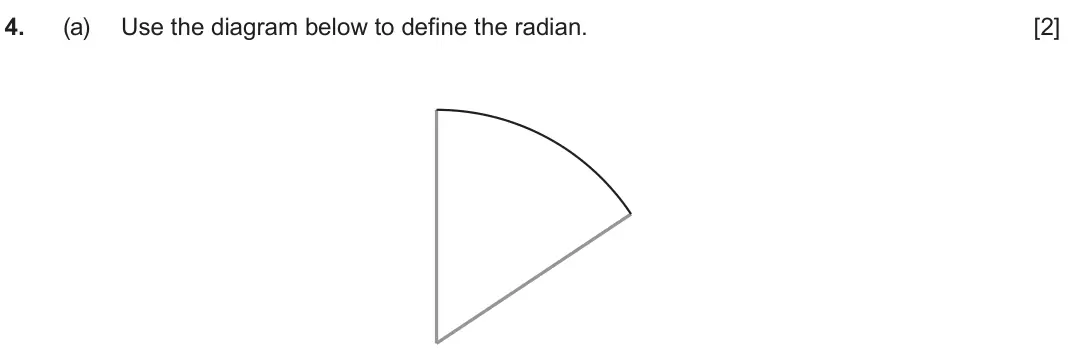
Q4(b)(i)
The whole paper ↗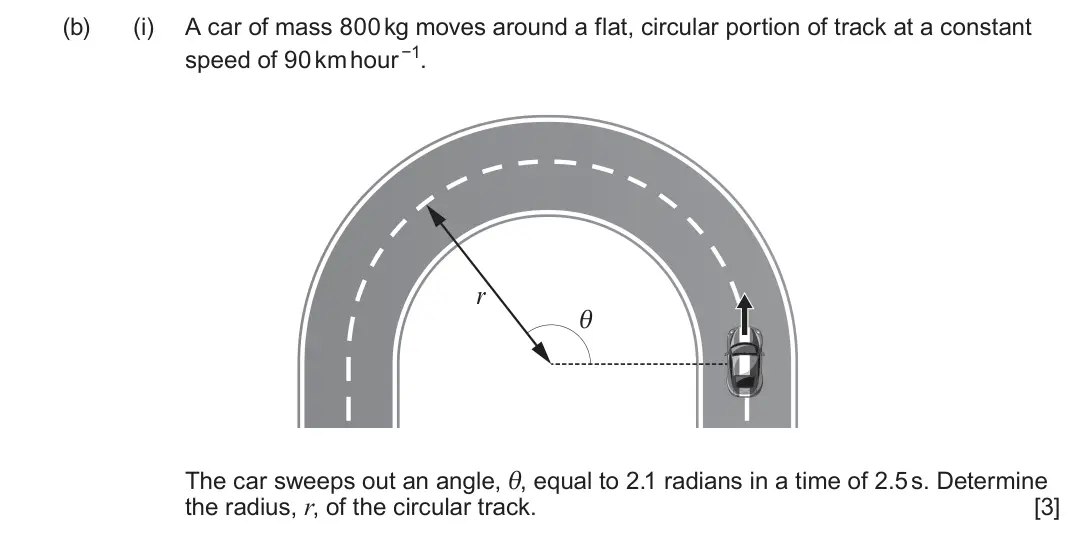
Q4(b)(iii)
The whole paper ↗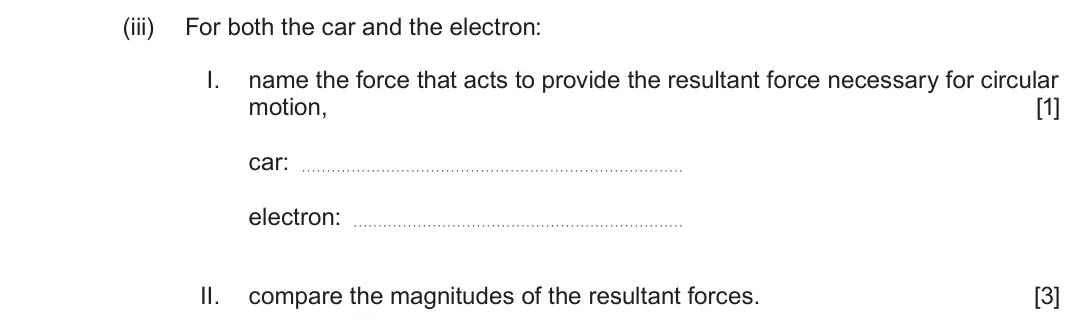
Q8(b)
The whole paper ↗
Q6(b)(iii)
The whole paper ↗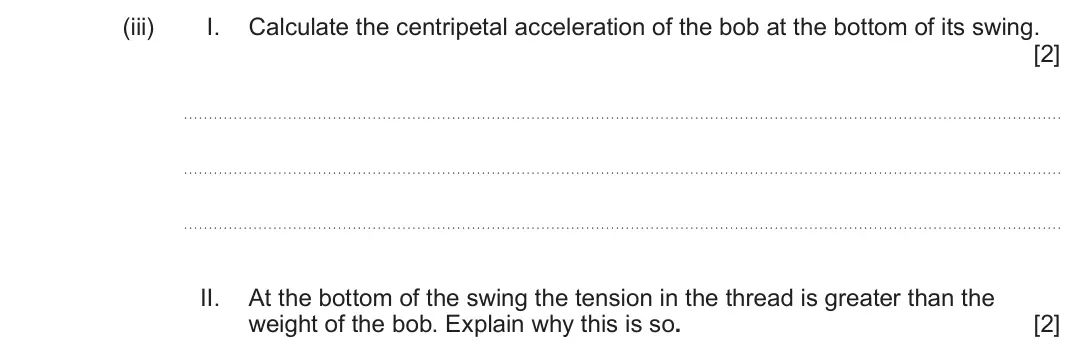
Q4(b)(ii)
The whole paper ↗
Q4(b)(iii)
The whole paper ↗
Q4(c)(i)
The whole paper ↗
Q4(c)(ii)
The whole paper ↗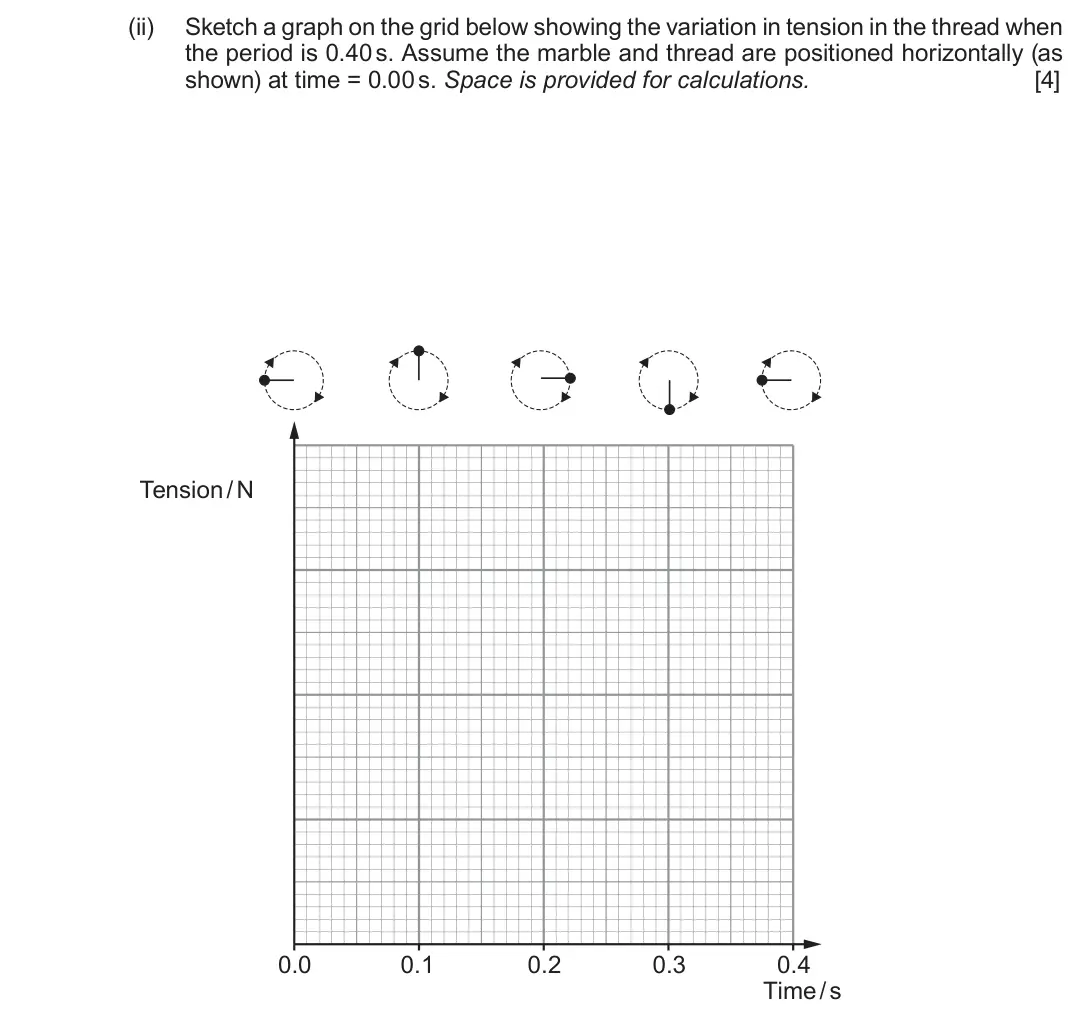
Q7(a)(iii)
The whole paper ↗
Q2(b)(i)
The whole paper ↗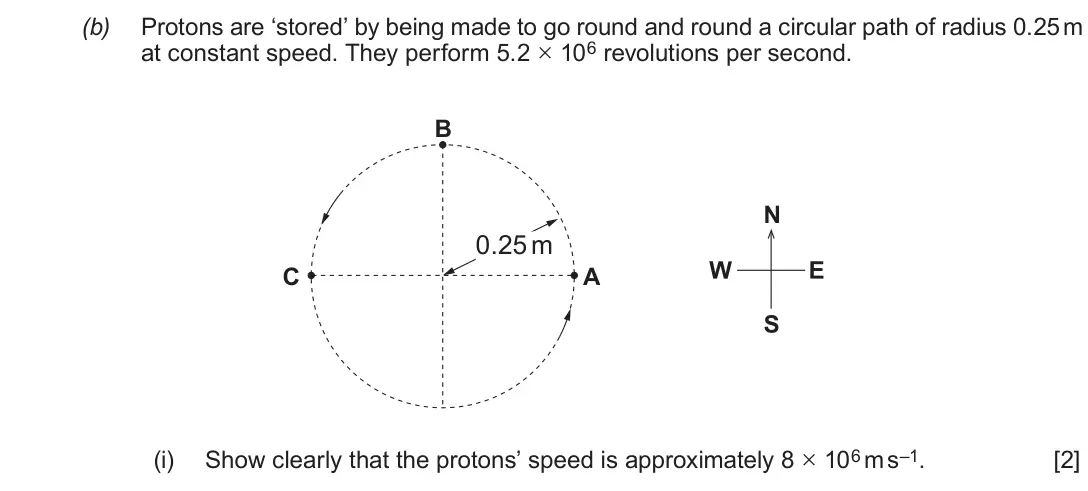
Q2(b)(ii)
The whole paper ↗
Q2(c)
The whole paper ↗
Q4(a)(i)
The whole paper ↗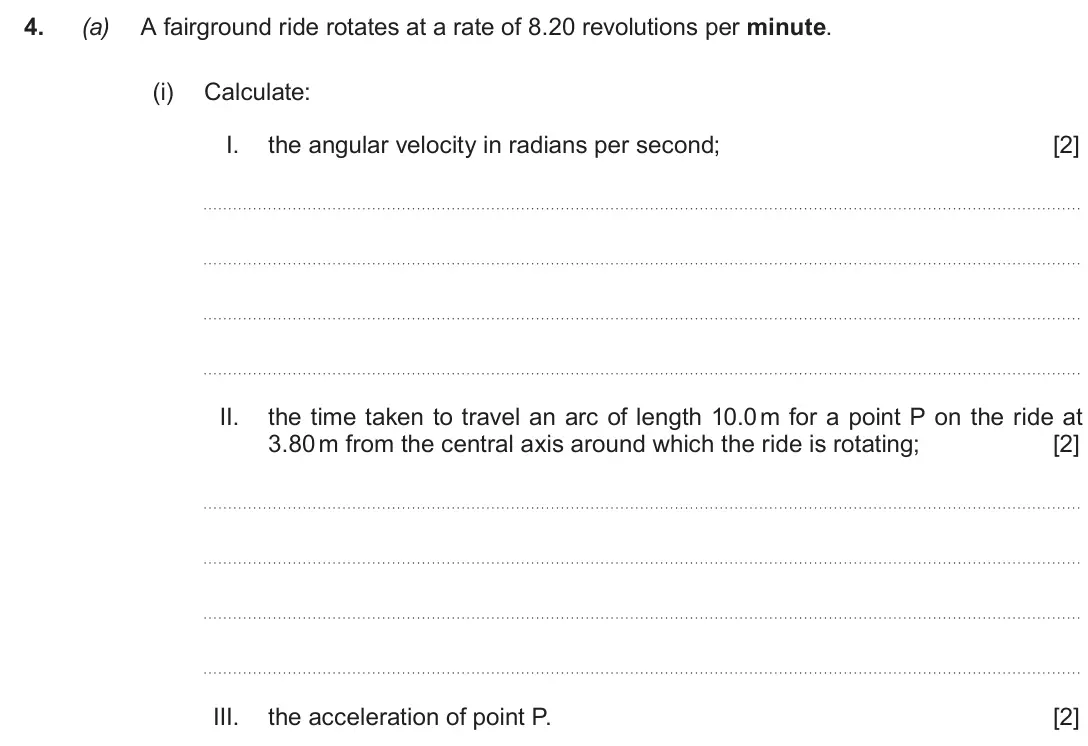
Q4(a)(ii)
The whole paper ↗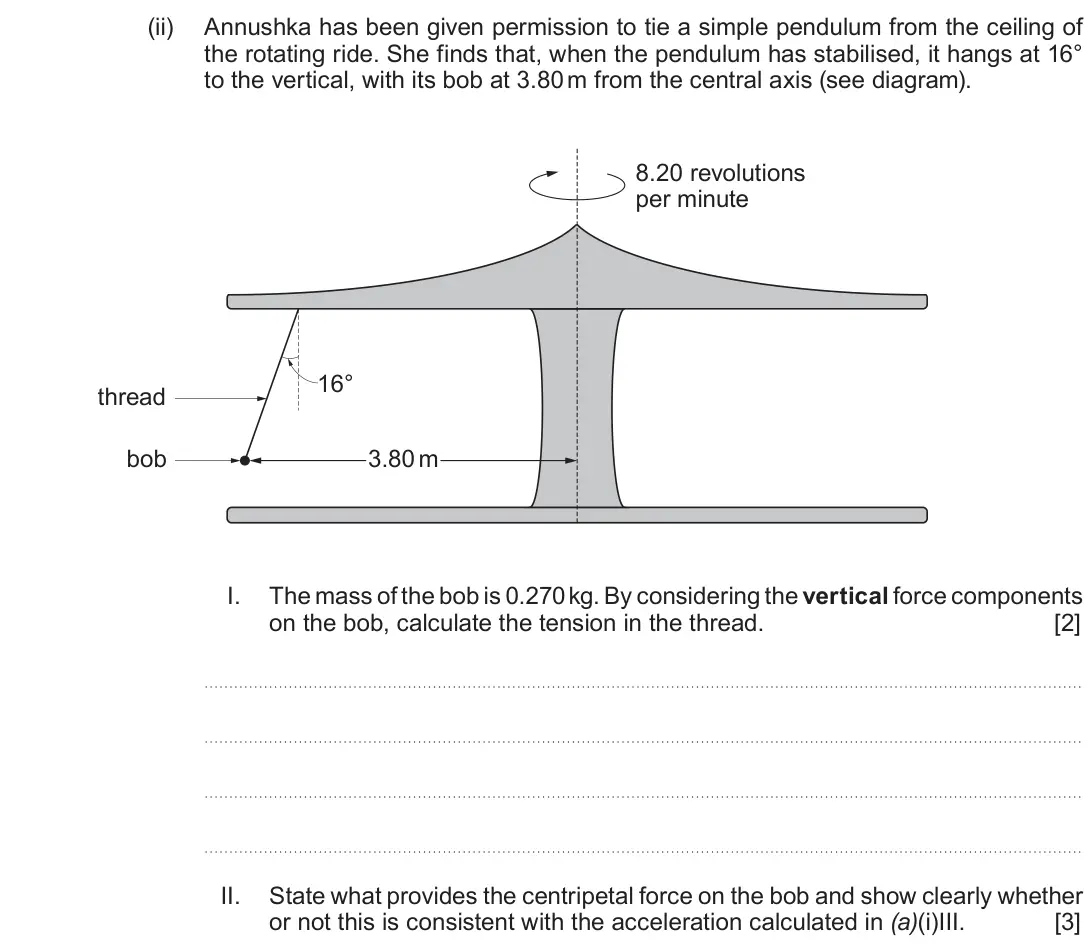
All 28 questions on Circular motion, as a list
- June 2025, Component 1, Q4(a) (1 mark): Define angular velocity, ω. [1]
- June 2025, Component 1, Q4(b)(i) (2 marks): Show that the angular velocity of the drum is approximately 150 rad s–1. [2]
- June 2025, Component 1, Q4(b)(ii) (3 marks): A wet sock has a mass of 0.15 kg and rotates in contact with the drum. Determine the magnitude of the centripetal force on the sock and state its direction. [3]
- June 2025, Component 1, Q4(c) (2 marks): A student considers the forces acting on the wet sock at position A. The student states, “There is a second force, acting outwards on the sock, to balance the c
- June 2025, Component 2, Q7(b)(ii) (3 marks): Show that the radius of orbit of the star is approximately 1.6 × 10⁹ m. [3]
- June 2024, Component 1, Q4(a) (2 marks): Use the diagram below to define the radian. [2]
- June 2024, Component 1, Q4(b)(i) (3 marks): A car of mass 800 kg moves around a flat, circular portion of track at a constant speed of 90 km hour −1 r θ The car sweeps out an angle, θ, equal to 2.1 radian
- June 2024, Component 1, Q4(b)(iii) (4 marks): For both the car and the electron: I. name the force that acts to provide the resultant force necessary for circular motion, [1] car: electron: II. compare the
- June 2024, Component 2, Q8(b) (4 marks): The maximum shift in wavelength measured by astronomers on Earth, when light of wavelength 656 nm from the star is analysed, is found to be about 0.20 pm. Using
- June 2023, Component 1, Q6(b)(iii) (4 marks): I. Calculate the centripetal acceleration of the bob at the bottom of its swing. [2] II. At the bottom of the swing the tension in the thread is greater than th
- Autumn 2021, Component 1, Q4(b)(ii) (3 marks): Assuming the charge on the nucleus to be +e, show that the speed of the electron is approximately 800 m s–1 [3]
- Autumn 2021, Component 1, Q4(b)(iii) (2 marks): Calculate the frequency at which the electron orbits. [2]
- Autumn 2021, Component 2, Q4(c)(i) (3 marks): Ian is a keen Physics student and believes he can whirl the marble, still attached to the thread, in a vertical circle at a rate of 0.40 seconds per complete ro
- Autumn 2021, Component 2, Q4(c)(ii) (4 marks): Sketch a graph on the grid below showing the variation in tension in the thread when the period is 0.40 s. Assume the marble and thread are positioned horizonta
- Autumn 2021, Component 2, Q7(a)(iii) (3 marks): Calculate the radius of the orbit of star A. [3]
- Autumn 2020, Component 1, Q2(b)(i) (2 marks): Show clearly that the protons’ speed is approximately 8 × 10⁶ m s–1 [2]
- Autumn 2020, Component 1, Q2(b)(ii) (3 marks): Determine the magnitude and direction of a proton’s acceleration at point B. [3]
- Autumn 2020, Component 1, Q2(c) (2 marks): Two students discuss the mean force on a proton over one revolution ABCA. Adam says that the mean force is the same as the force at B, because the force is the
- June 2019, Component 1, Q4(a)(i) (6 marks): Calculate: I. the angular velocity in radians per second; [2] II. the time taken to travel an arc of length 10.0 m for a point P on the ride at 3.80 m from the
- June 2019, Component 1, Q4(a)(ii) (5 marks): Annushka has been given permission to tie a simple pendulum from the ceiling of the rotating ride. She finds that, when the pendulum has stabilised, it hangs at
- June 2019, Component 1, Q4(b) (3 marks): Discuss one way in which our knowledge of the magnitude of centripetal force has been applied in the design of roads or railways or a domestic appliance. [3]
- June 2018, Component 1, Q2(a)(i) (1 mark): Define the angular velocity, ω, for a body moving in a circle. [1]
- June 2018, Component 1, Q2(a)(ii) (2 marks): Two equations giving the acceleration of a body moving at constant speed in a circle are: v2 a = and a = rω2 r Show clearly that the equations are equivalent. [
- June 2018, Component 1, Q2(b)(i) (2 marks): Calculate the speed of Deimos around Mars. [2]
- June 2017, Component 1, Q1(b) (1 mark): A physics student, Sundeep, calculates that if the wire breaks, then, 0.10 s after it breaks, the angular velocity of the bar about the hinge would be 1.3 rad s
- June 2017, Component 1, Q3(a)(ii) (2 marks): A teacher claims that the equation gives a ‘sensible’ value for the centripetal acceleration as r becomes extremely large. Justify her claim. [2]
- June 2017, Component 1, Q3(b)(i) (3 marks): Show that the magnitude of the centripetal force on the car is approximately 3 400 N. [3]
- June 2017, Component 1, Q3(b)(ii) (5 marks): The diagram shows the car at one point on its journey (clockwise) around the track. D is the force of air resistance on the car, and F is the horizontal compone
Questions, mark schemes and examiner’s reports are © WJEC Eduqas, from their published past papers. Plumi isn’t affiliated with any exam board. Want whole papers? Every Eduqas A-Level Physics paper.
Rather write your answers by hand on iPad? Plumi marks them against the same mark schemes.