 plumi
Shapes of molecules and ions: OCR A‑Level Chemistry A questions
OCR A-Level Chemistry A past-paper questions on 2.2.2.3 Shapes of molecules and ions, 2016–2025, with mark schemes and examiner’s reports where available.
Paper
All papers
Exam
All years
Calculations
Q16(d)
The whole paper ↗
- Your answer
Q5(a)(ii)
The whole paper ↗
Q5(b)
The whole paper ↗Q18(b)(i)
The whole paper ↗
Q18(b)(ii)
The whole paper ↗Q4(a)(ii)
The whole paper ↗
- Your answer
Q24(c)
The whole paper ↗
- Your answer
Q1(f)
The whole paper ↗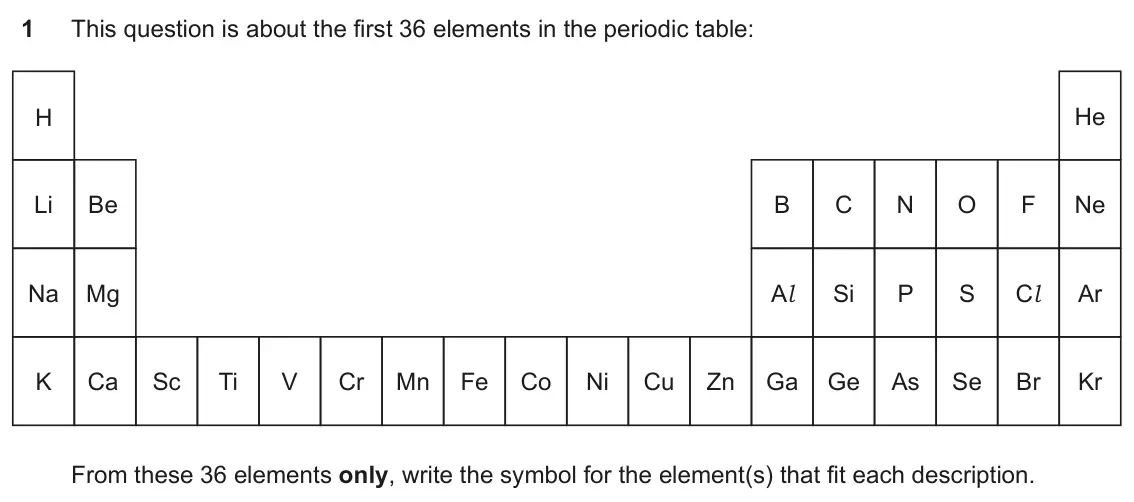
Q6(a)
The whole paper ↗
Q21(b)(i)
The whole paper ↗
Q21(b)(ii)
The whole paper ↗Q1(d)(i)
The whole paper ↗
Q4(c)
The whole paper ↗
- Your answer
- Your answer
- Your answer
Q1(d)(i)
The whole paper ↗
All 35 questions on Shapes of molecules and ions, as a list
- June 2025, Paper 1, Q16(d) (6 marks): This question is about trends in the periodic table. (d)* The hydrides of silicon, phosphorus and sulfur have simple molecular structures, but their molecules h
- June 2025, AS Paper 1, Q8 (1 mark): Which compound has molecules with a trigonal planar shape? A BeCl 2 B BCl 3 C NCl 3 D PCl 3 Your answer [1]
- June 2025, AS Paper 2, Q5(a)(ii) (2 marks): Name the shape of the chloromethane molecule and predict the value of the H–C–Cl bond angle. Name of shape Bond angle [2]
- June 2025, AS Paper 2, Q5(b) (3 marks): Chloroethene, H2C=CHCl , is a covalent molecule with a double bond. The bond angles in H2C=CHCl are different from those in CH3Cl . Predict the H–C–Cl bond angl
- June 2024, Paper 1, Q18(b)(i) (1 mark): Explain why the bond angles in SO3 are 120°. [1]
- June 2024, Paper 1, Q18(b)(ii) (2 marks): Explain why both SO2 and SO3 have polar bonds, but only SO2 has polar molecules. [2]
- June 2024, Paper 3, Q4(a)(ii) (3 marks): In a H3PO3 molecule, the O atoms are covalently bonded to the P atom. The H atoms are bonded to the O atoms. Draw the structure of a H3PO3 molecule, showing all
- June 2024, AS Paper 1, Q5 (1 mark): Which reaction produces a product with linear molecules? A 2B + 3F2 B C + O2 C 2H2 + O2 D N2 + 3H2 Your answer [1]
- June 2024, AS Paper 1, Q24(c) (5 marks): Propene, C3H6, has different bond angles and shapes around the carbon atoms. The displayed formula of a propene molecule is shown below. H H 1 H C C C H H 2 H P
- June 2023, Paper 2, Q15 (1 mark): Which ion(s) contain(s) bond angles of approximately 120º? CH3COO– 1 C6H5O– 2 (CH3)3C+ 3 A 1, 2 and 3 B Only 1 and 2 C Only 2 and 3 D Only 1 Your answer [1]
- June 2023, Paper 3, Q1(f) (1 mark): The p-block element in Period 3 that forms a compound with fluorine with octahedral molecules. [1]
- June 2023, Paper 3, Q6(a) (4 marks): Nitric acid has 2 single covalent bonds, 1 double covalent bond and 1 dative covalent bond as shown below. H O N O O Nitric acid Predict the H–O–N and O–N–O bon
- June 2023, AS Paper 1, Q21(b)(i) (2 marks): Predict the different shapes of, and bond angles in, NF3 and BF3 molecules. Bond angle Name of shape NF3 BF3 [2]
- June 2023, AS Paper 1, Q21(b)(ii) (2 marks): Explain why NF3 and BF3 molecules have different shapes and bond angles. [2]
- June 2022, Paper 3, Q1(d)(i) (3 marks): Glycine reacts with NaOH to form the salt H2NCH2COONa. Glycine reacts with HCl to form the salt HOOCCH2NH3Cl. The salts have different H–N–H bond angles. State
- June 2022, AS Paper 2, Q4(c) (4 marks): CO2 and H2O molecules have different shapes. State the bond angles in CO2 and H2O molecules and explain, in terms of electron pair repulsion, why the bond angle
- November 2021, Paper 1, Q14 (1 mark): Which statement(s) about a molecule of Cl–N=O is/are correct? 1: It is a polar molecule. 2: It contains 6 lone pairs of electrons. 3: It has a bond angle of 180
- November 2021, Paper 2, Q8 (1 mark): Which compound contains a bond angle of approximately 120º? A CH3CH2CN B CH3CH(OH)CH3 C CH3COOCH2CH2CH3 D CH3CH2CH2NH2 Your answer [1]
- November 2021, AS Paper 1, Q16 (1 mark): Which compound contains the smallest bond angle? A bromoethane B ethanol C ethane D ethene Your answer [1]
- November 2021, AS Paper 2, Q1(d)(i) (2 marks): State the shape of, and F—S—F bond angle in, an SF6 molecule. Shape Bond angle [2]
- November 2021, AS Paper 2, Q1(d)(ii) (1 mark): Suggest why SF6 is unreactive. [1]
- November 2020, Paper 3, Q6(a) (2 marks): Complete Table 6.1 to predict bond angles a and b and name the shapes which makes these bond angles in the functional groups of carboxylic acids and sulfonic ac
- November 2020, AS Paper 2, Q4(a) (3 marks): The ‘dot-and-cross’ diagram for nitrosyl chloride is shown below. N O Cl Predict the O=N–Cl bond angle and explain why NOCl has this bond angle. Bond angle Expl
- June 2019, Paper 3, Q5(c)(i) (1 mark): Predict the O–S–S bond angle and name of the shape of the thiosulfate ion. Bond angle Name of shape [1]
- June 2019, AS Paper 1, Q2 (1 mark): Which molecule contains the largest bond angle? A C2H4 B H2O C NH3 D CH4 Your answer [1]
- June 2018, Paper 2, Q5 (1 mark): Which molecule is not planar? A C2H4 B C2H6 C H2CO D HCN Your answer [1]
- June 2018, Paper 3, Q1(a)(iv) (1 mark): The element which forms a compound with fluorine that has octahedral molecules. [1]
- June 2018, AS Paper 1, Q21(b)(ii) (3 marks): Name the shape of a phosgene molecule and explain why it has this shape. Name of shape Explanation [3]
- June 2017, Paper 1, Q16(b) (2 marks): Nitrogen forms NH4 + and NH2 –. Predict the name of the shape of, and H–N–H bond angle in, NH4 Ion Name of shape H–N–H bond angle + NH4 – NH2 [2]
- June 2017, Paper 2, Q6 (1 mark): Four atoms, 1–4, are labelled in the structure below. 4 NH2 CH OH 1 3 2 H3C C O Which atom has a trigonal planar arrangement of bonds around it? A Atom 1 B Atom
- June 2017, Paper 3, Q1(a) (3 marks): The H–O–H bond angle in ice is about 109° but about 105° in gaseous H2O. Explain why there is this difference. [3]
- June 2017, AS Paper 2, Q5(b)(i) (2 marks): State the shape and bond angle around a carbon atom in the alkyl group of propanoic acid. Explain the shape. Shape Bond angle Explanation [2]
- June 2017, AS Paper 2, Q5(b)(ii) (1 mark): Suggest a value for the C–O–H bond angle in propanoic acid. [1]
- June 2016, AS Paper 1, Q7 (1 mark): A ‘dot-and-cross’ diagram for nitrogen trichloride, NCl3, is shown below. 7 X X X Cl Cl N X X Cl Which row shows the correct shape and bond angle in a molecule
- June 2016, AS Paper 2, Q6(b) (4 marks): The shape around the oxygen atom in butan-2-ol is non-linear. Predict the C–O–H bond angle and explain this shape. bond angle explanation [4]
Questions, mark schemes and examiner’s reports are © OCR, from their published past papers. Plumi isn’t affiliated with any exam board. Want whole papers? OCR A-Level Chemistry A past papers, or our free OCR-style practice pack.
The Plumi iPad app also offers exam-style questions with AI feedback on your handwritten working.