 plumi
Giant metallic and covalent lattices: OCR A‑Level Chemistry A questions
OCR A-Level Chemistry A past-paper questions on 3.1.1.3 Giant metallic and covalent lattices, 2016–2025, with mark schemes and examiner’s reports where available.
Paper
All papers
Exam
All years
Calculations
Q16(a)(ii)
The whole paper ↗
Q21(c)
The whole paper ↗
Q1(e)
The whole paper ↗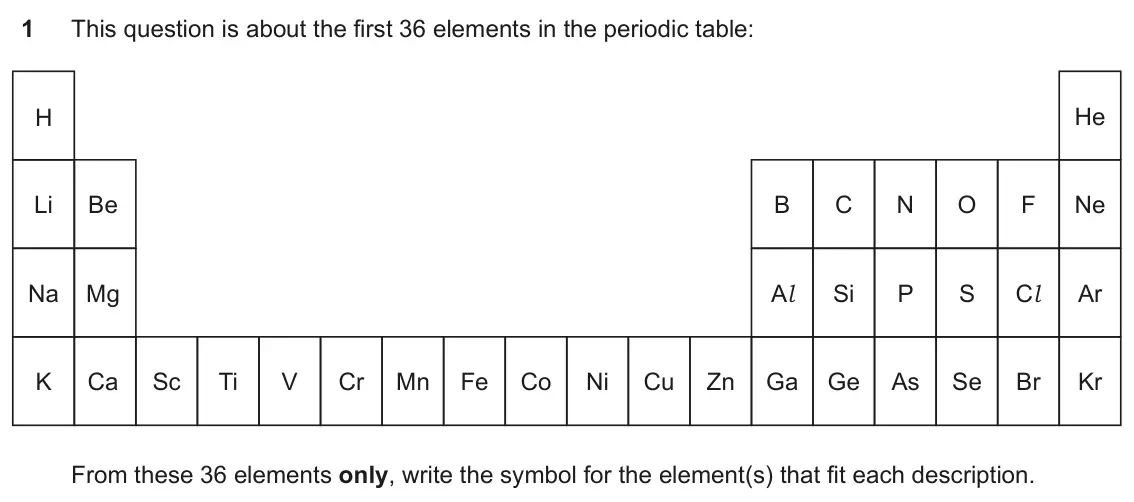
Q2(c)(i)
The whole paper ↗
Q2(c)(ii)
The whole paper ↗- Your answer
Q23(c)
The whole paper ↗
Q16(a)
The whole paper ↗
Q16(c)
The whole paper ↗
Q3(a)
The whole paper ↗
- Your answer
Q3(b)
The whole paper ↗
Q1(b)
The whole paper ↗
- Your answer
Q2(b)
The whole paper ↗
- Your answer
Q2(b)
The whole paper ↗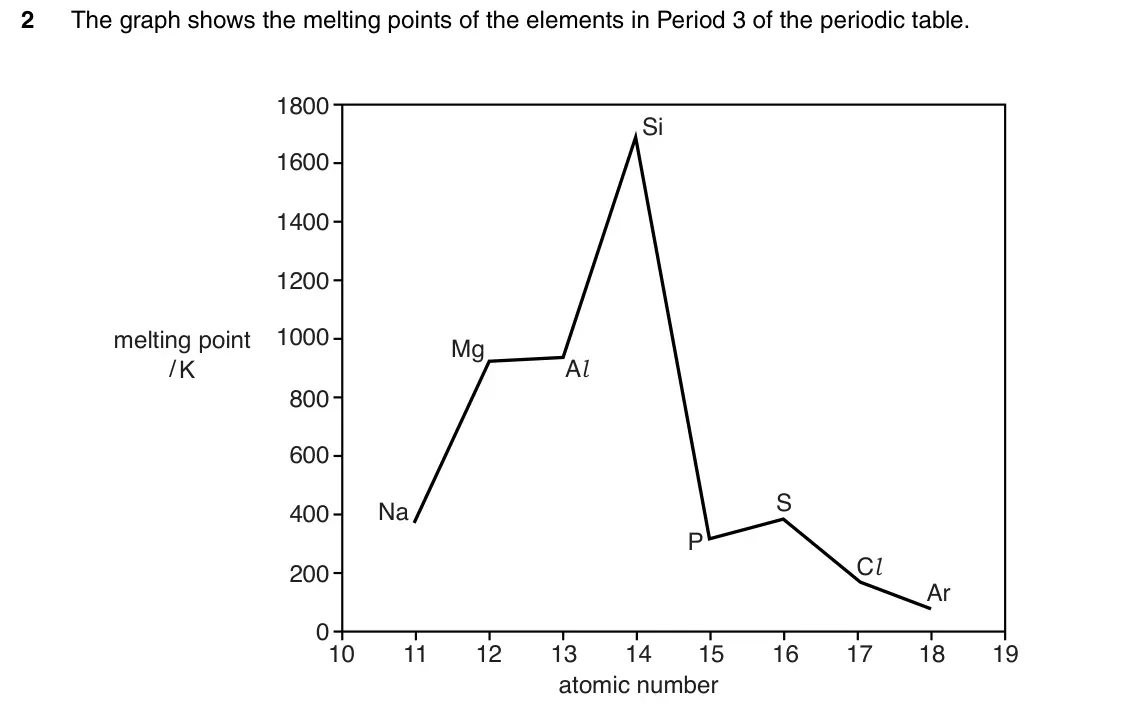
All 17 questions on Giant metallic and covalent lattices, as a list
- June 2025, Paper 1, Q16(a)(ii) (3 marks): Explain why silicon has a higher melting point than aluminium. Use ideas about structure and bonding in your answer. [3]
- June 2025, AS Paper 1, Q21(c) (3 marks): Magnesium has a giant metallic structure. • Draw a labelled diagram to show the bonding and structure in magnesium. Include the correct charges on the metal par
- June 2023, Paper 3, Q1(e) (1 mark): The element in Period 3 that exists in the solid state as a network of atoms bonded by strong covalent bonds. [1]
- June 2023, AS Paper 2, Q2(c)(i) (4 marks): Complete the table above to show the type of lattice structure of each substance. [4]
- June 2023, AS Paper 2, Q2(c)(ii) (4 marks): Explain the following: • MgS has a higher melting point than PCl 3. • Al has a greater electrical conductivity than Si. Melting points Conductivities [4]
- June 2022, AS Paper 1, Q1 (1 mark): Which substance has a giant covalent lattice structure in its solid state? A potassium B silicon C sodium chloride D water Your answer [1]
- June 2022, AS Paper 1, Q23(c) (4 marks): Describe the structure and bonding and electrical conductivity of calcium in the solid state. You may wish to include a labelled diagram in your answer. [4]
- November 2021, Paper 1, Q16(a) (3 marks): Magnesium has metallic bonding and is a good conductor of electricity. Describe, with the aid of a labelled diagram, the metallic bonding in magnesium and expla
- November 2020, Paper 1, Q16(c) (6 marks): This question is about magnesium, bromine and magnesium bromide. (c)* Table 16.1 shows some physical properties of magnesium, bromine and magnesium bromide. Ele
- November 2020, AS Paper 2, Q3(a) (5 marks): The table shows the melting point and electrical conductivity of two elements in Period 4. Element Melting Point / °C Electrical conductivity Calcium 842 Good B
- June 2019, Paper 1, Q7 (1 mark): Which set of elements in the solid state contain a simple molecular lattice, a giant covalent lattice and a giant metallic lattice? A S, Si, Al B P, Si, C C S,
- June 2019, Paper 3, Q3(b) (4 marks): SiO2 and CO2 are oxides of other Group 14 (Group 4) elements. Solid SiO2 melts at 2156 °C. Solid CO2 melts at −56 °C. Suggest the type of lattice structure in s
- June 2019, AS Paper 2, Q1(b) (5 marks): The table below shows two physical properties of the element strontium. Melting point high Electrical conductivity very good Explain these physical properties o
- June 2018, AS Paper 1, Q10 (1 mark): Which element has induced dipole–dipole interactions (London forces) in its solid lattice? A boron B magnesium C silicon D sulfur Your answer [1]
- June 2018, AS Paper 2, Q2(b) (3 marks): The table below compares the properties of sodium sulfide, sodium and sulfur. Complete the table. Sodium sulfide Sodium Sulfur Melting point / °C 1180 98 113 Ty
- June 2016, AS Paper 1, Q8 (1 mark): What is the shape around the carbon atoms in graphene? A linear B pyramidal C tetrahedral D trigonal planar Your answer [1]
- June 2016, AS Paper 2, Q2(b) (4 marks): Magnesium and silicon have different types of giant structures. Describe the bonding in magnesium and in silicon. Include the names of the particles and describ
Questions, mark schemes and examiner’s reports are © OCR, from their published past papers. Plumi isn’t affiliated with any exam board. Want whole papers? OCR A-Level Chemistry A past papers, or our free OCR-style practice pack.
The Plumi iPad app also offers exam-style questions with AI feedback on your handwritten working.