 plumi
Reacting quantities from equations: OCR A‑Level Chemistry A questions
OCR A-Level Chemistry A past-paper questions on 2.1.3.5 Reacting quantities from equations, 2016–2025, with mark schemes and examiner’s reports where available.
Paper
All papers
Exam
All years
Calculations
- Your answer
- Your answer
Q2(b)(ii)
The whole paper ↗
Q21(d)(i)
The whole paper ↗
Q25(c)
The whole paper ↗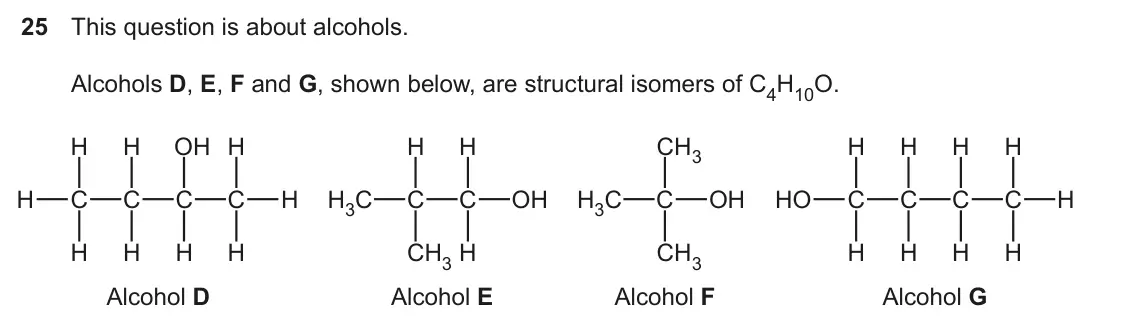
Q2(b)(i)
The whole paper ↗
Q4(b)(ii)
The whole paper ↗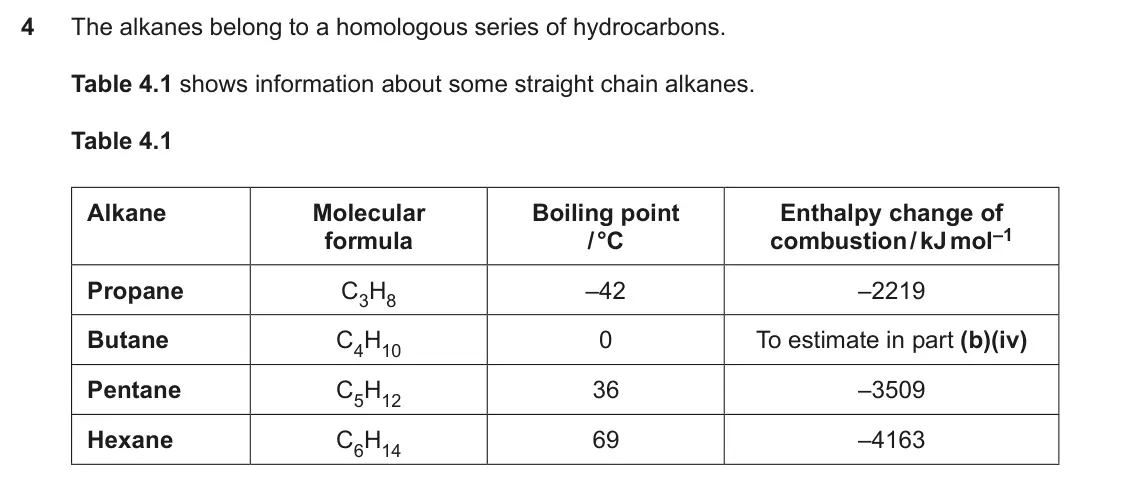
- Your answer
Q2(b)(ii)
The whole paper ↗
- Your answer
Q21(c)
The whole paper ↗
Q2(b)(ii)
The whole paper ↗
- Your answer
Q20(c)(ii)
The whole paper ↗
- Your answer
- Your answer
- Your answer
Q2(b)(ii)
The whole paper ↗
Q3(a)
The whole paper ↗
- Your answer
All 62 questions on Reacting quantities from equations, as a list
- June 2025, Paper 2, Q2 (1 mark): 0.0200 mol of the compound below reacts with Br2(aq) to make a saturated compound. How many grams of Br2 are needed for this reaction? Cl A 3.20 B 6.39 C 7.99 D
- June 2025, Paper 2, Q5 (1 mark): 0.200 mol of HOOCCH2CH2COOH is reacted with 0.300 mol NaOH. How many water molecules are formed? 1.204 × 10²³ A 1.806 × 10²³ B 2.408 × 10²³ C 3.612 × 10²³ D You
- June 2025, Paper 3, Q2(b)(ii) (4 marks): The student uses the reaction of nuromol tablets with Na2CO3(aq) to determine the mass of ibuprofen and the mass of paracetomol in one nuromol tablet. The stude
- June 2025, AS Paper 1, Q21(d)(i) (3 marks): Calculate the concentration of HCl that the student used. Give your answer to 2 significant figures and in standard form. Concentration of HCl = mol dm–3 [3]
- June 2025, AS Paper 1, Q25(c) (5 marks): 25.9 g of alcohol F is completely combusted in oxygen at a temperature of 100 °C and 1.50 × 10⁵ Pa pressure. The equation for this reaction is: C4H10O + 6O2 4CO
- June 2025, AS Paper 2, Q2(b)(i) (2 marks): and pressure (RTP). Give your answer to 3 significant figures. Volume of gas cm3 [2]
- June 2025, AS Paper 2, Q4(b)(ii) (2 marks): Use the information in Table 4.1 to calculate the mass of carbon dioxide formed when 1.00 kJ of energy is released during the complete combustion of pentane. Ma
- June 2024, Paper 2, Q6 (1 mark): 4.30 g of the alcohol C5H9OH, (Mr = 86.0), is burned in oxygen. C5H9OH(l) + 7O2(g) 5CO2(g) + 5H2O(l) Which volume of oxygen gas is needed, in dm3, for this comp
- June 2024, Paper 3, Q2(b)(ii) (3 marks): Determine the formula of compound A. formula of A = [3]
- June 2024, AS Paper 1, Q4 (1 mark): Carbon monoxide reacts with oxygen to form carbon dioxide: 2CO(g) + O2(g) 2CO2(g) Which volumes of CO(g) and O2(g) produce the largest volume of CO2(g)? All gas
- June 2024, AS Paper 1, Q21(c) (3 marks): The iron compound, Fe(NO3)3, decomposes when heated. The equation for the decomposition of Fe(NO3)3 is shown below. 4Fe(NO3)3(s) 2Fe2O3(s) + 12NO2(g) + 3O2(g) M
- June 2024, AS Paper 2, Q2(b)(ii) (3 marks): A student plans to add 0.0100 mol of Ca to 120 cm3 of 0.100 mol dm–3 HCl (aq). When the student carries out this reaction, they are surprised that all the calci
- June 2023, Paper 1, Q4 (1 mark): 40.0 cm3 of 0.200 mol dm–3 HCl is added to 60.0 cm3 of 0.100 mol dm–3 NaOH. 4 What is the concentration of the resulting solution? 0.0200 mol dm–3 HCl and 0.020
- June 2023, Paper 1, Q20(c)(ii) (2 marks): The student then reacts 1.00 g of calcium carbonate, CaCO3, with an excess of dilute nitric acid, HNO3. Explain why the student’s two reactions produce differen
- June 2023, Paper 2, Q8 (1 mark): For complete combustion, 0.100 mol of an alkane requires 22.8 dm3 of O2, measured at RTP. 8 Which alkane has undergone complete combustion? A pentane B hexane C
- June 2023, AS Paper 1, Q8 (1 mark): Magnesium nitrate, Mg(NO3)2, decomposes when heated: Mg(NO3)2(s) MgO(s) + 2NO2(g) + ½O2(g) 0.00250 mol of Mg(NO3)2 is decomposed. What is the volume of gas prod
- June 2023, AS Paper 1, Q9 (1 mark): Zinc reacts with aqueous silver nitrate, as shown in the equation: Zn(s) + 2AgNO3(aq) 2Ag(s) + Zn(NO3)2(aq) 0.10 g of zinc is added to 15 cm3 of 0.25 mol dm–3 a
- June 2023, AS Paper 2, Q2(b)(ii) (4 marks): The student obtains 3.28 g of precipitate. Calculate the percentage by mass of NaCl (s) in the 5.00 g mixture. Give your answer to 3 significant figures. percen
- June 2023, AS Paper 2, Q3(a) (6 marks): This question is about halogens and halogen compounds. (a)* Seawater contains very small quantities of dissolved iodide ions. The concentration of potassium iod
- June 2022, Paper 1, Q2 (1 mark): cm3 of nitrogen gas reacts with 10 cm3 of oxygen gas to form 20 cm3 of a gaseous product. 2 Which equation is the most likely for the reaction? A N2(g) + O2(g)
- June 2022, Paper 1, Q3 (1 mark): 0.541 g of an element X is reacted with oxygen to form 0.790 g of the oxide X2O3. What is the element X? A Al B Cr C Ga D Sc Your answer [1]
- June 2022, Paper 1, Q21(c)(i) (3 marks): A typical sample of limestone contains 95.0% by mass of calcium carbonate, CaCO3. Fertiliser Z, Ca5NH4(NO3)11•10H2O (Mr = 1080.5 g mol–1) can be made from limes
- June 2022, Paper 2, Q9 (1 mark): The compound below reacts with hydrogen gas to form a saturated compound. CN What is the volume of hydrogen, measured at room temperature and pressure, that rea
- June 2022, Paper 3, Q2(a)(i) (3 marks): 420 dm3 of chlorine, measured at RTP, is reacted with an excess of Ca(OH)2. The solid products are dissolved in water to form 4.00 m3 of solution. Calculate the
- June 2022, AS Paper 1, Q7 (1 mark): A sample of lead(II) sulfate (M = 303.3 g mol–1) is decomposed by heat, as shown in the equation 7 below. 2PbSO4(s) → 2PbSO3(s) + O2(g) The reaction forms 2.40
- June 2022, AS Paper 1, Q16 (1 mark): Complete combustion of an alkane forms 30 cm3 of carbon dioxide and 40 cm3 of water vapour, under the same conditions of temperature and pressure. Which alkane
- November 2021, Paper 1, Q5 (1 mark): Chromium(III) oxide, Cr2O3, is reduced to chromium by heating with magnesium. 5 What is the minimum mass of Mg required to reduce 11.4 g of chromium(III) oxide?
- November 2021, Paper 1, Q22(b)(i) (2 marks): Show that NaOH is in excess. [2]
- November 2021, Paper 3, Q2(b) (3 marks): Analyse the student’s results to conclude which of Equation 1 or 2 or 3, is supported by the experimental results. Assume that the conditions in the laboratory
- November 2021, Paper 3, Q2(d) (2 marks): The student modifies their method as outlined below: • 1.52 g (0.01 mol) of europium is reacted with an excess of dilute hydrochloric acid. • An excess of aqueo
- November 2021, Paper 3, Q5(a)(ii) (5 marks): A 16.0 dm3 airbag is inflated at 17.0 ºC. The pressure in the inflated airbag is 1.20 × 10⁵ Pa. Calculate the mass of NaN3 that has decomposed. Give your answer
- November 2021, Paper 3, Q5(c) (6 marks): This question is about nitrogen and its compounds. (c)* This question is about two reactions of ammonia. Reaction 1 Excess ammonia is reacted with 4.77 g of cop
- November 2021, AS Paper 2, Q6(c)(i) (2 marks): Calculate the mass of barium that the student uses. Give your answer to 2 decimal places. mass of barium = g [2]
- November 2020, Paper 1, Q3 (1 mark): 0.80 g of element X is reacted with 0.40 g of O2 to form an oxide with the formula X2O3. What is the identity of element X? A Aluminium B Titanium C Germanium D
- November 2020, AS Paper 1, Q9 (1 mark): 2.0 dm3 of Cl 2 gas reacts with 2.0 dm3 of Cl F3 gas to form 6.0 dm3 of a gaseous compound. 9 The reaction has 100% atom economy and all volumes are measured at
- November 2020, AS Paper 2, Q1(b)(i) (3 marks): Calculate the minimum volume, in cm3, of 0.150 mol dm–3 HCl (aq) that the student needs for the reaction. Give your answer to 3 significant figures. minimum vol
- November 2020, AS Paper 2, Q1(b)(iii) (2 marks): The student repeats the experiment with 0.192 g of magnesium instead of nickel, using the same volume of 0.150 mol dm–3 HCl (aq) as in (b)(i). State and explain
- June 2019, Paper 1, Q4 (1 mark): In the laboratory, acid spills can be cleaned up and made safe by spreading anhydrous sodium carbonate over the spill to neutralise the acid. A student accident
- June 2019, Paper 1, Q8 (1 mark): 3.528 g of a Group 2 metal, M, is reacted with an excess of chlorine. The reaction forms 9.775 g of a chloride. What is metal M? A magnesium B calcium C stronti
- June 2019, Paper 3, Q1(d) (2 marks): What mass of carbon dioxide (in g) is formed by the complete combustion of 42.0 m3 (measured at RTP) of propane? mass = g [2]
- June 2019, AS Paper 1, Q5 (1 mark): 8.0 dm3 of NO is mixed with 6.0 dm3 of O2 at room temperature and pressure (RTP). 5 The reaction below takes place until one of the reactants is used up. 2NO(g)
- June 2019, AS Paper 1, Q7 (1 mark): 0.24 g of an element, X, is reacted with 0.0100 mol Cl 2 to form a chloride with the formula XCl 2. What is element X? A carbon B magnesium C molybdenum D titan
- June 2019, AS Paper 2, Q2(b) (3 marks): A solution of magnesium nitrate can be prepared by reacting magnesium carbonate, MgCO3, with nitric acid, HNO3(aq). The equation is shown below. MgCO3(s) + 2HNO
- June 2019, AS Paper 2, Q4(a) (3 marks): The student plans to react 50.0 cm3 of 0.100 mol dm–3 HCl with 0.200 g of zinc (an excess). Calculate the volume, in cm3, of hydrogen that should be produced at
- June 2018, Paper 3, Q2(a)(ii) (3 marks): The student allows the reaction in equation 2.1 to proceed until no more gas is evolved. The volume of O2 in the syringe is now 55 cm3, measured at RTP. Calcula
- June 2018, AS Paper 1, Q4 (1 mark): Sodium reacts with water as shown below. 2Na(s) + 2H2O(l) → 2NaOH(aq) + H2(g) Which mass of sodium reacts with water to produce 960 cm3 of hydrogen gas at RTP?
- June 2018, AS Paper 1, Q22(a)(ii) (3 marks): The student plans to add magnesium to 50.0 cm3 of 1.24 mol dm−3 H3PO4. Calculate the mass of magnesium that the student should add to react exactly with the pho
- June 2018, AS Paper 1, Q22(b)(i) (4 marks): 3.20 × 10⁻² mol of H3PO3 is completely decomposed by this reaction. Calculate the volume of phosphine gas formed, in cm3, at 100 kPa pressure and 200 °C. volume
- June 2017, Paper 1, Q5 (1 mark): 0.0200 mol of calcium oxide is reacted completely with 2.00 mol dm–3 HCl. 5 What is the volume, in cm3, of 2.00 mol dm–3 HCl required for this reaction? A 15 B
- June 2017, Paper 1, Q7 (1 mark): Silicon can be made by heating silicon tetrachloride, SiCl 4, with zinc. SiCl 4 + 2Zn Si + 2ZnCl 2 8.50 g of SiCl 4 is reacted with an excess of zinc. The perce
- June 2017, Paper 1, Q19(a) (3 marks): Determine the total volume of oxygen, measured at room temperature and pressure, that the student should be prepared to collect in this investigation. Suggest a
- June 2017, Paper 2, Q3 (1 mark): Complete combustion of an organic compound forms 40 cm3 of carbon dioxide and 40 cm3 of 3 water vapour, under the same conditions of temperature and pressure. W
- June 2017, Paper 2, Q12 (1 mark): 0.1 mol of HOOCCH2COOH are reacted with 0.1 mol of aqueous NaOH. How many molecules of water are formed? 6.02 × 10²² A 3.01 × 10²² B 6.02 × 10²³ C 3.01 × 10²³ D
- June 2017, Paper 2, Q16(e)(i) (2 marks): Reaction of 204 mg of myrcene with hydrogen gas produces a saturated alkane. Calculate the volume of hydrogen gas, in cm3 and measured at RTP, needed for this r
- June 2017, Paper 2, Q16(e)(ii) (4 marks): β-Carotene is a naturally occurring unsaturated hydrocarbon found in carrots. A β-carotene molecule contains 40 carbon atoms, has two rings, and a branched chai
- June 2017, AS Paper 1, Q3 (1 mark): Samples of four hydrocarbons are completely burnt under the same conditions of temperature and pressure. Which sample produces the greatest volume of CO2? A 0.4
- June 2016, AS Paper 1, Q3 (1 mark): Calcium nitrate, Ca(NO3)2, decomposes when heated, as shown below. Ca(NO3)2(s) → CaO(s) + 2NO2(g) + ½O2(g) A student decomposes 0.00500 mol of Ca(NO3)2 and coll
- June 2016, AS Paper 1, Q22(c) (3 marks): A student prepares a solution of sodium sulfate, Na2SO4, by adding 6.25 × 10⁻² mol dm–3 sulfuric acid, H2SO4, from a burette to 25.0 cm3 of 0.124 mol dm–3 NaOH
- June 2016, AS Paper 1, Q24(c) (2 marks): The 50.0 cm3 of KI(aq) used in the experiment contains 10% more KI than is needed to react with 50.0 cm3 of 1.50 mol dm–3 Pb(NO3)2(aq). Pb(NO3)2(aq) + 2KI(aq) →
- June 2016, AS Paper 2, Q1(c)(ii) (3 marks): Identify the Group 2 metal, M. Show your working. Group 2 metal = [3]
- June 2016, AS Paper 2, Q1(d) (1 mark): The student plans to repeat the experiment using the same mass of a Group 2 metal from further down the group. Predict whether the volume of hydrogen produced w
- June 2016, AS Paper 2, Q5(a)(ii) (3 marks): An excess of strontium carbonate, SrCO3, is mixed with 20.0 cm3 of 1.25 mol dm–3 nitric acid, HNO3. Calculate the mass of SrCO3 that reacts with the HNO3. mass
Questions, mark schemes and examiner’s reports are © OCR, from their published past papers. Plumi isn’t affiliated with any exam board. Want whole papers? OCR A-Level Chemistry A past papers, or our free OCR-style practice pack.
The Plumi iPad app also offers exam-style questions with AI feedback on your handwritten working.