 plumi
Water of crystallisation: OCR A‑Level Chemistry A questions
OCR A-Level Chemistry A past-paper questions on 2.1.3.3 Water of crystallisation, 2016–2025, with mark schemes and examiner’s reports where available.
Paper
All papers
Exam
All years
Calculations
- Your answer
Q1(d)
The whole paper ↗
Q4(b)(ii)
The whole paper ↗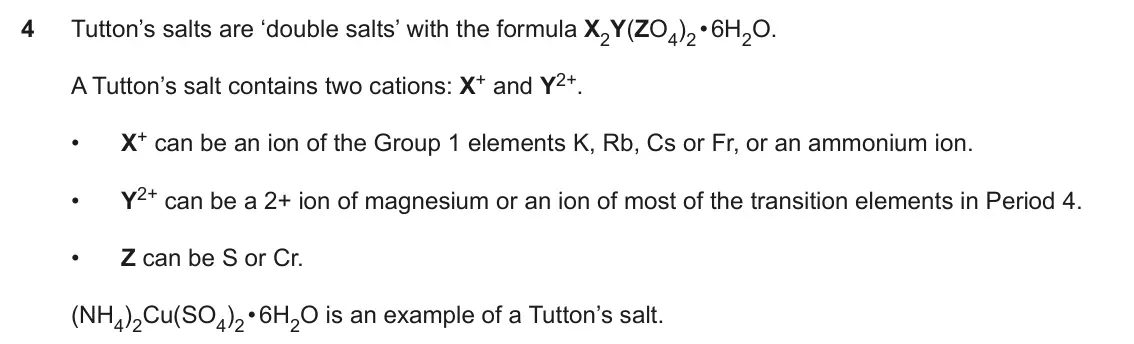
Q6(e)
The whole paper ↗
Q22(c)
The whole paper ↗
Q17(b)(ii)
The whole paper ↗
Q6(b)
The whole paper ↗
Q1(d)(i)
The whole paper ↗
Q1(d)(ii)
The whole paper ↗Q1(d)(iii)
The whole paper ↗Q21(d)
The whole paper ↗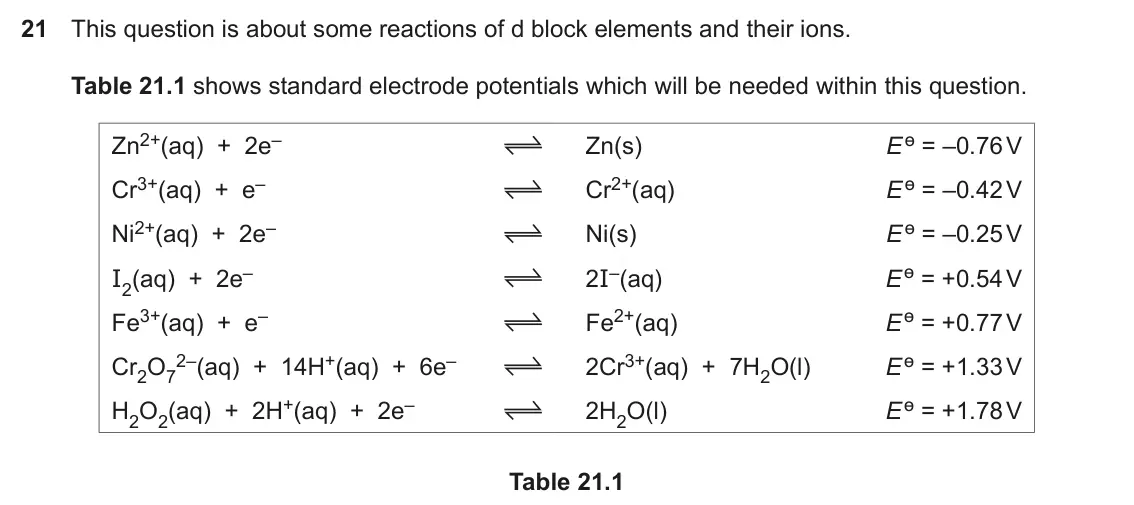
Q23(b)
The whole paper ↗
Q1(c)
The whole paper ↗
Q1(b)(iii)
The whole paper ↗
Q22(a)
The whole paper ↗
Q22(b)(i)
The whole paper ↗Q22(b)(ii)
The whole paper ↗Q22(b)(iii)
The whole paper ↗
All 18 questions on Water of crystallisation, as a list
- June 2025, Paper 1, Q2 (1 mark): 11.895 g of hydrated cobalt(II) chloride, CoCl 2•xH2O, is heated to remove the water of crystallisation. After heating to constant mass, the mass of the anhydro
- June 2024, AS Paper 2, Q1(d) (3 marks): A student heats 11.50 g of hydrated zinc sulfate, ZnSO4•7H2O, to remove all the water of crystallisation. Calculate the mass of anhydrous zinc sulfate that shou
- June 2023, Paper 3, Q4(b)(ii) (1 mark): In Step 3, why does the student allow the solvent to evaporate and not boil off all the solvent in Step 2? [1]
- June 2023, Paper 3, Q6(e) (6 marks): This question is about nitric acid, hydrochloric acid and sulfuric acid. (e)* Three reactions involving sulfuric acid are shown below. Reaction 1 Dilute sulfuri
- June 2022, AS Paper 1, Q22(c) (3 marks): Substance A is a hydrated salt with the following percentage composition by mass: Zn, 21.99%; H, 4.04%; N, 9.41%; O, 64.56%. • Determine the empirical formula o
- November 2021, Paper 1, Q17(b)(ii) (6 marks): This question is about d-block elements. (ii)* Determine the formulae of A and B. Write the ionic equation for the ligand substitution and show 3D structures fo
- June 2019, Paper 3, Q6(b) (6 marks): This question is about reactions of iron compounds. (b)* Compound C is a hydrated ionic compound with the empirical formula: FeH18N3O18. A student investigates
- June 2019, AS Paper 2, Q1(d)(i) (3 marks): Calculate the value of x in SrCl2•xH2O. Give your answer to 2 significant figures. x = [3]
- June 2019, AS Paper 2, Q1(d)(ii) (1 mark): Suggest why the student takes four readings of the mass of the crucible and residue. [1]
- June 2019, AS Paper 2, Q1(d)(iii) (2 marks): Suggest two modifications to the method that would reduce the percentage uncertainty in the mass of the residue. 1 2 [2]
- June 2018, Paper 1, Q21(d) (6 marks): This question is about some reactions of d block elements and their ions. Table 21.1 shows standard electrode potentials which will be needed within this questi
- June 2017, Paper 1, Q23(b) (6 marks): This question is about reactions of ions and compounds of transition elements. (b)* A hydrated nickel(II) complex, A, is heated in a crucible to remove the wate
- June 2017, Paper 3, Q1(c) (2 marks): Determine the formula of ‘methane hydrate’, CH4•xH2O. In the formula, show the value of x to two decimal places. formula = [2]
- June 2017, AS Paper 2, Q1(b)(iii) (2 marks): Hydrated barium chloride can be crystallised from solution. Hydrated barium chloride has the formula BaCl2•xH2O and a molar mass of 244.3 g mol −1. Determine th
- June 2016, AS Paper 1, Q22(a) (3 marks): A hydrated salt, compound A, is analysed and has the following percentage composition by mass: Cr, 19.51%; Cl, 39.96%; H, 4.51%; O, 36.02%. Calculate the formul
- June 2016, AS Paper 1, Q22(b)(i) (1 mark): The maximum error in each mass measurement using the balance is ±0.005 g. Calculate the percentage error in the mass of water removed. percentage error = % [1]
- June 2016, AS Paper 1, Q22(b)(ii) (1 mark): Suggest one modification that the student could make to their method to reduce the percentage error in the mass of water removed. [1]
- June 2016, AS Paper 1, Q22(b)(iii) (1 mark): The student is not sure that all the water of crystallisation has been removed. How could the student modify the experiment to be confident that all the water o
Questions, mark schemes and examiner’s reports are © OCR, from their published past papers. Plumi isn’t affiliated with any exam board. Want whole papers? OCR A-Level Chemistry A past papers, or our free OCR-style practice pack.
The Plumi iPad app also offers exam-style questions with AI feedback on your handwritten working.