 plumi
Legacy F332: Chemistry of Natural Resources: OCR A‑Level Chemistry B questions
OCR A-Level Chemistry B past-paper questions on L.F332 Legacy F332: Chemistry of Natural Resources, 2010–2025, with mark schemes and examiner’s reports where available.
Specification
Previous-specification questions for extra practice. Content and exam requirements may differ from your current course.
Past paper difficulty
Paper
All papers
Exam
All years
Calculations
Loading the full question list…
- 1
- 2
- 3
- 4
- 5
Q1(a)(i)
The whole paper ↗6

Q1(a)(ii)
The whole paper ↗7
Q1(b)
The whole paper ↗8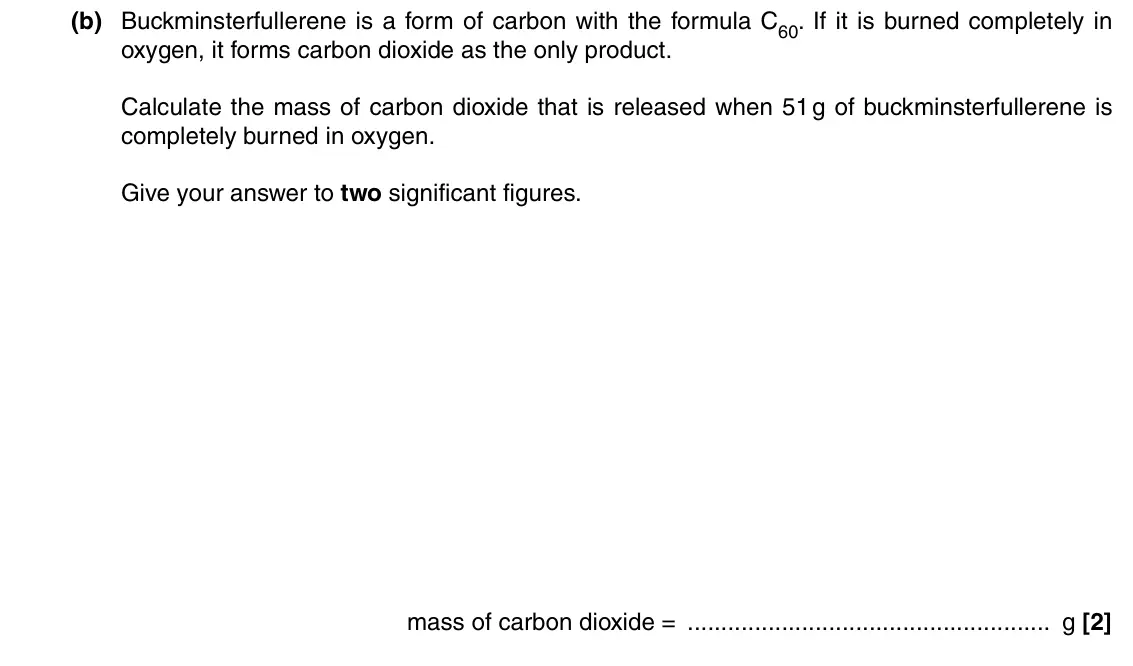
Q1(c)(i)
The whole paper ↗9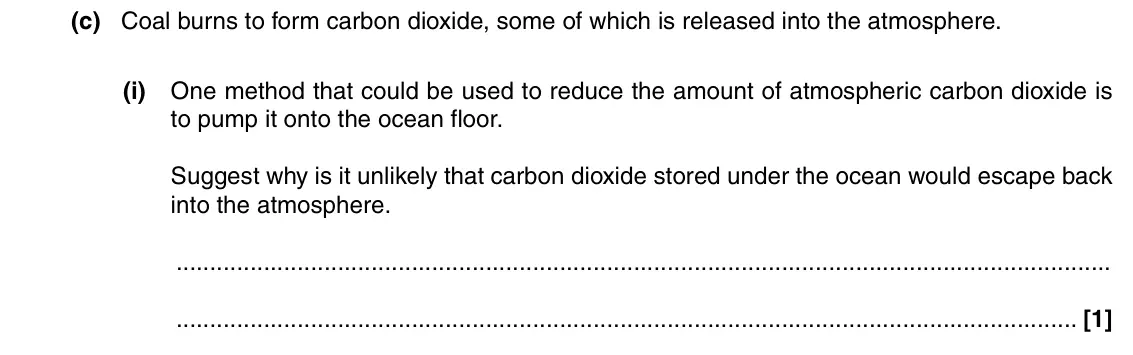
Q1(c)(ii)
The whole paper ↗10
Q1(c)(iii)
The whole paper ↗11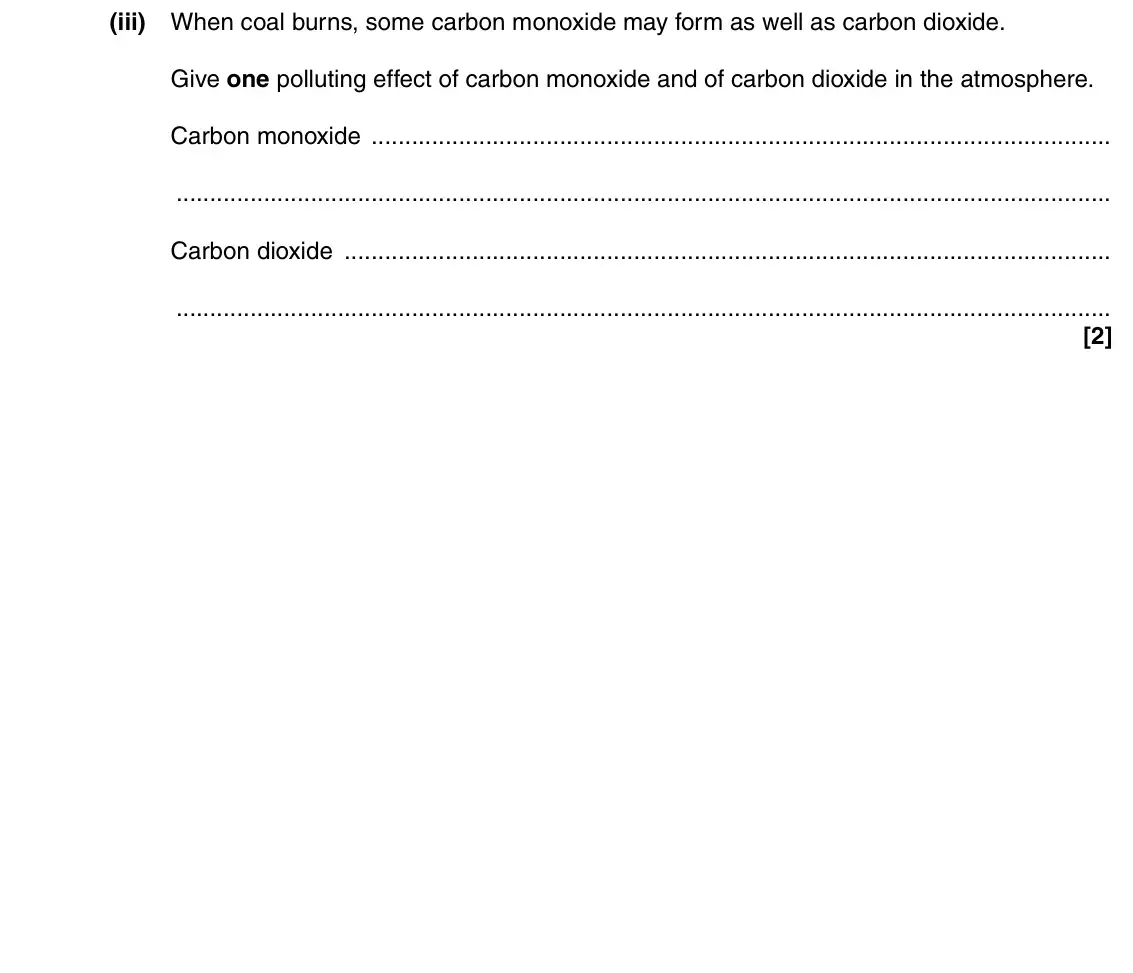
Q1(d)
The whole paper ↗12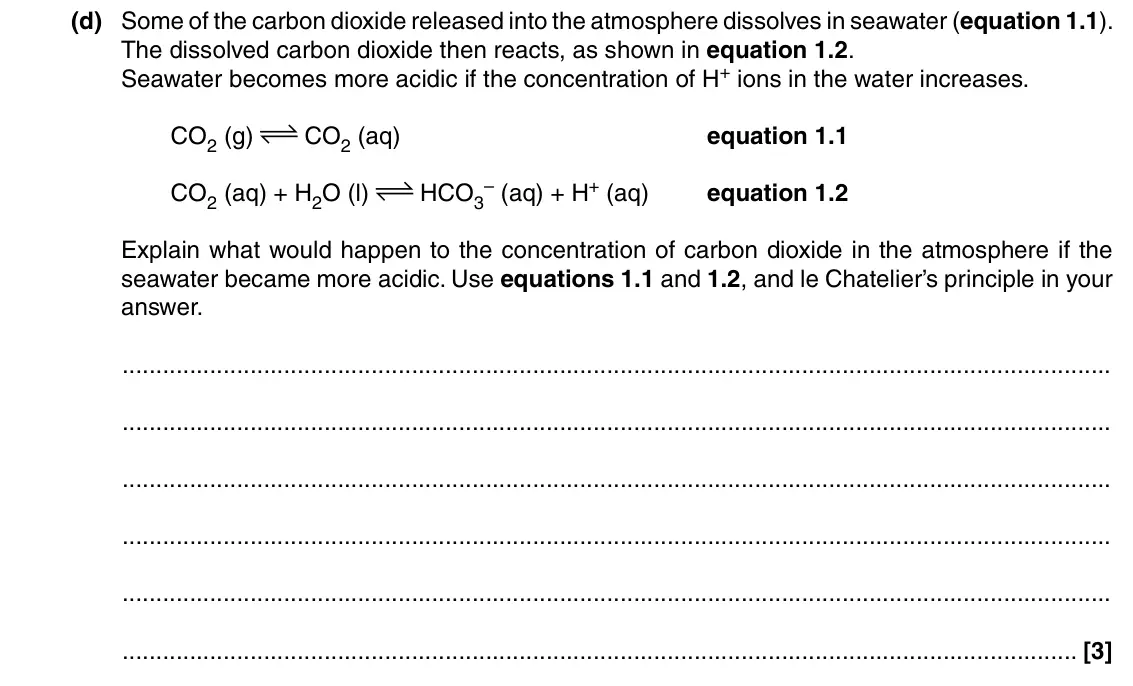
Q1(e)(i)
The whole paper ↗13
Q1(e)(ii)
The whole paper ↗14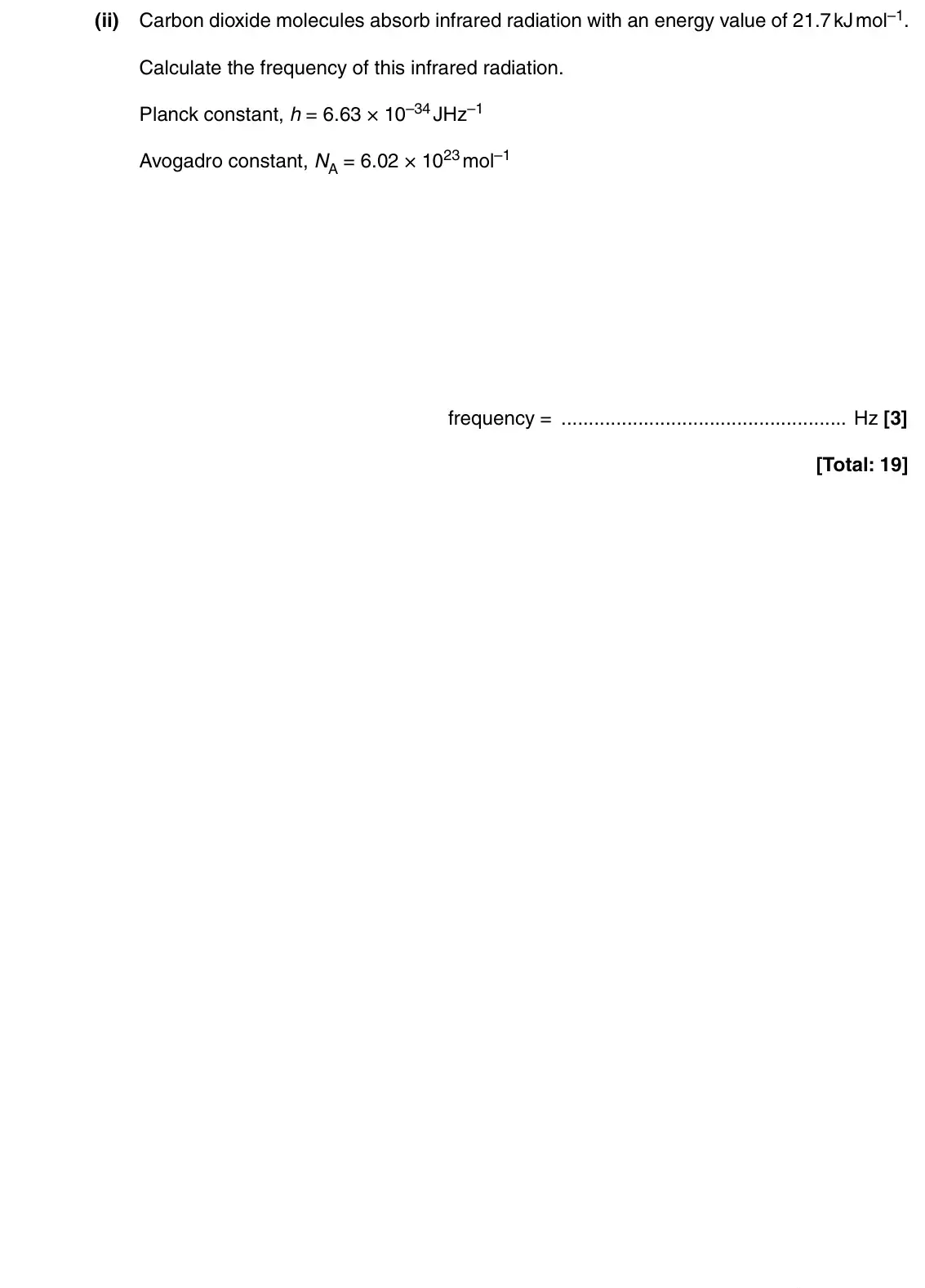
Q2(a)
The whole paper ↗15
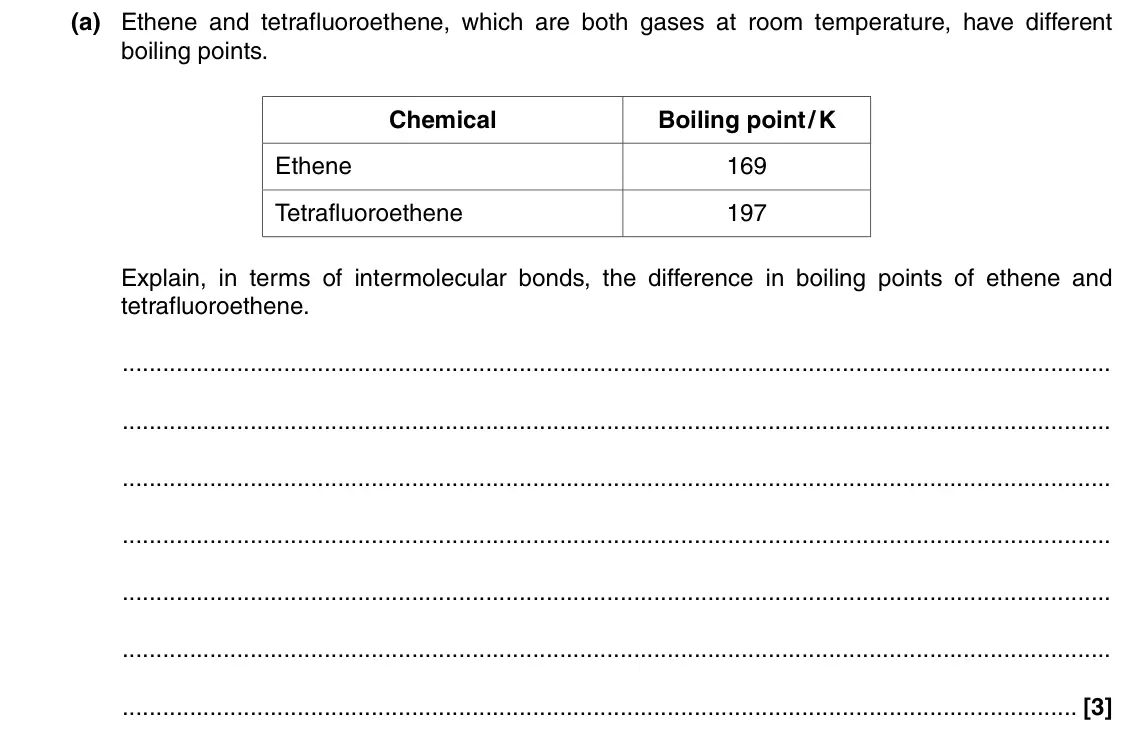
Q2(b)
The whole paper ↗16
Q2(c)
The whole paper ↗17
Q2(d)
The whole paper ↗18
Q2(e)(i)
The whole paper ↗19
Q2(e)(ii)
The whole paper ↗20
All 326 questions on Legacy F332: Chemistry of Natural Resources, as a list
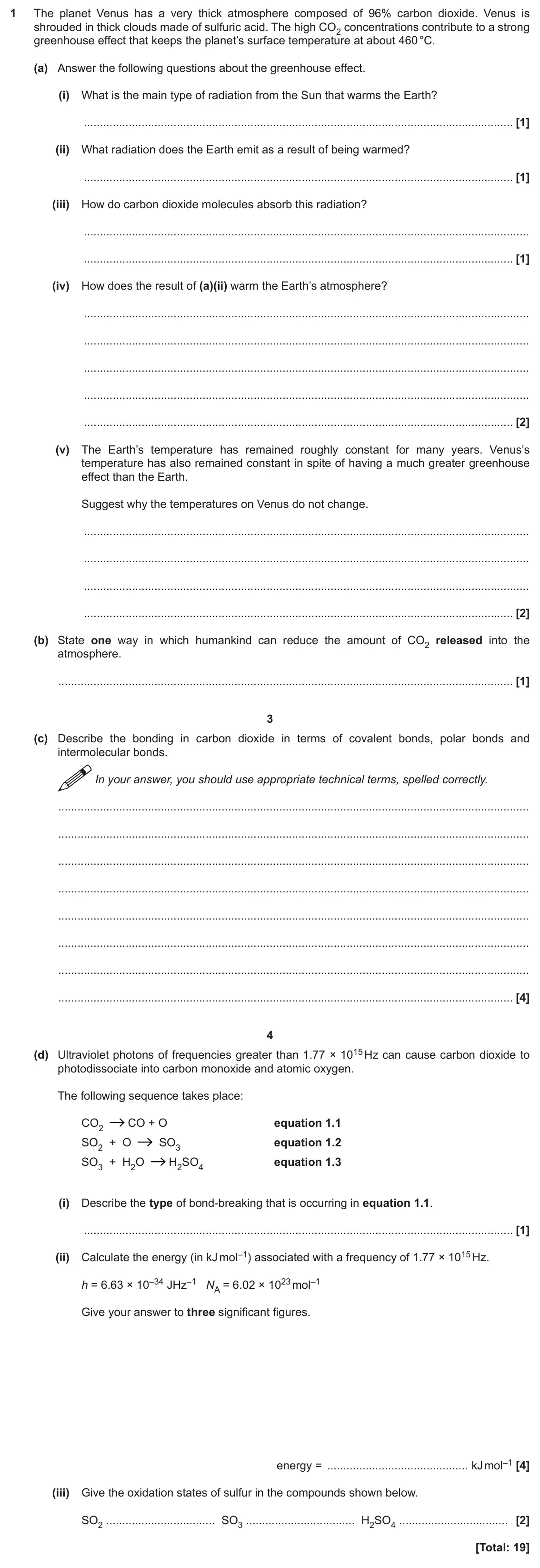
- June 2017, Legacy F332, Q1 (19 marks): 1 The planet Venus has a very thick atmosphere composed of 96% carbon dioxide. Venus is shrouded in thick clouds made of sulfuric acid. The high CO2 concentrati
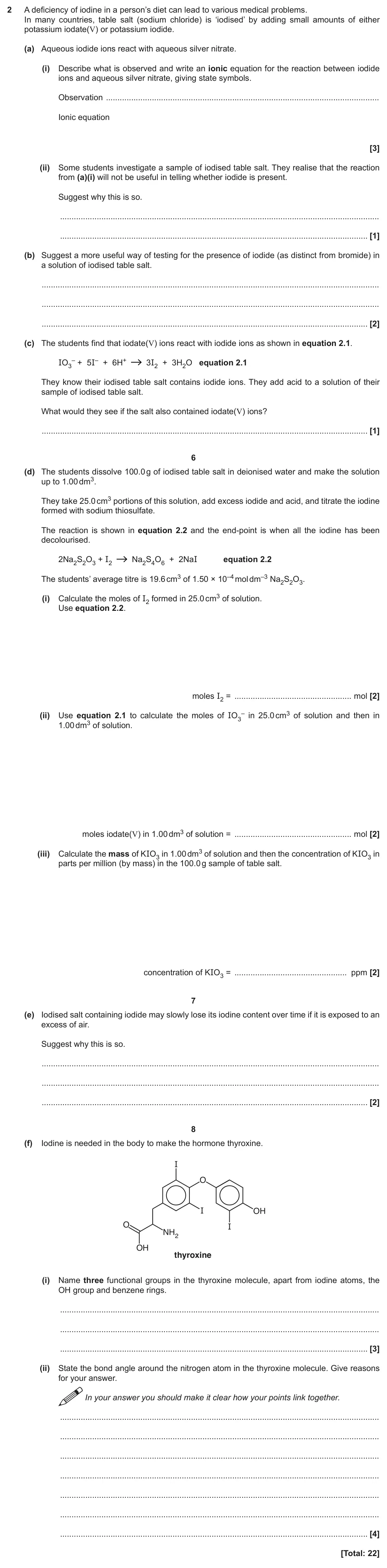
- June 2017, Legacy F332, Q2 (22 marks): 2 A deficiency of iodine in a person’s diet can lead to various medical problems. In many countries, table salt (sodium chloride) is ‘iodised’ by adding small a
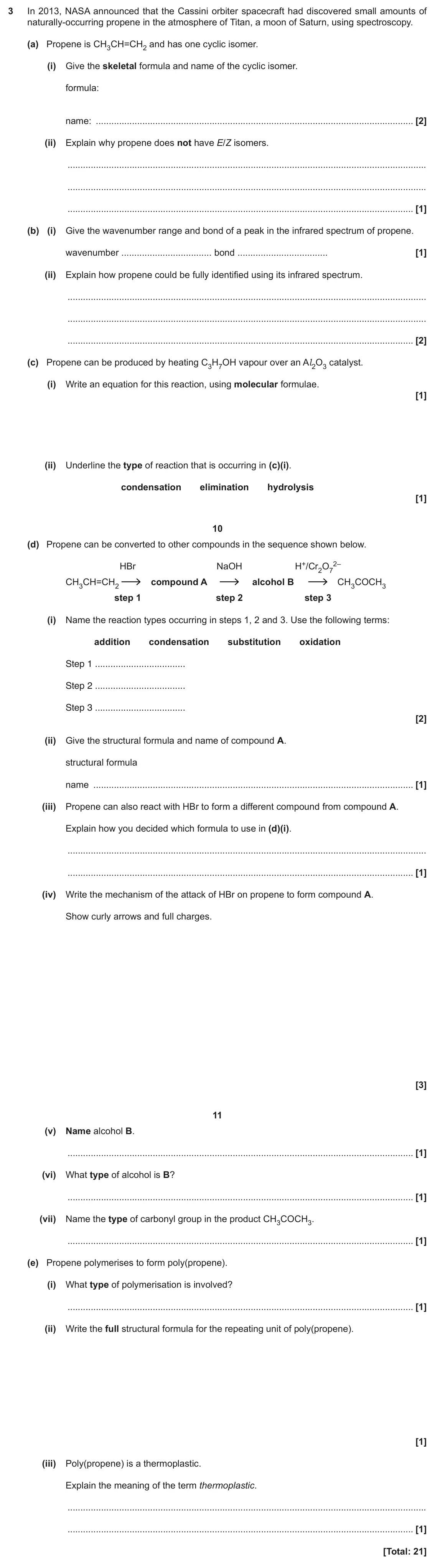
- June 2017, Legacy F332, Q3 (21 marks): 3 In 2013, NASA announced that the Cassini orbiter spacecraft had discovered small amounts of naturally-occurring propene in the atmosphere of Titan, a moon of
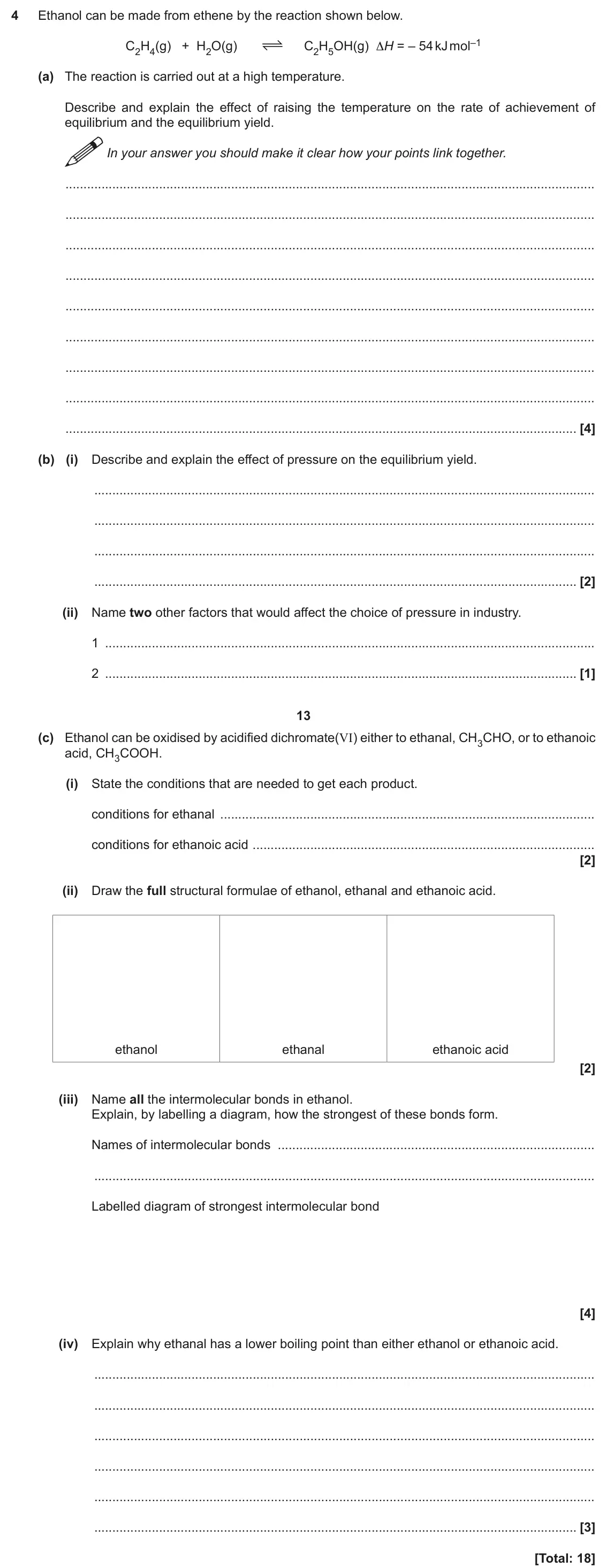
- June 2017, Legacy F332, Q4 (18 marks): 4 Ethanol can be made from ethene by the reaction shown below. C2H5OH(g) ∆H = – 54 kJ mol–1 C2H4(g) + H2O(g) (a) The reaction is carried out at a high temperatu
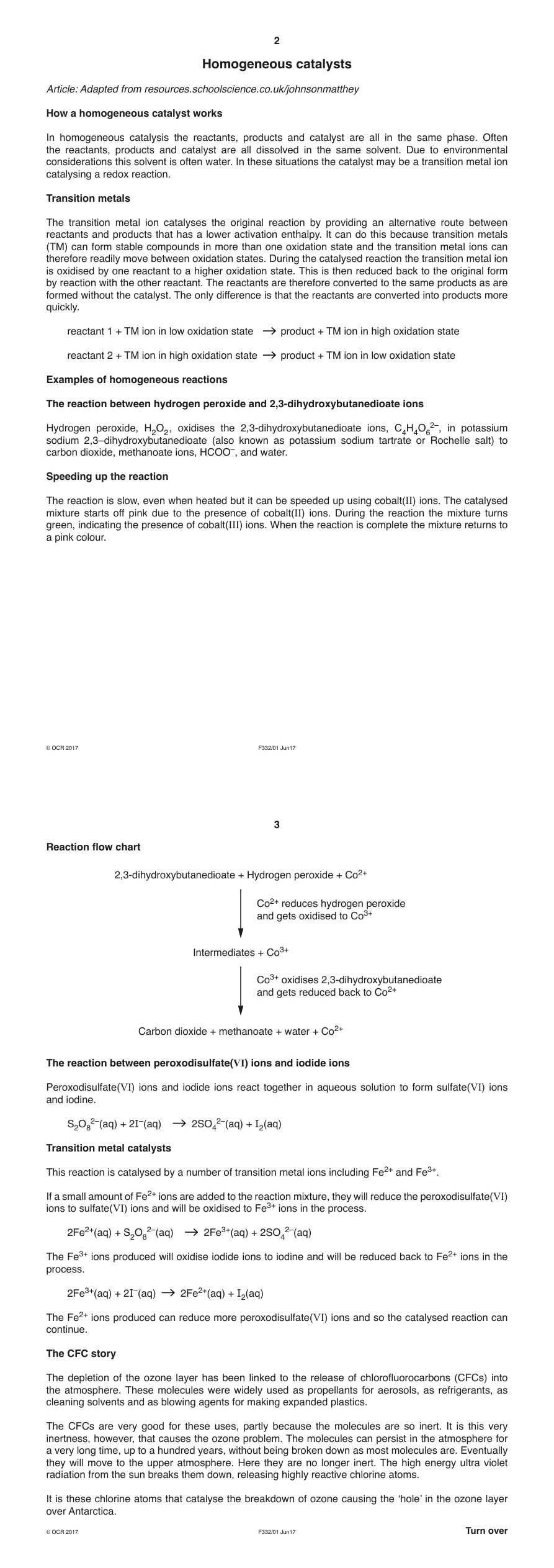
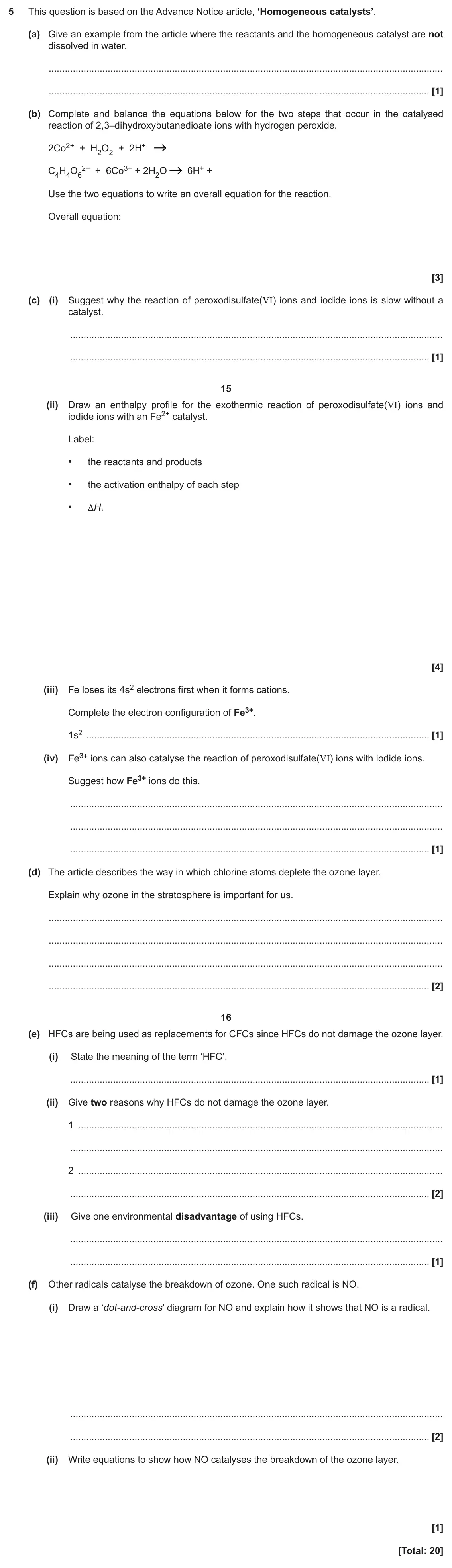
- June 2017, Legacy F332, Q5 (20 marks): 5 This question is based on the Advance Notice article, ‘Homogeneous catalysts’. (a) Give an example from the article where the reactants and the homogeneous ca
- June 2016, Legacy F332, Q1(a)(i) (2 marks): Describe two features of the structure and bonding in diamond that are similar to graphite. [2]
- June 2016, Legacy F332, Q1(a)(ii) (2 marks): Describe two features of the structure and bonding in diamond that are different from graphite. [2]
- June 2016, Legacy F332, Q1(b) (2 marks): Buckminsterfullerene is a form of carbon with the formula C60. If it is burned completely in oxygen, it forms carbon dioxide as the only product. Calculate the
- June 2016, Legacy F332, Q1(c)(i) (1 mark): One method that could be used to reduce the amount of atmospheric carbon dioxide is to pump it onto the ocean floor. Suggest why is it unlikely that carbon diox
- June 2016, Legacy F332, Q1(c)(ii) (2 marks): Give two ways, other than the one described in part (i), that can be used to remove carbon dioxide from the atmosphere. [2]
- June 2016, Legacy F332, Q1(c)(iii) (2 marks): When coal burns, some carbon monoxide may form as well as carbon dioxide. Give one polluting effect of carbon monoxide and of carbon dioxide in the atmosphere.
- June 2016, Legacy F332, Q1(d) (3 marks): Some of the carbon dioxide released into the atmosphere dissolves in seawater (equation 1.1). The dissolved carbon dioxide then reacts, as shown in equation 1.2
- June 2016, Legacy F332, Q1(e)(i) (2 marks): Explain how the interaction of infrared radiation with carbon dioxide molecules enables the identification of carbon dioxide. [2]
- June 2016, Legacy F332, Q1(e)(ii) (3 marks): Carbon dioxide molecules absorb infrared radiation with an energy value of 21.7 kJ mol–1. Calculate the frequency of this infrared radiation. Planck constant, h
- June 2016, Legacy F332, Q2(a) (3 marks): Ethene and tetrafluoroethene, which are both gases at room temperature, have different boiling points. Chemical Boiling point / K Ethene 169 Tetrafluoroethene 1
- June 2016, Legacy F332, Q2(b) (1 mark): Draw a section of the ETFE chain that includes one unit from ethene and two units from tetrafluoroethene. [1]
- June 2016, Legacy F332, Q2(c) (1 mark): Give the name that is used to describe a polymer formed from two different monomers. [1]
- June 2016, Legacy F332, Q2(d) (1 mark): One property of ETFE is that it is insoluble in water. This makes ETFE a suitable material for the domes at the Eden project. Explain, using ideas of intermolec
- June 2016, Legacy F332, Q2(e)(i) (1 mark): Give the name of the type of intermediate, such as intermediate A, that forms in this reaction. [1]
- June 2016, Legacy F332, Q2(e)(ii) (2 marks): The reaction in step 1 involves attack by an electrophile. Explain what is meant by the term electrophile. [2]
- June 2016, Legacy F332, Q2(e)(iii) (3 marks): A scientist reacts ethene with bromine in a solution that also contains sodium chloride. Two of the products that form are CH2BrCH2Br and CH2Cl CH2Br. Use Mecha
- June 2016, Legacy F332, Q2(f)(i) (2 marks): Reaction A can be carried out by two different nucleophiles. Name the two different nucleophiles that could be used for reaction A. [2]
- June 2016, Legacy F332, Q2(f)(ii) (1 mark): Give the full structural formula of compound B. [1]
- June 2016, Legacy F332, Q2(f)(iii) (1 mark): Which homologous series includes compound B? [1]
- June 2016, Legacy F332, Q2(f)(iv) (2 marks): The rate of the reaction of chloromethane with ammonia increases if the temperature is increased. Explain why the rate of a reaction increases if the temperatur
- June 2016, Legacy F332, Q2(g)(i) (2 marks): Use the Data Sheet to give two absorption ranges that are present in the infrared spectrum of ethanol. Complete the table below to show these absorption ranges
- June 2016, Legacy F332, Q2(g)(ii) (2 marks): Name the region of an infrared spectrum below 1500 cm–1 and explain the significance of this region. [2]
- June 2016, Legacy F332, Q2(h) (2 marks): Ethanol can be oxidised using acidified potassium dichromate(VI) solution. Two different organic products are formed depending on the oxidation conditions. Comp
- June 2016, Legacy F332, Q3(a) (1 mark): Chloride ions form when a chlorine atom gains one electron. Complete the diagram below, using arrows to indicate the arrangement of electrons in atomic orbitals
- June 2016, Legacy F332, Q3(b) (1 mark): Suggest a completion of the equation below for the overall reaction when sodium chloride solution is electrolysed. 2 NaCl + H2O [1]
- June 2016, Legacy F332, Q3(c)(i) (1 mark): Suggest a reason for removing the Mg2+ and Ca2+ ions from the solution before electrolysis. [1]
- June 2016, Legacy F332, Q3(c)(ii) (2 marks): Write an equation representing the second ionisation enthalpy of magnesium. Include state symbols. [2]
- June 2016, Legacy F332, Q3(c)(iii) (2 marks): The second ionisation enthalpy for magnesium is greater than that for calcium. Explain why. In your answer, you should use appropriate technical terms, spelled
- June 2016, Legacy F332, Q3(d)(i) (3 marks): Draw a diagram to show how one hydrogen chloride molecule attacks a molecule of methanol. Add ‘curly arrows’ to show the attack and the resulting electron pair
- June 2016, Legacy F332, Q3(d)(ii) (2 marks): Underline the two words that describe the mechanism of the reaction between hydrogen chloride and methanol. addition electrophilic elimination nucleophilic radi
- June 2016, Legacy F332, Q3(e)(i) (1 mark): Name a suitable piece of equipment for the student to use to add the barium hydroxide solution to the hydrochloric acid. [1]
- June 2016, Legacy F332, Q3(e)(ii) (1 mark): Write the equation for the reaction of barium hydroxide with hydrochloric acid. [1]
- June 2016, Legacy F332, Q3(e)(iii) (3 marks): The titration requires 19.6 cm3 of a 0.100 mol dm–3 solution of barium hydroxide. Calculate the concentration of H+ ions in the hydrochloric acid in mol dm–3. c
- June 2016, Legacy F332, Q4(a) (1 mark): Name a solid that could be used to dry the air. [1]
- June 2016, Legacy F332, Q4(b)(i) (1 mark): Give a natural source of NO in the atmosphere. [1]
- June 2016, Legacy F332, Q4(b)(ii) (1 mark): Give a human activity that could result in the production of nitrogen oxides in the atmosphere. [1]
- June 2016, Legacy F332, Q4(b)(iii) (1 mark): Give the systematic name for N2O. [1]
- June 2016, Legacy F332, Q4(c) (2 marks): A molecule of N2O has a central N atom forming a dative covalent bond. Draw a ‘dot-and-cross’ diagram to represent the bonding in N2O. [2]
- June 2016, Legacy F332, Q4(d) (2 marks): How much more abundant is N2 than N2O in this sample of air? answer = times more abundant [2]
- June 2016, Legacy F332, Q4(e) (3 marks): CH3CH=CHCH3 exists as two stereoisomers. Draw structures of the two stereoisomers and give their systematic names. Structure Name [3]
- June 2016, Legacy F332, Q4(f) (1 mark): The pie chart below shows the major components of tropospheric air and their percentage by volume. B 1% A 21% Nitrogen, N2 78% Complete the table to show the na
- June 2016, Legacy F332, Q4(g)(i) (1 mark): In the 1980s, scientists found there were abnormally low concentrations of ozone above the Antarctic. The scientists concluded that ozone depletion was occurrin
- June 2016, Legacy F332, Q4(g)(ii) (1 mark): Ozone depletion is catalysed by gaseous chlorine atoms in the atmosphere. What type of catalysis is this? [1]
- June 2016, Legacy F332, Q4(h) (6 marks): Earth’s atmosphere also contains water vapour. This water vapour often condenses into liquid water or forms ice particles. The density of ice is less than the d
- June 2016, Legacy F332, Q5(a) (1 mark): Ozone that is present in the atmosphere can cause environmental problems. Name one example from the article of an environmental problem to which ozone contribut
- June 2016, Legacy F332, Q5(b)(i) (2 marks): Give two sources of alkenes in the atmosphere that are mentioned in the article. [2]
- June 2016, Legacy F332, Q5(b)(ii) (2 marks): Deduce an equation for the reaction of ozone with propene to produce a biradical and another molecule. Use structural formulae for the organic molecules in your
- June 2016, Legacy F332, Q5(c)(i) (1 mark): The initiation reaction is described as being endothermic. Give an example of an exothermic reaction from the sequence of reactions in the article that involve
- June 2016, Legacy F332, Q5(c)(ii) (1 mark): Explain how you know that this reaction must be exothermic, without needing any energy data. [1]
- June 2016, Legacy F332, Q5(c)(iii) (1 mark): Write a propagation reaction for the last step in the production of CCl4 in the mixture. [1]
- June 2016, Legacy F332, Q5(d) (2 marks): The reaction of methane with irradiated chlorine is a process that occurs in the atmosphere and involves radicals. Name two other processes from the article tha
- June 2016, Legacy F332, Q5(e)(i) (1 mark): Explain what a Criegee biradical is. [1]
- June 2016, Legacy F332, Q5(e)(ii) (2 marks): Criegee biradicals can be generated in a laboratory. A first step involves breaking bonds in halogenoalkanes. The frequency of radiation needed to break the bon
- June 2016, Legacy F332, Q5(f) (7 marks): Describe how Criegee biradicals form in the atmosphere and how and why they have only recently been detected. Include the formula of one Criegee biradical given
- June 2015, Legacy F332, Q1(a) (1 mark): People dealing with a leak during this process would need to wear protective equipment. State one piece of protective equipment that would be worn and state why
- June 2015, Legacy F332, Q1(b) (2 marks): The process represented by equation 1.1 can reach a position of dynamic equilibrium. Explain, in terms of reaction rates and concentrations, what is meant by th
- June 2015, Legacy F332, Q1(c) (2 marks): The maximum equilibrium yield of methanol would be obtained by using high pressures and low temperatures. What information given in equation 1.1 suggests that t
- June 2015, Legacy F332, Q1(d) (2 marks): Suggest why the industrial process might not use high pressures and low temperatures. [2]
- June 2015, Legacy F332, Q1(e) (3 marks): A catalyst of copper and zinc oxide is used in this process. Complete the diagram below to show how a catalyst provides an alternative reaction route for an exo
- June 2015, Legacy F332, Q1(f) (1 mark): The catalyst is coated onto an inert alumina support. Why is the catalyst spread as a thin layer on the alumina? [1]
- June 2015, Legacy F332, Q1(g) (3 marks): ΔH = –91 kJ mol–1 CO(g) + 2H2(g) equation 1.1 (g) Name the strongest type of intermolecular bond present between molecules of methanol. Explain how these interm
- June 2015, Legacy F332, Q1(h)(i) (1 mark): Give the wavenumber range of one peak that is present in the infrared spectrum for methanol and identify the bond that produces this peak. [1]
- June 2015, Legacy F332, Q1(h)(ii) (1 mark): Give one use for the fingerprint region in an infrared spectrum. [1] [Total: 16]
- June 2015, Legacy F332, Q2(a) (1 mark): Name the functional group that is circled on the diagram of the carvone molecule. [1]
- June 2015, Legacy F332, Q2(b) (2 marks): Carvone can be produced in a process in which the reaction mixture requires heating under reflux. Describe the process of heating under reflux. [2]
- June 2015, Legacy F332, Q2(c)(i) (2 marks): Write the equation for the reaction of carvone, C10H14O, with excess bromine. C10H14O [2]
- June 2015, Legacy F332, Q2(c)(ii) (4 marks): Ethene reacts with bromine in a similar way to the reaction of carvone with bromine. Draw the mechanism for the reaction of bromine with ethene to form an inter
- June 2015, Legacy F332, Q2(d) (2 marks): Carvone can be converted into compound A. O OH HO compound A Give the reagents and conditions for the reaction to convert carvone into compound A. [2]
- June 2015, Legacy F332, Q2(e) (2 marks): The reaction in (d) can produce other alcohols that have the same molecular formula as compound A but different structural formulae. Draw the structures of two
- June 2015, Legacy F332, Q2(f)(i) (2 marks): Describe and explain what the student would see when compound A is heated with acidified potassium dichromate solution. [2]
- June 2015, Legacy F332, Q2(f)(ii) (2 marks): The student does an elimination reaction on compound A to form carvone. Explain what is meant by the term elimination reaction. [2]
- June 2015, Legacy F332, Q2(f)(iii) (2 marks): After the elimination reaction, the student collects a mixture of unreacted compound A, carvone and a trace of water. Carvone is miscible with compound A. State
- June 2015, Legacy F332, Q3(a)(i) (1 mark): A calcium ion has the same electronic configuration as an argon atom. Write the electronic configuration, in terms of s and p sub-shells, for a calcium ion. [1]
- June 2015, Legacy F332, Q3(a)(ii) (2 marks): The calcium and sulfide ions take part in a precipitation reaction to form calcium sulfide. Write the ionic equation for the precipitation reaction. Include sta
- June 2015, Legacy F332, Q3(a)(iii) (3 marks): Pure calcium sulfide and sodium chloride have a similar lattice structure. The diagram below shows part of a layer of the calcium sulfide lattice. Complete the
- June 2015, Legacy F332, Q3(b)(i) (1 mark): The titration requires 15.70 cm3 of a 0.0250 mol dm–3 solution of sodium hydroxide. Calculate the number of moles of hydroxide ions, OH–, used. moles = [1]
- June 2015, Legacy F332, Q3(b)(ii) (1 mark): Give the number of moles of H+ ions in the 40.0 cm3 sample of seawater. moles = [1]
- June 2015, Legacy F332, Q3(b)(iii) (3 marks): Calculate the concentration of H+ ions in the seawater in mol dm–3. Give your answer to three significant figures. concentration = mol dm–3 [3]
- June 2015, Legacy F332, Q3(c)(i) (1 mark): Write an equation representing the first ionisation enthalpy of lithium. [1]
- June 2015, Legacy F332, Q3(c)(ii) (2 marks): The first ionisation enthalpy of lithium is greater than that of any other Group 1 element. Explain why. In your answer, you should use appropriate technical te
- June 2015, Legacy F332, Q3(d) (2 marks): Scientists analysed a sample of seawater collected near the hydrothermal vent. They found that the sample contained calcium ions at a concentration of 1.70 %. O
- June 2015, Legacy F332, Q3(e) (3 marks): Reactions that occur in seawater happen more quickly near hydrothermal vents. Explain why. [3] [Total: 19]
- June 2015, Legacy F332, Q4(i) (2 marks): Some compounds like CFC-113 have now been replaced by HFCs. Give one advantage and one disadvantage of using HFCs in place of CFCs, other than ozone depletion p
- June 2015, Legacy F332, Q4(a) (2 marks): Give the systematic name for CFC-113. [2]
- June 2015, Legacy F332, Q4(b)(i) (1 mark): Suggest which bond in the fluothane molecule is most likely to break. [1]
- June 2015, Legacy F332, Q4(b)(ii) (1 mark): Name the type of electromagnetic radiation that is emitted from the Sun that causes this bond to break. [1]
- June 2015, Legacy F332, Q4(b)(iii) (4 marks): In a particular part of the Earth’s atmosphere, the available radiation has a maximum frequency of 5.30 × 10¹⁴ Hz. The weakest bond in the fluothane molecule ha
- June 2015, Legacy F332, Q4(c) (3 marks): Both CFC-113 and fluothane could cause ozone depletion in the stratosphere. Cl Cl F F Cl F F Cl F Br F Fluothane CFC-113 Suggest why CFC-113 and fluothane can c
- June 2015, Legacy F332, Q4(d) (2 marks): CHCl3 can be made industrially from a mixture of chlorine and methane. Chlorine and methane are pollutants in the atmosphere. Give one reason why each chemical
- June 2015, Legacy F332, Q4(e) (1 mark): Draw a ‘dot-and-cross’ diagram for a CHCl3 molecule. Show outer electron shells only. [1]
- June 2015, Legacy F332, Q4(f) (2 marks): Draw a diagram of the shape of a CHCl3 molecule. Give a value for the bond angle. [2]
- June 2015, Legacy F332, Q4(g) (5 marks): CHCl3 is described as a ‘greenhouse gas’. Explain how CHCl3 molecules are involved in the processes of energy transfer that start with UV radiation from the Sun
- June 2015, Legacy F332, Q4(h)(i) (2 marks): Describe two different methods that scientists have used to find evidence for this relationship. [2]
- June 2015, Legacy F332, Q4(h)(ii) (1 mark): Describe the relationship that scientists have worked out from this evidence. [1]
- June 2015, Legacy F332, Q5(a)(i) (1 mark): Draw the full structural formula for a molecule of propanone. [1]
- June 2015, Legacy F332, Q5(a)(ii) (1 mark): Name the functional group in a molecule of propanone. [1]
- June 2015, Legacy F332, Q5(b) (1 mark): Using the information in Fig. 1, name the mechanism of the first step of the reaction that produces ethane-1,2-diol from epoxyethane. [1]
- June 2015, Legacy F332, Q5(c)(i) (1 mark): Name the type of organic ion that is produced from 2-methylpropene in Fig. 2. [1]
- June 2015, Legacy F332, Q5(c)(ii) (1 mark): Give the atom economy for the overall reaction sequence shown in Fig. 2. [1]
- June 2015, Legacy F332, Q5(d) (2 marks): The article describes the hydrogenation of 2,4,4-trimethylpent-2-ene using nickel as a catalyst. Give the conditions that are required for this reaction and nam
- June 2015, Legacy F332, Q5(e) (3 marks): The article describes two different methods for the production of 2,2,4-trimethylpentane from 2-methylpropene. Give three differences between the two methods. [
- June 2015, Legacy F332, Q5(f) (1 mark): Some polymers are shown in Table 2. Name the polymer that has a chain containing an arene group. [1]
- June 2015, Legacy F332, Q5(g)(i) (1 mark): Describe how radicals form from a molecule. [1]
- June 2015, Legacy F332, Q5(g)(ii) (1 mark): Write an equation for a propagation reaction in the formation of poly(propene). [1]
- June 2015, Legacy F332, Q5(h) (7 marks): Both the atactic and isotactic forms of poly(propene) have the same type of intermolecular bond, but they have different physical properties. Explain why these
- June 2014, Legacy F332, Q1(a) (2 marks): Complete the table below to show the oxidation states for manganese and iodine in the reaction shown in equation 1.1. Element Initial oxidation state Final oxid
- June 2014, Legacy F332, Q1(b) (1 mark): Write the half-equation for the conversion of iodide ions to iodine. [1]
- June 2014, Legacy F332, Q1(c) (2 marks): Name the reducing agent in the reaction in equation 1.1. Explain your answer in terms of oxidation states. [2]
- June 2014, Legacy F332, Q1(d) (1 mark): Describe the appearance and physical state of iodine at room temperature. [1]
- June 2014, Legacy F332, Q1(e) (1 mark): Give one use for compounds of the iodine that is produced. [1]
- June 2014, Legacy F332, Q1(f)(i) (1 mark): What reagent would the student need to add to the water? [1]
- June 2014, Legacy F332, Q1(f)(ii) (2 marks): Give the result of the test for chloride ions and name the compound formed. [2]
- June 2014, Legacy F332, Q1(f)(iii) (2 marks): Suggest why the student might not get the expected test result. [2]
- June 2014, Legacy F332, Q1(g)(i) (1 mark): Write the electron configuration for a chlorine atom in terms of s and p sub-shells. [1]
- June 2014, Legacy F332, Q1(g)(ii) (1 mark): Write the electron configuration for the highest energy sub-shell for an iodine atom. [1]
- June 2014, Legacy F332, Q1(g)(iii) (1 mark): Chlorine is more readily reduced than iodine. Explain what is meant by reduction in terms of electrons. [1]
- June 2014, Legacy F332, Q1(h)(i) (1 mark): The titration required 28.40 cm3 of 0.200 mol dm–3 sodium thiosulfate solution. 2–, used. Calculate the number of moles of thiosulfate ions, S2O3 moles thiosulf
- June 2014, Legacy F332, Q1(h)(ii) (1 mark): Give the number of moles of iodine, I 2, in the iodine solution. moles iodine = mol [1]
- June 2014, Legacy F332, Q1(h)(iii) (2 marks): Calculate the percentage purity of the iodine. purity of iodine = % [2] [Total: 19]
- June 2014, Legacy F332, Q2(a)(i) (1 mark): Name the alcohol from which propanone can be made. [1]
- June 2014, Legacy F332, Q2(a)(ii) (1 mark): A student carries out the oxidation of ethanol, which can form two different oxidation products. The infrared spectrum of the compound the student obtained is g
- June 2014, Legacy F332, Q2(a)(iii) (2 marks): Explain how the spectrum in (ii) shows that no ethanol remains. [2]
- June 2014, Legacy F332, Q2(b) (3 marks): Ethanol can be made from ethene in an industrial process. Give the reagents and conditions required for this reaction. [3]
- June 2014, Legacy F332, Q2(c) (7 marks): Propanone dissolves in ethanol and methylbenzene dissolves in hexane. Name the strongest type of intermolecular bond formed between: • propanone and ethanol • m
- June 2014, Legacy F332, Q2(d)(i) (2 marks): The reaction in equation 2.1 is allowed to reach dynamic equilibrium. Explain what is meant by the term dynamic equilibrium. [2]
- June 2014, Legacy F332, Q2(d)(ii) (2 marks): Some ethanoic acid is added to the equilibrium mixture. The mixture is allowed to reach equilibrium again. Describe the effect on the amount of ethyl ethanoate
- June 2014, Legacy F332, Q3(a)(i) (1 mark): Give the systematic name for CF3Cl. [1]
- June 2014, Legacy F332, Q3(a)(ii) (2 marks): Draw a 3D diagram to show the shape of a CF3Cl molecule. Include the bond angle. [2]
- June 2014, Legacy F332, Q3(a)(iii) (1 mark): The molecules of CF3Cl, contain polar bonds. Mark all the partial charges on the atoms in the diagram of the CF3Cl molecule shown below. F Cl F C F [1]
- June 2014, Legacy F332, Q3(a)(iv) (2 marks): Explain why the molecule CF3Cl has the partial charges you have shown in (iii). In your answer, you should use appropriate technical terms, spelled correctly. [
- June 2014, Legacy F332, Q3(a)(v) (2 marks): Explain whether or not the molecule of CF3Cl is polar. [2]
- June 2014, Legacy F332, Q3(b) (1 mark): When a different halogenoalkane, CBrCl F2, is exposed to high temperatures in a fire, one of the bonds in the molecule breaks. Suggest which bond is most likely
- June 2014, Legacy F332, Q3(c)(i) (2 marks): Name the type of bond breaking that occurs. Explain what happens during this process. [2]
- June 2014, Legacy F332, Q3(c)(ii) (2 marks): The minimum frequency of radiation needed to break one C–Br bond is 7.14 × 10¹⁴ Hz. Calculate the minimum energy, in J, required to break one C–Br bond. Planck
- June 2014, Legacy F332, Q3(c)(iii) (3 marks): Calculate the bond enthalpy of the C–Br bond, in kJ mol–1. Give your answer to three significant figures. Avogadro constant, NA = 6.02 × 10²³ mol–1 bond enthalp
- June 2014, Legacy F332, Q3(d) (3 marks): The production of CBrCl F2 has been banned in most countries since 1994 because it contributes to ozone depletion. Describe the theoretical work and research th
- June 2014, Legacy F332, Q3(e)(i) (2 marks): Explain how an increase in the concentration of a greenhouse gas leads to an enhanced greenhouse effect. [2]
- June 2014, Legacy F332, Q3(e)(ii) (1 mark): Describe the evidence for the relationship between the increased concentration of greenhouse gases and global warming. [1] [Total: 22]
- June 2014, Legacy F332, Q4(a) (1 mark): The increased use of cars in the twentieth century is one reason for the increase in carbon monoxide emissions. Explain the origin of these carbon monoxide emis
- June 2014, Legacy F332, Q4(b) (2 marks): Give two reasons why carbon monoxide is classed as a polluting gas. [2]
- June 2014, Legacy F332, Q4(c)(i) (1 mark): Explain what is meant by the term radical. [1]
- June 2014, Legacy F332, Q4(c)(ii) (2 marks): Classify the reaction represented by equation 4.1 as initiation, propagation or termination. Explain your choice. [2] 12 CO + OH CO2 + H equation 4.1
- June 2014, Legacy F332, Q4(c)(iii) (1 mark): Suggest why OH radicals are not produced in the troposphere by the action of sunlight on water molecules. [1]
- June 2014, Legacy F332, Q4(c)(iv) (1 mark): The reaction represented by equation 4.1 has a low activation enthalpy. Suggest why the reaction represented by equation 4.1 still occurs slowly in the atmosphe
- June 2014, Legacy F332, Q4(d) (3 marks): The reaction represented by equation 4.1 produces carbon dioxide, which is a gas at room temperature. Silicon dioxide, another Group 4 oxide, is a solid at room
- June 2014, Legacy F332, Q4(e)(i) (1 mark): Calculate the percentage increase in carbon dioxide in the air between 1900 and the present day. Take the present day value to be 380 ppm. increase in carbon di
- June 2014, Legacy F332, Q4(e)(ii) (2 marks): A sample of air is analysed and found to contain 1.20 × 10⁻⁵% carbon monoxide by volume. How much more abundant is carbon dioxide than carbon monoxide in this s
- June 2014, Legacy F332, Q4(f)(i) (2 marks): Give one problem caused by tropospheric ozone and one benefit to humans of stratospheric ozone. problem caused by tropospheric ozone benefit of stratospheric oz
- June 2014, Legacy F332, Q4(f)(ii) (2 marks): Describe one natural process that causes ozone to be broken down in the stratosphere. [2]
- June 2014, Legacy F332, Q4(f)(iii) (3 marks): Describe one natural process that causes ozone to be formed from O2 in the stratosphere. [3] [Total: 21]
- June 2014, Legacy F332, Q5(a) (1 mark): During wine production, ethanol forms from sugars in grape juice. If the wine is left open to the air, the ethanol reacts with oxygen and the taste of the wine
- June 2014, Legacy F332, Q5(b)(i) (2 marks): Give the molecular formula of oct-1-en-3-one. [2]
- June 2014, Legacy F332, Q5(b)(ii) (2 marks): Name the two functional groups in oct-1-en-3-one. [2]
- June 2014, Legacy F332, Q5(b)(iii) (1 mark): Draw a circle around the term from the list below which describes the type of reaction that occurs when oct-1-en-3-ol is converted to oct-1-en-3-one. addition d
- June 2014, Legacy F332, Q5(b)(iv) (1 mark): Name a functional group, other than arene, that is in molecules of both 2,4,6-trichloroanisole and 2-methoxyphenol. [1]
- June 2014, Legacy F332, Q5(c)(i) (2 marks): Retinol can exhibit E/Z isomerism. One part of the molecule responsible for this isomerism is the structure around the C=C nearest to the OH group. One isomer i
- June 2014, Legacy F332, Q5(c)(ii) (1 mark): Retinol reacts with bromine at room temperature and pressure. Describe the colour change when retinol reacts with liquid bromine. [1]
- June 2014, Legacy F332, Q5(c)(iii) (2 marks): Write the equation for the reaction of retinol with excess bromine. Represent retinol by its molecular formula, C20H30O. [2]
- June 2014, Legacy F332, Q5(c)(iv) (2 marks): Fig. 1 in the article shows some of the compounds found in grape juice. Give two compounds in Fig. 1 that contain a primary alcohol group. [2]
- June 2014, Legacy F332, Q5(d) (6 marks): During the manufacture of wines, chemical processes often take place that improve their flavour. The article refers to two such processes. Describe, for each pr
- June 2013, Legacy F332, Q1(a)(i) (1 mark): Name a functional group that is present in all three of these compounds. [1]
- June 2013, Legacy F332, Q1(a)(ii) (1 mark): Name a functional group that is present in eugenol but not in linalool (not the arene ring or the hydroxyl group). [1]
- June 2013, Legacy F332, Q1(b)(i) (2 marks): Draw the structure of the molecule that is produced from the reaction of a molecule of limonene with excess bromine. [2]
- June 2013, Legacy F332, Q1(b)(ii) (2 marks): Underline two words that describe the mechanism of the reaction between limonene and bromine. addition electrophilic nucleophilic radical substitution [2]
- June 2013, Legacy F332, Q1(b)(iii) (1 mark): The impure liquid organic product of the reaction of limonene with bromine is dried after it has been prepared. Name a drying agent that could be used. [1]
- June 2013, Legacy F332, Q1(b)(iv) (1 mark): Name the process that would be used to purify the liquid product. [1]
- June 2013, Legacy F332, Q1(c) (2 marks): Limonene reacts with hydrogen. Give the reagents and conditions for the reaction of limonene with hydrogen. [2]
- June 2013, Legacy F332, Q1(d)(i) (1 mark): Classify the alcohol group in linalool as primary, secondary or tertiary. [1]
- June 2013, Legacy F332, Q1(d)(ii) (1 mark): Explain your answer to (d)(i). [1]
- June 2013, Legacy F332, Q1(d)(iii) (2 marks): Linalool is heated with acidified potassium dichromate solution. Describe and explain what you would see. [2]
- June 2013, Legacy F332, Q1(e)(i) (2 marks): Give the molecular formula of Z-ocimene. [2]
- June 2013, Legacy F332, Q1(e)(ii) (1 mark): The reaction producing Z-ocimene from linalool has an inorganic product. Identify this product. [1]
- June 2013, Legacy F332, Q1(e)(iii) (1 mark): Underline the term below that describes the type of reaction that has occurred when Z-ocimene is produced from linalool. addition hydrolysis elimination substit
- June 2013, Legacy F332, Q1(e)(iv) (1 mark): During the reaction that forms Z-ocimene from linalool, E-ocimene is also produced. Draw a skeletal formula for a molecule of E-ocimene. [1]
- June 2013, Legacy F332, Q1(f) (2 marks): Z-Ocimene reacts with hydrogen. One of the partially hydrogenated products of this reaction is shown below. Give the systematic name of this compound. [2] [Tota
- June 2013, Legacy F332, Q2(a) (1 mark): What does CFC stand for? [1]
- June 2013, Legacy F332, Q2(b) (1 mark): Give another large scale use for CFCs during the last century, other than as refrigerants. [1]
- June 2013, Legacy F332, Q2(c)(i) (2 marks): The reaction requires the use of a catalyst. Explain how a catalyst increases the rate of a chemical reaction. [2]
- June 2013, Legacy F332, Q2(c)(ii) (3 marks): Add relevant partial charges and ‘curly arrows’ to the diagram to show the attack of one hydrogen fluoride molecule on tetrachloromethane and the resulting elec
- June 2013, Legacy F332, Q2(d)(i) (1 mark): Name the type of bond breaking process that occurs to form chlorine radicals from CFC molecules. [1]
- June 2013, Legacy F332, Q2(d)(ii) (2 marks): The bond enthalpy of the C–F bond is +467 kJ mol–1. Calculate the minimum energy (in Joules) needed to break a single C–F bond. Avogadro constant, NA = 6.02 × 1
- June 2013, Legacy F332, Q2(d)(iii) (3 marks): Calculate the frequency of radiation that is needed to break a single C–F bond. Give your answer to three significant figures. Planck constant, h = 6.63 × 10⁻³⁴
- June 2013, Legacy F332, Q2(d)(iv) (2 marks): Explain why C–F bonds are much less likely than C–Cl bonds to be broken in the stratosphere. [2]
- June 2013, Legacy F332, Q2(d)(v) (1 mark): In the 1980s, scientists researching the levels of ozone in the atmosphere discarded some of the data because they thought it was incorrect. Explain why they th
- June 2013, Legacy F332, Q2(e) (2 marks): Give the systematic name for HFC 143a. [2]
- June 2013, Legacy F332, Q2(f) (5 marks): HFC 143a is also a powerful greenhouse gas. Explain how the ‘greenhouse effect’ enables energy from the Sun to be transferred to heat energy that warms the Eart
- June 2013, Legacy F332, Q2(g) (1 mark): Give the evidence for the relationship between the increased concentration of greenhouse gases in the atmosphere and global warming. [1] [Total: 24]
- June 2013, Legacy F332, Q3(a) (2 marks): Suggest two reasons why the new ODC cell is being classed as green technology when compared to the other types of cell. [2]
- June 2013, Legacy F332, Q3(b)(i) (2 marks): Write the half-equation for the production of chlorine at this electrode in any of these cells. [2]
- June 2013, Legacy F332, Q3(b)(ii) (1 mark): Write the electronic configuration, in terms of s and p sub-shells, for a chlorine atom. [1]
- June 2013, Legacy F332, Q3(b)(iii) (2 marks): Give two large scale uses for the chlorine that is formed. [2]
- June 2013, Legacy F332, Q3(b)(iv) (2 marks): If an accident occurred causing a release of chlorine, people dealing with the incident would wear breathing apparatus. Explain why this would be necessary. [2]
- June 2013, Legacy F332, Q3(c) (1 mark): Equations 3.1 and 3.2 show the processes that occur in an ODC cell at one electrode. O2 + 4e– 2O2– equation 3.1 2O2– + 2H2O 4OH– equation 3.2 Write the overall
- June 2013, Legacy F332, Q3(d)(i) (3 marks): Calculate the volume of chlorine gas (in dm3) that would be produced from 200 kg of dissolved sodium chloride. Assume that 1 mole of gas occupies 24 dm3 under t
- June 2013, Legacy F332, Q3(d)(ii) (1 mark): Give the atom economy for the reaction shown in equation 3.3. [1]
- June 2013, Legacy F332, Q3(e)(i) (2 marks): In the reaction between sodium and chlorine, each sodium atom forms a sodium ion. Write an equation representing the first ionisation enthalpy of sodium. Includ
- June 2013, Legacy F332, Q3(e)(ii) (3 marks): The diagram below shows part of a layer of the sodium chloride lattice. Label each type of particle and complete the diagram by drawing in enough particles to s
- June 2013, Legacy F332, Q4(a) (1 mark): Draw the structure of one repeat unit of poly(propene). [1]
- June 2013, Legacy F332, Q4(b) (1 mark): Suggest a property of poly(propene) that makes it suitable for the covering of electrical wires. [1]
- June 2013, Legacy F332, Q4(c) (1 mark): Poly(propene) is an example of a thermoplastic polymer. Explain what is meant by the term thermoplastic. [1]
- June 2013, Legacy F332, Q4(d) (5 marks): Propene reacts with water, forming propan-1-ol as one of the products. Propan-1-ol has a higher boiling point than propene. Explain this difference in boiling p
- June 2013, Legacy F332, Q4(e)(i) (2 marks): increasing the temperature, In your answer, you should use technical terms, spelled correctly. [2]
- June 2013, Legacy F332, Q4(e)(ii) (2 marks): increasing the pressure. [2]
- June 2013, Legacy F332, Q4(f)(i) (3 marks): The temperature of the reaction mixture is increased. Explain why the rate of the forward reaction in equation 4.1 increases. [3]
- June 2013, Legacy F332, Q4(f)(ii) (1 mark): What happens to the rate of the reverse reaction in equation 4.1 when the temperature is increased? [1] [Total: 16]
- June 2013, Legacy F332, Q5(a) (2 marks): Explain what is meant by the term radical. Give an example of a radical from the article, other than the hydroxyl radical. explanation: example: [2]
- June 2013, Legacy F332, Q5(b)(i) (2 marks): Draw a ‘dot-and-cross ’ diagram to represent the bonding in a molecule of N2O. Show outer electrons only. [2]
- June 2013, Legacy F332, Q5(b)(ii) (3 marks): Using your answer in (i), describe and explain the shape of an N2O molecule. [3]
- June 2013, Legacy F332, Q5(c)(i) (3 marks): The conversion of NH4 + and NO2 –. Use these oxidation Calculate the oxidation states for the nitrogen in NH4 states to explain why this conversion is classifie
- June 2013, Legacy F332, Q5(c)(ii) (1 mark): Give the systematic name for NO2 [1]
- June 2013, Legacy F332, Q5(d)(i) (1 mark): Write an equation for the decomposition of urea, in the presence of water, to form ammonia and carbon dioxide. [1]
- June 2013, Legacy F332, Q5(d)(ii) (2 marks): The concentration of ammonia in a sample of air is found to be 0.0010 ppm. The concentration of nitrogen in the same sample is 78%. How much more abundant is ni
- June 2013, Legacy F332, Q5(e) (6 marks): Nitrous oxide, N2O, is an important greenhouse gas. Describe ways in which nitrous oxide is put into the atmosphere and ways in which it is removed from the atm
- January 2013, Legacy F332, Q1(a)(i) (2 marks): Name two industrial processes that are major sources of atmospheric carbon dioxide. [2]
- January 2013, Legacy F332, Q1(a)(ii) (2 marks): Companies use various methods for the disposal of the carbon dioxide they produce to prevent its release straight into the atmosphere. Suggest two methods that
- January 2013, Legacy F332, Q1(b) (3 marks): Carbon dioxide is a gas at room temperature. Silicon dioxide, another Group 4 oxide, is a solid with a high melting point. Explain this difference in melting po
- January 2013, Legacy F332, Q1(c)(i) (1 mark): Describe what happens to carbon dioxide molecules when they absorb the infrared radiation. [1]
- January 2013, Legacy F332, Q1(c)(ii) (2 marks): The changes that happen after the process in (c)(i) result in the warming of the troposphere. Describe these changes and explain how they warm the troposphere.
- January 2013, Legacy F332, Q1(d) (1 mark): In an air sample that was analysed, carbon dioxide was found to be present at a concentration by volume of 395 parts per million. Calculate the percentage of ca
- January 2013, Legacy F332, Q1(e)(i) (1 mark): Give the systematic name of the HCO3 [1]
- January 2013, Legacy F332, Q1(e)(ii) (2 marks): The reaction in equation 1.3 can reach a state of dynamic equilibrium. Explain what is meant by the term dynamic equilibrium. [2]
- January 2013, Legacy F332, Q1(e)(iii) (1 mark): Suggest why the balance of CO2(g) in the atmosphere and CO2(aq) in the oceans cannot be regarded as a dynamic equilibrium. [1] 4 CO2(g) CO2(aq) equation 1.1 H+(
- January 2013, Legacy F332, Q1(e)(iv) (2 marks): The concentration of hydrogen ions in a sample of sea water is increased. Using equation 1.3, describe and explain what would happen, if anything, to the concen
- January 2013, Legacy F332, Q1(e)(v) (1 mark): Give the overall equation for the reaction of gaseous carbon dioxide with water that 2– ions. produces CO3 [1]
- January 2013, Legacy F332, Q1(f)(i) (2 marks): The student adds barium chloride solution to the water to precipitate out the sulfate ions as barium sulfate. The student collects, dries and weighs the precipi
- January 2013, Legacy F332, Q1(f)(ii) (3 marks): From the results, the student calculates that the mineral water contains sulfate ions at a concentration of 7.4 × 10⁻⁵ mol dm–3. The student looks at the label
- January 2013, Legacy F332, Q1(f)(iii) (1 mark): Suggest why the presence of CO3 obtaining a higher value for the sulfate ion concentration than is given on the label on the bottle. [1] [Total: 24]
- January 2013, Legacy F332, Q2(a) (1 mark): Why does chloromethane not photodissociate in the troposphere? [1]
- January 2013, Legacy F332, Q2(b)(i) (2 marks): The C–Br bond has an enthalpy of +290 kJ mol–1. Calculate the minimum energy (in Joules) needed to break a single C–Br bond. Avogadro constant, NA = 6.02 × 10²³
- January 2013, Legacy F332, Q2(b)(ii) (2 marks): Calculate the frequency of radiation that is needed to break a single C–Br bond. Planck constant, h = 6.63 × 10⁻³⁴ J Hz–1 frequency = Hz [2]
- January 2013, Legacy F332, Q2(c)(i) (2 marks): Name both types of intermolecular bond that can form between molecules of chloromethane. [2]
- January 2013, Legacy F332, Q2(c)(ii) (4 marks): Water molecules are held together by hydrogen bonds. Draw a diagram to show how two water molecules can be linked by a hydrogen bond. Include relevant lone pair
- January 2013, Legacy F332, Q2(c)(iii) (1 mark): Hydrogen bonds only form when hydrogen atoms are bonded to atoms of certain elements. Name these elements. [1]
- January 2013, Legacy F332, Q2(d)(i) (1 mark): why chloromethane has a lower boiling point than water; [1]
- January 2013, Legacy F332, Q2(d)(ii) (2 marks): why bromomethane has a higher boiling point than chloromethane. [2]
- January 2013, Legacy F332, Q2(e) (1 mark): Most of the chloromethane and bromomethane molecules that enter the troposphere are removed by reaction with hydroxyl radicals. Draw a ‘dot-and-cross ’ diagram
- January 2013, Legacy F332, Q2(f)(i) (1 mark): Write the equation for this hydrolysis of chloromethane. [1]
- January 2013, Legacy F332, Q2(f)(ii) (1 mark): Name the organic compound that forms in the reaction in (f)(i). [1]
- January 2013, Legacy F332, Q2(f)(iii) (2 marks): Underline two of the following words to describe the hydrolysis reaction in (f)(i). addition electrophilic elimination nucleophilic radical substitution [2]
- January 2013, Legacy F332, Q2(g)(i) (1 mark): State which bond, C–Cl or C–Br, is more polar and explain why. In your answer, you should use technical terms, spelled correctly. [1]
- January 2013, Legacy F332, Q2(g)(ii) (1 mark): Suggest which bond, C–Cl or C–Br, is stronger and explain why. [1]
- January 2013, Legacy F332, Q2(g)(iii) (1 mark): Under the same reaction conditions, the hydrolysis of bromomethane occurs more rapidly than the hydrolysis of chloromethane. Explain why this observation indica
- January 2013, Legacy F332, Q3(a)(i) (1 mark): Complete this diagram to show the arrangement of electrons in a sulfur atom. [Ne] 3s 3p [1]
- January 2013, Legacy F332, Q3(a)(ii) (1 mark): Industries producing sulfur dioxide have to make sure they do not allow the sulfur dioxide to escape into the atmosphere. Name a type of pollution caused by sul
- January 2013, Legacy F332, Q3(b)(i) (3 marks): Give the oxidation states of the iodine and sulfur before and after the reaction. Oxidation state of sulfur in: 2– SO2 SO4 Oxidation state of iodine in: I2 I– [
- January 2013, Legacy F332, Q3(b)(ii) (2 marks): Give the reducing agent in the reaction shown in equation 3.1. Explain your answer in terms of oxidation states. reducing agent: explanation: [2]
- January 2013, Legacy F332, Q3(b)(iii) (1 mark): Give the colour and physical state of the iodine that would be used to make the iodine solution. [1]
- January 2013, Legacy F332, Q3(c)(i) (1 mark): Name a suitable piece of equipment for adding the aqueous iodine solution to the wine. [1]
- January 2013, Legacy F332, Q3(c)(ii) (1 mark): 15.80 cm3 of 0.0100 mol dm–3 aqueous I2 solution is needed to react with 50.00 cm3 of the wine. Calculate the number of moles of iodine, I2, used in the titrati
- January 2013, Legacy F332, Q3(c)(iii) (1 mark): Use your answer to (ii) and equation 3.1 to write down the number of moles of sulfur dioxide in the 50.00 cm3 of wine. moles sulfur dioxide = mol [1]
- January 2013, Legacy F332, Q3(c)(iv) (1 mark): What is the concentration of sulfur dioxide in the wine in mol dm–3? concentration = mol dm–3 [1]
- January 2013, Legacy F332, Q3(c)(v) (1 mark): In Britain, the maximum amount of sulfur dioxide that can be added to white wine is 3.28 × 10⁻³ mol dm–3. Above this limit, the taste of the wine is affected. A
- January 2013, Legacy F332, Q3(d) (1 mark): The concentration of sulfur dioxide in wine can also be found by converting the sulfur dioxide to sulfuric acid. The sulfuric acid is then titrated with sodium
- January 2013, Legacy F332, Q4(a)(i) (1 mark): Name a functional group that is present in thujone but not in neral. [1]
- January 2013, Legacy F332, Q4(a)(ii) (1 mark): Name a functional group that is present in all these compounds except thujone. [1]
- January 2013, Legacy F332, Q4(b)(i) (2 marks): Draw the full structural formula of the functional group that forms and name this functional group. name of functional group: [2]
- January 2013, Legacy F332, Q4(b)(ii) (1 mark): Put a tick in the table for each of the other compounds in absinthe that would be oxidised by acidified dichromate(VI). Linalool Neral Thujone Will be oxidised
- January 2013, Legacy F332, Q4(c)(i) (1 mark): The diagram of neral shown on page 12 is the Z isomer. Draw a diagram of the E isomer of neral. [1]
- January 2013, Legacy F332, Q4(c)(ii) (2 marks): Explain why neral has E /Z isomers. [2]
- January 2013, Legacy F332, Q4(d) (1 mark): Citronellal molecules can take part in an addition polymerisation reaction. Underline the compound from the list that cannot form an addition polymer. linalool
- January 2013, Legacy F332, Q4(e)(i) (1 mark): Give the reaction conditions that would be needed for the reaction of neral with H2O, using a phosphoric acid catalyst. [1]
- January 2013, Legacy F332, Q4(e)(ii) (4 marks): Four organic products could form from the complete reaction of neral with H2O. Assume that the aldehyde group does not react. Draw the structures of the four is
- January 2013, Legacy F332, Q4(f) (5 marks): Neral and citronellal both react with bromine. A student adds bromine water drop by drop to 1 cm3 of neral in a test-tube. The tube is shaken after each additio
- January 2013, Legacy F332, Q5(a) (2 marks): Catalytic cycles include reactions that are classified as propagation reactions. Explain what is meant by a propagation reaction. Give the number of a reaction
- January 2013, Legacy F332, Q5(b)(i) (2 marks): In an ozone molecule, both bonds have a length of 0.128 nm. Explain why the bond length values in ozone suggest that the diagram in Fig. 1 of the article does n
- January 2013, Legacy F332, Q5(b)(ii) (2 marks): Explain why the diagram in Fig. 1 indicates that the ozone molecule is V-shaped. [2]
- January 2013, Legacy F332, Q5(c)(i) (2 marks): Explain why reaction 1 occurs at a faster rate at a higher altitude. [2]
- January 2013, Legacy F332, Q5(c)(ii) (2 marks): Reaction 2, like most gaseous reactions, gets faster as the pressure increases. Explain, in terms of the collision theory, why increased pressure increases the
- January 2013, Legacy F332, Q5(c)(iii) (1 mark): Fig. 2 in the article shows the variation of ozone concentration with altitude in the Earth’s atmosphere. Explain why the ozone concentration is highest at an a
- January 2013, Legacy F332, Q5(d) (2 marks): The article tells us that the ozone in the stratosphere is beneficial because it prevents some of the UV light from the Sun from reaching the Earth’s surface. E
- January 2013, Legacy F332, Q5(e) (7 marks): Ozone is totally removed from the atmosphere at 20 km altitude over the South Pole in the polar spring. Explain this. Include in your answer: a description of t
- January 2011, Legacy F332, Q1(a) (1 mark): Name the homologous series that includes propene. [1]
- January 2011, Legacy F332, Q1(b) (1 mark): Suggest a source for the propene used in industrial processes. [1]
- January 2011, Legacy F332, Q1(c) (1 mark): It is possible to test propene, to show it is unsaturated, by reacting it with bromine water. Give the colour change of the bromine water during this test. from
- January 2011, Legacy F332, Q1(d) (2 marks): Underline two words that describe the mechanism of both reaction 3 and reaction 4. addition electrophilic elimination nucleophilic radical substitution [2]
- January 2011, Legacy F332, Q1(e)(i) (1 mark): Classify the alcohol produced in reaction 4 as primary, secondary or tertiary. [1]
- January 2011, Legacy F332, Q1(e)(ii) (1 mark): Explain your answer to (i). [1]
- January 2011, Legacy F332, Q1(e)(iii) (3 marks): Give the reagents and conditions that would be required when reaction 4 is carried out in industry. [3]
- January 2011, Legacy F332, Q1(f) (2 marks): Give two possible structures for compound B. [2]
- January 2011, Legacy F332, Q1(g) (2 marks): Give the reagent and condition required for reaction 2. [2]
- January 2011, Legacy F332, Q1(h)(i) (2 marks): Add ‘curly arrows’ to the diagram below to show the attack of one hydroxide ion on CH3CHCl CH3 and the resulting electron pair movement within the molecule. H C
- January 2011, Legacy F332, Q1(h)(ii) (1 mark): Draw, in the box above, the structure of the organic product that forms in the reaction in (i). [1]
- January 2011, Legacy F332, Q1(h)(iii) (1 mark): Draw a ‘dot-and-cross ’ diagram to represent the bonding in an hydroxide ion. [1]
- January 2011, Legacy F332, Q1(h)(iv) (1 mark): Explain why the hydroxide ion is classified as a nucleophile in the reaction shown in (i). [1] [Total: 19]
- January 2011, Legacy F332, Q2(a) (1 mark): Suggest a property of ‘expanded’ poly(phenylethene), other than its insolubility, which makes it suitable for building houses in these countries. [1]
- January 2011, Legacy F332, Q2(b) (1 mark): The poly(phenylethene) monomer has the structure shown below. CH CH2 phenylethene Draw the structure of the repeating unit of poly(phenylethene). [1]
- January 2011, Legacy F332, Q2(c) (1 mark): Poly(phenylethene) is a thermoplastic. Explain the meaning of the term thermoplastic. [1]
- January 2011, Legacy F332, Q2(d)(i) (2 marks): Carrying out the reaction at a higher temperature. In your answer, you should use technical terms, spelled correctly. [2]
- January 2011, Legacy F332, Q2(d)(ii) (2 marks): Carrying out the reaction at a higher pressure. [2]
- January 2011, Legacy F332, Q2(e)(i) (2 marks): Explain why the use of a finely divided powder increases the reaction rate. [2]
- January 2011, Legacy F332, Q2(e)(ii) (2 marks): Explain how the use of a catalyst increases the reaction rate. [2]
- January 2011, Legacy F332, Q2(f) (1 mark): Underline the word that best describes the type of reaction to produce phenylethene occurring in equation 2.1. addition elimination reduction substitution [1]
- January 2011, Legacy F332, Q2(g) (7 marks): Poly(phenylethene) is insoluble in water. Other polymers, such as poly(ethenol), can dissolve in water. OH CH2 CH repeating unit of poly(ethenol) Poly(ethenol)
- January 2011, Legacy F332, Q3(a) (2 marks): A certain brand of ‘low salt’ contains one third potassium chloride, KCl, and two thirds sodium chloride, NaCl, by mass. Calculate the mole ratio of sodium to p
- January 2011, Legacy F332, Q3(b)(i) (1 mark): Give the colour of the precipitate that the student would see. [1]
- January 2011, Legacy F332, Q3(b)(ii) (1 mark): Give the chemical name of the precipitate. [1]
- January 2011, Legacy F332, Q3(b)(iii) (1 mark): Write an ionic equation for the reaction that takes place to form the precipitate. [1]
- January 2011, Legacy F332, Q3(c)(i) (1 mark): Give the appearance and physical state of chlorine at room temperature. [1]
- January 2011, Legacy F332, Q3(c)(ii) (1 mark): Complete the diagram below, showing the arrangement of electrons in atomic orbitals for a chlorine atom. [Ne] 3s 3p [1]
- January 2011, Legacy F332, Q3(d)(i) (1 mark): Write the electronic sub-shell arrangement for electrons in an atom of potassium. [1]
- January 2011, Legacy F332, Q3(d)(ii) (2 marks): Write an equation representing the first ionisation enthalpy of potassium. Include state symbols. [2]
- January 2011, Legacy F332, Q3(d)(iii) (2 marks): The first ionisation enthalpy for potassium is less than that for sodium. Explain why. [2]
- January 2011, Legacy F332, Q3(e) (2 marks): Solid potassium chloride has a lattice structure similar to that of sodium chloride. The diagram below shows part of a layer of the potassium chloride lattice.
- January 2011, Legacy F332, Q3(f)(i) (1 mark): The student measures out exactly 25.0 cm3 of a 0.100 mol dm–3 solution of potassium hydroxide using a volumetric pipette. Calculate the number of moles of potas
- January 2011, Legacy F332, Q3(f)(ii) (1 mark): Name a suitable piece of equipment for the student to use to add the hydrochloric acid to the potassium hydroxide solution. [1]
- January 2011, Legacy F332, Q3(f)(iii) (1 mark): The equation for the reaction between potassium hydroxide and hydrochloric acid is shown in equation 3.1. KOH(aq) + HCl (aq) J KCl (aq) + H2O(l) equation 3.1 St
- January 2011, Legacy F332, Q3(f)(iv) (3 marks): The student used 20.10 cm3 of the acid to neutralise the potassium hydroxide solution. Calculate the concentration of the hydrochloric acid that was used. Give
- January 2011, Legacy F332, Q3(g)(i) (1 mark): State which method has the greater atom economy and explain your answer. [1]
- January 2011, Legacy F332, Q3(g)(ii) (1 mark): Explain why the reaction with the greater atom economy is not the more economical method to use for making potassium chloride. [1]
- January 2011, Legacy F332, Q3(h)(i) (1 mark): Explain the link between the charge on a magnesium ion and the position of magnesium in the Periodic Table. [1]
- January 2011, Legacy F332, Q3(h)(ii) (1 mark): Give the formula of magnesium carbonate. [1]
- January 2011, Legacy F332, Q3(h)(iii) (3 marks): Minerals such as diamond have a different type of crystal structure. Describe the structure and bonding of diamond. [3] [Total: 27]
- January 2011, Legacy F332, Q4(a) (1 mark): Give the systematic name for CF3Br. [1]
- January 2011, Legacy F332, Q4(b) (2 marks): Draw a diagram of the shape of a CF3Br molecule. Give a value for the bond angle. [2]
- January 2011, Legacy F332, Q4(c) (1 mark): When CBrCl F2 is exposed to high temperatures in a fire, one of the bonds breaks. Suggest which bond is most likely to break. [1]
- January 2011, Legacy F332, Q4(d)(i) (1 mark): Name the type of bond breaking that would occur. [1]
- January 2011, Legacy F332, Q4(d)(ii) (2 marks): The minimum frequency of radiation needed to break one C– Cl bond is 8.67 × 10¹⁴ Hz. Calculate the minimum energy, in J, required to break one C– Cl bond. Planc
- January 2011, Legacy F332, Q4(d)(iii) (2 marks): Calculate the bond enthalpy of the C– Cl bond, in kJ mol–1. Avogadro constant, NA = 6.02 × 10²³ mol–1 bond enthalpy = + kJ mol–1 [2]
- January 2011, Legacy F332, Q4(e) (3 marks): The production of CBrCl F2 has been banned in most countries since 1994, because it contributes to ozone depletion. Describe the theoretical work and research t
- January 2011, Legacy F332, Q4(f)(i) (2 marks): Explain how an increase in the concentration of a greenhouse gas leads to an enhanced greenhouse effect. [2]
- January 2011, Legacy F332, Q4(f)(ii) (1 mark): Describe the evidence for the relationship between the increased concentration of greenhouse gases and global warming. [1] [Total: 15]
Questions, mark schemes and examiner’s reports are © OCR, from their published past papers. Plumi isn’t affiliated with any exam board. Want whole papers? OCR A-Level Chemistry B past papers.
The Plumi iPad app also offers exam-style questions with AI feedback on your handwritten working.