 plumi
Energetics: OCR A‑Level Chemistry B questions
Every OCR A-Level Chemistry B exam question on O Energetics (specification points O(a)–(h)), 2016–2025, with its mark scheme and examiner’s report.
Find questions2,049
Calculations


Q33(b)(i)
The whole paper ↗
Q33(b)(ii)
The whole paper ↗
Q33(c)
The whole paper ↗
Q33(d)(i)
The whole paper ↗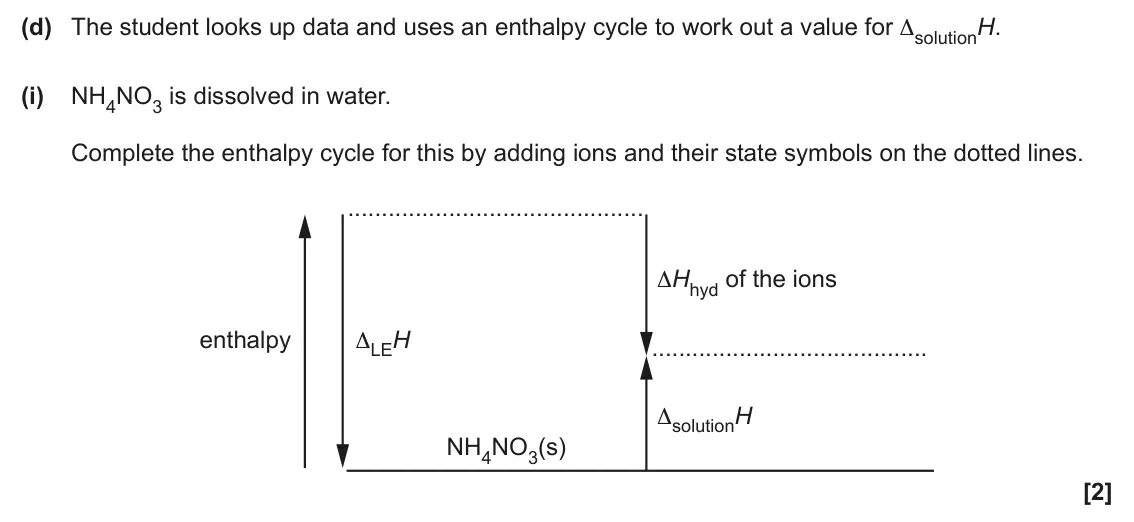
Q33(d)(ii)
The whole paper ↗
Q33(e)
The whole paper ↗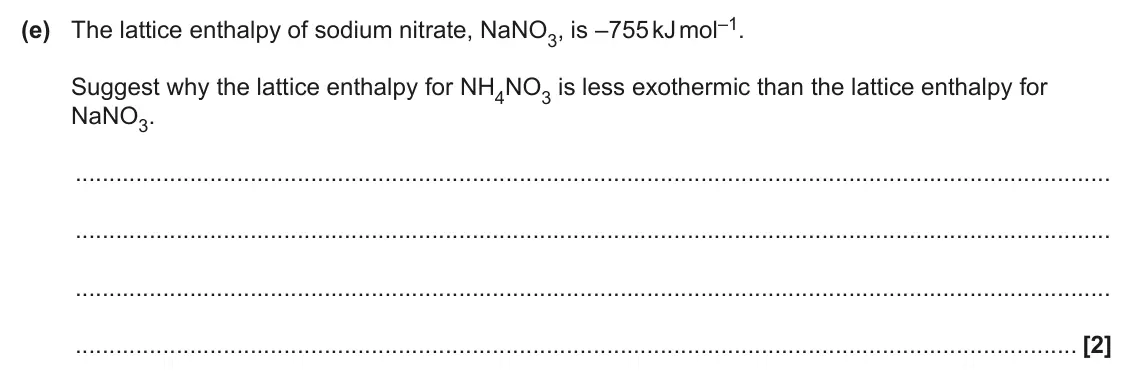
Q1(c)(ii)
The whole paper ↗![June 2025 Paper 3, question 1(c)(ii): A solution has [SO4 Calculate the smallest [Ba2+] in the solution which will just give a white precipitate. For barium sulfate, Ksp = 1.0 × 10⁻¹⁰ mol2 dm–6. [Ba](https://pub-e8a9dbab8e2a4d089f52b2a45e0d0b50.r2.dev/bank/h43303-jun25-01-cii-qp.webp?v=3)
Q3(a)(i)
The whole paper ↗
Q3(a)(ii)
The whole paper ↗


Q33(e)
The whole paper ↗
Q4(a)
The whole paper ↗
Q4(c)(i)
The whole paper ↗
Q4(c)(ii)
The whole paper ↗
Q4(d)(i)
The whole paper ↗
Q4(d)(ii)
The whole paper ↗
All 65 questions on Energetics, as a list
- June 2025, Paper 1, Q22 (1 mark): In a saturated solution of MgF2, the fluoride ion concentration is 2.4 × 10⁻³ mol dm–3. What is the solubility product of MgF2 in mol3 dm–9? 1.7 × 10⁻⁹ A 3.5 ×
- June 2025, Paper 1, Q24 (1 mark): Iodine is much more soluble in hexane than in water. What is a reason for this? A Hydrogen bonds between water molecules are stronger than the instantaneous dip
- June 2025, Paper 1, Q33(b)(i) (1 mark): Another student says this method only gives a small temperature change and this will cause a large percentage uncertainty. The thermometer has an uncertainty of
- June 2025, Paper 1, Q33(b)(ii) (2 marks): Suggest one change the student could make to the method (apart from changing the thermometer) to reduce this percentage uncertainty. Explain why this change wil
- June 2025, Paper 1, Q33(c) (4 marks): Use the student’s results to calculate a value for the enthalpy change of solution, ΔsolutionH, for ammonium nitrate, NH4NO3, in kJ mol–1. Assume that the solut
- June 2025, Paper 1, Q33(d)(i) (2 marks): NH4NO3 is dissolved in water. Complete the enthalpy cycle for this by adding ions and their state symbols on the dotted lines. ΔHhyd of the ions enthalpy ΔLEH Δ
- June 2025, Paper 1, Q33(d)(ii) (1 mark): Use the data in the table below to calculate the theoretical value for the enthalpy change of solution of NH4NO3. Value / kJ mol–1 Enthalpy change + ΔhydH NH4 –
- June 2025, Paper 1, Q33(e) (2 marks): The lattice enthalpy of sodium nitrate, NaNO3, is –755 kJ mol–1. Suggest why the lattice enthalpy for NH4NO3 is less exothermic than the lattice enthalpy for Na
- June 2025, Paper 3, Q1(c)(ii) (2 marks): A solution has [SO4 Calculate the smallest [Ba2+] in the solution which will just give a white precipitate. For barium sulfate, Ksp = 1.0 × 10⁻¹⁰ mol2 dm–6. [Ba
- June 2025, Paper 3, Q3(a)(i) (1 mark): Explain how Equation 3.1 shows that the value of ΔsysS will be positive. [1]
- June 2025, Paper 3, Q3(a)(ii) (3 marks): A student says that the forward reaction in Equation 3.1 is feasible at all temperatures. Comment on the student’s statement, giving the correct chemistry where
- June 2024, Paper 1, Q16 (1 mark): Which reaction has an increase in entropy? A H2O(g) H2O(l) B N2O4(g) 2NO2(g) C 2SO2(g) + O2(g) 2SO3(g) D C(CH3)4(g) CH3(CH2)3CH3(l) Your answer [1]
- June 2024, Paper 1, Q17 (1 mark): The compounds below have negative lattice enthalpies. Which option shows the compounds in order of more negative lattice enthalpies from left to right? A NaF, K
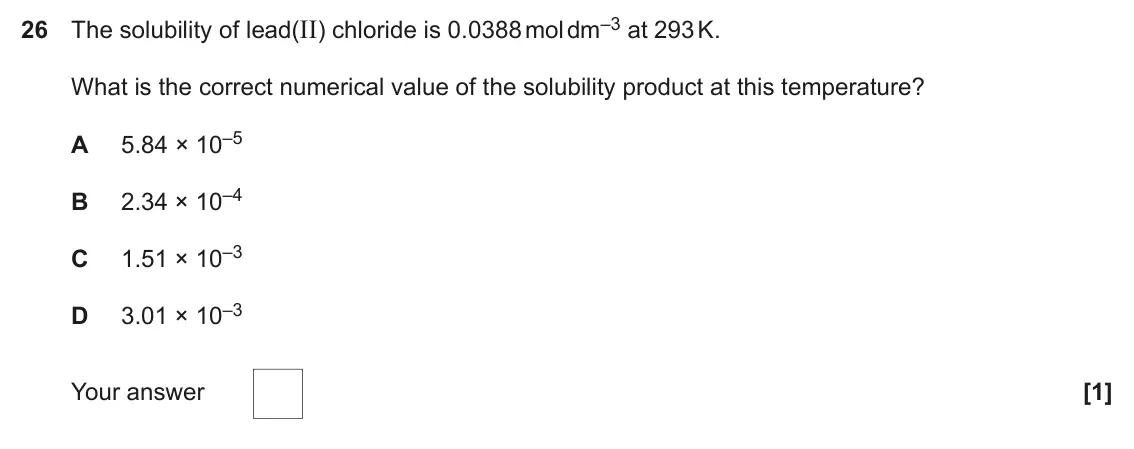
- June 2024, Paper 1, Q26 (1 mark): The solubility of lead(II) chloride is 0.0388 mol dm–3 at 293 K. What is the correct numerical value of the solubility product at this temperature? 5.84 × 10⁻⁵
- June 2024, Paper 1, Q33(e) (4 marks): The standard entropies of the substances involved in Equation 33.1 are shown in the table. S °/ J mol–1 K–1 Substance O2(g) 205.0 NO(g) 210.7 NO2(g) 240.0 Calcu
- June 2024, Paper 3, Q4(a) (2 marks): The students plot their results of temperature against time. They are told to start the temperature axis from 13 °C. Show the students’ plot below, labelling th
- June 2024, Paper 3, Q4(c)(i) (2 marks): The students use the graph to allow for the warming that occurs from the surroundings during the dissolving process. Draw lines on your graph in (a) to show wha
- June 2024, Paper 3, Q4(c)(ii) (2 marks): The students use the temperature decrease to calculate that the energy transferred in the experiment is 2200 J. Calculate a value for the enthalpy change of sol
- June 2024, Paper 3, Q4(d)(i) (4 marks): Use Table 4.1 and your knowledge of ions in solution to name the enthalpy changes ∆H1 to ∆H4. ∆H1 ∆H2 ∆H3 ∆H4 [4]
- June 2024, Paper 3, Q4(d)(ii) (2 marks): Use the data in Table 4.1 to calculate ∆H4. Give the correct sign. ∆H4 = kJ mol–1 [2]
- June 2024, Paper 3, Q4(d)(iii) (2 marks): Suggest and explain the two enthalpy changes that occur when ions are hydrated, and explain why the overall process is always exothermic. [2]
- June 2023, Paper 1, Q19 (1 mark): Which statement is correct for the Group 1 chlorides, going down the group? A The charge density of the anion becomes smaller. B The charge density of the catio
- June 2023, Paper 1, Q24 (1 mark): The data below is for the dissolving of MgCl 2 in water. kJ mol–1 Lattice enthalpy of MgCl 2(s) –2526 Enthalpy change of hydration of Mg2+(g) –1926 Enthalpy cha
- June 2023, Paper 1, Q27 (1 mark): The solubility product of silver carbonate, Ag2CO3, is p mol3 dm–9 at 298 K. The solubility of silver carbonate is s mol dm–3 at 298 K. Which equation is correc
- June 2023, Paper 1, Q30 (1 mark): Iodine is soluble in hexane. Which of the following is/are reason(s) that it dissolves? 1 Instantaneous dipole – induced dipole bonds of similar strength are br
- June 2023, Paper 2, Q3(a)(iv) (1 mark): The table shows some entropy data. S °/ J mol–1 K–1 Substance CH4(g) 186 CO2(g) 214 H2(g) 130 H2O(g) 189 Use the data to show that ∆S °sys = +170 J mol–1 K–1 fo
- June 2023, Paper 2, Q3(a)(v) (3 marks): Use calculations to determine if the forward reaction in Equation 3.1 is feasible at 750 °C. Give a reason for your answer. [3]
- June 2022, Paper 1, Q34(d)(i) (1 mark): State and explain the sign of ∆sysS for the reaction in Equation 34.2. [1]
- June 2022, Paper 1, Q34(d)(ii) (4 marks): Calculate the temperature (in K) at which the reaction in Equation 34.2 is just feasible. You should make use of the data in Table 34.1 below. ∆S °/J K–1 mol–1
- June 2022, Paper 2, Q5(e)(i) (2 marks): Explain the relationship between the ion product, IP, and the solubility product, Ksp, for an ionic substance. [2]
- June 2022, Paper 2, Q5(e)(ii) (3 marks): Calculate the supersaturation of calcium fluoride in saliva after brushing. Give your answer to the nearest whole number. supersaturation = [3]
- June 2022, Paper 2, Q5(g) (6 marks): This question concerns the Advanced Notice Article ‘Fluoride compounds in dental hygiene’ that is included as an insert with this paper. (g)* Use information fr
- November 2021, Paper 1, Q31(c)(iii) (3 marks): The solubility product of barium sulfate is 1.00 × 10⁻¹⁰ mol2 dm–6. Calculate the number of sulfate ions left in solution in the titration flask at the end poin
- November 2021, Paper 1, Q32(d)(ii) (6 marks): Chlorinated solvents were once widely used in industry. Some are made by chlorinating ethane. (ii)* Substance A was a solvent used in the electronics industry.
- November 2021, Paper 2, Q4(a)(i) (4 marks): Give practical details of how they would carry out the experiment. Include the apparatus required and the measurements to be made. [4]
- November 2021, Paper 2, Q4(a)(ii) (4 marks): Use the students’ result to calculate a value for ΔsolutionH in kJ mol–1. Give your answer to an appropriate number of significant figures. Assume the solution
- November 2021, Paper 2, Q4(b)(i) (2 marks): Explain the sign of ΔsysS in terms of the particles involved in the process. [2]
- November 2021, Paper 2, Q4(b)(ii) (4 marks): A student says that the dissolving of KIO3 is not feasible below 434 K. Carry out suitable calculations and comment on the student’s statement. [4]
- November 2021, Paper 2, Q4(c)(i) (1 mark): ΔsysS is very small for the forward reaction. Explain why, in terms of Equation 4.1. [1]
- November 2020, Paper 1, Q25 (1 mark): Mg2+ has a higher charge density than Ca2+. Which statement is correct? A MgCO3 is more thermally stable than CaCO3. The Mg2+ ion has a less exothermic enthalpy
- November 2020, Paper 1, Q31(d)(i) (3 marks): The forward reaction in equation 31.1 is only feasible above a certain temperature. Use the entropy values in the table to calculate this temperature. Entropy,
- November 2020, Paper 1, Q35(c)(i) (2 marks): The solubility product of silver chloride is: Ksp = 2.0 × 10⁻¹⁰ mol2 dm−6 Use this value to explain why [Ag+] = 1.41 × 10⁻⁵ mol dm−3 at the end-point. [2]
- November 2020, Paper 1, Q35(c)(ii) (3 marks): The solubility product of silver chromate(VI) is: Ksp = [Ag+]2 [CrO4 2−] = 3.0 × 10⁻¹² mol3 dm−9 Perform a calculation to show whether a precipitate of silver c
- November 2020, Paper 2, Q5(d)(iii) (3 marks): Suggest, in terms of intermolecular bonds, why satraplatin is soluble whereas cisplatin is not. [3]
- November 2020, Paper 3, Q1(d) (2 marks): Some Group 2 salts are soluble in water. The enthalpy cycle below shows the key enthalpy changes involved in dissolving ionic solids in water. gaseous ions and
- November 2020, Paper 3, Q1(e) (4 marks): The enthalpy change of hydration is less negative for barium ions than for calcium ions. Student A says this is because barium is more reactive than calcium. St
- June 2019, Paper 1, Q14 (1 mark): What occurs as Group 2 is descended? There is a greater attraction between Group 2 cations and Cl – ions. A B The hydration enthalpies of the Group 2 cations be
- June 2019, Paper 1, Q16 (1 mark): Entropy values for the combustion of propane are shown below. C3H8(g) + 5O2(g) 3CO2(g) + 4H2O(g) Entropy / J K–1 mol–1 Substance C3H8(g) +269.9 O2(g) +205.0 CO2
- June 2019, Paper 1, Q25 (1 mark): The solubility product of magnesium hydroxide, Mg(OH)2, is 2.00 × 10⁻¹¹ mol3 dm–9. What is the solubility of magnesium hydroxide, in mol dm–3? 3.16 × 10⁻⁶ A 4.4
- June 2019, Paper 1, Q31(d)(ii) (3 marks): Give the sign of ΔSsys in equation 31.3, with a reason. Use this to explain whether the reaction becomes more or less feasible at higher temperatures. [3]
- June 2019, Paper 2, Q2(e)(i) (2 marks): Write the equation for the equilibrium that occurs between solid strontium hydroxide and its ions in solution. Use your equation to write the expression for the
- June 2019, Paper 2, Q2(e)(ii) (3 marks): At 0 °C, the solubility of strontium hydroxide in water is 3.4 × 10⁻² mol dm−3. Calculate the solubility product of strontium hydroxide at this temperature. Giv
- June 2019, Paper 2, Q2(e)(iii) (2 marks): Explain how the solubility of strontium hydroxide in aqueous NaOH at 0 °C compares with 3.4 × 10⁻² mol dm−3. Use the idea of solubility product in your answer.
- June 2018, Paper 1, Q36(b)(i) (1 mark): Use the entropy values in the table below to calculate ΔsysS for the forward reaction in equation 36.1. Entropy S / J K–1 mol–1 Substance CH4(g) 186.2 H2O(g) 18
- June 2018, Paper 1, Q36(b)(ii) (1 mark): Explain how the sign of your answer to (i) is predicted by equation 36.1. [1]
- June 2018, Paper 1, Q36(c) (2 marks): Calculate the minimum temperature required for the forward reaction in equation 36.1 to be feasible. Give your answer to an appropriate number of significant fi
- June 2018, Paper 2, Q1(a)(i) (1 mark): Some data for the dissolving of NaCl is given below. Value / kJ mol–1 Enthalpy change ∆LEH NaCl −780 ∆hydH Na+ −402 ∆hydH Cl− −374 Calculate a value for the ent
- June 2018, Paper 3, Q2(d) (5 marks): An equilibrium, represented by equation 2.1, exists between the solid Hg2Cl2 and its ions in solution. 2+(aq) + 2Cl −(aq) Hg2Cl2(s) Hg2 Equation 2.1 The solubil
- June 2017, Paper 1, Q25 (1 mark): The maximum solubility of magnesium hydroxide is 1.71 × 10⁻⁴ mol dm–3. What is the value of the solubility product? 5.00 × 10⁻¹² A 2.00 × 10⁻¹¹ B 2.92 × 10⁻⁸ C
- June 2017, Paper 1, Q33(c)(i) (1 mark): How does the sign of ∆sysS relate to the equation for the reaction? [1]
- June 2017, Paper 1, Q33(c)(ii) (2 marks): The entropy values for some of the gases in equation 33.1 are shown below. Entropy, S / JK–1 mol–1 Gas CH4 +186.3 H2O +188.7 CO +197.7 Use the value of ∆sysS an
- June 2017, Paper 1, Q33(d) (2 marks): Calculate whether the forward reaction in equation 33.1 is feasible at 1000 K. [2] 22 3H2(g) + CO(g) ∆rH = +206 kJ mol–1 CH4(g) + H2O(g) Equation 33.1
- June 2017, Paper 1, Q35(b) (4 marks): The student looks up the enthalpy change of solution for anhydrous magnesium sulfate and finds it is – 84.00 kJ mol–1. The student measures the enthalpy change
- June 2017, Paper 1, Q35(c) (2 marks): ∆hydH values for the ions in magnesium sulfate are given in the table below. ∆hydH / kJ mol–1 Ion Mg2+ –1922 2– SO4 –1099 Fill in the missing species in the box
- June 2017, Paper 1, Q35(d) (2 marks): Strontium sulfate is much less soluble than magnesium sulfate. Use ideas of hydration enthalpy to suggest an explanation. [2]
Questions, mark schemes and examiner’s reports are © OCR, from their published past papers. Plumi isn’t affiliated with any exam board. Want whole papers? Every OCR A-Level Chemistry B paper.
Rather write your answers by hand on iPad? Plumi marks them against the same mark schemes.